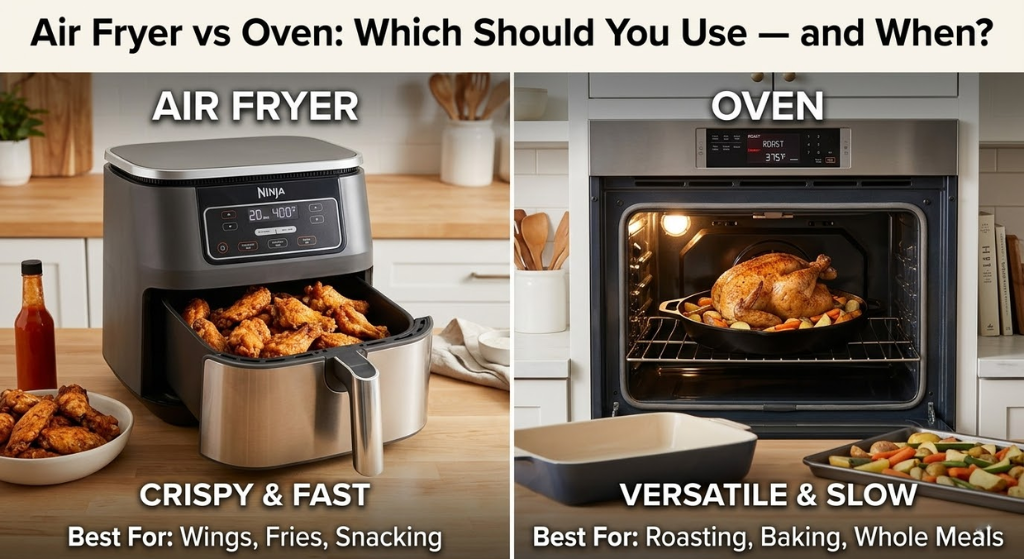
Air Fryer vs Oven: Which Should You Use — and When?
📋 What’s Covered
- Quick Answer — Which Should You Use?
- How Each Appliance Actually Works
- Speed Comparison
- Food-by-Food Results
- Energy & Running Costs
- Capacity & Batch Size
- Baking — Who Wins?
- Reheating
- When the Air Fryer Always Wins
- When the Oven Always Wins
- Converting Oven Recipes to Air Fryer
- Do You Need Both?
- Air Fryer vs Oven for Specific Diets
- Counter Space & Kitchen Setup
- Meal Prep Strategies
- Health Deep Dive
- Cooking Global Cuisines
- Air Fryer Oil Guide
- Common Mistakes & Fixes
- Troubleshooting When Things Go Wrong
- Noise & Kitchen Environment
- Safety Considerations
- Air Fryer Cooking Cheat Sheet
- Air Fryer Accessories Guide
- Air Fryer vs Toaster Oven vs Convection Oven
- Our Recommended Models
- Cleaning & Maintenance Compared
- Environmental Impact
- FAQs
The air fryer vs oven debate is one of the most-searched kitchen questions of the last five years — and for good reason. Air fryers have gone from novelty to countertop staple in less than a decade, and millions of households now own both. The question is no longer “should I get an air fryer?” but “which appliance should I use for this specific thing I’m cooking right now?”
This guide answers that question for 25 different cooking tasks, explains the real science behind why each appliance performs the way it does, and gives you a permanent decision framework for every future cook. We tested both appliances side-by-side for eight weeks across hundreds of cooking tasks before writing a single word.
Quick Answer — Which Should You Use?
The honest answer for most households: you need both, and they should be used for different things. This guide tells you exactly which to reach for in every situation — and at the end, tells you whether you actually need both or whether one can genuinely replace the other for your specific cooking style.
How Each Appliance Actually Works
How the Air Fryer Works
An air fryer is essentially a compact convection oven with a supercharged fan. Hot air is generated by a heating element and circulated at very high speed by a powerful fan positioned directly above the food basket. The rapid air movement achieves two things simultaneously: it transfers heat to the food surface extremely quickly, and it evaporates surface moisture almost as fast as it forms — which is why air-fried food gets so crispy.
The compact chamber size is the key advantage: because the air fryer’s interior volume is only 2–7 quarts compared to a full oven’s 4–6 cubic feet, the fan can circulate hot air around every exposed surface of the food much more efficiently. The food is essentially surrounded by rapidly moving hot air from all directions — this is fundamentally different from a regular oven, where air movement is more passive and heat distribution is less uniform.
How the Oven Works
A conventional oven heats air through elements (typically one at the bottom for baking, one at the top for broiling) and relies on natural convection — the movement of hot air rising and cool air falling — to distribute heat throughout the cavity. Most modern ovens also offer a convection setting that adds a fan, moving air more actively and improving browning.
A convection oven with the fan running is the closest thing a full oven can get to air fryer performance — but even with the fan, the large cavity means air circulation is significantly less intense than in an air fryer. The oven’s larger size is simultaneously its limitation (slower to heat, less intense air circulation) and its strength (fits large dishes, accommodates multiple racks, handles liquid-based cooking without splattering).
Speed Comparison
Speed is the air fryer’s most significant everyday advantage. We timed both appliances from cold start to finished food for 12 common cooking tasks.
Speed summary: For anything under 2 servings, the air fryer is almost always 2× faster or more when preheat time is included. For large batches, the oven’s capacity advantage closes the gap or reverses it entirely.
Food-by-Food Results: Air Fryer vs Oven
We cooked every item below in both appliances on the same day using identical ingredients and rated the results on crispiness, texture, and flavour. Winner determined by overall result quality.
Proteins
Vegetables & Sides
Snacks & Party Food
Energy & Running Costs
Energy cost is one of the most frequently cited reasons to buy an air fryer — but the reality is more nuanced than marketing suggests.
⚡ Energy Comparison — Air Fryer vs Oven
For single small-batch cooking tasks, the air fryer uses approximately 75–80% less energy than a full oven. The savings come from two sources: lower wattage and significantly shorter cook times. An oven is most energy-efficient when its full cavity is in use — roasting multiple trays simultaneously. For a single serving of chips, heating a full 60-litre oven is wasteful in both time and energy.
Over a year of daily use for single-serving tasks, switching from oven to air fryer could save £50–£80 on electricity bills (at UK energy rates) or $40–$60 (at US average rates). This is meaningful but not the transformational saving some marketing suggests — it typically takes 2–3 years to recoup the air fryer’s purchase price in energy savings alone.
Capacity & Batch Size — The Oven’s Biggest Advantage
Capacity is where the oven reasserts dominance. Every air fryer on the market has a basket limitation that the oven simply doesn’t face.
The capacity limitation becomes a cooking inefficiency when you’re feeding more than 3–4 people. Making air fryer chips for a family of five means running the basket 2–3 times, waiting for the first batch to stay warm while the rest cooks. For family meals, the oven’s capacity advantage is decisive and practical — not just theoretical.
Baking — Who Wins?
Baking is one area where the oven wins decisively and consistently — but not for the reason most people assume.
Why the Oven Wins for Baking
The oven’s advantage in baking isn’t temperature or heat source — it’s air movement intensity. Baking relies on a gradual, even rise that is driven by the slow expansion of steam and gas (from yeast, baking powder, or beaten eggs) inside the batter. Rapid, high-velocity air circulation — exactly what the air fryer excels at — interferes with this process. The high airspeed can cause batters to set unevenly, blow the surface of soufflés flat, and create hard outer crusts on cakes before the interior has had time to cook through.
For bread specifically: yeast fermentation and oven spring (the final rise in a hot oven) require the even, radiative heat of an oven cavity. Air fryers produce excellent small quick breads (banana bread in a pan, cornbread, biscuits) but cannot replicate proper bread crust development from a full oven — particularly not the steam-injected environment that produces great artisan bread crust.
What You Can Bake in an Air Fryer
- Cookies — works well (4 at a time), but 12 minutes in the oven beats 8 minutes × 3 batches in the air fryer for volume
- Muffins — excellent results in silicone muffin cups; 12 minutes at 160°C
- Banana bread — very good in a small loaf pan that fits the basket; 30–35 min at 150°C
- Brownies — surprisingly excellent; the intense heat produces a crackling top and fudgy centre
- Scones — good results; crispy outside, fluffy inside
- Personal-size cakes — works for small tins (up to 6-inch round); larger cakes cook unevenly
What Should Stay in the Oven
- Full-size layer cakes (8–9 inch rounds)
- Cheesecakes and egg-based custard tarts (need gentle, even heat)
- Soufflés (airflow deflates them)
- Yeasted breads (proper crust development requires steam)
- Meringues (low-temp long cook impossible in most air fryers)
- Pies and pastries larger than 8 inches
Reheating — Air Fryer Wins Almost Every Time
Reheating is where the air fryer demonstrates one of its clearest, most consistently useful advantages over every other reheating method including the oven, the microwave, and the stovetop.
When the Air Fryer Always Wins
These are the cooking scenarios where the air fryer is so clearly superior that it should be the automatic choice regardless of what else is happening in your kitchen.
When the Oven Always Wins
Converting Oven Recipes to Air Fryer
Most oven recipes can be adapted to the air fryer with two simple adjustments. Understanding why these adjustments work helps you apply them to any recipe confidently.
The Two Universal Rules
Additional Tips for Specific Categories
- Meats: Always use a meat thermometer. Air fryers can crisp the outside quickly while the interior is still underdone — appearance is a less reliable guide than in an oven. Chicken breast should reach 165°F (74°C), pork 145°F (63°C), beef to your preferred doneness.
- Baked goods: Reduce temperature by 25°F AND reduce time by 20%. Check earlier than you think necessary — the top surface of cakes and muffins can brown quickly in an air fryer.
- Frozen foods: Follow the package instructions for a convection oven if available, not a standard oven. If only standard oven instructions are given, apply the same two rules above.
- Liquid-containing dishes: Do not adapt. Dishes with sauces, marinades, or liquid fillings that can drip into the basket heating element belong in the oven.
- Covered dishes: Cover with foil if the air fryer recipe requires the food to steam or retain moisture — but reduce time further, as the foil slows crisping.
Do You Need Both?
This is the question that actually matters. Here’s our honest answer for different household types.
Buy the air fryer first — it handles 90% of your daily cooking better and faster. Add the oven when you want to bake or cook for guests.
The air fryer transforms frozen food quality. If you regularly cook frozen chips, nuggets, or party food, the air fryer will get daily use.
The oven is non-negotiable for feeding a family. Add the air fryer for weeknight shortcuts and reheating — they serve different functions.
The oven is your primary appliance. An air fryer is a useful supplement for savoury weeknight cooking, but baking stays in the oven.
If your priority is fast weeknight dinners for 1–3 people, the air fryer handles 80% of your cooking faster and better than the oven.
The oven is irreplaceable for a proper roast with multiple dishes cooking simultaneously. The air fryer can supplement with chips and veg sides.
The honest verdict on needing both: For most households that cook regularly, both appliances earn their place. The air fryer handles weeknight solo/couple cooking, reheating, and crispy food tasks. The oven handles batch cooking, baking, large roasts, and anything with liquid. They genuinely don’t overlap much once you understand each one’s strengths — using the right tool for each task produces noticeably better results than forcing one appliance to do everything.
Air Fryer vs Oven for Specific Diets
Your dietary needs influence which appliance serves you better day-to-day. While both the air fryer and oven can cook virtually any type of food, certain dietary patterns lean heavily toward one appliance or the other. Here’s how each diet intersects with your cooking method choice.
Keto and Low-Carb Cooking
The keto diet emphasises high-fat proteins, non-starchy vegetables, and minimal carbohydrates — and the air fryer is a natural fit for this way of eating. Keto cooking relies heavily on achieving crispy, well-browned surfaces on meats and vegetables without flour-based coatings or sugary glazes. The air fryer excels at exactly this: chicken thighs with crackling skin, crispy bacon, roasted broccoli with charred edges, and cheese crisps made from nothing but grated parmesan.
For keto meal prep, the air fryer handles the two most common keto proteins — chicken thighs and salmon fillets — faster and with better skin crispiness than the oven. A batch of four chicken thighs takes 22 minutes in the air fryer versus 35–40 minutes in the oven. Keto-friendly vegetables like cauliflower, courgette, and Brussels sprouts all develop superior caramelisation in the air fryer due to the intense surface heat. Cheese crisps — simply mounds of grated parmesan air-fried at 190°C for 5–6 minutes — are a snack that’s nearly impossible to replicate in a conventional oven without burning.
Where the oven wins for keto: large-batch cooking (a whole roast chicken for the week’s meal prep), slow-cooked cuts like pork shoulder or brisket that need hours at low temperature, and any dish that uses a keto-friendly sauce or braising liquid (like a creamy Tuscan chicken bake). These dishes need the oven’s contained environment and capacity. If you’re doing a weekend cook-up of pulled pork or a beef brisket, the oven is your only realistic option.
Vegan and Plant-Based Cooking
Plant-based cooking presents an interesting split between the two appliances. The air fryer transforms vegetables in ways that a standard oven struggles to match — crispy cauliflower bites, charred Brussels sprouts, perfectly roasted tofu with a crunchy exterior, and air-fried chickpeas that become genuinely snackable. For anyone transitioning to a plant-based diet and missing the texture of fried foods, the air fryer is a revelation.
Tofu is perhaps the air fryer’s greatest plant-based achievement. Pressed, cubed, and air-fried at 200°C for 15–18 minutes, tofu develops a golden, crunchy exterior with a creamy interior that’s genuinely comparable to deep-fried tofu — something the oven takes 30+ minutes to achieve and never quite matches in crispiness. Tempeh, seitan, and plant-based meat alternatives all benefit similarly from the air fryer’s intense surface heat. Even humble chickpeas become irresistible when air-fried with spices at 200°C for 12 minutes — crispy on the outside, creamy inside, perfect for salads or snacking.
The oven remains essential for vegan batch cooking: large trays of roasted vegetables, baked pasta dishes, sheet-pan dinners with multiple components, and any plant-based baking (banana bread, muffins, savoury pies). For a family-sized tray of roasted root vegetables or a full lasagne, the oven’s capacity is irreplaceable. Vegan casseroles, gratins, and baked dishes with sauces all require the oven’s contained environment.
Gluten-Free Cooking
For those avoiding gluten, the air fryer offers a significant advantage in recreating the textures of traditionally breaded foods without wheat flour. Gluten-free breadcrumbs, crushed rice crackers, and almond flour coatings all crisp exceptionally well in the air fryer — often better than in the oven, where gluten-free coatings tend to remain soft and pale. Air-fried gluten-free chicken tenders, fish fingers, and onion rings produce results that are genuinely close to their wheat-based counterparts.
The key technique for gluten-free air frying is to use a three-stage breading process: seasoned gluten-free flour, beaten egg, then crushed gluten-free cereal or breadcrumbs. The air fryer’s intense surface heat sets the coating quickly, creating a sealed crust that stays crunchy. In the oven, gluten-free coatings have more time to absorb moisture from the food, resulting in a softer, sometimes soggy exterior.
The oven is still necessary for gluten-free baking, which is already more challenging than conventional baking. Gluten-free breads, cakes, and pastries rely on precise, even heat to achieve proper structure without the gluten network that provides elasticity. The air fryer’s intense airflow can cause gluten-free batters to set unevenly or develop tough crusts. For serious gluten-free baking, the oven with a pizza stone or baking steel for even heat distribution is the better tool.
Low-Fat and Heart-Healthy Cooking
Both appliances support low-fat cooking well, but the air fryer has a measurable edge for foods where you’d traditionally add oil. Air-fried chips use a fraction of the oil needed for oven-roasted chips — typically a light spray versus 2–3 tablespoons on a baking tray. Over a week of daily cooking, this difference adds up to a meaningful reduction in total fat intake without sacrificing the textures you enjoy.
For lean proteins like chicken breast, white fish, and pork tenderloin, the air fryer produces moist, well-browned results with minimal or no added oil. The rapid air circulation creates a surface seal that locks in moisture — similar to searing but without the oil requirement. The oven can achieve similar results but typically requires a light coating of oil to prevent sticking and promote browning.
For heart-healthy cooking specifically, the air fryer’s ability to render and drain fat from naturally fatty proteins is valuable. Chicken thighs, sausages, and bacon all lose visible fat during air frying — the rendered fat drips into the tray below rather than sitting in the food. This doesn’t make these foods “health food,” but it does meaningfully reduce the fat content per serving compared to oven cooking where the fat stays in the pan and is reabsorbed.
Counter Space & Kitchen Setup Considerations
The physical footprint of each appliance matters more than most buyers realise. A full-size oven is built into your kitchen — it takes no counter space. An air fryer, however, lives on your countertop permanently (or occupies cupboard space when not in use, which means you’ll use it less). Understanding the real spatial requirements helps you plan your kitchen layout effectively.
Air Fryer Dimensions by Type
Ventilation Requirements
Air fryers require adequate ventilation on all sides — typically 5 inches of clearance at the back and top, and 3–4 inches on each side. Placing an air fryer directly under a wall cabinet without sufficient clearance can damage the cabinet finish over time from heat exposure, and in extreme cases, poses a fire risk. If your kitchen has low-hanging cabinets, measure the clearance before purchasing — many 6+ quart air fryers are too tall to fit safely under standard upper cabinets.
Ovens are designed with built-in ventilation systems that direct heat and steam through a vent, typically at the back of the cooktop or through a range hood. No additional clearance planning is needed beyond what your kitchen already provides. This is one of the oven’s underappreciated advantages — it’s integrated into your kitchen’s existing ventilation infrastructure.
Heat Output Into the Kitchen
An air fryer releases significantly less heat into your kitchen than a full oven. During summer cooking, this is a meaningful comfort advantage — running a full oven for 45 minutes can raise a small kitchen’s temperature by 3–5°F, while an air fryer’s compact chamber and shorter cook times produce minimal ambient heat. For households in warm climates or those without air conditioning, this difference alone can be a reason to default to the air fryer for weeknight cooking.
The Storage Problem
If you don’t have permanent counter space for an air fryer, you’ll store it in a cupboard — and experience shows that appliances stored out of sight get used 50–70% less frequently than those left on the counter. Before buying an air fryer, identify where it will live permanently. If the answer is “in the cupboard above the fridge,” consider whether you’ll actually pull it out for a 10-minute batch of roasted broccoli. The air fryer’s speed advantage only matters if the appliance is accessible enough to use daily.
A practical solution for small kitchens: choose a compact 3–4 quart model that fits under standard cabinets and can stay on the counter without dominating the workspace. These smaller models handle single-serving cooking perfectly and are far more likely to become a daily-use appliance than a large dual-basket model that needs to be stored after every use.
Meal Prep Strategies: Air Fryer vs Oven Workflows
Meal prepping — cooking multiple meals in advance for the week — requires a different evaluation than single-meal cooking. The appliance that’s faster for one serving isn’t always the better choice when you’re cooking five days’ worth of lunches. Here’s how each appliance fits into realistic meal prep workflows.
Air Fryer Meal Prep Workflow
The air fryer works best for meal prep when you’re cooking proteins and vegetables for 1–2 people across the week. A typical air fryer meal prep session might look like this:
- Batch 1 (22 min): 4 chicken thighs — cook, rest, slice for salads and grain bowls
- Batch 2 (14 min): 400g frozen chips — cook and store for quick side dishes
- Batch 3 (8 min): Broccoli florets — roast until charred, portion into containers
- Batch 4 (10 min): Salmon fillets — cook gently at 180°C for flaky, cold-served protein
Total time: approximately 60 minutes including basket swaps and resting. This produces 4–5 prepared meals with minimal cleanup between batches — the basket wipes clean or goes in the dishwasher.
Oven Meal Prep Workflow
The oven dominates when you’re meal prepping for a family or cooking large quantities that fill multiple trays. A typical oven meal prep session:
- Tray 1 (40 min): 1 kg chicken breast on the top rack — season, roast, slice for the week
- Tray 2 (35 min): Mixed root vegetables on the bottom rack — roast simultaneously with the chicken
- Tray 3 (25 min, added later): Sweet potatoes — swap in when the vegetables come out
Total time: approximately 50 minutes for 8–10 prepared meals. The oven’s multi-rack capability means you’re cooking 2–3 components simultaneously, which is impossible in a single-basket air fryer.
The Hybrid Approach
The most efficient meal prep strategy for households with both appliances is to use them simultaneously. Start the oven with a large protein and tray of vegetables, then use the air fryer for quick-cooking items that benefit from its crisping power — bacon for breakfast prep, crispy tofu, roasted nuts, or a batch of frozen spring rolls for snacks. Running both appliances in parallel cuts total meal prep time by 30–40% compared to using either one alone.
Health Deep Dive: Acrylamide, Nutrients & Fat Reduction
The health comparison between air frying and oven cooking goes beyond simple calorie counts. Three scientific factors matter when evaluating which cooking method is genuinely healthier: acrylamide formation, nutrient retention, and fat reduction. Understanding each one helps you make informed decisions about which appliance to use for health-conscious cooking.
Acrylamide Formation
Acrylamide is a chemical compound that forms when starchy foods are cooked at high temperatures — above 120°C (248°F) — through a process called the Maillard reaction. It’s found in fried, baked, and roasted starchy foods, with chips, crisps, and toast being the most common sources. Acrylamide has been classified as a “probable human carcinogen” by the International Agency for Research on Cancer, though the evidence is based on animal studies at high doses.
Both air fryers and ovens produce acrylamide in starchy foods — the formation is driven by temperature and time, not the cooking method itself. However, because air fryers cook faster and at slightly lower effective temperatures (due to the reduced-temperature conversion rule), air-fried chips typically contain 10–15% less acrylamide than oven-baked chips cooked to the same level of crispiness. The shorter cook time is the primary factor — less time at high heat means less acrylamide formation.
To minimise acrylamide in either appliance: soak cut potatoes in water for 30 minutes before cooking (this removes surface starch), avoid cooking chips to dark brown (golden yellow has significantly less acrylamide), and don’t store potatoes in the fridge (cold storage increases the sugars that react to form acrylamide). These simple steps reduce acrylamide formation by up to 50% regardless of which appliance you use.
Nutrient Retention
Cooking method affects nutrient retention differently depending on the nutrient in question. Water-soluble vitamins (vitamin C, B vitamins) are the most vulnerable to heat loss, while fat-soluble vitamins (A, D, E, K) and minerals are more stable.
For vegetables, the air fryer generally retains more nutrients than oven cooking for two reasons: shorter cook times mean less heat exposure, and the dry cooking environment doesn’t leach water-soluble vitamins into cooking water (as boiling or steaming would). Studies on air-fried versus oven-roasted vegetables show that air-fried broccoli retains approximately 10–15% more vitamin C than oven-roasted broccoli cooked to the same tenderness, primarily due to the shorter cooking duration.
For proteins, the difference is minimal — both methods effectively cook meat and fish without significant nutrient loss. The primary concern with protein cooking is overcooking, which denatures proteins and reduces moisture (and with it, water-soluble nutrients). Because the air fryer cooks faster, there’s a narrower window for overcooking — but this also means the margin for error is smaller. A meat thermometer is essential for both appliances.
Fat Reduction Science
The air fryer’s most measurable health advantage is fat reduction in foods that would traditionally be deep-fried or heavily oiled. The numbers are significant:
The fat reduction comes from two mechanisms: first, you add less oil to the cooking process (a light spray versus tablespoons); second, the air fryer’s basket design allows fat from the food itself to drip away during cooking, rather than being reabsorbed. For chicken wings and sausages, the rendered fat visibly collects in the drip tray below — fat that would remain on the food in an oven or be absorbed in a deep fryer.
Cooking Global Cuisines: Air Fryer vs Oven
Different culinary traditions have different relationships with frying, roasting, and baking — and this affects which appliance produces more authentic results for each cuisine. Here’s how the air fryer and oven compare for four major global cooking traditions.
Asian Cooking
Many Asian cooking techniques involve high-heat, quick cooking with crispy results — exactly what the air fryer excels at. Japanese tempura, Chinese spring rolls, Korean fried chicken, and Thai fish cakes all translate remarkably well to the air fryer. The appliance produces the light, crispy textures that define these dishes without the deep-frying that traditionally makes them high in fat.
Korean fried chicken is a standout air fryer achievement: double-air-fried chicken (cook at 180°C for 20 minutes, rest for 5 minutes, then cook again at 200°C for 8 minutes) produces shatteringly crispy skin that rivals deep-fried versions. The oven cannot replicate this double-cook technique effectively because the skin doesn’t crisp sufficiently in the first pass.
For dumplings and gyoza, the air fryer produces a crispy-bottomed result in 8–10 minutes from frozen — similar to the pan-fry-then-steam method but without the oil or the technique required. The oven produces softer, more uniformly steamed dumplings that lack the textural contrast of the crispy base.
Where the oven wins for Asian cooking: large-format dishes like a whole Peking duck (which needs the oven’s space and the hanging/roasting technique), baked bao buns (which need gentle, even steam-heat to rise properly), and any stir-fry or curry that’s finished in the oven with a sauce — the air fryer cannot handle liquid-based dishes.
Mediterranean Cooking
Mediterranean cuisine relies heavily on roasting vegetables, grilling fish, and baking bread — a mix that favours both appliances depending on the specific dish. The air fryer excels at Mediterranean vegetable sides: roasted peppers, courgette, aubergine, and cherry tomatoes all develop intense caramelisation in the air fryer in half the oven time. Halloumi cheese air-fried at 200°C for 8 minutes produces a golden, squeaky result that’s superior to pan-frying — crispy outside, soft inside, with beautiful grill-like marks.
For Mediterranean fish dishes — whole sea bass, baked salmon with herbs, or fish en papillote — the oven is the better choice. Whole fish needs the oven’s space, and papillote-style cooking requires the sealed, steamy environment that the oven’s enclosed cavity provides. The air fryer’s intense airflow works against the gentle steaming that makes these dishes successful.
Mediterranean baking (flatbreads, focaccia, pita) belongs in the oven. The bread needs the oven’s even radiative heat and, for certain breads, the steam injection that produces proper crust development. Air fryer flatbreads are acceptable but lack the pillowy interior and blistered crust of oven-baked versions.
Latin American Cooking
Latin American cuisine features many foods that translate beautifully to the air fryer: empanadas, taquitos, plantains, churros, and breaded milanesas. Air-fried empanadas develop a flaky, golden crust in 12–14 minutes at 190°C — the pastry crisps evenly on all sides without the need for deep-frying. Frozen taquitos are transformed in the air fryer: crispy on the outside, hot and creamy inside, in 8 minutes flat.
Plantains (both ripe maduros and green tostones) are exceptional in the air fryer. Ripe plantains caramelise beautifully at 200°C for 10 minutes, developing the sweet, sticky exterior that defines the dish. Tostones (twice-fried green plantains) can be made with a light spray of oil instead of submerging in oil — the air fryer version has 70% less fat with nearly identical texture.
The oven wins for Latin American braised dishes like ropa vieja, carnitas (after the initial braise), and large-format roasts like pernil (slow-roasted pork shoulder). These dishes need the oven’s low-and-slow capability and the capacity for large cuts of meat that simply don’t fit in an air fryer basket.
Indian Cooking
Indian cuisine’s relationship with the air fryer is surprisingly strong, particularly for tandoori-style dishes and snacks. Tandoori chicken, tikka, and kebabs all develop excellent char and smokiness in the air fryer — the intense heat mimics the surface temperatures of a tandoor oven more closely than a conventional home oven. Marinated chicken tikka cooked at 200°C for 18 minutes in the air fryer produces results that are genuinely close to restaurant-quality tandoori.
Indian snacks — samosas, pakoras, and bhajis — are transformed by the air frying method. Frozen samosas air-fried at 190°C for 12 minutes develop a crispy, flaky pastry that’s difficult to distinguish from deep-fried versions. Pakoras and bhajis, traditionally deep-fried in generous oil, become viable everyday snacks when air-fried with a light spray — the texture is 90% as good with a fraction of the fat.
For curries, biryanis, and any dish with sauce, the oven (or stovetop) remains essential. Biryani finished in the oven with its sealed dum-style cooking needs the oven’s contained environment. Naan bread can be made in the air fryer (4–5 minutes at 200°C) but the oven with a pizza stone produces a more authentic blistered, puffy result. The air fryer is best used as a supplement to Indian cooking — handling the tandoori proteins and crispy snacks while the stovetop and oven manage the sauced dishes and breads.
Air Fryer Oil Guide — How Much, What Type, and When to Skip It
One of the most misunderstood aspects of air frying is oil usage. Marketing often implies “no oil needed” — but the reality is more nuanced, and understanding when and how to use oil transforms your results.
When You Need Oil (and When You Don’t)
You do NOT need oil for: foods with high natural fat content that will render during cooking. Chicken wings, sausages, bacon, and skin-on chicken thighs all release their own fat as they cook, which self-bastes and crisps the food without any added oil. Adding oil to these foods wastes it and can cause excessive smoking if dripping fat ignites on the heating element.
You DO need a light coat of oil for: lean proteins (chicken breast, fish fillets, pork loin), fresh vegetables, homemade chips, and any food coated in breadcrumbs or flour. Without oil, these foods dehydrate quickly and develop a tough, papery surface rather than a properly crisped crust. A light spray or brush is sufficient — you’re coating the surface, not soaking the food.
How Much Oil to Use
The optimal amount is 1–2 teaspoons of oil for most air fryer basket loads — far less than oven roasting typically uses. The best application method is a pressurised oil mister or a food-safe spray bottle rather than pouring directly from the bottle, which makes it easy to over-apply. Aerosol cooking sprays work but should be used sparingly — the propellants in some aerosol sprays can damage non-stick basket coatings over time. A dedicated refillable oil mister (~$12) is the better long-term investment.
Best Oils for Air Frying
- Avocado oil — the best all-purpose air fryer oil. Smoke point of 520°F/271°C means it never burns even at the highest air fryer temperatures. Neutral flavour. Slightly expensive but a small amount goes a long way.
- Light olive oil (not extra virgin) — smoke point of ~465°F/240°C. Works for most air fryer temperatures. Extra virgin olive oil has a lower smoke point (~375°F) and can smoke at high air fryer temperatures.
- Coconut oil — works well for foods where a slight coconut flavour is welcome; smoke point of ~450°F/232°C. Solidifies at room temperature — melt before use in a mister.
- Vegetable / sunflower oil — the budget option with a high smoke point (~450°F). Neutral flavour. Fine for everyday air frying.
- Avoid: Butter and extra virgin olive oil at high temperatures — they smoke and can leave a coating on the basket that’s difficult to clean.
Air Fryer Mistakes That Ruin Results — And How to Fix Them
After eight weeks of daily testing comparing air fryer and oven results, these are the mistakes we consistently saw produce disappointing outcomes — and the fixes that immediately improve results.
Mistake 1: Not Shaking or Flipping Mid-Cook
Even though air fryers circulate hot air around food, the pieces sitting at the bottom of the basket make more direct contact with the hot basket surface than those on top. For chips, cubed vegetables, and smaller pieces, shaking the basket halfway through cooking ensures every surface gets direct heat exposure. For larger pieces like chicken thighs or salmon fillets, flip once at the midpoint. This single habit produces dramatically more even browning — a clearly visible improvement.
Mistake 2: Cooking Wet, Un-Dried Protein
Moisture on the surface of chicken, fish, or pork forms steam when it hits the hot air, which actively works against the crisping process. Before seasoning any protein, pat it completely dry with paper towel — including inside the cavity of a whole chicken. This takes 30 seconds and produces noticeably crispier skin and more evenly browned surfaces. Dry protein = crispy result. Wet protein = steamed surface that never properly browns.
Mistake 3: Under-Seasoning
The air fryer’s intense heat evaporates surface moisture very quickly — which also carries away surface seasoning. Air-fried food requires 20–30% more seasoning than equivalent oven-cooked food to achieve the same flavour intensity. Season generously before cooking and taste immediately after — if it tastes under-seasoned, it probably is. This is particularly noticeable with salt on chips and chicken.
Mistake 4: Ignoring the Drip Tray
The drip tray below the basket collects fat and food debris with every cook. If it’s not emptied and cleaned regularly, this accumulated debris begins to smoke at high temperatures — filling your kitchen with acrid smoke and affecting the flavour of everything subsequently cooked. Empty and rinse the drip tray after every use. This takes 60 seconds and is the single most important maintenance habit for an air fryer.
Mistake 5: Using Cooking Spray on the Basket
Aerosol cooking sprays (PAM, etc.) contain propellants and additives that can break down the non-stick coating of air fryer baskets over time, causing it to flake and peel. Use a refillable oil mister with pure oil instead. If you must use an aerosol spray, apply it to the food rather than the basket — this significantly reduces coating contact.
Mistake 6: Opening the Drawer Too Often
Every time you open the air fryer drawer, heat escapes and the cook cycle is interrupted. The air fryer needs to reheat from a lower temperature, extending the total cook time. Check food once at the midpoint for shaking or flipping, then leave the drawer closed until the timer ends. Trust the process — frequent checking disrupts the cooking environment and produces less consistent results.
Troubleshooting: When Your Cook Goes Wrong
Even experienced cooks encounter problems with both appliances. Here are the most common issues, their root causes, and the fixes that work every time.
Air Fryer Troubleshooting
Oven Troubleshooting
Noise Levels & Kitchen Environment
The practical experience of using each appliance extends beyond cooking results. Noise, heat output, and smell all affect your daily kitchen environment — and the two appliances differ significantly in each area.
Noise Comparison
The air fryer’s noise is noticeable but not disruptive — it’s roughly equivalent to a microwave running. For open-plan kitchens where the cooking area is adjacent to living or dining spaces, the air fryer’s constant fan noise for 15–25 minutes may be mildly annoying during conversation or television viewing. The oven’s near-silent operation is an underappreciated advantage for households that cook while entertaining or during family time in an open-plan space.
Smell and Smoke
Air fryers produce more cooking smell than ovens for one specific reason: the rapid air circulation evaporates surface moisture and fat more aggressively, which means more aromatic compounds are released into your kitchen. When cooking bacon, sausages, or any fatty protein, the air fryer will fill your kitchen with cooking smell within minutes. This is pleasant while cooking but can linger for hours in a small kitchen without good ventilation.
The oven, being a sealed cavity, contains most cooking smells during the cook. You’ll smell the food when you open the door, but the daily cooking smell is significantly less than with an air fryer. For households sensitive to cooking smells (open-plan apartments, shared living spaces), this is a meaningful difference.
Smoke is more common with air fryers than ovens, primarily because fat drips directly onto the heating element below the basket. With ovens, fat lands in a roasting tray several inches below the element and rarely smokes unless the tray is already dirty from previous cooks. The air fryer smoke problem is easily solved: add a tablespoon of water to the drip tray before cooking fatty foods, and clean the drip tray after every use.
Safety Considerations: Air Fryer vs Oven
Both appliances are safe when used correctly, but they present different risk profiles that are worth understanding — particularly if you have children in the kitchen or are new to cooking with either appliance.
Burn Risk
Air fryers present a concentrated burn risk around the basket area. The basket reaches temperatures of 200°C+ during cooking and remains dangerously hot for 5–10 minutes after the cook ends. The drawer mechanism means you’re pulling a very hot component toward your body — unlike an oven where you reach into a fixed cavity. Always use oven gloves when handling the air fryer basket, even for quick checks, and place the hot basket on a heat-resistant surface when removing food.
Ovens present a broader burn risk from the open door, the interior walls, and the heating elements. The door glass on modern ovens stays cooler than older models but can still cause burns at high temperatures. The primary oven safety advantage is that you’re reaching into a fixed cavity rather than pulling a hot component toward your body — the ergonomics are inherently safer.
Fire Risk
Air fryers have a documented fire risk when used improperly. The most common causes are: accumulated fat and food debris in the drip tray igniting at high temperatures, aerosol cooking sprays creating a flammable mist near the heating element, and the unit being placed too close to combustible materials (curtains, paper towels, wooden cabinets). Always clean the drip tray after every use, never spray aerosol products inside the air fryer while it’s running, and maintain the recommended clearance on all sides.
Oven fires are less common but more dangerous when they occur, typically caused by accumulated grease igniting on the bottom element or food falling directly onto the element. Self-cleaning oven cycles can also trigger fires if the oven interior has excessive grease buildup. Regular cleaning is the primary prevention method for both appliances.
Material Safety
Modern air fryer baskets use PTFE (Teflon) non-stick coatings that are safe at normal cooking temperatures but can release fumes if overheated above 260°C (500°F) — well above normal air frying temperatures. If the non-stick coating is visibly damaged, flaking, or peeling, replace the basket. Ingesting small flakes of non-stick coating is not harmful (they pass through the digestive system), but a damaged coating loses its non-stick properties and makes cooking less effective.
For those who prefer to avoid PTFE entirely, ceramic-coated and stainless steel air fryer baskets are available. Ceramic coatings are PTFE-free and perform well, though they tend to lose their non-stick properties faster than PTFE (typically after 1–2 years of daily use). Stainless steel baskets require more oil to prevent sticking but have no coating concerns and last indefinitely.
The Air Fryer Cooking Cheat Sheet
A quick reference for the most common air fryer cooking tasks — times and temperatures verified in our testing on a 5.8 Qt basket air fryer at sea level. Add 1–2 minutes if your model runs cool or at altitude.
Air Fryer Accessories That Actually Help
The air fryer accessory market is enormous — and most of it is unnecessary. After testing dozens of accessories over eight weeks, these are the ones that genuinely improve your results and the ones that are a waste of money.
Must-Have Accessories
Nice-to-Have Accessories
- Silicone muffin cups — for baking muffins, egg cups, and mini frittatas directly in the basket. Reusable and dishwasher-safe. A set of 6 costs under $8.
- Small cake tin (6-inch round) — fits most 5+ quart baskets for air fryer banana bread, brownies, and small cakes. Look for one with a removable bottom for easy release.
- Grill pan insert — creates grill marks on meats and vegetables. Adds visual appeal but doesn’t change the cooking result significantly. Worth it if you grill frequently.
- Skewer rack — holds kebab skewers vertically in the basket, allowing air to circulate around each skewer. Good for chicken tikka, satay, and vegetable kebabs.
- Stackable rack — adds a second level to the basket for cooking more food at once. Works well for items that don’t need shaking (sausages, chicken pieces, fish fillets).
Accessories to Skip
- Silicone basket liners (non-perforated) — block airflow entirely and defeat the purpose of the air fryer. Food steams instead of crisping. Always use perforated liners.
- “Air fryer specific” cookbooks — most are repackaged oven recipes with reduced times. Use the conversion rules in this guide instead and save your money.
- Magnetic cheat sheets — the cooking times are generic and often inaccurate for your specific model. Use the cheat sheet in this guide and adjust based on your own results.
- Egg bite moulds — unless you make egg bites weekly, a regular silicone muffin cup does the same job at a fraction of the cost.
Air Fryer vs Toaster Oven vs Convection Oven: Three-Way Comparison
The lines between these three appliances have blurred significantly. Many toaster ovens now include air fry functions, and most modern ovens offer a convection setting. Understanding the real differences helps you choose the right appliance — or combination — for your kitchen.
How They Differ
The Hybrid Option: Toaster Oven with Air Fry Function
A toaster oven with an air fry function (like the Breville Smart Oven Air Fryer Pro) is the closest thing to a single appliance that does both jobs. These units have a larger cooking chamber than a basket air fryer, a powerful fan for air frying, and the versatility to bake, broil, toast, and roast. For small households that want one counter appliance instead of two, a high-quality toaster oven with air frying is the most space-efficient solution.
The trade-off: toaster oven air fryers don’t match the crisping intensity of a dedicated basket air fryer. The larger chamber means air circulation is less concentrated, producing results closer to a convection oven than a true air fryer. For casual air frying (reheating, frozen food, roasted vegetables), the difference is negligible. For serious air frying (wings, chips, breaded fish), a dedicated basket air fryer produces noticeably crispier results.
Which Should You Buy?
Best if you already have a good oven and want maximum crisping performance for 1–3 people. Smallest footprint, fastest preheat, crispiest results.
Best if you want one counter appliance that replaces both a toaster and an air fryer. Good for small kitchens, moderate air frying needs, and occasional baking.
Best if you have a modern oven with a convection setting and don’t want any counter appliances. The convection fan closes the gap with air frying for most tasks.
Our Recommended Models
If you’re buying a new air fryer or oven, here are our tested picks from each category.
Cleaning & Maintenance Compared
Cleaning is one of the most significant practical differences between the two appliances — and it’s an area where the air fryer has a clear advantage for daily use.
Air Fryer Cleaning
After every use: remove the basket and drip tray, discard accumulated fat, and wash both components with warm soapy water or place in the dishwasher (if stated dishwasher-safe by the manufacturer). The entire cleaning process takes 2–3 minutes by hand or zero minutes if you use the dishwasher.
For stubborn residue: fill the basket with hot soapy water and let it soak for 10–15 minutes before washing. Avoid abrasive scouring pads on non-stick baskets — a soft cloth or sponge is sufficient and preserves the coating. For burnt-on food, a paste of baking soda and water applied with a soft brush removes residue without damaging the non-stick surface.
Monthly maintenance: wipe the interior of the air fryer unit (not the basket) with a damp cloth when cool. Clean the heating element by turning the unit upside down and gently wiping the element with a damp cloth — accumulated grease on the element causes smoking during cooking. This monthly deep clean takes 5 minutes and prevents the majority of smoking and odour issues.
Oven Cleaning
Most ovens need a thorough clean every 1–3 months depending on usage. Self-cleaning cycles heat the oven to approximately 900°F (480°C), incinerating food residue into ash that can be wiped away. The process takes 2–4 hours, produces significant heat and smell, and uses substantial energy. Some oven manufacturers recommend against frequent self-cleaning cycles as the extreme heat can damage oven components over time.
For manual cleaning: spray the interior with an oven cleaner or a paste of baking soda and water, leave overnight, and wipe clean the next day. This takes 15–20 minutes of active work plus overnight soaking time. Oven racks should be cleaned separately in the bathtub with dish soap and a scrub brush.
The oven’s cleaning disadvantage is clear: it requires significantly more time, effort, and chemical cleaners than an air fryer. A dirty oven also affects cooking performance more than a dirty air fryer — accumulated grease causes smoking, off-flavours, and in extreme cases, fire hazards. Regular oven cleaning is important but is one of the most procrastinated kitchen tasks for good reason.
Maintenance Schedule
Environmental Impact: Energy, Waste & Sustainability
As households become more conscious of their environmental footprint, the energy and resource implications of cooking appliance choices matter. Here’s how the air fryer and oven compare on environmental impact.
Energy Efficiency Per Cook
For small-batch cooking (1–2 servings), the air fryer is significantly more energy-efficient. A typical air fryer cook uses 0.3–0.5 kWh, while the same food in a full oven uses 1.0–1.5 kWh when preheating is included. Over a year of daily single-serving cooking, this difference amounts to approximately 300–400 kWh — equivalent to running a refrigerator for 3–4 months.
For large-batch cooking (4+ servings), the oven becomes more energy-efficient per portion. Cooking four trays of food simultaneously in a preheated oven uses less total energy than running the air fryer four separate times. The oven’s efficiency advantage scales with batch size — the more food you cook at once, the more efficient it becomes per serving.
Manufacturing and Lifespan
Air fryers have a shorter typical lifespan than ovens. Most air fryers last 3–5 years with daily use before the heating element weakens, the non-stick coating wears, or the fan motor degrades. Ovens typically last 15–20 years with proper maintenance. This means an air fryer will be replaced 3–5 times during the life of a single oven, creating more electronic waste over the long term.
However, the manufacturing footprint of an air fryer is substantially smaller than an oven — less metal, less energy to manufacture, smaller shipping volume. When the full lifecycle is considered (manufacturing energy + daily operating energy + lifespan), the air fryer’s lower daily energy use typically offsets its shorter lifespan for households that use it as their primary cooking appliance for small meals.
Reducing Your Cooking Carbon Footprint
The most environmentally friendly approach is to use the right appliance for each task: air fryer for small batches, oven for large batches. Matching the appliance to the cooking task minimises wasted energy. Additional steps: batch your oven cooking (cook multiple items when the oven is already hot), avoid preheating longer than necessary, and use residual heat (turn the oven off 5–10 minutes before the food is done and let the retained heat finish the cook).
Frequently Asked Questions
Continue Reading
Top-rated air fryers tested — best picks at every price point.
Our #1 rated air fryer reviewed in full detail — the Ninja DZ401.
The best countertop ovens including air fryer combo models.
Add a pressure cooker to your kitchen arsenal — the ultimate buying guide.


