
Lakeland Dual-Basket Air Fryer Review: Double the Capacity, Half the Hassle?
Is the UK’s beloved homeware brand offering the ultimate Ninja alternative? We test its Sync Finish technology, crisping power, and overall value for money in our definitive 2026 review.
1. Introduction: The Rise of Dual-Zone Cooking
If you have ever cooked a meal in a standard, single-basket air fryer, you know the frustration. Your chicken breasts are cooked to crispy perfection, but they now have to sit on a plate getting cold while you wait 15 minutes for your chips to finish cooking in the next batch. The culinary “bottleneck” is the single biggest flaw of traditional air frying.
To solve this, the appliance industry introduced the dual-basket air fryer. While brands like Ninja have dominated this space globally, UK shoppers have increasingly turned to a trusted, homegrown name: Lakeland. Known for exceptional customer service and rigorous quality control, Lakeland has introduced their own line of Dual-Basket Air Fryers to compete with the heavyweights.
In this comprehensive Lakeland Dual-Basket Air Fryer review, we put their flagship split-drawer machine to the test. We will analyze how its “Sync Finish” technology handles diverse meal timings, evaluate its massive 8L+ capacity, and determine if it truly delivers premium performance at a more accessible price point.
The dual-zone category has genuinely exploded in UK kitchens over the past few years, evolving from a Ninja-only niche into a crowded field that now includes own-brand options from high street names, discount retailers, and specialist appliance brands. Lakeland was a relatively late arrival to air frying compared with its decades-long reputation for bakeware, storage solutions, and kitchen gadgets, but its move into dual-basket territory landed at exactly the right moment. Rising household energy bills have pushed a lot of shoppers to look for ways to cut down on oven usage, and a machine that can cook an entire two-part meal without heating an entire oven cavity is an easy sell. Below, we go well beyond the marketing copy: we break down exact wattage figures, the recipes you can realistically cook, the ongoing running costs compared with a conventional oven, common problems owners report, and how this machine stacks up against half a dozen genuine rivals. By the end of this guide you should know definitively whether it belongs on your countertop.
A brief note on why this matters: Lakeland spent decades building its reputation almost entirely on bakeware, kitchen storage, and small gadgets sold through catalogues and a growing network of high street stores, long before it became a serious player in larger electricals. That heritage is relevant here because it shapes the whole ownership experience in ways a newer, purely online appliance brand can’t easily replicate. Customers who’ve bought Lakeland products for kettles, mixing bowls, or cake tins already trust the brand’s returns process and customer service reputation, and that goodwill has clearly carried over into how the dual-basket air fryer has been received since launch. It’s also worth noting that Lakeland’s expansion into electricals hasn’t stopped at air fryers; the same design language and three-year guarantee now extend across coffee machines, pizza ovens, and other countertop appliances, suggesting the brand is treating kitchen electricals as a long-term category rather than a one-off experiment.
2. Design & Build Quality: Sleek & Practical
Taking the Lakeland Dual-Basket Air Fryer out of the box, it immediately strikes a balance between modern aesthetics and practical durability. It shuns the overly aggressive, industrial look of some competitors in favor of a smoother, matte-finish exterior that sits elegantly on contemporary worktops.
The Footprint: Make no mistake, dual-basket air fryers are large appliances. Housing two separate convection fans and heating elements requires a wide chassis. Measuring roughly 40cm wide, it will command a dedicated section of your kitchen counter. However, because the drawers pull straight out, you do not need excessive overhead clearance, meaning it tucks neatly under standard kitchen cabinets.
Viewing Windows (Model Dependent)
One of the most requested features in modern air fryers is the ability to see the food cooking. Several of Lakeland’s newer dual-basket models incorporate clear viewing windows on the front of the drawers, paired with an internal light. This allows you to check on your browning progress without pulling the drawer out and letting all the precious heat escape.
Weight and materials: Expect the unit to weigh somewhere in the region of 6.8kg to 7.5kg depending on the exact variant, which is heavy enough to feel stable and planted on the worktop during operation, but light enough that most people can lift it single-handedly to wipe underneath. The outer shell is predominantly durable plastic rather than brushed steel, which keeps the price down but does mean the surface can pick up fingerprints and light scuffs over time, particularly around the touch panel. The drawers themselves sit on sturdy runners that glide smoothly even when both baskets are fully loaded, and a stay-cool outer handle means you can pull a drawer out mid-cook to check progress without needing an oven glove.
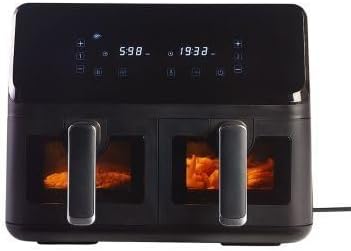
Lakeland Dual-Basket Air Fryer
Stop eating cold side dishes. Upgrade to the Lakeland Dual-Basket Air Fryer and let the smart Sync Finish technology ensure your entire meal is hot and ready at the exact same time.
Check Price on Amazon3. Capacity & Basket Layout: Feeding the Family
The Lakeland Dual-Basket typically boasts a generous 8-liter or 9-liter total capacity. This volume is split directly down the middle, giving you two independent 4L (or 4.5L) cooking zones.
This layout fundamentally changes how you approach meal prep:
- The Main Event: A 4L drawer is wide enough to comfortably hold two large chicken breasts, four thick pork chops, or a generous portion of salmon fillets in a single, uncrowded layer.
- The Sides: The second drawer can simultaneously handle enough chips, roasted vegetables, or potato wedges to feed a family of four.
If you are someone who likes to bake or get creative with breakfasts, having dual zones is a revelation. You can utilize silicone egg molds and space-saving accessories in one drawer while cooking bacon or sausages in the other, creating a full English breakfast in under 15 minutes.
4. Which Lakeland Dual-Basket Model Should You Choose?
One detail that trips up a lot of shoppers is that Lakeland doesn’t sell just one dual-basket air fryer. The range has evolved across several product cycles, and older listings sometimes still surface in search results and on third-party marketplaces. Before you add anything to a basket, it’s worth understanding exactly which variant you’re looking at, because the differences affect both price and day-to-day usability far more than the product photos suggest.
The original entry-level Lakeland Dual Basket Air Fryer launched with an 8-litre total capacity split unevenly across a 5-litre main drawer and a smaller 3-litre side drawer, rather than two identical zones. This version has a single control button that you cycle through repeatedly to scroll between its eight preset programmes, no viewing windows, and a comparatively modest wattage rating. It’s the cheapest way into the Lakeland ecosystem, but the mismatched basket sizes and single-button interface mean it feels closer to a budget appliance than a flagship one.
The version most people actually mean when they search for “Lakeland Dual Basket Air Fryer” today is the Easy View variant, which swaps the mismatched drawers for two genuinely equal 4-litre zones and adds the clear viewing windows with internal lighting that this review focuses on. This is the model that most closely competes with Ninja’s DualZone range on a feature-for-feature basis, and it’s the one we’d recommend prioritising if the two options are similarly priced when you’re shopping.
| Feature | Standard 8L Dual Basket | Dual Basket with Easy View |
|---|---|---|
| Basket Split | Uneven: 5L main + 3L side | Even: 4L + 4L |
| Viewing Windows | No | Yes, with interior light |
| Controls | Single cycling button per zone | Dedicated touch icons per zone |
| Best For | Budget-conscious solo/couple cooking | Families wanting parity between zones |
If you spot a heavily discounted “Lakeland Dual Basket Air Fryer” listing, always check the product photos for the viewing windows and equally sized drawers before assuming you’re getting the machine reviewed here. Lakeland has also introduced a larger Adjustable Large Drawer Air Fryer aimed at bigger households, which uses a single reconfigurable cavity rather than two fixed drawers, so it solves a different problem (fitting a whole chicken or large roast) rather than true simultaneous dual-zone cooking.
5. How Air Fryers Actually Work: The Science Behind the Crisp
Understanding the mechanics behind an air fryer explains a lot about why the Lakeland performs the way it does, and it also helps with troubleshooting uneven results later in this guide. At its core, every air fryer is a compact convection oven. A heating element positioned above the food warms the air inside a sealed cooking chamber, while a high-speed fan forces that hot air to circulate rapidly around every surface of whatever sits in the basket. Because the cavity is so much smaller than a domestic oven and the airflow is far more concentrated, heat transfer happens much faster, which is why a batch of chips that might take 25 minutes in a conventional oven can crisp up in under 15 minutes here.
One detail worth checking before buying any dual-basket model, Lakeland included, is whether the machine uses two fully independent heating elements and fans, or a single shared heating system with a physical divider running down the middle of one large drawer. True dual-zone machines, like the Easy View model this review focuses on, give each side its own motor and element, which is what allows you to run genuinely different temperatures and times in each basket at once. Budget “divided basket” fryers that share a single fan cannot really do this, and food on one side often cooks more slowly than the other simply because airflow isn’t distributed evenly between the two halves.
This also explains why shaking the basket partway through cooking is standard advice across virtually every air fryer recipe you’ll come across, regardless of brand: it’s not a gimmick, it’s a genuinely useful way of compensating for the fact that even the best fan placement can’t perfectly reach every surface of a densely packed basket on its own.
The other piece of the puzzle is the basket coating itself. Most air fryers, Lakeland’s range included, use a non-stick coating on the drawers and removable crisper plates. It’s worth looking out for coatings explicitly marketed as PFOA-free, since older PTFE-based non-stick surfaces historically involved this now-restricted chemical during manufacturing. Ceramic-style coatings are an increasingly popular alternative because they tend to be more scratch-resistant and release food more easily, though they can wear slightly faster if you regularly use metal utensils or abrasive scouring pads, which is exactly why we recommend soft sponges only in the cleaning section further down this guide.
It’s also worth understanding where basket-style machines like this Lakeland model sit within the broader air fryer landscape. Broadly speaking, air fryers fall into two camps: basket-style models, where food sits in a removable pull-out drawer, and toaster-oven-style models, which look more like a small conventional oven with a door, internal racks, and a fixed cooking cavity. Basket-style dual fryers, including this one, tend to be easier to clean since the entire drawer and crisper plate lift out and can be washed in the sink, whereas oven-style models usually have a fixed interior that can only be wiped down by hand. The trade-off is versatility: oven-style machines can typically accommodate larger dishes, multiple trays at once, and a wider range of cooking modes such as proper baking or rotisserie, while basket-style machines like the Lakeland prioritise speed, simplicity, and easy cleanup over sheer flexibility. If your household cooks mostly quick, everyday meals, a basket-style dual fryer is usually the more practical choice; if you regularly cook multi-tray bakes or want to replace a small oven entirely, it’s worth at least considering the oven-style alternative before committing.
4. Smart Sync & Match Cook Features
The true value of this machine lies in its brain. The Lakeland features two critical programming modes that eliminate the guesswork of timing a meal.
Sync Finish
Imagine cooking a 25-minute chicken breast in the left drawer and 12-minute chips in the right drawer. With Sync Finish, you program both zones and press Start. The machine immediately fires up the chicken but intelligently pauses the chips. Exactly 13 minutes later, the right drawer turns on. Both drawers finish at the exact same millisecond.
Match Cook
If you are cooking a massive batch of the exact same food (e.g., 8 liters of chips for a party), you don’t want to program the left drawer and then manually repeat the process for the right. Match Cook allows you to set the parameters for Zone 1 and instantly duplicate them to Zone 2 with a single button press.
A Quick Terminology Guide: Every Brand Names This Differently
If you’ve been comparing dual-basket air fryers across multiple brands, you’ve probably noticed that nobody uses quite the same language, which makes like-for-like comparison shopping unnecessarily confusing. Ninja calls its version “Sync,” Lakeland (along with several other brands) refers to essentially the same concept as “Sync Finish” or “Smart Finish,” and some budget manufacturers simply label it “Sync Cook” on the box without much further explanation. Whatever the branding, the underlying function is identical: the machine calculates the time difference between two different cook cycles and automatically delays the start of the shorter one so that both drawers finish simultaneously.
“Match Cook” (sometimes called “Match” or “Copy”) is a separate and genuinely distinct feature from Sync Finish, even though the two are frequently confused in casual conversation and in marketplace reviews. Match Cook duplicates one zone’s settings onto the other, which is useful when you’re cooking a large single batch of the same food and want both baskets running identical programmes rather than two different ones. Understanding this distinction matters when comparing spec sheets, since a machine advertising only “Match” functionality without “Sync” cannot actually finish two different foods at the same time, it can only mirror the same food across both zones.

Keep Your Drawers Spotless
Protect the non-stick coating of your Lakeland air fryer. Grab a set of reusable, food-grade silicone liners designed specifically for rectangular dual-basket models to catch all grease and crumbs.
Shop Dual Basket Silicone Liners5. Cooking Performance: Testing the Maillard Crunch
Dual-basket fryers must divide their wattage (often 2400W to 2800W total) between two independent heating elements. Does the Lakeland have enough power to deliver a true deep-fried crunch?
To understand the results, we look at the science of temperature control and the Maillard reaction. The Lakeland’s rapid air technology circulates heat aggressively under the elevated crisper plates. During our tests, frozen chips achieved a golden, shattering exterior while maintaining a fluffy interior. Raw chicken thighs rendered their fat perfectly, resulting in beautifully blistered skin.
Energy Efficiency: A massive hidden benefit of the dual-zone design is that the baskets operate entirely independently. If you are just heating up a sausage roll for lunch, you only have to turn on one 4L drawer. This uses significantly less electricity than powering up a traditional oven or a massive 8L single-basket fryer.
Because “how long do I cook this for” is the question we get asked most often, we’ve put together a quick-reference cooking chart based on our own testing. Treat these as starting points rather than gospel: thickness, whether food is fresh or frozen, and how full the basket is will all shift the numbers slightly, and Lakeland’s own instruction booklet includes a more detailed chart specific to your exact model.
| Food | Temperature | Approx. Time | Notes |
|---|---|---|---|
| Frozen chips | 200°C | 16-20 mins | Shake basket at the halfway point |
| Fresh-cut chips | 190°C | 22-25 mins | Toss in 1 tbsp oil before cooking |
| Chicken breast (boneless) | 190°C | 18-22 mins | Flip halfway; check internal temp reaches 75°C |
| Chicken thighs (bone-in) | 190°C | 25-28 mins | Skin-side up for the final 5 minutes |
| Salmon fillets | 180°C | 10-12 mins | No need to flip |
| Frozen nuggets/fish fingers | 200°C | 10-14 mins | Single layer for best crisping |
| Bacon | 180°C | 7-9 mins | Watch closely near the end; fat renders fast |
| Roasted mixed vegetables | 190°C | 15-18 mins | Cut into even sizes for consistent cooking |
| Jacket potato | 200°C | 40-45 mins | Pierce skin first; no foil needed |
| Small cake/loaf (in tin) | 160°C | 25-35 mins | Use a tin that fits the drawer depth; check with a skewer |
8. Recipe Inspiration: What to Cook in Each Basket
The real appeal of a dual-zone machine isn’t any single recipe, it’s the pairings. Once you start thinking in terms of “what goes in the left drawer and what goes in the right,” entire categories of weeknight cooking get faster. Here are some combinations we found ourselves reaching for again and again during testing.
Fakeaway Friday
Southern-fried style chicken thighs in one drawer, thick-cut chips in the other. Program the chicken first since it needs longer, and let the Sync-style timing bring the chips in later so everything lands on the plate hot and crisp at once, no soggy takeaway substitute required.
Full English Breakfast
Bacon and sausages in one basket, hash browns and a silicone egg mold in the other. A complete cooked breakfast for two in around 15 minutes, with a fraction of the washing up a frying pan session would generate.
Midweek Fish Supper
Salmon fillets in one zone, tenderstem broccoli and cherry tomatoes tossed in olive oil in the other. Both finish inside 12 minutes, making this one of the fastest genuinely healthy dinners the machine can produce.
Mini Sunday Roast
Chicken thighs or a small joint in the main drawer, roast potatoes and carrots in the second. It won’t replace a full oven roast for six people, but for a household of two or three it’s a genuine, oven-free alternative.
Packed Lunch Prep
Batch-cook chicken strips in one drawer while roasting a tray of mixed vegetables in the other, then portion both into containers for several days of lunches at once.
Dietary-Split Dinners
Because the drawers are fully separate, you can cook a fish dish in one basket and a completely different, allergen-free meal in the other without any risk of cross-contamination or flavour transfer, which matters if anyone in your household has a food intolerance.
Lakeland also includes a short recipe booklet with the machine, typically featuring a handful of starter recipes such as crispy spiced chickpeas, courgette fritters, and a teriyaki-style salmon. It’s a useful nudge if you’re new to air frying, though most owners quickly move on to experimenting with their own regular meals once they’ve got a feel for the timings.
Walkthrough: Fakeaway Friday Chicken & Chips, Step by Step
To show exactly how the two zones work together in practice, here’s how we’d approach the fakeaway pairing mentioned above from start to finish:
- Prep both components first. Toss thick-cut chips in a tablespoon of oil and season generously. Coat chicken thighs in your preferred seasoning or a light layer of seasoned flour for extra crunch.
- Load the longer-cooking item first. Place the chicken thighs in Zone 1 and set it to 190°C for roughly 25 minutes, since bone-in chicken takes noticeably longer than the chips.
- Load the chips into Zone 2 and set them to 200°C for around 20 minutes.
- Use the sync feature (where fitted) so the machine automatically calculates the roughly 5-minute head start the chicken needs and delays the chips accordingly, or simply start the chicken manually first and add the chips once your kitchen timer tells you there’s 20 minutes remaining.
- Shake the chip basket halfway through its cycle for even crisping, and flip the chicken thighs at the same point.
- Rest for two minutes once both zones finish before plating, which allows the chicken’s juices to redistribute for a better bite.
The entire process from prep to plate typically takes under 35 minutes, with only a few minutes of hands-on effort, which is precisely the kind of everyday win that makes dual-zone cooking worth the extra counter space.
Accessories Worth Considering
While the Lakeland Dual-Basket works perfectly well straight out of the box, a handful of inexpensive accessories noticeably expand what you can cook in it. Reusable silicone liners (like the ones linked earlier in this guide) cut down on washing up considerably and help protect the non-stick coating from scratches over time. Silicone egg moulds and small ramekins let you use the drawers for baking and breakfast items that wouldn’t otherwise hold their shape. A basic skewer rack, while not included with this particular model, can be bought separately and used to cook kebabs vertically, making better use of the drawer’s height. If you bake regularly, look specifically for loaf tins and small round tins marketed as “air fryer safe,” since these are sized to fit the narrower drawer shape discussed earlier in this guide, rather than standard oven bakeware sizes. Lakeland has also indicated it’s exploring dedicated silicone insert accessories designed specifically for the dual-basket range, which would be a welcome addition given how frequently this comes up as a request in owner feedback.
9. Energy Efficiency & Running Costs: How Much Does It Actually Cost to Use?
One of the biggest reasons shoppers give for switching to an air fryer is the promise of lower running costs compared with heating an entire oven cavity. Dual-basket models complicate this slightly because they contain two heating elements, so it’s worth understanding the real numbers rather than assuming “smaller equals cheaper” by default.
Dual-basket air fryers in this category typically draw somewhere between 1700W and 2700W when both zones are running at once, depending on the exact model and whether both drawers are active simultaneously. A standard UK electric oven, by comparison, often draws 2000W to 3000W and needs to heat a cavity many times larger than either air fryer basket, plus it usually needs a longer preheat.
| Appliance | Typical Wattage | Cook Time (Family Meal) | Approx. Energy Used |
|---|---|---|---|
| Dual-basket air fryer (one zone) | ~900W-1000W | 20 mins | ~0.3 kWh |
| Dual-basket air fryer (both zones) | ~1700W-2000W | 20 mins | ~0.6 kWh |
| Full-size electric oven | ~2000W-3000W | 35-40 mins (incl. preheat) | ~1.4-1.7 kWh |
Using average UK electricity pricing, that gap can translate to roughly two to three times more energy used per meal when relying on a full oven instead of the air fryer, purely because of the preheat time and the volume of air being heated. The saving compounds further if you’re currently in the habit of running the oven just to cook a small side dish; being able to use a single 4L zone rather than firing up an entire oven cavity is where the dual-basket design earns back a meaningful chunk of its purchase price over a year of regular use.
It’s worth noting that these figures are estimates for planning purposes rather than a guarantee, since your actual costs depend on your electricity tariff, how full each basket is, and how often you’re running both zones versus just one.
There’s a broader sustainability angle here too, beyond the pounds-and-pence saving on your energy bill. Shorter cook times and smaller heated cavities mean less overall energy consumption per meal across a household’s cooking habits over a year, which is a meaningful reason air fryers in general have been positioned as a lower-impact alternative to constant oven use, alongside the more commonly cited health benefit of using little to no additional oil. None of this makes the appliance itself more “eco-friendly” to manufacture or dispose of than any other electrical good, but from a pure day-to-day energy usage perspective, replacing frequent single-item oven use with a dual-basket air fryer is one of the more effective small changes a household can make without altering what they’re actually cooking.
6. Interface & Usability: Touchscreen Mastery
The control panel on the Lakeland is situated elegantly across the top face of the unit. It utilizes a digital LED touchscreen that is highly responsive and easy to read.
It features separate, clearly defined controls for Zone 1 and Zone 2, minimizing the chance of accidentally adjusting the temperature of your vegetables when you meant to adjust your meat. The interface includes several one-touch presets for common foods (fries, meat, baking, dehydrating), but easily allows for manual minute-by-minute and degree-by-degree adjustments for those who prefer total control.
It’s worth setting expectations here: this touchscreen layout applies specifically to the Easy View model. On the standard, entry-level Dual Basket unit, you’ll instead find a single physical button per zone that you press repeatedly to cycle through the eight preset icons, which is noticeably slower and more fiddly than tapping a dedicated icon directly. Even on the touchscreen version, some of the smaller symbols (particularly the sync/match icon, which is represented by a simple arrow rather than a text label) take a session or two to memorise. We’d recommend keeping the instruction booklet handy for the first week of ownership rather than assuming the icons are self-explanatory.
11. Safety Features You Should Know About
Beyond the headline cooking features, it’s worth understanding the safety mechanisms built into any dual-basket air fryer before it becomes a permanent fixture on your countertop, especially in a household with children or pets nearby.
What’s Built In
- Auto shut-off: The unit powers down automatically once the programmed timer ends, rather than continuing to run indefinitely.
- Overheat protection: Internal sensors cut power if the appliance detects a fault or excessive internal temperature.
- Cool-touch handles: The drawer handles stay significantly cooler than the cooking chamber, reducing the risk of burns during use.
- Non-slip base: Rubberised feet keep the unit stable on the worktop even when a drawer is pulled fully open.
Sensible Precautions to Take Yourself
- Ventilation: Leave at least 10-15cm of clear space behind and beside the unit so hot exhaust air can escape properly.
- High-fat foods: Avoid cooking very high-fat items like whole sausages without piercing them first, as rendered fat pooling in the basket can occasionally cause smoking.
- Empty the crumb tray: Built-up food debris beneath the basket is a fire risk in any air fryer, not just this one, so check it periodically.
- Never leave unattended for extended periods: As with any heating appliance, this is a sensible habit regardless of built-in safeguards.
None of this makes the Lakeland unusual in the current market. These protections are effectively standard across reputable dual-basket air fryers sold in the UK, and their presence (or absence) is one of the quickest ways to distinguish a trustworthy mid-range appliance from an unbranded budget import. As a general rule, if a listing for a dual-basket air fryer doesn’t clearly state auto shut-off and overheat protection anywhere in its specifications, that’s worth treating as a red flag rather than an oversight.
7. Cleaning & Maintenance: Non-Stick Care
Cleaning up after a meal is where many air fryers lose their appeal. Fortunately, Lakeland has equipped both the drawers and the removable crisper plates with a high-quality non-stick coating.
While the manual may suggest that the drawers are dishwasher safe, we strongly advise against putting them in the dishwasher. The extreme heat and abrasive detergents used in modern dishwashers will eventually degrade the non-stick finish, causing it to peel. A quick hand-wash with warm, soapy water and a soft sponge takes less than two minutes per drawer.
If you prefer to use liners to make cleanup even easier, ensure you are using heat-safe options. You can read our updated guide on safe air fryer liner materials to understand the differences between silicone, parchment, and foil.
A note on bakeware sizing: because the drawers on the dual-basket design are long and comparatively narrow rather than wide and square, standard round cake tins that fit easily into single-basket air fryers often won’t fit here. If you plan to bake regularly, check your tin against the drawer’s internal dimensions before assuming it will slide in, or plan on using a smaller loaf tin or dedicated air-fryer-sized bakeware instead.
If a crisper plate or basket is ever damaged, replacement parts are generally inexpensive and available directly from Lakeland or its authorised sellers, which is a small but meaningful advantage of buying into an established homeware brand rather than an obscure marketplace-only appliance where spare parts may simply not exist a year or two down the line.
13. Troubleshooting Common Problems
Most issues owners report with dual-basket air fryers, Lakeland’s included, come down to a handful of recurring causes. Here’s how to diagnose and fix the most common ones before assuming the unit itself is faulty.
Food is browning unevenly on one side of the basket
This is almost always caused by overcrowding rather than a fault with the machine. Once food exceeds a single, roughly even layer, it blocks the hot air from circulating properly around every piece. Shake or flip the basket halfway through cooking, and if you’re regularly cooking for a crowd, consider cooking in two smaller batches rather than one overloaded one.
The chips or fries aren’t crisping up properly
Excess surface moisture is the usual culprit. Always pat fresh-cut potatoes dry after washing, and avoid adding too much oil, since a thin, even coating crisps far better than a heavy, saturated one. Overloading the basket has the same effect as above: steam has nowhere to escape, so the food essentially steams rather than air-fries.
One drawer seems to cook slower than the other
Check that the vents on the rear or side of the unit aren’t obstructed by being pushed too close to a wall or cupboard. If both drawers are consistently uneven even with clear ventilation and similar food loads, this is one of the few genuine fault scenarios worth raising with Lakeland’s customer service team under the three-year guarantee.
The unit won’t turn on at all
Confirm the drawers are pushed in fully and seated correctly. Most air fryers, this one included, use a safety interlock that prevents the heating element from activating unless both drawers are properly closed, which is a deliberate safety feature rather than a fault.
A burning or smoking smell during the first few uses
A faint smell during the very first one or two cooks is common as manufacturing residue burns off the heating element, and it should dissipate quickly, especially if you run an empty five-minute cycle before first use as most instruction booklets recommend. A persistent smell after several uses, however, usually points to built-up grease on the element or crumb tray that needs cleaning.
The touchscreen isn’t responding to taps
Check for grease or moisture on the panel surface, since capacitive touch controls can become less responsive when covered in a thin film of cooking residue. A dry microfibre cloth wipe-down while the unit is unplugged and cooled usually resolves this. If the panel remains unresponsive after cleaning, it’s worth contacting Lakeland customer service, as this would fall under the three-year guarantee rather than being something to fix yourself.
Food is cooked but not as crispy as expected
This is rarely a fault and almost always comes down to one of three things: too much oil creating a soggy rather than crisp coating, too little airflow because the basket is overloaded, or too much natural moisture in the food itself (frozen vegetables in particular release a lot of water as they cook). Patting food dry before cooking, using oil sparingly, and giving the basket an extra shake partway through are the three most effective fixes.
14. Competitor Comparison: Lakeland vs. The Rest of the Market
How does Lakeland’s offering hold up against the wider field of dual-basket air fryers sold in the UK, not just the obvious Ninja comparison?
| Feature | Lakeland Dual-Basket (8L/9L) | Ninja Foodi DualZone (AF300UK) | Tower Vortx Dual Basket | Instant Vortex Plus Dual | Tefal Easy Fry Dual |
|---|---|---|---|---|---|
| Capacity | 8L or 9L (Model Dependent) | 7.6L | 9L | ~8L | ~8.3L |
| Sync Finish / Smart Cook | Yes | Yes | Yes | Yes | Yes |
| Max Temperature | 200°C | 240°C (Max Crisp Mode) | 200°C | 200°C | 200°C |
| Viewing Windows | Yes (On specific models) | No | Yes (On specific models) | Yes (“ClearCook”) | No |
| Extra Cook Modes | Air fry only | Roast, bake, dehydrate, reheat | Air fry, roast | Bake, reheat, dehydrate | Air fry, grill |
| Price Tier | Budget / Mid-Range (Excellent Value) | Premium (Highest Price) | Budget / Mid-Range | Mid-Range | Mid-Range |
When comparing brand ecosystems like Ninja vs Philips or Lakeland, the Ninja undoubtedly wins on raw peak temperature (240°C Max Crisp) and on the sheer number of additional cooking modes. However, the Lakeland matches the Ninja on almost every core software feature (Sync Finish, Match Cook) while offering competitive capacities and, frequently, a much more attractive price tag backed by Lakeland’s legendary 3-year guarantee.
The Instant Vortex Plus Dual is arguably the closest match to Lakeland in spirit: both prioritise an intuitive interface and a see-through window over an exhaustive list of cooking modes, and both are frequently praised for being approachable to first-time air fryer owners. The Tefal Easy Fry Dual leans slightly more toward the grilling side of things thanks to its removable grill plate accessory, which none of the other machines in this table offer. If your priority is maximum versatility and you don’t mind paying a premium for it, Ninja remains the machine to beat; if your priority is getting 90% of that functionality at a meaningfully lower price with the reassurance of in-store UK support, Lakeland is very hard to argue with.
15. Who Should (and Shouldn’t) Buy the Lakeland Dual-Basket?
No single appliance suits every household, and a dual-basket air fryer is a bigger commitment of both money and counter space than a compact single-basket model. Here’s our honest breakdown of who gets the most value out of this particular machine.
Families of 3-5
This is the sweet spot. You get enough combined capacity to cook a full protein-and-side meal in one go, and the even 4L/4L split on the Easy View model means neither portion feels like an afterthought.
Couples Wanting Variety
Being able to cook two completely different meals, or the same meal with different seasoning, in one appliance is a genuine quality-of-life upgrade for households with differing tastes or dietary needs.
First-Time Air Fryer Buyers
The straightforward preset system and lower price point (relative to premium rivals) make this a sensible entry point if you’ve never owned an air fryer and aren’t ready to commit to a £200+ machine.
Anyone Short on Counter Space
If your kitchen worktop is already tight, the roughly 40cm-wide footprint may simply not fit. A single-basket model or a vertically stacked design would suit you better.
Serious Home Bakers
The narrow drawer shape limits which tins and dishes will fit. If baking is a primary use case rather than an occasional extra, an oven-style air fryer with a full-width cavity will serve you better.
Households Wanting Every Cook Mode
If dehydrating, proper roasting, or grilling functions matter to you, the Lakeland’s air-fry-only limited temperature range (typically 80°C-200°C) won’t cover it. Look toward Ninja or Instant’s multi-mode machines instead.
Stepping back, the common thread across every “yes” scenario above is a household that values everyday convenience and reliable, no-fuss results over an exhaustive feature list. The common thread across the “no” scenarios is a specific, more specialised need, whether that’s extreme capacity, dedicated baking, or multi-mode versatility, that a budget-to-mid-range dual-basket machine simply isn’t designed to solve. Being honest with yourself about which category you fall into before buying will save far more disappointment than any spec sheet comparison ever could.
16. Where to Buy & What to Expect to Pay
One underrated advantage Lakeland has over online-only appliance brands is its retail footprint: with dozens of physical stores across the UK, you can typically see, handle, and ask staff questions about the machine in person before committing, which matters if you’ve been burned before by an appliance that looked great in photos but felt cheap and flimsy in real life.
Pricing for dual-basket air fryers in this category generally sits in the budget-to-mid-range bracket, comfortably below premium Ninja and multi-mode Instant models, which is consistently the reason this machine gets recommended as a value pick across independent UK reviews. As with any appliance, prices fluctuate around seasonal sales events, so it’s worth comparing the price directly from Lakeland against major online retailers before buying, since stock promotions don’t always run in both places simultaneously.
A Quick Tip Before You Buy
Always double-check whether the specific listing you’re viewing is the standard 8L (5L+3L) model or the Easy View 4L+4L version discussed throughout this review, since both are frequently sold under near-identical product names and thumbnail images.
It’s also worth registering your appliance with Lakeland shortly after purchase if the option is available, since this can streamline any future guarantee claims by having your proof of purchase and serial number already on file rather than needing to dig out a receipt years down the line. Keep the original box for at least the first few weeks of ownership too; if a fault does appear early on, having the original packaging makes any return or exchange process considerably smoother, particularly for a bulky item like this that isn’t practical to post back without proper protection.
Seasonal sales events, particularly around Black Friday and the new year, are typically when the biggest discounts on both the standard and Easy View models appear. If you’re not in a rush, it’s worth setting a price alert or simply checking back periodically rather than buying at full price the moment you decide you want one, since dual-basket air fryers in this bracket rarely stay at their initial launch price for the whole year.
17. What UK Owners Are Saying
Beyond our own hands-on testing, it’s worth looking at the broader pattern of feedback this machine has picked up across independent UK reviewers and everyday owners since launch. A few consistent themes show up again and again.
Recurring Praise
- Owners frequently mention using their conventional oven far less often after switching, particularly for weeknight meals.
- The value-for-money angle comes up constantly, especially when compared directly against premium-priced Ninja models with similar core functionality.
- Frozen food performance is repeatedly singled out as a strong point, with wedges, nuggets, and fish fingers crisping up noticeably better than in a microwave or conventional oven.
- The three-year guarantee is regularly cited as a meaningful reassurance factor at this price point.
Recurring Criticism
- Some owners describe the outer casing as feeling somewhat plasticky compared with pricier alternatives, even though it holds up structurally over time.
- The icon-based controls on both variants take a little longer to learn than some competitors’ plain-text menus.
- The narrow drawer shape is a recurring frustration for anyone hoping to bake in standard round tins.
- A handful of reviewers note that cooking can run slightly slower than expected for a machine at this wattage, so building in a few extra minutes of buffer time is a sensible habit.
None of these criticisms are dealbreakers on their own, and they’re broadly consistent with what you’d expect from any budget-to-mid-range appliance rather than being unique flaws specific to Lakeland. Taken together, the general consensus across independent testing lines up closely with our own experience: strong value, reliable everyday cooking, with a few understandable compromises given the price point.
It’s also worth flagging a theme that comes up specifically among longer-term owners rather than first-week reviewers: several people who’ve had the machine for six months or more report that, aside from routine cleaning, they haven’t needed to do anything beyond the basics to keep it running well. That kind of unremarkable, low-maintenance longevity doesn’t generate exciting headlines the way a flashy new feature does, but it’s arguably the more important signal for anyone weighing up whether this is a genuine long-term kitchen investment or simply a well-reviewed appliance that fades in usefulness after the novelty wears off.
18. Pros and Cons: The Final Summary
The Pros
- Sync Finish: Having meat and sides finish at the exact same time is a culinary game-changer.
- Value for Money: Offers premium dual-zone features at a lower price point than Ninja.
- Energy Efficient: Cook for one person using just half the machine.
- Viewing Windows: (On select models) Allows you to monitor food without losing heat.
- Lakeland Guarantee: Backed by one of the best customer service warranties in the UK.
The Cons
- Worktop Footprint: It is a wide appliance that requires dedicated space.
- No Large Roasts: Splitting 8L means you cannot fit a massive whole chicken that would otherwise fit in a single 8L basket.
- Max Temp 200°C: Lacks the extreme 240°C “Max Crisp” setting found on premium Ninja models.
19. Final Verdict: Should You Buy the Lakeland Dual-Basket?
The Lakeland Dual-Basket Air Fryer successfully democratizes premium air frying technology. It takes the most desirable features of the high-end market—namely Sync Finish and independent dual-zone cooking—and packages them into an accessible, highly reliable appliance.
If you regularly cook full meals consisting of a protein and a side dish, and you are tired of eating things cold because of the single-basket bottleneck, this machine will revolutionize your weeknight dinners. Backed by Lakeland’s outstanding 3-year guarantee, it is undoubtedly one of the smartest kitchen investments you can make in 2026.
Buy the Lakeland Dual-Basket Air Fryer Today


