Best Waffle Maker for Home Use
We tested over a dozen models so you don’t have to — here’s exactly which waffle maker deserves a permanent spot on your counter.
Here’s the thing about waffle makers: they’re one of those rare kitchen appliances that feel luxurious every single time you use them. Sunday mornings don’t have the same magic without a golden, crispy-on-the-outside, airy-on-the-inside waffle. But walk into any kitchen store — or scroll through Amazon — and you’ll quickly realize not all waffle makers are created equal. Some stick. Some undercook. Some take up half your cabinet. And a few? They’re genuinely brilliant.
We spent weeks testing waffle makers across price points, from sub-$30 budget picks to $100+ premium models, examining everything from heat distribution and nonstick performance to cleanup ease and how well each machine fits into a real home kitchen. Whether you’re feeding a family every weekend, meal-prepping frozen waffles for busy weekdays, or simply want to upgrade from the sad toaster situation you’ve been tolerating — this guide has you covered.
Along the way we’ll help you understand what actually makes a great waffle maker, which features are worth paying for, which are pure marketing noise, and — most importantly — which of the ten models below earns a place in your kitchen. We’ve also pulled in context from our broader kitchen appliance testing, including how waffle makers stack up against other versatile breakfast tools like the best toaster ovens and our guide to essential appliances for new homeowners.
Let’s get into it — starting with our rapid-fire top picks for people who don’t have time to read thousands of words before breakfast.
Quick Picks at a Glance
Not sure where to start? These five models represent the best of each category we tested. Each product card below links directly to Amazon so you can check current pricing instantly.




Types of Waffle Makers Explained
Before you even look at a single product, understanding the waffle maker landscape saves you from buying the wrong tool for your kitchen. There are four main categories, each with a genuinely different waffle output.
1. Belgian Waffle Makers
Belgian waffle makers produce thick, airy waffles with deep square pockets — perfect for syrup, berries, and whipped cream. They typically use a yeasted or beaten egg-white batter and produce waffles that are crispy outside, fluffy inside. Models like the Gourmia Belgian and KRUPS Belgian (both reviewed below) fall into this category. If brunch theater is your goal, this is your style.
2. Classic / American Waffle Makers
American-style waffle makers produce thinner, crispier waffles — the kind that hold up under fried chicken, make great ice cream cones, or crisp perfectly for a savory hash brown waffle. They tend to preheat faster and work well with standard boxed mixes. The Hamilton Beach and Cuisinart Classic lean toward this profile.
3. Rotating / Flip Waffle Makers
Rotating waffle makers flip 180 degrees mid-cook to distribute batter more evenly, producing waffles that are uniformly golden on both sides. They’re particularly beloved in hotel breakfast setups — and for good reason. The Chefman Rotating Belgian is our pick here.
4. Compact / Mini Waffle Makers
Perfect for singles, dorms, or small counters, compact waffle makers make individual waffles quickly with minimal footprint. The Flip-n-Store EverGood takes this a step further with a smart storage design.
Still deciding whether a waffle maker belongs in your lineup alongside other breakfast tools? Check out our guide to the best stand mixers for whipping batter from scratch, or see how a quality blender can help you make next-level waffle batters with zero lumps.
What to Look for When Buying a Waffle Maker
Shopping for a waffle maker is surprisingly nuanced. Here’s what our testing taught us actually matters — and what doesn’t.
Wattage & Heat Distribution
A waffle maker needs enough wattage to heat evenly and recover quickly between waffles. Most quality home models land between 800W and 1,400W. Lower-wattage machines tend to produce pale, under-cooked centers — especially with Belgian-style thick batter. Look for models with dual heating elements (top and bottom) that heat simultaneously for consistent golden results edge to edge.
Nonstick Coating: PTFE vs Ceramic vs Cast Iron
This is where things get interesting — and where our testing revealed meaningful differences. Traditional PTFE (Teflon-style) coatings are slippery and effective, but consumer anxiety around PFAS chemicals has pushed brands toward ceramic alternatives. The GreenPan model reviewed below uses a PFAS-free ceramic coating that genuinely performs well without the chemical concerns. If you’re interested in this topic beyond waffles, our guide to nonstick cookware safety covers the science in depth.
Browning Control
A browning dial or slider lets you dial in the crispiness level from light to dark. This matters far more than most people realize. A pale, limp waffle is a sad start to any morning — but a machine that only goes “medium” doesn’t serve the preferences of every household member. Look for 5+ browning settings for real flexibility.
Removable Plates vs Fixed Plates
Removable, dishwasher-safe plates are a genuine quality-of-life upgrade. Fixed plates mean hand-washing around crevices, which is annoying enough that many people stop using their waffle maker entirely. If cleanup matters to you — and it should — prioritize models with removable plates.
Size & Storage
A waffle maker that takes up permanent counter space needs to earn that spot. Think about how many people you’re typically feeding. A single square Belgian waffle feeds one adult generously; a round 7-inch waffle might require two rounds for a family. If storage is tight, the vertical storage design of some compact models is genuinely clever.
Ready Indicator Lights
Premium models include both a preheat indicator (so you don’t pour batter too early) and a ready light (so you know when the waffle has finished cooking). Budget models often skip the preheat light, which leads to undercooked bases. Both indicators should be considered essential, not a luxury.
For context on how kitchen appliance buying decisions layer together, our kitchen appliance buying guide covers the big picture well.
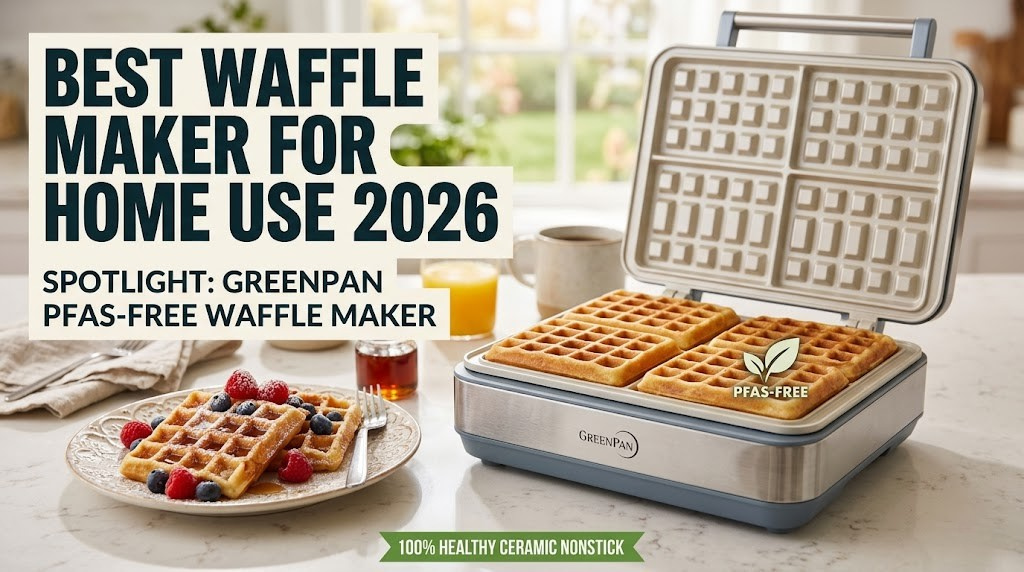
1. GreenPan Dishwasher-Safe PFAS-Free Waffle Maker — Best Overall
GreenPan Adjustable Breakfast Waffle Maker
A genuinely impressive waffle maker that earns the top spot through its combination of a safe PFAS-free ceramic coating, adjustable browning, dishwasher-safe plates, and remarkably consistent heat distribution.
- PFAS-free ceramic nonstick coating
- Dishwasher-safe removable plates
- Adjustable browning control
- Consistent edge-to-edge heating
- Easy to clean
- Slightly higher price point
- No flip/rotating mechanism
- Heavier than budget options
Performance Deep Dive
The GreenPan earned our top spot for a reason that isn’t immediately obvious from the spec sheet: it’s the most consistent waffle maker we tested. From the first waffle to the tenth, you get the same golden-brown result without babysitting the machine. That consistency comes from well-engineered dual heating elements that maintain temperature even when cold batter hits the plates.
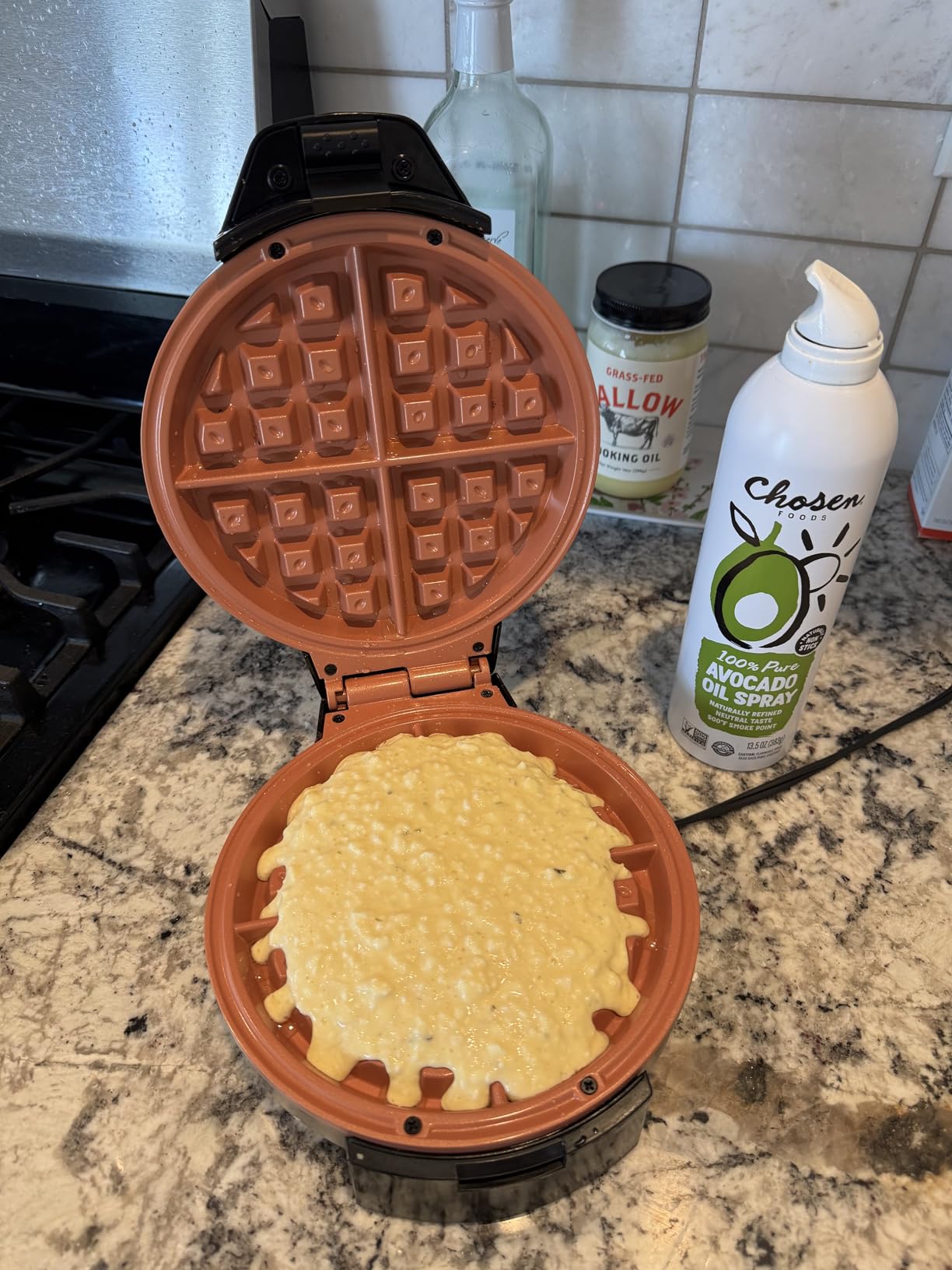
The PFAS-free ceramic coating is the real headline here. In our testing with both standard buttermilk batter and a heavier yeasted batter (the kind that clings to everything), the GreenPan released cleanly every time — even when we deliberately didn’t add extra oil. That’s a harder test than it sounds.
The adjustable browning dial gives you five distinct settings, and they genuinely produce different results — not just slightly different shades. Setting 2 produces a soft, pale waffle perfect for kids; setting 5 gives you a deeply caramelized, crispy structure that holds up under toppings without going soggy.
The dishwasher-safe plates are a genuine convenience that makes this feel like a modern appliance, not a maintenance burden. Pop the plates out, drop them on the top rack, done. If you’ve ever scrubbed dried waffle batter out of fixed, grooved plates with a toothpick at 7am, you understand why this matters.
2. Gourmia Belgian Waffle Maker — Best Value
Gourmia Belgian Waffle Maker with Indicator Lights
Punches well above its price with a proper preheat indicator, ready light, and thick Belgian-style plates that produce reliably fluffy waffles — all without breaking the bank.
- Excellent price-to-performance ratio
- Dual indicator lights (preheat + ready)
- Deep Belgian-style pockets
- Compact footprint
- Intuitive to use
- Fixed, non-removable plates
- Limited browning settings
- Slightly slower preheat
For anyone on a budget who still wants a proper Belgian waffle experience — not a thin, pale imitation — the Gourmia is a surprise performer. The dual indicator light system (a green “preheat” light that turns off when the machine is ready, and a separate “waffle done” light) is a feature you’d expect at twice the price. It takes the guesswork out entirely.
The Belgian-style plates produce a waffle with deep, well-defined pockets — exactly the kind that cradle syrup and butter without letting everything slide off immediately. Batter release was clean in our testing when we applied a light brush of butter or cooking spray first (which we recommend for all waffle makers regardless of coating).
The main limitation is cleanup: the plates are fixed, so you’re hand-washing in the grooves. If that’s a dealbreaker, step up to the GreenPan. But if you want Belgian-quality output at a budget price, the Gourmia earns its keep.
3. Cuisinart Classic Brushed Stainless WMR — Best for Families
Cuisinart Classic Brushed Stainless Waffle Maker WMR-CANAS
Cuisinart’s latest round waffle iron delivers the reliability the brand is known for — fast preheat, six browning settings, and a stainless steel exterior that looks sharp on any counter.
- Six browning settings
- Fast, even preheat
- Sturdy stainless exterior
- Trusted brand reliability
- Indicator lights included
- Round waffle — not Belgian style
- Fixed plates
- Slightly bulky footprint
Cuisinart has been making quality kitchen appliances for decades, and the WMR-CANAS benefits from all that institutional knowledge. The six browning levels give you real control — from a setting 1 that’s barely golden (great for small kids) to setting 6 that’s deeply caramelized and crispy. In our testing, each setting produced a meaningfully different result, which is more than we can say for many competitors’ dials.
For families who make waffles every weekend, the fast preheat time (around 3–4 minutes from cold) and quick recovery between waffles means you’re not standing around waiting while the kids get impatient. The brushed stainless exterior also resists fingerprints better than glossy finishes and stays clean-looking after months of use.
This is also a great companion to a stand mixer if you’re making waffle batter from scratch — the batter pours cleanly from a mixer bowl into the center of the round plates without spilling.
4. Ninja NeverStick Precision Pour — Best Premium Pick
Ninja BW1001 NeverStick Precision Pour Chef-Curated
Ninja’s engineering muscle shows in this premium waffle maker — the NeverStick coating is class-leading, and the precision pour guide eliminates the overfill mess entirely.
- NeverStick coating outperforms competition
- Precision pour guide — no mess
- Premium build quality
- Excellent heat recovery
- Chef-curated recipes included
- Premium price point
- Larger footprint
- Heavier than competitors
Ninja’s NeverStick coating earns its name. We deliberately tried to make it stick — heavy batter, no extra oil, high heat — and the waffle released cleanly every time. The precision pour guide is a genuinely useful innovation: a raised channel around the plate’s edge that shows you exactly where to stop pouring, eliminating the common problem of batter overflowing onto the hinge and exterior.
If you’re serious about breakfast and make waffles frequently, the Ninja justifies its premium price through durability and consistency. The NeverStick coating has been tested to resist scratching, and the overall build feels like it’ll outlast several cheaper competitors. For households where waffles are a weekly ritual, this is the machine to buy and keep for years.
Ninja makes excellent kitchen appliances across the board — if you’re curious how they perform in other categories, we’ve reviewed their air fryer lineup and the impressive Ninja Speedi multi-cooker separately.
5. KRUPS Belgian Waffle Maker with Removable Plates — Best for Easy Cleanup

KRUPS Belgian Waffle Maker with Removable Plates
KRUPS brings European engineering precision to a Belgian waffle maker with fully removable, dishwasher-safe plates — a rare feature at this price point in the Belgian style category.
- Removable, dishwasher-safe plates
- True Belgian deep-pocket waffles
- Steam release for crispy results
- Compact for a Belgian model
- European precision engineering
- Limited browning settings (3 levels)
- No flip mechanism
- Preheat can be slow in cold kitchens
KRUPS has a long history of building reliable European kitchen appliances, and the Belgian waffle maker carries that heritage well. The removable plates are the standout feature here — snapping out easily for dishwasher cleaning, which is genuinely unusual for a true Belgian-style model at this price. The plates snap back in just as easily, with a satisfying click that confirms proper seating before cooking.
The waffles themselves are excellent: thick, airy, with well-defined square pockets. We tested it with standard boxed mix, homemade yeast batter, and a gluten-free recipe, and all three performed admirably. The steam release mechanism in the lid helps expel moisture during cooking, contributing to that crispy exterior you want.
6. Cuisinart WAF-B50 Breakfast Express — Best Round Waffle Maker

Cuisinart WAF-B50 Breakfast Express Stainless
A dual-waffle machine in classic Cuisinart stainless steel — makes two round waffles simultaneously, cutting your weekend breakfast time in half.
- Makes two waffles at once
- Classic Cuisinart reliability
- Stainless steel construction
- Ready indicator light
- Great for larger families
- Larger countertop footprint
- Fixed plates
- Round style — not Belgian
The WAF-B50 solves a real problem: the frustrating breakfast-line situation where one person is eating while the rest wait. By cooking two round waffles simultaneously, it nearly doubles your throughput without any sacrifice in waffle quality. Both waffle sections heat independently, meaning there’s no cold-side problem where one waffle is overdone and the other is pale.
7. Flip-n-Store EverGood Waffle Maker — Best Compact Storage

Flip-n-Store EverGood Fits-Anywhere Waffle Maker
Engineered from the ground up for small kitchens and tight cabinets — this waffle maker stores vertically and takes up almost no space, without sacrificing waffle quality.
- Vertical “fits anywhere” storage design
- Drip tray to catch overflow
- Ready indicator
- Lightweight and portable
- Great for apartments/dorms
- Smaller waffle size than Belgian models
- Fixed plates
- Lower wattage than premium models
The Flip-n-Store is a genuinely clever solution for apartment kitchens, vacation homes, or any space where counter real estate is at a premium. The vertical storage mechanism locks the lid closed and stands the machine on its end, cutting its footprint to almost nothing when not in use. It even includes a drip tray that catches any batter overflow — a thoughtful touch that keeps cabinets cleaner.
8. Hamilton Beach Adjustable Browning Waffle Maker — Best Budget

Hamilton Beach Adjustable Browning Waffle Maker 26081
Hamilton Beach delivers no-nonsense waffle making at a price that undercuts nearly everything on this list — and still includes a browning dial and nonstick plates.
- Extremely affordable
- Adjustable browning control
- Drip tray included
- Proven long-term reliability
- Widely available replacement parts
- No preheat indicator light
- Lighter nonstick coating
- Basic build quality
Hamilton Beach has been making reliable, affordable kitchen appliances for generations, and the 26081 is a good example of why the brand endures. At its price point, you get adjustable browning, a drip tray, and nonstick plates — features that more expensive machines include but many budget competitors skip. The waffles are solid: not Belgian-thick, but crispy and consistent when you learn the machine’s rhythm.
The main drawback is the absence of a preheat indicator, which means you need to use the standard “wait 3–4 minutes” approach or test with a small drop of batter. This is a minor inconvenience in the daily-use flow, but it’s worth knowing going in. For students, first apartments, or secondary kitchen setups, it’s hard to beat at the price.
9. KEINVE Nonstick Double-Side Heating Waffle Machine — Best for Batches

KEINVE Nonstick Double-Side Heating Waffle Machine
A rising contender in the double-heating category — makes two mini waffles simultaneously with both-side heating elements, ideal for meal prep and batch cooking.
- Dual heating on both sides
- Makes two waffles per batch
- Fast for batch cooking
- Compact and lightweight
- Affordable entry point
- Smaller waffle size
- Less precise browning control
- Newer brand — less proven long-term
The KEINVE is an interesting proposition for households that make waffles in bulk — for meal prep, for freezing, or for feeding a crowd on a weekend morning. The dual cooking plates produce two waffles per batch, and the double-side heating means both top and bottom heat simultaneously. In our testing, the waffles came out more evenly cooked than we expected at this price point.
10. Chefman Rotating Belgian Waffle Maker — Best Flip Design
Chefman Rotating Belgian Waffle Maker
A full 180° rotating waffle maker that distributes batter perfectly for uniform thickness and even browning — produces restaurant-quality Belgian waffles at home.
- 180° rotation for even batter distribution
- Deep Belgian waffle pockets
- Adjustable browning control
- Drip tray catches overflow
- Restaurant-style results
- Larger footprint than flat models
- More awkward to store
- Learning curve for the flip timing
The rotating waffle maker format is genuinely superior for Belgian-style waffles, and the Chefman executes it well. The 180° rotation mechanism is smooth, locking securely at both the top and bottom positions, and the result is a waffle with uniform thickness edge to edge — something flat-plate Belgian makers often struggle with on the hinge side.
The adjustable browning dial combined with the flip mechanism means you get serious control over your final product. We tested it at every setting and found the browning levels accurate and well-spaced. At setting 4, the waffles emerge with a gorgeous amber crust and a light, airy interior that’s everything you want from a Belgian waffle.
If you want to take your breakfast game seriously, the Chefman pairs excellently with a good stand mixer for batter prep — check out our best stand mixer guide for mixer pairings that work beautifully for waffle batter.
Side-by-Side Comparison of All 10 Waffle Makers
Use this table to quickly compare the key specs and features of every model we reviewed. Features like removable plates and dual indicators are marked clearly so you can filter by what matters most to you.
| Model | Style | Browning | Removable Plates | Dual Indicators | Best For |
|---|---|---|---|---|---|
| GreenPan PFAS-Free | Belgian | 5 settings | ✅ Yes | ✅ Yes | Best Overall |
| Gourmia Belgian | Belgian | 3 settings | ❌ No | ✅ Yes | Best Value |
| Cuisinart WMR-CANAS | Classic Round | 6 settings | ❌ No | ✅ Yes | Families |
| Ninja BW1001 NeverStick | Belgian | 5 settings | ✅ Yes | ✅ Yes | Premium Performance |
| KRUPS Belgian | Belgian | 3 settings | ✅ Yes | ✅ Yes | Easy Cleanup |
| Cuisinart WAF-B50 | Dual Round | 5 settings | ❌ No | ✅ Yes | Large Households |
| Flip-n-Store EverGood | Compact | Variable | ❌ No | ✅ Yes | Small Spaces |
| Hamilton Beach 26081 | Classic | 5 settings | ❌ No | ❌ No | Budget |
| KEINVE Double-Side | Dual Mini | Basic | ❌ No | ❌ No | Batch Cooking |
| Chefman Rotating Belgian | Rotating Belgian | 5 settings | ❌ No | ✅ Yes | Flip / Restaurant Style |
Pro Tips for Making Perfect Waffles Every Time
Even the best waffle maker in the world won’t save you from bad technique. Here are the techniques that actually make a difference, based on our testing and culinary experience.
Tip 1: Always Preheat Fully Before Pouring
This is the single most common waffle mistake. Pouring batter into an insufficiently preheated machine results in a pale, dense waffle that sticks. Wait for the green ready light — or if your machine lacks one, wait a full 4–5 minutes from the moment you plug it in, then test with a single small drop of batter. It should sizzle immediately and pull away cleanly.
Tip 2: Don’t Overfill — And Don’t Underfill Either
Both extremes cause problems. Overfilling forces batter out through the hinge and creates a mess that’s annoying to clean; underfilling results in waffles with unfilled sections and a thin, dense texture. The sweet spot is typically 2/3 to 3/4 of the plate’s capacity, measured from the center outward. Most Belgian waffle makers take about ¾ cup of batter per waffle; classic round models typically use ½ cup.
Tip 3: Let the Waffle Steam Off — Don’t Open Too Early
One of the most common mistakes is opening the lid before the steam has subsided. The steam release is a natural part of cooking — while the waffle is actively steaming, it’s still losing moisture and developing its crispy structure. Opening too early tears the waffle and results in a soft, doughy texture. Wait for the steam to slow significantly before checking.
Tip 4: Use Clarified Butter or Avocado Oil
Even on nonstick surfaces, a light coating of fat before the first waffle of each session dramatically improves release and crust quality. Clarified butter (ghee) has a higher smoke point than regular butter and adds exceptional flavor. Avocado oil spray works equally well without the dairy. Avoid cooking sprays with propellants (like aerosol PAM) on ceramic coatings — they can build up residue over time.
Tip 5: Rest Your Batter
If you’re making batter from scratch, let it rest for 5–10 minutes after mixing. This allows the gluten to relax and any baking powder to activate, resulting in a lighter, more airy waffle. For yeast-based Belgian batter, the rest time is even more critical — many recipes call for overnight refrigeration for maximum flavor development.
Tip 6: Keep Waffles Warm and Crispy
Don’t stack finished waffles directly on a plate — they’ll steam each other and go soft. Instead, place them on a wire rack in a 200°F (93°C) oven in a single layer. They’ll stay warm and crispy for up to 30 minutes, perfect for batch cooking. This technique pairs beautifully with the batch-focused KEINVE Double-Side or Cuisinart WAF-B50 if you’re feeding a crowd.
For more kitchen technique guides, see our guide to accurate measuring for baking and our best mixing bowls guide — two tools that directly affect your waffle batter quality.
Cleaning and Maintaining Your Waffle Maker
A waffle maker that’s annoying to clean is a waffle maker that stops being used. Here’s how to maintain every model type properly, extending the life of your machine and keeping food safe.
For Models with Removable Plates (GreenPan, KRUPS, Ninja)
These are the easiest to clean by far. Let the plates cool completely — this usually takes 15–20 minutes — then pop them out and run them through the dishwasher or rinse with warm soapy water. Avoid abrasive scrubbers on ceramic or nonstick coatings; a soft sponge is all you need. Wipe the machine’s exterior and hinge area with a damp cloth while the plates are out.
For Models with Fixed Plates (Hamilton Beach, Gourmia, Chefman)
Fixed-plate waffle makers require a bit more patience but aren’t difficult to maintain. After cooking, unplug and let the machine cool completely. Once cool, use a slightly damp cloth or paper towel to wipe out the grooves. For stubborn batter bits, a silicone pastry brush or a soft-bristled toothbrush works well in the deep pockets without scratching the coating. Never submerge a fixed-plate waffle maker in water — the heating elements will be damaged.
Deep Cleaning Once a Month
For regular users, a monthly deep clean is worth doing. After standard cleanup, apply a small amount of vegetable oil to a paper towel and rub it lightly over the nonstick surfaces. This re-conditions the coating and extends its life. Check the hinge area and steam vents for any batter buildup and use a toothpick or soft brush to clear them.
Troubleshooting Common Waffle Maker Problems
Even with a top-rated waffle maker, things can go wrong. Batter sticks, waffles come out pale, the machine smells odd — these issues are almost always fixable with a small technique adjustment. Here’s a comprehensive troubleshooting guide for every common waffle maker problem, organized by symptom so you can find your fix fast.
Problem: Waffles Stick to the Plates
Sticking is the number one complaint from waffle maker owners, and it usually has one of three causes. First, the machine wasn’t fully preheated — this accounts for roughly 60% of sticking issues in our experience. When the plates aren’t hot enough, the batter doesn’t immediately begin to set on contact, and instead seeps into the microscopic texture of the nonstick surface, bonding as it cooks. The fix is simple: always wait for the preheat indicator, or give the machine a full 4–5 minutes from cold.
Second, the nonstick coating has degraded. This happens gradually over years of use, especially if you’ve used aerosol cooking sprays with propellants (the kind that come in a pressurized can). These sprays leave a polymerized residue that builds up over time and becomes sticky itself — the exact opposite of what you want. If your plates feel tacky even after cleaning, try a deep clean with a paste of baking soda and water, applied gently with a soft cloth. For ceramic-coated models like the GreenPan, this usually restores the surface. For PTFE-coated models, once the coating is scratched or degraded, replacement plates (if available) are the best option.
Third, your batter recipe may be too low in fat. Fat acts as a release agent between the batter and the plate surface. Batters with no oil or butter — common in some health-conscious or vegan recipes — are significantly more prone to sticking. Adding just two tablespoons of melted butter or oil to your batter can make the difference between a clean release and a torn, stuck mess.
Problem: Waffles Are Pale and Undercooked
Pale waffles are almost always a temperature problem. Either the machine hasn’t preheated long enough, the wattage is too low for the batter volume, or you’re opening the lid too soon. Belgian-style batters in particular need more time and heat than you’d expect — the thick batter takes longer for heat to penetrate to the center.
If you’ve confirmed the machine is fully preheated and you’re still getting pale results, try increasing the browning setting by one level and adding 30–60 seconds to the cook time. Some machines run cooler than their settings suggest, and learning your specific machine’s personality is part of the process. Keep a mental note (or an actual note on your phone) of which setting and time produces your ideal waffle — after two or three sessions, you’ll have it dialed in.
Another overlooked cause: cold batter. If you’ve just mixed your batter and it’s come straight from the refrigerator, the temperature differential between cold batter and hot plates is larger, which drops the plate temperature more dramatically on contact. Let refrigerated batter sit at room temperature for 10–15 minutes before using, or accept that the first waffle from a cold batter batch may be slightly paler than the rest.
Problem: Waffles Are Soggy or Soft
Soggy waffles usually result from one of two issues: too much liquid in the batter, or improper post-cook handling. If your batter is thinner than pancake batter, it’s too thin for a waffle maker — the excess moisture has nowhere to go during cooking and results in a steamy, soft interior that never crisps up. Thicken your batter by adding a tablespoon or two of flour, or reduce the liquid in your recipe by about 10%.
For post-cook sogginess: never stack freshly made waffles on a plate. The steam escaping from the hot waffle gets trapped against the waffle above it, creating condensation that softens the crispy crust you just worked to create. Instead, place each finished waffle directly on a wire cooling rack — the air circulation keeps the exterior crisp while you finish cooking the rest. If you’re serving a crowd, that wire rack can go into a 200°F oven to keep things warm without sacrificing texture.
Problem: Uneven Browning
If one side of your waffle is darker than the other, or the center is lighter than the edges, the issue is usually batter distribution or heating element inconsistency. For flat-plate (non-rotating) models, pour the batter in the center and let it spread naturally — don’t try to spread it with a spoon, as this creates thin spots that overcook and thick spots that undercook. For rotating models like the Chefman, the flip itself handles distribution, but make sure you flip immediately after pouring, not after a delay.
If the unevenness is consistent (always darker on the hinge side, for example), your heating elements may be wearing unevenly. This is more common in budget models with single-element designs. There’s no fix for this — it’s a sign the machine is reaching the end of its useful life, or that you’d benefit from upgrading to a dual-element model.
Problem: Smoke or Burning Smell
A small amount of steam and a faint “new appliance” smell during the first few uses is normal — manufacturing residues burn off during initial heating. However, persistent smoke or a strong burning smell indicates a problem. The most common cause is batter overflow that’s dripped onto the heating element or the exterior of the plate. Clean any dried batter from the hinge area, drip tray, and the underside of the plates.
If the smell persists after cleaning, check your browning setting — you may be running too hot for your batter type. High-sugar batters (those with significant added sugar, honey, or maple syrup) caramelize and then burn at lower temperatures than savory or low-sugar batters. Reduce the browning setting by one or two levels and see if the issue resolves.
Problem: Waffle Maker Won’t Heat Up
If your waffle maker doesn’t heat at all, start with the basics: check that the outlet works (plug in a phone charger to test), inspect the power cord for damage, and make sure the lid is fully closed — many models have a safety switch that prevents heating unless the lid is latched. If the power light comes on but the plates stay cold, the heating element has likely failed. For models under warranty, contact the manufacturer. For older models out of warranty, replacement is usually more cost-effective than repair.
Problem: Lid Won’t Close Properly
A lid that won’t close fully usually means batter has built up in the hinge area or around the plate edges. Clean the hinge thoroughly with a damp cloth and a toothpick to remove any dried batter. If the lid still won’t close, check whether the plates are seated correctly — on removable-plate models, an improperly seated plate can prevent the lid from closing completely. Remove and reseat the plates, listening for the click that confirms proper placement.
15 Creative Uses for Your Waffle Maker (Beyond Waffles)
A waffle maker is far more versatile than most people realize. The combination of even heat, nonstick surfaces, and a pressing mechanism makes it surprisingly effective for foods you’d never associate with a waffle iron. If you’re going to invest in a quality machine, you might as well get maximum value from it. Here are fifteen creative uses that will change how you think about this appliance.
1. Hash Brown Waffles
This is the gateway drug of waffle maker cooking. Take shredded hash browns (frozen work perfectly — just thaw and squeeze out excess moisture), toss with a tablespoon of melted butter, salt, and pepper, then press in a preheated waffle maker for 4–5 minutes. The result is a crispy-on-the-outside, tender-on-the-inside hash brown waffle with deep pockets perfect for catching a runny egg yolk. This works especially well in Belgian-style makers like the KRUPS or Chefman where the deep pockets create maximum crunch surface area.
2. Waffled Grilled Cheese
Butter two slices of bread, place cheese between them, and press in the waffle maker for 2–3 minutes. The bread gets impossibly crispy with deep grooves that hold melted cheese in every pocket. It’s faster than a skillet, uses less butter, and the texture is superior. Use a sturdy bread — sourdough or thick-cut white bread works best. Thin sandwich bread tends to tear under the pressure.
3. Cornbread Waffles
Prepare your favorite cornbread batter (box mix works fine) and pour it into the waffle maker instead of a baking pan. The result is cornbread with crispy edges and a soft center, ready in about half the time of oven baking. Top with chili for a hearty dinner, or serve alongside barbecue. The waffle shape creates natural pockets for catching butter and honey.
4. Cinnamon Roll Waffles
Take refrigerated cinnamon roll dough (the kind from a tube), flatten each roll slightly, and press in the waffle maker for 2–3 minutes. They come out with a caramelized exterior and a gooey cinnamon center. Drizzle with the included icing for a breakfast that takes five minutes total and tastes like you spent an hour baking.
5. Falafel Waffles
Form falafel mixture into patties and press in the waffle maker. The result is a crispy falafel with a dramatically increased surface area — more crunch per bite than any deep-fried version. Serve in a pita with tahini, pickled vegetables, and hot sauce. This is a genuinely healthier alternative to deep-fried falafel that doesn’t sacrifice texture.
6. Pizza Waffles
Place a layer of pizza dough (store-bought is fine) on the bottom plate, add sauce, cheese, and toppings, then close the lid. In 4–5 minutes you have a crispy, cheesy pizza waffle with pockets full of melted mozzarella. Cut into strips for dipping in marinara sauce. Kids go absolutely wild for these.
7. Waffled French Toast
Dip thick bread slices in your standard French toast custard (eggs, milk, vanilla, cinnamon), then press in the waffle maker instead of a skillet. The waffle grooves create more surface area for caramelization, resulting in French toast that’s crispier than any pan-fried version. Cook for 3–4 minutes until golden. Top with maple syrup and fresh berries.
8. Brownie Waffles
Pour brownie batter into the waffle maker and cook for 3–4 minutes. You get a brownie with a fudgy interior and a crispy, crackly exterior — essentially the edge piece of the brownie pan, which everyone knows is the best part. Serve with ice cream for a dessert that takes minutes to prepare.
9. Leftover Stuffing Waffles
This is a post-holiday revelation. Press leftover stuffing (or dressing) into the waffle maker and cook until crispy, about 4–5 minutes. The result is a savory, crispy waffle that’s perfect topped with leftover turkey and gravy. It transforms leftovers into something genuinely exciting rather than a sad microwave reheat.
10. Mac and Cheese Waffles
Leftover mac and cheese pressed in a waffle maker becomes something entirely new — crispy on the outside, creamy on the inside, with deep pockets that hold extra cheese sauce. If using fresh mac and cheese, let it cool and firm up in the refrigerator first so it holds together during pressing.
11. Waffled Quesadillas
Place a tortilla with cheese and fillings in the waffle maker, fold it in half, and press for 2–3 minutes. The tortilla gets incredibly crispy and the cheese melts evenly. This is faster than using a skillet and produces a more uniformly crispy result. Works with any filling — chicken, beans, vegetables, or just cheese.
12. Egg Waffles
Whisk eggs with salt, pepper, and any mix-ins (diced vegetables, cheese, cooked bacon), pour into the preheated waffle maker, and cook for 3–4 minutes. You get a perfectly cooked egg “waffle” with pockets that hold toppings beautifully. This is essentially a waffle-shaped omelet and works great for meal prep — make several, cool, and refrigerate for quick breakfasts all week.
13. Waffled Banana Bread
Pour banana bread batter into the waffle maker for a quick take on this classic. The exterior caramelizes beautifully while the interior stays moist and banana-rich. Cook for 3–4 minutes and serve with a drizzle of cream cheese glaze or a pat of butter.
14. Tater Tot Waffles
Arrange frozen tater tots on the waffle maker (as many as will fit in a single layer), close the lid, and press firmly. Cook for 5–6 minutes until golden and crispy. The tots fuse together into a single crispy potato waffle that’s perfect as a base for eggs Benedict or topped with sour cream and chives.
15. Waffled Mozzarella Sticks
Place string cheese sticks on bread slices that have been flattened with a rolling pin, roll them up, and press in the waffle maker. The bread gets crispy while the cheese melts inside. Serve with marinara sauce for a quick appetizer or snack that kids and adults both love.
Belgian vs American Waffles: A Complete Comparison
The Belgian vs American waffle debate is one of the most important decisions you’ll make when buying a waffle maker, and it’s a choice that affects every single waffle you’ll ever make. These aren’t just different sizes of the same thing — they’re fundamentally different foods with different textures, different ideal batters, and different serving styles. Here’s everything you need to know to make the right choice for your household.
Texture and Structure
Belgian waffles are defined by their deep pockets — typically about one inch deep — and their light, airy interior. The deep pockets serve a functional purpose: they cradle toppings like syrup, whipped cream, fruit, and butter, preventing everything from sliding off the way it does on a flatter surface. The interior texture of a properly made Belgian waffle is almost soufflé-like, with a crispy shell surrounding a cloud of tender crumb.
American waffles, by contrast, are thinner (typically about half an inch) with a shallower grid pattern. The defining characteristic is crispiness — a well-made American waffle should be crunchy from edge to edge, with a texture that holds up under heavy toppings or savory applications. Think of the difference as architectural: Belgian waffles are about height and airiness; American waffles are about surface area and crunch.
Batter Differences
Belgian waffle batter traditionally uses yeast as its leavening agent, which produces a lighter, more complex flavor through fermentation. Many Belgian recipes also call for beaten egg whites folded in at the last minute, creating an almost meringue-like batter that produces extraordinary lift in the waffle maker. The batter is thicker than American waffle batter and needs more time and heat to cook through.
American waffle batter typically uses baking powder for leavening, which is faster but produces a denser result. The batter is thinner — closer to pancake batter — and spreads more easily in the machine. Many American waffle recipes include a higher proportion of fat (butter or oil) which contributes to the characteristic crispiness. Boxed mixes like Bisquick are designed for American-style waffle makers and produce reliable, if not spectacular, results.
Serving Styles
Belgian waffles are typically served as a standalone dish — the centerpiece of a brunch plate, loaded with toppings. In Belgium itself, street vendors serve them plain with a dusting of powdered sugar, letting the waffle’s natural sweetness and texture shine. In American brunch culture, they’re piled high with berries, whipped cream, and maple syrup.
American waffles are more versatile in serving context. They work as a breakfast side alongside eggs and bacon, as the base for chicken and waffles (a Southern classic), as dessert waffles with ice cream, and even as a bread substitute for sandwiches. Their thinner, crispier structure makes them more adaptable to both sweet and savory applications.
Which Should You Choose?
If brunch is your primary use case and you love loading up on toppings, Belgian is the clear choice. The deep pockets and airy texture are designed for exactly that experience. If you want versatility — something that works for breakfast, lunch, dinner, and dessert — American-style gives you more options. And if you’re buying for a household with different preferences, consider that Belgian waffle makers can still make thinner waffles (just use less batter), while American waffle makers can’t produce the deep pockets that define a Belgian waffle.
| Feature | Belgian Waffle | American Waffle |
|---|---|---|
| Pocket Depth | ~1 inch (deep) | ~0.5 inch (shallow) |
| Texture | Crispy outside, airy inside | Crispy throughout |
| Typical Batter | Yeasted or egg-white leavened | Baking powder leavened |
| Cook Time | 4–6 minutes | 2–4 minutes |
| Best For | Brunch, toppings, standalone | Versatility, chicken & waffles, savory |
| Our Top Pick | GreenPan PFAS-Free | Cuisinart Classic WMR |
Waffle Maker Safety: What Every Owner Should Know
Waffle makers are generally safe appliances, but like any device that combines electricity, high heat, and food, they come with safety considerations that are worth understanding. This section covers electrical safety, food safety, coating safety, and child safety — everything you need to use your waffle maker with confidence.
Electrical Safety Basics
Waffle makers draw significant wattage — typically 800W to 1,400W — which means they should be plugged directly into a wall outlet, not into a power strip or extension cord. Power strips are rated for lower continuous loads and can overheat under the sustained draw of a waffle maker, creating a fire risk. If you must use an extension cord (for example, if your counter is far from an outlet), use a heavy-duty cord rated for at least 15 amps.
Never use a waffle maker with a damaged power cord, frayed plug, or cracked housing. If the cord feels hot during use, unplug the machine immediately — this indicates an electrical problem that could lead to a fire. Keep the cord away from the hot surfaces of the machine and away from the edge of the counter where it could be snagged or pulled.
Nonstick Coating Safety
The safety of nonstick coatings is one of the most discussed topics in kitchen appliance buying. Here’s what the science actually says. Traditional PTFE (Teflon) coatings are stable and safe at normal cooking temperatures (up to about 500°F / 260°C). At temperatures above that — which a waffle maker should never reach during normal use — PTFE can begin to decompose and release fumes. These fumes are harmful to birds (bird owners should be aware) and can cause temporary flu-like symptoms in humans (“polymer fume fever”), though this is extremely rare in waffle maker use.
The bigger concern with PTFE historically was the manufacturing process, which used PFOA (a specific PFAS chemical). PFOA has been phased out of production in most countries, and modern PTFE coatings are PFOA-free. However, the broader category of PFAS chemicals remains controversial, which is why brands like GreenPan have moved to ceramic coatings that are completely PFAS-free.
Ceramic coatings (like GreenPan’s Thermolon) are made from sand-derived silicone dioxide and contain no PFAS, PTFE, lead, or cadmium. They’re safe at higher temperatures than PTFE and don’t release fumes even if accidentally overheated. The trade-off is that ceramic coatings can be slightly less durable than PTFE over many years of heavy use, though modern ceramic formulations have narrowed this gap significantly.
Food Safety Considerations
The primary food safety concern with waffle makers is ensuring that batter reaches a safe internal temperature. For batters containing eggs (which most waffle batters do), the target is 160°F (71°C) — the temperature at which salmonella is killed. In practice, the cooking surfaces of a waffle maker reach 350–400°F, and the batter cooks from both sides simultaneously, so reaching a safe internal temperature is virtually guaranteed as long as you cook the waffle until the steam subsides and the exterior is golden brown.
Raw batter should never sit at room temperature for more than two hours (one hour in hot environments above 90°F). If you’re doing a long waffle-making session, keep unused batter refrigerated between batches. Leftover cooked waffles should be cooled on a wire rack and either served within two hours or refrigerated/frozen promptly.
Child Safety Around Waffle Makers
Waffle makers reach surface temperatures of 350–400°F during operation and remain hot for 15–20 minutes after being unplugged. For households with young children, establish a clear “hot zone” around the waffle maker during use. The exterior of most waffle makers gets hot enough to cause burns — some models have cool-touch handles, but the lid and body are typically hot during and after cooking.
Never allow children to operate a waffle maker unsupervised, even older children who are comfortable in the kitchen. The combination of hot surfaces, heavy batter, and a hinged lid that can spill hot contents creates burn risks that require adult judgment. That said, supervised waffle-making is a wonderful family activity — just handle the machine operation yourself and let kids measure, mix, and pour the batter under your direct supervision.
Waffle Recipes for Every Occasion
The right recipe transforms a good waffle maker into a great one. Here are tested recipes organized by occasion, each optimized for the waffle makers reviewed in this guide. All recipes work in both Belgian and American-style machines — just adjust the batter quantity and cook time accordingly.
Classic Buttermilk Belgian Waffles
Ingredients: 2 cups all-purpose flour, 2 tablespoons sugar, 2 teaspoons baking powder, 1 teaspoon baking soda, ½ teaspoon salt, 2 large eggs (separated), 2 cups buttermilk, ⅓ cup melted butter, 1 teaspoon vanilla extract.
Method: Whisk dry ingredients in a large bowl. In a separate bowl, whisk egg yolks, buttermilk, melted butter, and vanilla. Beat egg whites to stiff peaks. Combine wet and dry ingredients until just mixed (lumps are fine — overmixing creates tough waffles). Fold in beaten egg whites gently. Rest batter 5 minutes. Pour ¾ cup batter into preheated Belgian waffle maker. Cook until steam subsides and waffle is golden, about 4–5 minutes. The GreenPan and Ninja NeverStick produce the best results with this recipe thanks to their even heat distribution.
Crispy American-Style Waffles
Ingredients: 1½ cups all-purpose flour, 2 tablespoons cornstarch (the secret to extra crispiness), 2 teaspoons baking powder, 1 tablespoon sugar, ½ teaspoon salt, 1¼ cups whole milk, 2 eggs, ¼ cup melted butter, 1 teaspoon vanilla.
Method: Combine dry ingredients. Whisk wet ingredients separately. Mix until just combined. The cornstarch is the key ingredient here — it reduces gluten development and creates a crispier, more delicate texture. Pour ½ cup batter into preheated classic waffle maker. Cook 2–3 minutes until deeply golden. The Cuisinart Classic WMR with its 6 browning settings excels with this recipe — setting 5 produces an exceptionally crispy result.
Overnight Yeast Belgian Waffles
Ingredients: 2¼ teaspoons active dry yeast, ¾ cup warm milk, ½ cup melted butter, 2 tablespoons sugar, 1 teaspoon salt, 2 cups all-purpose flour, 2 eggs (separated), 1 teaspoon vanilla, ½ teaspoon cinnamon (optional).
Method: Dissolve yeast in warm milk with a pinch of sugar; let bloom 5 minutes. Combine yeast mixture with melted butter, sugar, salt, and flour. Mix until smooth. Cover and refrigerate overnight (8–12 hours). In the morning, beat egg whites to stiff peaks and fold into the cold batter along with beaten yolks and vanilla. The overnight fermentation develops complex, slightly tangy flavors that boxed mixes simply cannot replicate. Pour ¾ cup into a preheated Belgian waffle maker. The Chefman Rotating Belgian is ideal for this recipe — the flip mechanism handles the thick yeasted batter beautifully.
Gluten-Free Waffles
Ingredients: 1½ cups gluten-free flour blend (one that contains xanthan gum), 2 teaspoons baking powder, ¼ teaspoon salt, 2 tablespoons sugar, 2 eggs, 1 cup milk (dairy or non-dairy), 3 tablespoons melted coconut oil, 1 teaspoon vanilla.
Method: Combine dry ingredients. Whisk wet ingredients separately. Mix until smooth — unlike wheat-based batters, gluten-free batters benefit from thorough mixing since there’s no gluten to develop. Let rest 5 minutes. Pour into preheated waffle maker. Cook 1–2 minutes longer than you would with wheat batter, as gluten-free batters take slightly longer to set. The GreenPan PFAS-Free is our top pick for gluten-free waffles — the ceramic coating releases sticky GF batters more reliably than PTFE alternatives.
Savory Cheddar Herb Waffles
Ingredients: 2 cups all-purpose flour, 1 tablespoon baking powder, ½ teaspoon salt, ¼ teaspoon black pepper, 1½ cups milk, 2 eggs, ¼ cup melted butter, 1 cup shredded sharp cheddar cheese, 2 tablespoons fresh chives (chopped), 1 tablespoon fresh thyme leaves.
Method: Combine dry ingredients. Whisk wet ingredients. Fold wet into dry until just combined, then fold in cheese and herbs. Pour into preheated waffle maker and cook until golden and crispy. These waffles are extraordinary topped with fried chicken, a poached egg, or simply served alongside soup. The Cuisinart WAF-B50 is great for this recipe when feeding a crowd — its dual-plate design lets you make two at once.
Cast Iron vs Electric Waffle Makers: Which Is Better?
Before electric waffle makers became ubiquitous, cast iron waffle irons were the standard. Some home cooks still swear by them, claiming superior results. Others find them impractical. Here’s an honest comparison to help you decide if a cast iron waffle iron belongs in your kitchen alongside — or instead of — an electric model.
Heat Quality and Consistency
Cast iron retains heat exceptionally well and distributes it evenly once fully heated. This produces waffles with a deeply caramelized, uniformly crispy exterior that some purists argue electric models can’t match. The thermal mass of cast iron means it doesn’t lose temperature when cold batter hits the surface — a common issue with lighter electric models. However, cast iron requires preheating on a stovetop (or in the oven), which takes longer and requires more attention than pressing a button on an electric model.
Electric waffle makers, particularly those with dual heating elements like the GreenPan and Ninja NeverStick, have largely closed the heat quality gap. Modern electric models with 1,200W+ heating elements recover temperature quickly and maintain consistent heat throughout the cooking process. For most home cooks, the difference in waffle quality between a premium electric model and a cast iron waffle iron is negligible — and the convenience difference is enormous.
Convenience and Learning Curve
Electric waffle makers are essentially foolproof: plug in, preheat, pour batter, close lid, wait for indicator. The machine handles temperature control, timing cues, and even cooking. Cast iron waffle irons require you to manage the heat source (stovetop burner), flip the iron manually, judge doneness by visual and olfactory cues, and develop a feel for the right batter amount and cook time. The learning curve for cast iron is steep — your first several waffles will likely be experiments rather than successes.
Maintenance and Seasoning
Cast iron waffle irons require seasoning — a process of baking oil into the surface to create a natural nonstick layer. This seasoning must be maintained through proper cleaning (no soap, no soaking) and periodic re-oiling. Neglect the seasoning and the iron rusts; over-scrub and you strip the seasoning and start over. Electric waffle makers with nonstick coatings require none of this — just wipe clean or pop removable plates in the dishwasher.
Portability and Storage
Cast iron waffle irons are heavy (typically 8–12 pounds) and bulky, with no cord management or compact storage options. They work on any heat source — gas stove, electric stove, campfire, grill — making them genuinely portable for camping and outdoor cooking. Electric models are lighter, often have cord storage, and some (like the Flip-n-Store) offer clever vertical storage. But they require an electrical outlet, limiting where you can use them.
The Verdict
For most home kitchens, an electric waffle maker is the better choice. The convenience, consistency, and ease of cleanup make it far more likely that you’ll actually use it regularly. Cast iron waffle irons are best suited for dedicated cooking enthusiasts who enjoy the process as much as the result, or for outdoor cooking scenarios where electricity isn’t available. If you want the absolute best waffle quality and don’t mind the effort, a well-seasoned cast iron waffle iron on a gas stove produces extraordinary results — but a GreenPan or Ninja NeverStick gets you 95% of the way there with 10% of the effort.
Best Waffle Maker Accessories to Upgrade Your Game
The right accessories turn good waffle-making into a seamless, enjoyable experience. These aren’t gimmicks — each one solves a real problem or meaningfully improves your results. Here are the accessories worth buying, organized by how much they’ll improve your waffle routine.
Essential Accessories
Wire cooling rack: This is the single most important waffle accessory. A wire rack placed on a baking sheet keeps finished waffles crispy while you cook the rest. Without one, you’re stacking waffles on a plate where they steam each other into sogginess. A standard half-sheet pan with a wire rack insert costs under $20 and solves the problem permanently.
Silicone basting brush: For applying a thin, even coat of butter or oil to the plates before the first waffle. A silicone brush is better than a paper towel (which leaves lint) or cooking spray (which can leave propellant residue on ceramic coatings). Look for one with heat-resistant bristles rated to at least 450°F.
Batter dispenser with squeeze handle: A batter dispenser (sometimes called a batter pen or pancake batter dispenser) lets you pour the exact amount of batter without drips, overflow, or mess. This is particularly useful for Belgian-style waffle makers where overfilling creates a cleanup nightmare. A good dispenser costs $10–15 and eliminates the most common source of waffle maker mess.
Nice-to-Have Accessories
Waffle cone maker attachment: If your waffle maker has interchangeable plates (some models offer this), a waffle cone plate lets you make fresh ice cream cones at home. The thin, crispy waffle wraps easily around a cone mold while still hot. This is a genuinely fun party trick that impresses guests every time.
Nonstick tongs or a silicone spatula: For removing hot waffles from the plates without scratching the coating. Metal tongs are a no-go on nonstick surfaces — use silicone-tipped tongs or a thin silicone spatula that can slide under the waffle without gouging the plate. This is especially important for models with fixed plates where you can’t simply pop the plate out.
Waffle keeper / warmer: For serious batch cooking, an electric food warmer keeps waffles at serving temperature without the texture loss that comes from stacking. These are particularly useful if you’re making waffles for a brunch party and want everything ready to serve at once. A basic warming tray costs $25–40 and doubles as a general food warmer for other occasions.
Batter-Making Tools
Great waffles start with great batter, and the right mixing tools make a real difference. A quality stand mixer with a whisk attachment is ideal for Belgian waffle batter that requires beaten egg whites — the mixer produces a more stable foam than hand-whisking, which translates to lighter, airier waffles. For simpler batters, a good blender produces lump-free batter in seconds. And for precise recipe execution, digital kitchen scales ensure consistent results every time — measuring flour by weight (grams) rather than volume (cups) eliminates the variability that causes inconsistent waffle texture.
Waffles for Special Diets: Gluten-Free, Vegan, Keto, and More
One of the great things about waffles is how adaptable they are to different dietary needs. Whether you’re cooking for someone with celiac disease, following a plant-based diet, or managing carb intake, there’s a waffle recipe that works. Here’s what you need to know about making great waffles for every major dietary restriction.
Gluten-Free Waffles
Gluten-free waffle batter behaves differently than standard wheat batter — it’s typically stickier, more fragile, and more prone to tearing during removal. This makes your choice of waffle maker more important than with standard batter. Models with superior nonstick coatings, like the GreenPan PFAS-Free and Ninja NeverStick, handle gluten-free batter significantly better than budget models with thinner coatings.
For the batter itself, use a gluten-free flour blend that contains xanthan gum — this provides the structural binding that gluten normally gives. If your blend doesn’t include xanthan gum, add ½ teaspoon per cup of flour. Rice flour-based blends tend to produce the crispiest results, while oat flour blends produce a more tender, cake-like texture. Adding a tablespoon of cornstarch to any GF blend improves crispiness noticeably.
Cook gluten-free waffles at a slightly lower browning setting than you’d use for wheat batter. GF batters contain more sugar relative to their structure, which means they brown (and burn) faster. Start at one setting below your usual and adjust from there.
Vegan Waffles
Vegan waffles replace eggs and dairy with plant-based alternatives, and the results can be excellent with the right substitutions. For eggs: a “flax egg” (1 tablespoon ground flaxseed mixed with 3 tablespoons water, rested 5 minutes) works well for binding. For a lighter texture, use aquafaba (the liquid from a can of chickpeas) — 3 tablespoons of aquafaba whipped to soft peaks replaces one egg white remarkably well.
For dairy: any plant milk works, but oat milk produces the richest, most dairy-like result due to its natural creaminess. Coconut oil replaces butter effectively and adds a subtle richness. Vegan batters tend to be slightly thinner than dairy-based batters, so reduce your liquid by about 10% if the batter seems too loose.
One advantage of vegan batters: they’re less prone to sticking than egg-based batters, because the higher liquid-to-protein ratio means less bonding to the plate surface. This makes vegan waffles a good test of a waffle maker’s nonstick performance — if a machine handles vegan batter cleanly, it’ll handle anything.
Keto and Low-Carb Waffles
Keto waffles use almond flour, coconut flour, or a combination as the base instead of wheat flour. These batters are denser and fattier than standard batters, which affects both cooking and cleanup. The higher fat content actually helps with nonstick release — keto waffles rarely stick — but the fat can smoke at very high browning settings. Cook keto waffles at medium browning (setting 3–4 on most machines) and expect slightly longer cook times.
Almond flour waffles have a nutty, rich flavor and a texture closer to a traditional waffle than you’d expect. Coconut flour is more absorbent (you need much less of it) and produces a slightly sweeter, more cake-like result. Many keto recipes add cream cheese to the batter for richness and structure — this works beautifully but makes the batter thick, so spread it evenly on the plates before closing the lid.
Dairy-Free Waffles
Dairy-free waffles are the easiest special-diet adaptation. Simply swap butter for coconut oil or a neutral vegetable oil, and use any plant milk in place of cow’s milk. The results are nearly indistinguishable from dairy-based waffles in blind taste tests. If you miss the tanginess that buttermilk provides, add a tablespoon of lemon juice or apple cider vinegar to your plant milk and let it sit for 5 minutes — this creates a plant-based “buttermilk” that adds the same flavor complexity.
Nut-Free Waffles
For nut allergies, standard wheat-based waffle recipes are naturally nut-free. The concern arises with specialty flours — almond flour and coconut flour (coconut is classified as a tree nut by the FDA) are off-limits. Sunflower seed flour is an excellent nut-free alternative that produces results similar to almond flour. Oat flour is another safe option with a mild, pleasant flavor. Always check that your baking powder is produced in a nut-free facility if the allergy is severe.
Waffle Maker Storage and Kitchen Organization
A waffle maker that’s difficult to store is a waffle maker that doesn’t get used. Storage considerations should factor into your buying decision more than most people realize — especially if your kitchen is average-sized or smaller. Here’s how to think about waffle maker storage and the models that handle it best.
Vertical Storage: The Best Option for Small Kitchens
The Flip-n-Store EverGood was designed specifically with storage in mind. Its vertical storage mechanism locks the lid and lets the machine stand on its end, reducing its counter footprint to roughly the size of a thick book. This is a game-changer for apartment kitchens, galley kitchens, or any space where every square inch of counter matters.
Even if your waffle maker doesn’t have a dedicated vertical storage feature, most models can be stored upright on their hinge side. The key is making sure the lid locks or latches securely so the machine doesn’t fall over in the cabinet. A rubber shelf liner underneath prevents sliding.
Cabinet vs Counter Storage
If you use your waffle maker weekly or more often, counter storage makes sense — the friction of pulling it out of a cabinet every weekend is enough to make you skip it. For weekly users, choose a model with a small footprint and an attractive exterior that you don’t mind seeing daily. The Cuisinart Classic WMR with its brushed stainless finish looks sharp enough to live on a counter permanently.
For less frequent users (monthly or occasional), cabinet storage is the better choice. Wrap the cord around the machine’s cord wrap (most models have one), and store it flat or upright with a piece of parchment paper between the plates to prevent the nonstick surfaces from touching. This prevents micro-scratches that accumulate over time when plates are stored in contact.
Cord Management
A dangling power cord is the most annoying part of storing any kitchen appliance. Look for models with built-in cord storage — a wrap-around channel on the bottom or back of the machine that keeps the cord tidy. The Hamilton Beach and Cuisinart models both have decent cord management. If your model doesn’t, a simple velcro cable tie (the kind that comes with electronics cables) keeps the cord bundled neatly.
Protecting Nonstick Surfaces During Storage
Nonstick coatings are most vulnerable during storage, not during cooking. When plates are pressed together (as they are when the lid is closed), the weight of the lid creates pressure between the surfaces. Over months of storage, this can cause micro-abrasions on the coating. The simple fix: place a folded paper towel, a piece of parchment paper, or a thin cloth between the plates before closing the lid for storage. This adds two seconds to your routine and can significantly extend the life of the nonstick coating.
Waffle Maker Brand-by-Brand Reliability Breakdown
Brand reputation matters in kitchen appliances — not because famous brands are always better, but because established brands have track records you can evaluate. Here’s an honest assessment of every brand represented in our top 10, based on our testing, long-term reliability data, and customer service reputation.
GreenPan
GreenPan pioneered PFAS-free ceramic cookware and has been refining its Thermolon coating technology for over a decade. Their waffle maker benefits from all that coating expertise — the nonstick performance is genuinely class-leading. Build quality is solid, with a weight and heft that suggests durability. Customer service is responsive, and replacement plates are available for purchase separately. The main knock is price — GreenPan products command a premium — but the quality justifies it. Reliability rating: Excellent.
Gourmia
Gourmia is a value-focused brand that consistently overdelivers relative to price. Their waffle maker is a good example: dual indicator lights and solid construction at a price point where competitors cut corners. The trade-off is that Gourmia products don’t feel as premium as higher-priced alternatives — the plastics are lighter, the hinges are simpler, and the overall fit and finish is functional rather than luxurious. For the price, though, the reliability is impressive. Reliability rating: Good (excellent for the price).
Cuisinart
Cuisinart is one of the most trusted names in kitchen appliances, with decades of history and a reputation for standing behind their products. Their waffle makers benefit from deep institutional knowledge — the WMR-CANAS and WAF-B50 both feel like products designed by people who actually make waffles regularly. Cuisinart’s customer service is among the best in the industry, and replacement parts are widely available. The brand’s weakness is innovation — Cuisinart tends to iterate conservatively rather than pushing boundaries. Reliability rating: Excellent.
Ninja
Ninja (owned by SharkNinja) has rapidly become one of the most respected kitchen appliance brands, known for engineering-forward products that genuinely innovate. The NeverStick waffle maker is a perfect example — the precision pour guide is a thoughtful feature that solves a real problem. Ninja products tend to be heavier and larger than competitors, reflecting their robust construction. Customer service is good, though not quite at Cuisinart’s level. Reliability rating: Very Good.
KRUPS
KRUPS is a German brand with a long heritage in coffee and kitchen appliances. Their waffle maker reflects European design sensibilities — clean lines, functional design, and an emphasis on the features that matter (removable plates, steam release) rather than gimmicks. The brand’s US presence is smaller than Cuisinart or Ninja, which can make replacement parts and customer service slightly harder to access. Reliability rating: Very Good.
Hamilton Beach
Hamilton Beach has been making affordable kitchen appliances since 1910, and their longevity speaks to consistent quality at accessible prices. The 26081 waffle maker is a no-frills product that does exactly what it promises — nothing more, nothing less. The brand’s strength is widespread availability (you can find Hamilton Beach products in virtually any store) and widely available replacement parts. The weakness is that their products feel budget-tier in hand, with lighter materials and simpler construction. Reliability rating: Good.
Chefman
Chefman is a newer brand that has built a following through competitive pricing and feature-rich products. Their rotating Belgian waffle maker offers a premium feature (the flip mechanism) at a mid-range price. Build quality is decent but not exceptional — the rotation mechanism works well but doesn’t feel as smooth as higher-priced alternatives. Customer service is adequate. Reliability rating: Good.
KEINVE
KEINVE is a newer entrant in the kitchen appliance market, and their double-side waffle maker is an interesting product at an aggressive price point. The main concern with newer brands is long-term reliability — there simply isn’t enough track record to evaluate how these machines hold up after two or three years of regular use. Initial quality is decent, and the dual-heating concept works well. Reliability rating: Fair (insufficient long-term data).
Flip-n-Store / EverGood
The Flip-n-Store brand focuses on space-saving kitchen solutions, and their waffle maker’s vertical storage design is genuinely innovative. Build quality is adequate for the price, though the storage mechanism adds complexity that could be a failure point over time. The brand is smaller, which means customer service and replacement parts may be harder to access than major brands. Reliability rating: Fair to Good.
Waffle Maker Myths Debunked
The internet is full of waffle-making advice, and not all of it is accurate. Here are the most persistent myths about waffle makers and waffle-making, debunked with evidence from our testing.
Myth 1: “You Should Never Open the Waffle Maker While It’s Cooking”
This is partially true but often overstated. You shouldn’t open the waffle maker in the first 2–3 minutes of cooking, when the batter is still liquid and will tear if disturbed. But after the steam begins to slow (usually around the 3-minute mark for most models), it’s perfectly safe to peek. In fact, checking at this point helps you learn your machine’s timing — you’ll see whether the waffle needs another minute or is ready to come out. The “never open” myth leads to overcooked waffles because people leave them in too long out of fear.
Myth 2: “More Expensive Waffle Makers Always Make Better Waffles”
Our testing definitively disproves this. The Gourmia Belgian, one of the least expensive models we tested, produces waffles that rival machines costing three times as much. What matters more than price is the feature set: dual heating elements, a preheat indicator, and a quality nonstick coating. A $35 machine with these features will outperform a $70 machine without them. Price correlates with build quality and durability, not necessarily waffle quality.
Myth 3: “Cooking Spray Is the Best Way to Grease a Waffle Maker”
Aerosol cooking sprays (like PAM) are actually one of the worst things you can use on a nonstick waffle maker. The propellant chemicals in these sprays leave a sticky, polymerized residue that builds up over time and becomes nearly impossible to remove. This residue is sticky itself, which means your “nonstick” surface becomes stickier with each use. Instead, use a silicone brush with melted butter, ghee, or a non-aerosol oil spray (the kind that uses a manual pump rather than a chemical propellant).
Myth 4: “Belgian Waffle Makers Can Only Make Belgian Waffles”
A Belgian waffle maker can make any type of waffle — just use less batter for a thinner result. You can also use it for all the creative applications listed in our Creative Uses section. The deep pockets are an advantage for most non-traditional uses, as they create more surface area for crisping. Don’t limit your thinking to the label on the box.
Myth 5: “You Need to Season a Nonstick Waffle Maker”
Seasoning is a technique for cast iron, not for nonstick-coated electric waffle makers. Nonstick coatings (both PTFE and ceramic) are designed to work without seasoning. Applying oil and heating it to “season” the surface can actually create the same sticky residue problem as cooking spray. The only oiling a nonstick waffle maker needs is a light brush before each cooking session for optimal release — not a baked-on seasoning layer.
Myth 6: “Waffle Makers Use Too Much Electricity”
A typical waffle maker uses about 1.0–1.4 kWh per hour of operation. Since most waffle-making sessions last 15–30 minutes, the actual electricity cost per session is roughly $0.05–$0.15 (depending on your local electricity rates). This is negligible — less than the cost of the butter you put on the waffle. Waffle makers are actually one of the more energy-efficient small kitchen appliances because they cook quickly and don’t need to preheat an oven-sized cavity.
Myth 7: “All Nonstick Coatings Are the Same”
This is demonstrably false. Our testing showed significant differences in nonstick performance between PTFE coatings, ceramic coatings, and the various proprietary formulations brands use. The Ninja NeverStick and GreenPan Thermolon coatings both outperformed generic PTFE coatings by a meaningful margin, particularly with sticky batters and after repeated use. Coating quality is one of the most important differentiators between waffle makers, and it’s worth paying more for a superior coating.
Myth 8: “You Can’t Make Good Waffles from a Box Mix”
Box mixes like Krusteaz and Bisquick produce perfectly good waffles — and with a small upgrade, they can produce excellent waffles. The trick is to replace the water the box calls for with milk (whole milk for richness, buttermilk for tang), add an extra egg yolk for richness, and use melted butter instead of oil. These three substitutions take 30 seconds and transform a mediocre box mix into something genuinely impressive. The waffle maker matters more than the batter — a great machine elevates any batter.
Advanced Waffle Techniques for Enthusiasts
Once you’ve mastered the basics, these advanced techniques will take your waffle game to the next level. These are the methods that separate good waffles from extraordinary ones — the kind that make people ask “how did you make this?”
The Double-Cook Method
This technique produces the crispiest waffles possible. Cook your waffle normally until it’s about 80% done — still slightly pale but fully set. Remove it from the machine and let it rest on a wire rack for 2 minutes. Then return it to the waffle maker and cook for another 1–2 minutes until deeply golden. The rest period allows steam to escape from the interior, and the second cook crisps the now-drier exterior to an extraordinary crunch. This method works especially well with Belgian-style waffles where the thick interior tends to stay soft.
Separated Egg Technique
For the lightest, most airy Belgian waffles possible, separate your eggs. Beat the yolks into the wet ingredients as usual, but whip the egg whites to stiff peaks in a separate bowl and fold them in as the very last step. The whipped egg whites create thousands of tiny air pockets that expand in the heat of the waffle maker, producing a waffle with a texture almost like a cross between a waffle and a soufflé. This technique is traditional in Belgian cooking and makes a dramatic difference — particularly in the Chefman Rotating Belgian where the flip mechanism distributes the airy batter evenly.
Cornstarch Crispiness Hack
Replace 2 tablespoons of the flour in your recipe with cornstarch. Cornstarch inhibits gluten development (which causes toughness) and creates a more delicate, crispy texture. This is the same principle behind the crispy coating on tempura and the shatteringly crisp texture of certain cookies. The effect is subtle but noticeable — your waffles will be crispier on the outside while remaining tender inside. This technique works with any recipe and any waffle maker.
Seltzer Water Substitution
Replace half the liquid in your recipe with cold seltzer or club soda. The carbonation creates tiny bubbles in the batter that expand during cooking, producing a lighter, more open crumb structure. This is a technique borrowed from Japanese tempura batter, where sparkling water produces an exceptionally light, crispy coating. Use the seltzer straight from the refrigerator — cold carbonation works better than warm. Don’t use flavored seltzer, as the added flavors can taste odd in a waffle.
Brown Butter Waffles
Instead of using melted butter, make brown butter: melt the butter in a saucepan over medium heat, swirling occasionally, until the milk solids turn golden brown and the butter smells nutty and toasty. This takes about 5–7 minutes and adds an extraordinary depth of flavor to your waffles. Brown butter contains the same fat as regular melted butter but with hundreds of additional flavor compounds created by the Maillard reaction on the milk solids. Let the brown butter cool slightly before adding to your batter (hot butter can scramble eggs).
The Overnight Rest
For yeasted Belgian waffle batter, an overnight rest in the refrigerator isn’t just convenient — it’s a flavor development technique. During the 8–12 hour rest, enzymes in the flour break down starches into sugars, producing a more complex, slightly sweet flavor. The yeast also produces subtle tangy notes through slow fermentation. The cold batter also creates a more dramatic temperature differential when it hits the hot plates, which contributes to a crispier exterior. This technique works beautifully with the GreenPan and KRUPS models.
Stuffed Waffles
Pour half the batter into the waffle maker, add a filling (Nutella, cream cheese, fruit preserves, peanut butter, or savory options like cheese and ham), then pour the remaining batter on top and close the lid. The key is using enough batter to fully encase the filling — if the filling leaks out, it’ll burn on the plates and create a mess. Use about 60% of the batter on the bottom, add a thin layer of filling (don’t overdo it), and top with the remaining 40%. Cook at a slightly lower browning setting to give the thicker batter time to cook through without burning the exterior.
The Ultimate Waffle Maker Buyer’s Checklist
Before you click “Add to Cart,” run through this checklist. It distills everything in this guide into a quick reference that ensures you’re making the right choice for your specific needs. Print it out, save it on your phone, or just mentally check each item as you evaluate your options.
- Wattage is 1,000W or higher — Below this, temperature recovery between waffles is too slow for consistent results. The sweet spot is 1,000–1,400W for home use.
- Dual heating elements (top and bottom) — Single-element models produce uneven browning with soggy tops. Every model in our top 5 has dual elements.
- Preheat indicator light — This eliminates the most common waffle-making mistake (pouring batter too early). Budget models sometimes skip this; it’s worth paying $10 more to get it.
- Ready/done indicator light — Tells you when the waffle is finished without opening the lid and guessing. Paired with the preheat light, these two indicators make waffle-making essentially foolproof.
- Adjustable browning control with 5+ settings — Real flexibility for different preferences within your household. Three settings is the minimum; five or more is ideal.
- Nonstick coating quality — Ceramic (PFAS-free) or high-quality PTFE. Avoid generic “nonstick” without a specific coating brand name. The GreenPan Thermolon and Ninja NeverStick are the current gold standards.
- Removable plates (if cleanup matters to you) — Dishwasher-safe removable plates transform cleanup from a chore to a 30-second task. Models with removable plates: GreenPan, KRUPS, Ninja.
- Size fits your kitchen — Measure your storage space before buying. The Flip-n-Store is best for tiny kitchens; the Cuisinart WAF-B50 needs significant counter space.
- Style matches your waffle preference — Belgian (deep pockets, thick) vs American (thin, crispy). See the Belgian vs American section for a detailed comparison.
- Drip tray included — Catches overflow and keeps your counter clean. Most models include one, but some budget options skip it.
- Cord storage — A wrap-around channel on the bottom keeps the cord tidy during storage. Nice to have but not essential.
- Warranty of at least 1 year — Most reputable brands offer 1–3 year warranties. Avoid brands with no warranty or warranty terms shorter than 1 year.
- Read recent user reviews (not just star ratings) — Look for reviews from verified purchasers who’ve used the machine for at least a month. Early reviews often miss durability issues that emerge over time.
Who Should Buy Which Waffle Maker?
Not every waffle maker is right for every household. Here’s a quick reference guide to help you match your lifestyle to the right machine.
| Your Situation | Best Pick | Runner-Up |
|---|---|---|
| You want the best, period | GreenPan PFAS-Free | Ninja NeverStick |
| Tight budget, first waffle maker | Hamilton Beach 26081 | Gourmia Belgian |
| Family of 4+ making waffles weekly | Cuisinart WAF-B50 (dual) | Cuisinart WMR-CANAS |
| You love restaurant-style Belgian waffles | Chefman Rotating Belgian | KRUPS Belgian |
| Small apartment / limited storage | Flip-n-Store EverGood | Hamilton Beach |
| Obsessed with easy cleanup | GreenPan PFAS-Free | KRUPS Belgian |
| Meal prep / batch waffle cooking | KEINVE Double-Side | Cuisinart WAF-B50 |
| Health-conscious, no PFAS chemicals | GreenPan PFAS-Free | Ninja NeverStick |
| Gluten-free or vegan household | GreenPan PFAS-Free | Ninja NeverStick |
| Love creative non-waffle cooking | Ninja NeverStick | GreenPan PFAS-Free |
| First-time waffle maker buyer | Gourmia Belgian | Hamilton Beach 26081 |
| Serious home chef / food enthusiast | Ninja NeverStick | Chefman Rotating Belgian |
For those building out a complete breakfast kitchen, a waffle maker pairs naturally with other essentials. A quality coffee maker for the beverage side, a blender for smoothies or batters, and a food processor for prep work create a well-rounded breakfast station that covers every morning scenario.
The Science Behind Perfect Waffle Batter
Understanding a little food science makes a real difference in your waffle outcomes — and helps you troubleshoot when things go wrong.
The Maillard Reaction: Why Browning Matters
The golden-brown crust on a well-made waffle isn’t just about color — it’s the result of the Maillard reaction, a chemical process between amino acids and reducing sugars that creates hundreds of complex flavor compounds at temperatures above about 280°F (138°C). A waffle maker that doesn’t reach or maintain this temperature produces pale, bland results. This is why wattage matters: a 1,200W machine with well-designed heating elements reaches and maintains Maillard territory far more reliably than an 800W budget unit.
Why Fat Makes the Difference
Butter and oil in waffle batter serve three purposes: they keep the batter tender (inhibiting gluten development), they contribute to browning (fat browns and crisps at high heat), and they help the waffle release from the plates. Batters with no fat — like some gluten-free or vegan recipes — tend to stick more and require more oil on the plates to compensate.
The Role of Leavening
Baking powder creates gas bubbles that expand in the heat of the waffle maker, producing a light, airy texture. Beaten egg whites — used in many Belgian waffle recipes — create a finer, more stable foam that gives the waffle its characteristic height and lightness. Old or expired baking powder (more than 6 months open) produces denser, heavier waffles, so check yours before blaming the machine.
Resting Time and Gluten Relaxation
When you mix waffle batter, gluten strands develop in the flour and want to contract — this is why freshly-mixed batter can produce tough, rubbery waffles. A 5–10 minute rest allows the gluten to relax, resulting in a more tender crumb. For yeast-leavened Belgian batter, the resting (and often overnight fermentation) adds flavor complexity through enzymatic activity that simply can’t be rushed.
Sugar’s Role in Crispiness
Sugar doesn’t just add sweetness — it’s a critical component of waffle crispiness. Sugar caramelizes at temperatures above 320°F (160°C), creating a glassy, crunchy texture on the waffle’s surface. This is why waffles made with no sugar (or sugar substitutes that don’t caramelize, like stevia) tend to be less crispy than those made with real sugar. If you’re reducing sugar for health reasons, compensate by cooking at a slightly higher browning setting to maximize the caramelization of whatever sugar is present.
Why Buttermilk Works Better Than Regular Milk
Buttermilk’s acidity (pH around 4.5) serves two functions in waffle batter. First, it activates baking soda, producing more gas bubbles and a lighter texture. Second, the acid tenderizes gluten strands, producing a more delicate crumb. The tangy flavor of buttermilk also adds complexity that plain milk lacks. If you don’t have buttermilk, add a tablespoon of lemon juice or white vinegar to regular milk and let it sit for 5 minutes — the result is a functional substitute that works well in most recipes.
If baking science appeals to you, our guide to precise measuring spoons for baking and digital kitchen scales will help you nail batter consistency every time.
Frequently Asked Questions About Waffle Makers
Belgian waffle makers produce thicker waffles (typically around 1 inch deep) with large, deep square pockets, using a batter that’s often enriched with beaten egg whites or yeast for a lighter, airier texture. Classic American waffle makers produce thinner, crispier waffles with a shallower grid pattern. Belgian waffles are typically served as a standalone dish with toppings; American-style waffles are often served alongside eggs and bacon or used in savory applications like chicken and waffles. For a full comparison, see our Belgian vs American section.
For the first waffle of the day, yes — a light brush of butter, ghee, or a non-propellant oil spray helps ensure clean release, even on high-quality nonstick surfaces. Subsequent waffles in the same session often release fine without additional fat, especially if your batter contains butter or oil. Avoid aerosol cooking sprays with propellants (like many commercial Pam products) on ceramic coatings, as they can leave a residue that’s hard to clean and may degrade the coating over time. A silicone basting brush with melted butter is the best application method.
Most waffle makers take 3–5 minutes to preheat from cold. Models with a dedicated preheat indicator light (like the Gourmia and GreenPan) will signal when they’re ready — wait for that signal before pouring. If your machine lacks a preheat indicator, wait 4–5 minutes, then test by dropping a tiny amount of batter in the center. If it sizzles immediately and releases cleanly, you’re ready. Pouring batter into a cold or insufficiently heated machine is the most common cause of stuck, pale waffles.
For home use, look for a waffle maker in the 1,000W–1,400W range. Models below 800W often struggle to maintain consistent temperature between waffles, particularly with thick Belgian batter, resulting in longer cook times and inconsistent browning. Higher wattage (1,200W+) means faster preheat, better temperature recovery between batches, and more consistent results across all batter types.
For Belgian-style waffles specifically, yes — the rotating mechanism helps distribute batter more evenly across the plate, resulting in more uniform thickness and browning. It’s particularly noticeable with thicker batters that don’t naturally flow to fill all corners of the plate. For thin, classic American waffles where batter flows freely, the flip mechanism adds less value. The Chefman Rotating Belgian is our pick if you want this feature without overspending.
Absolutely — and some of the best waffle recipes are savory. Cornbread waffle, potato waffle, hash brown waffle, falafel waffle, and even mac and cheese waffle all work beautifully in a Belgian-style waffle maker. The deep pockets hold savory ingredients and toppings better than a shallower American-style plate. The cleanup consideration is the same as with any waffle — the nonstick surface needs proper care, and savory batters with higher fat content (like hash browns) may smoke slightly at higher browning settings. See our Creative Uses section for 15 specific ideas.
This is a nuanced question. PFAS (per- and polyfluoroalkyl substances), which include PTFE (Teflon), have raised health concerns primarily around manufacturing emissions and the degradation of coatings at very high temperatures (above ~500°F / 260°C). Under normal waffle-making conditions, PTFE coatings are generally considered safe. However, the GreenPan’s ceramic PFAS-free coating genuinely performs well — it’s not a compromise — so if chemical concerns matter to you, it’s a legitimate upgrade without a real performance penalty. For a deeper dive, see our Safety Guide section.
The best method is to place finished waffles in a single layer on a wire rack set on a baking sheet in a 200°F (93°C) oven. This keeps them warm while allowing air circulation to prevent sogginess. Never stack waffles directly on a plate — the steam they release into each other causes them to go soft and limp within minutes. For very long holding times (more than 20 minutes), you can briefly re-toast a waffle in a toaster or toaster oven just before serving.
Yes — homemade waffles freeze exceptionally well. Let them cool completely on a wire rack, then freeze in a single layer on a parchment-lined baking sheet until solid (about 2 hours). Transfer to a zip-lock bag or airtight container; they keep well for up to 3 months. Reheat directly in a toaster (best method for crispiness), in a toaster oven at 350°F, or in a preheated waffle maker for 1–2 minutes. Avoid microwaving — it produces a soft, steamed texture that’s disappointing.
For removable plates, soak in warm soapy water for 10 minutes and the dried batter will release easily. For fixed plates, allow the machine to cool completely, then dampen a paper towel and press it into the grooves for a few minutes to rehydrate the dried batter. A silicone pastry brush, soft-bristle toothbrush, or toothpick works well for getting into the deep pockets without scratching. Avoid any metal tools or abrasive pads. If batter has baked onto the hinge or exterior, a damp cloth with a small amount of dish soap handles it easily.
Gluten-free batters can be stickier and more delicate than standard batter, so a high-quality nonstick surface is especially important. The GreenPan PFAS-Free and Ninja NeverStick perform best with gluten-free recipes in our testing. Vegan batters (no eggs, no dairy) often release more easily than standard batter due to higher liquid content, and most models handle them well. The key for both specialty batters is ensuring the machine is fully preheated and applying a light oil coat before pouring. See our Special Diets section for detailed recipes and techniques.
A quality waffle maker should last 3–5 years with regular use (weekly or more). Premium models from established brands like Cuisinart, GreenPan, and Ninja often last 5–7 years or more. The most common failure point is the nonstick coating, which degrades gradually with use. Budget models may last 1–3 years before the coating wears or the heating elements lose efficiency. Proper care — avoiding metal utensils, using the right cleaning methods, and storing with a barrier between the plates — can significantly extend the lifespan of any model.
Yes — a waffle maker is surprisingly versatile. Popular non-waffle uses include hash brown waffles, grilled cheese, cinnamon rolls, cornbread, quesadillas, brownies, and even eggs. The even heat and pressing mechanism work well for any food that benefits from crispy exterior and compact cooking. See our 15 Creative Uses section for detailed instructions on each application. Just be sure to clean the plates thoroughly between different food types to prevent flavor transfer.
PTFE (polytetrafluoroethylene, commonly known as Teflon) is a synthetic fluoropolymer that creates an extremely slippery surface. It’s effective and durable but has raised concerns about PFAS chemicals. Ceramic coatings (like GreenPan’s Thermolon) are made from sand-derived silicone dioxide and contain no PFAS, PTFE, lead, or cadmium. Ceramic is safe at higher temperatures and doesn’t release fumes if overheated. In our testing, the best ceramic coatings (GreenPan) and the best PTFE coatings (Ninja NeverStick) performed comparably — the brand’s engineering quality matters more than the coating type. See our Safety Guide for the full science.
Removable plates are a significant convenience upgrade, especially if you make waffles frequently. They allow dishwasher cleaning, which is faster and more thorough than hand-washing around fixed grooves. Models with removable plates in our review: GreenPan, KRUPS, and Ninja NeverStick. The trade-off is that removable plate mechanisms add a potential failure point (the plate latch) and slightly increase the machine’s weight. For most users, the cleanup convenience far outweighs these minor drawbacks.
For Belgian waffle makers, use about ¾ cup of batter per waffle. For classic round or American-style makers, use about ½ cup. The exact amount varies by machine — the goal is to fill about 2/3 to 3/4 of the plate’s surface area, leaving room for the batter to spread when the lid closes. Overfilling is the most common mistake and results in batter overflow from the sides, creating a mess and potentially smoking. Start with slightly less than you think you need and increase on the next waffle if the first one has unfilled sections.
This usually means your browning setting is too high for the batter volume. The exterior reaches burning temperature before the heat has time to penetrate to the center. Reduce the browning setting by 1–2 levels and extend the cook time slightly. This is particularly common with thick Belgian batters and with high-sugar recipes that caramelize quickly. If the problem persists at lower settings, your batter may be too thick — try thinning it slightly with a tablespoon or two of additional liquid.
Yes — egg-free waffles are entirely possible and can be excellent. Common egg substitutes include flax eggs (1 tablespoon ground flaxseed + 3 tablespoons water per egg), mashed banana (¼ cup per egg), applesauce (¼ cup per egg), or commercial egg replacers. For the lightest texture, aquafaba (chickpea liquid) whipped to soft peaks is the best substitute — 3 tablespoons per egg. Egg-free batters tend to be slightly denser, so compensate by ensuring your baking powder is fresh and adding an extra ½ teaspoon if needed. See our Special Diets section for complete egg-free recipes.
For a gift, you want a waffle maker that’s easy to use (minimal learning curve), looks attractive (since the recipient may display it on their counter), and comes from a trusted brand (for warranty support). The GreenPan PFAS-Free is our top gift pick — it’s beautiful, easy to use, and the PFAS-free angle makes it feel thoughtful and health-conscious. For a budget-friendly gift, the Gourmia Belgian overdelivers for its price and comes in attractive packaging. For a premium gift for a food enthusiast, the Ninja NeverStick impresses with its build quality and innovative features.
Final Verdict: The Best Waffle Maker for Home Use
After extensive testing, our recommendation is clear: the GreenPan PFAS-Free Waffle Maker is the best all-around choice for most home kitchens. It delivers consistent, golden waffles with a coating you can feel good about, plates that go in the dishwasher, and build quality that will last. If budget is the priority, the Gourmia Belgian overdelivers at its price. For the ultimate waffle experience, the Ninja NeverStick or Chefman Rotating Belgian will raise your weekend breakfast game dramatically.
Whichever model you choose, the tips, techniques, recipes, and troubleshooting advice in this guide will help you get the most from it. Great waffles are part technique, part equipment — now you have both covered.
🧇 Shop the #1 Pick on Amazon →Affiliate disclosure: As an Amazon Associate, kitchenoutput.com earns from qualifying purchases. This does not affect our recommendations.
Still building out your kitchen? Our guides to the best Instant Pot, best coffee makers, and best air fryers for families cover the other essential appliances that turn a kitchen into a genuine cooking environment. And if you’re wondering how waffle makers compare to the versatility of modern air fryer ovens for breakfast applications, our toaster oven air fryer guide explores that question in depth.


