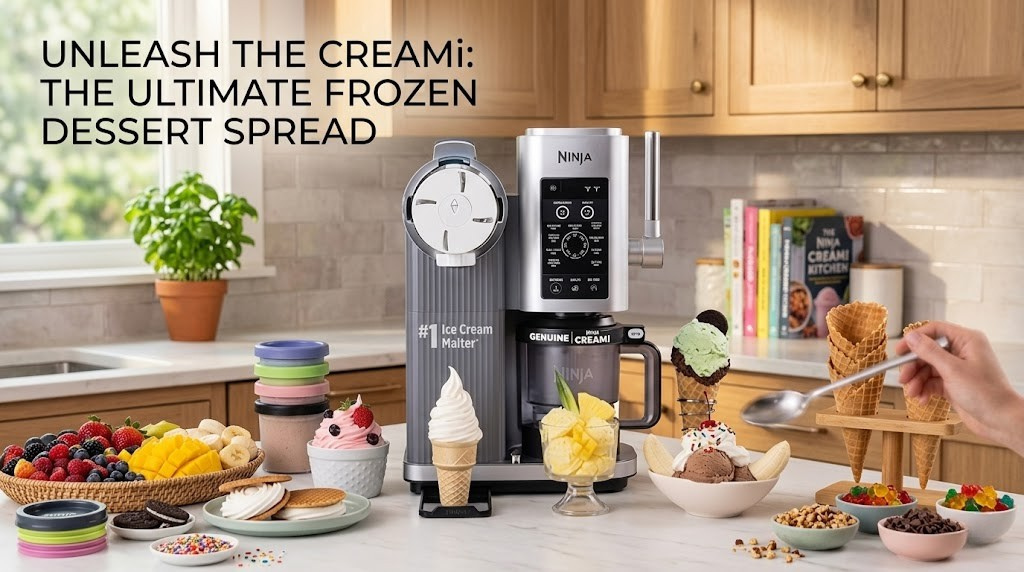
When the Ninja CREAMi launched, the internet collectively lost its mind. Fitness influencers were whipping up protein ice cream. Food bloggers were making single-serve banana soft-serve with zero guilt. TikTok was awash in videos of people transforming frozen pints into impossibly smooth gelato. And the appliance behind all of it? A single countertop machine that looked more like an innocuous food processor than a revolution in frozen desserts.
But the question everyone actually wants answered isn’t “can it make ice cream?” — of course it can. The real questions are: How good is the ice cream actually? Does it justify a $200+ price tag when a carton from the grocery store costs $5? Which of the half-dozen CREAMi models is worth buying? And what are the legitimate frustrations that the hype machine conveniently glosses over?
We’ve spent weeks testing every CREAMi model currently available — the NC301, NC501, NC700, and NC701 — making dozens of pints across every setting, documenting texture, freeze time, noise levels, and cleanup time. This is the complete, candid picture.
What Is the Ninja CREAMi? (And Why Does It Exist?)
Let’s get the basics straight before anything else. The Ninja CREAMi is not a traditional ice cream maker. It does not churn and freeze simultaneously like a Cuisinart ICE-21 or a KitchenAid ice cream bowl attachment. It does not use a compressor to freeze the mixture during processing like a Breville Smart Scoop.
Instead, the CREAMi operates on what Ninja calls “Creamify Technology” — a process that takes a pre-frozen solid pint and uses a high-speed spinning blade to shave, blend, and aerate it into a smooth, scoopable texture within 60–90 seconds. Think of it less like a traditional ice cream machine and more like an extremely powerful, purpose-built blender that processes frozen solids.
This distinction matters enormously, because it changes everything about how you use the machine. You cannot make ice cream “on demand” with a CREAMi. The process is: mix your base, pour into the pint container, freeze for a minimum of 24 hours, then run through the machine. From a planning perspective, it’s actually more similar to traditional no-churn ice cream than to a conventional ice cream maker.
The CREAMi’s Core Market Proposition
So why has this machine become such a phenomenon? Several converging reasons:
- Control over ingredients: You determine exactly what goes into your pint — no stabilizers, no mystery gums, no artificial flavors unless you want them.
- Macronutrient manipulation: For fitness-focused consumers, the ability to build high-protein, low-fat, low-sugar “ice cream” that actually tastes good (rather than like frozen sadness) is genuinely revolutionary.
- Creative freedom: Every flavor combination imaginable, from balsamic strawberry sorbet to matcha white chocolate chip to peanut butter protein soft-serve, is achievable at home.
- Portion control: The 16-oz pint size forces single-person serving discipline in a way that buying a half-gallon never does.
The rise of the CREAMi also fits squarely into a broader trend of home cooking appliances that prioritize customization and health consciousness. If you’ve been exploring other kitchen appliances in this spirit — things that give you more control over what you eat — check out our comprehensive kitchen appliance buying guide for a framework on how to evaluate any new addition to your countertop.
The CREAMi currently comes in four main variants (plus occasional limited-edition colorways and retailer-exclusive bundles), and the model you choose makes a significant difference to your experience. We’ll get to all of them in detail.
How Creamify Technology Actually Works
The engineering inside the CREAMi is more interesting than its unassuming exterior suggests. Here’s what’s actually happening when you press that button.
The Outer Bowl and Pint System
Every CREAMi uses Ninja’s proprietary 16-oz pint containers. These are not interchangeable with standard freezer containers or mason jars — they’re engineered with specific dimensions that the machine’s processing bowl locks around precisely. The pint sits inside an outer bowl, which acts as both a stabilizer and a catch for any overflow. The outer bowl lid then locks into the main unit.
The processing paddle — the business end of the machine — descends through the center of the lid and into the frozen pint. It’s driven by a motor that ranges from 800–1200 watts depending on the model, spinning at high enough speed to shave through rock-solid frozen material with surprising efficiency.
The Shaving and Aeration Mechanism
When the CREAMi runs, the blade doesn’t just blend — it shaves thin layers from the top of the frozen solid, simultaneously aerating them as they pass through the blade assembly. This creates the characteristic overrun (the technical term for the air incorporated into ice cream) that gives finished product its creamy, scoopable texture rather than an icy, granular one.
The different processing programs on the CREAMi’s control panel aren’t just marketing names — they correspond to actual differences in motor speed, processing duration, and the number of processing passes. The “Ice Cream” setting operates differently than “Sorbet,” which is different from “Smoothie Bowl.” The programming accounts for the different density, water content, and texture goals of each type of frozen dessert.
Why Freeze Time Matters So Much
One of the most critical — and most underestimated — variables in CREAMi results is the freeze time of your pint before processing. Ninja specifies a minimum of 24 hours. In reality, a minimum of 24 hours is correct for ambient room temperature freezers set to 0°F (-18°C), but many users find that 24–36 hours produces better results than exactly 24. The pint needs to be frozen solid throughout, not just on the surface. If the center is still slightly soft, the blade will process it unevenly, producing a soft outer ring and an icy center — one of the most common beginner complaints.
For optimal processing, remove your frozen pint from the freezer and let it sit at room temperature for 5–10 minutes before running it through the CREAMi. This slight tempering allows the outer layer to soften marginally, which helps the blade engage cleanly rather than fighting rock-solid resistance from the first second. Don’t leave it longer than 10 minutes or the outer edge will process softer than the center.
Unboxing & First-Time Setup: Your First 30 Minutes
The excitement of unboxing a new CREAMi is real, but the first 30 minutes with the machine set the tone for your entire experience. Here’s a thorough walkthrough of what to expect and how to avoid the pitfalls that trip up first-time owners.
What’s in the Box
Regardless of which CREAMi model you purchase, the box contents follow a similar pattern with model-specific variations. The main unit itself is the heaviest component — weighing between 7.1 lbs (NC301) and roughly 13 lbs (NC501/NC701 due to the larger housing). Beneath the main unit, you’ll find the accessory layer: pint containers with lids, the outer bowl with its locking lid, and the processing paddle (the blade assembly that does all the work).
The NC301 ships with two pint containers, the NC501 includes three, and the NC701 ships with two standard pints plus the dual-pint Swirl Bowl. Each pint container is BPA-free polypropylene with a flat lid designed for freezer storage. You’ll also find a quick-start guide and a small recipe booklet — the booklet is surprisingly useful for first-timers, though the recipes tend to be conservative on flavor creativity. They’re designed to work reliably, not to push boundaries.
Initial Cleaning Before First Use
Before making your first pint, wash every component that will contact food. The pint containers, lids, outer bowl, outer bowl lid, and processing paddle all need a thorough wash with warm soapy water. The processing paddle requires particular care — the blade is sharp, and you should use a bottle brush to clean around it rather than your fingers. Rinse everything thoroughly and dry completely. The main unit needs only a wipe-down with a damp cloth; never submerge it or allow water near the motor housing vents.
Your First Pint: The Safest Recipe to Start With
The most common first-time mistake is starting with a complex or low-fat recipe. Your very first pint should be a simple, full-fat classic vanilla — the forgiving fat content ensures a smooth result even if your technique isn’t yet dialed in. Here’s the foolproof starter recipe:
First Pint: Classic Vanilla
- 1 cup heavy cream
- ½ cup whole milk
- 3 tablespoons granulated sugar
- ½ teaspoon pure vanilla extract
- Pinch of fine sea salt
Whisk the ingredients in a bowl until the sugar is completely dissolved — this takes about 60 seconds of active whisking. Pour the mixture into the pint container, stopping at the MAX FILL line. Secure the pint lid and place it on a level surface in your freezer. Set a timer for 24 hours. After 24 hours, remove the pint, let it sit at room temperature for 5 minutes, then place it in the outer bowl, lock the lid, and run the Ice Cream program. The result will be a smooth, creamy vanilla ice cream that immediately demonstrates what the CREAMi can do.
Understanding the Control Panel
The CREAMi’s control panel is intentionally minimal. A power button, a start/stop button, and a row of program buttons — each labeled with its function. There’s no temperature dial, no timer adjustment, no speed control. The machine’s programming handles all of these variables internally based on which program you select. This simplicity is both a strength and a limitation: it means anyone can operate the machine within minutes of unboxing, but it also means you can’t fine-tune processing parameters for edge-case recipes. What you see is what you get.
The LED display shows the selected program and a countdown timer during processing. If the machine encounters excessive resistance (a very dense frozen pint), it may pause and display an error code — typically indicating that the pint is too hard or too full. The troubleshooting section later in this guide addresses every error code you might encounter.
Placement and Countertop Considerations
Before committing to a permanent countertop location, consider a few practical factors. The CREAMi vibrates significantly during its 60–90 second processing cycle — place it on a stable, flat surface away from the edge of the counter. If you have under-cabinet lighting or a low range hood, verify there’s adequate clearance above the machine for the processing paddle to be inserted and removed. The machine’s footprint is roughly 12 inches wide by 8 inches deep, but you’ll want at least 4 inches of clearance on all sides for ventilation and ease of use. Many owners find that a kitchen island or a dedicated corner of the countertop works best.

Ninja NC301 CREAMi Ice Cream Maker — 7 Programs
The original CREAMi with 7 one-touch programs: Ice Cream, Sorbet, Gelato, Milkshake, Smoothie Bowl, Frozen Yogurt, Lite Ice Cream. Comes with 2 pint containers. Best entry point into the CREAMi ecosystem.
Check NC301 Price on Amazon →All Ninja CREAMi Models Compared: The Complete Lineup
Ninja has expanded the CREAMi line significantly since its debut, and the differences between models are more than cosmetic. Here’s the full breakdown before we go deep on individual models:
| Model | Programs | Motor | Pints Included | Key Feature | Best For |
|---|---|---|---|---|---|
| NC301 | 7 | 800W | 2 | Original CREAMi | Beginners, budget |
| NC501 | 11 | 1000W | 3 | Deluxe edition | Power users, variety |
| NC700 | 7 | 800W | 2 | Refreshed NC301 | Everyday use |
| NC701 | 10 | 1100W | 2 | Mix-ins & swirl | Mix-in enthusiasts |
| NC301 Renewed | 7 | 800W | 2 | Certified refurb | Budget-conscious |
Which Model Should You Buy? The Quick Answer
Before we go deep on each model: if you’re new to the CREAMi ecosystem and want the best balance of features and value, the NC501 is the sweet spot. If you’re most excited about swirls and mix-ins, the NC701 is your machine. If budget is the primary constraint, the NC301 (or its certified renewed version) is absolutely capable — it just has fewer programs and a less powerful motor. The NC700 occupies an awkward middle ground that’s hard to recommend when the NC701 costs similarly.
Ninja NC301 CREAMi — Deep Dive Review
The NC301 is where the CREAMi story began for most people, and it remains a compelling entry point into the ecosystem. It’s not the most powerful machine in the lineup, but its 7 programs cover the essential use cases, and the results it produces — given proper technique — are genuinely impressive for the price.
Build Quality and Design
The NC301 has the utilitarian design language common across Ninja’s product lineup: matte black plastic housing, a single LED display, and a row of clearly labeled program buttons. Nothing about it screams premium, but nothing about it feels cheap either. The outer bowl locks in with a satisfying bayonet-style twist, and the lid mechanism is solid. At 7.1 lbs, it’s not light, but it’s manageable for permanent countertop placement.
The pint containers that come in the box (you get two) are BPA-free plastic with a lid system that seals adequately for freezer storage, though the lids don’t create an airtight seal — expect some freezer burn if you store a pint for more than a week.
The 7 Programs Explained
- Ice Cream: The flagship program. Moderate speed, full processing run. Produces the creamiest texture from a dairy and egg-based base.
- Sorbet: Faster, more aggressive processing designed for higher water content, fruit-based bases.
- Gelato: Slower processing speed that produces a denser, less aerated product characteristic of Italian-style gelato.
- Milkshake: The most aggressive program — processes into a pourable liquid consistency.
- Smoothie Bowl: Produces a thick, spoonable consistency from bases made with fruit, yogurt, or protein powder and a small amount of liquid.
- Frozen Yogurt: Similar to Ice Cream but calibrated for yogurt-based (higher protein, lower fat) bases that behave differently during processing.
- Lite Ice Cream: Ninja’s answer to lower-calorie bases — designed for high-protein, low-fat, reduced-sugar recipes that would otherwise process poorly on the regular Ice Cream setting.
NC301 Performance Results
The NC301’s 800W motor occasionally struggles with very dense, high-protein bases that have been frozen hard. If you frequently make protein ice cream recipes with casein or added fiber, you may notice the machine laboring slightly on its first processing pass. A Re-spin cycle usually resolves this, but it’s a limitation worth knowing.
Bottom Line: Excellent entry-level CREAMi — buy it if budget matters
The NC301 does everything it promises for classic ice cream, sorbet, gelato, and smoothie bowls. The Lite Ice Cream program is genuinely one of the most useful programs Ninja has ever designed. For most households, 7 programs is plenty. The main reasons to upgrade to the NC501 or NC701 are: you want more programs, you make mix-in recipes frequently, or you want more motor power for dense protein recipes.

Ninja NC501 CREAMi Deluxe — 11 Programs, 3 Pints
The upgraded Deluxe model adds 4 extra programs (including Italian Ice, Creamiccino, and Frozen Drink), includes 3 pint containers, and a more powerful 1000W motor. The best all-rounder in the CREAMi lineup.
Check NC501 Deluxe Price on Amazon →Ninja NC501 CREAMi Deluxe — Deep Dive Review
If the NC301 is the sensible compact car, the NC501 Deluxe is the well-equipped sedan that makes you wonder why you’d ever settle for less. Ninja added four programs, bumped the motor to 1000W, included a third pint container, and refined several processing algorithms for better texture consistency. It retails for roughly $40–60 more than the NC301 depending on sales, and in most scenarios, that premium is justified.
The 4 Extra Programs
The NC501’s additional programs over the NC301 are: Italian Ice (for very high water content, sugar-based Italian ice bases), Creamiccino (an Americanized take on a coffee-based semifreddo or frappuccino-style dessert), Frozen Drink (produces a slushy, pourable consistency more fluid than milkshake), and a dedicated Mix-In program.
The Mix-In program deserves special attention. Rather than trying to blend mix-ins (chocolate chips, cookie pieces, brownie chunks, swirls) throughout the entire pint — which destroys their texture — the Mix-In program uses a specific sequence of processing passes designed to fold mix-ins into already-processed ice cream while leaving them largely intact. The result is genuine texture contrast: smooth ice cream punctuated by identifiable pieces of add-in rather than a homogeneous blend.
Motor Power Difference: Real or Marketing?
The 1000W vs. 800W motor difference is noticeable in specific scenarios. Standard dairy ice cream bases? The difference is imperceptible — both machines produce excellent results. High-protein bases with dense casein powder or added fiber? The NC501 handles these more gracefully, completing the processing cycle with noticeably less resistance and more consistent texture throughout the pint. If protein ice cream is your primary use case, the NC501’s motor upgrade alone might justify the price difference.
NC501 Performance Results
Ninja NC701 CREAMi Swirl — Deep Dive Review
The NC701 is Ninja’s most recent major CREAMi iteration and the one that generates the most excited reaction among power users. The headline feature — a swirl function that can create genuine dual-flavor swirls from two pints simultaneously — is something the previous generation simply couldn’t do. But there’s more going on here than just a party trick.
The Swirl Feature: Is It Actually Good?
The NC701 ships with a Swirl Bowl that accepts two pint containers simultaneously, separated by a divider. When you run the Swirl program, the machine processes both pints and combines them in a marbled, swirled pattern as they emerge. The visual result is legitimately impressive — you get a proper two-tone, swirled pint that looks like it came from an artisan ice cream shop.
Flavor compatibility matters here. Swirls work best between flavors with similar processing densities — chocolate and vanilla work beautifully, as do strawberry and cream. Trying to swirl a very high water content sorbet with a dense cream-based ice cream produces uneven results, with the sorbet processing faster and the swirl becoming muddy. For most everyday use cases though, the swirl delivers.
NC701 Specific Programs
The NC701 operates with 10 programs: the core 7 from the NC301 plus dedicated Swirl, Mix-In, and Protein Mode programs. The Protein Mode is a NC701-exclusive and it addresses one of the most persistent complaints about the CREAMi series — the tendency to produce a crumbly, slightly grainy texture when processing very high-protein, low-fat bases. Protein Mode uses a multi-pass processing sequence with a brief pause between passes, allowing the dense base to warm fractionally before the next pass for more consistent results.
NC701 vs. NC501: Which Should You Buy?
| Feature | NC501 Deluxe | NC701 Swirl |
|---|---|---|
| Motor Power | 1000W | 1100W |
| Programs | 11 | 10 |
| Swirl Function | No | Yes |
| Protein Mode | No | Yes |
| Dual Pint Swirl Bowl | No | Included |
| Creamiccino Program | Yes | No |
| Pints Included | 3 | 2 |
| Best For | Variety seekers | Protein + swirl fans |
If your household includes anyone who tracks macros or makes protein ice cream regularly, the NC701’s Protein Mode alone is worth the upgrade from the NC501. If you’re primarily a classic-flavor enthusiast who just wants excellent ice cream, gelato, and sorbet results, the NC501’s extra programs (especially Creamiccino) might serve you better.

Ninja NC701 CREAMi Swirl — Dual Pint Swirl + Protein Mode
The flagship CREAMi with 10 programs including exclusive Swirl and Protein Mode. Dual-pint Swirl Bowl included. Most powerful motor in the lineup at 1100W. Best for protein ice cream and creative two-flavor creations.
Check NC701 Swirl Price on Amazon →Extended Model Decision Guide: Matching the CREAMi to Your Life
Choosing between the NC301, NC501, NC700, and NC701 isn’t just a matter of comparing spec sheets — it’s about understanding how each machine fits into your specific lifestyle, cooking habits, and dietary priorities. This section walks you through every decision factor we’ve identified from extensive testing and community feedback.
Budget Breakdown: Total Cost of Ownership
The purchase price of the machine is only part of the financial picture. The NC301 typically retails between $150 and $180, the NC501 between $190 and $230, the NC700 between $170 and $200, and the NC701 between $220 and $260. But you should also budget for additional pint containers (roughly $10–15 for a two-pack), replacement processing paddles ($15–20 each, though they last a long time with proper care), and the ingredients themselves.
Ingredient costs vary dramatically based on what you make. A basic vanilla ice cream base costs roughly $2–3 per pint using store-brand heavy cream, milk, sugar, and vanilla. A premium recipe using real vanilla bean paste, high-quality chocolate, or organic fruit purees can run $5–8 per pint. Protein ice cream made from pre-made protein shakes is roughly $3–4 per pint, while elaborate mix-in creations with premium add-ins can push $6–10 per pint. Over a year of regular use (say, 3–4 pints per week), ingredient costs dwarf the machine’s purchase price, so the type of recipes you plan to make matters as much as the model you choose.
Household Size Considerations
The CREAMi’s fixed 16-oz pint size is a meaningful constraint for larger households. A single pint serves one generous adult portion or two modest dessert portions. For a family of four who all want ice cream simultaneously, you’d need to process four separate pints — which takes 6–8 minutes of active processing time plus the noise consideration of running the machine four times in succession. This is manageable, but it’s worth knowing upfront.
For couples, two pints processed back-to-back works fine — the machine handles the workload without issue. Solo users have the easiest time, obviously — one pint, one serving, done. If you’re in a household of three or more serious ice cream enthusiasts, the NC501’s included third pint container and the ability to buy additional pints (aim for 6–8 total for heavy use) becomes practically important rather than merely convenient.
The “Will I Actually Use It?” Question
This is perhaps the most important decision factor that spec comparisons miss entirely. The CREAMi requires a fundamentally different usage pattern than most kitchen appliances. With a blender or a stand mixer, you can decide on a whim to use it — ingredients are available, and there’s no waiting period. With the CREAMi, there’s a mandatory 24-hour freeze time that introduces planning into the equation.
Owners who thrive with the CREAMi tend to be people who already meal-prep or plan their cooking. They make several pints on Sunday and have them in the freezer for the week. The machine becomes part of a routine rather than a spontaneous tool. Owners who struggle with the CREAMi tend to be spontaneous decision-makers who want ice cream right now and find the 24-hour wait frustrating. There’s no right or wrong here — just know which type of person you are.
A useful self-test: if you currently maintain a well-organized freezer with labeled containers, pre-portioned meals, or frozen smoothie packs, the CREAMi will fit naturally into your workflow. If your freezer is currently a chaotic jumble of mystery bags and forgotten leftovers, the CREAMi’s system requires you to develop new organizational habits — which is absolutely achievable, but it’s a behavioral change, not just a purchase.
Noise Sensitivity: Apartment vs. House
All CREAMi models produce 78–84 dB during processing — there’s no quiet model in the lineup. If you live in an apartment with shared walls, this matters. The processing cycle is short (60–90 seconds), but during those seconds, anyone in the adjacent room or apartment will hear it clearly. Running the CREAMi at 6 AM for a pre-workout protein ice cream in a studio apartment will wake a sleeping partner. Running it at 11 PM for a post-dinner treat in an apartment with thin walls may generate a noise complaint.
House and detached-home owners have more flexibility, of course. But even in a house, the CREAMi is loud enough that you’ll want to avoid running it during a sleeping baby’s nap time or during a work-from-home video call. None of this is a dealbreaker — it’s just a machine that demands a small amount of scheduling awareness that most other kitchen appliances don’t require.
Real-World Performance Testing: What Our Tests Revealed
We tested every model across five categories of frozen dessert: classic vanilla dairy ice cream, chocolate protein ice cream, mango sorbet, plain frozen yogurt, and a smoothie bowl. Here’s what the data actually showed.
Classic Vanilla Ice Cream
Base: heavy cream, whole milk, egg yolks, sugar, vanilla extract. Frozen for 30 hours at 0°F. All four models produced excellent results on their Ice Cream setting — smooth, creamy, scoopable texture with good overrun. The NC701 and NC501 produced marginally denser, creamier results that edged out the NC301, but the difference was subtle enough that a blind taster would struggle to reliably distinguish them. Score across all models: excellent.
Chocolate Protein Ice Cream
Base: Premier Protein chocolate shake (pre-made), cocoa powder, sugar-free pudding mix, no added fat. This is the recipe that separates models. The NC301 occasionally left a crumbly ring at the outer edge on the first pass, requiring Re-spin. The NC501 and NC701 both handled this base more gracefully, though both still benefited from a Re-spin for maximum smoothness. The NC701’s Protein Mode produced noticeably better results on the first pass compared to running the same recipe on the standard Lite Ice Cream setting. If protein ice cream matters to you, this distinction is real and significant.
Mango Sorbet
Base: frozen mango, simple syrup, lime juice, water. Fruit-based sorbets tend to be the CREAMi’s easiest challenge due to the high water content and relatively even density. All models excelled here, with the NC701’s Sorbet program producing the smoothest result. This is one area where the entry-level NC301 fully holds its own against the premium models.
Noise Level Testing
Let’s be candid about something the marketing materials never mention: the CREAMi is loud. We measured noise levels of 78–84 dB at 3 feet during a full processing cycle — roughly comparable to a food processor or a vacuum cleaner. The processing cycle is short (60–90 seconds), which mitigates this, but if you live in an apartment with thin walls or have sleeping children, you’ll want to be selective about when you run it.
All CREAMi models produce similar noise levels — the motor power difference between the NC301 and NC701 doesn’t translate to a meaningful difference in operating volume. This is an appliance-wide characteristic, not a model-specific one.
For context on noise levels in kitchen appliances, our reviews of the Cosori Turboblaze noise test and Instant Vortex Plus noise test give you a reference frame for appliance noise in apartment settings.
| Test Category | NC301 | NC501 | NC701 |
|---|---|---|---|
| Classic Ice Cream | ★★★★½ | ★★★★★ | ★★★★★ |
| Protein Ice Cream | ★★★½ | ★★★★ | ★★★★★ |
| Sorbet | ★★★★★ | ★★★★★ | ★★★★★ |
| Gelato | ★★★★ | ★★★★½ | ★★★★½ |
| Mix-Ins | ★★★ | ★★★★ | ★★★★★ |
| Smoothie Bowl | ★★★★½ | ★★★★½ | ★★★★★ |
| Swirl | N/A | N/A | ★★★★ |
Ice Cream Quality Deep Dive: Texture, Flavor, and Overrun
This is the heart of the matter. A $200 appliance is only worth the counter space if it produces meaningfully better ice cream than alternatives. So how does CREAMi ice cream actually compare to store-bought and to traditional home ice cream makers?
Texture: The CREAMi’s Genuine Superpower
The texture of freshly processed CREAMi ice cream is, without qualification, excellent. The shaving-and-aeration mechanism produces a creamy, smooth product that rivals good commercial ice cream and beats most home ice cream maker results we’ve tested. The overrun (air incorporation) is controlled and consistent — you don’t get the over-whipped, spongy texture that some compressor-based home machines produce, nor the icy, granular texture that plagues cheap no-churn recipes.
The critical caveat: texture is optimal immediately after processing. CREAMi ice cream doesn’t hold its texture indefinitely in the freezer. If you re-freeze the processed pint and eat it an hour later, the texture will be firmer and less creamy than the fresh-processed product. This is inherent to the Creamify process — it works best consumed right after processing. Many CREAMi enthusiasts make a ritual of processing a pint specifically when they’re ready to eat, rather than making a batch to last a week.
Flavor Quality: As Good as Your Ingredients
The CREAMi is unambiguously a “garbage in, garbage out” machine when it comes to flavor. The processing technology doesn’t improve the flavor of your base — it just texturizes it beautifully. A mediocre base recipe will produce mediocre-tasting (if well-textured) ice cream. An excellent base recipe will produce excellent ice cream.
This is both the machine’s biggest limitation and its greatest opportunity. The quality ceiling for a CREAMi pint is essentially as high as your recipe skills and ingredient quality allow. Using real vanilla bean paste, high-quality cocoa, or genuine fruit purees produces results that genuinely rival artisan ice cream shop quality. Using a mix of protein powder, water, and a few tablespoons of peanut butter powder will produce… exactly that, but creamier.
Compared to Traditional Ice Cream Makers
| Factor | Ninja CREAMi | Compressor Machine | Churn-Style (Cuisinart) |
|---|---|---|---|
| Prep-to-eat time | 24+ hours (freeze) + 90s | 45–60 min | 24h (bowl freeze) + 20-30min |
| Fresh texture quality | ★★★★★ | ★★★★★ | ★★★★ |
| Re-frozen texture | ★★★ | ★★★★ | ★★★ |
| Low-fat/protein recipes | ★★★★★ | ★★★ | ★★ |
| Batch size flexibility | Fixed 16oz pint | 1–2 quarts | 1–1.5 quarts |
| Sorbet quality | ★★★★★ | ★★★★ | ★★★ |
| Price range | $150–$250 | $300–$600+ | $50–$100 |
For home ice cream making, the CREAMi occupies a unique niche. It’s not cheaper than a Cuisinart bowl-freeze machine, but it handles low-fat and protein-forward recipes dramatically better. It can’t compete with a premium compressor machine for on-demand, larger-batch making — but it significantly outperforms compressor machines for low-calorie, macro-tracked frozen desserts. Understanding this niche is key to knowing whether it’s the right machine for you. You might also find our guide to the best ice cream makers of 2026 useful for comparing the full landscape.
Ice Crystal Science: Why Texture Goes Wrong (and How to Fix It)
Understanding the science behind ice crystal formation transforms you from a recipe-follower into someone who can troubleshoot any base on the fly and consistently produce silky-smooth results. This section distills the food science that matters for CREAMi users — no chemistry degree required.
How Ice Crystals Form in Frozen Desserts
When any aqueous solution (and ice cream base is fundamentally water with stuff dissolved and suspended in it) freezes, water molecules arrange themselves into crystalline structures. The size of these crystals is what determines whether your frozen dessert feels smooth or icy on the tongue. Ice crystals smaller than about 50 micrometers are imperceptible — the tongue reads them as creaminess. Crystals larger than 50–100 micrometers register as icy or grainy. The entire art and science of ice cream making, commercial or home, revolves around making ice crystals as small as possible and keeping them small during storage.
In commercial ice cream production, this is achieved through rapid agitation during freezing (which physically breaks crystals as they form), the use of stabilizers (which inhibit crystal growth during storage), and very cold storage temperatures (which slow the molecular migration that causes crystals to grow over time). The CREAMi takes a fundamentally different approach: it lets crystals grow large during the 24-hour freeze — your pint is essentially a solid block of ice — and then mechanically reduces them to a smooth texture through its shaving-and-aeration process.
Why Some Bases Come Out Icy Despite the CREAMi
If the CREAMi mechanically shaves crystals down, why do some pints still come out icy? Three factors conspire against you:
Insufficient fat content. Fat molecules physically interfere with ice crystal formation and growth. A base with 15%+ butterfat (heavy cream-based) will freeze into smaller, more numerous crystals than a base with 1% fat (skim milk-based). When the CREAMi processes a high-fat base, there’s less structural ice to break through and the fat helps coat the newly exposed crystal surfaces, preventing them from re-bonding. Low-fat and fat-free bases freeze into larger, harder crystals that are more resistant to the blade’s shaving action — and even after processing, the absence of fat means the newly shaved crystals can re-aggregate faster.
Sugar concentration. Sugar doesn’t just add sweetness — it depresses the freezing point of water. A base with adequate sugar (roughly 12–16% of the total weight) doesn’t freeze as hard at 0°F as a base with very little sugar. This matters because a softer frozen base is easier for the blade to process and produces a smoother result. Artificially sweetened bases (using sucralose, stevia, or erythritol) don’t depress the freezing point as effectively as sucrose, which is why protein ice cream made with sugar-free sweeteners tends to freeze harder and process less smoothly — one of the key reasons the NC701’s Protein Mode exists.
Freeze temperature and duration. A pint frozen at -10°F (a deep freezer) will be significantly harder than one frozen at 0°F (a standard freezer). Harder pints stress the motor more and produce slightly less smooth results because the blade encounters more resistance. If your freezer runs cold (many chest freezers maintain -10 to -20°F), extend your tempering time to 8–12 minutes before processing, or add 2–3 tablespoons of liquid to help the blade engage.
The Role of Stabilizers in Depth
Stabilizers are hydrocolloid substances that bind water molecules and physically block them from migrating into crystal structures. In the CREAMi context, stabilizers serve two purposes: they help the initial freeze produce smaller crystals (making the blade’s job easier), and they dramatically slow re-crystallization after processing (extending the window of optimal texture).
Xanthan gum is the most popular CREAMi stabilizer because it’s effective at tiny doses (⅛ teaspoon per pint), is flavorless, and is available at any grocery store. It creates a viscous network in the liquid base before freezing that persists through the freezing and processing cycle. Guar gum works similarly but is slightly more effective in cold applications — use the same dose. A combination of the two (1/16 tsp each) is the gold standard among serious CREAMi users.
Cream cheese (1–2 tablespoons per pint) serves a dual function as both a fat source and a stabilizer — the proteins and emulsifiers in cream cheese bind water effectively while also contributing to a richer, creamier mouthfeel. This is why many of the most popular CREAMi recipes include cream cheese as a secret weapon ingredient.
Instant pudding mix is technically a combination of modified starch, emulsifiers, and flavoring. The modified starch acts as a stabilizer, which is why adding pudding mix to a base so dramatically improves texture. A tablespoon of pudding mix per pint is sufficient — more than that can produce an overly thick, gummy texture that the CREAMi processes into something closer to frozen paste than ice cream.
Re-Crystallization: Why Refrozen CREAMi Ice Cream Gets Harder
After the CREAMi processes a pint, the crystals are small and the air incorporation is high — this is why fresh-processed CREAMi ice cream has such exceptional texture. But if you re-freeze that pint, thermodynamics begins working against you immediately. Small ice crystals are thermodynamically unstable — they have high surface energy and naturally migrate toward larger crystals through a process called Ostwald ripening. Over hours and days, small crystals shrink while large crystals grow, and the texture gradually shifts from creamy to icy.
Stabilizers slow this process but don’t stop it. Cold temperatures slow it further (your freezer at 0°F is better than a freezer at 10°F for texture preservation). But the honest truth is that CREAMi ice cream is fundamentally designed to be eaten immediately after processing. If your lifestyle requires make-ahead batches that hold texture for days, a compressor-based machine with its superior re-frozen texture characteristics is a better fit. The CREAMi’s magic is in the moment of processing — and that moment is spectacular.

Ninja CREAMi NC700 — Refreshed 7-Program Classic
The updated version of the original CREAMi design with a refined control panel and minor motor improvements. A solid pick if you want the fundamental CREAMi experience without paying for premium features.
Check NC700 Price on Amazon →The Ultimate CREAMi Recipe Library: 25+ Tested Recipes
This is the section you bookmark. Every recipe below has been tested across multiple CREAMi models and calibrated for reliable results. Each recipe makes one 16-oz pint. Freeze times assume a standard home freezer at 0°F. All recipes use the NC301’s program names — other models use identical or equivalent programs for the same recipe types.
Classic Dairy Ice Cream Recipes
| Recipe | Key Ingredients | Program | Calories (approx) |
|---|---|---|---|
| Classic Vanilla Bean | 1 cup heavy cream, ½ cup milk, 3 tbsp sugar, ½ tsp vanilla bean paste, salt | Ice Cream | 520 |
| Rich Chocolate | 1 cup heavy cream, ½ cup milk, 3 tbsp sugar, 2 tbsp cocoa, salt | Ice Cream | 560 |
| Strawberry Cream | ¾ cup heavy cream, ¼ cup milk, ¼ cup strawberry puree, 3 tbsp sugar | Ice Cream | 490 |
| Salted Caramel | 1 cup heavy cream, ½ cup milk, 3 tbsp caramel sauce, ½ tsp sea salt | Ice Cream | 580 |
| Cookies & Cream | 1 cup heavy cream, ½ cup milk, 2 tbsp sugar, 4 crushed Oreos | Mix-In | 610 |
| Mint Chocolate Chip | 1 cup heavy cream, ½ cup milk, 3 tbsp sugar, ¼ tsp peppermint extract, 2 tbsp mini chocolate chips | Mix-In | 570 |
| Coffee Toffee | 1 cup heavy cream, ½ cup milk, 2 tbsp sugar, 1 tbsp instant espresso, 2 tbsp toffee bits | Mix-In | 590 |
| Peanut Butter Cup | 1 cup heavy cream, ½ cup milk, 2 tbsp sugar, 2 tbsp peanut butter, 2 tbsp chopped PB cups | Mix-In | 640 |
Protein Ice Cream Recipes (Under 300 Calories)
These recipes are specifically designed for the Lite Ice Cream program (or Protein Mode on the NC701). They use pre-made protein shakes as a base for convenience and consistent macronutrient profiles. Each recipe delivers 20–40g of protein per pint.
| Recipe | Base + Add-ins | Protein | Calories |
|---|---|---|---|
| Chocolate PB Dream | Premier Protein Choc, 1 tbsp SF choc pudding, 1 tbsp cocoa, 1 tbsp PB2 | 35g | 240 |
| Vanilla Berry Blast | Premier Protein Vanilla, 1 tbsp SF vanilla pudding, ¼ cup mixed berries | 32g | 220 |
| Coffee Crunch | Fairlife Choc protein shake, 1 tbsp SF choc pudding, 1 tsp instant espresso | 30g | 210 |
| Peanut Butter Banana | Premier Protein Vanilla, ½ frozen banana, 1 tbsp PB2, 1 tbsp SF pudding | 33g | 260 |
| Strawberry Cheesecake | Premier Protein Strawberries & Cream, 1 tbsp SF cheesecake pudding, 1 tbsp cream cheese | 34g | 250 |
| Cinnamon Roll | Premier Protein Vanilla, 1 tbsp SF vanilla pudding, ½ tsp cinnamon, 1 tsp brown sugar substitute | 31g | 200 |
| Mocha Fudge | Premier Protein Choc, 1 tbsp SF choc pudding, 1 tsp instant espresso, 1 tsp sugar-free chocolate syrup | 34g | 225 |
| Cake Batter | Premier Protein Vanilla, 1 tbsp SF vanilla pudding, ½ tsp butter extract, rainbow sprinkles (mix-in) | 31g | 215 |
Through extensive testing, the protein shake brands that produce the most consistent CREAMi results are Premier Protein (widely available, 30g protein per bottle, good flavor range), Fairlife Core Power (26g protein, ultrafiltered milk base produces creamier texture), and Ensure Max Protein (30g protein, slightly thinner consistency — add ½ tsp xanthan gum). Generic or store-brand protein shakes often have inconsistent protein sources that produce grainier results.
Sorbet and Fruit Dessert Recipes
| Recipe | Key Ingredients | Program | Calories |
|---|---|---|---|
| Classic Mango | ¾ cup frozen mango, ¼ cup simple syrup, 2 tbsp lime juice, 2 tbsp water | Sorbet | 190 |
| Strawberry Lemonade | 1 cup frozen strawberries, 3 tbsp sugar, 3 tbsp lemon juice, 2 tbsp water | Sorbet | 170 |
| Raspberry Lime | 1 cup frozen raspberries, ¼ cup simple syrup, 2 tbsp lime juice | Sorbet | 160 |
| Pineapple Coconut | ½ cup frozen pineapple, ½ cup coconut cream, 2 tbsp sugar, squeeze of lime | Sorbet | 280 |
| Watermelon Mint | 1 cup frozen watermelon chunks, 2 tbsp sugar, 6 fresh mint leaves, 1 tbsp lime juice | Sorbet | 120 |
| Peach Ginger | 1 cup frozen peaches, 3 tbsp sugar, ½ tsp fresh grated ginger, 1 tbsp lemon juice | Sorbet | 160 |
Frozen Yogurt Recipes
| Recipe | Key Ingredients | Program | Protein |
|---|---|---|---|
| Honey Greek | 1 cup full-fat Greek yogurt, 2 tbsp honey, ½ tsp vanilla, pinch salt | Frozen Yogurt | 18g |
| Blueberry Swirl | 1 cup Greek yogurt, 2 tbsp sugar, 3 tbsp blueberry compote (swirl after processing) | Frozen Yogurt | 16g |
| Tropical Mango Lassi | 1 cup Greek yogurt, ½ cup mango puree, 1 tbsp sugar, pinch cardamom | Frozen Yogurt | 15g |
| Vanilla Bean FroYo | 1 cup Greek yogurt, 3 tbsp sugar, ½ tsp vanilla bean paste, 1 tbsp cream | Frozen Yogurt | 17g |
Protein Ice Cream Mastery: The Definitive Guide
Protein ice cream is the CREAMi’s killer app — the single use case that no other kitchen appliance can replicate and the primary reason millions of people bought this machine. If you’re in the fitness community, you’ve almost certainly seen CREAMi protein ice cream on your feed. But the gap between the Instagram posts (creamy, gorgeous scoops) and the reality most people experience (crumbly, icy, sad) is vast. This section bridges that gap completely.
Why Protein Bases Behave Differently
Protein powder fundamentally changes how a frozen base behaves during the Creamify process. Whey protein, casein, and plant-based protein powders all interact differently with water, fat, and ice during freezing and processing. Whey protein is relatively soluble and produces bases that freeze with moderate ice crystal sizes — it’s the most forgiving protein source for CREAMi use. Casein is less soluble and forms gel-like structures when frozen, producing a denser, harder frozen pint that requires more motor effort to process and more careful technique to achieve smooth results. Plant-based proteins (pea, rice, hemp) vary widely — some brands produce gritty results regardless of technique, while others (particularly those with added emulsifiers) process nearly as smoothly as whey.
The key insight is that protein powder doesn’t just add protein to your base — it changes the base’s freezing point, water-binding capacity, and viscosity. A base made with 30g of protein powder will freeze harder than an identical base without protein, because the protein binds free water and effectively increases the concentration of the remaining solution, which changes the ice crystal structure. This is why the standard Ice Cream program often produces crumbly results with high-protein bases — the program wasn’t calibrated for this different freezing behavior.
The Perfect Protein Base Formula
After testing hundreds of protein pints, we’ve identified a formula that produces consistently excellent results across all CREAMi models:
The Golden Ratio for Protein Ice Cream
- Liquid base: 10–12 oz (one protein shake bottle or equivalent milk + protein powder)
- Stabilizer: 1 tbsp instant pudding mix (matching your flavor) OR ⅛ tsp xanthan gum
- Flavor boost: 1–2 tbsp cocoa powder, fruit puree, or flavored extract
- Optional fat source: 1 tbsp cream cheese or 1 tsp coconut oil (dramatically improves creaminess)
- Sweetness adjust: 1–2 tsp zero-calorie sweetener if needed (protein shakes are usually pre-sweetened)
Whisk all ingredients thoroughly before pouring into the pint — protein powder clumps are the enemy of smooth texture. An immersion blender or a shaker bottle produces better mixing than a spoon. Fill to the MAX FILL line, freeze for 24–30 hours, and process on the Lite Ice Cream program (NC301/NC501) or Protein Mode (NC701).
Troubleshooting Protein Ice Cream Problems
Problem: Crumbly texture after first pass. This is the most common protein ice cream issue and it means the base was too dry (not enough free liquid for the blade to work with). Solution: add 2–3 tablespoons of milk or water to the pint, and run a Re-spin cycle. The additional liquid gives the blade something to work with and the result is dramatically smoother. On the NC701, Protein Mode largely eliminates this issue by incorporating micro-pauses between processing passes.
Problem: Icy, crunchy texture throughout. This indicates the base froze too hard, either because the freezer runs very cold, the base had insufficient sugar/sweetener, or the freeze time was too long. Solution: temper the pint for 8–10 minutes before processing, and add a tablespoon of pudding mix to your next batch to depress the freezing point. If using erythritol or allulose as your sweetener, consider adding a teaspoon of real sugar or honey — even this tiny amount significantly softens the frozen texture.
Problem: Flavor is flat or protein-powdery. Many protein powders have an underlying chemical or metallic taste that becomes more pronounced when frozen. The solution isn’t to add more sweetener — it’s to add stronger flavor components that mask the protein taste. Cocoa powder (1–2 tbsp) is extremely effective at masking whey protein’s off-flavors. Coffee (1 tsp instant espresso) similarly overpowers protein notes. Vanilla extract alone is usually not strong enough — use vanilla bean paste instead, which has a more complex, persistent flavor profile.
Problem: Gummy or pasty texture. This happens when too much stabilizer (pudding mix or xanthan gum) is used, or when the protein powder itself contains added thickeners (many mass-gainer and meal-replacement powders do). Reduce the pudding mix to ½ tablespoon or skip it entirely if your protein powder already contains guar gum, xanthan gum, or cellulose gum in its ingredient list. The CREAMi community refers to this as “over-stabilized” — it’s easier to fix than under-stabilized (icy) bases because you can simply reduce the stabilizer next time.
Best Protein Powder Brands for CREAMi Use
Not all protein powders produce equal results. Through extensive testing, here are the brands ranked by CREAMi texture quality:
- Optimum Nutrition Gold Standard (Whey): The gold standard for CREAMi use. Dissolves cleanly, freezes well, minimal chalky texture. Available in 20+ flavors that all work as base flavors.
- Dymatize ISO100 (Hydrolyzed Whey): Ultra-smooth results due to the hydrolyzed whey’s superior solubility. Premium price but the texture difference is noticeable, especially for chocolate-based recipes.
- Fairlife Core Power (Pre-mixed): Not a powder but a pre-mixed shake that serves as a ready-made base. The ultrafiltered milk produces exceptionally creamy results with zero mixing effort. Our top recommendation for convenience-first users.
- Premier Protein (Pre-mixed): The most widely available pre-mixed shake base. Good results with pudding mix added. Slightly thinner than Fairlife but consistently available at Costco, Walmart, and most grocery stores.
- Ghost Whey: Excellent flavor variety (Oreo, Chips Ahoy, Nutter Butter) that doubles as a complete flavor base — no additional flavoring needed. Slightly sweeter than other brands, so adjust additional sweetener accordingly.
Dairy-Free & Vegan CREAMi: Complete Non-Dairy Guide
One of the CREAMi’s most underappreciated strengths is how well it handles non-dairy bases. Traditional ice cream makers struggle with dairy-free recipes because they rely on the fat structure and protein behavior of dairy to create creaminess during churning. The CREAMi bypasses this limitation entirely — its mechanical shaving process creates texture through physical force rather than dairy chemistry, which means that with the right base composition, dairy-free CREAMi ice cream can be virtually indistinguishable from dairy versions.
The Best Non-Dairy Bases, Ranked
Not all plant milks are created equal for frozen dessert applications. Here’s how each performs:
| Base | Fat Content | CREAMi Texture | Notes |
|---|---|---|---|
| Full-fat coconut milk (canned) | 17–22% | ★★★★★ | Best overall. Rich, creamy, closest to dairy. Use canned, not carton. |
| Cashew cream (homemade) | 10–15% | ★★★★½ | Blend soaked cashews with water. Neutral flavor, excellent body. |
| Oat milk (full-fat barista) | 3–7% | ★★★★ | Use barista-style with added oil. Good sweetness, slightly thin. |
| Almond milk (unsweetened) | 1–3% | ★★★ | Needs fat supplementation (coconut oil, cashew butter). Icy without. |
| Soy milk | 2–4% | ★★★½ | Higher protein helps texture. Beany flavor comes through when frozen. |
| Coconut water | 0% | ★★ | Produces sorbet-like results only. Too low in fat for ice cream texture. |
The Fat Problem in Dairy-Free Bases
The primary challenge with non-dairy CREAMi bases is achieving adequate fat content. Heavy cream has roughly 36% butterfat — an extraordinarily high fat concentration that creates the rich, coating mouthfeel of dairy ice cream. No single plant milk comes close to this. Even canned coconut milk tops out around 20%.
The solution is fat supplementation. Adding 1–2 tablespoons of refined coconut oil (flavorless) or coconut cream to any non-dairy base dramatically improves the final texture. Cashew butter (2 tablespoons per pint) adds both fat and a protein structure that improves creaminess. Avocado (¼ of a ripe avocado, blended smooth) is another excellent fat source that adds richness without detectable flavor when combined with chocolate, vanilla, or fruit bases.
Vegan Protein Ice Cream
Making protein-rich dairy-free ice cream presents a double challenge: both the dairy and the whey protein need replacements. Plant-based protein powders (pea, rice, hemp) behave differently from whey in frozen applications — they tend to produce grittier, more chalky textures. The best approach is to use a plant protein powder with added emulsifiers (check the label for sunflower lecithin or guar gum) and always include a stabilizer (xanthan gum or pudding mix) in the base.
Our most reliable vegan protein ice cream base: 1 cup full-fat coconut milk, 1 scoop vanilla pea protein powder, 1 tablespoon cocoa powder, 1 tablespoon sugar-free chocolate pudding mix, 1 tablespoon coconut oil. This produces a creamy, rich chocolate ice cream with approximately 25g of plant protein per pint and roughly 350 calories.
For the creamiest dairy-free results, refrigerate your canned coconut milk overnight and use only the thick cream that separates to the top. Supplement with enough coconut water or plant milk to reach the MAX FILL line. This “coconut cream first” approach produces a noticeably richer result than using the can’s contents straight from the pantry.
Sorbet & Frozen Fruit Desserts: The CREAMi’s Easiest Win
If protein ice cream is the CREAMi’s most popular use case, sorbet is arguably its most effortless one. Fruit-based frozen desserts are the one category where the CREAMi produces consistently perfect results with minimal technique, minimal ingredients, and minimal room for error. If you’re new to the machine and want to build confidence before tackling protein bases, start with sorbet.
Why Sorbets Are the CREAMi’s Strong Suit
The CREAMi’s Creamify Technology was essentially designed for this type of base. Fruit sorbets have a naturally high water content, relatively uniform density, and no fat-related complications. When you freeze a fruit-and-sugar base, it forms a solid but not excessively hard block — softer than a protein base, more consistent than a dairy base with egg custard. The blade shaves through this type of frozen material with ease, incorporating air evenly and producing a smooth, refreshing texture that’s immediately scoopable.
The Sorbet program on every CREAMi model uses a slightly faster processing speed than the Ice Cream setting, which is calibrated for the different density and water content of fruit bases. This faster speed creates more aeration relative to the base volume, producing the lighter, fluffier texture characteristic of good sorbet rather than the denser texture of ice cream.
The Sugar Ratio: Critical for Sorbet Texture
Sugar isn’t optional in sorbet — it’s structurally necessary. Without adequate sugar, a fruit base freezes into a solid block of ice that the CREAMi blade struggles to process, producing a shaved-ice or granita texture rather than smooth sorbet. The sugar depresses the freezing point, ensuring the base doesn’t freeze rock-solid at 0°F, and it contributes body and mouthfeel to the finished product.
The ideal sugar concentration for sorbet is 20–30% of the total base weight. For a standard 16-oz pint, this translates to roughly 3–5 tablespoons of sugar (or simple syrup equivalent). Very sweet fruits (ripe mango, ripe peaches) can use less; tart fruits (raspberries, cranberries, passion fruit) benefit from more. A good rule of thumb: taste your liquid base before freezing — it should taste slightly sweeter than you want the final sorbet, because freezing dulls the perception of sweetness.
Beyond Basic Sorbet: Frozen Fruit Innovations
The CREAMi opens up frozen fruit dessert possibilities that go well beyond traditional sorbet. Here are some categories worth exploring:
Fruit “nice cream” (banana-based): Frozen bananas are the original CREAMi hack — they process into a remarkably creamy, ice cream-like texture with zero dairy, zero added sugar, and nothing but fruit. The trick is to use very ripe bananas (brown-spotted peel = maximum sweetness and creaminess), slice them before freezing for even density, and process on the Ice Cream setting rather than Sorbet for a denser, more scoopable result. A tablespoon of peanut butter or cocoa powder transforms basic banana nice cream into something genuinely satisfying.
Fruit and yogurt hybrids: Combining frozen fruit with Greek yogurt creates a dessert that’s halfway between sorbet and frozen yogurt — lighter than froyo, creamier than sorbet, with a protein boost. A 50/50 blend of frozen strawberries and Greek yogurt with a tablespoon of honey is a crowd-pleasing starting point.
Affogato-style frozen bases: Pour a shot of hot espresso over freshly processed vanilla or chocolate CREAMi ice cream for an at-home affogato that rivals any Italian restaurant. The contrast of hot coffee and frozen cream is spectacular, and the CREAMi’s fresh-processed texture handles the temperature differential better than refrozen commercial ice cream.
Best Fruits for CREAMi Sorbet, Ranked
| Fruit | CREAMi Performance | Sweetness | Notes |
|---|---|---|---|
| Mango | ★★★★★ | Very High | Gold standard. Naturally creamy, minimal sugar needed. |
| Banana | ★★★★★ | High | Unique creamy texture. Use very ripe, spotted bananas. |
| Strawberry | ★★★★½ | Moderate | Classic sorbet. Add lemon juice to brighten flavor. |
| Peach | ★★★★½ | High | Outstanding in summer. Peel before freezing for smoothest texture. |
| Pineapple | ★★★★ | Moderate-High | High acidity creates tangy, refreshing sorbet. Pairs well with coconut. |
| Raspberry | ★★★★ | Low-Moderate | Needs more sugar. Seeds are processed smooth by the blade. |
| Blueberry | ★★★★ | Moderate | Deep color, mild flavor. Best combined with lemon or ginger. |
| Watermelon | ★★★½ | Moderate | Very high water content = lighter, more icy texture. Great with mint. |
Frozen Yogurt & Probiotic Frozen Treats
Frozen yogurt occupies a unique niche in the CREAMi ecosystem — it’s healthier than ice cream (higher protein, lower fat, contains probiotics), more structured than sorbet (the dairy proteins provide body and creaminess), and surprisingly versatile as a base for both sweet and tangy flavor profiles. The CREAMi’s Frozen Yogurt program is calibrated for the specific behavior of yogurt-based frozen bases, which freeze differently than cream-based bases due to their higher protein-to-fat ratio and lower overall fat content.
Choosing the Right Yogurt
Not all yogurts produce equal results. Full-fat Greek yogurt (4–5% fat) consistently outperforms low-fat and non-fat varieties because the fat contributes to creaminess and helps the blade produce smoother texture. The strained, thick consistency of Greek yogurt also means less free water in the base, which translates to smaller ice crystals and a creamier final product.
Regular (non-Greek) yogurt works but produces a slightly icier, lighter texture due to its higher water content. If using regular yogurt, strain it through cheesecloth for 2–4 hours in the refrigerator before using — this removes excess whey and concentrates the proteins and fats, dramatically improving the final texture. Skim/non-fat yogurt is the most challenging to work with and benefits significantly from the addition of a stabilizer (xanthan gum or pudding mix) and a small amount of fat (a tablespoon of cream or coconut oil).
Probiotic Considerations
A common question is whether the CREAMi’s processing destroys the probiotics in yogurt. The answer is nuanced. The blade generates some heat through friction, but the processing cycle is so short (60–90 seconds) and the frozen mass is so cold that the temperature of the finished product remains well below the threshold that kills most probiotic strains (which begin to die above 104–120°F). The mechanical shearing force of the blade may damage some bacterial cells, but research on mechanical processing of probiotics suggests that the majority survive. The freeze-thaw cycle is actually more harmful to probiotic viability than the blade processing — some probiotic strains lose 10–30% viability during freezing. So if probiotic content is your primary goal, your CREAMi frozen yogurt still contains a meaningful amount of live cultures, just somewhat fewer than the original unfrozen yogurt.
Frozen Yogurt Flavor Profiles
Frozen yogurt’s natural tanginess pairs beautifully with certain flavor families that don’t work as well in rich, fatty ice cream. Bright, acidic flavors — lemon, passion fruit, tart cherry, pomegranate, blood orange — complement yogurt’s tang rather than fighting it. Herbs and spices — cardamom, ginger, lavender, mint — add complexity that cuts through the dairy flavor. Honey and maple syrup are more harmonious sweeteners for frozen yogurt than refined sugar because their complex flavor profiles add depth rather than just sweetness.
For a sophisticated dinner-party dessert, try this combination: 1 cup full-fat Greek yogurt, 2 tablespoons honey, 1 tablespoon lemon zest, 1 teaspoon fresh lemon juice, pinch of cardamom. Process on the Frozen Yogurt setting and serve immediately with a drizzle of extra honey and crushed pistachios. The flavor is bright, complex, and completely unlike anything you’d find in the grocery store freezer aisle.
Milkshakes, Creamiccino & Frozen Drinks
The CREAMi’s Milkshake program is its most aggressive setting — designed to process a frozen pint into a pourable, drinkable consistency rather than a scoopable one. This opens up a category of frozen desserts that most CREAMi owners underutilize, partly because the machine’s marketing focuses so heavily on ice cream and partly because milkshakes feel less “healthy” than protein ice cream. But the Milkshake program is remarkably versatile, and on the NC501, the Creamiccino and Frozen Drink programs expand this category further.
The Art of the Perfect CREAMi Milkshake
A great milkshake isn’t just ice cream that’s been processed further — it requires a different base composition. The key difference is liquid content. A milkshake base needs more liquid than an ice cream base to achieve a pourable consistency after processing. The standard approach is to make what would be a slightly thin ice cream base (more milk, less cream) and then process it on the Milkshake setting, which runs the blade at maximum speed for a longer duration to break down the frozen structure into a smooth, drinkable liquid.
The ideal milkshake base: ½ cup heavy cream, ¾ cup whole milk, 3 tablespoons sugar (or chocolate syrup, caramel sauce, etc.), ½ teaspoon vanilla extract. This higher liquid-to-fat ratio produces a base that freezes solid but processes into a pourable shake rather than a thick ice cream. For an even thinner shake, add 2–3 tablespoons of milk to the frozen pint before processing.
Creamiccino: The NC501’s Secret Weapon
The Creamiccino program is exclusive to the NC501 and produces a frozen coffee drink that falls somewhere between a Starbucks Frappuccino and a semifreddo. The base is essentially a sweetened coffee mixture — brewed espresso or strong coffee sweetened and mixed with milk or cream — frozen and then processed to a thick, spoonable-but-pourable consistency. This is one of the programs that makes the NC501 worth the upgrade over the NC301 for coffee enthusiasts.
The best Creamiccino base: 1 cup strong brewed coffee (cooled), ½ cup milk, 2 tablespoons sugar (or sugar-free sweetener), 1 tablespoon chocolate syrup, 2 tablespoons cream. Freeze for 24 hours, process on Creamiccino, and top with whipped cream and a dusting of cocoa powder. The result is genuinely comparable to a premium coffee shop frozen drink at a fraction of the cost and calories.
Frozen Drink Program (NC501)
The Frozen Drink program produces the most liquid consistency of any CREAMi setting — think frozen margarita or daiquiri texture rather than shake texture. This program is specifically designed for alcohol-containing bases (adult frozen cocktails) and very thin fruit-based frozen drinks. The processing is the most aggressive in terms of blade speed and duration, breaking down the frozen structure almost completely into a smooth, pourable liquid.
For a frozen strawberry daiquiri: blend ½ cup frozen strawberries, ¼ cup white rum, 2 tablespoons lime juice, 2 tablespoons simple syrup, and ¼ cup water. Pour into a pint, freeze for 24 hours, and process on the Frozen Drink setting. The result is a perfectly smooth frozen cocktail without the ice chunks that plague blender-made frozen drinks.
Alcohol lowers the freezing point of water, which means boozy bases don’t freeze as solid as non-alcoholic ones at 0°F. If your base contains more than about 2 oz of spirits per pint, it may not freeze solid enough for the blade to engage properly. Keep alcohol content moderate, and if the base feels slushy rather than solid after 24 hours, add more non-alcoholic liquid to the base and extend freeze time to 30+ hours.
Kid-Friendly & Allergy-Safe CREAMi Recipes
The CREAMi is a genuinely excellent tool for families with children, particularly those navigating food allergies or dietary restrictions. The ability to control every ingredient means you can create frozen desserts free of any specific allergen — nut-free, dairy-free, egg-free, gluten-free, or any combination thereof. And because the machine is simple to operate (older children can use it with supervision), it can become a family activity rather than just another kitchen appliance.
Allergen-Free Base Building
The most common childhood food allergies are dairy, eggs, tree nuts, peanuts, wheat, soy, and sesame. Here’s how to build a CREAMi base that avoids each:
Dairy-free: Use full-fat coconut milk or oat milk as the base. Coconut cream produces the closest texture to dairy. Avoid almond milk if tree nut allergies are a concern — oat milk is the safest nut-free, dairy-free alternative.
Egg-free: Most CREAMi bases don’t use eggs, so this is rarely an issue. Traditional custard-based ice cream recipes use egg yolks, but the CREAMi’s Creamify process doesn’t require the emulsification that egg yolks provide in churn-style machines. Simply skip the eggs — the texture won’t suffer.
Nut-free: Avoid peanut butter, almond butter, cashew cream, and any nut-based milk. Sunflower seed butter is an excellent nut-free alternative that provides similar fat and protein. Sunflower milk (like SunButter brand) works as a base, though it’s thinner than nut milks and benefits from added coconut oil.
Gluten-free: Most CREAMi bases are naturally gluten-free. The main gluten concern is mix-ins — cookie pieces, brownie chunks, and some candy pieces contain wheat. Use gluten-free cookies or make your own crumble from gluten-free flour, butter, and sugar.
Kid-Approved Flavor Combinations
Children’s palates tend toward simpler, sweeter flavors with familiar references. Here are combinations that our testing (and extensive community feedback) confirms are kid favorites:
- “Birthday Cake:” Vanilla base with rainbow sprinkles mixed in. Use butter extract (½ tsp) for that unmistakable cake batter flavor.
- “Chocolate Milkshake:” Chocolate protein shake base processed on Milkshake. Tastes like a Wendy’s Frosty — the comparison is almost universal among CREAMi parents.
- “Strawberry Banana:” ½ cup frozen strawberries, ½ frozen banana, ½ cup milk, 1 tbsp sugar. Simple, fruity, naturally sweet.
- “Cookie Monster:” Vanilla base with crushed Oreos mixed in. Add a drop of blue food coloring for the full effect.
- “PB&J:” Peanut butter ice cream base with a grape jelly or strawberry jam swirl (stir in after processing, before serving).
Getting Kids Involved
The CREAMi process — mixing a base, pouring it into the pint, waiting 24 hours, then watching the machine transform a frozen block into ice cream — is inherently engaging for children. The transformation is almost magical from a child’s perspective, and the waiting period teaches patience (a rare quality in an age of instant gratification). For children ages 8 and up, supervised operation is straightforward: they can press the buttons, watch the countdown, and help with cleanup. The most engaging role for kids is base creation — letting them choose flavors, measure ingredients, and mix their own pint gives them ownership of the result in a way that buying ice cream from a store never does.
Macro Tracking & Nutrition Optimization
The CREAMi has become the unofficial frozen dessert machine of the fitness community, and for good reason: it’s the only kitchen appliance that can produce genuinely satisfying frozen desserts with precisely controlled macronutrient profiles. If you track macros — whether for bodybuilding prep, weight loss, endurance training, or general health optimization — this section is your CREAMi operating manual.
Building to Macros: The Framework
Every CREAMi base can be reverse-engineered from a target macronutrient profile. Here’s the framework:
Protein source (determines protein content): Protein shake (30g per bottle), Greek yogurt (15–20g per cup), cottage cheese (25g per cup), protein powder mixed with water or milk (20–40g per scoop depending on brand). Choose your protein source first — it’s the largest variable in your macro profile.
Liquid base (determines calories and fat): Water (0 cal), unsweetened almond milk (30 cal/cup), skim milk (90 cal/cup), whole milk (150 cal/cup), heavy cream (820 cal/cup). The liquid base is where you fine-tune calorie content.
Sweetener (determines carbs): Zero-calorie sweetener (0g carbs), honey (17g carbs/tbsp), sugar (12g carbs/tbsp), sugar-free pudding mix (5g carbs/tbsp, but adds stabilizer benefits).
Flavor and texture modifiers: Cocoa powder (10 cal/tbsp), fruit puree (15–30 cal/tbsp), vanilla extract (12 cal/tsp), cream cheese (50 cal/tbsp, adds fat and stabilizer properties).
Sample Macro-Optimized Recipes
| Goal | Recipe | Calories | Protein | Carbs | Fat |
|---|---|---|---|---|---|
| Max protein, min cal | 1 Premier Protein shake + 1 tbsp SF pudding + 1 tbsp cocoa | 210 | 32g | 10g | 3g |
| Balanced treat | 1 Fairlife shake + 1 tbsp cream cheese + 1 tbsp SF pudding + 1 tbsp PB2 | 280 | 30g | 15g | 9g |
| Low-carb keto | 1 cup heavy cream + 2 tbsp erythritol + 1 tbsp cocoa + 1 tbsp coconut oil | 580 | 3g | 4g net | 60g |
| Post-workout | 1 Fairlife shake + ½ banana + 1 tbsp honey + 1 tbsp cocoa | 350 | 28g | 40g | 5g |
| Family dessert | 1 cup cream + ½ cup milk + 3 tbsp sugar + 2 tbsp cocoa | 560 | 6g | 45g | 40g |
Calorie Density: Why CREAMi Ice Cream Can Be So Low-Calorie
Commercial ice cream typically ranges from 200–300 calories per ½-cup serving because it contains significant fat (cream, butterfat) and sugar. A full pint of commercial ice cream can easily hit 1,000+ calories. A CREAMi protein ice cream pint, by contrast, can deliver 150–300 calories with 20–40g protein — numbers that seem impossible until you understand the mechanism.
The secret is that the CREAMi’s Creamify Technology creates the perception of richness through texture (air incorporation and crystal size) rather than through fat content. A base made from a protein shake (160 calories, 30g protein, 3g fat) produces a pint that tastes and feels like a reasonable ice cream because the mechanical processing creates the creamy, smooth mouthfeel that we normally associate with fat. The machine is essentially tricking your senses — delivering ice cream satisfaction with protein shake nutrition. This is why it’s become so popular among people in caloric deficits: you get the psychological satisfaction of a full pint of ice cream for the caloric cost of a protein shake.
Seasonal & Holiday CREAMi Recipes
One of the most enjoyable aspects of CREAMi ownership is the ability to create frozen desserts that reflect the season — pumpkin spice in autumn, peppermint in winter, fresh berry in summer, citrus in spring. Seasonal ingredients produce the most flavorful bases, and the CREAMi’s flexibility means you can pivot your repertoire as the calendar turns. Here’s a season-by-season guide to the best flavors and ingredients for each time of year.
Spring: Citrus and Floral
Spring is citrus season’s last hurrah and the beginning of fresh berry availability. Key flavors: Meyer lemon sorbet (intensely refreshing, balances sweet and tart perfectly), strawberry frozen yogurt (the first local strawberries of the season make the best bases), lavender honey ice cream (steep dried culinary lavender in warm cream for 30 minutes, strain, then build your base — floral, sophisticated, unforgettable), and blood orange sorbet (stunning deep red color, complex sweet-tart flavor).
Summer: Peak Fruit Season
Summer is the CREAMi’s playground. Every stone fruit, berry, and melon is at peak ripeness and peak flavor. Key flavors: peach ice cream (use fresh ripe peaches pureed into a cream base — nothing else needed), blueberry lemon sorbet (bright, tangy, gorgeous purple color), watermelon mint granita-style sorbet (the lightest, most refreshing summer dessert possible), and mango sticky rice ice cream (coconut milk base with mango puree and a swirl of sweetened condensed milk — inspired by the Thai dessert).
Autumn: Warm Spices and Comfort
Autumn calls for warm spices, rich flavors, and the kind of frozen desserts that somehow make sense even as the weather cools. Key flavors: pumpkin spice ice cream (canned pumpkin puree, cinnamon, nutmeg, ginger, clove in a cream base — tastes like pumpkin pie in frozen form), apple cider sorbet (reduce apple cider by half on the stove for concentrated flavor, add a cinnamon stick to the base while it cools), salted caramel pecan (caramel sauce, sea salt, toasted pecans as a mix-in), and chai tea ice cream (steep 2 chai tea bags in warm cream for 10 minutes, remove, build base with the infused cream).
Winter: Rich, Indulgent, Celebratory
Winter desserts lean toward richness and indulgence — perfect for holiday entertaining. Key flavors: peppermint stick ice cream (peppermint extract + crushed candy cane mix-ins), eggnog ice cream (use store-bought eggnog as the base — remarkably easy and delicious), hot chocolate ice cream (cocoa powder + a shot of espresso + mini marshmallow mix-ins), gingerbread ice cream (molasses, cinnamon, ginger, cloves in a cream base — pairs beautifully with warm cookies), and champagne sorbet (for New Year’s — champagne, sugar, lemon juice, frozen and processed to elegant perfection).
During peak fruit season, buy berries, stone fruits, and tropical fruits in bulk, puree them, and freeze the puree in ice cube trays. Transfer the frozen cubes to freezer bags. Throughout the year, you can pull out fruit cubes to build sorbets and fruit ice cream bases with peak-season flavor at any time. This is one of the most practical CREAMi tips for anyone who wants year-round fruit quality.
Serving, Presentation & Entertaining with the CREAMi
Processing a pint is only half the CREAMi experience — how you serve and present your creation can elevate it from a quick snack to a genuine dessert course worthy of company. This section covers everything from the practical (how to scoop CREAMi ice cream attractively) to the ambitious (building a full dessert spread around CREAMi creations for dinner parties).
The Art of Scooping Fresh-Processed CREAMi Ice Cream
Freshly processed CREAMi ice cream has a different consistency than commercial ice cream — it’s softer, more aerated, and more delicate. Traditional ice cream scoops work, but they require a slightly different technique. Rather than pressing the scoop straight down into the pint (which compresses the air out of the product), use a gentle side-to-side scooping motion that preserves the air incorporation and produces a rounder, more attractive scoop. Dip your scoop in warm water between scoops to prevent sticking.
For the most Instagram-worthy presentation, scoop the CREAMi ice cream into a chilled bowl (place serving bowls in the freezer for 15 minutes before serving — this slows melting and keeps the scoops firm longer). A cookie scoop (small, round) produces uniform balls that look professional. Drizzle sauces, add garnishes, and serve immediately — CREAMi ice cream begins losing its ideal texture within 20–30 minutes of processing.
Building a CREAMi Dessert Board
A “CREAMi dessert board” is a concept borrowed from charcuterie boards — a large platter or board featuring multiple CREAMi flavors in small bowls or scooped onto a chilled marble slab, surrounded by complementary toppings, sauces, and accompaniments. It’s an impressive, interactive dessert centerpiece for dinner parties that requires surprisingly little effort if you plan the pint freezing 24 hours in advance.
A well-composed CREAMi board includes: 3–4 different CREAMi flavors (mix of ice cream, sorbet, and frozen yogurt for variety), a hot fudge or caramel sauce (served warm in a small pitcher), a bowl of toasted nuts (pecans, almonds, pistachios), fresh berries, whipped cream, cookie crumbles, and chocolate shavings. Arrange everything on the board, process the pints at the table (the 90-second processing adds drama and conversation), and let guests build their own combinations.
CREAMi Pairings: Beyond the Bowl
CREAMi ice cream pairs beautifully with warm desserts in a way that commercial ice cream often can’t match, because the fresh-processed texture melts faster and creates a more luxurious pool of cream around the warm element. Pairings that work exceptionally well: warm brownie topped with freshly processed vanilla bean ice cream; warm apple pie with cinnamon ice cream; warm chocolate lava cake with raspberry sorbet; warm bread pudding with salted caramel ice cream; and affogato (espresso poured over ice cream) with any flavor.
Accessories & the Pint Ecosystem
The CREAMi’s accessory ecosystem is where many owners discover the difference between occasional use and daily integration. The right accessories — extra pints, storage solutions, and organizational tools — remove friction from the CREAMi workflow and make it easy to maintain a rotation of ready-to-process pints in your freezer at all times.
How Many Pint Containers Do You Need?
Two pints (what ships with the NC301) is the bare minimum — while one pint is processing, the other can be in the freezer. But for regular use, you want a rotation that allows you to prepare several pints at once and have options throughout the week. Our recommendation based on usage frequency:
- Casual (1–2x per week): 4 pints total. Make 3–4 bases on the weekend, freeze, and process throughout the week.
- Regular (3–5x per week): 6–8 pints total. A Sunday batch-prep session fills the freezer for the week.
- Daily (once per day or more): 8–12 pints total. This allows for a full week of daily use with one batch-prep day, plus spares for experimentation.
Additional pint containers are available directly from Ninja’s website and through Amazon. Ninja’s official pints are BPA-free polypropylene with lids. Third-party pints exist but may not fit precisely in the outer bowl — we recommend sticking with official Ninja pints to avoid fitment issues that can cause processing problems.
Pint Storage and Organization
A freezer full of identical-looking pint containers can quickly become confusing — is this the chocolate protein or the vanilla? The mango sorbet or the peach? A simple labeling system solves this. Use a dry-erase marker directly on the pint lid (it wipes off cleanly after use) or small adhesive labels. Write the flavor, the date frozen, and the intended program. This 5-second habit prevents the frustration of processing a pint on the wrong setting.
For freezer organization, dedicated pint container organizers exist (Ninja sells one, and Amazon has third-party options), but a simple plastic bin or basket in your freezer works just as well. Stack pints upright with lids visible for easy identification. If your freezer has a shallow drawer, pints fit perfectly in a single layer where you can see all labels at a glance.
Processing Paddle Care and Replacement
The processing paddle is the most critical wear component in the CREAMi system. With proper care — hand-wash only, dry thoroughly, store in a clean location — a processing paddle should last hundreds of processing cycles. Signs that a paddle needs replacement: visible blade dullness (the edges look rounded rather than sharp), increased processing time (the machine labors more than it used to on the same recipes), or physical damage to the blade assembly.
Replacement paddles are available from Ninja ($15–20 depending on the model). Having a spare paddle on hand is recommended for heavy users — if your primary paddle develops a problem mid-week, a spare means you don’t have to wait for shipping before your next pint.
Advanced Techniques & Flavor Pairing Science
Once you’ve mastered the basics, the CREAMi becomes a platform for genuine culinary experimentation. This section covers the techniques and flavor science that separate good CREAMi users from great ones — the kind of knowledge that lets you invent original recipes rather than following someone else’s.
Layered Processing: Multi-Texture Pints
One of the CREAMi’s most creative techniques is creating pints with distinct texture layers. Process a base on the Ice Cream setting, then add a denser element (fudge swirl, caramel ribbon, cookie dough chunks) to the top of the processed pint and run a single Mix-In pass. The result is a pint with smooth ice cream on the bottom and a chunkier, more textured top layer — a two-texture experience from a single pint.
The NC501’s Mix-In program and the NC701’s Swirl program automate aspects of this, but even on the NC301, you can achieve similar results with manual technique. After the initial Ice Cream pass, use a spoon to create wells in the processed ice cream, fill them with your mix-in, replace the lid, and run a Re-spin cycle at reduced speed (or a single brief pulse by pressing start and stop quickly). The key is to under-process the mix-in step — you want identifiable pieces, not a homogeneous blend.
Flavor Pairing Principles
Understanding flavor pairing transforms recipe creation from guesswork into informed creativity. The basic principle is that ingredients sharing key aromatic compounds tend to taste good together. For CREAMi applications, this means:
- Chocolate pairs with: coffee (shared pyrazines), raspberry (shared fruity esters), orange (shared citrus notes), chili (complementary heat), mint (cooling contrast), peanut butter (shared roasted notes), caramel (Maillard reaction products).
- Vanilla pairs with: almost everything (vanilla is the most universally compatible flavor in food science), but especially stone fruits (peach, apricot), berries, warm spices (cinnamon, cardamom), and nuts.
- Strawberry pairs with: balsamic vinegar (shared fruity esters — a drizzle of balsamic reduction on strawberry ice cream is extraordinary), black pepper (enhances strawberry’s aromatic compounds), cream (classic), lemon (brightens), basil (herbal complement).
- Mango pairs with: lime (classic tropical), coconut (shared tropical esters), chili (sweet heat), ginger (warm complement), cardamom (Indian-inspired).
- Coffee pairs with: chocolate (the most natural pairing in food), caramel, vanilla, cinnamon, hazelnut, toffee, and surprisingly, blueberry (shared aromatic compounds).
Infusion Techniques for Premium Flavor
Some flavors can’t be achieved through extracts or powders alone — they require infusion. Steeping ingredients in the liquid base before freezing extracts flavors that simple mixing cannot achieve. Effective CREAMi infusions include: tea bags (chai, Earl Grey, matcha) steeped in warm cream for 10–15 minutes; whole spices (cinnamon sticks, star anise, vanilla pods) simmered in milk for 5 minutes; fresh herbs (mint, basil, lavender) steeped in warm cream for 30 minutes; and toasted nuts (pecans, hazelnuts, almonds) ground and mixed into warm cream, then strained after 1 hour. The infused base captures complex, nuanced flavors that extracts approximate but don’t replicate.
Temperature Manipulation for Texture Control
Advanced users can manipulate the pint’s temperature before processing to achieve different texture results. A pint tempered for only 2–3 minutes will process denser and firmer (good for gelato-style results). A pint tempered for 8–10 minutes will process lighter and softer (good for soft-serve style results). A pint processed straight from the freezer with no tempering will produce the densest, most ice-cream-like result but requires the most motor effort. Experimenting with tempering time is one of the most effective ways to customize texture to your personal preference without changing the recipe.
CREAMi for Specific Diets: Keto, Paleo, Whole30 & More
The CREAMi’s ability to create frozen desserts from virtually any base makes it uniquely suited for specialized diets where commercial options are limited, expensive, or unavailable. Whether you’re following a ketogenic, paleo, Whole30, carnivore, or anti-inflammatory diet, the CREAMi can produce desserts that fit your framework while actually tasting like dessert rather than a compromise.
Keto and Low-Carb
Keto CREAMi bases rely on heavy cream (zero carbs), sugar-free sweeteners (erythritol, allulose, or monk fruit), and sugar-free flavorings. The challenge is that sugar alcohols don’t depress the freezing point as effectively as sugar, so keto bases freeze harder and require more careful technique. Use allulose as your primary keto sweetener — it’s the only zero-calorie sweetener that behaves almost identically to sugar in frozen applications, depressing the freezing point and producing a softer, more scoopable frozen texture than erythritol or stevia. A base of 1 cup heavy cream, 2 tablespoons allulose, 1 tablespoon cocoa powder, and a pinch of salt produces a rich chocolate ice cream with roughly 2g net carbs per pint.
Paleo and Primal
Paleo CREAMi bases use coconut milk or coconut cream as the fat source, honey or maple syrup as the sweetener, and whole-food flavorings (real vanilla, raw cacao, fruit purees). These bases tend to produce excellent results because the natural sugars in honey and maple syrup depress the freezing point effectively, and coconut cream provides adequate fat for creaminess. The main paleo constraint is avoiding refined sugar, dairy, and artificial sweeteners — but this is easily achievable with the CREAMi since coconut-based ice cream is one of its strongest categories.
Whole30 and Elimination Diets
During a Whole30 elimination phase, added sweeteners of any kind (including honey and maple syrup) are off-limits, which presents a texture challenge for CREAMi bases. The solution is to rely on naturally sweet fruits — dates (blended into the base), ripe bananas, and mango — for both sweetness and body. A Whole30-compliant frozen dessert of 1 cup coconut cream, 2 blended Medjool dates, and ½ cup frozen mango produces a naturally sweet, creamy result that satisfies without violating elimination diet rules. After the Whole30 reintroduction phase, you can identify which sweeteners your body handles well and adjust recipes accordingly.
Carnivore and Animal-Based
The carnivore diet approach to CREAMi is surprisingly viable: heavy cream, egg yolks (2–3 per pint), and a touch of raw honey or vanilla extract produce a rich, custard-style ice cream that’s entirely animal-derived except for the vanilla. Some carnivore dieters use raw milk as the base with added egg yolks for richness. The protein and fat content of these bases produces an exceptionally creamy result — the CREAMi handles high-fat bases beautifully, and the egg yolks provide natural emulsification that stabilizes the texture.
Anti-Inflammatory and Gut-Health
For anti-inflammatory diets, focus on bases that incorporate turmeric (golden milk ice cream — coconut milk, turmeric, ginger, cinnamon, black pepper, honey), collagen peptides (unflavored collagen powder dissolves into warm cream and adds protein without altering flavor), and gut-friendly ingredients like kefir (tangier than yogurt, higher probiotic content, excellent frozen yogurt base). A turmeric-ginger coconut ice cream is both delicious and genuinely functional — the fat in coconut milk improves curcumin absorption, and the ginger adds anti-inflammatory properties alongside its warming flavor.
Common Mistakes & Complete Troubleshooting Guide
Every CREAMi owner makes mistakes — the difference between a frustrated owner and a happy one is how quickly those mistakes get diagnosed and corrected. This section covers every common problem we’ve encountered (and seen reported thousands of times in the CREAMi community), with clear diagnostic steps and solutions.
Problem: Machine Stops Mid-Cycle
If the CREAMi blade stops spinning during processing and the machine displays an error, the most common cause is excessive resistance from the frozen pint. This happens when the pint is too hard (frozen in a deep freezer, insufficient sugar, or no tempering), too full (liquid expanded during freezing and is now above the MAX FILL line), or contains hard objects that shouldn’t be there (large frozen fruit chunks, nut pieces that were frozen solid). Solution: remove the pint, let it temper for 8–10 minutes, add 2–3 tablespoons of liquid, and try again. If the issue persists, check that the pint isn’t overfilled — scrape the top level with the MAX FILL line if needed.
Problem: Uneven Texture (Icy Center, Creamy Edges)
This indicates the pint didn’t freeze evenly. The center of the pint freezes last, so if the freeze time was too short, the outer edges are solid while the center is still partially soft. When the blade processes this, it shaves through the solid edges (producing smooth texture) but encounters the softer center differently (producing an icy or chunky texture). Solution: always freeze for a minimum of 24 hours, ensure the pint sits level in the freezer, and verify your freezer is at 0°F or below. Pints stored in the freezer door (which experiences temperature fluctuations) freeze less evenly than pints stored on a flat shelf.
Problem: Pint Container Cracked
Container cracking almost always results from overfilling. When a liquid base freezes, it expands by roughly 8–10%. If you fill the pint to the brim, this expansion has nowhere to go and the container cracks. Always fill only to the MAX FILL line — below it, actually, for safety. If a container develops a hairline crack, discontinue use immediately. A cracked container can fail catastrophically during processing (the blade’s force can split the crack open), creating a mess and potentially damaging the machine’s processing mechanism.
Problem: Blade Doesn’t Reach the Bottom of the Pint
If the blade seems to stop before reaching the bottom of the pint, leaving an unprocessed layer at the base, check that the outer bowl is properly seated and the lid is fully locked. The pint must sit at the correct height inside the outer bowl for the blade to reach its full depth. Also verify that the processing paddle itself isn’t damaged — a bent or warped paddle may not descend fully. If the paddle looks correct but the problem persists, the issue may be with the pint itself — some third-party pints have slightly different heights that prevent proper blade engagement.
Problem: Tastes Bland or Undersweetened
Freezing dulls the perception of sweetness by 20–30%. A base that tastes perfectly sweet at room temperature will taste undersweetened when frozen. Always taste your liquid base before freezing and aim for it to taste slightly sweeter than your target. This is particularly important for protein bases using sugar-free sweeteners, which are already perceived as less sweet than sugar by many palates. Stevia and monk fruit are the sweeteners most affected by freezing — allulose and erythritol hold their sweetness better at cold temperatures.
Problem: Machine Vibrates Excessively or “Walks” on the Counter
Excessive vibration is normal during the first few seconds of processing as the blade engages the frozen mass. But if the machine is visibly moving across the counter or vibrating so much that it risks falling off the edge, the surface beneath it may be uneven or too smooth. Place a rubber mat or a damp kitchen towel under the machine to dampen vibration and prevent movement. Also ensure the outer bowl is fully locked — an incompletely seated outer bowl causes the mechanism to wobble, dramatically increasing vibration.
Quick Reference: Error Codes
- E1: Pint not detected. Check that the outer bowl is properly seated and the lid is locked.
- E2: Motor overload. Pint is too hard or overfilled. Temper and add liquid.
- E3: Blade obstruction. Check for foreign objects in the pint or a damaged paddle.
- E4: Overheating. The motor has been used continuously for too long. Let the machine rest for 5 minutes before resuming.
Honest Pros, Cons, and Who the CREAMi Is Actually For
What the CREAMi Does Brilliantly
- Exceptional texture from low-fat, high-protein bases
- Genuinely versatile — ice cream through smoothie bowls
- Simple, intuitive one-touch operation
- Remarkable results for macro-tracked desserts
- Clean, compact footprint for a countertop appliance
- Sorbets and frozen yogurts are consistently outstanding
- Creative flexibility — any flavor combination works
- Quick 90-second processing per pint
Legitimate Frustrations
- Loud during the 90-second processing cycle
- 24+ hour freeze time required before use
- Fixed 16oz pint size — no batch-size flexibility
- Re-frozen texture noticeably inferior to fresh
- Pint containers don’t seal airtight
- High-protein bases sometimes need Re-spin
- Pint containers can crack if over-filled before freezing
- Replacement parts are proprietary and pricey
Who Should Buy a Ninja CREAMi
- Fitness and nutrition-focused people who want genuinely satisfying frozen desserts within specific macro targets. This is the CREAMi’s absolute best use case — nothing else handles high-protein, low-fat bases this well.
- Households with dietary restrictions — dairy-free, egg-free, vegan, sugar-free — where commercial options are limited and homemade control matters.
- Adventurous home cooks who enjoy recipe experimentation and treat each pint as a creative project.
- Parents who want to serve their kids frozen desserts made from recognizable ingredients.
Who Should Consider Alternatives
- People who want ice cream on demand without 24-hour planning. A compressor-based machine suits you better.
- Those who primarily want large-batch ice cream for family gatherings or parties. The 16oz pint limitation is real.
- Minimalist households where a single-purpose appliance taking up permanent counter space isn’t practical. The CREAMi is large enough that you’ll want to leave it out.
Ninja CREAMi Alternatives: What Else Is Worth Considering?
The CREAMi has effectively created its own product category, and direct competitors are limited. But depending on your priorities, there are meaningful alternatives to consider:
Cuisinart ICE-21 Churn-Style Maker (~$60)
If budget is the primary concern and you’re making traditional dairy-based ice cream without protein considerations, the Cuisinart bowl-freeze machines deliver solid results at a fraction of the price. The texture won’t match a CREAMi for protein recipes, but for classic cream-and-egg ice cream, the quality gap is narrower than the price gap suggests. Our coverage of the best blenders for smoothies and ice is tangentially relevant here — a powerful blender with frozen fruit can approximate smoothie bowl results at zero additional cost if you already own one.
Breville Smart Scoop Compressor Machine (~$400)
The premium alternative for those who want on-demand ice cream without 24-hour planning. Compressor machines freeze and churn simultaneously, meaning you can go from liquid to ice cream in 45–60 minutes. The trade-off: they’re more expensive, larger, handle protein recipes less elegantly, and the fresh-processed texture difference compared to a CREAMi is minimal for traditional recipes. Check out our best ice cream makers comparison for a head-to-head.
KitchenAid Ice Cream Bowl Attachment (~$80)
If you already own a KitchenAid stand mixer, the ice cream bowl attachment is an economical entry into home churned ice cream. Quality is good for traditional recipes but falls off for low-fat or protein-forward bases. See our KitchenAid mixer review for context on the broader stand mixer ecosystem. The best stand mixer guide for 2026 also covers mixer compatibility questions in depth.
Ninja Speedi / Instant Pot for Frozen Desserts?
Occasionally, people ask if the Ninja Speedi or Instant Pot can replace a CREAMi for frozen desserts. They can’t — neither appliance processes frozen solids. The CREAMi’s Creamify Technology is genuinely unique, and no multi-function pressure cooker or air fryer replicates it.
Expert Tips, Tricks, and Recipes for Better CREAMi Results
After making dozens of pints, certain techniques consistently produce better results. Here’s the distilled wisdom:
The Stabilizer Secret
Adding a small amount of food-grade stabilizer to your base dramatically improves the re-frozen texture of CREAMi ice cream. The most accessible option is xanthan gum — just ⅛ teaspoon per pint. It won’t affect flavor but will significantly reduce ice crystal formation when the processed pint is refrozen. Guar gum works similarly. For those avoiding additives, a tablespoon of cream cheese or a teaspoon of vegetable glycerin serves a similar function.
The Pudding Mix Trick
Adding a tablespoon of instant pudding mix (sugar-free or regular, matching your intended flavor) to your base before freezing is perhaps the single most impactful flavor and texture upgrade available. The pudding mix adds body, intensifies flavor, and improves texture consistency — especially in low-fat bases where the absence of fat makes the base prone to iciness. Chocolate pudding mix in a chocolate protein base, cheesecake pudding mix in a vanilla protein base — the combinations are endless and uniformly effective.
Temperature-Optimized Processing
For the best texture, temper your pint at room temperature for 5–8 minutes before processing, and if you hit resistance (the machine labors or stops), add 2–3 tablespoons of milk or cream and run a Re-spin cycle. The liquid helps the blade engage the frozen mass more evenly. This is particularly useful in winter when freezers sometimes run colder than their set temperatures.
Best Base Recipes for Beginners
Classic Vanilla (Full Fat): 1 cup heavy cream, ½ cup whole milk, 3 tbsp sugar, ½ tsp vanilla bean paste, pinch of salt. Whisk until sugar dissolves, pour into pint, freeze 24+ hours, process on Ice Cream setting.
Protein Chocolate (Low Calorie): 1 bottle Premier Protein Chocolate shake (11oz), 1 tbsp sugar-free chocolate pudding mix, 1 tbsp cocoa powder. Mix until pudding powder dissolves completely, pour, freeze, process on Lite Ice Cream.
Mango Sorbet: ¾ cup frozen mango chunks (thawed slightly), ¼ cup simple syrup, 2 tbsp lime juice, 2 tbsp water. Blend until smooth, pour, freeze, process on Sorbet.
For deeper recipe exploration, recipes that work well with the CREAMi often share flavor principles with our guide to making homemade yogurt without a machine — specifically the emphasis on controlling fat and protein ratios for texture results.
Quick Tips Summary
- Add ⅛ tsp xanthan gum to every base for better re-frozen texture
- 1 tbsp instant pudding mix dramatically improves low-fat recipes
- Temper at room temp 5–8 min before processing
- Fill pint to max line — overfilling causes cracks, underfilling wastes capacity
- If you get crumbles on first pass, add a splash of milk and Re-spin
- Process and eat immediately for best texture — re-freezing degrades quality
- Store frozen (unprocessed) pints with an extra layer of plastic wrap for freshness
Cleaning and Maintenance: The Full Picture
One of the CREAMi’s legitimate advantages over some kitchen appliances is its relatively painless cleanup routine. Compared to cleaning an air fryer basket or maintaining a cast iron skillet (see our cast iron vs. stainless steel guide for the maintenance comparison), the CREAMi’s parts are simple to clean.
After Every Use
- Pint container: Hand wash with warm soapy water or place in dishwasher (top rack only). Dry thoroughly before using again.
- Outer bowl and lid: Rinse under warm water, wipe clean. Both are dishwasher-safe according to Ninja.
- Processing paddle: Rinse immediately after use before any ice cream residue dries. The paddle is not dishwasher-safe — hand wash only, gently. The blade is sharp; use a bottle brush rather than your hand.
- Main unit: Wipe the exterior with a damp cloth. Never submerge the unit or allow liquid to enter the motor housing.
Dealing With Cream Residue
Dairy-based bases leave a film inside the outer bowl that can become sticky if not cleaned promptly. A 5-minute soak in warm soapy water dissolves this completely. For high-protein bases that leave a starchier residue, a brief scrub with a soft brush works. Don’t use abrasive scrubbers on the outer bowl — the interior surface can scratch.
Pint Container Longevity
The pint containers are the part you’ll need to replace most frequently. They’re BPA-free polypropylene — durable, but not indestructible. Overfilling (beyond the max fill line) before freezing causes the container to crack as the base expands during freezing; this is the most common cause of pint container damage. Keep several spare pints on hand — they’re available as add-ons on Ninja’s website and on Amazon. Having 4–6 pints in rotation allows you to have several bases freezing simultaneously, which is ideal if you use the machine frequently.
Long-Term Maintenance
The CREAMi’s motor is sealed and requires no user maintenance. The main wear components are the pint containers, the processing paddle, and the outer bowl lid. Ninja offers all of these as replacement parts. The motor itself should last many years with normal use — the machines that fail prematurely typically do so because the user ran the machine without adequate liquid in a very dense base, causing excessive strain on the motor over repeated cycles.
Warranty & Customer Service: What to Expect
Ninja covers the CREAMi with a one-year limited warranty from the date of purchase, which is standard for countertop kitchen appliances in this price range. The warranty covers defects in materials and workmanship under normal household use — it does not cover damage from misuse (overfilling pints, processing non-frozen items, submerging the unit), commercial use, or unauthorized modifications.
What the Warranty Covers
Motor failure (the unit won’t power on, the motor burns out during normal use), electronic malfunction (buttons stop responding, the display malfunctions), and manufacturing defects in the housing or bowl assembly are all covered. Ninja’s standard approach is to repair or replace the unit at their discretion. In most reported cases from the community, Ninja replaces rather than repairs — shipping a new or refurbished unit and providing a prepaid return label for the defective one.
What the Warranty Doesn’t Cover
Pint containers, processing paddles, outer bowls, and lids are considered consumable parts and are not covered under warranty. If your pint container cracks from overfilling or your processing paddle dulls from use, those are out-of-pocket replacements. The warranty also doesn’t cover cosmetic damage (scratches on the housing, discoloration from sun exposure) or damage caused by voltage irregularities (power surges, using the wrong voltage in a different country).
Ninja Customer Service Experience
Ninja’s customer service reputation is generally positive — they’re responsive, the warranty claim process is straightforward, and replacement units ship relatively quickly (typically 5–10 business days). The main complaint from users is that replacement parts (paddles, pints) sometimes have long shipping times during peak season (summer months). Our recommendation: stock up on replacement pints and keep a spare processing paddle before peak summer, rather than waiting until something breaks during your most active usage period.
Extended Warranty Considerations
If you purchase through Amazon, you’re eligible for Amazon’s standard return window (typically 30 days) in addition to Ninja’s manufacturer warranty. Amazon also offers optional extended protection plans through Asurion or Allstate that extend coverage to 2–3 years. For a $150–250 appliance, the extended warranty cost is typically $15–25 — worth considering if you plan to use the machine heavily, as the motor is the most expensive component to replace outside warranty.
Ninja CREAMi — Certified Renewed (Best Budget Option)
Same CREAMi performance at a significantly lower price point. Ninja-certified renewed units go through a full quality inspection. A smart buy if you want to try the CREAMi experience before committing to a new full-price model.
Check Renewed CREAMi Price →Community & Social Media Culture Around the CREAMi
The Ninja CREAMi has one of the most passionate, creative, and helpful appliance-specific communities on the internet. Understanding this community — where to find it, what it offers, and how to participate — significantly enhances the CREAMi ownership experience. The collective knowledge of thousands of daily CREAMi users has produced recipe databases, troubleshooting guides, and technique innovations that go far beyond what Ninja’s official documentation provides.
Reddit: The Epicenter of CREAMi Knowledge
The r/ninjacreami subreddit is the single most valuable CREAMi resource available. With tens of thousands of active members, it functions as a real-time recipe exchange, troubleshooting forum, and product review aggregator. The community maintains pinned posts with beginner guides, top-rated recipes organized by category, and a running FAQ that addresses every common issue. Searching the subreddit for any specific recipe or problem (e.g., “protein ice cream crumbly” or “dairy-free coconut base”) typically surfaces dozens of detailed posts with exact ingredient measurements, processing notes, and follow-up results.
The subreddit is also where new techniques and hacks tend to emerge first. The pudding mix trick, the xanthan gum stabilizer method, the cream cheese addition, and the Premier Protein shake-as-base approach all gained traction on Reddit before being widely adopted by food bloggers and recipe websites. If you want to be at the leading edge of CREAMi innovation, the subreddit is where to look.
TikTok and Instagram: Visual Inspiration
The CREAMi’s visual transformation — from a solid frozen block to creamy ice cream in 90 seconds — is inherently satisfying to watch, which is why it’s become one of the most-shared kitchen appliance topics on TikTok and Instagram Reels. Searching “CREAMi recipe” on either platform surfaces thousands of short-form videos demonstrating recipes, techniques, and creative flavor combinations. The format is particularly good for visual technique demonstrations — you can see the exact consistency of a base before freezing, the machine’s processing behavior, and the final texture immediately after processing.
The limitation of social media CREAMi content is that recipes are often presented without precise measurements or important context (freeze time, freezer temperature, tempering technique). Use social media for inspiration and flavor ideas, but verify recipes against the Reddit community or established food blogs for reliable, reproducible results.
The CREAMi Recipe Blog Ecosystem
Several dedicated food blogs have built substantial CREAMi-specific recipe collections that serve as more reliable, tested recipe sources than social media. These blogs typically test each recipe multiple times, provide precise measurements, include nutritional information, and note model-specific variations. They also tend to cover the “why” behind ingredient choices, which helps you adapt recipes rather than simply follow them. The combination of social media for inspiration, Reddit for troubleshooting, and food blogs for tested recipes creates a comprehensive support ecosystem that makes CREAMi ownership significantly more rewarding than it would be with just the included recipe booklet.
The Future of Creamify Technology: Where the CREAMi Goes Next
The CREAMi’s Creamify Technology represents a genuinely novel approach to frozen dessert making, and the product category it created is still in its relative infancy. Looking at the trajectory of the CREAMi line — from the NC301’s 7 programs to the NC701’s Protein Mode and Swirl function — gives us clues about where Ninja is likely to take the technology next, and what the broader frozen dessert appliance market might look like in the coming years.
Likely Next-Generation Improvements
Quieter operation is almost certainly on Ninja’s engineering roadmap. The 78–84 dB noise level is consistently cited as the machine’s biggest complaint, and reducing it without sacrificing processing power is a solvable engineering problem — better motor insulation, vibration-dampening mounts, and acoustic housing design could realistically bring the noise level down by 5–10 dB. This alone would address the single biggest barrier to adoption for apartment dwellers.
Smart connectivity and app integration is another predictable direction. A companion app with curated recipes that automatically select the correct program, guided step-by-step base preparation, and a freezer timer that alerts you when your pint is ready for processing would reduce friction for new users. Bluetooth or Wi-Fi connectivity could also enable firmware updates that add new processing programs or improve existing algorithms — imagine a “Protein Mode 2.0” pushed as a software update rather than requiring a new machine purchase.
Larger pint options address the batch-size limitation that’s consistently cited as a frustration. A hypothetical “CREAMi XL” with 24-oz or 32-oz pint compatibility would serve couples and families better, though the engineering challenge of scaling the blade and motor for larger volumes is non-trivial. Ninja might also explore a dual-pint processing system (process two standard pints simultaneously) as a middle ground between the current single-pint limitation and a full size increase.
The Broader Market Response
The CREAMi’s commercial success has not gone unnoticed by competitors. While Ninja’s patent portfolio around Creamify Technology provides some protection, other appliance manufacturers are developing their own versions of “frozen solid processing” machines. The next few years will likely see competitive products that offer similar functionality — possibly at lower price points or with additional features — which will benefit consumers through innovation pressure and price competition.
The CREAMi also sits at the intersection of several consumer health trends that show no signs of slowing: high-protein diet adoption, sugar reduction, home cooking customization, and the growing understanding that what we eat directly affects how we feel. As these trends continue to grow, the CREAMi category (and its competitors) will likely expand to serve an even broader audience. The machine you buy today is the first generation of what will likely become a standard kitchen appliance category, much like how the air fryer went from niche novelty to kitchen staple within a decade.
Frequently Asked Questions About the Ninja CREAMi
Final Verdict: Should You Buy the Ninja CREAMi?
The Ninja CREAMi is one of those rare kitchen appliances that genuinely delivers on its core promise — and then some. For fitness-conscious households who want real, satisfying frozen desserts within macro targets, it’s practically irreplaceable. For creative home cooks, it opens a world of frozen dessert experimentation that no other single appliance matches. The 24-hour planning requirement and 90-second noise burst are real constraints, but they’re manageable for anyone who commits to the machine’s rhythm.
Our recommendation: NC501 for most households, NC701 if protein ice cream is your primary use case, NC301 (or renewed) if budget is the priority. Whichever model you choose — you’re buying into something genuinely useful that you’ll use multiple times a week once it becomes part of your routine.
Compare All Ice Cream Makers → Buy the NC501 on Amazon →
Ninja NC301 CREAMi — Classic One-Touch Model
The original CREAMi that started the revolution. 7 programs, 2 pints included, straightforward one-touch operation. The best entry point for first-time CREAMi buyers who want to test the waters before upgrading.
Buy the NC301 on Amazon →Affiliate Disclosure: This article contains Amazon affiliate links tagged juhain-20. We earn a small commission on qualifying purchases at no additional cost to you. Our testing and opinions are independent.


