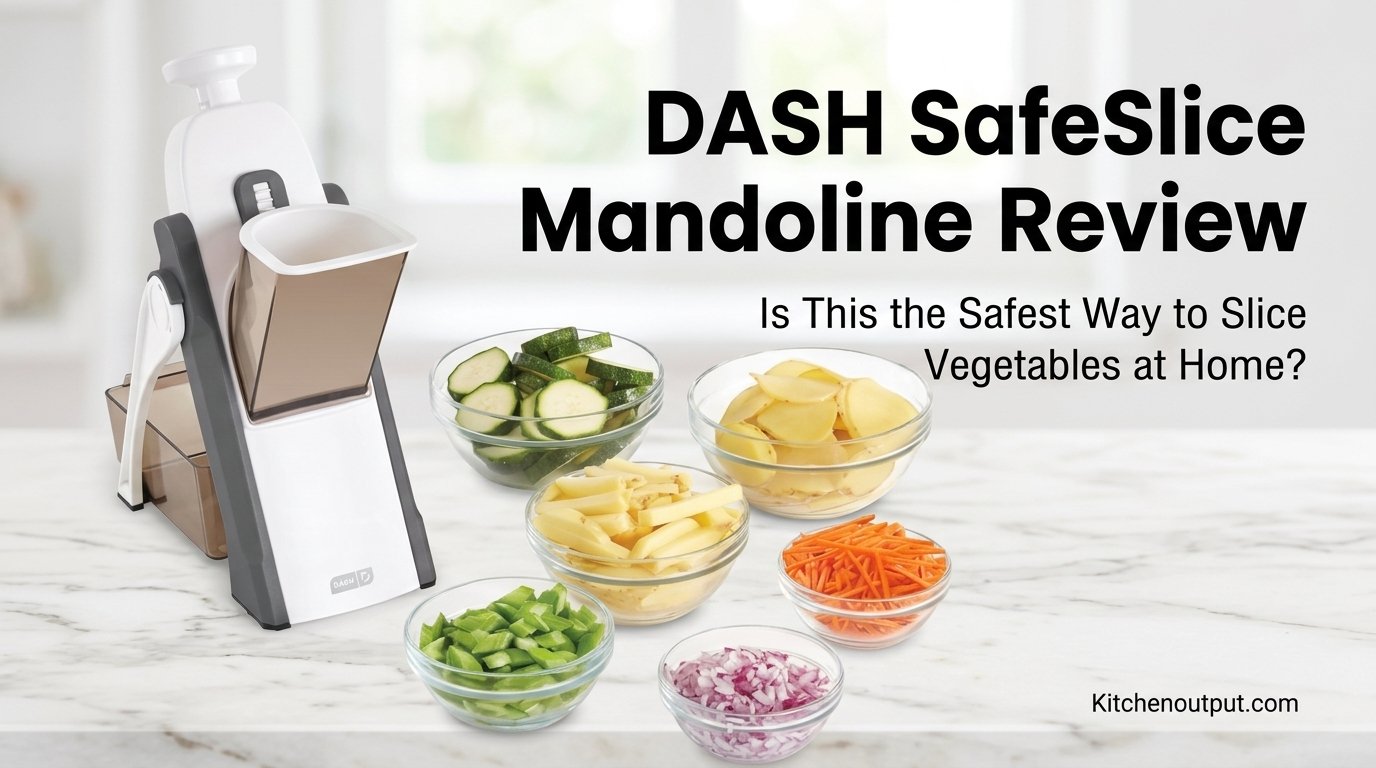
Dash SafeSlice Mandoline Review: Is This the Safest Way to Slice Vegetables at Home?
A hands-on breakdown of the Dash SafeSlice Mandoline — the covered-blade slicer that promises restaurant-quality cuts without the finger-tip anxiety of a traditional mandoline.
What Is the Dash SafeSlice Mandoline?
If you’ve ever owned a traditional mandoline slicer, you already know the uneasy relationship most home cooks have with them. They’re brilliant at what they do — paper-thin cucumber ribbons, perfectly uniform potato rounds, matchstick carrots in seconds — but that razor-sharp exposed blade sitting a few inches from your fingertips has sent more than a few kitchens into a first-aid-kit scramble. The Dash SafeSlice Mandoline was built specifically to solve that problem, and after spending real time with it across a variety of vegetables, fruits, and prep tasks, it’s worth digging into exactly how well it succeeds.
At its core, the Dash SafeSlice Mandoline is a manual slicing tool that replaces the classic “hold the food, drag it across the blade” motion with a vertical, gravity-fed chute system. Instead of your hand ever coming near the cutting surface, you drop whole or halved produce into a top-loading chute, place a plastic pusher on top, and press straight down. The blade assembly sits below, out of reach, and the sliced or chopped result collects in a catch tray underneath. It’s a fundamentally different mechanical approach than the flat-bed mandolines most of us grew up fearing, and that difference is the entire selling point.
Dash positions this as an everyday kitchen tool rather than a specialty gadget for serious cooks only, and the design reflects that. It’s white and gray, compact when folded, dishwasher-safe in its main components, and marketed toward home cooks who want professional-looking cuts — julienne, matchstick, thin rounds, thick rounds, dice, and minced textures — without investing in knife skills or risking an ER visit. For readers who are still comparing categories of prep tools altogether, our guide on the best mandoline slicers puts this model into a broader context of what’s currently available.

See current pricing and availability for the Dash SafeSlice Mandoline on Amazon.
Check Price on AmazonWhy Mandoline Safety Actually Matters
It’s easy to dismiss “safety features” as marketing fluff until you’ve actually nicked a knuckle on a mandoline blade — an injury that tends to be deeper and more startling than a typical kitchen knife cut, precisely because the blade is fixed, exposed, and moving faster than most people expect relative to how little pressure it takes to catch skin. Emergency room data on kitchen injuries consistently lists mandolines as a disproportionate contributor to lacerations relative to how infrequently they’re actually used compared to a chef’s knife. The combination of a stationary blade, a food item getting smaller as you slice, and a hand that’s naturally drawn closer to the blade as the vegetable shrinks is a recipe for exactly the kind of accident most people have either experienced themselves or heard about from a friend.
Manufacturers have tried to address this in different ways over the years. Some, like the well-known OXO Good Grips V-Blade line, rely on a hand guard accessory that clamps onto the food and keeps fingers a safe distance from the blade — a solution we cover in detail in our OXO Good Grips V-Blade mandoline breakdown. Others, like the OXO Chef’sMandoline 2.0, add a spring-loaded, angled carriage that food sits in as it’s pushed. Both approaches work reasonably well, but they still require a hand guard to be attached correctly every single time, and a moment of complacency — using your bare hand “just this once” to finish off a small end piece — is where most injuries happen.
The Dash SafeSlice Mandoline takes a structurally different approach: rather than guarding the hand from the blade, it removes the interaction between hand and blade entirely. The chute and pusher mechanism means there is no scenario, short of intentionally disassembling the unit mid-use, where a finger gets anywhere near the cutting edge. That’s a meaningfully different safety philosophy, and it’s the main reason this product has found an audience among households with older children learning to cook, cooks with limited hand dexterity, or anyone who has simply had one too many close calls with a flat-bed slicer.
Design and Build Quality
Physically, the Dash SafeSlice Mandoline stands upright rather than lying flat, which is the first thing that separates it visually from almost every other mandoline on the market. The main body is a white plastic housing with gray rubberized side rails, a top-mounted plunger-style pusher handle, and a hinged base that folds flat for storage. A side dial adjusts blade depth, which is how thickness gets controlled — more on that in the cutting styles section below.
Build quality feels appropriate for the price point: it’s not a professional-grade stainless steel unit like a benchtop deli slicer, but it also doesn’t feel flimsy in hand. The stainless steel blade cartridge is the one component that feels genuinely premium, with a crisp, double-beveled edge that stayed sharp through repeated testing on starchy vegetables like potatoes, which tend to dull blades faster than watery produce like cucumber or zucchini.
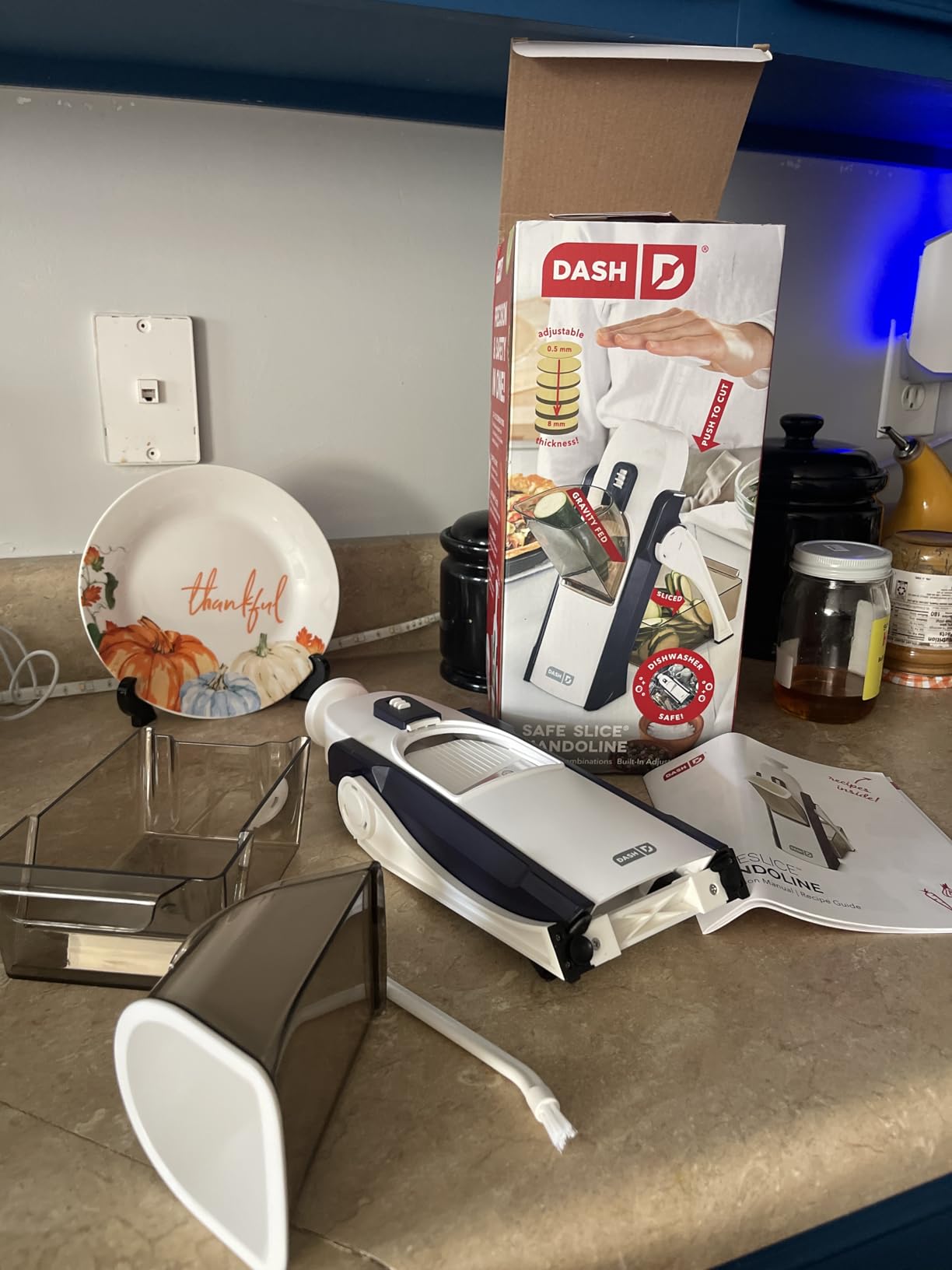
The included accessory set is worth calling out specifically, since it’s part of what makes the whole system function as intended:
- Ingredient chute — the angled loading funnel that holds whole or halved produce before it drops toward the blade.
- Ingredient pusher — a contoured plastic plunger that fits into the chute and transfers downward pressure without your hand entering the chute itself.
- Ingredient container / catch tray — a clear plastic bin that slides beneath the blade housing to catch every slice, dice, or julienne strand as it falls.
- Cleaning brush — a narrow bristled tool designed to clear stuck produce fibers from between the blade teeth without requiring fingers near the cutting edge.
Every one of these pieces snaps on and off without tools, and the whole unit collapses into a flat profile for storage, which we’ll get into later. One design quirk worth flagging up front: because the unit is vertical and gravity-fed rather than flat-bed, it does take up more vertical clearance on a counter during use than a traditional mandoline laid across a cutting board. If you’re working under low upper cabinets, you may need to bring it out to open counter space rather than using it tucked under a cabinet line.
How the SafeSlice System Works
The mechanical sequence is genuinely simple, and Dash’s own marketing breaks it down into four steps, which held up accurately in practice:
- Drop the ingredient into the chute. Most produce needs to be trimmed to fit — a whole potato or zucchini generally needs to be halved lengthwise first so it sits securely against the internal blade guide rather than rattling loosely in the chute.
- Press the ingredient pusher into place on top of the loaded chute, seating it so it will travel straight down through the guide channel.
- Push down firmly on the pusher using your palm, keeping steady, even pressure rather than short jabbing motions, which tend to produce uneven slices.
- Collect the results in the tray below, which slides out easily for transferring straight into a bowl, pan, or salad.
What makes this system different from a spiralizer or a rotary slicer is that there’s no crank or turning motion — it’s a straight vertical push, similar in feel to using a manual French fry cutter, except with interchangeable results depending on which blade insert and thickness setting is loaded. The gravity-fed chute also means you’re not manually guiding the food across a stationary blade at an angle, which is where most technique-related mandoline injuries happen on flat-bed models.
Want to see the full accessory kit and current deals?
View on AmazonCutting Styles and Thickness Control
This is where the SafeSlice earns most of its “worth it or not” verdict, since versatility is the entire reason anyone buys a mandoline over just using a knife. Dash advertises more than 100 possible cutting combinations once you factor in blade selection and thickness adjustment together, and while that number leans on marketing math (multiplying cut styles by thickness settings), the practical variety is genuinely impressive for a single compact unit.
| Cut Style | Best For | Notes |
|---|---|---|
| Thin rounds | Potato chips, cucumber salad, apple crisps | Consistent, near-restaurant thinness |
| Thick rounds | Zucchini for baking, gratins, roasting | Holds shape well during cooking |
| Julienne | Carrots, daikon, slaw mixes | Uniform matchstick width |
| Matchstick | Fries, stir-fry vegetables | Slightly thicker than julienne setting |
| Diced | Peppers, onions, celery | Fast prep for soups and salsas |
| Minced | Onion, garlic-adjacent aromatics | Fine texture, less knife work needed |
The thickness dial is the main control point and offers a genuinely useful range — from shave-thin to a hearty quarter-inch-plus setting — controlled by a small adjustment wheel on the side of the housing. Switching between blade inserts for julienne, dice, or mince requires popping out one cartridge and snapping in another, which takes a few seconds once you’ve done it a handful of times but does require your hands to briefly interact with the blade edge during the swap. This is the one moment in the entire workflow where some caution is genuinely still required, and it’s worth handling that cartridge by its plastic housing edges rather than gripping near the blade itself.
For readers weighing whether a mandoline like this one covers enough cutting variety compared to a dedicated vegetable slicer, our comparison of V-slicer vs. mandoline tools is a useful companion read, since it breaks down where flat V-blade tools still outperform vertical gravity-fed designs like this one — namely in handling very large, irregularly shaped produce like whole cabbages or squash.
Real-World Performance
Across a testing run that included zucchini, russet and yellow potatoes, cucumbers, red onions, bell peppers, celery, carrots, and apples, the results were consistently even — noticeably more uniform than what most home cooks achieve freehand with a knife, and comparable in consistency to a flat-bed mandoline when the thickness dial is set correctly and pressure is applied steadily.
A few performance notes stood out. First, watery, low-density produce (cucumber, zucchini, apple) sliced almost effortlessly and produced clean, unbruised cuts. Second, starchy, denser produce (potatoes, especially larger russets) required more deliberate, sustained pressure, and occasionally needed a slight wiggle of the pusher to clear a jam if a slice folded rather than dropped away cleanly — a known quirk of gravity-fed chute systems generally, not unique to this unit. Third, very soft produce like ripe tomatoes is genuinely not a great match for this tool; the chute mechanism works best on produce with enough structural firmness to hold its shape as it’s pushed through, and soft tomatoes tended to compress rather than slice cleanly.
Julienne and matchstick cuts were the standout performers — genuinely restaurant-quality, uniform strands that would take a skilled home cook several minutes of knife work to replicate by hand. The dice and mince settings were solid but not flawless; a small percentage of pieces on each pass came out slightly larger than the target size, likely due to how the food settles in the chute before the push. This is a minor complaint and one shared by essentially every dicing attachment on the market, mandoline-style or otherwise, so it shouldn’t be treated as a unique shortcoming of this particular model.
If your kitchen already leans heavily on quick-prep tools, it’s worth pairing this kind of review against something like our best food processor reviews roundup, since a food processor’s dicing disc covers similar ground for larger batches, while the SafeSlice wins on precision and control for smaller, more deliberate cuts.
Consistency across repeated passes is another area where this unit performs well. Slicing an entire large potato produced rounds that varied by only a fraction of a millimeter from the first slice to the last, which speaks to how well the blade cartridge stays seated during use — a small but important detail, since a blade that shifts even slightly mid-task can throw off thickness uniformity in a way that’s obvious once the slices are laid out side by side on a cutting board or plated for something like a gratin where visual evenness actually matters.
Noise level and overall user experience are also worth a brief mention, since manual slicers vary more than people expect in how pleasant they are to actually use. The SafeSlice is essentially silent apart from the soft mechanical click of the blade cartridge engaging with each pass, which makes it a reasonable option for early-morning or late-night meal prep without disturbing anyone else in the house — a small advantage over anything electric or motorized, and one that’s easy to overlook until you’ve used a noisier appliance for the same task.
Cleaning and Maintenance
Cleanup is one of the strongest arguments in favor of this design over a traditional mandoline. Flat-bed mandolines are notoriously awkward to clean because you’re scrubbing directly around an exposed blade with a sponge, which reintroduces exactly the safety risk the tool is otherwise meant to avoid during use. The SafeSlice sidesteps this almost entirely.
The chute, pusher, and catch tray are all listed as dishwasher-safe and can go straight into a top rack without any special handling. The blade cartridge itself is also dishwasher-safe, but Dash includes a dedicated cleaning brush specifically so that stuck fibrous bits — think celery strings or potato starch — can be cleared from between the blade teeth without fingers making contact with the cutting edge, even when hand-washing. In testing, this brush did meaningfully reduce the temptation to just wipe the blade down with a sponge and a bare hand, which is exactly the kind of habit-forming safety design that matters more than a one-time feature.
One practical tip: starchy vegetables like potatoes leave behind more residue in the blade teeth than watery vegetables, so a quick brush-through between different produce types keeps slices cleaner and prevents cross-flavor transfer (a genuine concern if you slice onion and then move straight to apple without a rinse).
Storage and Footprint
Because the SafeSlice stands vertically during use, it initially looks like it might be bulky to store, but the hinge at the base folds the entire unit flat, collapsing the upright chute assembly down against the body. Flattened, it slides into a standard kitchen drawer or a shallow cabinet shelf without much more footprint than a large cutting board. This is a meaningful upgrade over bulkier electric slicers or box graters with multiple loose attachments, since there’s nothing to lose track of beyond the catch tray and cleaning brush, both of which are compact enough to store inside the folded unit itself in most kitchen drawers.
For anyone doing a broader kitchen declutter or comparing footprint across multiple prep tools, our kitchen appliance buying guide covers how to think about counter and drawer space allocation across small appliances generally, which is a useful framework if you’re trying to decide what earns permanent counter space versus what gets folded away between uses.
Ready to add faster, safer prep to your kitchen routine?
Buy the Dash SafeSlice MandolineWhy the Chute Design Works Mechanically
It’s worth taking a moment to unpack why a vertical, gravity-fed chute actually changes the safety equation rather than just repositioning the same risk somewhere else. On a flat-bed mandoline, the blade is fixed in a stationary track, and the food is the moving part — dragged across the cutting edge by your hand, which necessarily travels in roughly the same plane as the blade itself. As the piece of food gets smaller with each pass, the distance between your fingertips and the blade shrinks in direct proportion, which is exactly why so many mandoline injuries happen on the last inch or two of whatever’s being sliced.
The SafeSlice inverts that relationship. The blade sits in a fixed horizontal plane at the base of a vertical channel, and gravity plus a plunger-style pusher do the work of moving food downward and across the cutting edge. Your hand interacts only with the top of the pusher, which never travels past a point roughly a foot away from the blade itself, regardless of how small the remaining piece of food gets. In practical terms, that means the “last inch” scenario that causes most mandoline injuries simply doesn’t exist in this design, because there’s no moment where your hand’s position relative to the blade changes as the food shrinks.
This is also why the pusher’s shape matters more than it might seem at first glance. It’s molded to sit snugly inside the ingredient chute with minimal side-to-side play, which keeps the downward force consistent and prevents the kind of wobble that could otherwise cause an uneven, torn cut rather than a clean slice. In testing, the snugness of that fit was noticeably tighter than a few competing gravity-fed slicers, which likely explains why cut consistency stayed high even on firmer produce that required more forceful pushing.
A Closer Look at the Included Accessories
Because so much of the SafeSlice’s value proposition depends on its accessory ecosystem working smoothly together, it’s worth walking through each piece individually rather than treating them as an afterthought.
The Ingredient Chute
The chute is the funnel-shaped piece that produce drops into before slicing. Its internal walls are gently tapered and ribbed, which helps guide irregularly shaped vegetables — a halved potato, for instance — into a more centered position before the pusher engages. This tapering is a small design detail, but it noticeably reduced the number of crooked or partial slices compared to dropping food into a straight-walled tube.
The Ingredient Pusher
The pusher itself has a contoured top surface designed to sit comfortably under a full palm rather than just fingertips, which matters because some of the denser produce in testing required real, sustained downward force — closer to pressing down on a stiff bicycle pump than a gentle push. A pusher shaped for fingertip use alone would likely become uncomfortable quickly under that kind of repeated pressure.
The Ingredient Container
The clear catch tray slides in and out from the base of the unit and is sized generously enough to hold a reasonable batch — enough for a side dish of julienned carrots or a full round of sliced potatoes for a gratin — before needing to be emptied. Its clear plastic construction also makes it easy to visually check portion size mid-task without interrupting your slicing rhythm.
The Cleaning Brush
This is a small but genuinely thoughtful inclusion. Its bristles are stiff enough to dislodge stringy celery fibers or starchy potato residue from between blade teeth, and its narrow profile lets it reach into tight gaps that a sponge simply can’t access safely. Given that most mandoline injuries during cleaning happen because someone reaches for a sponge or their bare fingers out of habit, having a purpose-built brush readily at hand meaningfully changes that behavior over time.
How It Compares to Other Mandolines
No mandoline review is complete without placing it next to the tools people are most likely comparing it against. The two most relevant competitors in this category are the OXO Good Grips V-Blade Mandoline and the OXO Chef’sMandoline 2.0, both of which we’ve reviewed in depth separately, along with the budget-friendly Mueller V-Pro 5-Blade Mandoline Slicer.
| Feature | Dash SafeSlice | OXO Good Grips V-Blade | OXO Chef’sMandoline 2.0 | Mueller V-Pro 5-Blade |
|---|---|---|---|---|
| Blade exposure during use | Fully enclosed | Exposed, hand guard required | Exposed, carriage-guided | Exposed, hand guard required |
| Orientation | Vertical, gravity-fed | Flat-bed | Flat-bed, angled carriage | Flat-bed |
| Cut variety | High (6+ styles via cartridges) | Moderate (adjustable slice + julienne) | High (multiple inserts) | High (5 interchangeable blades) |
| Best suited for | Safety-first home cooks, families | Cooks comfortable with hand guards | Serious home cooks wanting speed | Budget-conscious high-volume prep |
| Cleanup | Dishwasher-safe, low blade contact | Dishwasher-safe, some blade contact | Dishwasher-safe, some blade contact | Dishwasher-safe, some blade contact |
| Storage footprint | Folds flat, compact | Flat, stores easily | Flat, stores easily | Flat, stackable blades |
The honest takeaway from putting these side by side is that flat-bed mandolines like the OXO Chef’sMandoline 2.0 and the Mueller V-Pro 5-Blade still have an edge with large, irregular produce — a whole cabbage, a big sweet potato, a wide daikon radish — because the flat surface accommodates a wider range of shapes than the SafeSlice’s narrower vertical chute. Where the Dash pulls ahead decisively is in day-to-day safety margin: there is no version of normal use where a hand guard slips, is forgotten, or is skipped “just this once.” If your household includes kids learning to cook, older adults, or anyone who has had a scare with a bare-blade mandoline before, that difference in risk profile matters more than the marginal loss of maximum produce size.
It’s also worth noting how these tools differ in learning curve. Flat-bed mandolines with hand guards, including both OXO models above, tend to require a short adjustment period before the hand guard feels natural rather than clumsy — many first-time users report their earliest few uses feeling slower than just reaching for a knife, until the motion becomes familiar. The SafeSlice’s chute-and-pusher motion, by contrast, mimics a pressing action most people already understand intuitively from other kitchen tools, like a garlic press or a manual pasta cutter, which shortens that learning curve considerably. For anyone buying a mandoline as a first-time purchase rather than an upgrade from an existing one, that lower learning curve is a real practical advantage on top of the safety benefit.
Pros and Cons
Pros
- Fingers never come near the blade during normal slicing
- Genuinely restaurant-quality julienne and matchstick cuts
- Dishwasher-safe components with a dedicated cleaning brush
- Folds flat for compact drawer storage
- Adjustable thickness dial covers a wide practical range
- Built-in catch tray keeps counters clean during prep
Cons
- Blade cartridge swaps require brief, careful hand contact
- Struggles with very large or oddly shaped produce
- Soft produce like ripe tomatoes doesn’t slice cleanly
- Denser vegetables need firm, sustained pushing force
- Takes more vertical counter clearance during use than flat-bed designs
Who Should (and Shouldn’t) Buy This
The Dash SafeSlice Mandoline makes the most sense for households where safety is a genuine, ongoing concern rather than a nice-to-have — families with kids beginning to help in the kitchen, cooks with reduced hand strength or dexterity, or anyone who has simply decided they don’t trust themselves (or a distracted family member) around an exposed blade at 6 p.m. on a weeknight. It also suits anyone who values clean, uniform cuts for slaws, gratins, or stir-fries but doesn’t want to invest in developing advanced knife skills to get there.
It’s a weaker fit for anyone regularly prepping very large batches of produce for canning, meal prep, or catering, where a flat-bed mandoline’s ability to handle bigger pieces of food in fewer passes saves real time. It’s also not the right tool for very soft produce, so if your prep needs lean heavily toward tomatoes, ripe avocados, or similarly delicate items, a sharp knife will still outperform it.
It’s also worth thinking about this purchase in the context of your broader kitchen setup rather than as an isolated decision. If you already own a full beginner knife set and feel confident with a chef’s knife, the SafeSlice’s main value is speed and consistency rather than unlocking cuts you couldn’t otherwise achieve. On the other hand, if knife skills have always felt like a barrier to more ambitious weeknight cooking — thin gratins, uniform slaws, evenly diced mirepoix for soups — this tool meaningfully lowers that barrier without requiring you to build new technique from scratch. It’s the kind of purchase that pays off most for cooks who want the visual and textural results of good knife work without the years of practice that usually come with it.
One more consideration: households that do a lot of entertaining or batch-cook for the week ahead will get more value out of this tool than someone who cooks primarily single portions. The setup and cleanup time is roughly fixed regardless of how much produce you’re slicing, so the per-vegetable time savings scale up considerably once you’re prepping for a crowd or filling several days’ worth of meal-prep containers in one sitting.
Tips for Getting the Best Results
- Trim produce to fit the chute first. Halving or quartering larger vegetables lengthwise helps them sit flush against the internal guide rather than shifting mid-push.
- Use steady, continuous pressure rather than short pumping motions, which tend to produce uneven slice thickness.
- Brush the blade between produce types to avoid flavor transfer and keep slices clean, especially after onions or garlic-adjacent items.
- Chill firm vegetables slightly before slicing thin — cold potatoes and cucumbers hold their shape better under the blade than room-temperature ones.
- Empty the catch tray frequently during large batches so slices don’t pile up and interfere with clean drops from the blade.
- Rotate produce orientation between passes for julienne and matchstick cuts if you notice one side coming out slightly wider — this usually means the food shifted in the chute rather than a blade issue.
- Store the blade cartridge separately if you swap between styles often, so you’re not hunting through a drawer for the right insert mid-recipe.
- Pat produce dry before loading if it’s been rinsed — excess surface water can make firmer vegetables slide unpredictably in the chute rather than sitting flush against the guide.
Taken together, these small habits make a bigger difference than they might seem on paper. Most of the inconsistent results reported by first-time users trace back to one of two things: skipping the initial trim-to-fit step, or applying uneven, hesitant pressure instead of one confident, steady push. Once those two habits are dialed in, the unit performs close to its ceiling on nearly every produce type it’s designed to handle.
Frequently Asked Questions
Is the Dash SafeSlice Mandoline actually safer than a traditional mandoline?
Yes, structurally so. Because food travels through an enclosed chute and never crosses an exposed blade edge under your own hand’s direct control, the risk of an accidental cut during normal slicing is dramatically lower than with flat-bed mandolines that rely on hand guards.
Can it handle whole vegetables, or do I need to cut them first?
Most produce needs to be halved or quartered to fit the chute properly and sit securely against the internal guide. Small items like cucumbers may fit whole, but larger vegetables like potatoes or zucchini generally need pre-trimming.
Is it dishwasher-safe?
Yes, the chute, pusher, catch tray, and blade cartridge are all listed as dishwasher-safe, which is a notable advantage over mandolines that recommend hand-washing near the blade only.
How thin can it slice?
The thickness dial goes down to a shave-thin setting suitable for potato chips or delicate cucumber ribbons, up through a thick setting appropriate for roasting or gratins.
Does it julienne and dice as well as it slices?
Julienne and matchstick cuts performed the most consistently in testing. Dicing and mincing were solid but occasionally produced slightly uneven piece sizes, which is common across most dicing attachments generally.
Is it hard to switch between blade cartridges?
It’s mechanically simple — the cartridges snap in and out — but this is the one moment where hands do come near the blade edge, so it’s worth handling cartridges by their plastic housing rather than the blade itself.
Can it slice tomatoes or other soft produce?
Not particularly well. Soft, high-moisture produce like ripe tomatoes tends to compress rather than slice cleanly through the gravity-fed chute. A sharp knife is a better tool for that specific job.
How does it compare to the OXO Chef’sMandoline 2.0?
The OXO handles larger and more irregularly shaped produce more easily thanks to its flat-bed design, while the Dash SafeSlice offers a meaningfully lower risk of accidental cuts since the blade is never exposed during normal use.
Does it take up a lot of storage space?
No. The hinged base folds the unit flat, so it stores in a drawer or shallow cabinet shelf with roughly the footprint of a large cutting board.
Is it good for meal prepping in large batches?
It works well for moderate batches, but very high-volume prep — think canning season or catering — may be faster with a flat-bed mandoline that accepts larger pieces of food per pass.
Does it require much force to use?
It depends on the produce. Watery vegetables like cucumber and zucchini need light pressure, while dense, starchy vegetables like russet potatoes require firmer, sustained pushing.
Is it a good option for kids learning to help in the kitchen?
Under adult supervision, yes — the enclosed blade design significantly reduces the risk profile compared to handing a child a traditional mandoline or chef’s knife for early prep tasks.
Final Verdict
The Dash SafeSlice Mandoline succeeds at the one thing it set out to do: it makes mandoline-quality slicing meaningfully safer without asking you to sacrifice much in the way of cut variety or consistency. It’s not a replacement for a flat-bed mandoline in every scenario — large produce, high-volume batches, and very soft fruits and vegetables all expose its limits — but for the everyday home cook who wants clean julienne, uniform rounds, and quick dicing without an exposed blade sitting inches from their fingers, it’s a genuinely well-thought-out tool. Paired with its dishwasher-safe parts and flat-folding storage, it earns its place as a practical, lower-anxiety alternative to the mandolines most of us have half-heartedly used and then buried in a drawer out of caution.
If your kitchen prep routine could use more safety margin without giving up precision, this is worth adding to your countertop rotation. It won’t fully replace a good chef’s knife or a flat-bed mandoline for every task — nothing handles an oversized butternut squash or a delicate heirloom tomato quite like a blade in a skilled hand — but for the huge share of everyday prep that involves potatoes, zucchini, cucumbers, onions, carrots, and peppers, it consistently delivers clean, even results with a risk profile that’s hard to match anywhere else in this category. For most home kitchens looking to trim prep time on weeknight dinners without adding a new source of anxiety to the process, that trade-off comes out clearly in the SafeSlice’s favor.
Check today’s price and availability before you decide.
See It on AmazonRelated reading:
As an Amazon Associate, this site earns from qualifying purchases. Product images and prices are provided by Amazon and subject to change.


