V-Slicer vs Mandoline: Which Vegetable Slicer Actually Belongs in Your Kitchen?
Two blades, two philosophies, one big decision. Here’s how a V-slicer and a traditional mandoline really stack up on precision, safety, speed, and everyday usability.
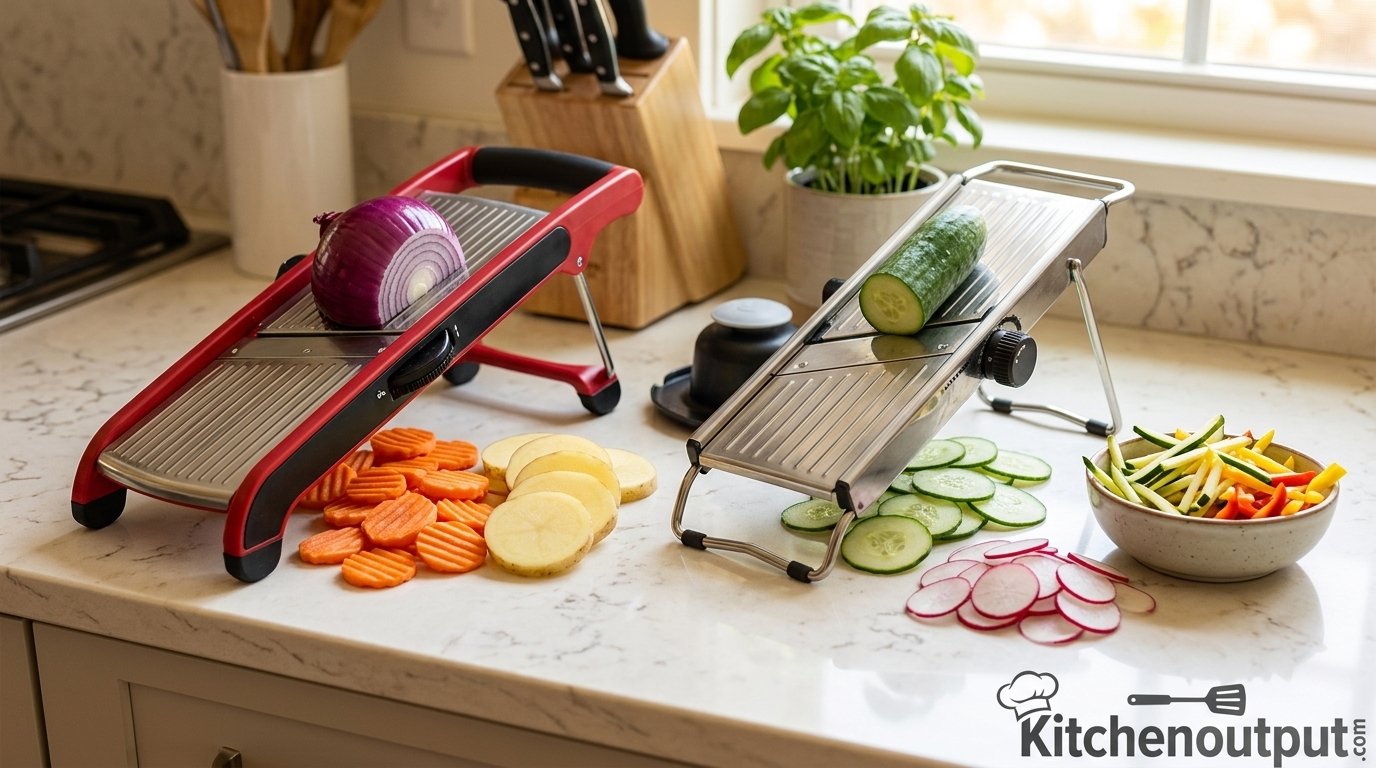
Walk down the kitchen gadget aisle and you’ll spot two tools that look almost identical at first glance: the mandoline and the V-slicer. Both promise paper-thin cucumber ribbons, restaurant-style potato chips, and julienned carrots in a fraction of the time a chef’s knife would take. Both sit flat on your counter, both use a fixed blade and a sliding motion, and both can turn a mountain of prep work into a five-minute job.
But the two tools are not interchangeable, and the differences matter more than most buying guides let on. A V-slicer uses an angled, V-shaped blade that shears through produce with a slightly different motion and feel than the straight or wavy blade found on a classic mandoline. That single design choice ripples out into how each tool handles soft versus firm vegetables, how much pressure you need to apply, how easy each is to clean, and even how safe each one is for a beginner cook.
This guide breaks down every meaningful difference between a V-slicer and a mandoline slicer, from blade geometry to long-term durability, so you can decide which one actually deserves counter space in your kitchen — or whether you need both.
It’s worth saying up front that either tool will genuinely upgrade your prep work compared to slicing by hand. The real question isn’t “which one is objectively better” but “which one matches the way you actually cook.” A weeknight cook who mostly wants quick, fresh salads has very different needs than someone prepping a big holiday gratin for a dozen people, and the right slicer for each situation isn’t always the same tool. Keep your own typical grocery list and go-to recipes in mind as you read through each section below — the specs matter less than how they translate to your kitchen routine.
What Is a Mandoline Slicer?
A mandoline slicer is a flat, rectangular kitchen tool with a razor-sharp blade mounted horizontally across a slicing platform. You run food along the platform, usually with the help of a hand guard or food holder, and the blade shaves off consistent slices as the food passes over it. Most mandolines include an adjustable thickness dial so you can go from paper-thin cucumber rounds to thicker potato slices for gratins without switching tools.
The word “mandoline” traditionally refers to the entire category of flat slicing tools, including straight-blade models and V-blade models. In everyday kitchen language, though, people often use “mandoline” to mean the classic straight-blade or wavy-blade version, which is why the comparison with a V-slicer even exists. Traditional mandolines are common in professional kitchens because they produce extremely uniform slices at high volume, which matters when a restaurant needs fifty identical potato rounds for a gratin.
Most home mandolines are made from either stainless steel or food-grade plastic with a stainless or ceramic blade insert. Higher-end versions include multiple interchangeable blades for julienne, waffle-cut, and crinkle-cut styles, turning one tool into several. If you’re comparing dedicated models, the best mandoline slicer picks we’ve tested cover a wide range of price points and blade styles.
What Is a V-Slicer?
A V-slicer is technically a type of mandoline, but its blade is shaped like a wide, shallow “V” rather than a single straight edge. That V-shaped blade slices from the center outward in two directions at once, which is why V-slicers tend to glide through produce with noticeably less resistance than a straight blade of the same sharpness. The angled cutting edge also self-clears more efficiently, so thin slices are less likely to bunch up or jam mid-cut.
Because the V-blade cuts at an angle instead of straight across, it tends to handle irregularly shaped vegetables — think knobby heirloom tomatoes or unevenly round zucchini — a little more gracefully than a rigid straight blade. V-slicers are also frequently sold as compact, budget-friendly units aimed at home cooks who want speed and simplicity over the full accessory ecosystem of a professional mandoline.
Many V-slicers on the market today are marketed simply as “mandoline slicers” with a V-blade design, which is exactly the source of confusion this guide is meant to clear up. If you want a closer look at how one specific V-blade model performs in real kitchen use, our OXO Good Grips V-Blade Mandoline Slicer review walks through hands-on testing notes.

Want a slicer that handles both jobs well? A quality V-blade mandoline with an adjustable thickness dial is a solid all-around starting point for most home kitchens.
Check Current Price on AmazonKey Differences at a Glance
Before diving into each category in detail, here’s a side-by-side snapshot of how a V-slicer and a traditional straight-blade mandoline compare across the factors that matter most to home cooks. Use this table as a quick reference while you read through the deeper breakdowns below, since each row links back to a fuller explanation later in the guide.
| Factor | V-Slicer | Traditional Mandoline |
|---|---|---|
| Blade shape | Angled V-shaped blade | Straight or wavy horizontal blade |
| Cutting motion | Shears from center outward | Single straight pass |
| Best for soft produce | Tomatoes, mushrooms, soft cheese | Firm vegetables like potatoes and carrots |
| Resistance while slicing | Generally lower | Can be higher on dense produce |
| Julienne/waffle attachments | Less common | Frequently included on premium models |
| Typical price range | Budget to mid-range | Budget to professional-grade |
| Cleaning | Angled blade needs careful brushing | Flatter blade, generally easier to wipe |
| Storage footprint | Usually compact and slim | Can be bulkier with multiple blade inserts |
Blade Types & Cutting Mechanism
The single biggest difference between these two tools comes down to blade geometry. A straight-blade mandoline uses one continuous cutting edge that spans the width of the slicing chute. As food passes over it, the blade makes one clean, linear cut across the entire piece at once. This is mechanically simple and tends to produce extremely flat, even slices, which is why professional kitchens favor straight-blade designs for high-volume prep.
A V-slicer’s blade is angled into a shallow “V,” meeting in the middle and sloping outward toward both edges of the chute. As food is pushed across it, the two angled edges cut simultaneously from the center out, similar to how scissors shear rather than chop straight down. This angled shearing action reduces the amount of downward pressure needed, which is part of why V-slicers often feel like they “glide” rather than “push through” produce.
Why the angle matters for different foods
Firm, dense vegetables like russet potatoes or carrots respond well to a straight blade because there’s no need to shear at an angle — a clean, direct cut is efficient and produces flat, stackable slices ideal for gratins or chips. Softer or rounder produce, like ripe tomatoes, mushrooms, or radishes, tends to hold its shape better under a V-blade because the shearing motion doesn’t compress or squash the food the way a straight blade sometimes can on delicate items.
Some premium mandolines split the difference by offering interchangeable blade inserts, letting you swap between straight, V-shaped, julienne, and waffle-cut blades on the same base unit. If you like the idea of one tool covering every cutting style, it’s worth comparing full mandoline sets against single-purpose V-slicers before you buy, since the interchangeable systems typically cost more but eliminate the need for two separate tools.
Blade angle also affects the sound and feel of slicing, which is a small but real part of the user experience. A straight blade tends to produce a single, clean “shear” sound with each full pass, while a V-blade’s two-point contact often feels smoother and quieter, since the cutting force is distributed across two angled edges rather than concentrated along one straight line. Neither is objectively better, but cooks who slice frequently sometimes develop a strong preference for one feel over the other after enough repetitions.
Precision & Cut Consistency
Precision is where both tools genuinely shine compared to a knife, but there are subtle differences worth knowing. Straight-blade mandolines tend to produce marginally flatter, more uniform slices on firm vegetables because the blade contacts the entire width of the food at once. This matters for dishes where visual presentation counts, like a classic potato gratin or a cucumber salad where every slice needs to look identical.
V-slicers, on the other hand, are excellent at maintaining consistency across a wider range of produce shapes. Because the angled blade adapts more naturally to curved or irregular surfaces, you’re less likely to end up with a wedge-shaped or uneven end piece when slicing something like a bell pepper or a small round squash. In practice, most home cooks find both tools capable of restaurant-quality consistency once you get a feel for the right pressure and angle.
One practical tip that applies to both tools: consistency drops sharply once the blade starts to dull. A mandoline or V-slicer that’s cutting unevenly is almost always a sign that it’s time to sharpen or replace the blade insert, not a flaw in the tool’s design.
It’s also worth testing precision with the specific foods you cook most. A slicer that produces flawless potato rounds might behave differently on a soft heirloom tomato, and vice versa. If your recipes lean heavily toward one type of produce, prioritize the tool that performs best on that category rather than chasing an all-around “best” rating that may not reflect your actual cooking habits. Many experienced home cooks eventually keep both a V-slicer and a straight-blade mandoline in rotation specifically because no single blade shape is perfect for every vegetable.
Speed & Efficiency
Both tools dramatically outpace a chef’s knife for repetitive slicing tasks, but there are small differences in how quickly you can work with each. V-slicers, thanks to their lower-resistance cutting action, often let you move through a pile of vegetables slightly faster because each pass requires less force and the angled blade self-clears thin slices more readily, reducing jams.
Straight-blade mandolines can occasionally bunch up very thin, delicate slices right at the blade edge, especially with juicy produce like tomatoes, which slows you down as you clear the chute. However, straight blades tend to pull ahead in efficiency when slicing large batches of firm vegetables like potatoes, since the full-width cut means less back-and-forth adjustment.
For high-volume meal prep — think slicing five pounds of potatoes for a big batch of chips or hash browns — a straight-blade mandoline with a wide feed chute is usually the faster choice. For everyday, smaller-batch cooking with a mix of vegetable types, a V-slicer’s adaptability often wins out on overall efficiency.
Setup and adjustment time is another factor people tend to overlook when comparing speed. A tool that takes a full minute to configure the thickness dial before you can start slicing effectively cancels out any speed advantage during the actual cutting. Look for a thickness adjustment that’s simple to read and turn with wet or slightly slippery hands, since that’s the realistic condition you’ll be adjusting it in mid-recipe. If you regularly find yourself reaching for an appliance instead of a manual slicer for large batches, it’s also worth comparing results against a food processor’s slicing disc, which trades some precision for significantly less hands-on time.
Safety Features
Both mandolines and V-slicers are notorious in home kitchens for one reason: exposed, extremely sharp blades sitting at a fixed height. Neither tool is inherently safer than the other in terms of blade sharpness, but there are design differences that affect real-world safety.
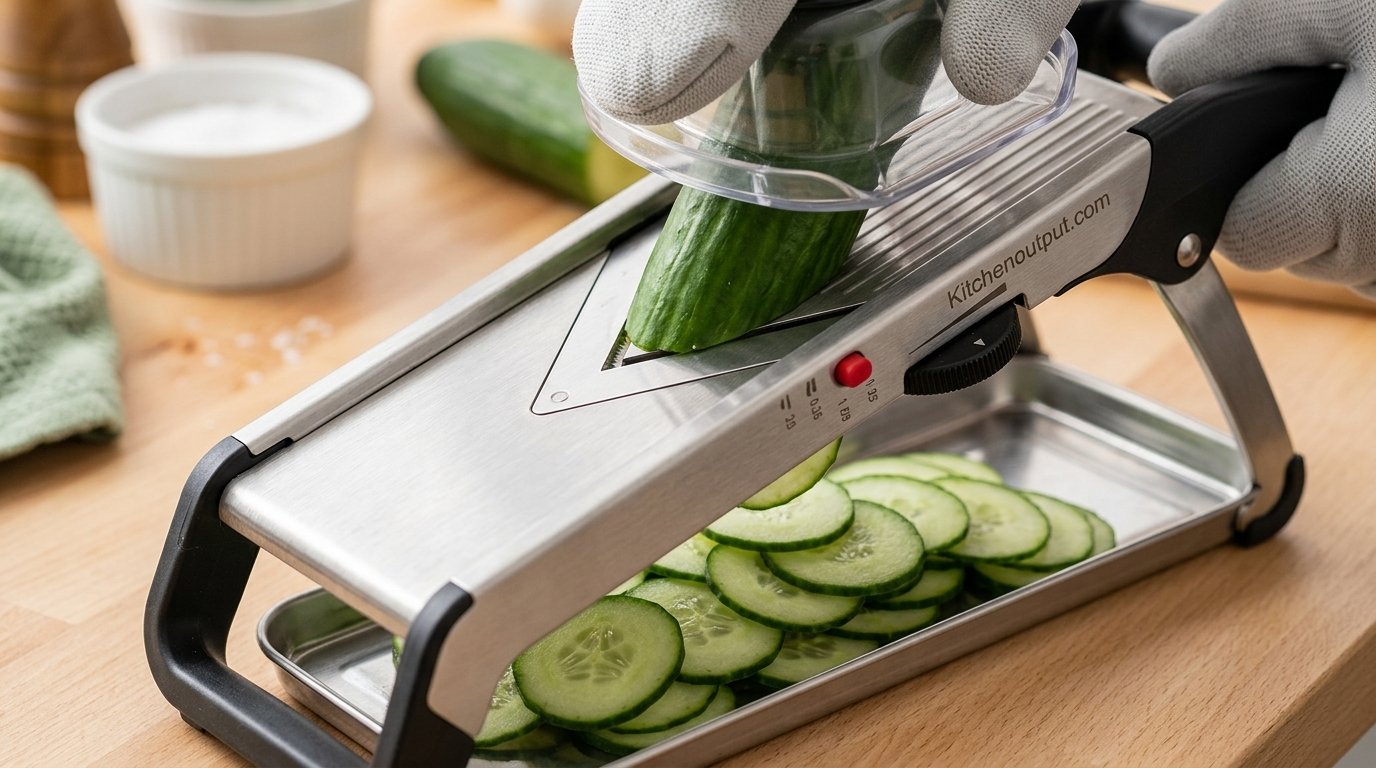
Most V-slicers ship with a plastic food holder that has small prongs to grip food securely, keeping fingers well clear of the blade. Because the V-blade’s cutting angle is less aggressive on the push stroke, some users find it slightly more forgiving if the food holder slips. Straight-blade mandolines often include a similar hand guard, and higher-end models add features like textured non-slip grips or locking mechanisms that only expose the blade once the guard is engaged.
Non-negotiable safety habits
- Always use the hand guard or a cut-resistant glove — never your bare hand near the end of the pass.
- Keep the blade angle low relative to the food when starting, and let the guard do the gripping.
- Store the tool with the blade covered or retracted so it isn’t exposed in a drawer.
- Replace or resharpen dull blades — a dull blade requires more pressure, which increases slip risk.
If safety is your top priority, look specifically for models with a locking blade guard and a wide, textured food holder. Our Dash Safe Slice Mandoline review covers one option built specifically around beginner-friendly safety features.
It’s also worth thinking about who else uses your kitchen. If children or inexperienced cooks might reach for the tool, a model with a locking mechanism that fully covers the blade when not actively slicing adds a meaningful extra layer of protection. Some households choose to keep the mandoline or V-slicer stored separately from everyday utensils specifically to avoid it being grabbed casually by someone unfamiliar with how sharp it really is. A few minutes spent reading the manufacturer’s specific safety instructions for your model — including recommended hand position and maximum food size for the guard — is time well spent before first use.
Ease of Cleaning & Maintenance
Cleaning is one area where the blade shape genuinely changes the day-to-day experience. A straight blade is flat and easy to wipe down or run a brush across in one motion. A V-blade has a center seam where the two angled edges meet, and that seam can trap small food particles — especially starchy vegetables like potatoes — if you don’t clean it promptly after use.
Neither tool should go anywhere near your bare hand during cleaning. A stiff-bristled kitchen brush is the safest way to clear both blade types, and most manufacturers recommend hand-washing rather than the dishwasher, since high heat and detergent can dull the blade edge over time and dishwasher racks can knock the blade against other items.
Plastic-bodied units are generally easier to clean than mixed-material designs with multiple crevices, so if easy cleanup is a priority, look for a single-piece platform with a removable blade insert rather than a model with lots of moving parts or attachment points.
A quick soak in warm, soapy water for a couple of minutes before brushing can loosen stuck-on starch or seeds, making the actual cleaning pass faster and reducing how much scrubbing pressure you need near the blade. Avoid abrasive scouring pads on stainless blades, since they can create tiny scratches that dull the edge faster and give bacteria more surface area to cling to. If your model includes a removable blade insert, take it out for cleaning rather than trying to clean around it while it’s still mounted — it’s safer and gets the job done more thoroughly.

Prefer a professional-style straight blade? Stainless steel mandolines with adjustable thickness dials remain the go-to for high-volume, restaurant-style prep at home.
Shop Mandoline Slicers on AmazonMaterial & Build Quality
Both V-slicers and traditional mandolines are typically built from one of two base materials: food-grade ABS plastic or stainless steel. Plastic-bodied units are lighter, less expensive, and often dishwasher-safe on the body (though the blade itself usually still calls for hand-washing). They’re a sensible choice for occasional use, but the platform can flex slightly under heavy pressure, which sometimes affects slice consistency on very firm vegetables.
Stainless steel bodies, more common on premium mandolines and some higher-end V-slicers, offer a noticeably sturdier feel on the counter. The added weight actually helps during use, since the tool is less likely to slide around while you’re pushing food across the blade. Stainless construction also tends to resist staining from foods like beets or turmeric better than plastic, which can discolor permanently over time.
Blade material matters too
Blade quality is arguably more important than body material for long-term performance. Look for high-carbon or surgical-grade stainless steel blades, which hold an edge longer than basic stainless alloys. Ceramic blades, found on some budget models, stay sharp for a long time but are more brittle and can chip if dropped or twisted, whereas steel blades are more forgiving of everyday kitchen wear and tear.
Rubberized, non-slip feet on the base of either tool are a small detail that makes a real difference in daily use — they keep the unit anchored to the counter during firm, repeated slicing motions, reducing both mess and safety risk.
Storage & Portability
V-slicers tend to have a slight edge in storage simplicity. Most are single, flat units without a large stand or multiple interchangeable blade inserts, so they slide easily into a drawer or a narrow cabinet slot. Their compact footprint also makes them easy to pack for travel, potlucks, or a second kitchen.
Traditional mandolines, especially the higher-end models with a folding stand and a set of interchangeable blades, take up noticeably more space. The upside is versatility — one storage case can hold everything from a straight blade to a julienne blade to a waffle-cut blade — but that convenience comes at the cost of a bulkier drawer or cabinet footprint.
If counter and drawer space is limited, prioritize a V-slicer or a compact single-blade mandoline. If you have a dedicated gadget drawer or don’t mind a slightly larger storage case, a full mandoline set gives you more cutting styles in one purchase.
Some manufacturers now sell slim wall-mounted storage racks specifically designed for flat slicing tools, which can be a smart middle-ground solution if you want your slicer within easy reach without dedicating drawer space to it. A protective blade sheath is worth buying separately if your model doesn’t already include one, since it lets you store the tool safely even without a dedicated drawer slot.
Accessories & Attachments Compared
One area where traditional mandolines usually pull ahead is the sheer range of available accessories. Many mid-range and premium mandoline sets include interchangeable inserts for julienne cuts, crinkle cuts, waffle cuts, and varying thickness settings, all stored in a single carrying case. This turns one base unit into what’s effectively five or six different cutting tools.
V-slicers are more likely to ship as a simpler package: the slicing platform, a food holder or hand guard, and sometimes a single alternate blade. That simplicity is part of the appeal for cooks who don’t want to manage a case full of small blade inserts, but it does mean less built-in versatility if your recipes call for julienne or waffle-cut vegetables.
Food holders and hand guards
Almost every model in either category includes some kind of food holder, but quality varies widely. Look for a holder with sturdy gripping prongs, a comfortable handle, and enough surface contact to hold irregularly shaped food securely. Cheaper holders sometimes struggle to grip very small or very round items near the end of a slicing pass, which is exactly when the risk to your fingers goes up.
If you already own a food processor with a slicing disc, it’s worth comparing that option too — our best food processor reviews cover models with slicing attachments that can handle large batches with even less hands-on effort, though they typically can’t match the paper-thin precision of a dedicated mandoline or V-slicer.
Price & Value
Both categories span a wide price range, but there are general patterns worth knowing before you shop. Basic V-slicers are frequently among the most affordable slicing tools on the market, often priced as an easy impulse-add to a grocery order. That affordability makes them a popular first purchase for cooks who’ve never used a mandoline-style tool before.
Traditional mandolines span a much wider range. Entry-level plastic models sit near the same price as a basic V-slicer, while mid-range stainless steel models with adjustable thickness settings cost more, and professional-grade mandolines with multiple blade inserts and a sturdy folding stand sit at the top of the price ladder. The Mueller V-Pro 5-Blade Mandoline Slicer is a good example of a mid-tier option that bundles several blade styles into one purchase, which can be better value than buying a V-slicer and a separate mandoline.
When weighing value, don’t just compare sticker price — factor in how many blade styles you’re getting, whether replacement blades are available and affordably priced, and how the included hand guard and storage case hold up over time. A cheaper tool that needs replacing within a year isn’t necessarily better value than a slightly pricier one that lasts through years of regular use.
Warranty coverage is another value signal worth checking before you buy. Brands confident in their blade quality often back the product with a longer warranty period, which can be a useful tiebreaker between two similarly priced options. It’s also worth checking whether replacement blades and food holders are sold individually — a tool with easily available replacement parts effectively has a much longer useful life than one where a single damaged piece means buying an entirely new unit.
Best Uses for a V-Slicer
A V-slicer earns its keep in kitchens that regularly handle a variety of produce shapes and softer vegetables. Its shearing cut is particularly good at producing clean slices from tomatoes, mushrooms, radishes, cucumbers, zucchini, and small round vegetables where a straight blade might squash or unevenly cut the edges.
- Salads and slaws: Quick, uniform slices of mixed vegetables for fresh, crisp salads.
- Garnishes: Thin, even rounds of radish or cucumber for plating.
- Small-batch prep: Ideal for weeknight cooking where you’re slicing a handful of vegetables rather than a large batch.
- Compact kitchens: A great pick when storage space is tight and you want one simple, effective tool.
If your cooking style leans toward fresh vegetable-forward meals and you value speed over having every cutting style available, a V-slicer is likely to become one of your most-used kitchen tools.
A V-slicer also tends to be the more approachable choice for anyone new to mandoline-style tools in general. The lighter resistance and forgiving angle make it a comfortable starting point before you graduate to more advanced techniques like ultra-thin gratin slices or precise julienne work, which often benefit from a dedicated straight-blade or attachment-based mandoline instead.
Best Uses for a Mandoline
A traditional straight-blade mandoline is the better fit for cooks who regularly work with firm, starchy vegetables in larger quantities, or who want the flexibility of multiple cutting styles from one tool.
- Potato dishes: Gratins, scalloped potatoes, and homemade chips all benefit from the flat, even slices a straight blade produces.
- Batch cooking: Meal-preppers slicing large quantities of carrots, potatoes, or onions will appreciate the wider feed chute on many mandoline models.
- Julienne and waffle cuts: If your recipes call for matchstick vegetables or decorative waffle-cut fries, a mandoline with interchangeable blades covers that need in one tool.
- Professional-style presentation: When visual uniformity matters most, a sharp straight blade tends to edge out a V-blade for flatness and consistency.
For a closer look at a well-rounded, tested option in this category, our OXO Chef’s Mandoline Slicer 2.0 review covers how it performs across different vegetable types and prep volumes.
A traditional mandoline is also the more sensible pick for anyone who hosts frequently or cooks for a large household. The wider feed chute and typically sturdier build handle repeated, heavy use better over time than a lighter, more compact V-slicer, which is built with smaller everyday batches in mind rather than back-to-back holiday-sized prep sessions.
Pros & Cons Breakdown
V-Slicer
Pros
- Lower resistance, easier gliding cut
- Handles soft and irregularly shaped produce well
- Compact, easy to store
- Usually budget-friendly
Cons
- Center seam can trap food particles
- Fewer interchangeable blade options on most models
- Less ideal for very large batch prep
Traditional Mandoline
Pros
- Extremely flat, uniform slices on firm vegetables
- Wider range of blade attachments available
- Better suited to large-batch prep
- Easier to clean flat blade surface
Cons
- Can bunch up thin, delicate slices
- Premium multi-blade models take up more storage space
- Higher price ceiling for full-feature sets
Which Should You Buy?
If you had to boil this decision down to one question, it would be: what do you cook most often, and how much variety do you need from one tool? Cooks who mostly slice soft, round, or irregularly shaped produce — tomatoes, mushrooms, cucumbers, zucchini — will likely get more everyday satisfaction out of a V-slicer’s gliding cut and compact footprint.
Cooks who regularly prep firm vegetables in bulk, especially potatoes for gratins or chips, or who want the option to switch between straight, julienne, and waffle cuts, are usually better served by a traditional mandoline, ideally one with interchangeable blade inserts.
There’s also a simple middle-ground answer: many mandoline sets now include both a straight blade and a V-blade insert on the same base unit, letting you get the benefits of both cutting styles without buying two separate tools. If your budget allows for it, this hybrid approach removes the need to choose at all.
If you’re still unsure, think back over your last month of cooking. Count how many times you sliced tomatoes, cucumbers, or mushrooms versus how many times you sliced potatoes, carrots, or onions in bulk. Whichever category comes up more often is a strong hint toward which blade style will earn its keep in your kitchen first — you can always add the second tool later once you have a clearer sense of how you actually use it.
Top Recommendations
Based on blade quality, safety features, and everyday usability, here are a few standout options worth considering in each category.
| Model | Blade Style | Best For |
|---|---|---|
| OXO Good Grips V-Blade Mandoline | V-blade | Everyday vegetable prep, beginners |
| OXO Chef’s Mandoline Slicer 2.0 | Straight blade | Precision, firm vegetables |
| Mueller V-Pro 5-Blade Mandoline | Multiple blades | Versatility, best all-around value |
| Dash Safe Slice Mandoline | Straight blade | Extra safety features for beginners |
For a broader roundup covering budget picks, professional-grade models, and everything in between, our full best mandoline slicer guide is a good next stop. Each of these picks was chosen with a specific type of cook in mind, so match the “best for” column to your own habits rather than defaulting to whichever option has the most name recognition.

Not sure which style fits your kitchen? A multi-blade mandoline set gives you both straight and V-blade cutting in a single purchase.
Browse Multi-Blade Mandoline SetsExpert Tips for Professional Results
A few small technique adjustments can make either tool perform noticeably better, closing the gap between home results and what you’d expect from a restaurant kitchen.
- Start with cold, firm produce: Chilling vegetables like tomatoes or zucchini for 15–20 minutes before slicing firms up the flesh slightly, resulting in cleaner cuts with less tearing.
- Trim a flat base first: Cutting a thin flat edge on round vegetables before you begin gives the food holder a more stable surface to grip, improving both safety and consistency.
- Use steady, even pressure: Resist the urge to push hard and fast — a slow, consistent pass produces far more uniform slices than short, forceful strokes.
- Match thickness to the dish: Paper-thin settings work beautifully for garnishes and salads, but chips, gratins, and roasted vegetables usually hold together better at a slightly thicker setting.
- Rotate firm vegetables as you slice: For items like large potatoes, rotating a quarter-turn partway through keeps the remaining piece a manageable, grippable size for longer.
These techniques apply whether you’re working with a V-slicer’s shearing cut or a mandoline’s straight pass, and they’re the same habits that separate a merely functional slicer from one that consistently produces professional-looking results.
Maintenance & Care Tips
Whichever tool you choose, a little routine care goes a long way toward keeping the blade sharp and the tool safe to use for years. Follow these habits to extend the life of your slicer:
- Hand-wash promptly: Rinse and brush the blade immediately after use, before food residue has a chance to dry and harden.
- Dry thoroughly: Moisture left on a stainless steel blade can lead to spotting or, over long periods, corrosion.
- Store with the guard on: Keep the included blade guard or sheath in place during storage to protect both the edge and your fingers.
- Check the thickness dial regularly: A loose or sticky adjustment mechanism is often the first sign a unit needs a light cleaning or lubrication per the manufacturer’s instructions.
- Replace dull blades: Many mandolines and V-slicers offer replacement blade inserts — swapping in a fresh blade is often cheaper than buying an entirely new unit.
- Oil moving hinges occasionally: Folding stands on premium mandolines can benefit from a drop of food-safe mineral oil on the hinge points if they start to feel stiff.
- Keep the manual handy: Manufacturer instructions often include model-specific care notes, like whether a particular blade insert is dishwasher-safe, that are worth referencing rather than guessing.
Treated well, a quality mandoline or V-slicer can realistically last for many years of regular use, making it one of the better cost-per-use investments in a well-equipped kitchen, especially compared to how often flimsier gadgets end up replaced within a single season.
Common Mistakes to Avoid
Most mandoline and V-slicer injuries and frustrations trace back to a handful of avoidable mistakes:
- Skipping the hand guard: Even confident cooks should use the food holder — the blade doesn’t distinguish between vegetable and fingertip.
- Slicing too small a piece by hand: Once a vegetable gets too small to hold safely in the guard, switch to a knife for the final bit rather than pushing your luck.
- Ignoring a dull blade: Extra pressure on a dull blade increases slip risk far more than most people expect.
- Setting the thickness too thin for the food type: Very thin settings on soft produce can tear rather than slice cleanly — dial it up slightly for delicate vegetables.
- Storing it unprotected in a drawer: An exposed blade in a utensil drawer is a common source of accidental cuts unrelated to actual food prep.
- Rushing the last few slices: Most accidents happen near the end of a food item, when there’s less to hold onto. Slow down as the piece gets smaller rather than speeding up to finish.
- Using the wrong tool for the job: Trying to force a very hard vegetable like a whole raw beet through a lightweight V-slicer not designed for dense produce can damage the blade or cause it to slip unexpectedly.
None of these mistakes are complicated to avoid, but they’re worth reviewing occasionally, especially if you’ve been using the same slicer for a long time and have gotten a little too comfortable with the routine. A brief refresher on safe technique costs nothing and meaningfully lowers your risk of a kitchen injury, and it’s a good habit to pass along to anyone else in the household who might pick up the tool for the first time.
Frequently Asked Questions
Is a V-slicer the same thing as a mandoline?
A V-slicer is technically a category of mandoline — the term “mandoline” covers the whole family of flat slicing tools, while “V-slicer” specifically refers to models with an angled, V-shaped blade rather than a straight one.
Which is safer, a V-slicer or a straight-blade mandoline?
Neither design is inherently safer, since both use extremely sharp, exposed blades. Safety comes down more to the quality of the included hand guard and how consistently you use it than to the blade shape itself.
Can a V-slicer handle firm vegetables like potatoes?
Yes, most V-slicers handle potatoes and carrots just fine, though a straight-blade mandoline often produces slightly flatter, more uniform slices on very firm, starchy vegetables.
Do I need both a V-slicer and a mandoline?
Not necessarily. Many multi-blade mandoline sets include both straight and V-blade inserts on one base, which covers most home cooks’ needs without buying two separate tools.
Why does my mandoline keep jamming?
Jamming is usually caused by slicing very thin, juicy, or soft produce that bunches up at the blade edge. A V-slicer’s angled cut tends to self-clear more effectively in these situations than a straight blade.
Can I put my mandoline or V-slicer in the dishwasher?
Most manufacturers recommend hand-washing to protect blade sharpness and prevent the blade from knocking against other items in the dishwasher rack. Always check the specific care instructions for your model.
What thickness setting should I use for chips?
Most slicers offer settings in the thin-to-medium range for chips; a slightly thicker setting than “paper-thin” usually produces a chip that crisps evenly without becoming too fragile.
Are V-slicers or mandolines better for julienne cuts?
Straight-blade mandolines with a dedicated julienne insert typically produce more consistent matchstick cuts, since fewer V-slicer models include a true julienne attachment.
How do I know when to replace the blade?
If you notice you’re pressing harder than usual, slices are tearing instead of cutting cleanly, or the edge looks visibly nicked, it’s time to sharpen or replace the blade insert.
Is a more expensive mandoline or V-slicer always better?
Not always. Price often reflects the number of included blade styles, build material, and included safety features rather than pure cutting performance, so match the price tier to how much versatility you actually need.
Can beginners use a mandoline or V-slicer safely?
Yes, as long as the included hand guard is used every time and the blade is respected as a genuinely sharp tool. Starting with a model that has strong safety features, like a locking guard, is a smart choice for first-time users.
What’s the best all-around choice for a small kitchen?
A compact V-slicer or a single-blade straight mandoline both work well in tight storage spaces, since neither requires the bulkier stand and blade case that full multi-blade sets need.
Can a mandoline or V-slicer go dull, and how quickly?
Yes — with regular home use, most blades stay reasonably sharp for a year or more, though this varies by material and how often the tool is used. A visible drop in cutting performance is the clearest sign it’s time for sharpening or replacement.
Is it worth buying a mandoline with interchangeable blades instead of a basic V-slicer?
If you regularly need different cutting styles, such as julienne or waffle cuts, a multi-blade set typically offers better long-term value than buying several single-purpose tools separately.
Conclusion: The Right Slicer Comes Down to How You Cook
There’s no universal winner in the V-slicer versus mandoline debate — only the right tool for your kitchen habits. If your meals lean toward fresh, vegetable-forward dishes with a mix of soft and firm produce, a V-slicer’s gliding cut and compact size will likely earn a permanent spot in your prep routine. If you cook in bigger batches, work with a lot of firm vegetables like potatoes, or want the flexibility of julienne and waffle cuts, a traditional mandoline — ideally one with interchangeable blades — is the more versatile long-term investment.
Whichever direction you choose, prioritize a model with a sturdy hand guard, a comfortable adjustable thickness dial, and blades that are either replaceable or easy to resharpen. That combination will keep your new slicer safe, sharp, and useful for years of everyday cooking. And if you find yourself reaching for it a few times a week, don’t be surprised if you eventually add the second blade style to your collection anyway — plenty of home cooks end up keeping both once they discover how different the two cutting actions really feel in practice.
Compare Top-Rated Slicers on Amazon


