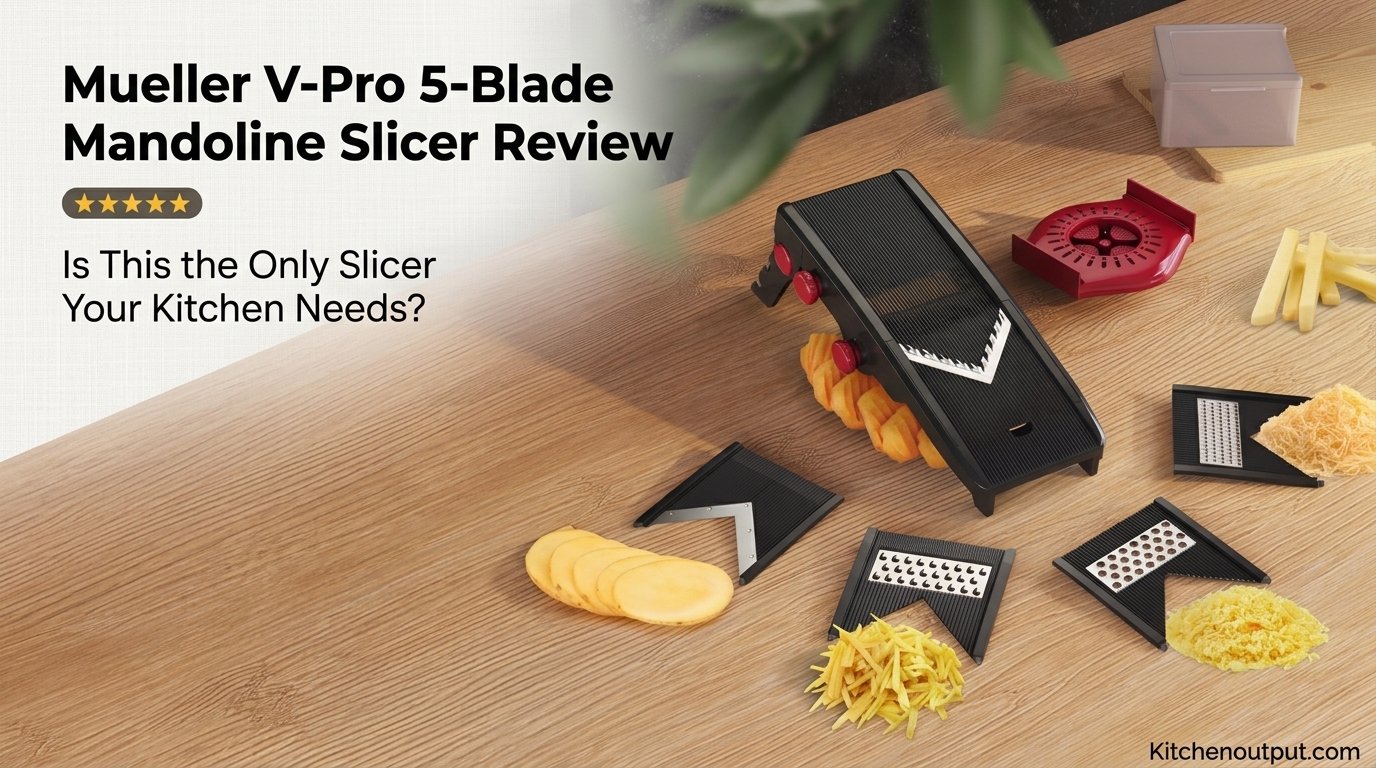
Mueller V-Pro 5-Blade Mandoline Slicer Review: Is This the Only Slicer Your Kitchen Needs?
A close, no-fluff look at slicing thickness, julienne blades, finger safety, and whether this budget mandoline earns a permanent spot in your kitchen drawer.
Quick Verdict
If you’ve ever stood over a cutting board trying to shave a potato into paper-thin, even rounds by hand, you already know the problem the Mueller V-Pro 5-Blade Mandoline Slicer is trying to solve. This is a manual, countertop mandoline built around one core idea: give home cooks a single tool that slices, juliennes, grates, and shreds without needing five separate gadgets cluttering a drawer. After spending real time slicing potatoes, cucumbers, cabbage, carrots, and zucchini with it, my take is straightforward — for the price this typically sells at, it punches well above its weight, provided you respect the blades and use the included food holder every single time.
It isn’t a professional restaurant-grade mandoline, and it isn’t trying to be. It’s a smart, compact, budget-friendly option for people who want restaurant-style uniform cuts at home without spending on a heavy-duty commercial unit. If that’s you, keep reading, because the details matter here more than the marketing photos suggest.
What follows is a thorough, section-by-section breakdown covering every blade, every adjustment knob, how it performed across a range of common vegetables, how it stacks up against a couple of well-known competitors, and the honest trade-offs worth knowing before you add it to your cart.

See real customer photos, current stock, and pricing on Amazon.
View on AmazonSpecs at a Glance
| Feature | Details |
|---|---|
| Blade material | 420-grade stainless steel |
| Number of blades | 5 interchangeable inserts |
| Slicing thickness range | 1mm to 9mm, adjustable via knob |
| Julienne sizes | 6mm and 9mm |
| Body material | Food-safe ABS plastic |
| Finger protection | Included food holder with grip |
| Base design | Folding non-slip feet, angled or flat |
| Cleanup | Blades and holder are dishwasher-safe |
| Storage | Included blade storage box |
| Best for | Potatoes, cucumbers, onions, carrots, cabbage, zucchini, apples |
Comparing your options before you buy? Take a look at our broader roundup of the best mandoline slicers to see where this model lands against the competition.
Unboxing & First Impressions
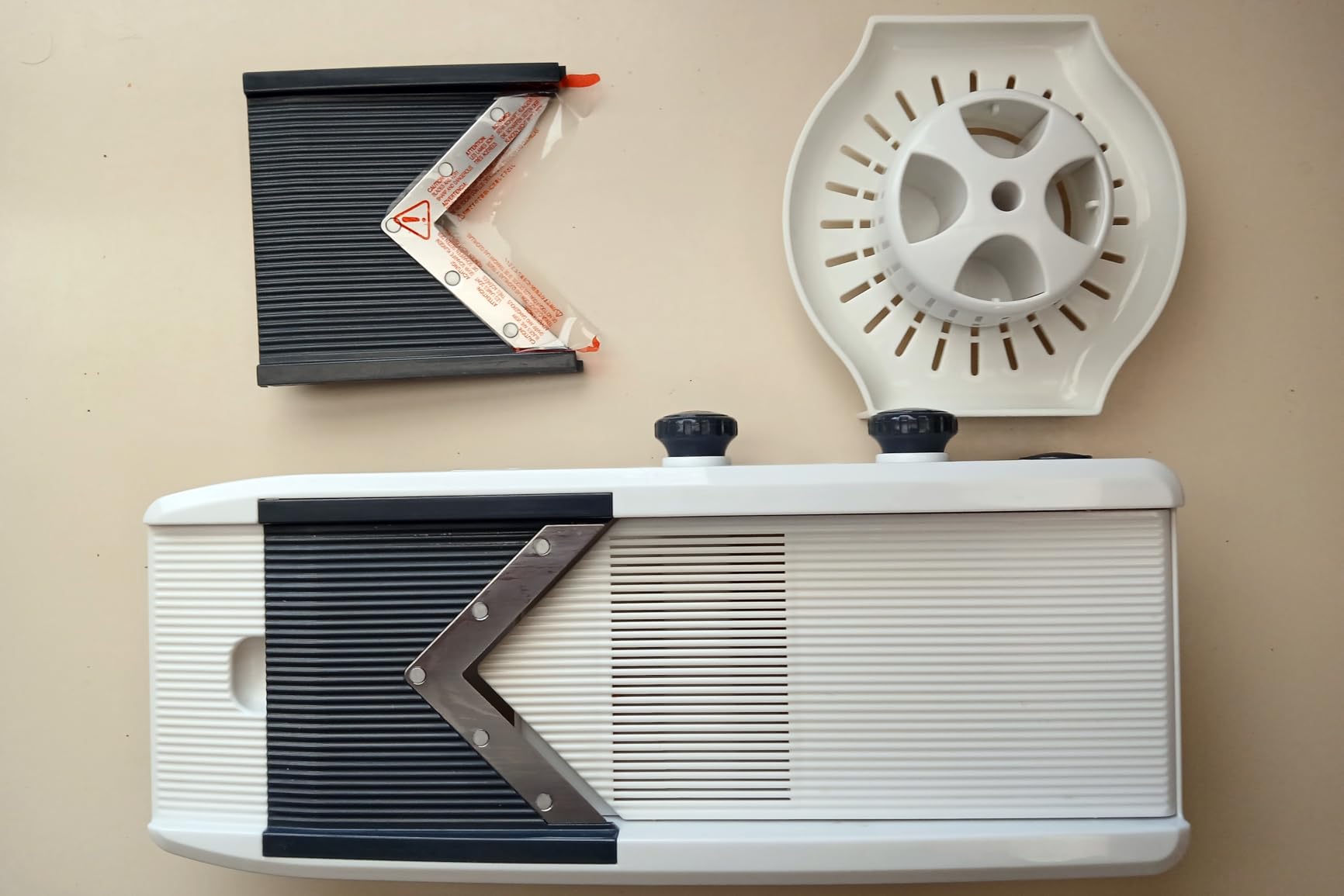
Out of the box, the Mueller V-Pro feels lighter than you might expect from photos, but that’s mostly a function of the ABS plastic body rather than a sign of flimsiness. The main slicing ramp has a slight incline built in, which helps gravity do some of the work as you push food down the track. Two red locking knobs sit toward the base — one controls slice thickness, the other controls julienne width — and both turn with a reassuring, slightly stiff resistance rather than feeling loose or wobbly.
The five blades come packed in a separate clear plastic case with a snap-shut lid, which is a small but genuinely useful touch. Mandoline blades are dangerously sharp, and having a dedicated home for them means you’re not fishing around a drawer risking a cut every time you want to switch blades. Each blade slots into the same open channel at the top of the ramp; you simply slide it in until it clicks and locks flush against the surface.
The included food holder — a red, dome-shaped grip with an internal spike plate — is the piece you’ll want to get comfortable with immediately, and we’ll cover exactly why in the safety section below.
One detail that stood out during setup is how intuitive the blade-locking mechanism feels compared to some competing mandolines that require awkward two-handed maneuvers to swap blades safely. Here, a single downward push is enough, and the mechanism gives clear tactile and audible feedback once the blade is properly seated. There’s also a small amount of flex in the plastic ramp when pressed firmly, which is worth noting simply so it isn’t mistaken for a defect — it’s a normal characteristic of the ABS construction rather than a sign of poor build quality.
The 5 Interchangeable Blades Explained
The headline feature of this unit is its blade system, and it’s worth walking through each one individually because they genuinely serve different purposes rather than being a marketing gimmick.
1. Slicer Blade
The flat slicer blade is the one you’ll reach for most often. It produces clean, even slices for potatoes, cucumbers, zucchini, onions, and apples. Combined with the adjustable thickness knob, this single blade can take you from wafer-thin gratin slices to thicker rounds suitable for baking or frying.
2. Shredder Blade
This blade produces fine, thin shreds — think shredded cabbage for slaw, shredded carrots for salads, or shredded cheese in a pinch (soft cheeses only; hard cheeses are better handled by a dedicated grater). The teeth are closely spaced, so the output is fluffy rather than chunky.
3. Grater Blade
The rounded-hole grater blade is built for harder produce that needs a coarser, rounder cut — think grated potatoes for hash browns, or grated carrots with a bit more bite than the shredder produces.
4. Wavy (Crinkle) Blade
This is the fun one. The wavy blade cuts ripple-cut chips, crinkle-cut pickles, and decorative vegetable garnishes. Beyond looking nice on a plate, crinkle cuts also hold onto sauces and dressings better than flat-cut slices because of the increased surface area.
5. Coarse Shredder Blade
Where the standard shredder is fine and fluffy, the coarse shredder produces thicker, sturdier shreds — better suited for things like hash brown potatoes that need to hold their shape when pan-fried, or coleslaw mixes where you want more bite and less mush.
Swapping blades takes seconds: slide the current one out, drop the next one into the same channel, and press down until it locks. There’s no tool required, which matters a lot when you’re mid-recipe and need to switch from slicing to shredding without losing momentum.
If you’re deciding between blade-swap systems and V-blade designs, our comparison of V-slicer vs. mandoline designs breaks down exactly how these mechanisms differ.
Get the full breakdown of blade types and current pricing on Amazon.
Check Price on AmazonAdjustable Slicing Thickness (1–9mm)
The slice-thickness knob sits near the base of the ramp and controls how far the blade protrudes above the sliding surface. Turning it clockwise raises the blade for thicker slices; turning it counterclockwise lowers it for thinner, more delicate cuts. The range runs from roughly 1mm — thin enough for gratin dishes or dehydrating — up to about 9mm, which is closer to a hearty steak-fry thickness.
In practice, the knob has enough resistance that it won’t drift mid-slice, which is a common complaint with cheaper mandolines. I found the sweet spot for potato chips around the 2mm mark, while thicker vegetable planks for grilling worked best around 6–7mm. The dial doesn’t have numbered markings printed directly on it, so getting to know your preferred settings takes a bit of trial and error the first few times you use it — but once you find your usual thickness for a given vegetable, it’s easy to return to.
Julienne Cutting Options: 6mm and 9mm
Underneath the main slicing ramp, hidden beneath a flip-up lid, sit the two julienne blade inserts. These aren’t separate attachable blades like the top five — they’re built into the unit itself and controlled by a second knob that adjusts the cut width between 6mm and 9mm.
This is genuinely one of the more clever design choices on this mandoline. Instead of needing a dedicated julienne peeler or a separate attachment, you flip the lid, dial in your width, and push vegetables through the same ramp you were just using for straight slices. Carrot matchsticks for a stir-fry, cucumber ribbons for a Vietnamese-style salad, or zucchini noodles for a lighter pasta substitute all become quick jobs rather than tedious knife work.
The two width options cover most home cooking needs — 6mm is closer to a traditional fine julienne, while 9mm produces a slightly chunkier matchstick that holds up better in stir-fries where you don’t want the vegetables to go limp.
Finger Guard & Safety Features
Let’s be honest about something upfront: mandolines have a reputation, and it’s not undeserved. The blades on this unit, like on any mandoline, are extremely sharp, and the flat slicing surface means there’s very little standing between your fingertips and the blade if you’re not using the safety tools provided.
The included food holder is the answer to that concern, and it’s better designed than many holders bundled with competing slicers. It’s a dome-shaped red plastic grip with internal spikes on the underside that bite into whatever you’re slicing — a potato, an onion half, a block of cabbage — so the food doesn’t slip while you’re pushing it down the ramp. Your hand sits on top of the dome, well clear of the blade edge, while downward pressure transfers through the spikes into the food itself.
The honest advice here, and the same advice that applies to every mandoline on the market: use the holder every time, even when the piece of food you’re slicing seems too small to bother. Most mandoline injuries happen in that exact moment — when someone decides the last inch of a cucumber is too small to need the guard and tries to finish it by hand. Don’t be that person. If a piece gets too small to hold safely even with the guard, set it aside for hand-slicing with a regular knife instead.
Cut-resistant gloves are a smart, inexpensive addition if you’re using this mandoline regularly, especially for beginners still building muscle memory around consistent, controlled pushing motions.
It’s also worth keeping small children and pets away from the immediate work area while the mandoline is in use, and rinsing blades promptly after each session rather than leaving them sitting wet in a sink where a hand might unexpectedly land on the edge while reaching for something else. None of this is unique to the Mueller V-Pro — it’s standard practice for any mandoline — but it bears repeating because the consequences of skipping these habits can be serious, even if they only take a few extra seconds to build into your routine.
Stability & Folding Non-Slip Feet
A mandoline that slides around on the counter mid-slice is worse than useless — it’s a safety hazard. Mueller addressed this with folding, non-slip feet at the base of the ramp that can be positioned two ways. Folded down and open, they prop the whole unit at an angle on a flat countertop or cutting board, giving you a natural downward slicing motion with gravity assistance. Folded flat against the body, the unit sits low and stable directly over a mixing bowl or plate, letting sliced food drop straight into your prep container without extra transferring.
In testing on both a granite countertop and a standard plastic cutting board, the rubberized feet held their grip well through repeated slicing motions. There was no meaningful lateral sliding, even when applying firm downward pressure on denser vegetables like sweet potatoes.
Cleaning & Storage
Cleanup is one area where blade-swap mandolines can get complicated, but this one keeps it fairly simple. The five top-loading blades pull straight out of their channel for individual rinsing or a spot in the dishwasher’s top rack. The two julienne blades, hidden under the flip-up lid, are similarly accessible once you open the panel — no tools or disassembly required.
The main plastic body isn’t submersible in the way you’d wash a bowl, but it wipes down easily under a running tap since there are no motors or electronics involved. The included storage box for the five spare blades solves the single biggest annoyance of blade-swap slicers: losing track of loose, extremely sharp blades in a drawer. Snap them into the case after washing and they’re ready for next time, with the added benefit of reduced injury risk during dish duty.
If you also use an air fryer to finish off mandoline-cut vegetables into chips or fries, our guide on how to clean an air fryer pairs well with keeping your whole prep-to-cook workflow low-maintenance.
Why a Mandoline Belongs in Your Kitchen
Before getting deeper into the specifics of this particular model, it’s worth stepping back and asking why a mandoline is worth owning in the first place. A sharp chef’s knife in skilled hands can technically do everything a mandoline does, but very few home cooks have the years of repetition needed to produce consistently even, paper-thin slices at speed. A mandoline closes that gap almost instantly. It turns a task that would otherwise take real knife skill and patience into something mechanical and repeatable — every slice comes out the same thickness as the last, which matters enormously for anything that needs to cook evenly, like gratins, chips, or roasted vegetable trays.
There’s also a time-saving argument that’s easy to underestimate until you’ve used one regularly. Julienning a few carrots by hand for a stir-fry might take five or six minutes of careful knife work. The same task on a mandoline with a built-in julienne function takes well under a minute. Multiply that across a week of regular cooking and the time savings add up quickly, which is really the entire value proposition of a tool like the Mueller V-Pro.
Real Kitchen Performance
Specs and marketing photos only tell half the story, so here’s what actually happened across a handful of common kitchen tasks.
Potato Chips
Set to the thinnest slice setting, this mandoline produced remarkably even, translucent potato slices — the kind you actually want for homemade chips or gratins where uniform cooking depends on uniform thickness. Slices came out consistent from the first cut to the last, with no noticeable blade drag or tearing.
Coleslaw Cabbage
Switching to the shredder blade, a half head of cabbage took under two minutes to shred completely, producing thin, even ribbons far more consistent than a hand-shredded batch. The coarse shredder blade, tested separately, gave a chunkier result better suited for slaws that need more texture.
Julienned Carrots
The julienne function under the flip lid handled carrots cleanly at both the 6mm and 9mm settings, producing matchsticks appropriate for stir-fry without the tedious hand-cutting that normally comes with restaurant-style julienne cuts.
Cucumber Ribbons
At a mid-range thickness setting, cucumbers sliced into long, even ribbons perfect for a quick pickle or a light summer salad. The slight incline of the ramp meant gravity did most of the work, requiring only light, steady downward pressure.
Across all of these tests, the main variable affecting quality wasn’t the mandoline itself but technique — keeping a steady, even push speed produced dramatically better results than rushing the motion.
Sweet Potato Fries and Wedges
Set to a thicker setting near the top of the range, sweet potatoes sliced into even planks that were then cut by hand into fry-shaped batons. The mandoline handled the density of sweet potato without excessive resistance, though denser vegetables like this do require slightly firmer, steadier pressure than something soft like a zucchini.
Apple Slices for Baking
For a quick apple tart, uniform apple slices matter more than almost anywhere else in cooking, since uneven pieces cook unevenly and can leave a dessert with both mushy and undercooked sections. The slicer blade at a mid-thin setting produced consistent apple rounds that baked evenly, which is a small but genuinely useful win for anyone who bakes regularly.
Crinkle-Cut Pickles
The wavy blade was, honestly, the most fun blade to test. Cucumber spears cut into crinkle shapes not only looked more appealing in a jar of homemade pickles but also seemed to pickle slightly faster, likely thanks to the increased surface area exposed to the brine.
| Food | Best Blade | Suggested Thickness |
|---|---|---|
| Potato chips | Slicer | 1–2mm |
| Gratin potatoes | Slicer | 2–3mm |
| Cucumber ribbons | Slicer | 3–4mm |
| Sweet potato fries (pre-cut) | Slicer | 7–9mm |
| Coleslaw cabbage | Shredder | N/A |
| Hash brown potatoes | Coarse shredder | N/A |
| Stir-fry carrots | Julienne | 6mm or 9mm |
| Crinkle-cut pickles | Wavy blade | 3–5mm |
Common Mistakes to Avoid
Even a well-designed mandoline can produce frustrating results, or worse, a trip to urgent care, if a few common mistakes creep into your routine. Here’s what to watch for.
Skipping the Food Holder “Just This Once”
This is, by far, the most common cause of mandoline injuries across every brand, not just this one. The temptation to finish off a small end piece by hand is strong, but that’s exactly when control is hardest to maintain and the blade is closest to your fingers. Set the small remainder aside for a knife instead.
Rushing the Push Motion
Fast, jerky pushes don’t make slicing faster in any meaningful way, but they do increase the odds of uneven slices, blade jamming, and loss of control. A slow, steady, deliberate motion produces better slices and is inherently safer.
Not Locking the Blade Fully
Each blade needs to click firmly into place before use. A blade that isn’t fully seated can shift mid-slice, producing uneven cuts or, in rare cases, popping loose unexpectedly.
Ignoring the Thickness Setting for the Task at Hand
Using the same thickness setting for every vegetable regardless of the dish is a common shortcut that leads to disappointing results. Thin gratin slices need a different setting than thick fries, and taking thirty seconds to adjust the dial pays off in the final dish. It also helps to think about how a food will cook afterward — thinner slices roast or fry faster and crisp more evenly, while thicker cuts hold their texture better in dishes like casseroles or slow-roasted vegetable trays.
Storing Blades Loosely
Tossing blades into a regular utensil drawer instead of the included storage case is asking for an accidental cut next time you reach in for a spatula. Get in the habit of returning blades to their case immediately after washing.
Long-Term Durability Considerations
Because the main body is food-safe ABS plastic rather than metal, it’s reasonable to ask how well this mandoline holds up over months or years of regular use. The blades themselves, made from 420-grade stainless steel, are the same grade of steel commonly used in kitchen knives and are built to hold an edge through repeated use without excessive care. The plastic housing, thickness knob, and folding feet are the components more likely to show wear over time with heavy daily use, though for typical home cooking frequency — a few times a week rather than several times a day — most owners should expect the unit to hold up well for a long stretch of regular use.
As with most kitchen tools built around a mix of plastic and steel, hand-washing the main body rather than exposing it to prolonged dishwasher heat cycles will help extend its useful life, even though the individual blades themselves are dishwasher-safe. Keeping blades dry before returning them to the storage case also helps prevent water spots or minor surface rust from developing over extended periods, which is a small habit that pays off considerably over months and years of regular use.
How the Mueller V-Pro Compares
No mandoline exists in a vacuum, so here’s how this model stacks up against two other popular options in the same general price bracket.
| Feature | Mueller V-Pro 5-Blade | OXO Good Grips V-Blade | Dash Safe Slice |
|---|---|---|---|
| Blade count | 5 interchangeable + 2 julienne | 1 fixed V-blade with inserts | Enclosed single blade |
| Thickness range | 1–9mm | Adjustable, narrower range | Fixed, limited adjustment |
| Julienne cutting | Yes, 6mm & 9mm built-in | Yes, via inserts | Not standard |
| Finger guard style | Dome grip with spikes | Handguard with pins | Fully enclosed housing |
| Storage for blades | Included blade box | Slot-in tray | N/A, single blade |
| Best for | Variety of cuts, home cooks who want one tool | Consistent slicing, ergonomic grip fans | Beginners prioritizing enclosed safety |
For a deeper side-by-side, our full OXO Chef’s Mandoline Slicer 2.0 review and Dash Safe Slice mandoline review go into more detail on each of those alternatives, and our OXO Good Grips V-Blade breakdown covers that model’s ergonomics specifically.
Pros & Cons
Pros
- Five distinct blade types cover slicing, shredding, grating, crinkle-cuts, and coarse shredding
- Built-in julienne function with two width options
- Wide 1–9mm thickness adjustment range
- Folding feet work on countertops, cutting boards, and directly over bowls
- Dishwasher-safe blades and included storage case
- Genuinely budget-friendly compared to multi-tool alternatives
Cons
- Blades are extremely sharp and require careful handling and storage
- Thickness dial has no printed numeric markings
- ABS plastic body feels lighter-duty than metal-frame mandolines
- Small end pieces of vegetables still need to be finished by hand
- Julienne lid mechanism takes a few uses to get used to
Who Should Buy This Mandoline
This slicer makes the most sense for home cooks who want variety without buying five separate gadgets. If your kitchen routine regularly involves potato dishes, slaws, salads, stir-fries, and the occasional decorative garnish, having slicing, shredding, grating, crinkle-cutting, and julienning in one compact unit is a genuine time-saver. It’s also a reasonable pick for anyone building out a starter set of must-have kitchen appliances on a budget, since it replaces multiple single-purpose tools at once.
It’s less suited to commercial kitchens or anyone prepping large volumes daily, where a heavier, all-metal mandoline with a larger surface area would hold up better to constant use. Casual and even fairly serious home cooks, though, are squarely in the target audience.
Meal Preppers
Anyone who batch-cooks on weekends will appreciate how much time this shaves off vegetable prep. A week’s worth of sliced onions, shredded cabbage, and julienned carrots can be knocked out in the time it would normally take to prep a single day’s portions by hand.
Home Cooks Who Entertain
Uniform, restaurant-style cuts make a real visual difference on a dinner party platter. Crinkle-cut vegetable trays, evenly sliced apple tarts, and consistent gratin layers all read as more polished without requiring advanced knife skills.
Anyone Watching Their Budget
Compared to buying a separate mandoline, box grater, julienne peeler, and crinkle cutter individually, a single tool that covers all of those functions at this price point represents a meaningfully better value, assuming you’re comfortable with the plastic-bodied build quality trade-off.
Who Might Want to Look Elsewhere
Cooks who prep large volumes of vegetables daily, run a small catering operation, or simply prefer the reassurance of an all-metal frame may be better served by a heavier-duty, higher-priced mandoline built for more demanding, repeated use.
What to Consider Before Buying Any Mandoline
Regardless of which specific model you end up choosing, a few factors are worth thinking through before making a purchase.
Blade Storage and Safety Design
Loose blades are the single biggest safety liability with any mandoline. Look for models, like this one, that include a dedicated storage case rather than leaving you to improvise with a plastic bag or a drawer.
Range of Cuts You Actually Need
It’s easy to be drawn in by a long list of included blades, but it’s worth being honest about which cuts you’ll actually use regularly. If julienne and shredding aren’t part of your usual cooking, a simpler single-blade slicer with a wider surface might serve you better than a multi-blade system.
Surface Grip and Stability
A mandoline that slides on the counter mid-use is a genuine hazard, not just an inconvenience. Non-slip, folding feet like the ones on this model are a meaningful safety feature, not just a convenience add-on.
Cleanup Effort
Multi-blade systems inherently mean more pieces to wash and dry compared to a single fixed-blade slicer. Dishwasher-safe components make a real difference here if you’re not eager to hand-wash five separate blades after every use, and having a clearly labeled place to put each blade after washing keeps the whole system from turning into a drawer full of unidentified sharp metal.
Tips for Getting the Best Results
- Always use the food holder, even for the final small piece of whatever you’re slicing.
- Keep push speed slow and steady — rushing causes uneven slices and increases injury risk.
- Dry blades thoroughly before storing them in the included case to prevent rust spots over time.
- Test your thickness setting on a scrap piece before committing to a full batch.
- Store the blade case somewhere out of reach of children, separate from everyday utensil drawers.
- For starchy vegetables like potatoes, rinse slices immediately after cutting to prevent browning and reduce starch before frying.
Recipes and Pairings That Make the Most of This Mandoline
A mandoline earns its keep fastest when it’s paired with recipes that actually benefit from uniform, thin cuts. Classic scalloped or au gratin potatoes are the obvious starting point — the entire dish depends on every slice cooking at the same rate, which is nearly impossible to achieve consistently with a knife but almost automatic with a mandoline set to a thin, even thickness. Homemade potato chips follow the same logic, and dialing the thickness down toward the 1–2mm range gives you the closest home approximation of the store-bought kind, especially once you factor in a quick soak to remove excess starch before frying or baking.
On the shredding side, coleslaw is the natural pairing, and switching between the fine shredder and coarse shredder blades lets you tune the texture between a classic deli-style slaw and a chunkier, more rustic version. The julienne function shines in stir-fries and Vietnamese-inspired salads like a quick bún or a simple carrot-and-daikon pickle, where thin, even matchsticks pickle faster and more evenly than roughly hand-cut pieces.
For anyone leaning on an air fryer for a lot of weeknight cooking, mandoline-cut vegetables are a natural match — evenly sliced zucchini, sweet potato, or squash all crisp up far more consistently in an air fryer basket than unevenly hand-cut pieces, which tend to finish at different rates. If that’s part of your routine, our guide on the best digital toaster oven air fryers is a useful companion piece for rounding out that side of your kitchen setup.
Alternatives Worth a Look
If a blade-swap mandoline isn’t quite what you’re after, it’s worth browsing a broader field before deciding. Our best mandoline slicers roundup covers a wider range of price points and safety mechanisms, while the OXO Chef’s Mandoline 2.0 is worth a look if you prioritize a single, ultra-consistent V-blade over multiple swap-in options. For those newer to mandolines and nervous about blade exposure, the enclosed design of the Dash Safe Slice trades some versatility for extra peace of mind.
And if slicing is just one piece of a larger kitchen upgrade, our kitchen appliance buying guide is a useful starting point for prioritizing what to buy next, especially if you’re also weighing bigger-ticket items like a food processor or stand mixer against smaller prep tools like this one.
Frequently Asked Questions
Is the Mueller V-Pro 5-Blade Mandoline Slicer dishwasher safe?
The interchangeable blades and the food holder are dishwasher-safe and can go on the top rack. The main plastic body is best cleaned by hand under running water since it isn’t fully submersible in the way small parts are.
How thin can this mandoline slice?
The adjustable thickness dial goes down to roughly 1mm, thin enough for gratin-style dishes, chips, or dehydrating, and up to about 9mm for thicker cuts.
Does it come with a julienne blade?
Yes. Two built-in julienne options, 6mm and 9mm, are hidden under a flip-up lid on the main ramp and controlled by a separate adjustment knob.
Is this mandoline safe for beginners?
It’s usable by beginners as long as the included food holder is used every time. Like any mandoline, the blades are sharp enough to cause injury if food is pushed through by hand without the guard, especially toward the end of a vegetable.
What foods work best with this mandoline?
Firm produce works best: potatoes, cucumbers, zucchini, carrots, cabbage, onions, and apples all slice cleanly. Very soft produce like ripe tomatoes can be trickier and may need a gentler hand or a different tool entirely.
How do you switch between the five blades?
Each blade slides into the same open channel at the top of the ramp and locks into place with light downward pressure. No tools are required, and swapping takes only a few seconds.
Can this mandoline grate hard cheese?
The grater blade is better suited to firmer vegetables like potatoes and carrots rather than hard cheeses, which are more efficiently handled with a dedicated box grater or microplane.
Does the mandoline stay stable on the counter while slicing?
Yes. The folding non-slip feet grip well on countertops and cutting boards, and the design also allows the unit to sit flat directly over a bowl or plate for catching slices as they fall.
How should the blades be stored between uses?
The mandoline comes with a dedicated plastic storage case for the five removable blades. Storing them there, rather than loose in a drawer, keeps them organized and reduces the risk of accidental cuts.
What’s the difference between the shredder and coarse shredder blades?
The standard shredder blade produces fine, thin shreds suitable for slaws and salads, while the coarse shredder blade cuts thicker, sturdier shreds better suited for dishes like hash browns that need to hold their shape during cooking.
Is the thickness dial marked with numbers?
No, the dial doesn’t have printed numeric markings, so finding your preferred thickness setting for specific vegetables takes a little trial and error the first few times you use it.
Is this mandoline a good gift for someone who cooks often?
It’s a reasonable option for anyone who enjoys home cooking and doesn’t already own a mandoline, particularly for people who like consistent, restaurant-style cuts without the cost of a professional-grade unit.
Final Verdict
The Mueller V-Pro 5-Blade Mandoline Slicer does something a lot of budget kitchen tools fail to do: it actually delivers on the promise of replacing several single-purpose gadgets with one reasonably well-built unit. The blade variety is the real selling point here — slicing, fine shredding, coarse shredding, grating, and crinkle-cutting cover the vast majority of everyday vegetable prep, and the built-in julienne function is a genuinely useful bonus rather than an afterthought.
It isn’t flawless. The plastic body won’t feel as substantial as a metal-frame mandoline, and the thickness dial’s lack of numbered markings means a small learning curve. But for the price point this typically occupies, those are minor trade-offs against the versatility on offer. Used correctly — with the food holder every time, and a bit of patience while dialing in your preferred settings — this is a mandoline that can genuinely speed up meal prep and produce more consistent results than most people manage by hand.
For the price, the combination of five distinct blade profiles, a genuinely useful julienne function, safe and organized blade storage, and a stable, folding base adds up to a tool that’s easy to recommend to most home cooks looking to upgrade their vegetable prep without a big investment. Treat the blades with respect, keep the food holder within reach at all times, and this mandoline should handle the bulk of your slicing, shredding, and julienning needs for a long time to come.

Check today’s price and customer reviews on Amazon before you decide.
Buy on AmazonStill comparing your options? Revisit our best mandoline slicers guide, or see the full details on the Mueller V-Pro 5-Blade Mandoline Slicer product page for additional specs.
As an Amazon Associate, this site earns from qualifying purchases made through links on this page. This has no effect on the opinions expressed in this review.


