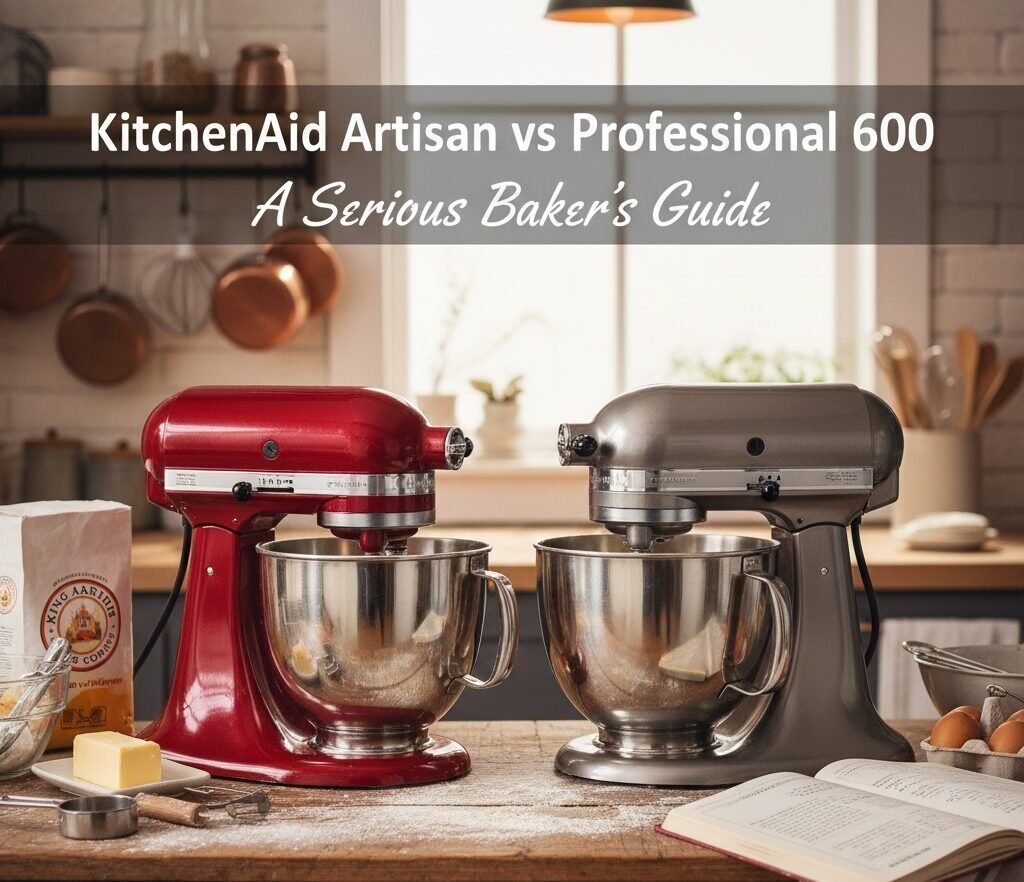
KitchenAid Artisan vs Professional 600: A Serious Baker’s Guide
You’ve decided to invest in a KitchenAid. Congratulations—you’re about to own a piece of American culinary history. But now you face the classic dilemma, the question that has echoed through the kitchens of passionate bakers for decades: do you choose the iconic, colorful Artisan, or do you step up to the power and capacity of the Professional 600? It’s a confusing choice because both are fantastic machines, yet they are built for fundamentally different kinds of bakers and different kinds of work.
Here at Digital Fryer, we’ve spent countless hours with both of these legendary mixers. We’ve creamed mountains of butter and sugar in the Artisan and kneaded dense, heavy bread dough in the Pro 600. We’ve felt the satisfying click of the Artisan’s tilt-head and heard the determined roar of the Pro 600’s motor under load. This isn’t just a spec comparison; it’s a deep dive into the real-world experience. We’re here to demystify the specs, explain the crucial mechanical differences, and help you diagnose your own baking habits to make the perfect choice. This is your definitive guide to choosing the right KitchenAid for your kitchen.
At a Glance: Artisan vs. Professional 600
For those in a hurry, this table breaks down the most critical differences between KitchenAid’s most popular model and its workhorse big brother.
| Feature | KitchenAid Artisan (5-Quart) | KitchenAid Professional 600 (6-Quart) |
|---|---|---|
| Core Mechanism | Tilt-Head Design: The head of the mixer tilts back for easy access to the bowl. | Bowl-Lift Design: The bowl is raised up to the stationary mixer head via a lever. |
| Motor Power | 325-Watt AC Motor. Excellent for most baking tasks. | 575-Watt AC Motor. Designed for heavier, denser mixtures and larger batches. |
| Capacity | 5 Quarts (Yields ~9 dozen cookies or 1 loaf of bread). | 6 Quarts (Yields ~13 dozen cookies or 2 loaves of bread). |
| Best For | The passionate hobbyist: cakes, cookies, frostings, and occasional single loaves. Values convenience and color. | The aspiring artisan: frequent bread baking, double batches, holiday baking. Values power and stability. |
| Key Advantage | Convenience and aesthetics. Easy to add ingredients and scrape the bowl. Huge color selection. | Power and stability. The workhorse for heavy doughs and large quantities. |
| Dough Hook | “C”-shaped dough hook. Effective for light doughs. | Spiral dough hook. More efficient for kneading heavier bread doughs. |
| Size & Weight | Shorter and lighter. Fits easily under standard cabinets. | Taller and heavier. A permanent countertop fixture. May not fit under all cabinets. |
The Most Important Decision: Tilt-Head vs. Bowl-Lift
Before you even think about color or wattage, you must understand this fundamental mechanical difference. It impacts your workflow, the stability of the machine, and the types of tasks it excels at more than any other feature.
The Artisan’s Tilt-Head Design: The Champion of Convenience
The tilt-head is the design most people picture when they think of a KitchenAid. A hinge at the back allows the entire motor head to tip up and back, giving you wide-open, unfettered access to the bowl. You can easily add ingredients, scrape down the sides with a spatula, or remove the bowl and beater without any obstruction.
Our Experience: For everyday baking—creaming butter and sugar, mixing cake batter, whipping cream—this design is a joy to use. The workflow is intuitive and seamless. Adding a cup of flour or a handful of chocolate chips is effortless. The main drawback is a consequence of this convenience: the hinge point is a potential weak spot. When you’re kneading a particularly heavy or stiff dough, you can physically see the head “bobbing” or rocking slightly. This isn’t a defect; it’s just the physics of a top-heavy machine with a hinge. For most tasks, it’s not an issue, but for serious bread makers, it’s a significant limitation.
- Pros: Unmatched convenience for adding ingredients and scraping, easier to change attachments, generally smaller footprint.
- Cons: Less stable under heavy loads, the head can rock with stiff doughs, the hinge is a point of mechanical stress.
The Professional 600’s Bowl-Lift Design: The Pillar of Stability
The bowl-lift design is borrowed directly from commercial bakery mixers. The head of the mixer is completely fixed and stationary. The bowl itself rests on two sturdy arms, and a large crank lever on the side raises the bowl up into position, locking it securely against the beater and the head.
Our Experience: The first time you lock the bowl into place on a Pro 600, you feel the difference. This machine is a tank. There is zero flex, zero rocking, zero movement, even when it’s kneading 10 cups of dense whole wheat dough. All the motor’s energy is transferred directly into the bowl. This stability is the number one reason serious bakers upgrade to a bowl-lift model. The trade-off, however, is convenience. To add ingredients, you have to pour them carefully down the side or use a pouring shield. To scrape the bowl, you have to fully lower it, remove the beater, and then scrape. It’s a more deliberate, less fluid workflow.
- Pros: Incredible stability for heavy doughs, more efficient power transfer, larger capacity, all-metal gear construction.
- Cons: Less convenient for adding ingredients and scraping, can be too tall for some cabinets, generally fewer color options.
Expert Take: Your choice here is a direct reflection of what you bake. If you spend 80% of your time making cookies, cakes, and frostings, the convenience of the Artisan’s tilt-head will make your baking life more enjoyable. If bread is your passion and you frequently find yourself making double batches or working with stiff doughs, the power and unwavering stability of the Professional 600’s bowl-lift is not just a feature, it’s a necessity.
Power and Capacity: How Much Mixer Do You Truly Need?
It’s easy to get caught up in the numbers—325 watts vs. 575 watts, 5 quarts vs. 6 quarts—but what do these numbers actually mean for your recipes?
Motor Power Translated
The Artisan’s 325-watt AC motor is a proven workhorse. It has more than enough power to cream cold butter, whip egg whites into stiff peaks, and knead a single loaf of standard bread dough without issue. It’s the perfect engine for the vast majority of home baking tasks.
The Professional 600’s 575-watt AC motor is a significant step up. This isn’t just about speed; it’s about torque—the raw twisting force needed to move a heavy mass. This extra power means that when it encounters the resistance of a dense dough, it doesn’t slow down or strain as much. The motor runs more efficiently and stays cooler, which is critical for the longevity of the machine when performing demanding tasks. This is the power you need for enriched doughs like brioche, stiff pasta dough, or back-to-back batches of holiday cookies. The importance of a robust motor is a common theme in high-performance appliances, whether it’s a mixer or a powerful blender, a topic we explore in our Blendtec vs Vitamix comparison.
Capacity in Real Terms
That single extra quart in the Pro 600 makes a world of difference. Let’s break it down into practical batch sizes:
- Cookies: The Artisan’s 5-quart bowl can comfortably handle dough for up to 9 dozen cookies. The Pro 600’s 6-quart bowl can handle up to 13 dozen. For holiday baking, that’s a huge difference.
- Bread: The Artisan is best suited for recipes calling for up to 7 cups of all-purpose flour, which typically yields one standard loaf. The Pro 600 can handle recipes using up to 14 cups of flour, allowing you to comfortably make two large loaves or a very large batch of rolls.
- Mashed Potatoes: The Artisan can handle about 6 pounds of potatoes. The Pro 600 can power through up to 8 pounds.
Performance Test: Where the Dough Meets the Hook
We put both mixers through their paces with two common but revealing recipes.
Test 1: Double Batch of Chocolate Chip Cookies
- Artisan: It handled a single batch (about 6 dozen cookies) with ease. Creaming was perfect, and incorporating the flour was no problem. When we attempted a double batch, the bowl was filled to the brim. Flour puffed out over the top, and the motor’s sound deepened as it worked to incorporate the final additions. It did the job, but it was clearly at its maximum capacity.
- Professional 600: A double batch was no problem at all. The 6-quart bowl had plenty of room to spare, which meant less mess and more efficient mixing. The powerful motor didn’t change its tune one bit when the flour and chips were added. It felt like it was just warming up.
Test 2: Two Loaves of Whole Wheat Bread Dough (Stiff)
- Artisan: We scaled this back to a single loaf. The Artisan’s “C”-shaped dough hook kneaded the dough, but the mixer head noticeably rocked and bobbed up and down. The motor made a distinct straining sound. While it developed the gluten, it was clear that doing this frequently would put a lot of stress on the machine’s gears and motor.
- Professional 600: This is what the Pro 600 was built for. We made the full two-loaf recipe. The mixer was perfectly stationary on the counter. The spiral dough hook, which is designed for more efficient kneading, worked the dough beautifully. The motor maintained a consistent, powerful hum without any sign of strain. The difference in performance, confidence, and stability was staggering.
The Pro 600 is a clear step up for bread, but for those who have truly dedicated themselves to the craft, it’s worth knowing that even more specialized machines exist. We compare KitchenAid to one such dough powerhouse in our Ankarsrum stand mixer vs KitchenAid article.
Head-to-Head: The Flagship Models
Let’s look at the specific, best-selling models in each line.
KitchenAid Artisan Series 5-Quart Tilt-Head Stand Mixer
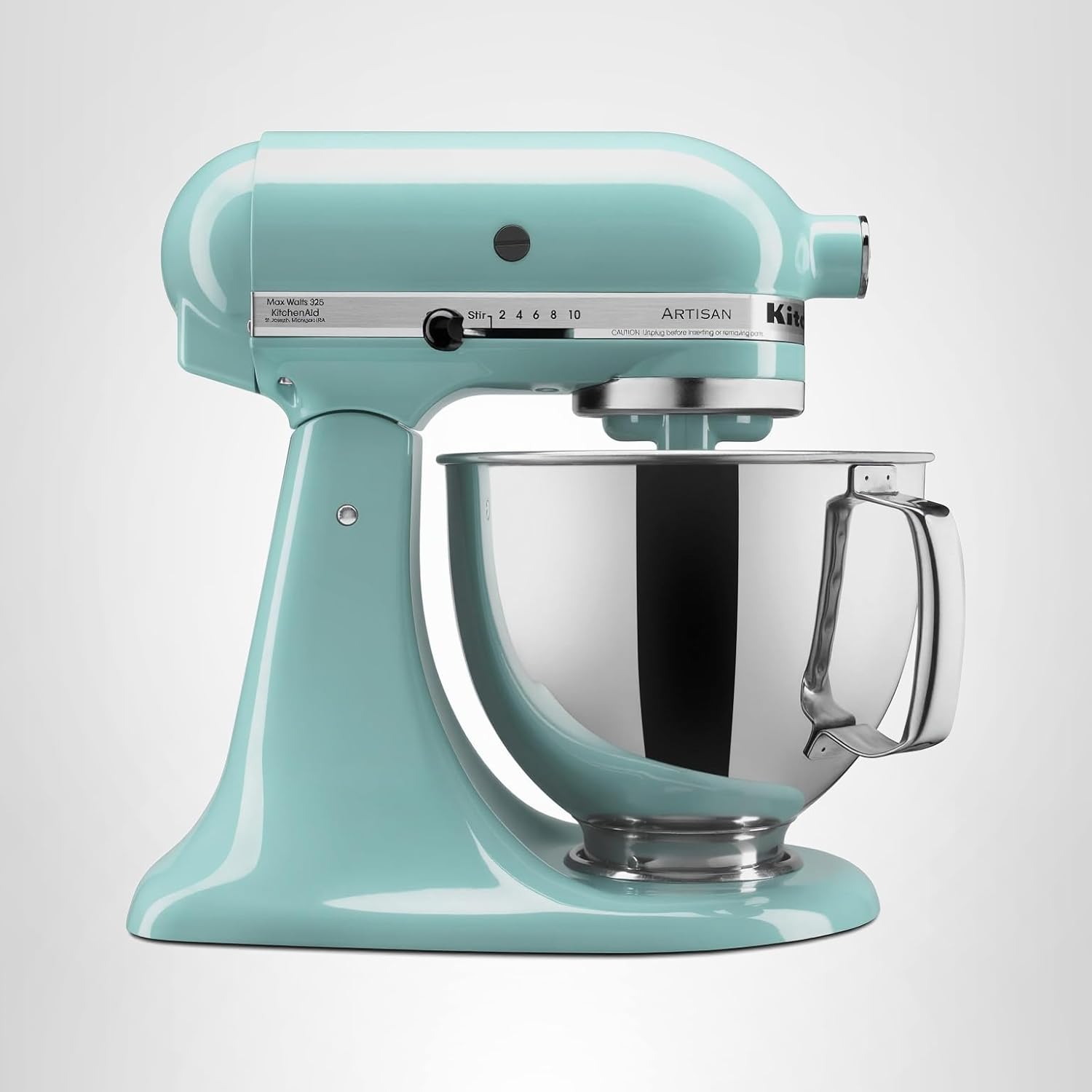
The icon. The legend. The Artisan 5-Quart is the world’s best-selling stand mixer for a reason. With its convenient tilt-head design, reliable 325-watt motor, and an incredible array of color options, it’s the perfect partner for the passionate home baker who does a little bit of everything.
Check Price on AmazonKitchenAid Professional 600 Series 6-Quart Bowl-Lift Stand Mixer

The workhorse. The Pro 600 is the gateway to serious baking. Its powerful 575-watt motor, massive 6-quart capacity, and ultra-stable bowl-lift design make it the ideal choice for bakers who regularly tackle heavy bread doughs, large batches of cookies, and other demanding recipes.
Check Price on AmazonSpeeds, Attachments, and What’s in the Box
Wattage and bowl capacity get most of the attention, but the day-to-day experience of owning a KitchenAid also comes down to speed control and the ecosystem of attachments you can build around it. Both the Artisan and the Professional 600 share the same 10-speed slide control, but how each machine delivers those speeds—and what comes standard in the box—differs in ways that matter once you start using the mixer regularly.
The 10-Speed Slide Control
Every current KitchenAid Artisan and Professional 600 uses the same familiar 10-speed lever on the right side of the machine. Speed 1 and 2 are for slow stirring and combining dry ingredients without a cloud of flour escaping the bowl. Speeds 3 through 6 handle creaming, mixing, and most everyday cake and cookie work. Speeds 7 through 10 are reserved for whipping cream, beating egg whites, and other fast, light-volume tasks. The mechanical action is identical between the two lines—both mixers use planetary mixing action, where the beater spins on its own axis while simultaneously orbiting the bowl in the opposite direction, touching 67 points around the bowl on every rotation. This is why KitchenAid mixers are famous for not needing a rotating bowl the way many cheaper mixers do.
Where the two machines start to differ is in how the motor holds those speeds under load. On the Artisan, if you push a thick cookie dough on a mid-range speed, you may notice the motor bogging down slightly and the effective speed dropping until the resistance eases. The Professional 600’s larger motor and electronic speed sensor feedback system are built to hold the selected speed more consistently, even as the dough thickens, which is part of why serious bakers describe the Pro 600 as feeling more “commercial” in how it behaves.
Soft Start and Splatter Control
Both mixers feature a soft-start function, meaning the motor ramps up gradually to the selected speed rather than jumping straight to full power. This is a small feature, but it matters enormously in practice: without soft start, flipping straight to speed 8 to whip cream would send a shower of ingredients across your countertop and cabinets before the beater catches up to speed. The soft-start behavior is slightly more refined on the Professional 600, a byproduct of its more advanced motor control electronics, though the difference is subtle enough that most home bakers wouldn’t notice it in a blind test.
What Comes in the Box
Standard accessories differ somewhat depending on retailer bundle, but the baseline attachments for each model are worth knowing before you buy:
- KitchenAid Artisan 5-Quart: Typically ships with a flat beater, a wire whip, a coated dough hook, and the stainless steel mixing bowl with a comfortable handle.
- KitchenAid Professional 600: Typically ships with a flat beater, a wire whip, a spiral (PowerKnead) dough hook designed specifically for bread, and the larger 6-quart stainless bowl with a handle. Many bundles also include a pouring shield, which snaps onto the bowl rim to contain splashes and provide a chute for adding ingredients while the bowl-lift mixer is running.
Neither mixer includes a splash guard or pouring shield as a universal standard across every retail package, so if that accessory matters to you, check the specific listing before purchasing.
The Power Hub: A Shared Advantage
One of the most underrated reasons people stay loyal to the KitchenAid ecosystem for decades is the front power hub, located just above the attachment locking lever on both the Artisan and the Professional 600. This hub accepts the same universal attachments across virtually every KitchenAid stand mixer ever made, tilt-head or bowl-lift, old or new. That means a pasta roller and cutter set, a meat grinder, a vegetable spiralizer, a food strainer for tomato sauce and applesauce, a citrus juicer, or an ice cream maker attachment will work identically whether it’s plugged into an Artisan or a Professional 600. If you already own attachments from a previous KitchenAid mixer, or you’re planning to build out a full attachment collection over time, this cross-compatibility is one of the strongest arguments for staying within the KitchenAid family rather than switching brands.
Build Quality and Gear Construction: What’s Really Inside
Beyond the visible design differences, there’s an internal distinction that heavily influences long-term durability and is one of the most searched-for details when people compare these two mixers: the gear transmission.
The KitchenAid Artisan uses a transmission with a mix of metal and reinforced nylon gears. This is a deliberate engineering choice, not a corner-cutting one. In a tilt-head mixer, having one nylon gear in the drive train actually protects the motor: if you ever overload the mixer with something the motor genuinely cannot handle, the nylon gear is designed to strip or wear down first, acting as a mechanical fuse that sacrifices itself rather than burning out the motor or cracking the housing. For the vast majority of home baking tasks, this transmission will comfortably outlast the mixer’s other components and give you a decade or more of reliable service.
The KitchenAid Professional 600, by contrast, uses an all-metal gear transmission throughout. There is no sacrificial nylon component. This is part of why the Pro 600 can tolerate sustained heavy loads, like back-to-back batches of bagel or pizza dough, without the same wear concerns. All-metal gears also mean less flex and a more direct transfer of torque from the motor to the beater, which contributes to the noticeably more solid feel bakers describe when kneading dense doughs on the Pro line. The trade-off is that because there’s no sacrificial component, a catastrophic overload on the Pro 600 is more likely to stress the motor itself rather than a replaceable gear, which is one more reason KitchenAid pairs the all-metal transmission with a substantially larger motor in the first place.
Both mixers use worm-drive style transmissions lubricated with a lifetime grease that generally does not need to be serviced under normal home use. If you ever notice a burning smell, grinding noise, or grease leaking from the head of either machine, that’s a sign to stop using it and contact KitchenAid service rather than attempting a DIY repair, since opening the head housing yourself typically voids the warranty.
Noise Levels and Kitchen Comfort
Motor noise is one of those details that rarely shows up in spec sheets but has an outsized impact on how much you enjoy using a mixer, especially if you bake in an open-concept kitchen, early in the morning, or with young kids sleeping nearby.
The Artisan’s 325-watt motor produces a moderate hum that rises in pitch as you move up through the speed settings, but it stays in a range most people find unobtrusive, comparable to a countertop blender running on a low setting. Conversations can continue nearby without raising your voice, and it’s generally considered one of the quieter stand mixers in its class.
The Professional 600 is a different experience entirely. Because it’s pushing significantly more torque through an all-metal gear train, it produces a deeper, more mechanical growl, especially at high speeds or under load with heavy dough. It’s not unpleasant, and many bakers actually associate that sound with power and confidence, but it is objectively louder, closer to a small kitchen exhaust fan or a stick blender working through frozen fruit. If you bake late at night, in an apartment with thin walls, or in a kitchen adjacent to a nursery, this is a legitimate factor to weigh, and it’s one of the most common surprises first-time Pro 600 owners mention after upgrading from an Artisan.
Price and Long-Term Value
Price is often the first filter people apply, and it’s worth addressing directly. The Professional 600 typically carries a meaningfully higher price tag than the Artisan, reflecting its larger motor, bigger bowl, and all-metal transmission. Sale events, retailer bundles, and refurbished or open-box listings can narrow that gap considerably, so it’s always worth comparing current pricing across a few retailers before deciding, since KitchenAid mixers see frequent promotional pricing around major holidays.
The more useful way to think about value isn’t the sticker price in isolation, but cost-per-use over the life of the mixer. Both machines are built to last many years, often decades, when properly cared for, which is part of why used and inherited KitchenAid mixers remain common and highly sought after. If you’re a casual baker who makes a batch of cookies every few weeks, the Artisan’s lower upfront cost will feel like the right value, since you’ll rarely if ever push it to its limits. If you bake bread weekly, cater events, or run a small home bakery, the Pro 600’s higher price is easily justified by the time saved not babying the machine through heavy loads, and by the reduced risk of premature wear that comes from consistently pushing a smaller mixer past its comfortable capacity.
It’s also worth factoring in attachment costs into your total budget. Because both mixers share the same power hub, your attachment investment carries forward regardless of which base mixer you choose, so this part of the value equation is a wash between the two models.
Footprint, Storage, and Countertop Considerations
We touched on cabinet clearance in the FAQ, but footprint deserves a closer look since it affects daily usability, not just a one-time fit check.
The Artisan’s compact, lighter tilt-head design (it weighs in around 22 to 25 pounds depending on color and bowl material) makes it realistic to lift in and out of a lower cabinet for bakers who don’t want a mixer permanently occupying counter space. It’s not necessarily light, but it’s manageable for most adults to move occasionally without strain.
The Professional 600 is a different proposition. At roughly 26 to 29 pounds and with a taller, top-heavier profile once the bowl is loaded, most owners treat it as a permanent countertop fixture rather than something to store away between uses. This isn’t just about weight; the bowl-lift arms and the wider base mean it doesn’t tuck into a standard appliance garage as easily as the Artisan does. If kitchen storage space is tight and you were hoping to keep your mixer out of sight when it’s not in use, this is a meaningful practical difference that goes beyond the simple “will it fit under the cabinet” question.
Cleaning and Everyday Maintenance
Neither mixer is dishwasher-friendly at the mixer level, obviously, but the bowls and attachments have some differences worth knowing. Stainless steel bowls on both lines are dishwasher safe, though many long-time KitchenAid owners prefer hand washing to preserve the mirror finish over the years. Coated flat beaters and dough hooks are also generally dishwasher safe, while the wire whip’s many crevices make hand washing with a bottle brush a faster and more thorough option in practice.
Day-to-day wipe-downs differ slightly by design. The Artisan’s tilt-head means flour and batter splatter tend to collect around the hinge and the underside of the head, which requires occasional attention with a damp cloth and a toothbrush to keep the hinge mechanism free of dried buildup. The Professional 600’s bowl-lift arms and the exposed lift mechanism on the side of the machine are the equivalent trouble spots, and dried dough or batter here can make the lift lever feel stiff over time if it’s not cleaned regularly. In both cases, unplugging the mixer before cleaning around any moving mechanical part is essential, and neither the head nor the motor housing should ever be submerged or rinsed directly under a faucet.
Specialty Tasks: Meringue, Pizza Dough, and Cake Decorating
Beyond the standard cookies-and-bread comparison, a few specific tasks come up often enough among home bakers that they’re worth addressing directly.
Whipping Meringue and Egg Whites
Both mixers handle meringue and whipped egg whites well, since this is a low-torque, high-speed task rather than a high-resistance one. The Artisan’s lighter bowl and quicker access via the tilt-head can actually make it feel slightly more convenient for meringue work, since you can watch the peaks form and stop the moment you hit stiff peaks without wrestling with a bowl-lift lever. The Pro 600 performs just as well functionally, but its extra size and weight offer no real advantage for this particular task.
Pizza and Bagel Dough
Stiff, low-hydration doughs like bagel dough or a classic Neapolitan-style pizza dough are among the most demanding tasks a stand mixer can face, arguably more demanding than a standard sandwich bread. This is a category where the Professional 600’s spiral dough hook and all-metal transmission show a clear advantage. The Artisan can manage a single batch of pizza dough for two or three pizzas without major issue, but bakers who make pizza dough weekly, or who scale up to a full batch of bagels, consistently report better results and less mechanical strain on the Pro 600.
Cake Decorating and Buttercream
For whipping large batches of American buttercream or Swiss meringue buttercream for a tiered cake, the Pro 600’s larger bowl capacity becomes genuinely useful, since decorators often need several batches’ worth of frosting on hand at once. That said, the Artisan remains the more popular choice among home cake decorators simply because most home bakers aren’t producing wedding-cake-scale quantities regularly, and the tilt-head’s easy bowl access makes swapping colors and flavors between smaller batches more convenient.
Alternatives Worth Knowing About
The Artisan and Professional 600 aren’t the only two models in KitchenAid’s lineup, and a few close relatives come up often enough in searches that they deserve a mention.
- KitchenAid Classic Series: A more budget-friendly tilt-head mixer with a smaller 4.5-quart bowl and a slightly less powerful motor than the Artisan. It’s a good entry point for casual bakers but lacks some of the Artisan’s refinements and color range.
- KitchenAid Artisan Mini: A compact, 3.5-quart version of the Artisan aimed at small kitchens and light baking, roughly 25% smaller and lighter than the standard Artisan, with a correspondingly smaller motor.
- KitchenAid Professional 5 Plus: A bowl-lift mixer that sits between the Artisan and Pro 600 in capability, often found at warehouse clubs. It uses a 450-watt motor and a 5-quart bowl, making it a middle-ground option for bakers who want bowl-lift stability without paying for the Pro 600’s full power and capacity.
- KitchenAid Professional 6500 Design: A premium bowl-lift model similar in power to the Pro 600 but finished with a glass bowl and additional styling touches, aimed at bakers who want Pro-level performance with a different aesthetic.
Availability of specific models can shift over time as KitchenAid updates its lineup, so if a particular model name isn’t showing up at your preferred retailer, a very similar bowl-lift or tilt-head alternative is usually available in its place.
Warranty and Long-Term Support
KitchenAid stand mixers, including both the Artisan and Professional 600, are generally backed by a standard limited warranty covering defects in materials and workmanship for a set number of years from the date of purchase, with coverage details varying slightly by region and retailer. Because these mixers are designed to be serviced rather than replaced, KitchenAid maintains a network of authorized service centers, and many parts, from beaters to gaskets to power cords, remain available as replacement parts for years after a given model is discontinued. Registering your mixer after purchase is worth doing, since it simplifies warranty claims and ensures you’re notified of any safety recalls.
Color Options and Kitchen Aesthetics
One of the reasons the Artisan remains the best-selling stand mixer in America has little to do with wattage or torque. It’s the color. KitchenAid has built an entire brand identity around the Artisan’s finish options, and at any given time there are typically several dozen colors available, ranging from classic Empire Red and Onyx Black to seasonal and limited-edition shades that rotate throughout the year. This is one of the most frequently searched aspects of the Artisan buying decision, and for good reason: for many home bakers, the mixer sits out on the counter as a permanent design element in the kitchen, not just a tool tucked away in a cabinet.
The Professional 600 takes a more restrained approach to color. Because it’s marketed toward serious bakers who prioritize function, the Pro 600 is typically offered in a smaller number of finishes, often limited to a handful of classic options like silver, black, and occasionally a seasonal red or blue. If having a specific color that matches your kitchen decor is a high priority, this alone may tip the decision toward the Artisan, since the color selection gap between the two lines is significant.
It’s also worth noting that both mixers are available with different bowl finishes depending on the exact model number. Standard bowls on both lines are polished stainless steel, but some Artisan bundles include a bowl with a contrasting brushed or hammered finish, and specialty editions occasionally pair the mixer body with a complementary bowl color. If aesthetics matter to you as much as performance, it’s worth browsing the full range of available finishes before settling on a specific model number, since two mixers with the same internal specs can look dramatically different on the counter.
A Brief History: Why These Two Designs Exist
Understanding a little of the backstory helps explain why KitchenAid still sells two fundamentally different mixer designs instead of consolidating into one. The tilt-head design, which the Artisan is built around, traces back to KitchenAid’s original home stand mixer models from the early-to-mid 20th century, when the priority was making a powerful commercial-style mixing action accessible and easy to use in a home kitchen. The tilt-head’s simplicity and ease of bowl access made it an instant favorite with home cooks and bakers, and that basic architecture has remained largely unchanged for decades, cemented by the introduction of the Artisan’s now-iconic silhouette and expanding color lineup.
The bowl-lift design, meanwhile, has its roots in KitchenAid’s commercial and semi-commercial mixer lines, originally intended for bakeries and food service operations that needed a more stable platform for continuous, heavy-duty use. As home baking, and particularly home bread baking, grew in popularity, KitchenAid brought this commercial-inspired architecture down into a consumer-friendly size and price point, which is how the Professional line, including the Professional 600, came to exist. In other words, the Artisan and the Professional 600 aren’t just two trims of the same product; they represent two different engineering lineages that KitchenAid has continued to refine in parallel because each serves a genuinely different use case.
A Practical Buying Checklist
If you’re still torn after reading through the specs and performance tests, running through this checklist can help clarify which machine actually fits your baking life, rather than which one simply sounds more impressive on paper.
- Count your bread bakes. If you make bread, pizza dough, or bagels more than once a month, lean toward the Professional 600.
- Measure your cabinet clearance. If your under-cabinet space is tight, verify the Pro 600’s height against your specific kitchen before buying.
- Think about batch size. If you regularly double recipes or bake for large gatherings, the Pro 600’s extra quart of capacity will save you from running multiple batches.
- Consider your kitchen noise tolerance. If you bake early in the morning or late at night in a home with light sleepers nearby, the Artisan’s quieter motor may matter more than raw power.
- Factor in storage habits. If you plan to store the mixer in a cabinet between uses rather than leaving it on the counter, the Artisan’s lighter weight and smaller footprint make that far more practical.
- Be honest about your budget. If the Professional 600’s higher price would stretch your budget thin, remember that the Artisan is not a compromise mixer; it’s an excellent tool in its own right, not just a stepping stone.
- Think about color and display. If the mixer will live permanently on your counter as a visible part of your kitchen’s look, the Artisan’s much larger color palette gives you far more room to match your space.
Extending the Life of Your Stand Mixer
Whichever model you choose, a few habits will meaningfully extend the working life of the machine, since both the Artisan and Professional 600 are built to be decades-long investments when treated well.
Avoid running the mixer at high speed with a thick, low-hydration dough for extended periods; both mixers perform best on bread dough at speed 2, which is specifically calibrated for kneading. Running dense dough at a higher speed than recommended is one of the most common causes of premature motor strain on either model. Give the motor a short rest between very large or back-to-back batches, especially on the Artisan, since its smaller motor has less thermal headroom than the Pro 600’s. Keep the mixer’s air vents, usually located near the base of the head, free of flour dust, which can restrict airflow and cause the motor to run hotter than necessary. Finally, avoid using the mixer’s attachments to process anything they weren’t designed for, such as extremely hard ingredients in the flat beater or overloading the wire whip with a thick batter it isn’t shaped to handle efficiently; using the wrong attachment for the job increases strain without improving results.
For the Professional 600 specifically, periodically check that the bowl-lift mechanism raises and lowers smoothly. If you notice increasing resistance or a grinding feel in the lift lever, clean any dried dough or batter buildup from the lift arms before it’s mistaken for a mechanical fault requiring service.
How These Compare to Other Popular Mixer Brands
For readers weighing a KitchenAid against other well-known stand mixer brands, it helps to know where the Artisan and Professional 600 sit in the broader market. Compared to more affordable mixers from brands like Cuisinart or Hamilton Beach, both KitchenAid models offer stronger build quality, a longer service life, and the significant advantage of the shared power hub attachment ecosystem, though at a higher price point. Compared to premium alternatives like Bosch’s Universal Plus, which uses a different bottom-drive mixing mechanism rather than KitchenAid’s planetary action, the Artisan and Pro 600 tend to have a smaller practical capacity for very large bread batches but a more intuitive, widely familiar operating style that most home bakers already know from years of cultural presence in American kitchens. And as mentioned earlier, dedicated bread bakers sometimes graduate past even the Professional 600 toward specialized dough mixers, but for the vast majority of bakers who want one versatile machine that handles everything from whipped cream to sourdough, the KitchenAid lineup remains the default recommendation for good reason.
Who Should Buy the KitchenAid Artisan?
The Artisan is Your Perfect Partner If…
- You are a passionate hobby baker who makes cakes, cookies, muffins, and frostings most often.
- Convenience is key; you love the easy-access tilt-head design.
- Aesthetics are important; you want a specific color to match your kitchen decor.
- You typically bake in single batches.
- You bake bread only occasionally, and usually a standard, single loaf.
- Your counter-to-cabinet space is limited.
You Will Outgrow It If…
- You discover a deep passion for bread making.
- You start regularly doubling your recipes.
- The “head bob” on heavy doughs starts to make you nervous.
Who Should Buy the KitchenAid Professional 600?
The Pro 600 is Your Next Logical Step If…
- You are a frequent bread baker.
- You bake in large quantities for family, friends, or holidays.
- Power and stability are your top priorities.
- You’re tired of your current mixer struggling with heavy loads.
- You want the durability of an all-metal gear transmission.
- You see your mixer as a long-term investment in a serious hobby.
It Might Be Overkill If…
- You find the bowl-lift mechanism cumbersome for your quick-and-easy baking style.
- You rarely bake in large batches.
- You have limited counter space or need to store your mixer in a cabinet (it’s very heavy).
While the Pro 600 is a significant upgrade, some bakers eventually look for even more power and technological innovation. We compare the KitchenAid ecosystem to another top-tier competitor in our Breville vs KitchenAid Stand Mixer review.
Final Verdict: The Right Mixer for Your Baking Journey
Choosing between the Artisan and the Professional 600 is an exercise in self-awareness as a baker. Both are built to last, both have access to the incredible Power Hub attachments, and both will serve you well for years. But they are optimized for different tasks. One is a master of convenience and versatility; the other is a master of power and capacity.
Our Final Recommendation:
Buy the KitchenAid Artisan if you are a passionate, all-around baker who values the joy and convenience of the process as much as the result. For the vast majority of home bakers, its power is more than sufficient, and the ease-of-use of the tilt-head design makes it a more pleasant companion for everyday baking tasks.
Buy the KitchenAid Professional 600 if you are a baker with serious ambitions, especially in the world of bread. If you are already pushing the limits of a smaller mixer, the investment in the Pro 600’s power, capacity, and rock-solid stability will feel like a liberating upgrade that opens up new possibilities in your kitchen.
The decision to invest in a “prosumer” appliance is a big one, whether it’s a stand mixer or a high-end espresso machine. We explore a similar dilemma for coffee lovers in our Breville Barista Pro vs DeLonghi La Specialista article.
Frequently Asked Questions (FAQ)
1. Is the Professional 600 really that much louder than the Artisan?
Yes, it is noticeably louder. The larger, more powerful 575-watt AC motor has a distinct, industrial roar, especially at higher speeds. The Artisan’s 325-watt motor is much quieter in comparison. If kitchen noise is a major concern for you, this is a significant factor to consider.
2. Can I use my Artisan glass bowl or attachments on a Professional 600?
No. The bowl and beater attachments are not cross-compatible between tilt-head and bowl-lift models. The bowls have different mounting systems, and the beaters are sized differently to fit their respective bowls. However, any attachments for the front Power Hub (pasta maker, grinder, etc.) are universal and will fit on any KitchenAid stand mixer.
3. I found a cheaper “Professional 5 Plus” model. How is it different from the Pro 600?
The Professional 5 Plus is a very popular bowl-lift model, often seen at warehouse clubs. It’s a great mixer, but the Pro 600 is a step up. The Pro 600 has a more powerful motor (575w vs 450w on the Pro 5 Plus), a larger 6-quart bowl vs 5 quarts, and typically includes a spiral dough hook, which is superior for bread. The Pro 600 is the true workhorse of the two.
4. Is it annoying to add ingredients to the bowl-lift mixer?
It takes some getting used to. You can’t just tip the head back and dump things in. Most users develop a technique of adding ingredients from the side while the mixer is running on low speed. Using a pouring shield attachment is highly recommended and makes the process much cleaner and easier. It’s a trade-off: you sacrifice some convenience for a huge gain in stability.
5. Will the Professional 600 fit under my kitchen cabinets?
This is a critical measurement to take before you buy. The Pro 600 is typically around 17 inches tall. The standard clearance between a countertop and the bottom of the upper cabinets in the U.S. is 18 inches. This means it will likely fit, but it will be a tight squeeze, and you will not be able to store anything on top of it. Always measure your specific space to be sure.
6. How much does the KitchenAid Professional 600 weigh compared to the Artisan?
The Artisan typically weighs between 22 and 25 pounds depending on the bowl material and color finish, while the Professional 600 weighs closer to 26 to 29 pounds. That difference may sound small, but combined with the Pro 600’s taller, top-heavier profile, it’s enough that most owners keep it permanently on the counter rather than lifting it in and out of storage.
7. Which mixer is better for pizza and bagel dough?
The Professional 600 has a clear edge here. Stiff, low-hydration doughs like pizza and bagel dough put a lot of resistance on the motor and gears, and the Pro 600’s spiral dough hook and all-metal transmission are built to handle that stress repeatedly without strain. The Artisan can make a small batch occasionally, but frequent pizza or bagel bakers tend to prefer the Pro 600.
8. Are the gears inside the Artisan and Professional 600 different?
Yes. The Artisan uses a transmission with a combination of metal and reinforced nylon gears, where the nylon component is designed to wear down first in the rare case of a serious overload, protecting the motor. The Professional 600 uses an all-metal gear transmission with no sacrificial nylon part, which contributes to its more solid feel under heavy loads but is paired with a larger motor to compensate.
9. Is the Professional 600 worth the extra money over the Artisan?
It depends entirely on how you bake. If you make bread, pizza dough, or large batches regularly, the extra cost is easily justified by the added power, capacity, and durability. If you mostly bake cookies, cakes, and single loaves occasionally, the Artisan delivers excellent performance for meaningfully less money, and the Pro 600’s extra capability would largely go unused.
10. Do the Artisan and Professional 600 use the same attachments?
The mixing bowls, flat beaters, wire whips, and dough hooks are not interchangeable between the two lines because of their different mounting systems and bowl sizes. However, every attachment that connects to the front power hub, such as pasta rollers, grinders, and spiralizers, is universal across both the Artisan and Professional 600, as well as most other KitchenAid stand mixers.
11. Which KitchenAid mixer is quieter, the Artisan or the Professional 600?
The Artisan is noticeably quieter. Its smaller 325-watt motor produces a moderate hum comparable to a blender on a low setting, while the Professional 600’s 575-watt motor and all-metal gear train produce a deeper, more mechanical sound, especially at high speeds or under heavy dough loads.
12. Can I make a half batch of bread dough in the Professional 600, or is it only good for large batches?
The Pro 600 handles small and large batches equally well; its bigger bowl simply gives you the option to scale up when needed. There’s no downside to making a single loaf of bread in the Professional 600, aside from having a bit more empty bowl space than you would in the Artisan.


