Ankarsrum Stand Mixer vs KitchenAid: The Heavyweight Dough Championship
If you’re reading this, you are likely no ordinary baker. You’ve probably pushed your current stand mixer to its limits. You’ve heard it strain, watched it walk across the counter, or felt the motor heat up during a long knead. You are a serious baker, likely a passionate bread artisan, and you’re ready for a machine that doesn’t just mix, but performs. This quest inevitably leads to the ultimate showdown: the iconic American KitchenAid versus the legendary Swedish powerhouse, the Ankarsrum Assistant.
Here at Digital Fryer, we have a deep reverence for beautifully engineered machines that master their task. We’ve spent an immense amount of time with both of these mixers, putting them through tests that would break lesser appliances. We’ve kneaded massive 12-pound batches of sourdough, developed stiff bagel doughs, and felt the profound difference in their core mechanics. This is not a simple comparison; it is a deep dive into two fundamentally different approaches to mixing. One uses a top-down planetary action we all know. The other uses a radical, bottom-up centrifugal force with a rotating bowl. This is the definitive guide to help you decide which of these lifetime investments is the right partner for your baking ambitions.
At a Glance: Ankarsrum vs. KitchenAid
To understand this battle, you first need to grasp their core differences. This table provides a high-level summary of these two distinct philosophies.
| Aspect | Ankarsrum | KitchenAid |
|---|---|---|
| Mixing Mechanism | Centrifugal Force: The bowl rotates, while the roller and dough hook provide resistance from the side and center. | Planetary Action: The beater rotates on its own axis while orbiting around a stationary bowl. |
| Primary Strength | Kneading massive quantities of heavy dough with unparalleled power and stability. | Exceptional all-around versatility for cakes, cookies, meringues, and a huge attachment ecosystem. |
| Motor & Drivetrain | Powerful motor with a worm gear transmission, delivering immense torque directly to the rotating bowl. | Powerful AC or DC motors (depending on the model) that drive the overhead beater assembly. |
| Best For | Artisan bread bakers, large families, and anyone who regularly makes multiple loaves or huge batches. | The all-around home baker who does everything from cookies to occasional bread, and wants a versatile kitchen hub. |
| Capacity (Dough) | Up to 21 cups of flour (approx. 11 lbs of dough). A true beast. | Up to 14 cups of flour (approx. 8 lbs of dough) in their largest Pro Line models. |
| Design | Open-bowl, counter-stable design. Incredibly easy to add ingredients. | Classic top-down design. Tilt-head or bowl-lift models available. |
| Learning Curve | Steep. Requires reading the manual and watching videos to understand the unique process. | Very intuitive and easy to use right out of the box. |
A Clash of Cultures: Swedish Engineering vs. American Icon
The soul of these mixers is a reflection of their heritage.
Ankarsrum: The Swedish “Assistent”
Born in Sweden in 1940, the Ankarsrum (originally known as the Electrolux Assistent) was designed with the Scandinavian home baker in mind—someone who bakes large quantities of hearty, dense rye and cardamom breads. Its design philosophy is rooted in commercial bakeries, where spiral mixers use a rotating bowl and a stationary hook. The Ankarsrum miniaturized this professional concept. It’s built on a foundation of power, durability, and efficiency. The motor is in the base, driving the bowl, which makes the machine incredibly stable. Every component feels over-engineered to last a lifetime. When you buy an Ankarsrum, you are buying a specialized, professional-grade tool that has been refined for over 80 years with one primary goal: to be the best dough-kneading machine in the world for the home kitchen.
KitchenAid: The American Standard
We’ve discussed KitchenAid’s storied history before, but it bears repeating in this context. For a century, it has been the gold standard of the American kitchen. Its top-down planetary mixing action was revolutionary, and its versatility is legendary. KitchenAid’s philosophy is to be the indispensable center of the kitchen. While it’s an excellent baker, it’s also designed to be a pasta maker, a meat grinder, and an ice cream maker. It is the ultimate jack-of-all-trades, and a master of many. When you buy a KitchenAid, you are investing in a familiar, proven system that can grow with your culinary interests far beyond the world of baking.
The Mechanical Masterclass: Planetary vs. Centrifugal Action
This is the most important section of this review. If you don’t understand this fundamental difference, you cannot make an informed choice.
KitchenAid’s Planetary Action (Top-Down Mixing)
This is the system we all know. The bowl remains stationary. The motor is in the head of the mixer and drives a gear assembly that spins the attachment (like a dough hook) on its own axis, while the entire attachment orbits around the bowl. Imagine the Earth spinning on its axis as it revolves around the Sun.
How it Kneads: The dough hook gathers the dough from the side of the bowl and pushes it down and towards the center. It’s a very effective system for developing gluten, but it puts a lot of stress on the overhead motor and gears, especially with stiff doughs. This can cause the mixer head to rock or the machine to “walk” on the counter. The dough also has a tendency to climb up the hook, requiring you to stop and push it back down.
Ankarsrum’s Centrifugal Action (Bottom-Up Mixing)
Flip everything you know on its head. In the Ankarsrum, the powerful motor is in the base of the machine and it turns the **bowl itself**. The mixing attachments are largely stationary, mounted on an adjustable arm. For dough, you use two primary tools: a dough roller and a dough hook.
How it Kneads: As the stainless steel bowl rotates, the dough is stretched as it passes between the adjustable roller and the side of the bowl. This action mimics the gentle, effective stretching and folding of hand-kneading. The dough hook is then used for stiffer doughs, anchoring the dough mass while the bowl’s rotation stretches and works the gluten. The mixing action comes from the side and below. Because the force is contained within the heavy rotating bowl and the motor is in the solid base, the machine is perfectly stable. It will not move, rock, or strain, even with 12 pounds of dough.
Expert Take: For gluten development in bread dough, the Ankarsrum’s method is mechanically superior. It is gentler on the dough, preventing over-oxidation, and its ability to handle massive, high-hydration or very stiff doughs without any strain on the motor is something no top-down planetary mixer can truly replicate. It is, without exaggeration, a completely different class of performance for bread making.
Performance Under Extreme Duress: The Baker’s Gauntlet
We pitted a top-of-the-line KitchenAid Pro Line 7-Quart (with its powerful DC motor) against the Ankarsrum to see how they handled three challenging tasks.
Test 1: Massive Sourdough Batch (12 Pounds)
This is a test that would destroy a lesser mixer. It’s a challenge of raw power and capacity.
- KitchenAid Pro Line 7-Qt: To its credit, the DC motor handled the load far better than an AC model would have. However, the 7-quart bowl was at its absolute limit. The dough hook struggled to incorporate all the flour, and the dough frequently climbed the hook. The head of the mixer exhibited some flex and movement under the strain. It got the job done, but it felt like it was at the very edge of its capabilities.
- Ankarsrum: This was like watching a lion yawn. The 12-pound dough mass didn’t even fill half the bowl. We started with the dough roller, which effortlessly incorporated the ingredients. The motor didn’t change its tune. There was no strain, no heat, no movement. The gentle stretching action developed a beautiful, silky gluten structure. For this task, the Ankarsrum wasn’t just better; it was in a different universe of capability.
Test 2: A Small Batch of Cream Cheese Frosting
A test of finesse. Can the powerhouse handle a delicate task?
- KitchenAid: With the flat beater, the KitchenAid performed beautifully, as expected. It creamed the butter and cream cheese perfectly and incorporated the powdered sugar with ease. It is perfectly designed for this kind of work.
- Ankarsrum: This required a change-up. We swapped the steel bowl for the included 3.5-liter plastic bowl and the dual-whisks assembly. This setup turns the Ankarsrum into a more conventional top-down mixer (the drive shaft comes up from the bottom). It took a moment to set up, but the result was excellent. The whisks creamed the ingredients perfectly. It can absolutely do the job, but it’s a less intuitive process than with the KitchenAid.
This highlights a key theme in high-end appliances: specialization vs. versatility. We see a similar debate when comparing the all-around KitchenAid mixer to another powerful competitor in our Breville vs KitchenAid Stand Mixer review.
Test 3: Stiff New York Style Bagel Dough (60% Hydration)
This is a motor and gear torture test. The resistance is immense.
- KitchenAid: The DC motor of the Pro Line model was essential here. It managed to knead the stiff dough, but the strain on the machine was palpable. We wouldn’t feel comfortable doing this regularly on a lesser model.
- Ankarsrum: Using the powerful dough hook, the Ankarsrum treated the bagel dough like any other. The bowl turned, the hook held the mass, and the gluten was developed without a single complaint from the motor. The machine’s stability and torque shone through, proving it is built for exactly this kind of punishment.
Head-to-Head: The Flagship Models
Let’s compare the specific models that represent the best of each brand.
Ankarsrum AKM 6230 Stand Mixer
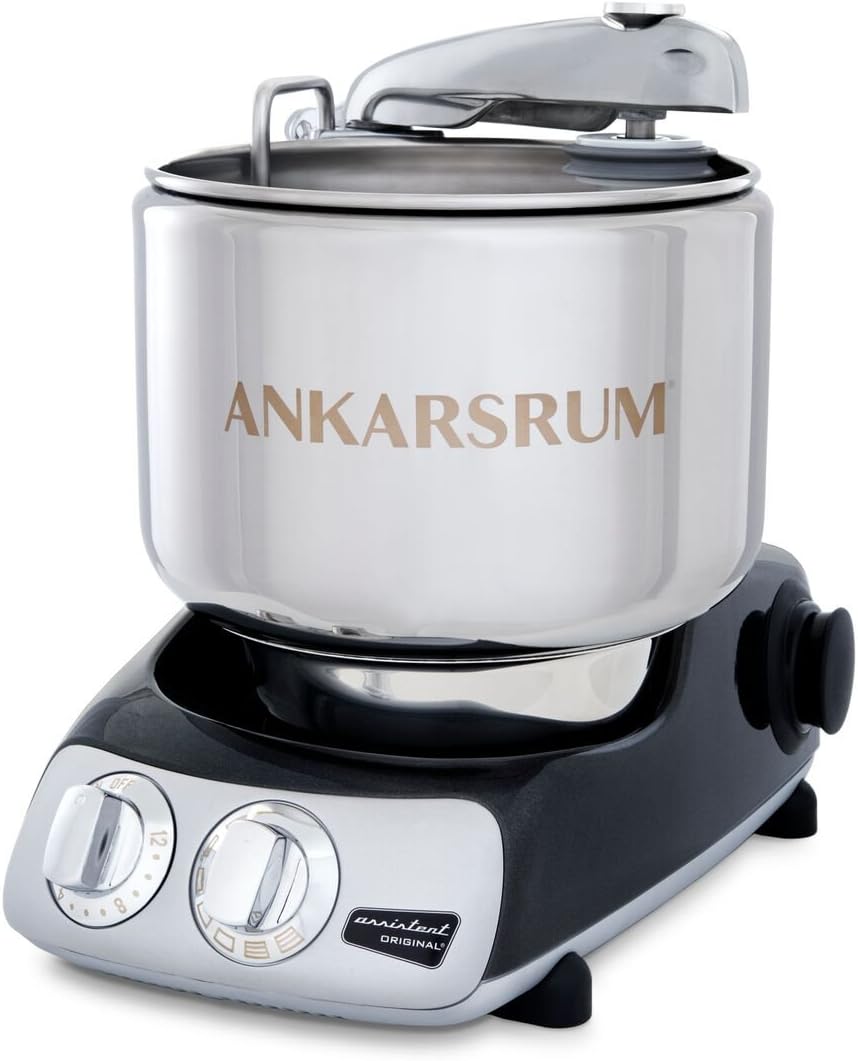
The legendary Swedish Original. This machine features a 600-watt motor with a worm gear drive, an enormous 7-liter stainless steel rotating bowl, and the unique roller and dough hook system. It includes the separate whisking bowl and attachments, making it a complete system for the baker who prioritizes dough performance above all else.
Check Price on AmazonKitchenAid Pro Line Series 7-Quart Bowl-Lift Stand Mixer

The most powerful mixer in KitchenAid’s residential lineup. The Pro Line 7-Quart boasts a high-efficiency 1.3 HP DC motor for quiet power and torque. Its 7-quart capacity and stable bowl-lift design make it their best offering for serious bakers, while still providing access to the full, legendary range of Power Hub attachments.
Check Price on AmazonThe Full Model Lineup: One Mixer vs. an Entire Family of Mixers
One of the biggest points of confusion for shoppers researching this comparison is the sheer difference in how each brand structures its product line. Ankarsrum keeps things simple by design, while KitchenAid offers a sprawling family of machines at wildly different price points and capabilities. Understanding this structure is essential before you commit your budget.
Ankarsrum: Deliberately Simple
Ankarsrum sells essentially one mixer design equipped with a 7-liter bowl, and the differences between “models” come down to color and included accessory bundles rather than any change to the core mechanism. You’ll see names like the Original 6230, the Original 6230 Cloud White, Assistent, and various “Original” and “Student” bundle configurations sold by different retailers, but the drivetrain, the worm gear, and the mixing philosophy stay identical across the board. This is a deliberate choice. Ankarsrum’s engineers decided decades ago that there was one correct way to build a home dough mixer, and they have refined that single design rather than fragmenting their lineup. The practical upshot for shoppers is that you’re never left wondering whether you bought the “wrong” Ankarsrum, since there effectively isn’t a lesser or lower-powered version being sold alongside it.
KitchenAid: A Mixer for Every Budget and Task
KitchenAid, in contrast, offers multiple mixer sizes ranging from compact 3.5-quart mini mixers all the way up to 8-quart commercial bowl-lift machines, and this tiered structure is core to how the brand approaches the market. Here’s a breakdown of where the major tiers land:
| KitchenAid Model Tier | Bowl Capacity | Typical Motor | Best For |
|---|---|---|---|
| Artisan Mini | 3.5 Quart | 250-Watt DC Motor | Small kitchens, singles, couples, apartment living |
| Artisan / Classic | 4.5–5 Quart | 325-Watt AC Motor | The most popular all-purpose home baker choice |
| Artisan Series 5 Plus | 5 Quart | 325-Watt AC Motor | Slightly upgraded Artisan with tilt-head convenience |
| Professional 600 | 6 Quart | 575-Watt AC Motor | Frequent bakers who want a bowl-lift design |
| Pro Line Series | 7 Quart | 1.3 HP DC Motor | Serious home bakers pushing the limits of a planetary mixer |
| Commercial Series | 8 Quart | 1.3 HP DC Motor | Small bakeries, cafes, and heavy daily use |
This tiered approach means the KitchenAid experience varies enormously depending on which model a shopper actually owns. A common mistake we see is people comparing their memory of an entry-level Artisan (which genuinely does struggle with stiff dough) to the Ankarsrum, when the fairer fight is against the Pro Line or Commercial models. The smallest mixer, the Artisan Mini, isn’t necessarily as weak as its size suggests, but it’s also not the machine to reach for if bread is your primary goal. Meanwhile the Artisan, KitchenAid’s most popular model by volume, isn’t as powerful as many buyers assume going in.
Motor Power, Wattage, and Torque: What the Numbers Actually Mean
Wattage numbers get thrown around a lot in mixer marketing, and they can be genuinely misleading if you don’t understand how each brand’s drivetrain converts that power into usable kneading force.
The Ankarsrum uses a 600-watt motor paired with a worm gear transmission that drives the bowl directly. Worm gears are prized in heavy machinery precisely because they deliver very high torque at low speeds and they are effectively self-locking, meaning the motor doesn’t have to fight to hold its position under load. This is a major reason the Ankarsrum can run continuously for extended periods without the motor bogging down or overheating, even under a full 12-pound dough load.
KitchenAid’s motors vary dramatically by tier. Entry-level AC motors in the Artisan line sit around 325 watts, while the flagship Pro Line and Commercial models step up to a 1.3 horsepower DC motor, which converts to roughly 970 watts of rated output. On paper, that makes the top KitchenAid more powerful in raw wattage than the Ankarsrum. In practice, however, the planetary geometry means much of that power is spent overcoming the mechanical disadvantage of driving an off-center attachment around a stationary bowl, rather than being delivered as pure, sustained torque into the dough itself. This is why, even with a nominally larger motor, a Pro Line KitchenAid can still struggle with a dough load that the lower-wattage Ankarsrum handles without any strain.
Noise Level: Which Mixer Is Quieter in Daily Use?
For anyone baking in a shared living space, an apartment, or a house with a napping toddler, noise matters as much as raw performance. This is a category where testers and reviewers consistently land on the same conclusion: the Ankarsrum is the quieter machine.
Because the Ankarsrum’s motor sits low in a solid, heavy base and drives the bowl through a smooth worm gear rather than a rattling planetary gear train, it produces a low, steady hum rather than the higher-pitched whirring and mechanical clatter associated with a KitchenAid under load. Several independent reviewers have specifically called out the Ankarsrum’s motor as surprisingly quiet compared to KitchenAid models, particularly when kneading dense dough at higher speeds. KitchenAid mixers, especially the AC-motor models, tend to get noticeably louder as the dough gets stiffer and the beater has to work harder to push through it, and the mixer head itself can add a rattling or knocking noise if it isn’t perfectly balanced or if the dough climbs unevenly up the hook.
If you plan to bake early in the morning, late at night, or in a small condo or apartment where sound travels, this is a meaningful point in the Ankarsrum’s favor.
Continuous Run Time, Overheating, and Cooldown Periods
This is one of the most practically important differences for anyone baking large batches regularly, and it’s a subject that has become more prominent recently as KitchenAid has adjusted its official guidance.
KitchenAid’s planetary motors, particularly the AC motors found in Artisan and Professional-tier machines, are not designed for indefinite continuous operation under heavy load. The company has historically recommended limiting continuous mixing time and, more recently, updated its stand mixer usage guidance to caution against kneading dough for extended periods above low-to-medium speeds. Push a KitchenAid too hard for too long, particularly on stiff dough, and you risk the motor overheating, the internal thermal safety cutoff triggering, or excess wear on the gears. Many long-time KitchenAid owners have learned through experience that a 10-to-15-minute knead on a demanding dough can require the machine to rest and cool down afterward, especially on older or lower-wattage units.
The Ankarsrum’s worm gear transmission was designed from the outset for sustained, continuous operation, much like the spiral mixers used in commercial bakeries. Because the motor isn’t fighting against an orbital mechanism and heat is dissipated efficiently through the solid metal base, the Ankarsrum can run for long, uninterrupted stretches, kneading multiple consecutive batches of stiff, high-hydration dough without needing a rest period. For a home baker who bakes for a large family, runs a small side business, or simply likes to bake several loaves in one session, this difference alone can be the deciding factor.
Attachments and the Broader Kitchen Ecosystem
Neither mixer exists in a vacuum. Both brands have built out attachment ecosystems that can transform the base mixer into a much more versatile kitchen tool, but the philosophy behind each ecosystem is quite different.
KitchenAid’s Power Hub
KitchenAid’s front-mounted Power Hub is arguably the single biggest reason the brand has such a devoted following outside of pure baking circles. A huge range of attachments clip directly onto the same hub, including pasta roller and cutter sets, a meat grinder, a food processor attachment, a vegetable spiralizer, a citrus juicer, an ice cream maker bowl, and even a grain mill. Because this ecosystem has existed for decades and is shared across nearly every KitchenAid model, there is also a robust secondhand and third-party market for attachments, and compatibility across different KitchenAid mixer generations is generally excellent.
Ankarsrum’s Side-Mounted Accessories
Ankarsrum’s accessory system works differently. Because the motor and drive mechanism live in the base and the bowl itself rotates, additional accessories such as the meat mincer, the blender attachment, the ice cream maker, the citrus press, the strainer, and the pasta roller mount onto the side of the machine using a spring-loaded attachment arm, and some can even be used with the machine tipped on its side. The accessory catalog is smaller than KitchenAid’s, and individual attachments tend to be more expensive, reflecting the brand’s smaller production scale and more specialized market. However, the ones that do exist are generally regarded as extremely well-built and durable, consistent with the rest of the machine.
The bottom line: if attachment variety and depth of ecosystem is a priority, especially for tasks like pasta-making, grinding meat for sausage, or juicing, KitchenAid’s Power Hub remains the more mature and flexible system. If you mainly care about a handful of high-quality accessories to complement serious dough work, Ankarsrum’s smaller but well-engineered lineup will cover the essentials.
Price and Long-Term Value
Both machines sit at the premium end of the stand mixer market, but they arrive at that price point differently. KitchenAid’s Artisan and Classic models are priced to be accessible to a much broader range of home cooks, while the Professional 600, Pro Line, and Commercial models climb steadily upward as capacity and motor power increase. The Ankarsrum, since it only comes in essentially one configuration, is priced as a premium, specialized appliance from the outset, and it typically sits at or above the cost of KitchenAid’s higher Pro Line and Commercial tiers.
When you factor in long-term value, though, the calculation shifts. Ankarsrum owners frequently report using the same machine for well over a decade of heavy, weekly bread baking with minimal wear, and replacement parts remain available for extremely old units. KitchenAid’s lower-tier AC motors, run hard on dough for years, are more likely to eventually need a repair or motor brush replacement, though the brand’s parts availability and repair network in the United States is excellent and often more accessible than sourcing Ankarsrum parts outside of Scandinavia and the brand’s authorized online retailers.
If you’re weighing cost against how often you’ll actually knead dense, high-hydration dough, a useful rule of thumb is this: the more frequently bread baking dominates your use case, the more the Ankarsrum’s higher upfront price is offset by durability and the near-elimination of motor strain over years of use.
Size, Weight, and Storage Considerations
These are both substantial countertop appliances, and neither is a good candidate for cabinet storage between uses if you bake regularly. The Ankarsrum’s low-profile, wide footprint design means it doesn’t take up much vertical space, which can be an advantage if you have upper cabinets close to your counter, but its footprint is noticeably wider than a KitchenAid, so you’ll want to measure your available counter space carefully before buying. It also tends to be heavier than the smaller KitchenAid tiers, though comparable to or lighter than the largest Pro Line and Commercial KitchenAid models.
A tilt-head KitchenAid, particularly in the smaller Artisan and Mini sizes, has a taller vertical profile because the head needs clearance to tilt back, which matters if your mixer lives under a cabinet. Bowl-lift models like the Professional 600, Pro Line, and Commercial avoid this issue since the head is fixed and the bowl itself raises and lowers, but they are correspondingly heavier and bulkier overall. If counter space and storage flexibility are major concerns, it’s worth measuring both the width and the vertical clearance you have available before deciding.
Whole Wheat, Gluten-Free, and Specialty Doughs
Beyond standard white sourdough and bagel dough, many bakers want to know how each machine performs with more specialized doughs.
Whole wheat and rye doughs tend to be stiffer and less elastic than white flour doughs, and they benefit enormously from a mixer that won’t strain or overheat during the longer kneading times these flours often require. This plays directly to the Ankarsrum’s strengths, and it’s worth remembering that the machine’s Scandinavian design heritage was built specifically around dense rye breads. Enriched doughs like brioche or Japanese milk bread, which require extended kneading at a strong setting to develop a silky, well-hydrated gluten structure, are another area where testers have found the Ankarsrum pulls ahead, since a KitchenAid isn’t really designed to be run at high speed for the extended periods these doughs demand.
Gluten-free doughs and batters, by contrast, are typically much wetter and don’t require the same intensive gluten development, which levels the playing field considerably. Both machines handle gluten-free bread batters, pancake batters, and quick bread mixes with ease using their respective paddle or whisk attachments, so this isn’t a major differentiator unless gluten-free baking is combined with high-volume production.
Common Problems and Troubleshooting
No appliance is entirely without quirks, and understanding the common failure points of each machine can help you make a more informed decision and know what to watch for down the road.
The most frequently reported KitchenAid issues involve the mixer “walking” or vibrating across the counter during heavy kneading, dough climbing up and over the hook and escaping the bowl, motor overheating on extended stiff-dough kneads, and, on older tilt-head models, a gradual loosening of the beater-to-bowl clearance that requires periodic adjustment using the height-adjustment screw. Fortunately, KitchenAid’s extensive US-based service network and huge installed base mean replacement parts, at-home fixes, and video troubleshooting guides are easy to find for almost any generation of the machine.
Ankarsrum owners more commonly report an initial learning-curve period where dough doesn’t seem to be kneading correctly because the roller or scraper hasn’t been positioned correctly, occasional confusion switching between the steel bowl and the plastic whisking bowl accessory, and, less frequently, difficulty sourcing certain replacement parts or accessories outside of the brand’s official retailers if you’re located far from Scandinavia. Mechanical failures of the core worm-gear motor assembly are reported far less often than motor issues on lower-tier KitchenAid models, which is consistent with the brand’s reputation for long-term durability.
Cleaning and Maintenance
Day-to-day cleanup is quick on both machines, but the details differ. The Ankarsrum’s open stainless steel bowl has no central column to trap dough or batter, so wiping it out or rinsing it is fast, and the roller and dough hook detach easily for washing. The included cover can also double as a proofing cover, letting you use the same bowl to mix, knead, and rise your dough without ever transferring it, which cuts down on cleanup considerably.
KitchenAid’s bowls are similarly simple to clean, particularly on bowl-lift models, though the fixed central beater shaft on some models can require a bit more attention to keep dough from building up around it. Most KitchenAid bowls, beaters, and whisks are dishwasher safe, as are the Ankarsrum’s stainless bowl and standard attachments, though both brands recommend hand-washing more delicate accessories like the dough roller’s precision components.
Who Should Buy an Ankarsrum?
An Ankarsrum is Your Lifetime Partner If…
- You are a passionate bread baker, period.
- You regularly bake more than two loaves at a time.
- The thought of a mixer that never strains or walks on the counter sounds like heaven.
- You value engineering and performance over familiarity and aesthetics.
- You love the idea of an open bowl for easily adding ingredients.
- You are willing to invest time in learning a new, superior method for kneading.
It Might Not Be For You If…
- You are a beginner baker. The learning curve is real.
- You want a machine that is primarily for cakes, cookies, and buttercream.
- You are excited by the huge variety of attachments from the KitchenAid Power Hub.
- You prefer a simple, intuitive, “out-of-the-box” experience.
Who Should Buy a KitchenAid?
A KitchenAid Remains the Reigning Champ If…
- You are an all-around baker and cook who wants ultimate versatility.
- The Power Hub attachment ecosystem (pasta makers, grinders, etc.) is a major selling point.
- You value an intuitive, easy-to-learn machine.
- Your baking is varied, with a good mix of cakes, cookies, and occasional bread.
- Aesthetics and color choice are important to you.
- You want the most powerful version of the mixer you already know and love.
You May Have Outgrown It If…
- Your primary focus is large-batch bread making, and you’re tired of watching your current mixer struggle.
- Motor strain and countertop “walking” are your biggest frustrations.
- You are ready to prioritize specialized dough performance over all-around utility.
Even within the KitchenAid family, choosing the right model is key. We break down the differences between their most popular lines in our article, KitchenAid Artisan vs Professional 600.
Color Options and Design Aesthetics
For many buyers, a stand mixer isn’t just a tool tucked away in a cabinet, it’s a permanent fixture on the counter that becomes part of the kitchen’s visual identity, and both brands understand this well, though they approach it from different angles.
KitchenAid has built an entire marketing identity around color choice. Depending on the model, shoppers can choose from dozens of finishes ranging from classic Empire Red and Onyx Black to seasonal and limited-edition shades released throughout the year, plus metallic finishes on higher-tier models. This variety lets a KitchenAid double as a genuine design statement, matching a kitchen’s color scheme or standing out as a deliberate pop of color. It’s part of why the brand has such a strong presence in wedding registries and gift-giving, where a specific color choice can feel personal and intentional.
Ankarsrum takes a more restrained approach, offering a smaller number of finishes that generally lean toward classic, understated tones such as white, black, and stainless-look metallic, consistent with the brand’s Scandinavian design sensibility. The aesthetic is minimalist and utilitarian rather than playful, and the machine’s low, wide silhouette reads more like a piece of purpose-built equipment than a decorative kitchen accessory. Neither approach is objectively better, it largely comes down to whether you want your mixer to make a colorful style statement or to blend quietly into a clean, functional kitchen.
A Deeper Look at Accessories: What You Can Actually Buy
It’s worth walking through the specific accessories available for each brand in more detail, since the breadth of options is a major factor for buyers who see their mixer as the long-term hub of their kitchen.
KitchenAid Power Hub Attachments
- Pasta Roller and Cutter Set: Roll and cut fresh fettuccine, spaghetti, and lasagna sheets directly from the mixer’s power hub.
- Food Grinder Attachment: Grind meat for sausage, burgers, and pates, with coarse and fine grinding plates.
- Ice Cream Maker Bowl Attachment: A frozen bowl attachment that churns ice cream, sorbet, and frozen yogurt.
- Spiralizer Attachment: Turns vegetables into ribbons, spirals, and noodles for low-carb cooking.
- Food Processor Attachment: Slices, shreds, and purees using the mixer’s existing power hub.
- Grain Mill Attachment: Mills whole grains into fresh flour at home, popular with dedicated bread bakers.
- Citrus Juicer Attachment: A simple reamer-style juicer that clips onto the power hub.
Ankarsrum Accessories
- Meat Mincer: A heavy-duty grinder attachment for meat, using the machine’s powerful base motor.
- Blender Attachment: Turns the Ankarsrum into a countertop blender for smoothies and soups.
- Ice Cream Maker: A churning attachment that produces small-batch ice cream and sorbet.
- Citrus Press: A juicing attachment designed for citrus fruits specifically.
- Pasta Roller Set: Rolls and cuts fresh pasta sheets and noodles, mounted via the side arm.
- Strainer and Sieve Attachment: Purees and strains fruits and vegetables for sauces, jams, and baby food.
- Extra Bowls and Covers: Additional stainless steel bowls let you proof multiple batches simultaneously.
If your ambitions extend well beyond bread, such as regularly making fresh pasta, grinding your own sausage meat, or wanting an ice cream maker that doesn’t require a separate appliance, KitchenAid’s ecosystem, refined over roughly a century of accessory development, is simply more mature and more widely available secondhand. If your accessory needs are more modest and your primary focus stays on dough, Ankarsrum’s smaller catalog will likely cover everything you need without requiring you to hunt for compatible third-party options.
Energy Efficiency and Everyday Running Costs
Neither mixer will meaningfully move the needle on a household electricity bill, but there are still real differences worth noting. Because the Ankarsrum’s worm-gear drivetrain is mechanically efficient and doesn’t waste energy overcoming the friction of an orbiting planetary mechanism, it tends to draw power efficiently even during long kneading sessions, and many long-term owners report that hours of holiday baking don’t produce any noticeable spike in their electric bill. KitchenAid’s motors, particularly the AC models, can draw more current under heavy resistance as the motor works harder to maintain speed against stiff dough, though again, the absolute cost difference over a year of typical home baking is negligible for either machine. This is a case where the difference matters far more for machine longevity and noise than it does for your utility bill.
Resale Value and Longevity in the Secondhand Market
Both brands hold their value unusually well compared to most kitchen appliances, which is itself a testament to how highly regarded they are by serious home cooks. KitchenAid’s massive installed base and decades of continuous production mean there’s a large, active secondhand market, with vintage models from the 1960s through the 1990s still sought after by collectors and bakers who prize their all-metal gearboxes over some modern plastic-gear budget models. Parts availability for older KitchenAids is excellent, and a well-maintained vintage unit can often be restored and kept running for decades.
The Ankarsrum’s secondhand market is smaller simply because fewer units have historically been sold outside Scandinavia and parts of Europe, but demand among serious bread bakers who understand the machine’s reputation is strong, and used units in good condition tend to sell close to a meaningful percentage of their original price. Because the core mechanism is so durable, a used Ankarsrum is generally a safer secondhand purchase than a used budget-tier stand mixer from almost any other brand, since the likelihood of a worn-out motor or stripped gears is comparatively low.
What Real Bakers Say: Community Consensus
Across baking forums, review sites, and cooking publications, a consistent pattern emerges whenever the Ankarsrum and KitchenAid are put head to head. Independent kitchen equipment testers who evaluate a wide range of stand mixers, including Bosch and Kenwood models, repeatedly single out the Ankarsrum as the top performer specifically for bread and pizza dough, citing its unique roller mechanism and enormous bowl capacity. At the same time, those same testers tend to recommend an entry-level KitchenAid, typically the Artisan, as the best choice for beginners who want an intuitive, easy-to-learn machine without a steep learning curve.
Longtime KitchenAid owners who eventually add an Ankarsrum to their kitchen often describe the transition in similar terms: they keep the KitchenAid for its versatility and its familiar attachment ecosystem, while the Ankarsrum becomes the go-to machine specifically for dough. This “both, for different jobs” outcome is common enough among serious home bakers that it’s worth considering as a legitimate third option if your budget allows for it, rather than viewing the decision as strictly either-or.
Where to Buy and What to Watch For
Both mixers are widely available through major retailers and directly from Amazon, and buying through an authorized retailer is important for warranty registration purposes, since counterfeit or gray-market units, particularly for the Ankarsrum, are less likely to be backed by the manufacturer’s full warranty in your region. When shopping for a KitchenAid, pay close attention to which specific model and bowl size a given color and price point represents, since KitchenAid’s marketing across different tiers can look visually similar despite significant differences in motor power and capacity. For the Ankarsrum, since the core machine is largely standardized, the main decisions come down to which accessory bundle is included with the base unit and which color finish you prefer.
Final Verdict: The Right Tool for the Serious Baker’s Job
This is one of the rare comparisons where the two products are both of exceptional quality, but are built for fundamentally different users. The choice is less about which is “better” and more about “what kind of serious baker are you?” Both are lifetime investments, but they will serve you in different ways.
Our Final Recommendation:
For the ARTISAN BREAD BAKER who deals in large quantities, high hydrations, and stiff doughs, the Ankarsrum is, without a doubt, the superior machine. Its unique mixing method, immense power, and unshakable stability put it in a class of its own for kneading. It is the end-game mixer for the dedicated bread enthusiast.
For the VERSATILE CULINARIAN who is a talented baker across all categories and wants their mixer to be a true kitchen workhorse for countless other tasks, the KitchenAid Pro Line remains an outstanding choice. Its power is more than sufficient for most tasks, its performance on cakes and creams is flawless, and its attachment ecosystem is unmatched.
The decision to invest in a high-end, specialized appliance is a serious one, whether it’s for baking or for your morning coffee. We explore a similar debate between two top-tier espresso machines in our Breville Barista Pro vs DeLonghi La Specialista article.
Frequently Asked Questions (FAQ)
1. Is the Ankarsrum really that hard to learn?
It’s not “hard” in a complex sense, but it is “different.” You have to unlearn what you know about planetary mixers. The key is positioning the roller and adjusting the arm as the dough comes together. We strongly recommend watching a few official tutorial videos. After two or three loaves, the process will click and become second nature. There is a learning curve, but the payoff is immense.
2. Can the Ankarsrum make a small batch, like a single loaf of bread or a dozen cookies?
Yes, it can. For a single loaf, the dough roller works beautifully. For a small batch of cookies, you would use the separate plastic bowl and multi-whisks. While it excels at large batches, it is surprisingly capable with smaller ones, though a tilt-head KitchenAid is often more convenient for very small tasks.
3. Which mixer is easier to clean?
The Ankarsrum is remarkably easy to clean. The stainless steel bowl has no central column, so it’s a wide-open, easy-to-wash container. The roller and dough hook are simple to remove and clean. The open design also means you make less of a mess when adding ingredients. Overall, we’d give the edge to the Ankarsrum.
4. What is the warranty like on these machines?
Both offer exceptional warranties, reflecting their premium build quality. The Ankarsrum comes with a 7-year warranty on the motor base and a 1-year warranty on attachments. KitchenAid’s Pro Line series typically comes with a 5-year limited warranty. Both companies have a reputation for standing behind their products.
5. Is the Ankarsrum worth the high price tag?
If you are a serious bread baker who has been frustrated by the limitations of planetary mixers, then yes, 100%. It is a specialized tool that performs its primary function better than any other residential machine on the market. If you are a generalist baker, the versatility and lower price point of a high-end KitchenAid might be a better value for your needs.
6. Which mixer is quieter, Ankarsrum or KitchenAid?
The Ankarsrum is consistently reported as the quieter machine, especially under heavy kneading loads. Its worm-gear drive produces a low, steady hum, while a KitchenAid’s planetary gear train tends to get louder and can rattle as dough gets stiffer and the beater works harder.
7. Do I need to let my KitchenAid or Ankarsrum “rest” between batches?
A KitchenAid, particularly on AC-motor models, can require a cooldown period after extended kneading at higher speeds, and the brand now recommends limiting continuous use on stiff dough. The Ankarsrum’s worm-gear transmission is built for sustained, continuous operation and typically doesn’t require rest periods between consecutive batches.
8. Which KitchenAid model is the fairest comparison to the Ankarsrum?
The Pro Line Series or Commercial Series, both with a 1.3 HP DC motor and 7-to-8-quart bowl, are the closest match in terms of capacity and power. Comparing an entry-level Artisan or Mini to the Ankarsrum isn’t a fair fight, since those smaller models were never designed for large, dense dough batches.
9. Does KitchenAid or Ankarsrum have more attachments available?
KitchenAid’s Power Hub ecosystem is larger and more mature, with attachments for pasta making, meat grinding, food processing, juicing, and more, plus a strong secondhand market. Ankarsrum’s side-mounted accessory lineup is smaller but well-built, covering meat mincing, blending, ice cream making, and pasta rolling.
10. Is the Ankarsrum better for whole wheat or rye bread specifically?
Yes. The Ankarsrum’s design heritage comes from Scandinavian rye and whole grain baking, and its gentle, sustained kneading action is particularly well suited to the stiffer, less elastic doughs made with whole wheat and rye flours.


