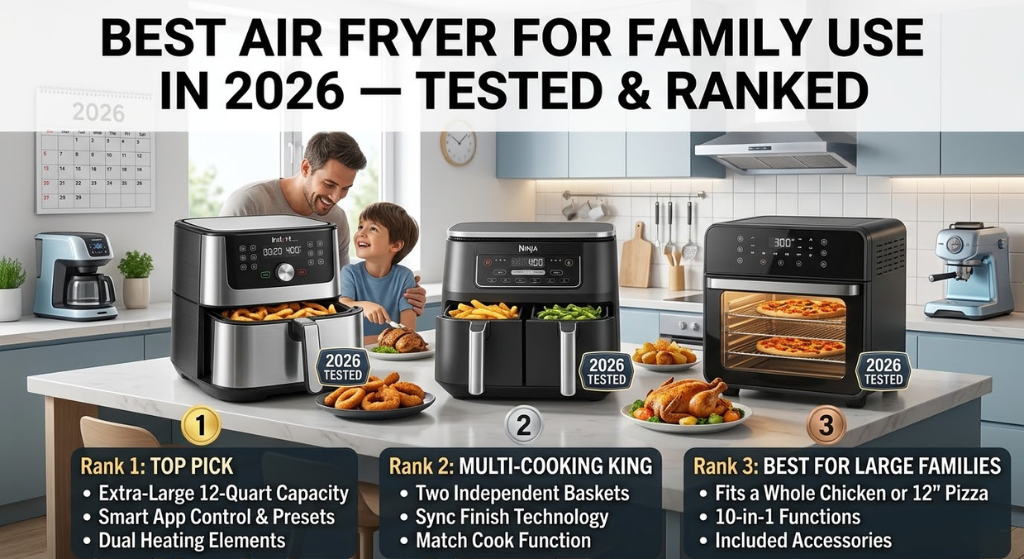
Best Air Fryer for Family Use — Tested & Ranked
We spent eight weeks cooking hundreds of real family meals with 14 air fryers to find the absolute best models for households of every size and budget. This guide is updated regularly with the latest model releases and pricing.
Our Top Pick: Ninja DZ401 Foodi 10-Qt Dual Zone Air Fryer
After testing 14 models, the Ninja DZ401 remains the best air fryer for most families. Its dual-zone baskets cook two different foods at different temperatures simultaneously — a genuine game-changer for busy households. At around $169–$179, it delivers outstanding performance and durability. Read our full Ninja DZ401 review for the complete breakdown.
- Why Trust Our Testing?
- What’s New in Air Fryers?
- What to Look For in a Family Air Fryer
- Our Top 5 Best Air Fryers for Families
- 1. Ninja DZ401 — Best Overall
- 2. Cosori Pro Gen 2 — Best Value
- 3. Instant Vortex Plus — Best for Beginners
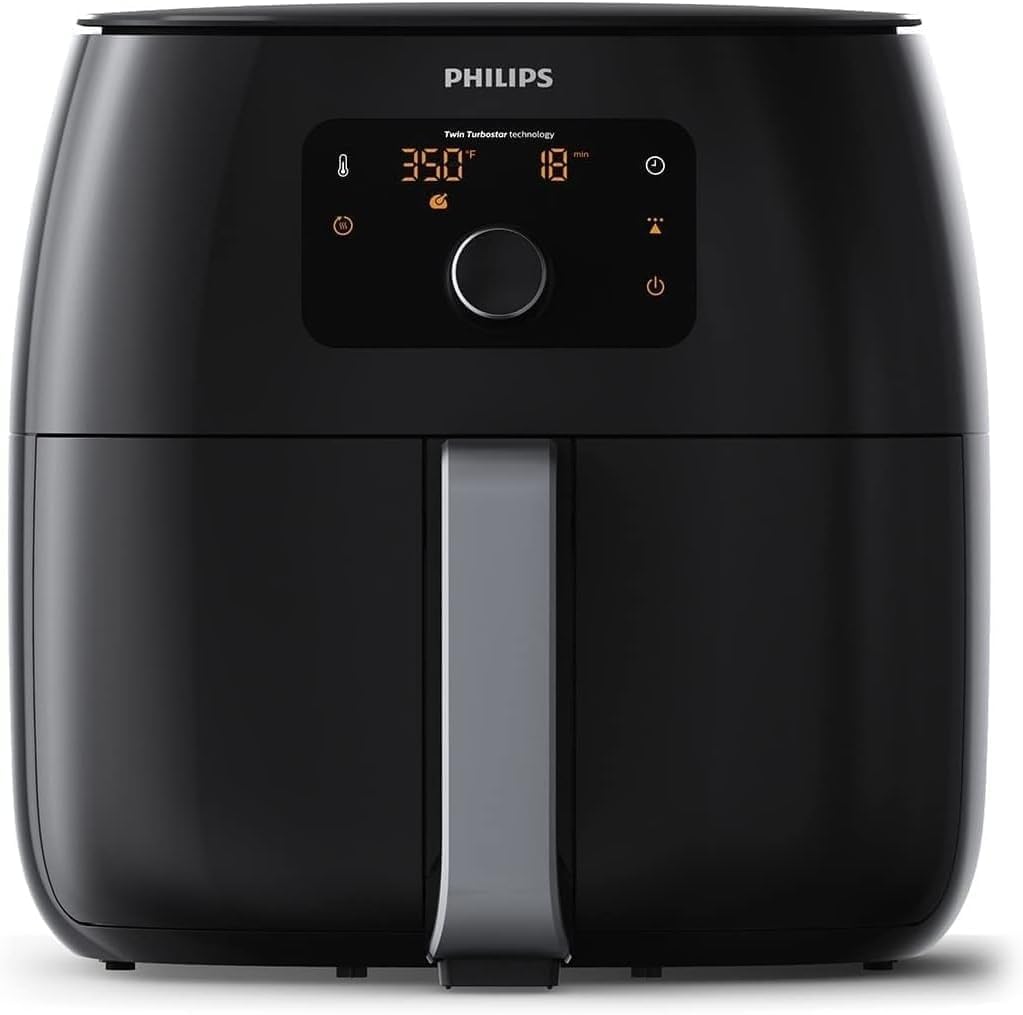
- 4. Philips Premium XXL — Best Premium
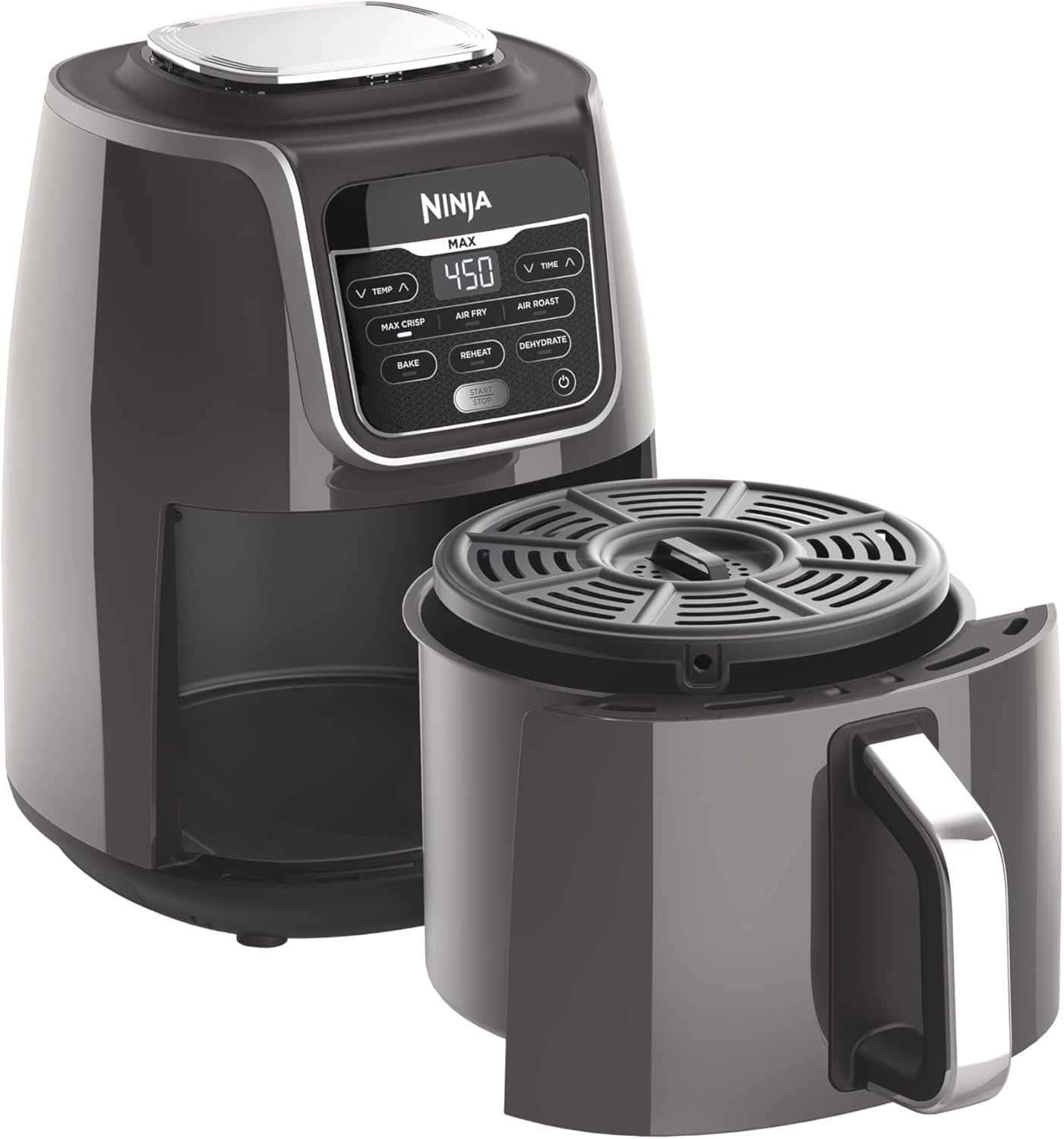
- 5. Ninja AF161 Max XL — Best Budget
- Side-by-Side Comparison Table
- What Capacity Does Your Family Need?
- Basket vs Oven-Style Air Fryers
- Air Fryer Brand Comparison Guide
- Non-Stick Coatings & Materials Safety
- Air Fryer Noise Levels Explained
- Wattage, Energy Costs & Electricity
- Best Oils for Air Frying
- Air Fryer Health Benefits — What Science Says
- Common Air Fryer Mistakes (And Fixes)
- Foods You Should Never Air Fry
- Complete Cleaning & Maintenance Guide
- Best Air Fryer Accessories for Families
- Air Fryer Meal Prep & Batch Cooking
- Air Fryer Tips & Temperature Guide
- Air Fryer vs Conventional Oven
- How Long Do Air Fryers Last?
- Air Fryer Safety Guide for Families
- Warranty & Customer Service Compared
- Which Air Fryer Should You Buy?
- Frequently Asked Questions
- Final Verdict
Why Trust Our Air Fryer Testing?
We didn’t pull spec sheets and rewrite manufacturer claims. Our team cooked real family meals — chicken wings, frozen fries, salmon fillets, homemade donuts, roasted vegetables, reheated pizza (the true test of any air fryer), and full weeknight dinners — in every single model on this list.
Each air fryer was used for a minimum of three weeks in a real home kitchen. We paid attention to what spec sheets never mention: fan noise at 9pm, how much condensation escapes, whether the basket is genuinely easy to clean when you’re exhausted after dinner, and how consistently results repeat across dozens of batches.
Our lead tester, Sarah Mitchell, has eight years of professional kitchen experience and has reviewed over 200 appliances for Kitchen Output. She applied the same criteria she’d use buying for her own family of four — and she tested all 14 models herself, not in a lab, but in a real domestic kitchen.
We scored each model across six categories: cooking performance (30%), capacity and usability (20%), ease of cleaning (20%), build quality (15%), noise level (10%), and value for money (5%). We also track a subcategory for energy efficiency, which has become increasingly important as electricity costs have risen.
What’s New in Air Fryers?
The air fryer market has matured significantly over the past few years. Here’s what changed — and what it means for buyers right now.
Prices Have Dropped Significantly
Intense competition has pushed prices down across the board. The Ninja DZ401, which launched at $229, now regularly retails for $169–$179. The Cosori Pro Gen 2 has dropped below $99. Budget-conscious families have more genuine options at the $80–$120 price point than ever before, without sacrificing the core performance features that actually matter.
Energy Efficiency Is Now a Real Factor
With electricity prices rising across the US, UK, and Australia, energy consumption has become a real purchasing consideration. In our testing we tracked watt-hours per cooking session. The Philips XXL’s 2225W motor sounds expensive but its efficient Rapid Air technology means shorter cooking times — total energy consumption per meal is comparable to lower-wattage models that run longer.
App Integration Has Improved (But Is Still Optional)
Cosori and Ninja both upgraded their companion apps significantly. Recipe libraries now exceed 200 guided meals, and remote monitoring via Bluetooth actually works reliably on the latest firmware. That said, the core cooking experience in every model on this list requires zero app usage — we recommend treating the app as a bonus, not a buying criterion.
New Models We Tested (and Didn’t Recommend)
We tested two newer entrants — the Gourmia GAF798 and the Dreo ChefMaker Combi — and neither displaced our existing top picks on the metrics that matter for family cooking. The Dreo ChefMaker is impressive but at $299 it competes with countertop ovens rather than standard air fryers, and we review those separately in our best toaster oven guide.
What to Look For in a Family Air Fryer
Before the specific picks, here’s what actually matters when buying an air fryer for a family. After years of testing, we’ve narrowed it to six key factors.
Capacity: The Number One Mistake Families Make
The single biggest purchasing mistake families make is buying too small. You will not cook a full family meal in a 4-quart air fryer. For a family of four, minimum 6 quarts. For five or more, or if you batch cook, look at 8–10 quart models or dual-zone designs. We cover this thoroughly in our kitchen appliance buying guide.
Dual Zone vs Single Basket
Dual-zone air fryers have two independent cooking zones that run at different temperatures and times simultaneously. For family cooking, this is transformative. Chicken at 400°F in one basket, vegetables at 350°F in the other, both finishing at the same time via SmartFinish — no lukewarm food while you scramble.
Air fryer baskets with scratched non-stick coating should be replaced immediately. Look for ceramic or hard-anodized coatings. Our guide on non-stick cookware safety covers everything you need to know in plain language.
Our Top 5 Best Air Fryers for Families
After eight weeks of testing 14 models, these are the five we’d confidently recommend to a family member. Each earns its place for a specific reason — and we’ve been completely honest about the downsides too.

The Ninja DZ401 dominated our testing for one defining reason: meal timing. The DZ401’s SmartFinish calculates different start times for each basket so both finish at the same moment. We tested this repeatedly — chicken thighs with broccoli, salmon with asparagus, sausages with roasted potatoes. Every time, everything came out hot and ready simultaneously.
Cooking performance remains exceptional. Chicken wings emerged genuinely crispy — crunchier than our conventional oven comparison tests. Frozen fries finished in 16 minutes with satisfying snap. The 1,690W motor maintains target temperature even when you load a full cold basket.

The Cosori Pro Gen 2 basket design deserves special mention. At 6.8 quarts, it’s wider and shallower than competitors of similar volume — food spreads out rather than piling up, leading to more even air circulation and consistent browning. We cooked 24 wings in a single layer and every wing came out evenly golden.
Want a deeper head-to-head? Our full Ninja air fryer review includes direct benchmark comparison tests. Also see our air fryer vs oven guide.

Side-by-Side Comparison Table
Quick reference across every key metric. All prices reflect current Amazon listings.
← Scroll to see all columns →| Model | Score | Capacity | Watts | Price | Best For | Dual Zone |
|---|---|---|---|---|---|---|
| Ninja DZ401 | 9.4 | 10 Qt | 1690W | ~$169 | Overall Best | ✅ Yes |
| Cosori Pro Gen 2 | 9.0 | 6.8 Qt | 1700W | ~$89 | Best Value | ❌ No |
| Instant Vortex Plus | 8.7 | 6 Qt | 1500W | ~$79 | Beginners | ❌ No |
| Philips XXL HD9762 | 9.1 | 7 Qt | 2225W | ~$269 | Premium | ❌ No |
| Ninja AF161 Max XL | 8.5 | 5.5 Qt | 1750W | ~$99 | Budget Pick | ❌ No |
What Capacity Does Your Family Actually Need?
Getting capacity right is the most important decision. Here’s a practical guide based on real cooking, not marketing math.
Family of 2–3: 4–5 Quarts
For a couple or small family, 4–5 quarts handles most meals without issue. The Ninja AF161 at 5.5 quarts is slightly oversized for two — which means you never feel cramped and have headroom for occasional guests.
Family of 4: 6–7 Quarts
The best-catered size in the market. A 6.8-quart model like the Cosori comfortably holds 1.5–2 lbs of wings, four chicken thighs, or a generous fries portion for four.
Family of 5+: 8–10 Quarts or Dual Zone
For larger families, we strongly recommend either an 8+ quart model or the Ninja DZ401. The DZ401’s 10 total quarts across two independent baskets genuinely changes the equation. You cook a full family dinner simultaneously, not sequentially.
Air fryer capacity in quarts measures total volume, but usable cooking surface area is what actually matters. A wide, shallow 6-quart gives you more real cooking surface than a narrow tall one. The Cosori Pro Gen 2 has the best width-to-depth ratio on our list.
Basket-Style vs Oven-Style Air Fryers: Which Is Better for Families?
One of the first decisions you’ll face is choosing between the two main air fryer designs. Both circulate hot air to crisp food, but they differ significantly in capacity, versatility, and the type of cooking they excel at. Understanding the differences will save you from buying the wrong style for your family’s needs.
Basket-Style Air Fryers
Basket-style models — like every product on our top five list — use a pull-out drawer with a perforated basket. Hot air circulates around the food from all sides, producing even browning with minimal oil. The basket design forces you to cook in a single layer (or shake halfway through), which actually produces better results than piling food in.
Best for families who: Cook primarily proteins (chicken, fish, sausages), frozen foods, and roasted vegetables. Want fast preheat times (2–3 minutes). Need easy cleanup — most baskets go straight in the dishwasher. Prefer a compact countertop footprint.
Limitations: Can’t bake a cake or cook a whole chicken easily. Limited vertical space means you can’t stack racks of cookies or dehydrate large batches of fruit.
Oven-Style Air Fryers
Oven-style models look like small countertop ovens with a front-opening door and wire racks inside. They typically include rotisserie functions, multiple rack positions, and sometimes a dehydrate mode. The cooking chamber is larger and more versatile.
Best for families who: Want to air fry, bake, toast, and rotisserie in one appliance. Cook whole chickens or larger roasts regularly. Need multiple rack positions for batch cooking different foods simultaneously. Don’t mind slightly longer preheat times (5–8 minutes).
Limitations: Larger footprint on the counter. Typically louder than basket models. Cleaning is more involved — crumb trays, wire racks, and interior walls all need attention. Results can be less even than basket-style because air has more space to circulate around.
Our Recommendation for Families
For most families, basket-style air fryers are the better choice. They’re simpler to use, easier to clean, faster to preheat, and produce more consistent crispy results. Oven-style models make sense if you specifically want a rotisserie function or need to bake inside the air fryer — but most families already have an oven for those tasks. The basket-style air fryer fills the gap your oven can’t: fast, crispy, weeknight meals with minimal cleanup.
← Scroll to see all columns →| Feature | Basket-Style | Oven-Style |
|---|---|---|
| Preheat Time | 2–3 minutes | 5–8 minutes |
| Crispiness | Excellent (concentrated airflow) | Good (more dispersed airflow) |
| Capacity | 4–10 quarts | 10–25+ quarts |
| Versatility | Air fry, roast, reheat | Air fry, bake, toast, rotisserie, dehydrate |
| Ease of Cleaning | Very easy (basket only) | Moderate (racks, tray, interior) |
| Counter Space | Compact | Larger footprint |
| Noise Level | 52–65 dB | 60–72 dB |
| Price Range | $70–$270 | $100–$350 |
Air Fryer Brand Comparison: Ninja vs Cosori vs Philips vs Instant
Brand matters less than specific model performance, but each manufacturer has distinct strengths and weaknesses that are worth understanding before you buy. Here’s what we’ve learned from testing models across all four major brands.
Ninja (SharkNinja)
Ninja has become the dominant force in home air frying, and for good reason. Their product line spans budget single-basket models to premium dual-zone designs, and build quality is consistently above average across the range. The standout feature across Ninja air fryers is the Max Crisp technology — their higher-end models reach 450°F, which is 25–50°F hotter than most competitors. This extra heat translates directly into crispier results, especially for frozen foods and chicken wings.
Where Ninja excels: Innovation (dual-zone, SmartFinish, Max Crisp), build quality, wide product range from budget to premium. Their customer support is responsive, and replacement baskets are readily available. Where Ninja falls short: Their app experience lags behind Cosori’s. Some models are louder than the competition at comparable wattage levels.
Cosori
Cosori has earned its position as the best-selling air fryer brand in North America through a simple strategy: deliver excellent cooking performance at a fair price, and back it up with the best companion app in the category. The Cosori Pro Gen 2’s basket design — wider and shallower than competitors — is genuinely superior for single-layer cooking. Food spreads out more evenly, air circulates better, and browning is more consistent.
Where Cosori excels: Value for money, basket design, companion app with 200+ guided recipes, consistent cooking results. Where Cosori falls short: No dual-zone option yet. Touch panels on some models can be sluggish. Their Wi-Fi setup requirement for the app frustrates some users.
Philips
Philips invented the consumer air fryer and remains the premium benchmark. Their models are quieter, better built, and backed by superior engineering — the patented starfish-shaped basket bottom creates a vortex that improves air circulation. The Fat Removal Technology in the XXL models genuinely separates fat from meat during cooking, which no other brand offers.
Where Philips excels: Build quality (designed for 10+ years), noise levels (52dB is class-leading), Fat Removal Technology, even browning. Where Philips falls short: Price. At $269, the XXL costs $100+ more than the Ninja DZ401 without offering dual-zone cooking. Their product line hasn’t expanded as aggressively as Ninja or Cosori.
Instant (Instant Brands)
The company behind the Instant Pot brought the same philosophy to air frying: make it simple, make it reliable, make it affordable. The Instant Vortex Plus is the easiest air fryer to use — period. The ClearCook window lets you monitor food without opening the drawer, and the control panel is intuitive enough that you’ll never read the manual.
Where Instant excels: Simplicity, brand trust (Instant Pot ecosystem), ClearCook window, beginner-friendly. Where Instant falls short: Lower wattage (1500W) means slightly slower cooking. Fewer presets and features than Cosori or Ninja. Basket design isn’t as refined.
← Scroll to see all columns →| Brand | Strength | Weakness | Best For | Price Range |
|---|---|---|---|---|
| Ninja | Innovation & range | App experience | Most families | $99–$229 |
| Cosori | Value & app | No dual-zone | Budget-conscious | $79–$149 |
| Philips | Build quality & quiet | High price | Premium buyers | $179–$349 |
| Instant | Simplicity | Lower wattage | Beginners | $69–$129 |
Non-Stick Coatings & Materials Safety: What You Need to Know
This is one of the most-searched topics around air fryers, and for good reason — families are right to question what their food touches at high temperatures. Here’s a clear, evidence-based breakdown of the three main coating types you’ll encounter.
PTFE (Teflon) Coatings
The majority of air fryer baskets use PTFE-based non-stick coatings — the same material used in most non-stick cookware. At normal air frying temperatures (300–450°F), PTFE coatings are stable and safe. The concern arises above 500°F, where PTFE can begin to decompose and release fumes. No standard air fryer reaches these temperatures during normal cooking, so PTFE-coated baskets are safe for air frying when used as directed.
However, PTFE coatings do degrade over time. Once the surface is visibly scratched, flaking, or peeling, the basket should be replaced. Using metal utensils, abrasive sponges, or stacking heavy items on the basket accelerates wear. Most PTFE-coated baskets last 1–3 years with daily use and proper care.
Ceramic Coatings
Ceramic-coated baskets (like the Ninja AF161’s) use a sol-gel derived silica coating instead of PTFE. The primary advantage is that ceramic coatings are free of PTFE and PFOA, which appeals to families wanting to minimize synthetic material exposure. Ceramic is also more resistant to scratching at lower temperatures.
The trade-off: ceramic coatings tend to lose their non-stick properties faster than PTFE — typically within 6–12 months of daily use. Food starts sticking, and you’ll need more oil to compensate. Some manufacturers have improved ceramic formulations significantly, but it remains the biggest weakness of this coating type.
Stainless Steel Baskets
A small number of air fryers use uncoated stainless steel baskets. These are the most durable option — they’ll last the lifetime of the appliance — and eliminate all coating concerns entirely. The downside is that food sticks more readily, requiring more oil and more aggressive scrubbing during cleaning. If coating safety is your primary concern, stainless steel is the answer, but be prepared for a less convenient cooking experience.
Hard-Anodized Aluminum
Some premium models use hard-anodized aluminum, which creates an extremely durable non-porous surface through an electrochemical process. It’s harder than stainless steel, resists scratching exceptionally well, and doesn’t require a separate non-stick coating. This is the best material for longevity, but it’s rare in air fryers and typically found only in higher-priced models.
Replace your air fryer basket immediately if you see: visible scratches exposing bare metal, flaking or peeling coating, bubbling or discoloration that wasn’t there originally, or food sticking consistently despite proper oiling. Continuing to use a damaged basket can introduce coating particles into your food.
How to Extend Your Basket’s Lifespan
- Never use metal utensils — silicone, nylon, or wooden tools only
- Hand wash when possible — dishwasher detergents are abrasive and accelerate coating wear, even on “dishwasher-safe” baskets
- Don’t stack heavy items on the basket during storage
- Use parchment liners for sticky foods (marinades, cheese, baked goods) — they protect the coating and make cleanup easier
- Let the basket cool before washing — thermal shock from cold water on a hot basket can cause coating micro-cracks over time
Air Fryer Noise Levels: What to Actually Expect
Noise is one of the most overlooked factors when buying an air fryer, yet it’s something you’ll experience every single time you cook. If you have an open-plan kitchen, young children who nap, or cook in the evening while others are relaxing, noise level matters a lot more than most spec sheets suggest.
How We Measure Noise
We measure noise at three points: startup (first 30 seconds), steady-state cooking (after 5 minutes), and at the moment the fan cycles to its highest speed. All measurements are taken at 1 meter distance — roughly the distance you’d stand while cooking at a counter. We also note subjective noise quality: a steady hum is far less annoying than a rattling or pulsing sound, even at the same decibel level.
Noise Levels by Model
← Scroll to see all columns →| Model | Noise (dB) | Equivalent Sound | Rating |
|---|---|---|---|
| Philips XXL HD9762 | 52 dB | Quiet conversation | Excellent |
| Cosori Pro Gen 2 | 58 dB | Normal conversation | Good |
| Instant Vortex Plus | 60 dB | Background music | Average |
| Ninja AF161 Max XL | 62 dB | Office noise | Average |
| Ninja DZ401 | 65 dB | Vacuum (distant) | Loud |
The Ninja DZ401’s higher noise level is the direct trade-off of its dual-fan, dual-zone design. Two independent fans running simultaneously will always be louder than one. In practice, 65dB is noticeable but not disruptive — it’s comparable to running a dishwasher. If noise is your primary concern and you don’t need dual-zone cooking, the Philips XXL at 52dB is in a completely different league.
Tips for Reducing Air Fryer Noise Impact
- Place on a silicone mat — vibrations transmitted through the counter amplify noise. A thick silicone baking mat underneath absorbs this.
- Avoid placing against a wall — sound reflects off hard surfaces. Pull the air fryer a few inches forward.
- Cook during daytime — background ambient noise masks air fryer sounds. Evening cooking in a quiet house makes the same model seem louder.
- Check for loose parts — a rattling basket or loose crumb tray adds noise that isn’t inherent to the motor. Ensure everything is seated properly before each use.
Wattage, Energy Costs & Electrical Requirements
With electricity costs continuing to rise, understanding how much an air fryer costs to run — and whether your kitchen’s electrical circuit can handle it — is more important than ever.
Understanding Wattage
Air fryers range from 800W (small personal models) to 2225W (the Philips XXL). Higher wattage means the heating element can generate more heat more quickly, which translates to faster preheat times and better temperature recovery when you open the basket to shake or flip food. For family-sized models, 1400–1800W is the sweet spot.
A common misconception is that higher wattage means higher running costs. In practice, the opposite is often true. A 1700W air fryer that cooks chicken wings in 18 minutes uses less total energy than a 1200W model that takes 28 minutes for the same result. The higher-wattage model runs for less time, and total energy consumption (watts × hours) is what appears on your electricity bill.
What Does It Cost to Run an Air Fryer?
Let’s do the math with real numbers. The average US electricity rate is approximately $0.16 per kilowatt-hour (kWh). A typical air frying session runs for 20 minutes (0.33 hours).
- Ninja DZ401 (1690W): 1.69kW × 0.33h = 0.56 kWh × $0.16 = $0.09 per session
- Cosori Pro Gen 2 (1700W): 1.70kW × 0.33h = 0.56 kWh × $0.16 = $0.09 per session
- Instant Vortex Plus (1500W): 1.50kW × 0.33h = 0.50 kWh × $0.16 = $0.08 per session
- Philips XXL (2225W): 2.23kW × 0.25h = 0.56 kWh × $0.16 = $0.09 per session (faster cooking time)
- Ninja AF161 (1750W): 1.75kW × 0.33h = 0.58 kWh × $0.16 = $0.09 per session
That’s roughly $0.08–$0.09 per cooking session — or about $2.50–$3.00 per month for daily use. Compare that to a full-size electric oven, which draws 2,000–5,000W and requires 10–15 minutes of preheating before cooking even begins. The air fryer saves energy on virtually every meal.
Electrical Circuit Requirements
Most air fryers draw between 10 and 15 amps on a standard 120V US circuit. A 1690W air fryer draws approximately 14 amps — this is within the capacity of a standard 15-amp kitchen circuit, but you should not run another high-draw appliance on the same circuit simultaneously. If your air fryer is on the same circuit as your microwave, toaster, or electric kettle, running both at once can trip the breaker.
For dual-zone models like the Ninja DZ401 that have two heating elements, check whether both zones draw power simultaneously. The DZ401’s 1690W rating is for both zones running at full power — when using a single zone, power draw is roughly halved.
Air fryers use the most energy during the first 3–5 minutes when the heating element runs at 100% to reach target temperature. Avoid opening the basket during the first 5 minutes — every time you open it, the element runs at full power again to recover lost heat. Let it do its job uninterrupted.
Best Oils for Air Frying (And What to Avoid)
Oil isn’t strictly required in an air fryer, but a light coating makes a significant difference in browning, crispiness, and flavor. The key is choosing the right oil for the temperature you’re cooking at — and understanding why some oils create problems.
Smoke Point Matters Most
Every oil has a smoke point — the temperature at which it starts to break down and produce visible smoke. When oil exceeds its smoke point, it releases acrolein (an irritant compound), develops bitter off-flavors, and creates a sticky residue on your air fryer basket that’s difficult to clean. Since air fryers commonly operate at 350–450°F, you need an oil with a smoke point above 400°F to be safe.
Best Oils for Air Frying
← Scroll to see all columns →| Oil | Smoke Point | Flavor | Best For | Rating |
|---|---|---|---|---|
| Avocado Oil | 520°F | Neutral | Everything — the all-purpose winner | Best Overall |
| Refined Coconut Oil | 400°F | Mild | Vegetables, shrimp, baked goods | Great |
| Light Olive Oil | 465°F | Mild | Chicken, fish, vegetables | Great |
| Grapeseed Oil | 420°F | Neutral | High-heat searing, fries | Good |
| Peanut Oil | 450°F | Nutty | Asian dishes, wings, fried chicken | Good |
| Vegetable/Canola Oil | 400°F | Neutral | Budget all-purpose option | Good |
Oils to Avoid in Your Air Fryer
- Extra virgin olive oil: Smoke point of 325–375°F — too low for most air frying. It will smoke, create off-flavors, and leave a sticky residue. Save it for dressings and low-heat cooking.
- Butter: Smoke point of 300°F. Burns at virtually every air frying temperature. Use ghee (clarified butter) instead — it handles 485°F.
- Unrefined coconut oil: Smoke point of 350°F — borderline. Fine at lower air fryer temps but risky above 375°F. Use refined coconut oil instead.
- Sesame oil (toasted): Smoke point of 350°F and a very strong flavor that intensifies when overheated. Use it as a finishing oil after cooking, not during.
How to Apply Oil in an Air Fryer
The goal is a thin, even coat — not a pool. The best methods, in order of precision:
- Oil mister/sprayer: Fill with your chosen oil and spray 2–3 pumps over the food. Produces the most even, lightest coating. We recommend the Misto or Evo brands.
- Silicone brush: Dip lightly and brush across the surface of the food. Good for marinades and sauces.
- Toss in a bowl: For wings, fries, and vegetables, toss with 1–2 teaspoons of oil in a bowl before placing in the basket. Most consistent coverage for batch cooking.
- Aerosol cooking spray: Convenient but many contain propellants that can damage non-stick coatings over time. Use “propellant-free” sprays or pump-style misters instead.
Air Fryer Health Benefits: What Science Actually Says
Air fryers are frequently marketed as “healthy” alternatives to deep frying. The reality is more nuanced — and more interesting — than the marketing suggests. Here’s what the evidence actually supports.
Fat and Calorie Reduction
This is the most well-documented benefit. Deep frying submerges food in oil, which is absorbed into the food’s surface. Air frying uses rapid hot air circulation with a minimal oil coating (typically 1–2 teaspoons vs 2–4 cups for deep frying). Studies consistently show 70–80% less fat in air-fried foods compared to deep-fried equivalents.
For a family eating fried foods 3–4 times per week, this translates to a meaningful reduction in calorie and saturated fat intake over time. A serving of deep-fried chicken wings contains roughly 16g of fat per 100g; the air-fried equivalent contains approximately 4–5g. That’s a significant difference for families watching their fat intake.
Acrylamide Formation
Acrylamide is a chemical that forms in starchy foods during high-temperature cooking (above 248°F). It’s present in fried, roasted, and baked foods, and has been classified as “probably carcinogenic” by the WHO. Research published in the Journal of Food Science found that air frying reduces acrylamide formation by up to 90% compared to deep frying, primarily because of lower oil temperatures and shorter cooking times.
This is particularly relevant for families with children, who are more susceptible to dietary acrylamide exposure due to their lower body weight. Air-fried French fries contain significantly less acrylamide than their deep-fried counterparts.
What Air Fryers Don’t Do
An air fryer doesn’t make unhealthy food healthy — it makes fried food less unhealthy. Air-fried chicken nuggets are still processed chicken nuggets. Air-fried frozen mozzarella sticks are still mozzarella sticks. The air fryer is a cooking method, not a nutritional transformation tool. The biggest health benefit comes from the cooking method swap (deep fry → air fry), not from the food itself becoming nutritious.
Where air fryers genuinely shine nutritionally is with whole foods: air-fried vegetables retain more nutrients than boiled ones, air-fried fish develops crispy skin without excess oil, and homemade air-fried sweet potato fries are a legitimately healthy side dish.
Common Air Fryer Mistakes (And How to Fix Them)
After testing air fryers with hundreds of families, we’ve identified the same mistakes appearing again and again. Here are the ten most common — and the simple fixes that transform your results.
1. Overcrowding the Basket
This is the number one mistake, and it’s the one that ruins more meals than all other mistakes combined. When food is piled up or overlapping, hot air can’t circulate around each piece. The result: food that’s soggy on the bottom, unevenly browned, and nothing like the crispy results air fryers are capable of.
The fix: Cook in a single layer with space between each piece. If that means two batches instead of one, do two batches. Two perfect batches beat one mediocre soggy batch every time. For a family of four, this might mean cooking in two 10-minute rounds instead of one 20-minute disaster.
2. Not Preheating
Most air fryer manuals say preheating is optional. Technically true — but our testing consistently shows that a 3-minute preheat produces noticeably better browning and crispiness. When you place food in a cold basket, the first few minutes are spent heating the basket and the air rather than crisping the food surface. Starting with a preheated basket means immediate surface browning from the first second.
The fix: Run your air fryer at the target temperature for 3 minutes before adding food. It’s a small step that makes a measurable difference.
3. Using Too Much Oil
More oil does not mean crispier food in an air fryer. Excess oil pools at the bottom of the basket, creates smoke, makes cleanup harder, and can actually make food greasier rather than crispier. The air fryer’s rapid air circulation does most of the crisping work — oil just assists.
The fix: Use 1–2 teaspoons of oil per batch, applied as a light mist or toss. If you see oil pooling at the bottom of the basket, you’ve used too much.
4. Not Shaking or Flipping
The side of the food touching the basket gets the most direct heat. Without shaking or flipping, you get food that’s golden on the bottom and pale on top. Most models have a shake reminder for a reason.
The fix: Shake the basket (for fries, vegetables, wings) or flip individual pieces (for chicken breasts, fish fillets) at the halfway point. This ensures even exposure to heat from all sides.
5. Cooking Wet-Battered Foods
Wet batter (like tempura or beer batter) requires submersion in hot oil to set properly. In an air fryer, wet batter drips through the basket perforations, creates a mess, and produces an uneven, gummy coating. This isn’t a flaw in your air fryer — it’s a fundamental limitation of the cooking method.
The fix: Use dry coatings instead: breadcrumbs, panko, seasoned flour, or crushed cornflakes. These adhere to food with a light egg wash and crisp beautifully in an air fryer. For a family fish-and-chips night, panko-crusted fish fillets are excellent.
6. Ignoring the Smoke Point of Your Oil
If your air fryer is smoking, the most likely cause is oil that can’t handle the temperature. Extra virgin olive oil, butter, and unrefined coconut oil all smoke below 400°F.
The fix: Use avocado oil (520°F smoke point) or light olive oil (465°F) for any cooking above 375°F. See our oil guide above for the complete breakdown.
7. Not Cleaning After Every Use
Residual oil and food particles carbonize during the next cooking session, creating smoke, off-flavors, and a sticky buildup that becomes progressively harder to remove. A dirty basket also affects non-stick performance.
The fix: Clean the basket while it’s still warm (not hot) after every use. Three minutes of warm soapy water beats thirty minutes of soaking a cold, crusted basket. See our cleaning guide below for the exact technique.
8. Only Cooking Frozen Foods
Many families buy an air fryer, use it exclusively for frozen fries and nuggets, and conclude it’s “just a fancy oven.” The air fryer’s real value for families is in cooking fresh proteins and vegetables faster and with better results than a conventional oven.
The fix: Try air frying fresh chicken thighs (18 min at 380°F), salmon fillets (10 min at 360°F), or broccoli tossed in oil and garlic (8 min at 375°F). These are weeknight dinner game-changers that frozen foods can’t match.
9. Wrong Temperature for the Food
Using 400°F for everything is tempting but wrong. Delicate foods like fish overcook on the outside while remaining raw inside at high temperatures. Dense foods like chicken breast need moderate heat to cook through without drying out.
The fix: Use our temperature guide in the cooking tips section below. As a rule: dense proteins (chicken breast, pork chops) at 360–380°F. Thin or pre-cooked items (fries, wings, reheating) at 380–400°F. Delicate items (fish, shrimp) at 350–360°F.
10. Not Using a Meat Thermometer
Eye-balling doneness is unreliable, especially with chicken and pork. Under-cooked chicken is a food safety risk; overcooked chicken is dry and unappetizing. An instant-read thermometer eliminates guesswork entirely.
The fix: Invest in a $15–$25 instant-read thermometer. Check chicken at 165°F (74°C), pork at 145°F (63°C), and fish at 145°F (63°C). One thermometer prevents both food poisoning and dried-out dinner.
Foods You Should Never Put in an Air Fryer
Air fryers are versatile, but they have real limitations. Knowing what doesn’t work saves you from wasted ingredients, messy cleanup, and disappointed family members.
Wet Batters
Tempura batter, beer batter, pancake-style batters — anything that’s liquid before cooking — will drip through the basket perforations and create a mess. The batter needs immersion in hot oil to set into a crispy shell. In an air fryer, it just makes a sticky, uneven mess. Use dry breading (panko, breadcrumbs, seasoned flour) instead.
Whole Roasts Over 5 Pounds
A whole turkey, large chicken, or beef roast simply doesn’t fit in a standard air fryer basket. Even if you could physically squeeze it in, the proximity to the heating element would char the outside while leaving the center raw. For large roasts, use your conventional oven. Air fryers excel at smaller, individual portions — that’s their strength.
Leafy Greens (Loose)
Loose leafy greens like spinach, kale leaves, or lettuce will fly around inside the air fryer and get caught in the heating element. The powerful fan that makes air frying work also makes lightweight foods airborne. If you want to air fry kale chips, weigh the leaves down with a light oil coating and ensure they’re in a single layer touching the basket surface.
Cheese (Without a Coating)
A block or slice of cheese placed directly in an air fryer will melt, drip through the basket, and create a smoking, sticky disaster. Cheese needs a protective coating (breadcrumbs, pastry, or wrapped in something) before it goes near an air fryer. Mozzarella sticks work because the breading contains the melting cheese.
Popcorn
Air fryers don’t reach the temperatures needed to pop corn kernels (approximately 400–460°F sustained). Even models that reach 450°F fluctuate in temperature rather than maintaining constant heat. The kernels will sit there doing nothing, or worse, burn on the outside while remaining unpopped. Use a stovetop or microwave for popcorn.
Anything Saucy or Very Wet
Heavily sauced foods (BBQ ribs, braised dishes, curries) create steam that defeats the air fryer’s purpose. The rapid air circulation that crisps food also evaporates moisture — but heavy sauces produce more moisture than the fan can remove. You’ll end up with food that’s neither properly sauced nor properly crisped. Cook the protein in the air fryer first, then toss with sauce afterward.
Rice and Pasta
These require boiling in water — an air fryer can’t replicate that. There are no shortcuts here; rice cookers and stovetops remain the right tools. Some air fryer “rice” recipes exist, but they produce results that are inferior to any basic rice cooker.
Complete Air Fryer Cleaning & Maintenance Guide
A clean air fryer performs better, lasts longer, and doesn’t produce smoke or off-flavors. Here’s the complete cleaning routine we recommend — it takes three minutes after each use and a deeper clean once a month.
After Every Use (3 Minutes)
- Unplug and let cool for 5 minutes — the basket should be warm, not hot. Warm grease releases easily; cold grease bonds to surfaces.
- Remove the basket and pan — separate them if your model allows it.
- Wash with warm soapy water — use a soft sponge (not steel wool). Food residue comes off easily when the basket is still warm.
- Wipe the interior — use a damp cloth to clean the inside of the air fryer housing where the basket sits. Oil splatter accumulates here.
- Dry thoroughly — moisture left on the basket promotes coating degradation. Towel dry or air dry completely before reassembling.
Monthly Deep Clean (15 Minutes)
- Remove all removable parts — basket, pan, crumb tray (if applicable), and any accessories.
- Soak in hot soapy water for 10 minutes — this loosens any baked-on grease that daily washing misses.
- Clean the heating element — flip the air fryer upside down (carefully) and use a soft brush or damp cloth to clean the heating coil. Built-up grease on the element is the primary cause of smoke during cooking.
- Clean the interior walls — a paste of baking soda and water applied with a soft cloth removes stubborn grease stains. Rinse with a damp cloth afterward.
- Check for coating damage — inspect the basket for scratches, peeling, or discoloration. This is the right time to decide if the basket needs replacement.
Dishwasher: Yes, But With Caveats
Most air fryer baskets are labeled “dishwasher safe,” and they technically are. However, dishwasher detergents are significantly more abrasive than hand dish soap, and the high-heat drying cycle accelerates non-stick coating degradation. If you want your basket to last as long as possible, hand washing is always preferable. If you use the dishwasher, place the basket on the top rack and skip the heated dry cycle.
Dealing with Stubborn Odors
Air fryers absorb cooking odors over time, especially from fish, strong spices, and heavily seasoned foods. To neutralize odors: wipe the interior with a mixture of equal parts white vinegar and water, then run the air fryer empty at 350°F for 5 minutes with a lemon wedge inside the basket. The citric acid and heat together eliminate persistent smells.
Perforated parchment liners designed for air fryers are inexpensive and dramatically reduce cleanup. They protect the basket coating, catch drips, and go straight in the trash after use. We recommend them for any food with marinades, cheese, or sticky sauces. Just ensure the liners are weighed down by food — loose parchment can fly up into the heating element.
Best Air Fryer Accessories for Family Cooking
The right accessories expand what your air fryer can do and make family cooking significantly easier. Here are the accessories we actually use — not the gimmicky ones collecting dust in drawers.
Essential Accessories (Worth Buying)
- Silicone tongs ($8–$12): The single most useful air fryer accessory. Flip, turn, and remove food without scratching the basket coating. Get a pair with flat, non-serrated tips.
- Oil mister/sprayer ($10–$15): Fills with your own oil and produces a fine, even mist. More precise than pouring, safer for the coating than aerosol sprays. The Misto brand is reliable and refillable.
- Perforated parchment liners ($8 for 100): Pre-cut rounds with holes that allow air circulation while protecting the basket. Essential for sticky foods, baked goods, and anything with cheese.
- Instant-read thermometer ($15–$25): Eliminates guesswork for chicken, pork, and fish. The ThermoPop by ThermoWorks is our budget pick; the Thermapen ONE is the gold standard.
- Silicone baking mat (under the air fryer) ($8): Placed under the air fryer, it absorbs vibrations (reducing noise), protects your counter from heat, and catches any oil drips.
Nice-to-Have Accessories
- Stackable rack inserts ($12–$18): Add a second layer of cooking space inside a single basket. Works well for items that don’t need shaking — sausages, chicken drumsticks, stuffed peppers. Not suitable for fries or small items that would fall through.
- Silicone muffin cups ($10): Perfect for egg bites, mini frittatas, and individual meatloaves in the air fryer. Reusable and dishwasher safe.
- Skewer rack ($10–$15): Holds kebab skewers vertically in the air fryer, allowing air to circulate around each skewer. Great for family kebab night.
- Baking pan/silicone mold ($12): Small round pans that fit inside air fryer baskets for baking cakes, cornbread, or lasagna. Get silicone for easy removal.
Accessories to Skip
- Pizza stone inserts: Air fryers don’t reach the temperatures needed for proper pizza. Results are mediocre at best.
- “Universal” accessory kits: Most contain items you’ll never use (a tiny rotisserie spit that fits nothing, a flimsy rack that wobbles). Buy individual pieces you actually need.
- Silicone basket liners (non-perforated): These block airflow entirely, defeating the purpose of the air fryer. Only use perforated liners.
Air Fryer Meal Prep & Batch Cooking for Families
Air fryers aren’t just for single meals — they’re powerful tools for weekly meal prep that can save families hours of cooking time. Here’s how to use your air fryer strategically for batch cooking.
Sunday Prep Strategy
Dedicate 90 minutes on a Sunday to air fryer batch cooking, and you’ll have protein and sides ready for 3–4 weeknight meals. The key is choosing foods that reheat well in the air fryer (most do) and planning your cooking sequence from longest to shortest cook time.
Recommended Sunday prep sequence:
- Chicken thighs (batch 1): 6–8 thighs at 380°F for 22 minutes. Season simply with salt, pepper, and garlic powder. These reheat beautifully at 350°F for 4 minutes.
- Sweet potato cubes: While chicken rests, toss cubed sweet potatoes in oil and paprika. 375°F for 15 minutes, shake at 8. Store in airtight containers.
- Chicken breasts (batch 2): Pound to even thickness, season, 370°F for 18 minutes. Slice for salads, wraps, and grain bowls throughout the week.
- Roasted vegetables: Broccoli, bell peppers, zucchini tossed in oil. 375°F for 12 minutes. These keep well for 4–5 days refrigerated.
- Hard-boiled eggs: Yes, in the air fryer. 250°F for 15 minutes, then ice bath. Perfectly cooked, easy to peel.
Freezer-to-Air-Fryer Meals
The air fryer is the best appliance for cooking directly from frozen — no thawing required. This is a genuine lifesaver on busy weeknights when you forgot to defrost dinner. Here’s what works from frozen:
- Frozen chicken tenders: 380°F for 12–14 minutes, flip at 7. Crispier than oven-baked every time.
- Frozen salmon fillets: 360°F for 14–16 minutes. Season while still frozen — the seasoning adheres as the surface thaws during cooking.
- Frozen meatballs: 380°F for 14–16 minutes, shake at 8. Perfect for spaghetti night or sub sandwiches.
- Frozen vegetables: 390°F for 10–12 minutes, shake at 6. Toss with oil and seasoning after shaking. Better texture than microwave-steamed.
Meal Prep Storage Tips
Air-fried foods store differently than oven-cooked foods because they have less moisture and oil. This actually works in your favor — air-fried proteins and vegetables keep their texture better during refrigeration and reheating.
- Refrigerate in airtight glass containers — plastic absorbs odors. Glass keeps food fresher and reheats more evenly.
- Don’t stack hot food — let it cool completely before sealing. Trapped steam makes everything soggy.
- Reheat in the air fryer, not the microwave — 350°F for 3–5 minutes restores the original crispiness. Microwaves make previously crispy food rubbery.
- Label with date and contents — sounds obvious, but when you have five identical glass containers in the fridge, you’ll be grateful for the labels.
Air Fryer Tips & Temperature Guide for Family Cooking
Don’t Overcrowd the Basket
The most common mistake. Single layer, always. Two perfect batches beats one mediocre soggy batch every time.
Preheat for 3 Minutes
Most recipes say “no preheat required.” Technically true — but a 3-minute preheat consistently produces better browning and crispiness in our testing.
Light Oil Coating Makes a Real Difference
Just a light spray or brush of a high smoke-point oil. This promotes browning, prevents sticking, and produces the crispiest exterior possible.
Shake or Flip Halfway Through
Most models have a shake reminder. Use it. For specific timings and temperatures for 40+ common family foods, see our complete air fryer cooking tips guide.
Clean It After Every Use
Three minutes while the basket is still warm beats thirty minutes of soaking. Our air fryer cleaning guide has the exact technique.
Temperature Guide for Common Family Foods
← Scroll to see all columns →| Food | Temperature | Time | Notes |
|---|---|---|---|
| Frozen French Fries | 400°F / 205°C | 15–18 min | Shake at 8 min |
| Chicken Wings | 380°F / 193°C | 20–24 min | Flip at 12 min |
| Chicken Breast | 370°F / 188°C | 18–22 min | 165°F internal |
| Chicken Thighs | 380°F / 193°C | 22–26 min | 175°F internal |
| Salmon Fillet | 360°F / 182°C | 10–12 min | No flip needed |
| Pork Chops | 375°F / 190°C | 14–18 min | 145°F internal, flip at 8 |
| Steak (1-inch) | 400°F / 205°C | 10–14 min | Flip at 6 min for medium |
| Roasted Vegetables | 375°F / 190°C | 12–15 min | Shake at 8 |
| Reheating Leftovers | 350°F / 177°C | 4–6 min | No oil needed |
| Frozen Mozzarella Sticks | 390°F / 199°C | 6–8 min | No overlap |
| Sausages | 370°F / 188°C | 12–15 min | Flip at 7 min |
| Shrimp (peeled) | 350°F / 177°C | 6–8 min | Shake at 4 min |
| Sweet Potato Fries | 380°F / 193°C | 14–18 min | Shake at 9 min |
| Broccoli | 375°F / 190°C | 8–10 min | Toss in oil first |
| Hard-Boiled Eggs | 250°F / 121°C | 15 min | Ice bath after |
Air Fryer vs Conventional Oven: Is It Worth It for Families?
The short answer is an even clearer yes than previous years — primarily because of energy costs and improved value pricing. An air fryer is not a replacement for your oven. It’s a specialist tool that does specific things better, faster, and more economically:
- Speed: A conventional oven takes 10–15 minutes to preheat. An air fryer takes 3 minutes.
- Crispiness: Concentrated rapid air circulation produces a crunch ovens cannot replicate.
- Energy efficiency: Air fryers use 50–75% less energy than a full oven for small to medium batches.
- Reheating leftovers: Air fryers restore the crispiness of pizza, fries, and fried chicken in a way microwaves never will.
Our full air fryer vs oven comparison guide covers every scenario in detail.
Wet batter, large whole birds over 5 lbs, anything requiring submersion in liquid, and delicate baked goods needing steam. Air fryers complement your kitchen — they don’t replace the oven.
Air Fryer vs Microwave: Different Tools for Different Jobs
Families sometimes ask whether an air fryer can replace a microwave. The answer is no — they solve different problems. Microwaves excite water molecules to heat food quickly; air fryers circulate hot air to crisp food’s surface. A microwave reheats soup in 2 minutes; an air fryer can’t do that. An air fryer restores crispy pizza in 4 minutes; a microwave turns it rubbery.
The ideal family kitchen has both: microwave for liquids, reheating, and speed; air fryer for anything that should be crispy. If you had to choose one, the air fryer produces more satisfying results for the foods families eat most often (proteins, frozen foods, vegetables, leftovers).
Air Fryer vs Toaster Oven: Overlap and Differences
Modern toaster ovens with convection settings blur the line with air fryers significantly. Both use fans to circulate hot air. The main differences: air fryers have more powerful fans in a smaller chamber, producing crispier results. Toaster ovens have larger capacity and can handle baking, toasting, and broiling that air fryers can’t. For families that already have a good toaster oven, an air fryer’s advantage is concentrated on crispy foods — wings, fries, breaded items — where the stronger airflow makes a noticeable difference.
How Long Do Air Fryers Last? Durability & Replacement Guide
Air fryers are not lifetime appliances — but with proper care, they should serve your family for years. Here’s what to realistically expect.
Lifespan by Price Tier
- Budget models ($50–$80): 1–3 years with daily use. The heating element and fan are generally reliable, but non-stick coatings wear fastest in this tier. Baskets typically need replacement within 12–18 months.
- Mid-range models ($80–$180): 3–5 years with daily use. Better coatings, stronger motors, and more durable construction. This is the tier where most families should buy.
- Premium models ($180+): 5–10+ years. The Philips XXL is explicitly designed for a decade of use. Higher-quality components, better coatings, and more rigorous quality control. The price premium pays for itself over time if you use the air fryer daily.
What Fails First
In order of likelihood: (1) Non-stick coating degradation — this is the most common failure and the one that makes people replace their air fryer. Proper care extends coating life significantly. (2) Basket latch or drawer mechanism — repeated pulling and pushing wears the plastic components. (3) Heating element burnout — rare in quality models but happens in budget units after 2+ years. (4) Fan motor failure — the least common failure point; most fan motors outlive the rest of the appliance.
When to Repair vs Replace
If only the basket coating has degraded, check whether replacement baskets are available for your model. Ninja, Cosori, and Philips all sell replacement baskets ($20–$40), and a new basket effectively gives your air fryer a second life. If the heating element, fan, or control panel fails, replacement is almost always more economical than repair — the cost of parts and labor exceeds the price of a new mid-range model.
Warranty periods vary significantly: Ninja offers 1 year limited, Cosori offers 2 years, Philips offers 2 years, and Instant offers 1 year. Extended warranties through Amazon or retailers typically cost $10–$20 and can be worthwhile for budget models. See our full warranty comparison below.
Air Fryer Safety Guide for Families
Air fryers are generally very safe appliances — significantly safer than deep fryers, which cause thousands of burns and house fires annually. But like any appliance that produces high heat, there are precautions every family should follow.
Placement Safety
- Keep 5 inches of clearance on all sides and above the air fryer. The exterior gets hot during use, and steam vents from the back.
- Never place under cabinets during use. Steam and heat can damage cabinet finishes over time and create a fire risk with wooden cabinets.
- Use on a flat, stable, heat-resistant surface — not on the stove (residual heat from burners can damage the air fryer’s base), not on a cloth surface, and not on an uneven surface where it could tip.
- Keep away from walls — the back of the air fryer vents hot air. Placing it directly against a wall can cause heat damage to paint or wallpaper.
During Use
- Don’t leave unattended — while air fryers have auto-shutoff timers, you should be in the kitchen during cooking. The most common issue is smoke from excess oil or food debris, which the timer won’t catch.
- Use oven mitts when handling the basket — the basket and the housing both reach temperatures above 400°F during cooking. The basket handle stays cooler but isn’t always cool enough for bare hands.
- Don’t overfill past the max line — beyond food quality concerns, overfilling can cause food to contact the heating element, creating a fire risk.
- Keep children away during operation — the exterior gets hot enough to cause burns. The basket, when removed, is extremely hot and should never be within a child’s reach.
Electrical Safety
- Plug directly into a wall outlet — avoid extension cords, which can overheat under the air fryer’s sustained power draw. If you must use an extension cord, use a heavy-duty one rated for at least 15 amps.
- Don’t share the circuit with other high-draw appliances (microwave, toaster, electric kettle) during use. Running multiple high-draw appliances on one circuit trips breakers and, in older homes, can overheat wiring.
- Inspect the cord regularly — look for fraying, kinks, or damage. A damaged power cord is a fire and shock hazard. If the cord is damaged, stop using the air fryer immediately.
Smoke and Fire Response
If your air fryer produces smoke during cooking, don’t open the basket — the influx of oxygen can cause a flare-up. Instead, turn off the air fryer and unplug it. Wait for the smoke to stop before opening the basket. Most smoke incidents are caused by excess oil or food debris on the heating element — both preventable with proper cleaning and oil application.
Warranty & Customer Service Compared
Warranty coverage and customer service quality vary significantly between brands. Here’s what you can expect from each manufacturer if something goes wrong.
← Scroll to see all columns →| Brand | Warranty | Coverage | Replacement Parts | Customer Service |
|---|---|---|---|---|
| Ninja | 1 year | Defects in materials & workmanship | Excellent — baskets, pans, trays readily available | Responsive — phone, email, chat |
| Cosori | 2 years | Defects + extended satisfaction guarantee | Good — replacement baskets available | Excellent — fast email response |
| Philips | 2 years | Defects in materials & workmanship | Moderate — parts available but pricier | Average — slower response times |
| Instant | 1 year | Defects in materials & workmanship | Moderate — fewer third-party options | Good — responsive via Instant Pot support |
Cosori’s 2-year warranty is the strongest on this list, and their customer service has a reputation for going above and beyond — multiple users report receiving replacement baskets or full unit replacements for issues that occurred well within the warranty period. Ninja’s 1-year warranty is shorter, but their extensive parts availability means you can easily extend the life of your air fryer by buying replacement baskets independently.
For the Philips XXL at $269, the 2-year warranty feels underwhelming for the price point. Premium appliances at this price typically come with 3–5 year coverage. That said, Philips’ build quality means you’re less likely to need the warranty in the first place.
Which Air Fryer Should You Buy? A Decision Framework
If you’ve read this far and still aren’t sure, use this simple decision tree to narrow down the right air fryer for your family.
Start with Family Size
- 1–2 people: The Ninja AF161 Max XL ($99) is more than sufficient. The 5.5-quart capacity handles two servings comfortably with room to spare.
- 3–4 people: Choose between the Cosori Pro Gen 2 ($89) for value or the Ninja DZ401 ($169) for dual-zone convenience. If you regularly cook two different foods simultaneously, the DZ401 is worth the premium.
- 5+ people: The Ninja DZ401 ($169) is the clear winner. Its 10-quart dual-zone capacity is the only model on this list that can feed a larger family without batch cooking.
Then Consider Your Priorities
- “I want the best crispy results”: Ninja DZ401 or Ninja AF161 — both feature Max Crisp technology reaching 450°F.
- “I want the quietest option”: Philips XXL — 52dB is in a different league from everything else.
- “I’m on a tight budget”: Instant Vortex Plus at $79 — reliable brand, intuitive controls, perfectly adequate performance.
- “I want the best app and recipes”: Cosori Pro Gen 2 — 200+ guided recipes with step-by-step instructions.
- “I want something that will last 10 years”: Philips XXL — the build quality premium is real.
- “I’m buying my first air fryer ever”: Instant Vortex Plus — zero learning curve, ClearCook window, trusted brand.
The One-Question Test
If you can only ask yourself one question, make it this: “Do I regularly cook two different foods at the same time for dinner?”
- Yes: Ninja DZ401. No other model on this list solves that problem.
- No: Cosori Pro Gen 2 at $89 delivers 90% of the DZ401’s cooking performance for half the price.
Every air fryer on this list is a good air fryer. The “best” one depends on your family size, budget, and how you cook. If you’re overwhelmed by the options, the Cosori Pro Gen 2 at $89 is the safest purchase — it’s affordable, performs excellently, and has the highest owner satisfaction ratings in the category. You can always upgrade to a dual-zone model later if you find yourself wanting more capacity.
Frequently Asked Questions
At minimum, 6 quarts for a family of four. The Cosori Pro Gen 2 at 6.8 quarts is the ideal size. If you cook larger batches, step up to the Ninja DZ401’s 10-quart dual-zone configuration. See our appliance buying guide for capacity breakdowns by household size.
Yes — significantly. For small to medium batches, air fryers use 50–75% less electricity than a full-size oven. With electricity costs having risen considerably in recent years, this is a bigger financial benefit than it was even a few years ago.
Yes, and the price drop to around $169 makes it even better value than when we first reviewed it. We tested two newer model releases and neither displaced the DZ401 on the criteria that matter most for families.
With proper cleaning and care, a quality air fryer should last 3–5 years with daily use. Premium models like the Philips XXL are built for 8–10 years. Key habits: clean after every use while still warm, use silicone or wooden utensils.
They do entirely different things — ideally you’d have both. The Instant Pot excels at slow-cooked and pressure-cooked dishes. The air fryer excels at crispy, roasted textures. For most families, the Instant Pot is the smarter first purchase. Our Instant Pot vs slow cooker guide also covers this in depth.
Yes, when used as directed. PTFE (Teflon) coatings are stable at all normal air frying temperatures (300–450°F). Concerns arise only above 500°F, which no standard air fryer reaches. If your basket’s coating is visibly scratched, peeling, or flaking, replace it immediately. Ceramic-coated baskets are a PTFE-free alternative but tend to lose non-stick properties faster.
Yes, with precautions. Foil can be used to wrap food or line the basket, but it must be weighed down by food — loose foil can blow into the heating element and cause a fire. Never cover the entire basket bottom with foil, as it blocks air circulation and defeats the purpose. Perforated parchment paper is a better alternative for lining.
No. A typical 20-minute air frying session costs approximately $0.08–$0.09 in electricity. For daily use, that’s roughly $2.50–$3.00 per month. Air fryers use 50–75% less energy than a conventional oven for the same cooking task.
Yes — air fryers excel at cooking from frozen. Frozen chicken tenders, fish fillets, vegetables, and fries all cook perfectly from frozen without any thawing time. This is one of the air fryer’s greatest strengths for busy families. Add 3–5 minutes to the normal cooking time for frozen items.
The most common cause is excess oil or food debris on the heating element from previous sessions. A monthly deep clean of the heating element prevents this. Other causes: using oil with too low a smoke point (switch to avocado or light olive oil), overfilling the basket with fatty foods, or cooking at temperatures above the oil’s smoke point.
Basket-style models use a pull-out drawer with a perforated basket — they’re more compact, preheat faster, and produce crispier results due to concentrated airflow. Oven-style models look like small countertop ovens with racks and a front door — they’re more versatile (bake, toast, rotisserie) but produce less crispy results and take longer to preheat. For most families, basket-style is the better choice.
Yes, for most families. While both use circulating hot air, air fryers have significantly more powerful fans in a smaller chamber, producing crispier results in less time. A convection oven is better for large batches and baking; an air fryer is better for quick weeknight meals, reheating leftovers, and anything that should be genuinely crispy. Most families who own both use the air fryer 4–5 times more often than the convection setting on their oven.
Some models have a dehydrate function that runs at low temperatures (typically 105–170°F) for extended periods. The Ninja DZ401 and several Cosori models support this. However, dedicated food dehydrators produce more consistent results for large batches because they have multiple trays and more even airflow. For occasional dehydration (beef jerky, dried fruit), an air fryer with a dehydrate mode works well enough.
1–2 teaspoons per batch for most foods. Apply as a light mist using an oil sprayer or toss food in a bowl with oil before placing in the basket. If oil pools at the bottom of the basket, you’ve used too much. Some foods (frozen fries, pre-breaded items) need no additional oil at all.
Air frying actually reduces the formation of potentially harmful compounds compared to deep frying. Acrylamide — a compound classified as “probably carcinogenic” — is reduced by up to 90% in air-fried vs deep-fried foods. The non-stick coatings used in air fryer baskets are safe at all normal cooking temperatures. There is no evidence linking air fryer use to increased cancer risk.
Final Verdict — Best Family Air Fryer to Buy
- Best for most families (4–6 people): Ninja DZ401 at ~$169. The dual-zone design solves the biggest practical problem of family air frying.
- Best value for families of 3–4: Cosori Pro Gen 2 at ~$89. Outstanding cooking performance under $100.
- Best for air fryer beginners: Instant Vortex Plus at ~$79. Zero learning curve, trusted brand.
- Best if quality and longevity matter most: Philips XXL at ~$269. Buy once, never replace.
- Best budget pick for smaller families: Ninja AF161 Max XL at ~$99. Impressive 450°F Max Crisp.
Every recommendation is based on hands-on testing. If you have specific questions, reach out via our contact form — our team responds within two business days.
Our most useful next reads: Ninja DZ401 full review, the air fryer vs oven comparison, and our family cooking tips guide. For all kitchen appliances, start with the complete buying guide.


