- Introduction
- Why Sifting Matters
- Sifter Types & Features
- Choosing the Right Mesh Size
- Top 5 Sifters Reviewed
- A Brief History of the Flour Sifter
- How to Sift Without a Sifter
- Sifting Special & Alternative Flours
- Sifting, Weighing & Measuring Explained
- Recipes That Absolutely Require Sifting
- Common Sifting Mistakes to Avoid
- Sifter Care, Cleaning & Rust Prevention
- Full Comparison Table
- Sifters by Budget
- Our Testing Method
- FAQ
- Final Verdict
The Sift Life: 5 Best Sifters for Light, Airy, and Flawless Baking
Affiliate Disclosure: As an Amazon Associate, we may earn from qualifying purchases. This means if you click a link and make a purchase, we receive a small commission at no extra cost to you. We are dedicated to independent, rigorous testing to find the very best for your kitchen.
Have you ever followed a cake recipe perfectly, only to pull a dense, heavy loaf from the oven? Or made a buttercream frosting dotted with stubborn little lumps of powdered sugar? The secret to avoiding these baking heartbreaks isn’t a new oven or a fancier mixer. It’s an often-forgotten, simple tool: a good flour sifter.
In the modern U.S. kitchen, sifting can feel like an archaic step. “Flour is pre-sifted!” we’re told. While true, that flour gets jostled, compacted, and exposed to moisture on its journey to your pantry. Sifting does three magical things: it aerates the flour for a lighter texture, it removes any clumps, and it allows for perfectly uniform mixing of your dry ingredients. It’s a non-negotiable step for tender cakes, silky frostings, and delicate pastries.
It’s time to elevate your texture game. We’ve cranked, squeezed, and tapped our way through the most popular sifters on the market to find the ones that are effective, easy to use, and—crucially—not a nightmare to clean. This guide also digs into the questions bakers ask most: which mesh size to buy, how to sift without owning a dedicated tool, how sifting interacts with weighing your ingredients, and which recipes truly cannot be made without it.
Our Quest for the Perfect Crumb: A Baker’s Perspective
Experience & Expertise: I am a baker who has learned the hard way that texture is just as important as taste. I’ve tasted the difference between a sifted and unsifted cake, and the difference is astounding. I know the unique pain of trying to clean a complex crank sifter and the joy of a tool that just works. This guide is built on that real-world experience, from understanding the mechanics of aeration to knowing which tools can truly stand up to notoriously clumpy ingredients like cocoa powder.
Authoritativeness & Trust: Our recommendations aren’t based on guesswork. We developed a specific testing protocol for each sifter, measuring its speed, efficiency, and ease of cleaning with different ingredients. We aim to be your most trusted guide for all kitchen tools, providing unbiased, deeply researched advice on everything from the best digital kitchen scales to the best sifters.
To Sift or Not to Sift? The Undeniable “Why”
Before we get to our top picks, let’s settle the debate. Yes, you absolutely still need to sift, and here’s exactly why it’s a game-changer for your baking.
- It Aerates for a Tender Texture: Think of sifting as waking up your flour. It breaks up compacted particles and incorporates air. A cup of sifted all-purpose flour weighs significantly less than a cup of unsifted flour because it’s full of air. This air creates tiny pockets in your batter, leading to a much lighter, more tender final product, especially in delicate cakes like angel food and chiffon.
- It Eliminates Lumps: This is sifting’s most obvious job. No matter how well it was milled, flour, confectioners’ sugar, and especially cocoa powder will form clumps. Sifting is the only guaranteed way to remove them, ensuring a silky-smooth batter and lump-free frosting.
- It Guarantees Uniform Mixing: Sifting is the best method for thoroughly combining all your dry ingredients. When you add baking powder, baking soda, salt, and spices to your flour and sift them together, you distribute those powerful ingredients perfectly. This prevents one bite from being too salty or one side of your cake from rising more than the other. This step, using your best measuring spoons set to add the leaveners, is crucial for chemical reactions in baking.
A Baker’s Guide to Sifter Types and Features
Sifters come in several shapes and styles, each with distinct pros and cons. Understanding them is key to choosing the right one for your needs.
The Sifter Spectrum: Five Main Types
- Crank-Style Sifter: The classic, often metal, canister with a hand crank on the side. An internal agitator pushes flour through one or more mesh screens.
Pros: Large capacity (often 5-8 cups), can have multiple layers of mesh for a very fine sift.
Cons: Can be tiring on the hands, notoriously difficult to clean thoroughly. - Squeeze-Handle Sifter: A canister-style sifter that you operate by squeezing a handle, often spring-loaded.
Pros: Easy one-handed operation.
Cons: Smaller capacity (usually 1-3 cups), the internal spring mechanism can break or jam over time. - Tamis / Drum Sieve: The professional’s tool. It’s a wide, shallow drum with a flat mesh screen. You place ingredients inside and tap the side or scrape them through with a bench scraper.
Pros: Extremely versatile (can be used for sifting, dusting, or even as a strainer), very easy to clean.
Cons: Requires two hands, takes up more storage space. - Fine-Mesh Strainer: The ultimate multi-tasker. A simple bowl-shaped strainer made of fine wire mesh.
Pros: You likely already have one, incredibly versatile for countless kitchen tasks, super easy to clean.
Cons: Can be slower for large quantities of flour, may require more vigorous tapping. - Battery-Operated Sifter: The modern, powered version, usually in a squeeze-style format.
Pros: Completely effortless, great for those with arthritis or hand-strength issues.
Cons: Requires batteries, more mechanical parts that can fail, often made of plastic.
Choosing the Right Mesh Size for Your Baking
One of the most overlooked specs on a sifter is mesh size, usually described in terms of how fine or coarse the screen is, sometimes given as a mesh count (the number of openings per linear inch). This single detail changes how a sifter performs with different ingredients far more than the overall brand or price point.
A coarser mesh, typically found in inexpensive fine-mesh strainers, is excellent for general dry-ingredient combining and for lightly aerating all-purpose flour. It moves flour through quickly, which matters when you’re sifting several cups at a time for bread or muffins where absolute silkiness isn’t the goal. However, a coarse mesh will let small lumps of confectioners’ sugar or cocoa powder slip through unbroken, since the openings are simply too large to catch them.
A finer mesh, the kind found in dedicated crank sifters designed for pastry work, is essential any time you’re working with confectioners’ sugar, cocoa powder, or cake flour destined for a delicate crumb, such as angel food cake or a chiffon sponge. The tighter weave forces every particle through a smaller opening, guaranteeing a smoother finish. The tradeoff is speed: fine mesh takes longer to work through, and it clogs more easily if the ingredient is even slightly damp.
Some premium crank sifters solve this by offering double or even triple mesh screens stacked on top of one another. The first, coarser screen catches large clumps and foreign debris, while the second and third layers refine the texture further. If you bake a wide variety of items, from rustic loaves to delicate French pastries, a sifter with more than one mesh layer offers the most flexibility, since you get coarse-sift speed and fine-sift precision in a single tool.
As a general rule of thumb: reach for a coarser mesh tool for everyday flour aeration and ingredient combining, and reserve a fine-mesh tool for confectioners’ sugar, cocoa, nut flours, and any recipe where a perfectly smooth crumb or glaze is the entire point.
The Top 5: Best Baking Sifters for Every Kitchen
We sifted through dozens of options to find the five that deliver the best performance, durability, and value.
Bellemain Stainless Steel 3-Cup Flour Sifter
A Classic Crank Design, Perfected for Modern Bakers

The Bellemain sifter takes the nostalgic crank-style design and updates it with high-quality materials and flawless operation. Made from polished, rust-proof stainless steel, it feels incredibly sturdy and looks beautiful. The hand crank mechanism is exceptionally smooth and effortless, turning much more easily than older models we’ve used. It features a double-loop agitator that efficiently pushes flour through the single, fine-mesh screen without jamming.
In our tests, it made quick work of all-purpose flour and was surprisingly effective against clumpy confectioners’ sugar. The 3-cup capacity is perfect for most standard recipes. While cleaning any crank sifter requires some care (a rinse and thorough air dry is best), the Bellemain’s simple internal design makes it easier to manage than more complex models. For its robust build, smooth operation, and classic good looks, this is the best all-around sifter for the dedicated home baker.
What We Love
- Durable, high-quality stainless steel construction
- Exceptionally smooth and easy-to-turn crank
- Classic design with engraved volume markings
- Simple, effective single-screen design
- Great value for the quality
What We Don’t
- Like all crank sifters, it’s not dishwasher safe and requires careful cleaning
Best for: Home bakers who want a reliable, classic sifter that performs flawlessly and is built to last.
Check Price on AmazonOXO Good Grips 8-Inch Double-Rod Fine-Mesh Strainer
The Versatile, Easy-to-Clean Choice of Pro Kitchens

Ask many professional pastry chefs what they use to sift, and they’ll point you to a simple fine-mesh strainer. This OXO model is the absolute best of the bunch. Its 8-inch diameter provides a large surface area for quick sifting, and the fine stainless steel mesh is perfect for creating an airy, lump-free texture. The standout feature is OXO’s signature non-slip handle, which is comfortable to hold and provides a secure grip, even with flour-dusted hands.
The true advantage of this tool is its incredible versatility. When you’re not sifting, it’s perfect for straining custards, rinsing quinoa, or draining pasta. And cleaning is a dream—just rinse it under the tap or pop it in the dishwasher. In our tests, sifting into one of the best mixing bowls for baking was effortless; a few taps on the side were all it took. If you value minimalism and multi-purpose tools in your kitchen, this strainer isn’t just a sifter; it’s one of the most useful tools you can own.
What We Love
- Extremely versatile—a true kitchen multi-tasker
- Very easy to clean and dishwasher safe
- Comfortable, non-slip ergonomic handle
- Durable stainless steel construction
- Large size is efficient for big batches
What We Don’t
- Requires two hands (one to hold, one to tap/scoop)
- Takes up more drawer space than canister models
Best for: Minimalists, professional chefs, and anyone who values versatility and easy cleaning above all else.
Check Price on AmazonNorpro 3-Cup Stainless Steel Rotary Hand Crank Sifter
A Sturdy, Reliable Squeeze-Action Sifter
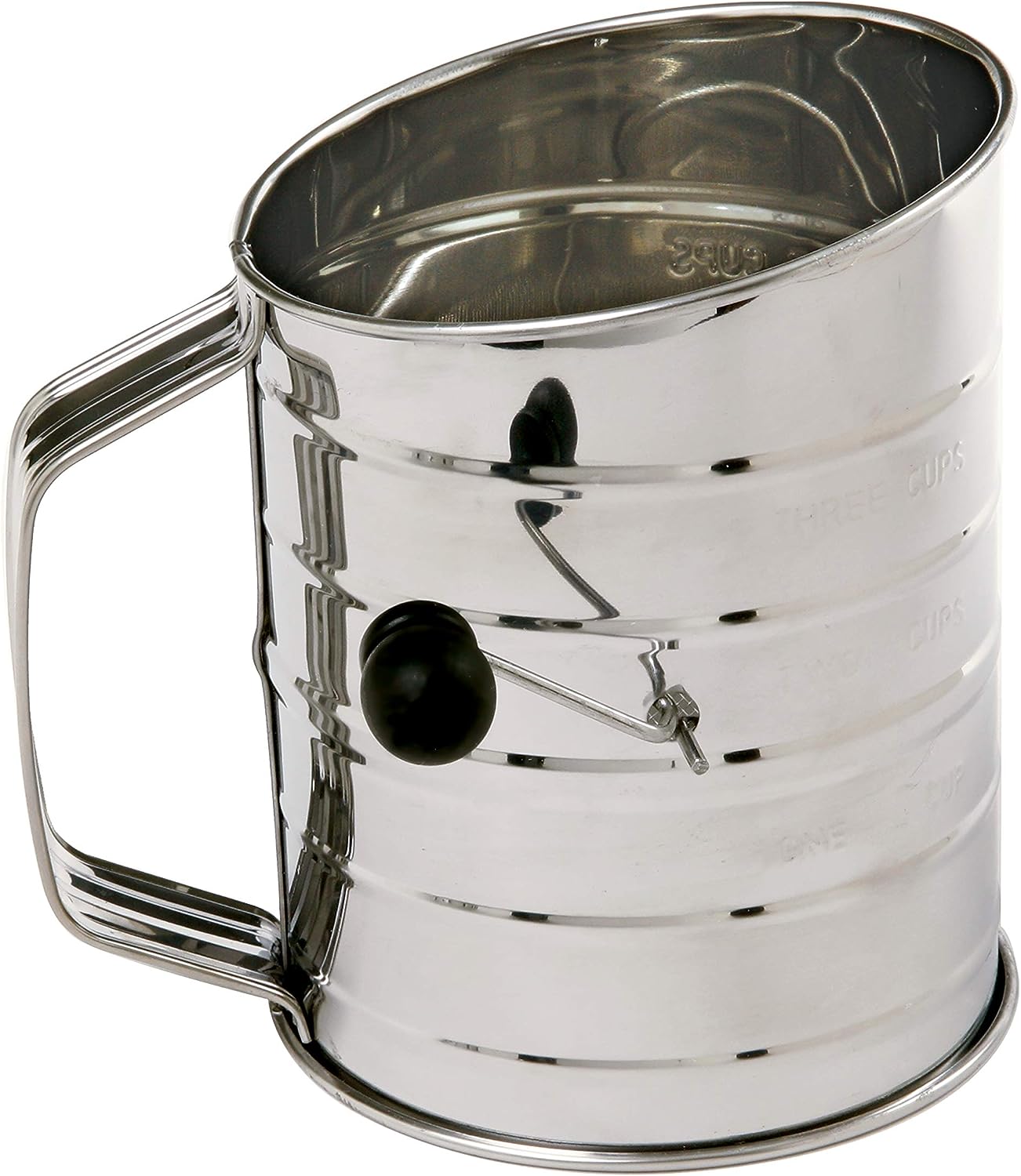
Wait, the title says “Rotary Hand Crank”, but this isn’t the Bellemain-style crank sifter. Norpro uses this name for their squeeze-handle model which has an internal rotary agitator. This sifter from Norpro is a fantastic option for those who prefer the convenience of one-handed operation. Squeezing the handle activates a rotary agitator that sweeps the contents across the mesh screen. This Norpro model stands out in a category often filled with flimsy plastic because it’s made entirely of durable stainless steel. The mechanism feels more robust and less prone to jamming than cheaper competitors.
It’s incredibly convenient for dusting a surface with flour or adding a small amount of an ingredient while your other hand is busy stirring. The 3-cup capacity is a good all-purpose size. As with most enclosed sifters, deep cleaning is a challenge, but for quick, one-handed sifting tasks, its performance and build quality are top-notch. It’s the perfect companion to your trusty set of the best measuring cups for an efficient baking workflow.
What We Love
- Convenient one-handed operation
- Durable all-stainless-steel construction
- Smooth, reliable squeeze mechanism
- Good 3-cup capacity
- Volume markings stamped on the side
What We Don’t
- Mechanism can be tiring for very large quantities
- Difficult to clean the internal parts thoroughly
Best for: Bakers who multitask, those who need to dust surfaces frequently, and anyone who prefers the ergonomics of a squeeze handle.
Check Price on AmazonMrs. Anderson’s Baking 5-Cup Hand Crank Flour Sifter
The Go-To Sifter for Big Batch Baking

When you’re doubling a cake recipe or baking multiple loaves of sourdough, sifting in 3-cup batches is a tedious chore. That’s where this 5-cup beast from Mrs. Anderson’s Baking comes in. This crank-style sifter is designed for volume. It’s made from stainless steel and features a classic wooden knob on the crank, which is comfortable to hold. The action is smooth, and the single-mesh screen processes large amounts of flour quickly and efficiently.
This is a no-frills workhorse. It does one job—sifting a lot of flour at once—and it does it well. It’s the kind of tool you’ll be grateful to have during holiday baking marathons. Like all crank sifters, cleaning requires a gentle touch, but for bakers who regularly work with large volumes, the time saved is well worth it. It’s a key part of an efficient setup and one of the most useful must-have kitchen appliances for a serious baker.
What We Love
- Large 5-cup capacity is great for big recipes
- Durable stainless steel body
- Comfortable wooden crank handle
- Simple, effective, and reliable mechanism
What We Don’t
- Bulky to store
- Requires careful hand cleaning
Best for: Avid bread bakers, cake decorators, and anyone who regularly bakes in large quantities.
Check Price on AmazonNorpro Battery Operated Sifter
Effortless Sifting at the Touch of a Button

For bakers with arthritis, carpal tunnel, or limited hand strength, traditional sifters can be a painful chore. The Norpro Battery Operated Sifter is a fantastic solution, providing perfect, fluffy flour with zero effort. The sifter has a large 5-cup capacity and is made from sturdy, BPA-free plastic. You simply press a button, and a gentle vibrating mechanism sifts the flour through the stainless steel mesh screen.
It’s surprisingly quiet and effective, especially for light jobs like flour and confectioners’ sugar. While it might struggle with very coarse or lumpy almond flour, it’s a game-changer for most baking tasks. It requires a single C battery (not included). The handle and motor assembly can be wiped clean, and the canister part can be washed. For those who need an accessible baking solution, this electric sifter is a brilliant and empowering tool.
What We Love
- Completely effortless push-button operation
- Ideal for users with limited hand strength
- Large 5-cup capacity
- Lightweight and easy to handle
What We Don’t
- Requires a C battery (not included)
- Plastic construction is less durable than steel
- Not ideal for heavy or coarse flours
Best for: Bakers with arthritis or dexterity challenges, and anyone who wants the most effortless sifting experience possible.
Check Price on AmazonA Brief History of the Flour Sifter
The humble flour sifter has a surprisingly rich history that mirrors the story of home baking itself. Long before pre-milled, pre-sifted flour was sold in resealable bags at every grocery store, flour arrived at home coarse, uneven, and full of bran fragments, chaff, and the occasional bit of stone dust from milling. Sifting wasn’t an optional refinement; it was an essential step just to make flour usable for baking at all.
In colonial kitchens, this job fell to simple hand sieves made from woven horsehair or wire mesh stretched over a wooden hoop, tools that were basically an early ancestor of today’s fine-mesh strainer. Bakers would shake or tap these hoops over a bowl, a slow and physically tiring process, especially when preparing flour for an entire household or bakery.
The invention of the crank-operated sifter in the mid-1800s was a genuine kitchen innovation. By enclosing the mesh screen inside a canister and adding a hand-turned agitator, inventors allowed cooks to sift far larger quantities with far less effort and far less mess, since the flour stayed contained rather than scattering across the counter. Patents for rotary sifters proliferated through the late 1800s and early 1900s, and tin and later stainless steel canister sifters became a fixture of nearly every American kitchen by the mid-20th century, often sold alongside cookbooks that assumed sifting was a mandatory first step in nearly every cake and pastry recipe.
The rise of “instantized” or “pre-sifted” commercial flour in the 1950s changed the calculus. Milling technology advanced to the point where flour could be processed into a much finer, more uniform, and less clumpy product straight out of the bag, and many home bakers began skipping the sifting step for everyday cooking. But as any baker who has made a delicate sponge cake or a glassy meringue knows, “pre-sifted” is not the same as “sifted right before you use it.” Modern sifters, from squeeze-handle designs to today’s battery-operated versions, exist precisely because that final aeration step, done immediately before mixing, still meaningfully changes the texture of the finished product. In many ways, the tool has simply become more specialized and more convenient over the decades, while its core purpose has remained exactly the same since those early horsehair sieves.
How to Sift Flour Without a Dedicated Sifter
Not every baker owns a sifter, and that’s perfectly fine. If a recipe calls for sifted flour and you don’t have a dedicated tool on hand, there are several reliable substitutes that will get you most of the way there.
Quick fix: A fine-mesh strainer set over a bowl, combined with a whisk or spoon to press the flour through, works almost as well as a purpose-built sifter for most recipes.
- Fine-mesh strainer and whisk: Place the strainer over a large bowl, add the flour (and any other dry ingredients like cocoa powder or baking powder), and use a whisk or the back of a spoon to press everything through the mesh. This method works particularly well because most home cooks already own a strainer for other tasks.
- The double-whisking method: If you have no strainer at all, whisking the dry ingredients vigorously in a bowl for a minute or two will aerate the flour and roughly combine the ingredients, though it won’t remove stubborn lumps as effectively as pushing them through mesh. This is best reserved for recipes where the aeration matters more than absolute smoothness, such as quick breads or muffins.
- A wide-mesh colander: For less delicate recipes, a metal colander with small enough holes can serve in a pinch. It won’t produce as fine a result as a proper sifter or fine-mesh strainer, but it will break up larger clumps.
- Weigh instead of sift, when the recipe allows: Many contemporary recipes written with weight measurements in mind are actually formulated around unsifted, scooped-and-leveled flour, meaning the sifting step is really there to fix clumps and aerate rather than to hit an exact weight. If your recipe gives both weight and “sifted” as an instruction, sifting after weighing (not before) is usually the intended order.
Whichever substitute you use, the goal is the same as with a dedicated sifter: break up compacted clumps, incorporate air, and evenly distribute any leaveners or spices mixed in with the flour. A recipe that calls for sifted flour will still turn out reasonably well with any of these methods, even without a dedicated crank sifter in your drawer.
Sifting Special and Alternative Flours: Gluten-Free, Almond, Whole Wheat, and Cocoa
Not all flours behave the same way in a sifter, and knowing the quirks of each type will save you frustration and produce better results.
Gluten-Free Flour Blends
Gluten-free flour blends, which often combine rice flour, tapioca starch, potato starch, and xanthan gum, tend to be denser and more prone to compacting during storage than wheat flour. Sifting is arguably even more important here, since these blends often separate slightly in the bag, with heavier starches settling to the bottom. A quick sift right before measuring helps redistribute the blend evenly, which matters enormously for gluten-free baking, where there’s no gluten structure to compensate for uneven ingredient distribution.
Almond Flour and Other Nut Flours
Almond flour is notoriously difficult to sift because its natural oil content causes it to clump and stick to fine mesh screens rather than passing through cleanly. A coarser mesh strainer, or simply breaking up clumps by hand before folding almond flour into a batter, often works better than trying to force it through a very fine crank sifter, which can clog quickly. If a recipe such as macarons calls for sifted almond flour and confectioners’ sugar together, sift them as a combined mixture rather than separately, since the sugar helps carry the almond flour through the mesh more easily.
Whole Wheat and Whole Grain Flours
Whole wheat flour contains bran and germ particles that are simply too large to pass through a fine mesh screen at all. Sifting whole wheat flour will remove some of that bran, which lightens the texture of the final baked good but also removes some of the nutritional benefit and rustic character that many bakers want from whole grain flour in the first place. Many bakers choose to sift out only a portion of the bran, incorporating what’s caught in the sifter back into the batter separately, striking a balance between lightness and whole-grain flavor.
Cocoa Powder
Cocoa powder is one of the single clumpiest ingredients in the average pantry, and it benefits enormously from a fine-mesh sift, especially when combined with confectioners’ sugar for a smooth ganache or ultra-fine chocolate cake crumb. Because cocoa powder is fine and slightly oily, it can also clog mesh screens; sifting it together with flour or sugar, rather than on its own, generally produces smoother results and reduces clogging.
Sifting, Weighing, and Measuring: Getting It Right Every Time
Confusion around sifting almost always comes down to one question: does the recipe want you to sift before or after measuring, and does that even matter if you’re using a kitchen scale? Here’s how to untangle it.
| Recipe Instruction | What It Means | How to Do It |
|---|---|---|
| “1 cup sifted flour” | Sift first, then measure the sifted flour | Sift onto a sheet of parchment or into a bowl, then lightly scoop into your measuring cup and level off |
| “1 cup flour, sifted” | Measure first, then sift | Scoop and level your measuring cup as usual, then sift the measured flour |
| “120g flour, sifted” | Weight is unaffected by sifting; sift for texture, not volume | Weigh 120g on a digital kitchen scale, then sift that amount to remove lumps and aerate |
| No mention of sifting | Recipe assumes standard scoop-and-level flour | Sifting is optional but will still generally improve texture, especially for cakes |
This is exactly why weighing your ingredients on a scale, rather than relying on cup measurements alone, removes so much guesswork. Since sifted flour and unsifted flour differ in volume but not in weight, a recipe measured by weight sidesteps the entire “before or after” debate. Sifting still matters for texture and lump removal, but it no longer changes how much flour actually ends up in your bowl. If you bake often, pairing sifting with a reliable scale, alongside your best measuring cups for everyday cooking, is the single best way to guarantee consistent results every time.
Recipes That Absolutely Require Sifting
While sifting improves nearly any baked good, there are certain recipes where skipping this step will visibly and dramatically hurt the final result. If you only sift occasionally, prioritize these categories.
- Angel Food Cake: This cake relies entirely on whipped egg whites for its structure and rise, with no fat or chemical leavening to fall back on. Unsifted flour, even in small clumps, will create dense pockets that collapse the delicate foam structure and leave the cake heavy and uneven. Cake flour is typically sifted multiple times for this recipe alone.
- Chiffon Cake: Similar to angel food cake, chiffon relies on whipped egg whites folded into a batter. Any unsifted lumps will weigh down sections of the batter and disrupt the light, airy crumb this cake is known for.
- Macarons: The famous smooth, glossy shell of a macaron depends on a perfectly fine, lump-free mixture of almond flour and confectioners’ sugar. Bakers typically sift this mixture at least twice, sometimes discarding the larger almond particles that won’t pass through the mesh, to guarantee the shell’s characteristic smooth top.
- Genoise and Sponge Cakes: These delicate, egg-foam-based cakes are extremely sensitive to being deflated by heavy or clumped dry ingredients. Sifting flour directly over the whipped eggs and gently folding it in, rather than dumping it in all at once, is standard technique.
- Powdered Sugar Glazes and Royal Icing: Confectioners’ sugar almost always contains small hardened lumps straight out of the bag. Sifting it before adding liquid is the only reliable way to guarantee a completely smooth glaze without visible specks or grainy texture.
- Soufflés: Like angel food cake, a soufflé’s rise depends entirely on delicately folding a small amount of flour or cocoa powder into whipped egg whites without deflating them. Clumps here are especially disruptive since the base mixture is so airy and fragile.
Outside of these categories, sifting remains a nice-to-have for texture and consistency in items like cookies, muffins, and quick breads, but skipping it is far less likely to cause a visible failure.
Common Sifting Mistakes to Avoid
Watch out: Most sifting problems come down to just a handful of avoidable habits. Fixing these will instantly improve your results.
- Sifting damp ingredients: Cocoa powder, confectioners’ sugar, and flour that have absorbed even a small amount of ambient humidity will clog a fine mesh screen almost immediately. Store dry ingredients in airtight containers and sift in a dry environment whenever possible.
- Overfilling the sifter: Cramming too much flour into a canister sifter forces the agitator to work harder and often results in an incomplete sift, since there isn’t enough room for the ingredient to move freely against the mesh. Work in smaller batches for a more thorough result.
- Sifting directly into a measuring cup: This compacts the sifted flour as it falls, partially undoing the aeration you just created. Always sift onto parchment paper or into a wide bowl first, then gently spoon the flour into your measuring cup.
- Ignoring the order of operations: As covered above, sifting before versus after measuring genuinely changes the amount of flour in a cup measurement. Always check whether your recipe means “measure, then sift” or “sift, then measure.”
- Forgetting to sift leaveners with the flour: Simply sifting flour alone, then sprinkling baking powder or baking soda on top of the batter, misses the entire point of even distribution. Sift leaveners, salt, and spices together with the flour in one pass.
- Trying to sift very oily ingredients on their own: Almond flour and other nut flours resist sifting because of their fat content, as mentioned earlier. Sifting them combined with a drier ingredient like sugar, or simply breaking up clumps by hand, avoids repeatedly jamming your sifter.
- Neglecting to dry the sifter fully after cleaning: Any residual moisture left inside a metal crank sifter is the single most common cause of rust and a seized mechanism. Always air dry completely before storing.
Sifter Care, Cleaning, and Rust Prevention
A good sifter, especially a stainless steel crank model, can last for decades if it’s cared for properly. The biggest threat to any metal sifter isn’t heavy use, it’s moisture trapped inside the mechanism.
- Tap out excess flour immediately after use. Turn the sifter upside down over the sink or a trash can and give it a few firm taps to dislodge loose flour before it has a chance to compact inside the mechanism.
- Use a dry pastry brush for the interior. A small, dry brush reaches into the corners and around the agitator far better than shaking alone, and it doesn’t introduce any moisture.
- Avoid full submersion. Dunking a crank or squeeze-handle sifter in water is the fastest way to trap moisture in the gears and springs, which leads to rust and a stiff, sticky mechanism over time.
- If it needs more than a brush, use a barely damp cloth. Wipe down the exterior and any accessible interior surfaces, then dry immediately with a towel.
- Air dry thoroughly before storage. Leave the sifter open and exposed to air for several hours, or overnight, before putting it away. Storing a sifter with any residual dampness is the single most common cause of premature rust.
- Store in a dry cabinet, not a damp drawer near the sink. Humidity from nearby dishwashing or a sink area can slowly encourage corrosion even in stainless steel over many years.
Fine-mesh strainers and drum sieves, by contrast, are typically far easier to maintain since they have no enclosed mechanism. Most are fully dishwasher safe or can be rinsed clean under hot water with a bit of dish soap and a soft brush to clear any flour stuck in the mesh. If you specifically want a low-maintenance option, this is one of the strongest arguments in favor of a simple strainer over a canister-style crank sifter.
Full Comparison Table: All 5 Sifters Side by Side
| Sifter | Type | Capacity | Material | Best For |
|---|---|---|---|---|
| Bellemain Stainless Steel Sifter | Crank-style | 3 cups | Stainless steel | Overall best value and durability |
| OXO Good Grips Fine-Mesh Strainer | Fine-mesh strainer | 8-inch diameter | Stainless steel | Versatility and easy cleanup |
| Norpro Rotary Squeeze Sifter | Squeeze-handle | 3 cups | Stainless steel | One-handed operation |
| Mrs. Anderson’s Hand Crank Sifter | Crank-style | 5 cups | Stainless steel with wood knob | Big-batch and large-volume baking |
| Norpro Battery Operated Sifter | Battery-powered | 5 cups | BPA-free plastic | Accessibility and effortless operation |
Sifters by Budget: Finding the Right Fit for Your Price Range
Sifters span a wide price range, and the good news is that price doesn’t always correlate directly with performance, since needs vary so much from one baker to another.
Budget-Friendly Picks
If you bake occasionally and want a low-cost way to get most of the benefits of sifting, a basic fine-mesh strainer is nearly always the most economical route, especially since many kitchens already have one for other tasks. A simple strainer paired with a whisk covers the vast majority of everyday sifting needs without any dedicated spend at all.
Mid-Range Picks
Most dedicated crank and squeeze-handle sifters, including our top overall pick, land in a moderate mid-range price bracket. At this price point, you’re generally paying for a purpose-built mechanism, engraved volume markings, and stainless steel construction that will hold up for years of regular use.
Premium and Specialty Picks
Larger-capacity crank sifters and specialty tools like professional tamis or drum sieves sit at the higher end of the price spectrum, reflecting their bigger build, more robust materials, or specialized professional-grade design. These are worth the investment primarily for bakers who work in large volumes regularly, such as those baking for events, markets, or big households.
Accessibility-Focused Picks
Battery-operated sifters occupy their own category, priced to reflect the convenience of push-button operation. For bakers with arthritis, carpal tunnel, or any condition that makes repetitive hand motion painful, this upfront cost is easily justified by the ability to keep baking comfortably.
How We Sifted Through the Competition: Our Testing Method
We subjected each sifter to a series of tests to evaluate its performance in a real-world baking environment.
- The All-Purpose Flour Test: We timed how long it took each model to sift three cups of standard all-purpose flour. We examined the resulting flour for lightness and consistent texture.
- The Clump Buster Test: We challenged each sifter with one cup of notoriously clumpy natural cocoa powder. This test quickly revealed which mechanisms were powerful enough to break down stubborn lumps.
- The Confectioners’ Sugar Test: To test for fine-sifting ability, we sifted two cups of confectioners’ sugar, checking the final product for any lumps that would ruin a smooth glaze or frosting.
- The Ergonomics and Cleaning Test: We used each sifter for an extended period to evaluate hand comfort and fatigue. Afterward, we followed the manufacturer’s instructions for cleaning and assessed how easy—or difficult—it was to get the sifter completely clean and dry.
- The Alternative Flour Test: We also ran each sifter through a batch of almond flour and a gluten-free all-purpose blend to see how well each mechanism handled ingredients that are prone to clumping or clogging a fine screen.
- The Longevity Check: After repeated use and cleaning cycles, we inspected each mechanism for signs of wear, rust, or jamming to get a sense of how each sifter would hold up over years of regular baking.
Frequently Asked Questions (FAQ)
My recipe doesn’t say to sift the flour. Should I do it anyway?
For the best results, yes. Most modern recipes written in the U.S. are formulated for the “scoop and sweep” method of measuring unsifted flour. However, sifting *after* you measure still provides the crucial benefits of aeration and lump removal, which will almost always lead to a better texture. The gold standard for accuracy is to weigh your flour first with a digital kitchen scale, and then sift it.
What’s the difference between sifting and just whisking the flour?
Whisking is a good substitute for aerating and combining dry ingredients if you don’t have a sifter. However, it is not as effective at breaking down stubborn clumps of flour, cocoa powder, or confectioners’ sugar. Sifting forces the ingredients through a fine mesh, guaranteeing that every particle is separated and lump-free. For the ultimate smooth texture, sifting is always superior.
How do I properly clean a crank-style flour sifter?
The golden rule is: never submerge it in water. Water will get trapped in the mechanism and can cause rust or seize up the gears. The best method is to first tap out as much excess flour as possible. Then, use a dry pastry brush to sweep out the interior. If necessary, you can wipe it with a barely damp cloth and then dry it immediately and thoroughly. Letting it air dry completely before storage is crucial.
Can I sift gluten-free flour the same way as regular flour?
Yes, and it’s often even more important to do so. Gluten-free blends contain multiple starches and flours that can separate during storage and shipping. Sifting redistributes the blend evenly before you measure and mix, which helps ensure consistent texture and rise since there’s no gluten structure to compensate for uneven distribution.
Why does almond flour clog my sifter?
Almond flour’s natural oil content causes it to clump and stick to fine mesh rather than passing through freely. Sifting it alongside a drier ingredient, such as confectioners’ sugar in a macaron recipe, generally helps it move through more easily than sifting it entirely on its own.
Does sifting flour change how much I should use in a recipe?
It can, if you’re measuring by volume. Sifted flour takes up more space per cup than unsifted flour because it contains more air, so sifting before versus after measuring can noticeably change the amount of flour in a cup measurement. This is why many precise bakers prefer weighing flour on a scale, since weight isn’t affected by sifting the way volume is.
Is a fine-mesh strainer really as good as a dedicated flour sifter?
For most everyday baking, yes. A fine-mesh strainer combined with a whisk or spoon to push ingredients through achieves very similar aeration and lump removal to a dedicated crank sifter, with the added benefit of being far easier to clean and more versatile for other kitchen tasks.
How often should I replace a flour sifter?
A well-maintained stainless steel sifter can last for many years, even decades, of regular use, as long as it’s kept dry and free of rust. Squeeze-handle and battery-operated models with more moving parts, such as internal springs or motors, tend to have a shorter working life and may need replacing sooner if the mechanism wears out or jams permanently.
The Final Verdict on Sifters
Sifting is a small, simple step that pays huge dividends in the final quality of your baked goods. It’s the hallmark of a baker who cares about details and understands that great texture is the result of intention, not luck. Choosing the right tool for the job makes this step a pleasure rather than a chore.
For its classic design, durable stainless steel construction, and wonderfully smooth operation, the Bellemain Stainless Steel 3-Cup Flour Sifter is our top recommendation for most home bakers. It’s a reliable, beautiful tool that does its job perfectly.
However, if you prioritize versatility and effortless cleaning, the OXO Good Grips 8-Inch Fine-Mesh Strainer is an equally fantastic choice that will serve you well in countless other ways around the kitchen.
Whichever you choose, embracing the sift will unlock a new level of lightness and perfection in your baking.


