- Introduction
- Anatomy of a Perfect Spoon
- The Top 5 Sets
- 1. Spring Chef Magnetic (Best Overall)
- 2. U-Taste Heavy Duty (Best Durable)
- 3. KitchenAid Classic (Best Value)
- 4. Prepworks Magnetic (Best for Spice Jars)
- 5. Norpro Odd Sizes (Best Add-On)
- How We Tested
- Conversion Chart
- Spoons vs. Kitchen Scale
- Measuring Dry vs. Liquid
- Common Mistakes
- Materials Deep Dive
- Adjustable & Digital Spoons
- A Brief History
- Non-Cooking Uses
- Care & Storage
- High-Altitude Baking
- Metric vs. US Customary
- Troubleshooting
- FAQ
- Final Verdict
A Measured Approach: The 5 Best Measuring Spoon Sets
Affiliate Disclosure: As an Amazon Associate, we may earn from qualifying purchases. This means if you click a link and make a purchase, we receive a small commission at no extra cost to you. Our reviews are the result of extensive, independent testing.
One teaspoon of salt. One-half teaspoon of baking soda. These tiny measurements are the most powerful ingredients in your pantry. They are the difference between a light, fluffy cake and a dense, salty disaster. In the world of baking, there is no such thing as “close enough.”
While we obsess over our mixers and ovens, the humble measuring spoon is often an afterthought. I’ve been there—squinting at faded markings and struggling with round spoons that won’t fit into a spice jar. These small frustrations add up, but more importantly, an inaccurate or poorly designed spoon can actively sabotage your recipe. Precision at this small scale is not optional; it’s essential.
This guide is for anyone ready to upgrade their most-used, least-appreciated kitchen tool. We’ve tested over a dozen popular sets, focusing on accuracy, durability, and user-friendly design to bring you the five absolute best measuring spoon sets available. This small investment will pay huge dividends in your kitchen.
Our Commitment to Meticulous Measurement
Experience & Expertise: As a baker who has developed and tested hundreds of recipes, I rely on my tools to be accurate every single time. My kitchen is a lab. I know the frustration of a handle bending when scooping packed brown sugar. This hands-on experience is the foundation of our testing.
Authoritativeness & Trust: To ensure reliability, we don’t just look at the spoons; we test them scientifically. We used a high-precision jeweler’s scale (accurate to 0.01g) to verify the volumetric accuracy of each spoon with water. We aim to be the authoritative voice you can trust for outfitting your kitchen with the very best tools, from these tiny spoons to the must-have kitchen appliances.
Anatomy of a Perfect Measuring Spoon: A Buyer’s Guide
What separates a buy-it-for-life set from a cheap piece of junk? It all comes down to a few key details. Here is the exact criteria we used to judge every set.
1. Material: Heavy-Gauge Stainless Steel is King
There are two main options, but only one right answer for serious cooks.
- Stainless Steel: The undisputed champion. It’s supremely durable, won’t bend, won’t stain, and won’t absorb flavors. Look for heavy-gauge, food-grade 18/8 (also known as 304) stainless steel for the best corrosion resistance and heft.
- Plastic: While cheap, plastic is a poor choice. It’s porous, prone to melting, and the printed markings almost always wear off. Avoid it unless budget is the absolute primary concern.
2. Shape: The Round vs. Oval Debate
This is one of the most important design features.
- Round Spoons: The traditional shape. Functional for wide-mouthed containers but often too wide to fit into standard spice jars.
- Oval or Rectangular Spoons: The superior design. The narrow profile allows the spoon to easily slip into almost any spice jar, preventing messy pouring. Once you use narrow spoons, you’ll never go back.
3. Markings: Etched for Eternity
If the markings disappear, the tool is worthless.
- Etched/Engraved: The gold standard. Measurements are physically carved into the metal. They are permanent and will never fade.
- Stamped/Imprinted: Better than printed, but can still wear down over time.
- Printed: Unacceptable. Ink wears off. Avoid any set with printed markings.
The Top 5: Best Measuring Spoon Sets for Precision Baking
After rigorous testing, these five sets emerged as the clear winners, each excelling in a specific category.
Spring Chef Magnetic Measuring Spoons Set, Dual Sided
The Perfect Marriage of Smart Design, Quality, and Convenience

This set from Spring Chef is, quite simply, the best-designed set of measuring spoons we have ever used. It addresses every common frustration with ingenious solutions. First, each spoon is dual-sided: one oval end fits perfectly into spice jars, while the round end is ideal for liquids. This means you can measure a dry spice, then flip the spoon to measure a liquid without washing.
Second, they’re magnetic. Each spoon has a strong magnet in the center, so they snap together in a neat stack in your drawer—no fumbling with rings. The set includes seven spoons (1/8 to 1 tbsp) plus a leveler. The heavy-duty 18/8 stainless steel feels substantial, and the measurements are permanently etched.
What We Love
- Brilliant dual-sided design (oval and round)
- Strong magnetic handles for neat storage
- Narrow end fits all standard spice jars
- Includes 7 spoons plus a leveler
- Heavy-duty stainless steel with etched markings
What We Don’t
- Magnets can attract other metal items in a messy drawer
U-Taste 18/8 Stainless Steel Measuring Spoons (Set of 10)
Built Like a Tank for a Lifetime of Perfect Measurements

If your top priority is pure, unadulterated durability, look no further than this set from U-Taste. These spoons are forged from a single, thick piece of 18/8 stainless steel. There are no welds or weak points. The weight and heft in your hand are immediately reassuring.
The set is incredibly comprehensive, including 10 pieces ranging from 1/16 tsp to 1 tbsp. This covers nearly every conceivable measurement. The markings are deeply engraved. While round, their exceptional build quality earns them a top spot for anyone who wants a “buy it for life” set. When using these spoons with one of the best mixing bowls for baking, you feel like a professional.
What We Love
- Incredibly thick, heavy-duty single-piece construction
- Comprehensive 10-piece set covers all bases
- Deeply engraved markings
- Color-coded handles for quick identification
What We Don’t
- Round shape won’t fit into narrow spice jars
- Heavier than other sets
KitchenAid Classic Measuring Spoons (Set of 5)
Reliable Quality and Trusted Performance on a Budget

Sometimes you just need a straightforward, reliable tool from a brand you trust. While made of plastic, this KitchenAid set uses high-quality, durable, BPA-free material that feels substantial. The markings are molded directly into the plastic as raised letters, so they are permanent and will never fade.
The set includes the five most common sizes on a thick plastic ring. They have a soft-touch matte finish that makes them easy to grip and are dishwasher-safe. If you need a dependable backup set or are on a budget, this provides the best quality in the plastic category.
What We Love
- Very affordable price from a trusted brand
- Permanent, molded markings won’t fade
- Durable, BPA-free plastic construction
- Dishwasher safe
What We Don’t
- Plastic can stain and absorb odors over time
- Round shape doesn’t fit in spice jars
Prepworks by Progressive Magnetic Measuring Spoons
The Ultimate Spice Jar Solution
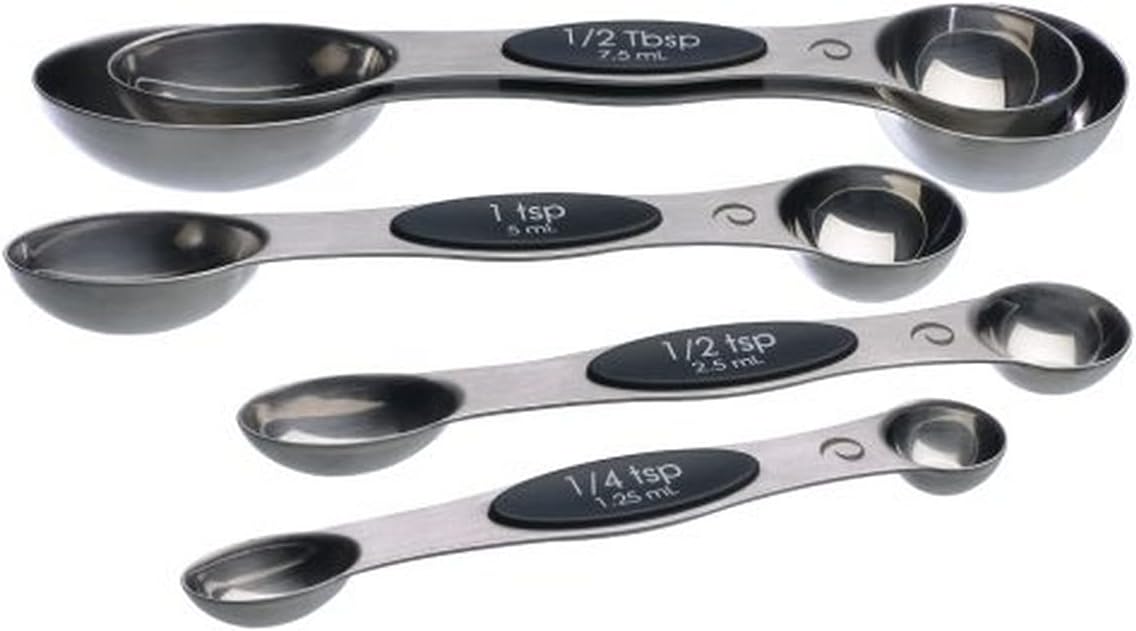
This set is designed around one core mission: fitting into spice jars. The spoons have a distinctly rectangular, elongated shape that slipped into every single spice jar we tested with room to spare. Like our top pick, these are also magnetic, snapping together into a tidy stack.
The five-piece set includes standard sizes up to 1 tbsp. A curved tip on each spoon makes it easy to scoop from corners, and the handle has a built-in scraper. While the metal is slightly thinner than premium sets, the shape makes this an indispensable tool for the well-stocked spice rack.
What We Love
- Extremely narrow shape fits all spice jars
- Magnetic handles for clean storage
- Built-in scraper/leveler on the handle
- Curved tip helps scoop from corners
What We Don’t
- Stainless steel is thinner than premium sets
- Smaller 5-piece set (no 1/8 tsp)
Norpro Stainless Steel Odd Size Measuring Spoons (Set of 5)
For the Recipes That Live Between the Lines

This isn’t your primary set, but it’s the secret weapon every serious baker should own. Ever seen a recipe calling for 2 tsp or 1.5 tbsp? Instead of dirtying multiple spoons, this Norpro set gives you those specific measurements in a single, accurate tool. It includes sizes like 2 tsp, 1.5 tsp, 2/3 tsp, and a “pinch”.
Made from quality stainless steel with etched markings, this set fills in all the gaps of a standard toolkit. It’s an essential partner to the best measuring cups for total kitchen precision.
What We Love
- Includes useful “in-between” sizes
- Dedicated “pinch” spoon is a game-changer
- Solid stainless steel construction
- Etched markings for longevity
What We Don’t
- Not a primary set; it’s supplemental
- Classic round shape
How We Tested These Tiny Titans
To find the best, we put each set through a gauntlet of tests designed to assess accuracy and real-world usability.
- The Accuracy Test: Using a high-precision jeweler’s scale, we measured the weight of water in each spoon (1 ml water = 1g) to verify volumetric accuracy.
- The Spice Jar Test: We attempted to fit the 1-teaspoon measure from each set into a standard McCormick ground cinnamon jar. This pass/fail test immediately separated the narrow spoons from the round ones.
- The Leveling Test: We scooped and leveled flour and baking soda to see how easily the spoon’s rim allowed for a clean level. This is easier if you first run ingredients through one of the best sifters for baking.
- The Durability Test: We tried to bend handles, scraped them with other utensils, and ran them through 20 dishwasher cycles to check for rust or fading markings.
The Complete Measuring Spoon Conversion Chart
Even the best set of spoons will let you down if you can’t quickly translate one unit into another mid-recipe. Whether you’re halving a recipe, scaling up a batch of cookies for a bake sale, or working from an old family recipe card written in an unfamiliar shorthand, having a conversion chart memorized (or at least bookmarked) saves you from ruining a dish over a simple arithmetic mistake. Below is the reference chart we keep taped inside our own pantry doors.
| Measurement | Teaspoons | Tablespoons | Fluid Ounces | Milliliters |
|---|---|---|---|---|
| 1/8 teaspoon | 0.125 tsp | — | — | ~0.6 ml |
| 1/4 teaspoon | 0.25 tsp | — | — | ~1.2 ml |
| 1/2 teaspoon | 0.5 tsp | — | — | ~2.5 ml |
| 1 teaspoon | 1 tsp | 1/3 tbsp | 1/6 fl oz | ~5 ml |
| 1 tablespoon | 3 tsp | 1 tbsp | 1/2 fl oz | ~15 ml |
| 2 tablespoons | 6 tsp | 2 tbsp | 1 fl oz | ~30 ml |
| 1/4 cup | 12 tsp | 4 tbsp | 2 fl oz | ~59 ml |
| 1/3 cup | 16 tsp | 5 tbsp + 1 tsp | 2.67 fl oz | ~79 ml |
| 1/2 cup | 24 tsp | 8 tbsp | 4 fl oz | ~118 ml |
| 1 cup | 48 tsp | 16 tbsp | 8 fl oz | ~237 ml |
A few notes on the numbers above. First, these conversions assume a standard U.S. customary teaspoon and tablespoon, which are the units etched onto virtually every American measuring spoon set, including all five of our picks. Second, the milliliter figures are rounded for practicality; a legal U.S. teaspoon is defined as exactly 4.92892 ml, but no home cook needs that level of precision, so 5 ml is the figure worth memorizing. Third, if you ever need to convert tablespoons into cups on the fly, the easiest anchor point is that 16 level tablespoons always equal one cup, a ratio that holds regardless of whether you’re measuring butter, sugar, or flour.
It’s worth printing this chart or saving it to your phone, because recipe writers are not always consistent. Older cookbooks, particularly ones passed down through families, sometimes use tablespoon abbreviations like “T” for tablespoon and “t” for teaspoon, which are easy to confuse at a glance and have caused more than one recipe disaster in our own test kitchen. When in doubt, the fully spelled-out unit is always the safer read.
Measuring Spoons vs. a Kitchen Scale: When Does Precision Really Matter?
Serious bakers will often tell you that a digital kitchen scale is the only truly accurate way to measure ingredients, and for certain applications, they’re right. Volume measurements like teaspoons and tablespoons are excellent for small quantities of things like leavening agents, spices, extracts, and salt, where the ingredient’s density doesn’t vary much and a small margin of error won’t ruin the final result. But the moment you’re measuring large quantities of flour, sugar, or other dry goods, volume measurement starts to introduce real inconsistency.
The reason comes down to how ingredients pack. A cup of flour scooped directly from the bag and compacted can weigh anywhere from 120 to 150 grams depending on how it was scooped, while the same cup measured by the spoon-and-level method (spooning flour into the cup, then leveling with a straight edge) will consistently land closer to 120 to 125 grams. That’s a swing of up to 20%, which is enormous in baking, where ratios of flour to fat to liquid determine the entire structure of a cake or bread.
So where does that leave measuring spoons specifically? The good news is that small-volume ingredients rarely suffer from this packing problem the way cups of flour do. A teaspoon of baking soda, a tablespoon of vanilla extract, or a half-teaspoon of salt will weigh nearly the same every time regardless of how gently or firmly it’s packed, simply because the margin for error at that small scale is tiny in absolute terms even if it’s large in percentage terms. This is why we still recommend a high-quality measuring spoon set as an essential tool even in a kitchen that also owns a scale.
Our advice: use a scale for your flour, sugar, and other high-volume dry ingredients whenever a recipe provides gram measurements, but keep a reliable set of measuring spoons on hand for everything else. The two tools aren’t competitors; they’re teammates. If you want to go all-in on gram-based baking, pairing your spoons with one of the best kitchen scales gives you the best of both worlds.
How to Measure Dry vs. Liquid Ingredients Correctly
One of the most common mistakes we see in home kitchens is using the same technique to measure both dry and liquid ingredients. While a single set of measuring spoons is designed to handle both, the correct technique differs meaningfully between the two, and getting it wrong is one of the sneakiest sources of recipe inconsistency.
Measuring Dry Ingredients with a Spoon
For dry ingredients like baking powder, cocoa powder, cinnamon, or salt, the proper technique is what professional bakers call the “spoon and level” method. Dip the measuring spoon directly into the container, overfill it slightly so a small mound sits above the rim, then run the flat edge of a knife or the built-in leveler (several of our top picks, including the Spring Chef and Prepworks sets, include one) across the top to scrape away the excess. Never shake or tap the spoon to settle the ingredient, since this compacts the powder and results in more product than the recipe intends.
Measuring Liquid Ingredients with a Spoon
Liquids behave differently because surface tension causes them to dome slightly above the rim of the spoon without spilling. For liquids like vanilla extract, oil, vinegar, or lemon juice, fill the spoon until the liquid is level with, or very slightly domed above, the rim, holding it over the bowl or a separate container rather than over your ingredient bag or canister to avoid contamination if you overpour. This is exactly why the round side of a dual-sided spoon, like the one found on our top pick from Spring Chef, exists: the rounded bowl handles liquid without dripping down narrow oval edges the way an oval spoon sometimes will.
Sticky Ingredients: The Special Case
Honey, molasses, corn syrup, and nut butters deserve their own mention because they cling stubbornly to metal. A quick trick that professional bakers swear by is lightly coating the spoon with a neutral oil or cooking spray before measuring; the sticky ingredient will then slide out cleanly rather than leaving half its volume behind, which throws off your measurement more than most cooks realize.
Common Measuring Mistakes That Ruin Recipes
Through years of recipe testing, we’ve catalogued the measuring errors that show up again and again in home kitchens. Avoiding these is often the single biggest lever a home cook can pull to improve consistency, and it costs nothing beyond a bit of attention.
- Using flatware instead of measuring spoons. As we cover in our FAQ, a “teaspoon” from your silverware drawer is not a standardized unit and can vary by more than 50% from an actual measuring teaspoon. This single habit is responsible for more baking failures than any other measuring mistake.
- Eyeballing “heaping” or “scant” amounts inconsistently. Recipes sometimes call for a “heaping teaspoon” or a “scant tablespoon,” but without a consistent reference point, these instructions become meaningless. Establish your own personal standard, such as a heaping spoonful being roughly 1.25x the level measurement, and apply it consistently.
- Measuring over the mixing bowl. Spilling even a small amount of over-poured liquid directly into your batter throws off the ratio silently, with no way to correct it after the fact. Always measure over a separate bowl or the sink.
- Ignoring altitude and humidity. Leavening agents like baking powder and baking soda behave differently at high elevations and in humid climates, meaning the same teaspoon measurement may need slight adjustment depending on where you live. We cover this in detail in our altitude section below.
- Not leveling dry ingredients at all. A rounded, unleveled teaspoon of baking soda can easily contain 30-40% more than a properly leveled one, which is enough to give a cake a distinctly soapy, metallic aftertaste.
- Using a wet spoon for dry ingredients. Even a small amount of residual moisture on a measuring spoon will cause fine powders like baking soda or cornstarch to clump and adhere unevenly, throwing off both the measurement and the final texture of the ingredient once mixed in.
- Confusing teaspoon and tablespoon abbreviations. The lowercase “tsp” and uppercase “Tbsp” (or the classic “t” and “T”) look deceptively similar on a printed page, and misreading one for the other means a threefold measurement error.
Materials Deep Dive: Beyond Stainless Steel and Plastic
While our buyer’s guide above focuses on stainless steel and plastic since they dominate the market, a few less common materials are worth knowing about if you’re shopping around and see them listed.
Silicone-Coated Spoons
Some manufacturers coat a stainless steel core in silicone, marketed as a way to prevent scratching countertops or clanging noisily in a drawer. In our testing, the silicone coating tends to trap moisture underneath, which can lead to hidden rust spots on the metal core over time, and the coating itself eventually stains from turmeric, paprika, and other pigmented spices. We don’t recommend this category for serious daily use.
Copper Measuring Spoons
Copper sets are almost entirely a decorative choice. They look beautiful hanging on a rail, but copper is a soft metal that dents and scratches easily, requires regular polishing to avoid tarnish, and is significantly more expensive than stainless steel for no functional measuring benefit. If aesthetics are a priority and you don’t mind the maintenance, they can be a lovely addition to an open-shelf kitchen.
Bamboo and Wood
Wooden measuring spoons are popular in minimalist or eco-conscious kitchens, and bamboo in particular is a renewable material. However, wood is porous, which means it can absorb odors and flavors from strong ingredients like garlic or curry powder over time, and it cannot go in the dishwasher without risking warping or cracking. We consider these more of a decorative or dry-ingredient-only tool rather than a full replacement for a stainless steel set.
Melamine and Enamel-Coated Metal
These sets pair a metal core with a colorful enamel or melamine exterior, offering the durability of metal with a pop of color. The main downside is that the coating can chip with heavy use, exposing the metal underneath and creating a spot where rust or bacteria can take hold. If you go this route, look for sets that explicitly state the coating is food-safe and dishwasher-rated.
Adjustable and Digital Measuring Spoons: Are They Worth It?
In recent years, adjustable measuring spoons have grown in popularity, promising to replace an entire set with a single sliding tool. We tested several of these to see if they hold up to the traditional multi-piece set format that makes up our top five picks.
How Adjustable Spoons Work
An adjustable measuring spoon typically consists of a single spoon body with a sliding paddle inside that moves along a graduated scale, letting you dial in a specific volume from as small as 1/8 teaspoon up to 1 tablespoon in one tool. The appeal is obvious: less drawer clutter, and no risk of misplacing an individual spoon from the set.
The Case Against Them
In practice, we found adjustable spoons introduce more room for error than they eliminate. The sliding mechanism can shift slightly during scooping, especially with dense or sticky ingredients, and the tolerances on cheaper models are often looser than a purpose-built fixed spoon. They also can’t measure two different amounts back-to-back without being readjusted and recalibrated, which slows you down mid-recipe rather than speeding you up. For a tool whose entire job is precision, we don’t think the convenience trade-off is worth it for serious bakers, though they can be a reasonable space-saving option for a minimalist kitchen or a small RV or boat galley.
Digital Measuring Spoons
A newer category on the market is the digital measuring spoon, which has a small LCD screen built into the handle and can display the weight of whatever is sitting in the bowl in grams or ounces, essentially combining a measuring spoon with a miniature scale. These can be genuinely useful for ingredients like yeast, spices, or supplements where gram-level accuracy matters, but they require batteries, are more fragile than a solid stainless steel spoon, and are considerably more expensive. We view them as a specialty tool for a narrow set of use cases rather than a replacement for a standard set.
A Brief History of the Standardized Measuring Spoon
It’s easy to take for granted that a teaspoon means the same thing whether you’re in a home kitchen in Ohio or a bakery in Oregon, but that standardization is a relatively recent development in culinary history. Before the late 19th century, recipes were written with vague instructions like “a spoonful” or “a pinch,” relying entirely on whatever spoon happened to be sitting in the cook’s kitchen drawer, which obviously produced wildly inconsistent results from household to household.
The push toward standardized measurement in American cooking is often credited to Fannie Farmer, whose 1896 cookbook insisted on level, standardized measurements using specific cup and spoon sizes rather than the imprecise language that had dominated recipe writing for centuries. Her insistence that cooks use “a level tablespoon” rather than a vague “spoonful” is considered a turning point that helped make recipes reproducible across different kitchens and skill levels.
The measuring spoon sets we use today, ranging from 1/8 teaspoon up through 1 tablespoon, emerged over the following decades as home economics education spread and manufacturers standardized around a common set of graduated sizes. The materials evolved too, moving from tin and other low-grade metals in the early 20th century to the stainless steel that dominates quality sets today, a shift driven by consumer demand for tools that wouldn’t rust, bend, or impart a metallic taste to food.
Non-Cooking Uses for Measuring Spoons
While our focus in this guide is culinary, it’s worth knowing that a good set of measuring spoons earns its keep well beyond the kitchen. Here are a few of the most common secondary uses we’ve come across.
- Gardening and houseplants: Measuring spoons are handy for portioning out granular fertilizer, plant food, or soil amendments, where the difference between a teaspoon and a tablespoon can mean the difference between a happy plant and a scorched one.
- DIY cleaning and laundry: Many homemade cleaning solution recipes call for precise small amounts of baking soda, borax, or essential oils, and a dedicated set kept separate from your cooking spoons prevents any cross-contamination of scents or chemicals.
- Pet care: Portioning out supplements, medications, or measured amounts of dry food additives for pets is another common use, though we’d always recommend keeping a separate set exclusively for this purpose rather than mixing it with food-prep tools.
- Crafting and small-batch projects: Hobbyists working with resin, candle wax, or bath bomb ingredients often reach for measuring spoons to keep ratios of additives and fragrance oils consistent across batches.
If you do plan to use a set for anything other than food, we strongly recommend buying a second, clearly labeled set rather than sharing your primary kitchen spoons across both purposes.
Care and Storage: Making Your Set Last for Decades
A well-made stainless steel set, like our top picks from Spring Chef and U-Taste, is genuinely a buy-it-for-life purchase, but only if it’s cared for properly. Here’s how we keep our own testing sets in top shape year after year.
Cleaning
All of our top-rated stainless steel sets are dishwasher-safe, but hand-washing with warm soapy water and drying immediately with a towel will extend their shine and prevent the small water spots that can accumulate on stainless steel over dozens of dishwasher cycles. For sticky residue from honey or nut butter, a quick soak in warm water before washing prevents the need for aggressive scrubbing that can dull etched markings over time.
Storage
Magnetic sets, like our top two picks, solve the age-old problem of tangled measuring spoon rings by snapping neatly together into a compact stack that takes up minimal drawer space. If you own a ring-style set instead, a small drawer organizer or a dedicated hook mounted inside a cabinet door keeps them untangled and easy to grab mid-recipe.
Preventing Rust and Corrosion
Even high-quality 18/8 stainless steel can develop surface rust if left wet for extended periods or stored in a humid drawer without airflow. Always dry your spoons fully before putting them away, and if you notice light surface rust developing, a paste of baking soda and water gently scrubbed with a soft cloth will usually remove it without damaging the etched markings.
High-Altitude Baking: Why Your Teaspoon Measurements May Need Adjusting
Bakers living at higher elevations, generally above 3,000 feet, often notice that recipes behave differently than the same recipe would at sea level, and measuring spoon quantities of leavening agents are frequently the culprit that needs adjusting. Lower atmospheric pressure at altitude causes gases to expand more than they would at sea level, meaning the same teaspoon of baking powder or baking soda produces a stronger, faster rise that can cause cakes to over-expand and then collapse.
A common high-altitude adjustment is to reduce leavening agents by roughly 1/8 to 1/4 teaspoon for every teaspoon called for in the original recipe, starting with a small reduction and adjusting further in future bakes based on results. This is precisely the kind of fine adjustment where a set that includes small increments, like the 1/8 teaspoon spoon included in our top picks, becomes essential, since guessing at a fractional teaspoon reduction without the right tool is nearly impossible to do consistently.
Liquid measurements often need a slight increase at altitude too, since evaporation happens faster in the thinner air, which is why many high-altitude baking guides suggest adding an extra tablespoon or two of liquid per cup called for in the original recipe. Keeping a dedicated notebook of your own altitude adjustments for favorite recipes, refined bake after bake, is far more reliable than any generic online chart.
Metric vs. U.S. Customary: Navigating International Recipes
If you cook from recipes published outside the United States, particularly from the UK, Australia, or continental Europe, you’ll eventually run into a measurement mismatch that trips up even experienced home cooks. While a teaspoon and tablespoon exist as recognized units in the metric system too, their exact volumes differ slightly by country.
- U.S. teaspoon: 4.93 ml
- U.S. tablespoon: 14.79 ml
- Metric/Australian teaspoon: 5 ml
- Australian tablespoon: 20 ml (notably larger than the U.S. tablespoon, which trips up a lot of home bakers following Australian recipes)
- UK/Canadian tablespoon: 15 ml (much closer to the U.S. standard)
The Australian tablespoon discrepancy is the one that causes the most kitchen disasters, since a recipe calling for “2 tablespoons” of baking powder from an Australian food blog is actually closer to 2 and 2/3 U.S. tablespoons in volume. When following a recipe from an unfamiliar regional source, it’s always worth a quick check of which tablespoon standard the author is using, particularly for ingredients like leavening agents or spices where the ratio genuinely matters. All five of the sets in our roundup use standard U.S. customary measurements etched onto the handles, which is the correct standard for the overwhelming majority of American and Canadian recipes.
Troubleshooting: What to Do When You Don’t Have the Right Size
Even with a comprehensive set like our top picks, you’ll occasionally hit a recipe that calls for an odd or uncommon measurement you don’t have a dedicated spoon for. Here’s how to handle the most common gaps.
- Need 3/4 teaspoon but only have 1/2 and 1/4? Simply measure both and combine them; this is one of the most common odd sizes and doesn’t require any special tool.
- Need 2 teaspoons but only have a 1 teaspoon spoon? Measure twice, or consider adding a Norpro-style odd-size set like our #5 pick, which includes a dedicated 2 tsp spoon for exactly this scenario.
- Need a “pinch” or a “dash”? These informal measurements are traditionally understood as roughly 1/16 teaspoon and 1/8 teaspoon respectively, small enough that most cooks simply eyeball them between two fingers, though dedicated pinch spoons do exist in specialty sets.
- Need to measure a fraction of a tablespoon precisely, like 2/3 tablespoon? Convert to teaspoons first; since 1 tablespoon equals 3 teaspoons, 2/3 tablespoon works out to exactly 2 teaspoons, which any standard set can measure directly.
- Lost or misplaced one spoon from your set? Most major manufacturers, including several represented in our top five, sell individual replacement spoons rather than requiring you to buy an entirely new set, so it’s worth checking the manufacturer’s site before assuming you need a full replacement.
Frequently Asked Questions (FAQ)
Is there a difference between a measuring spoon and a regular teaspoon?
Yes! A measuring teaspoon is a standardized unit (approx. 5 ml). A teaspoon from your silverware drawer is not standardized and can hold anywhere from 3ml to 7ml. Using cutlery for baking is a guaranteed way to get inconsistent results.
Are magnetic measuring spoons better than ones on a ring?
We find magnetic spoons far superior for organization. They snap together neatly, and you can grab just the one you need without opening a ring. Rings often lead to a tangled mess.
Why are my “stainless steel” measuring spoons rusting?
Lower grade stainless steel (like 18/0) contains less chromium and nickel, making it prone to rust. High-quality sets like our top picks are made from 18/8 stainless steel, which offers superior corrosion resistance.
The Final Word on Small Measurements
A high-quality set of measuring spoons is a small, one-time investment that will eliminate small frustrations and improve your cooking consistency for decades.
For its brilliant design and high-quality materials, the Spring Chef Magnetic Measuring Spoons Set is our enthusiastic top choice. It solves every problem we’ve ever had with measuring spoons and is a joy to use.
By choosing any of the sets on this list, you are upgrading from a simple tool to a precision instrument. Your recipes will thank you.


