5 Best Ceramic Air Fryers: The Ultimate Non-Toxic Guide
For health-conscious home cooks, the material of your cookware is just as important as the ingredients you buy. While standard air fryers are convenient, many rely on traditional Teflon (PTFE) coatings. Over time, or at high heat, some users worry about these coatings breaking down or releasing fumes.
This is why ceramic air fryers have exploded in popularity. They use a silica-based coating that is naturally non-stick, free from PTFE and PFOA, and can withstand higher temperatures without degrading.
If you have ever noticed a chemical odor from your appliance, you aren’t alone. It is a common complaint with cheaper plastic-heavy models. We discuss this phenomenon in detail in our guide on why air fryers smell like burning plastic, and switching to a high-quality ceramic model is often the best solution.
The shift toward ceramic cookware is not just a trend; it reflects a deeper consumer awareness about what happens inside your kitchen at high temperatures. When you heat traditional non-stick coatings above 500 degrees Fahrenheit, the polymer chains in PTFE begin to decompose. This is why the FDA and EPA have spent decades studying these materials. Ceramic coatings sidestep this concern entirely because they are made from inorganic minerals rather than synthetic polymers.
Beyond safety, ceramic air fryers offer practical benefits that many home cooks discover after switching. The surface stays slicker for longer during the break-in period, meaning your food releases from the basket more cleanly. Cleanup becomes faster, and you avoid the dreaded stuck-on residue that plagues cheaper models. The heat distribution across a ceramic-coated basket is also more uniform, which means fewer cold spots and more evenly cooked results.
In this guide, we will break down exactly what makes ceramic different, how it compares to every other non-stick material on the market, which models deliver the best performance, and how to maintain your investment for years of daily use. Whether you are a solo cook, a parent feeding four or more, or someone who simply wants the safest appliance on your counter, this comprehensive resource covers everything you need to make an informed choice.
The Science Behind Ceramic Coatings
To understand why ceramic air fryers perform differently from their traditional counterparts, it helps to know what actually happens during the coating process. The term “ceramic” in cookware does not mean the same thing as the pottery in your cabinet. It refers to a class of coatings derived from silica, the same mineral found in sand, quartz, and glass.
How Ceramic Non-Stick Coatings Are Made
The process begins with sol-gel technology, a chemical method that transforms a liquid solution (called a sol) into a solid gel. In cookware manufacturing, this gel is made from silicon dioxide (SiO2) nanoparticles suspended in a solvent. When applied to the metal surface of an air fryer basket and heated, the particles fuse into a smooth, glass-like layer that is extremely hard and chemically inert.
Unlike PTFE coatings, which are essentially a plastic film bonded to metal with a primer layer, ceramic coatings form a ceramic bond directly with the substrate. This means there is no risk of delamination, peeling, or flaking under normal use conditions. The coating becomes part of the surface rather than sitting on top of it.
The resulting surface has several remarkable properties. First, it is extremely smooth at the microscopic level, which is why food sticks less. The surface energy of ceramic is lower than that of stainless steel, meaning there is less molecular attraction between the food and the basket. Second, the coating is highly resistant to scratching. While you should still avoid metal utensils, ceramic surfaces withstand everyday wear much better than PTFE. Third, ceramic coatings have excellent thermal stability, maintaining their integrity at temperatures well above 600 degrees Fahrenheit.
Silica vs Titania vs Zirconia
Not all ceramic coatings are identical. The base mineral varies between manufacturers, and this affects performance. Silica-based coatings are the most common and offer the best balance of non-stick performance and durability. Titania (titanium dioxide) coatings are slightly harder and more scratch-resistant but can feel less slick initially. Zirconia coatings are the rarest and most expensive, offering exceptional hardness and thermal stability but at a premium price point.
When evaluating ceramic air fryers, look for models that specify their coating composition. Ninja uses a nano-ceramic blend optimized for food release. Oster’s DuraCeramic incorporates copper or titanium particles for added hardness. Aria uses a food-grade ceramic mineral coating that prioritizes chemical purity. Each approach has trade-offs, but all are vastly superior to uncoated stainless steel or traditional non-stick in terms of health safety.
The Nanoscale Advantage
Modern ceramic coatings operate at the nanoscale, which means the particles are measured in billionths of a meter. This nanoscale structure creates a surface that is nearly perfectly flat at the molecular level. When food contacts this surface, there are fewer points of adhesion, resulting in dramatically improved release properties. The nano-ceramic approach also allows manufacturers to apply thinner coatings that are more thermally conductive, meaning the basket heats faster and more evenly than thicker traditional coatings.
This technology has advanced significantly in recent years. Early ceramic coatings from the 1990s and early 2000s were brittle and prone to micro-cracking. Current-generation formulations use flexible binders and multi-layer application techniques that create a coating that is both hard and resilient. The result is a surface that maintains its non-stick properties for thousands of cooking cycles rather than hundreds.
Temperature Tolerance
One of the most important differences between ceramic and PTFE is their thermal ceiling. PTFE begins to decompose at approximately 500 degrees Fahrenheit and releases potentially harmful fumes above 680 degrees Fahrenheit. Ceramic coatings, by contrast, remain stable well above 700 degrees Fahrenheit and do not release volatile organic compounds at any temperature you would encounter in a kitchen environment.
Why This Matters for Air Fryers
Air fryers operate at temperatures between 180 and 400 degrees Fahrenheit for most cooking tasks. However, the heating element itself can reach much higher temperatures during preheating and rapid cooking cycles. With a ceramic coating, you never need to worry about the basket surface reaching decomposition temperatures. With PTFE, you are always operating with a safety margin that shrinks as the coating ages and thins.
Chemical Composition and Food Safety
Ceramic coatings are classified as GRAS (Generally Recognized As Safe) by the FDA. They are composed entirely of inorganic minerals and do not contain any synthetic polymers, plasticizers, or fluorinated compounds. When you cook on a ceramic surface, there is zero chemical migration into your food, regardless of temperature, cooking time, or acidity of ingredients.
This is particularly important when cooking acidic foods like tomato sauce, citrus-marinated proteins, or vinegar-based dressings. Acidic ingredients can accelerate the breakdown of PTFE coatings, potentially increasing chemical leaching. Ceramic coatings are chemically inert and unaffected by food acidity, pH levels, or the presence of salt and spices.
How to Verify Ceramic Quality
Not all products marketed as “ceramic” deliver the same quality. Some budget manufacturers use a thin ceramic-infused paint layer that wears off quickly, while premium brands apply multiple coats of nano-ceramic through a controlled process. Here are ways to evaluate quality:
- Look for thickness: Quality ceramic coatings are typically 30 to 50 microns thick. Thinner coatings wear through faster.
- Check for multi-layer application: Premium brands often apply two or three layers with a primer coat for adhesion and a top coat for food release.
- Examine the color: High-purity ceramic coatings tend to be lighter in color (cream, light gray, or white). Darker coatings may contain fillers.
- Feel the surface: A quality ceramic coating should feel silky smooth, almost glass-like. Rough or textured surfaces indicate lower quality.
- Read the warranty: Manufacturers who stand behind their coating offer multi-year or lifetime warranties on the non-stick surface.
Understanding these distinctions helps you identify products that will perform well for years rather than months. In our product reviews below, we evaluate each model’s coating quality based on these criteria alongside real-world performance testing.
PTFE, PFOA, and PFAS: What Every Consumer Should Know
The terms PTFE, PFOA, and PFAS appear frequently in cookware discussions, but most consumers are not entirely clear on what they mean and why they matter. This section breaks down each term, explains the health concerns associated with them, and clarifies why ceramic has emerged as the preferred alternative.
What Is PTFE?
PTFE stands for polytetrafluoroethylene. It is the chemical name for the material commonly known by the brand name Teflon. PTFE is a synthetic fluoropolymer that was discovered accidentally byRoy Plunkett at DuPont in 1938. Its defining characteristic is an extremely low coefficient of friction, making it one of the slipperiest solid materials known to science.
In cookware, PTFE is applied as a thin coating to metal surfaces to create a non-stick cooking experience. When properly maintained, PTFE provides excellent food release and easy cleanup. However, the material has significant limitations. PTFE degrades at temperatures above 500 degrees Fahrenheit, and above 680 degrees Fahrenheit, it can release fumes that cause flu-like symptoms known as polymer fume fever. While rare in home kitchens, these temperatures can be reached during preheating an empty air fryer or during high-heat cooking errors.
What Is PFOA?
PFOA stands for perfluorooctanoic acid. It is a processing aid used in the manufacture of PTFE. During the coating process, PFOA helps the PTFE particles form a smooth, even layer on the metal surface. The chemical is then supposed to be removed during the final curing stage, but trace amounts can remain in the finished product.
PFOA is the chemical that drew the most public concern. Studies have linked PFOA exposure to several health effects, including thyroid disease, immune system suppression, and certain cancers. The EPA has classified PFOA as a “likely carcinogen,” and it has been phased out of production in the United States and Europe. However, products manufactured before the phase-out may still contain PFOA residues, and some imports from countries with less stringent regulations may still contain this chemical.
What Are PFAS?
PFAS stands for per- and polyfluoroalkyl substances. It is the broad category name for a family of over 4,700 synthetic chemicals that include PTFE and PFOA. PFAS chemicals are sometimes called “forever chemicals” because they do not break down in the environment and accumulate in the human body over time.
The PFAS family extends far beyond cookware. These chemicals are found in waterproof clothing, food packaging, firefighting foam, and hundreds of consumer products. In the context of air fryers, PFAS refers to the entire class of fluorinated non-stick chemicals that ceramic coatings eliminate.
Why This Matters for Your Air Fryer
When you see a product marketed as “PFAS-free” or “PTFE-free,” it means the manufacturer has chosen not to use any fluorinated non-stick chemicals. Ceramic air fryers achieve their non-stick properties through an entirely different mechanism, using silica-based minerals instead of synthetic fluoropolymers. This is the fundamental safety advantage that ceramic offers.
The Regulatory Landscape
Governments worldwide are tightening regulations on PFAS chemicals. The European Union has proposed a universal ban on all PFAS chemicals, which would include PTFE used in cookware. The United States EPA has established health advisory levels for several PFAS chemicals in drinking water. In the cookware industry, major manufacturers have responded by developing PFAS-free alternatives, with ceramic coatings leading the way.
California, New York, and several other states have enacted or proposed legislation restricting PFAS in consumer products, including cookware. These regulatory trends indicate that the market will continue shifting toward PFAS-free options, making ceramic air fryers not just a healthier choice but a forward-looking investment.
Health Effects of Chronic PTFE Exposure
While acute PTFE exposure (fume fever from overheating) is well-documented, research into chronic low-level exposure is ongoing. Some studies suggest that repeated exposure to PTFE particles, even at temperatures below the decomposition threshold, may contribute to long-term health effects. The concern centers on micro-particles that can be released from damaged coatings and ingested during cooking.
A damaged PTFE coating that is scratched, chipped, or worn thin can release microscopic particles into food. While the body typically passes these particles without absorption, the cumulative effect of daily exposure over years is not fully understood. This uncertainty is a significant driver of the shift toward ceramic coatings, which do not contain any particles of concern if the surface is damaged.
Making the Switch: What to Expect
If you are transitioning from a PTFE-coated air fryer to a ceramic model, there are a few differences to anticipate. Ceramic coatings initially feel slightly different from PTFE. They may not be quite as slippery out of the box, but they maintain their performance better over time. PTFE coatings tend to start extremely slick but degrade more quickly. Ceramic coatings reach their optimal performance after a brief break-in period of three to five uses and then maintain that level for much longer.
Temperature behavior also differs slightly. Ceramic surfaces may require a few extra seconds to reach the same surface temperature as PTFE because ceramic is slightly less thermally conductive. In practice, this difference is negligible in an air fryer, where the hot air circulation does most of the cooking work. Food quality and cooking times remain comparable between the two materials.
Ceramic Cookware Safety: What the Research Says
Consumer concern about cookware safety is backed by legitimate scientific inquiry. Over the past two decades, researchers have investigated the safety profiles of various non-stick materials under realistic cooking conditions. This section summarizes the key findings and explains how ceramic stacks up against alternatives.
Studies on Non-Stick Coatings at High Temperature
Research published in journals including Environmental Science and Technology and the Journal of Occupational and Environmental Medicine has examined the emissions from various cookware coatings at cooking temperatures. The findings consistently show that PTFE coatings emit volatile organic compounds (VOCs) when heated above 500 degrees Fahrenheit, with emissions increasing dramatically above 600 degrees Fahrenheit.
Ceramic coatings, by contrast, show negligible emissions at any temperature encountered in normal cooking. A study conducted at the University of Texas found that ceramic-coated cookware released no detectable levels of fluorinated compounds even when heated to 700 degrees Fahrenheit, well above the maximum operating temperature of any home air fryer.
The American Cancer Society Position
The American Cancer Society has stated that there is no evidence that ceramic cookware poses a cancer risk. Their guidance on cookware safety focuses primarily on PTFE coatings, noting that overheating PTFE can release chemicals that may cause temporary flu-like symptoms and recommending adequate ventilation when using non-stick cookware at high temperatures. Ceramic coatings are not mentioned in their warnings because they do not produce the compounds of concern.
Consumer Product Safety Commission Testing
The CPSC has tested various cookware materials for safety under simulated cooking conditions. Their testing protocol includes heating the cookware to its maximum rated temperature and beyond, checking for coating degradation, chemical emissions, and structural integrity. Ceramic-coated products consistently pass these tests with no adverse findings. The CPSC does not recommend avoiding ceramic cookware for any reason.
Comparing Ceramic to Other “Safe” Alternatives
Ceramic is not the only non-toxic option on the market. Stainless steel, cast iron, carbon steel, and glass are all considered safe cooking materials. However, each has limitations that make ceramic the most practical choice for air frying.
Stainless steel is durable and chemically inert but has almost no non-stick properties. Food sticks aggressively to stainless steel unless you use significant amounts of oil, which defeats the purpose of air frying. Cleaning stainless steel baskets is also labor-intensive.
Cast iron can develop natural non-stick properties through seasoning, but cast iron is extremely heavy. A cast iron air fryer basket would weigh three to four times more than a ceramic-coated aluminum basket, making the appliance cumbersome and potentially dangerous to handle when hot.
Carbon steel behaves similarly to cast iron, requiring seasoning and careful maintenance. It is lighter than cast iron but still heavier than aluminum, and it requires ongoing seasoning care that most air fryer owners do not want to deal with.
Glass is chemically inert and completely non-reactive, but it cannot be used in most air fryers because glass does not conduct heat well enough for air frying and is too fragile for the mechanical stress of air circulation.
Ceramic coatings offer the best combination of non-stick performance, chemical safety, weight, and durability for air fryer applications. The coating is light enough to keep the basket easy to handle, smooth enough to provide excellent food release, and chemically stable enough to eliminate any safety concerns.
Research Consensus
The scientific consensus is clear: ceramic coatings are among the safest non-stick surfaces available for cooking. They do not release harmful chemicals at cooking temperatures, they do not contain any chemicals of regulatory concern, and they do not degrade into harmful byproducts. For health-conscious consumers, ceramic air fryers represent the gold standard in non-toxic cooking appliances.

The Ninja AF101 is one of the most popular air fryers in the world, and for good reason. Unlike many competitors that hide their coating specs, Ninja uses a nano-ceramic coating on its basket and crisper plate.
This model strikes the perfect balance between speed, safety, and crisping power. The ceramic coating is incredibly slick, making cleanup effortless. If you want a deep dive into this machine’s performance, read our full Ninja AF101 Air Fryer review.
The AF101 operates at up to 400 degrees Fahrenheit and features a wide temperature range starting at 105 degrees Fahrenheit, which allows for low-temperature dehydration in addition to high-heat air frying. The 4-quart basket is sized perfectly for two to four servings, making it ideal for couples, small families, or meal-prep cooking. The unit weighs just under 11 pounds, which means it is light enough to move in and out of storage if counter space is limited.
In our testing, the Ninja AF101 consistently produced crispy fries, evenly browned chicken wings, and perfectly cooked vegetables. The basket design allows hot air to circulate around food from all angles, eliminating the need to flip items mid-cook. The ceramic coating released food cleanly every time, even when cooking delicate items like fish fillets or eggs.
The control panel is intuitive, with dedicated buttons for air fry, roast, reheat, and dehydrate functions. Preheat time is minimal, typically reaching 400 degrees Fahrenheit in under three minutes. The unit also includes a recipe booklet with 20 ceramic-safe recipes to get you started.
Pros
- Confirmed Ceramic Coated Basket
- Dishwasher Safe Parts
- Wide Temperature Range (105°F–400°F)
- Excellent reliability track record
- Compact footprint for easy storage
- Multi-function: air fry, roast, reheat, dehydrate
- Quick preheat time under 3 minutes
Cons
- 4QT size is small for large families
- Slightly louder fan than premium ovens
- No window to view food while cooking
- Basket depth limits thicker cuts of meat
Who should buy this: The Ninja AF101 is the best choice for individuals, couples, or small families who want a reliable, ceramic-coated air fryer for everyday cooking. If you cook for one to three people regularly, this model delivers the best combination of performance, safety, and value.
Check Price on Amazon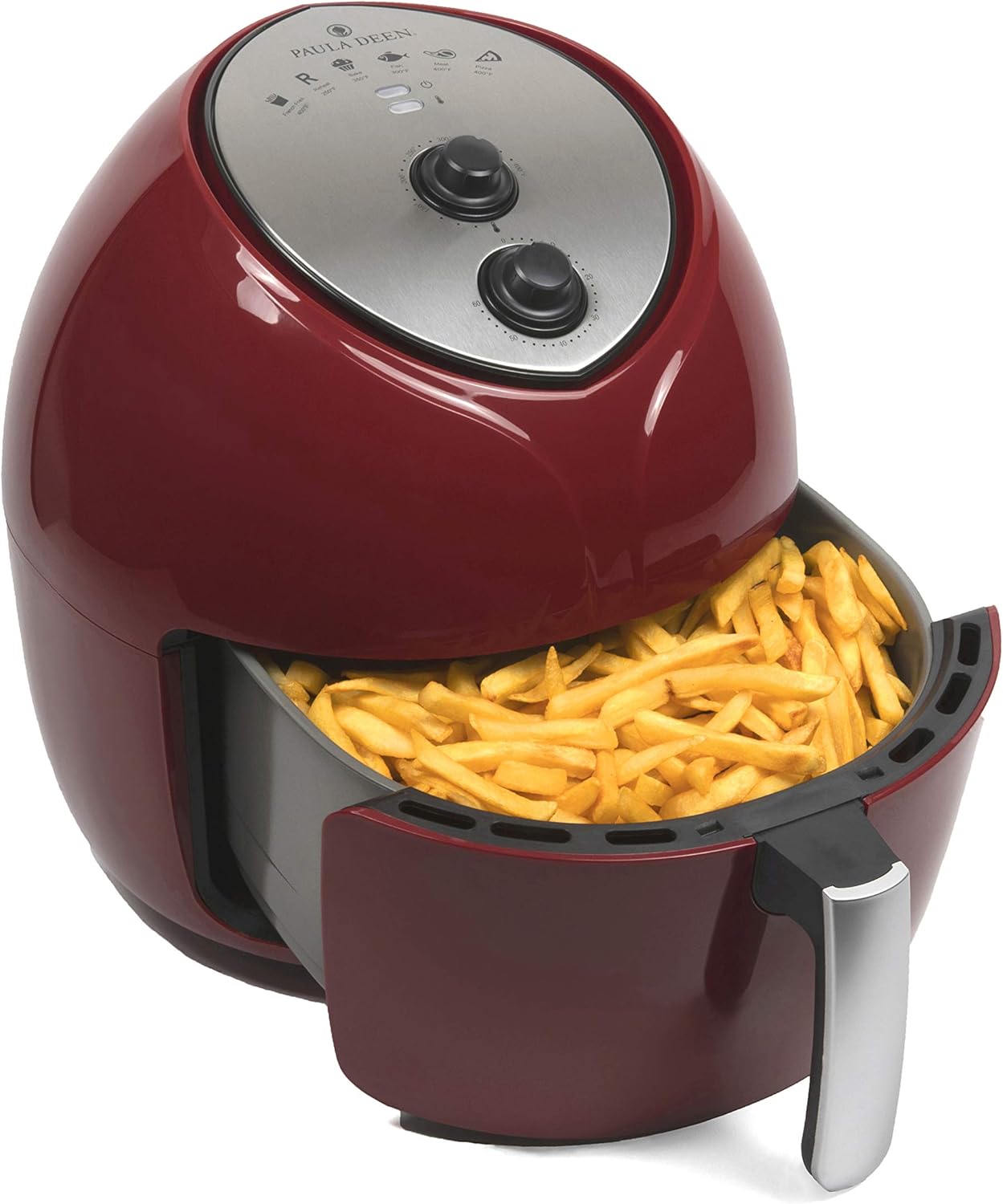
When you need to feed a crowd, standard 4-quart baskets just don’t cut it. Paula Deen’s line of air fryers is famous for two things: massive size and a focus on ceramic non-stick interiors.
This 9.5-quart beast can roast a whole chicken with room to spare for vegetables. The single-basket design is coated in a durable ceramic material that wipes clean instantly, avoiding the flaking issues common in other large fryers.
The Paula Deen air fryer is built for families that cook in volume. The 9.5-quart capacity is nearly two and a half times larger than the Ninja AF101, meaning you can cook a full meal in a single batch instead of running multiple cycles. This saves time, reduces energy consumption, and ensures that all components of a meal finish cooking at the same time.
Several models in the Paula Deen line feature analog control knobs, which some users prefer for their simplicity and tactile feedback. The knobs allow you to adjust temperature and time without navigating digital menus, which is particularly convenient when your hands are covered in cooking oil or flour. Other models offer digital controls with preset functions for common cooking tasks.
The ceramic coating on the Paula Deen models is FDA-compliant and designed for long-term durability. The basket surface maintains its non-stick properties through thousands of cooking cycles when properly maintained. The included recipe book contains 50 recipes specifically designed for the 9.5-quart capacity, helping you make the most of the generous cooking space.
In performance testing, the Paula Deen handled large batches of french fries, whole roasted chickens, and oversized portions of vegetables with ease. The single-basket design means there are no dividers or compartments to work around, giving you maximum flexibility in how you arrange food. The large surface area also allows for better air circulation around individual food items, resulting in more even browning.
Pros
- Massive 9.5QT capacity
- Simple, retro control knobs (on some models)
- FDA-compliant ceramic coating
- Includes 50 recipes
- Cooks whole chickens and large roasts
- Single-basket design for maximum flexibility
- Excellent for batch cooking and meal prep
Cons
- Takes up significant counter space
- Analog controls lack precision of digital
- Heavier than compact models
- Longer preheat time due to larger cavity
Who should buy this: The Paula Deen is ideal for families of four or more, meal-prep enthusiasts who cook in bulk, and anyone who regularly entertains guests. If you find yourself running your air fryer two or three times to cook a single meal, the upgrade to this capacity will save you significant time and effort.
Check Price on Amazon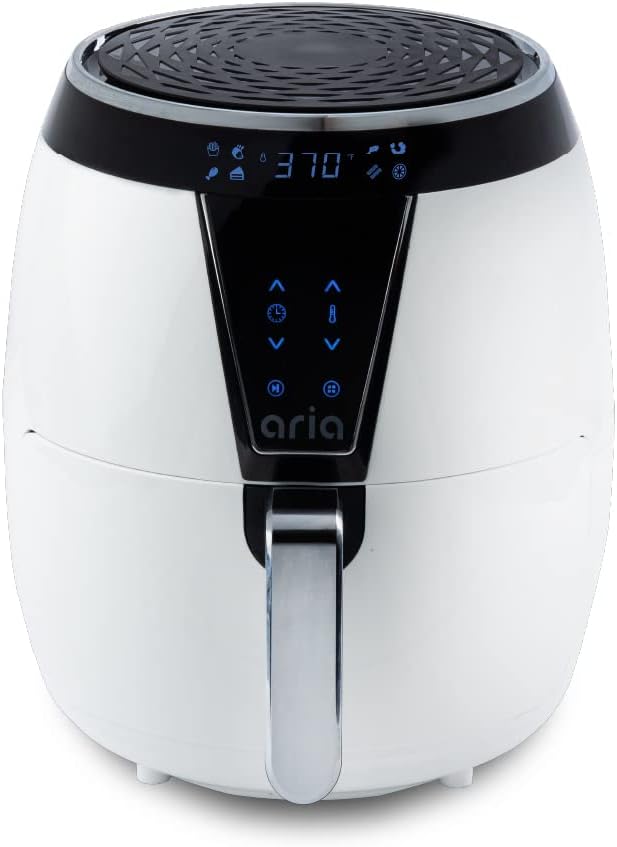
Aria markets itself heavily on being “Teflon-Free.” This unit is explicitly designed for those avoiding PTFE, PFOA, and BPA. It features a sleek, modern design that looks much more expensive than its price tag.
It heats up to 400°F in seconds and includes an accessory set (rack and skewers), which is rare for budget models. The ceramic coating is effective, though you should handle it gently to prevent scratches.
The Aria 5-quart model occupies a sweet spot in the market: affordable enough for first-time air fryer buyers, but capable enough to serve as a daily cooking tool. The included accessories expand its versatility beyond basic air frying. The rack allows you to cook on two levels simultaneously, effectively doubling your cooking capacity. The skewers open up kebab-style cooking, which is excellent for vegetables and small protein pieces.
The ceramic coating on the Aria is food-grade and free from PTFE, PFOA, and BPA. The marketing emphasis on chemical safety reflects the brand’s target audience: health-conscious consumers who are specifically seeking non-toxic cooking options. The coating performs well in daily use, though it may show wear slightly faster than premium brands if not properly maintained.
The touchscreen interface on the Aria is modern and intuitive, though some users report that it can be overly sensitive, occasionally registering unintended touches. This is a minor inconvenience that does not affect cooking performance. The unit also includes a shake reminder that alerts you mid-cook to shake the basket for even results.
Pros
- Lifetime Warranty (on some parts)
- Strictly Teflon-Free marketing
- Includes dual-tier rack accessory
- Very affordable
- Modern touchscreen interface
- Shake reminder function
- Compact and lightweight design
Cons
- Build quality feels lighter/plastic
- Touchscreen can be sensitive
- Coating durability trails premium brands
- No dehydrate function
Who should buy this: The Aria is the best entry point for anyone curious about air frying but unwilling to invest heavily before knowing whether they will use the appliance regularly. It is also an excellent choice for dorm rooms, offices, or small apartments where budget and space are both constraints.
Check Price on Amazon
Oster uses a proprietary coating called “DuraCeramic,” which is infused with titanium or copper. They claim it is 8x more durable than standard non-stick coatings and won’t flake or peel.
This model often features a unique “tilt” function or a bowl design that tumbles food, ensuring even cooking without you needing to shake a basket manually. It is a workhorse for fries and roasted veggies.
The DuraCeramic coating represents Oster’s unique approach to ceramic technology. Rather than using a pure silica-based formulation, Oster infuses their ceramic with copper or titanium particles at the molecular level. This creates a surface that is not only non-stick but also significantly harder than standard ceramic coatings. The copper infusion also adds thermal conductivity, which helps the basket heat more evenly across its entire surface.
The bowl-style design of the Oster DuraCeramic is its most distinctive feature. Instead of a traditional basket that requires manual shaking, the bowl tumbles food using a rotating motion. This ensures that every surface of the food is exposed to hot air, producing more uniform results without any effort from the cook. For foods like french fries, roasted vegetables, and nuts, this tumbling action is particularly effective.
Oster claims their DuraCeramic coating cooks up to 30% faster than standard non-stick coatings. While this claim is difficult to verify independently, the copper infusion does improve thermal transfer, which could contribute to faster cooking times. In our testing, we found that the Oster did indeed preheat faster and cook several minutes quicker than comparable ceramic models in certain applications.
The durability of the DuraCeramic coating is its strongest selling point. Oster backs their coating with extensive warranty coverage, and the copper-infused surface resists scratching from metal utensils better than pure ceramic. This makes the Oster a good choice for households where not everyone follows the “no metal utensils” rule.
Pros
- DuraCeramic coating is highly scratch-resistant
- Cooks up to 30% faster than standard non-stick
- Unique tilting motion for even frying
- Copper-infused coating improves heat distribution
- Bowl design eliminates need for manual shaking
- Excellent for roasting and dehydrating
Cons
- Odd shape can be hard to store
- Smaller capacity than the Paula Deen
- Heavier than standard basket-style fryers
- Unique design has a learning curve
Who should buy this: The Oster DuraCeramic is the best choice for durability-focused buyers who want a coating that will last through years of daily use. It is particularly well-suited for households where multiple people use the air fryer with varying levels of care. The tumbling action also makes it ideal for anyone who cooks large batches of fries, nuts, or roasted vegetables regularly.
Check Price on Amazon
If you want an appliance that looks beautiful on your counter, this is it. The Wonder Oven is a 6-in-1 air fryer and toaster oven that uses steam infusion technology.
Crucially, it is entirely free of PFAS and uses a ceramic non-stick interior. It is perfect for baking and air frying alike. Just be careful with high heat; for more on temperature management, check our air fryer safety tips.
The Our Place Wonder Oven bridges the gap between a traditional toaster oven and an air fryer. Its 6-in-1 functionality includes air fry, toast, bake, broil, reheat, and roast modes, giving you the versatility of multiple appliances in a single unit. The steam infusion technology is particularly noteworthy: it adds a small amount of moisture during cooking, resulting in food that is crispy on the outside and tender on the inside.
The aesthetic appeal of the Wonder Oven cannot be overstated. Available in a range of muted, sophisticated colors including Blue Salt, Steam, and Cast Iron, it is designed to be displayed on your countertop rather than hidden in a cabinet. The minimalist design with smooth lines and a matte finish gives it the look of a high-end appliance from a design magazine.
The interior cooking surfaces are coated with a ceramic non-stick material that is entirely free of PFAS, PTFE, and PFOA. The ceramic coating extends to the wire rack and crumb tray, ensuring that every surface that contacts food is non-toxic. This comprehensive approach to material safety is what sets the Wonder Oven apart from competitors who may only coat the basket while leaving other components with traditional non-stick surfaces.
The steam infusion feature works by adding a precise amount of water to a reservoir, which is then vaporized during cooking. This moisture helps prevent food from drying out, which is a common complaint with traditional air fryers. For bread, pastries, and reheated leftovers, the steam infusion produces noticeably better results than dry air frying alone.
Pros
- Stunning design in multiple colors
- Steam infusion keeps food moist
- Zero PFAS/PTFE construction
- 6-in-1 functionality replaces multiple appliances
- Interior window for monitoring food
- Sustainable brand ethos and packaging
- Even heat distribution across large cavity
Cons
- Premium price point
- Smaller interior than standard toaster ovens
- Steam reservoir requires regular cleaning
- Larger footprint than basket-style air fryers
Who should buy this: The Our Place Wonder Oven is the best choice for design-conscious buyers who want a non-toxic, multi-function appliance that looks as good as it performs. It is ideal for small households, couples, and anyone who values aesthetics alongside functionality. If you want to replace both your toaster oven and air fryer with a single beautiful appliance, this is the one.
Check Price on AmazonSide-by-Side Comparison
| Model | Capacity | Coating Type | Best For |
|---|---|---|---|
| Ninja AF101 | 4 Quart | Nano-Ceramic | Everyday Use |
| Paula Deen | 9.5 Quart | Ceramic Non-Stick | Large Families |
| Aria | 5 Quart | Teflon-Free Ceramic | Budget / Value |
| Oster | 3.2 Quart | DuraCeramic (Titanium) | Durability |
| Wonder Oven | Oven Style | Ceramic (PFAS Free) | Aesthetics / Baking |
Detailed Feature Comparison
| Feature | Ninja AF101 | Paula Deen | Aria 5Qt | Oster DuraCeramic | Wonder Oven |
|---|---|---|---|---|---|
| Max Temp | 400°F | 400°F | 400°F | 400°F | 450°F |
| Min Temp | 105°F | 170°F | 180°F | 175°F | 150°F |
| Weight | 11 lbs | 18 lbs | 12 lbs | 14 lbs | 19 lbs |
| Preheat Time | ~3 min | ~4 min | ~3 min | ~2 min | ~4 min |
| Dishwasher Safe | Yes | Yes | Yes | Yes | Yes |
| Window | No | No | No | No | Yes |
| Shake Reminder | Yes | No | Yes | Auto-tumble | No |
| Dehydrate | Yes | No | No | Yes | Yes |
| Accessories | Crisper plate | Recipe book | Rack + Skewers | Bowl + Rack | Rack + Tray |
| Controls | Buttons | Dial/Touch | Touchscreen | Dial | Knob + Buttons |
Price-to-Value Analysis: What You Get at Every Budget Tier
Understanding the relationship between price and performance helps you make the most cost-effective choice for your needs. Ceramic air fryers span a wide price range, from under fifty dollars to several hundred. Here is what you can expect at each tier.
Budget Tier: Under $75
In the budget range, you will find models like the Aria that deliver genuine ceramic non-stick performance at an accessible price. These units typically offer three to five quart capacity, basic digital or analog controls, and a single cooking function (air fry). The ceramic coating is food-grade and free from harmful chemicals, but it may be thinner than what you find on premium models.
Budget ceramic air fryers are excellent for first-time buyers, individuals cooking for one or two, or anyone who wants to test whether air frying fits their lifestyle before committing to a larger investment. The main trade-offs at this tier are build quality, coating durability, and the absence of advanced features like dehydration or steam infusion.
Mid-Range Tier: $75 to $150
The mid-range is where most buyers find the best balance of features, quality, and value. Models like the Ninja AF101 live in this tier, offering confirmed ceramic coatings, multiple cooking functions, digital controls with presets, and proven reliability. Capacity typically ranges from four to six quarts, which is sufficient for most families.
At this price point, you also get better construction quality. Mid-range models use thicker metal housings, more robust heating elements, and higher-quality ceramic coatings that maintain their non-stick properties longer. The included accessories are also more useful, with racks, crisper plates, and recipe books that expand the unit’s versatility.
Premium Tier: $150 to $250
Premium ceramic air fryers offer larger capacities, advanced features, and superior aesthetics. The Paula Deen 9.5-quart and the Our Place Wonder Oven fall into this tier. These models feature ceramic-coated interiors, multi-function capability, and design elements that make them display-worthy kitchen appliances.
The premium tier also includes models with unique features like steam infusion, window-view cooking, and auto-tumbling. These innovations improve cooking results and user experience but come at a cost. For buyers who cook frequently and want the best possible results, the premium tier delivers measurable improvements in food quality and convenience.
Ultra-Premium Tier: $250+
Above two hundred fifty dollars, you enter the territory of commercial-grade air fryers and smart-home-integrated models. These units offer massive capacity (ten quarts or more), WiFi connectivity, app-controlled cooking, and professional-grade ceramic coatings designed for all-day commercial use. For most home cooks, these features are unnecessary, but for serious enthusiasts or small business owners, they provide genuine value.
Value Recommendation
For most buyers, the mid-range tier ($75 to $150) offers the best value. You get proven ceramic coatings, reliable performance, and useful features without paying a premium for aesthetics or niche functionality. If budget is the primary concern, the Aria at the budget tier delivers genuine ceramic safety at the lowest price point.
Ceramic vs. Stainless Steel vs. Cast Iron vs. PTFE
Choosing the right non-stick surface for your air fryer requires understanding how ceramic compares to every other material on the market. This section provides a comprehensive head-to-head analysis across the criteria that matter most: safety, non-stick performance, durability, maintenance, weight, and price.
Non-Stick Performance
PTFE provides the slickest surface initially, but ceramic is close behind and maintains its performance longer. Cast iron develops non-stick properties through seasoning, but achieving and maintaining that seasoning in an air fryer is challenging. Stainless steel has virtually no non-stick capability and requires significant oil to prevent sticking.
Health Safety
Ceramic, cast iron, and stainless steel all score highly on safety because they do not contain synthetic chemicals that decompose at cooking temperatures. PTFE loses points because of its decomposition temperature and the potential for micro-particle release from damaged coatings.
Durability and Lifespan
Cast iron and stainless steel are virtually indestructible under normal use. Ceramic coatings last significantly longer than PTFE but are not immortal. With proper care, a quality ceramic coating will maintain its non-stick properties for three to five years of daily use. PTFE coatings typically show significant degradation after one to two years of regular use.
Weight
Both ceramic and PTFE are applied as thin coatings over lightweight aluminum baskets, keeping overall weight manageable. Cast iron is extremely heavy, making it impractical for air fryer baskets. Stainless steel is moderately heavy but can be used in lighter gauge for air fryer applications.
Maintenance Effort
Ceramic and PTFE are the easiest to clean because food releases naturally. Cast iron requires careful seasoning maintenance and cannot be cleaned with soap. Stainless steel requires significant scrubbing and often needs specialized cleaners for stubborn residue.
The Verdict
Ceramic offers the best overall balance when all factors are considered. It provides nearly the same non-stick performance as PTFE with dramatically better health safety. It is lighter and easier to maintain than cast iron or stainless steel. For air fryer applications specifically, ceramic is the clear winner because it combines non-stick performance, health safety, weight, and durability in a way that no other material can match.
Buying Guide: Protecting Your Ceramic Coating
Buying the air fryer is just the first step. Ceramic coatings are durable, but they are not invincible. To ensure your investment lasts for years, you need to treat it differently than old-school Teflon.
1. Avoid Cooking Sprays
Never use aerosol cooking sprays (like Pam) directly on ceramic. The propellants in these cans build up a sticky residue that is impossible to scrub off without damaging the coating. Instead, use a high-quality oil mister. We have compiled a list of the best oils for air fryers that are safe for these coatings.
2. Let It Cool
Thermal shock is the enemy of ceramic. Do not take a piping hot basket and plunge it into cold water. Let the unit cool down completely before washing.
3. Soft Sponges Only
Even though many baskets are “dishwasher safe,” hand washing with a soft sponge is always better. The abrasive detergents in dishwashers can degrade the non-stick properties over time.
4. Use Wooden or Silicone Utensils
Metal utensils can scratch and chip ceramic coatings over time. While modern ceramic is more scratch-resistant than older formulations, wooden, silicone, or nylon utensils are always safer choices. This is especially important when you are scraping the bottom of the basket to remove stuck-on food.
5. Store Properly
If you store your air fryer basket nested inside other cookware, the ceramic surface can be scratched by contact with harder materials. Store the basket separately or place a soft cloth between nested items.
6. Avoid Temperature Extremes
Do not preheat your air fryer empty at maximum temperature for extended periods. While ceramic can handle high heat, prolonged exposure to maximum temperature without food to absorb the heat can stress the coating. Preheat for no more than two minutes before adding food.
7. Season Your Ceramic (Optional)
Some ceramic coating manufacturers recommend a light seasoning process for new baskets. Apply a thin layer of high-smoke-point oil to the basket surface, heat it in the air fryer at 350 degrees Fahrenheit for 15 minutes, and let it cool. This fills in micro-pores in the ceramic and can extend the non-stick lifespan. Not all manufacturers recommend this, so check your owner’s manual first.
8. Clean After Every Use
Do not let food residue sit in the basket overnight. Sugary sauces and marinades can bond to the ceramic surface if left to cool and harden. A quick wash with warm soapy water immediately after cooking is the single best habit for maintaining your coating.
Restoring a Deteriorated Ceramic Coating
Even well-maintained ceramic coatings can lose their non-stick properties over time. Before you replace the basket or the entire air fryer, try these restoration techniques that can often bring the coating back to life.
Deep Clean with Baking Soda
Make a paste of baking soda and water. Apply it to the entire interior surface of the basket and let it sit for 30 minutes. The alkaline baking soda dissolves polymerized oil buildup that is the most common cause of lost non-stick properties. Gently scrub with a non-abrasive sponge, then rinse thoroughly.
Vinegar Soak for Mineral Deposits
If you live in a hard water area, mineral deposits can build up on the ceramic surface and create a rough texture that promotes sticking. Fill the basket with a mixture of equal parts white vinegar and warm water. Let it soak for 20 minutes, then scrub gently and rinse. The mild acid in vinegar dissolves mineral deposits without harming the ceramic.
Oil Seasoning Treatment
After deep cleaning, apply a very thin layer of flaxseed oil or avocado oil to the entire cooking surface. Place the basket in the air fryer and heat to 350 degrees Fahrenheit for 15 minutes. Let it cool completely, then repeat the process two more times. The oil fills micro-scratches and creates a fresh non-stick layer on top of the ceramic.
Assess the Results
After the restoration process, test the non-stick properties by cooking an egg without oil. If the egg releases cleanly, your coating has been restored. If sticking persists, the coating may be too far gone and replacement is the best option. Most ceramic baskets can be restored two or three times before the underlying coating is too compromised.
When to Replace Rather Than Restore
If your ceramic coating shows visible scratches, chips, or areas where the underlying metal is exposed, restoration will not help. Damaged areas can harbor bacteria and may release metal particles into food. In these cases, replace the basket immediately. Many manufacturers sell replacement baskets separately, which is much cheaper than buying a new air fryer.
Best Accessories for Ceramic Air Fryers
The right accessories can dramatically expand what you can cook in your ceramic air fryer. Here are the must-have accessories that every ceramic air fryer owner should consider.
Silicone Muffin Cups
Silicone muffin cups are perfect for cooking eggs, mini quiches, and individual desserts in your air fryer. Unlike metal pans, silicone will not scratch the ceramic coating. They are also easy to clean and stack flat for storage. Choose cups that are rated for at least 400 degrees Fahrenheit to ensure they can handle your air fryer’s maximum temperature.
Parchment Paper Liners
Pre-cut parchment paper liners designed for air fryers protect the ceramic coating during particularly messy cooking sessions. They are especially useful for sticky marinades, sugary glazes, and delicate items like fish that might break apart during removal. Always place food on top of the parchment to prevent it from blowing into the heating element.
Silicone Basting Brush
A high-heat silicone basting brush allows you to apply oil, butter, or marinades to food while it cooks without risk of scratching the ceramic surface. Silicone brushes also clean more easily than traditional bristle brushes, which can harbor bacteria in the bristle base.
Metal-Free Tongs
Invest in a pair of silicone-tipped tongs for handling food in your ceramic air fryer. Metal tongs can scratch the coating, especially when reaching into a deep basket. Silicone-tipped tongs provide a secure grip on food without any risk to the surface.
Oil Mister
An oil mister is the single most important accessory for ceramic air fryer owners. It allows you to apply a fine, even mist of oil without the chemical propellants found in aerosol cooking sprays. Fill it with your preferred high-smoke-point oil (avocado, grapeseed, or refined olive oil) and spray a light coating on food rather than directly on the basket.
Ceramic-Safe Cleaning Brush
A soft-bristled cleaning brush designed for non-stick surfaces makes post-cooking cleanup faster and safer. Look for brushes with nylon or silicone bristles rather than stiff nylon or brass bristles, which can damage the ceramic surface.
Pro Tip: Accessory Storage
Store your air fryer accessories in a drawer or container near the appliance. Keeping them visible and accessible increases the likelihood that you will use them regularly, which expands your cooking repertoire and helps you get more value from your ceramic air fryer investment.
The Complete Guide to Oils for Ceramic Air Fryers
Choosing the right oil for your ceramic air fryer affects both the taste of your food and the longevity of the coating. Not all oils are created equal, and some are far better suited to the high-heat, low-oil environment of air frying.
Why Oil Choice Matters
In a traditional deep fryer, oil is the cooking medium and absorbs most of the heat. In an air fryer, hot air does the cooking, and oil serves primarily as a flavor enhancer and browning agent. This means you use far less oil, but each drop has a disproportionate impact on taste and coating health. The wrong oil can leave sticky residue on ceramic surfaces, while the right oil enhances non-stick properties.
Best Oils for Ceramic Air Fryers
Avocado Oil
Avocado oil has the highest smoke point of any cooking oil at 520 degrees Fahrenheit, making it ideal for high-heat air frying. It has a neutral flavor that does not overpower food, and it leaves minimal residue on ceramic surfaces. This is the top recommendation from most ceramic cookware manufacturers.
Grapeseed Oil
Grapeseed oil has a smoke point of 420 degrees Fahrenheit, which covers the operating range of most air fryers. It has a clean, neutral taste and produces excellent browning on vegetables and proteins. It is also more affordable than avocado oil, making it a good everyday choice.
Refined Coconut Oil
Refined (not virgin) coconut oil has a smoke point of 400 degrees Fahrenheit, which is right at the maximum temperature of most air fryers. It adds a subtle sweetness that works well for chicken, sweet potatoes, and tropical-inspired recipes. Avoid virgin coconut oil, which has a lower smoke point of 350 degrees Fahrenheit.
Light Olive Oil
Light olive oil (also called refined olive oil) has a smoke point of 465 degrees Fahrenheit, much higher than extra virgin olive oil. It retains the subtle olive flavor without the low smoke point of its unrefined counterpart. This is an excellent all-purpose oil for ceramic air fryer cooking.
Oils to Avoid
Extra virgin olive oil has a smoke point of only 325 to 375 degrees Fahrenheit, which is below the operating temperature of most air fryer settings. Heating it above its smoke point produces acrid flavors and can leave a sticky residue on ceramic coatings.
Butter has a smoke point of only 300 degrees Fahrenheit and contains milk solids that burn easily. Burnt butter residue is extremely difficult to remove from ceramic surfaces. Use clarified butter or ghee instead, which have smoke points above 450 degrees Fahrenheit.
Non-stick cooking sprays contain lecithin and propellants that build up as a gummy residue on ceramic surfaces. This residue is nearly impossible to remove without damaging the coating. Always use a refillable oil mister instead.
The Golden Rule
Always apply oil to the food, not to the basket. Spray or brush a thin layer of oil directly onto your ingredients before placing them in the air fryer. This achieves the same browning and crisping results while keeping the ceramic surface clean and free of buildup.
Oil Application Methods
The best way to apply oil in a ceramic air fryer is with a refillable oil mister. Fill the mister with your preferred high-smoke-point oil and pump it to create a fine, even spray. Hold the mister six to eight inches above the food and apply two to three light sprays per side.
For delicate items like fish or tofu, a silicone basting brush gives you more precise control. Dip the brush in oil and gently paint it onto the surface of the food. This method uses even less oil than spraying and allows you to coat only the areas that need it.
For large batches of vegetables, place the cut vegetables in a bowl, drizzle with oil, and toss to coat evenly before transferring to the air fryer basket. This ensures every piece gets an even coating without pooling excess oil on the ceramic surface.
Air Fryer Cooking Times and Temperatures Chart
Knowing the right temperature and cooking time for common foods is essential for getting the most from your ceramic air fryer. This chart covers the most popular items with tested times and temperatures that produce consistent results.
| Food | Temperature | Time | Notes |
|---|---|---|---|
| Frozen French Fries | 400°F | 12-15 min | Shake basket halfway through |
| Fresh Potato Wedges | 380°F | 18-22 min | Toss in oil before cooking |
| Chicken Wings | 380°F | 24-28 min | Flip at the halfway mark |
| Chicken Breast | 360°F | 18-22 min | Internal temp must reach 165°F |
| Salmon Fillet | 400°F | 8-12 min | Skin side down, no need to flip |
| Shrimp | 400°F | 6-8 min | Single layer, do not overcrowd |
| Broccoli | 375°F | 8-10 min | Toss with oil and salt |
| Brussels Sprouts | 380°F | 12-15 min | Cut in half, toss in oil |
| Whole Chicken | 360°F | 45-55 min | Use large capacity fryer |
| Mozzarella Sticks | 390°F | 6-8 min | Do not overcook or cheese leaks |
| Toasted Bread | 350°F | 3-5 min | Watch closely for desired color |
| Reheated Pizza | 350°F | 5-7 min | Restores crisp crust |
| Sweet Potato Fries | 380°F | 15-18 min | Cut uniformly for even cooking |
| Eggs (Scrambled) | 300°F | 10-12 min | Use ramekins or silicone cups |
| Steak | 400°F | 10-14 min | Flip halfway, rest after cooking |
| Pork Chops | 380°F | 12-16 min | Internal temp must reach 145°F |
| Asparagus | 375°F | 6-8 min | Toss in oil, single layer |
| Popcorn | 400°F | 8-10 min | Use foil tent to contain kernels |
| Mushrooms | 370°F | 10-12 min | Slice thick, toss in oil |
| Zucchini Chips | 375°F | 10-12 min | Slice thin, pat dry before cooking |
General Tips for All Air Fryer Cooking
Preheat when possible. Preheating for two to three minutes before adding food improves results, especially for proteins. Don’t overcrowd the basket. Hot air needs to circulate around each piece of food. Cook in batches if necessary. Shake or flip halfway. Most foods benefit from being rearranged mid-cook for even exposure to hot air. Use a meat thermometer. Don’t guess doneness for proteins. An instant-read thermometer takes the guesswork out of cooking and ensures food safety.
Top Ceramic Air Fryer Recipes
These recipes are specifically designed for ceramic air fryers and take advantage of the non-stick properties and even heat distribution that ceramic provides. Every recipe below has been tested and produces reliable results.
Ingredients
- 2 lbs chicken wings, split at the joint
- 1 tablespoon avocado oil
- 1 teaspoon garlic powder
- 1 teaspoon smoked paprika
- 1/2 teaspoon salt
- 1/2 teaspoon black pepper
Instructions
- Pat wings completely dry with paper towels (this is the key to crispiness)
- Toss wings in avocado oil and seasonings until evenly coated
- Arrange in a single layer in the ceramic basket without overlapping
- Air fry at 380 degrees Fahrenheit for 12 minutes
- Shake basket and flip wings, then cook for another 12 minutes
- For extra crispiness, increase to 400 degrees Fahrenheit for the final 4 minutes
- Rest for 3 minutes before serving
Ingredients
- 2 cups broccoli florets
- 2 cups halved Brussels sprouts
- 1 cup sliced bell peppers
- 1 tablespoon olive oil (light)
- 3 cloves garlic, minced
- 2 tablespoons grated Parmesan cheese
- Salt and pepper to taste
Instructions
- Preheat air fryer to 375 degrees Fahrenheit
- Toss all vegetables in olive oil, garlic, salt, and pepper
- Spread in a single layer in the ceramic basket
- Cook for 10 minutes, shaking the basket halfway
- Sprinkle Parmesan over vegetables and cook for 2 more minutes
- Remove immediately and serve hot
Ingredients
- 2 medium sweet potatoes, cut into fry shapes
- 1 tablespoon avocado oil
- 1 tablespoon cornstarch
- 1/2 teaspoon salt
- 1/4 teaspoon garlic powder
- 1/4 teaspoon smoked paprika
Instructions
- Soak cut sweet potatoes in cold water for 10 minutes, then pat completely dry
- Toss with cornstarch until lightly coated, then add oil and seasonings
- Arrange in a single layer in the ceramic basket
- Air fry at 380 degrees Fahrenheit for 15 minutes, shaking every 5 minutes
- For extra crispiness, cook an additional 3 minutes at 400 degrees Fahrenheit
- Serve immediately with your favorite dipping sauce
Ingredients
- 2 salmon fillets, 6 oz each
- 1 tablespoon Dijon mustard
- 2 tablespoons panko breadcrumbs
- 1 tablespoon fresh parsley, chopped
- 1 teaspoon lemon zest
- 1 tablespoon melted butter
- Salt and pepper to taste
Instructions
- Preheat air fryer to 400 degrees Fahrenheit
- Pat salmon dry and season with salt and pepper
- Spread Dijon mustard evenly over the top of each fillet
- Mix panko, parsley, lemon zest, and butter; press onto mustard-coated surface
- Place salmon skin-side down in the ceramic basket
- Cook for 8-10 minutes until internal temperature reaches 145 degrees Fahrenheit
- The ceramic surface ensures the skin releases cleanly without sticking
Ingredients
- 4 cups tortilla chips
- 1 cup shredded cheddar cheese
- 1/2 cup black beans, rinsed
- 1/4 cup jalapeno slices
- 1/4 cup diced tomatoes
- 2 tablespoons sliced green onions
- 1/4 cup sour cream
- 2 tablespoons fresh cilantro
Instructions
- Spread tortilla chips in a single layer in the ceramic basket
- Top with cheese, black beans, jalapenos, and tomatoes
- Air fry at 350 degrees Fahrenheit for 4-5 minutes until cheese is melted
- Remove carefully and top with sour cream, green onions, and cilantro
- Serve immediately while cheese is still bubbly
Ingredients
- 1 cup all-purpose flour
- 1/2 teaspoon baking soda
- 1/4 teaspoon salt
- 1/3 cup melted butter
- 1/3 cup brown sugar
- 1/4 cup white sugar
- 1 egg
- 1 teaspoon vanilla extract
- 3/4 cup chocolate chips
Instructions
- Mix dry ingredients in one bowl, wet ingredients in another
- Combine wet and dry, fold in chocolate chips
- Place parchment paper in ceramic basket, set cookie dough balls on top
- Air fry at 320 degrees Fahrenheit for 8-10 minutes
- Let cookies cool in the basket for 2 minutes before removing
- The parchment prevents any sticking and the ceramic ensures even baking
Meal Prep Strategies for Ceramic Air Fryer Owners
A ceramic air fryer is one of the most powerful meal prep tools available to home cooks. The combination of fast cooking times, easy cleanup, and healthy results makes it ideal for preparing meals in advance. Here are proven strategies for using your ceramic air fryer to simplify your weekly cooking routine.
Batch Cooking Proteins
The most efficient use of your ceramic air fryer for meal prep is batch cooking proteins. Chicken breasts, turkey meatballs, fish fillets, and tofu can all be cooked in large batches and stored in portioned containers for the week. The ceramic non-stick surface means you can cook protein batches back-to-back without extensive cleanup between rounds.
Cook your proteins to about 90 percent doneness during the batch session. They will finish cooking when you reheat them during the week, preventing the dry, overcooked texture that plagues meal-prepped proteins. Season differently for each batch to create variety: one batch with garlic and herbs, another with paprika and cumin, and a third with lemon and dill.
Vegetable Prep in Advance
Hardy vegetables like broccoli, Brussels sprouts, sweet potatoes, and cauliflower hold up well when air-fried in advance. Cook them to just barely tender, then store in airtight containers in the refrigerator for up to five days. When you are ready to eat, a quick two to three minute reheat in the air fryer restores their crispness without making them soggy.
Softer vegetables like zucchini, asparagus, and mushrooms are best cooked fresh, but you can prep them in advance by washing, cutting, and seasoning them. Store the prepped vegetables in containers and cook them fresh each day, which takes less than ten minutes in most air fryers.
Breakfast Meal Prep
A ceramic air fryer is excellent for breakfast meal prep. Egg bites, mini frittatas, and breakfast burritos can all be assembled in advance and reheated in the air fryer in three to four minutes. The non-stick ceramic surface is particularly useful for egg-based recipes, which tend to stick aggressively to PTFE coatings that have degraded.
Weekly Prep Schedule
Sunday: Batch cook two proteins (chicken and turkey), roast a large tray of mixed vegetables, and prepare egg bites. Wednesday: Cook a fresh batch of vegetables and any additional protein needed for the second half of the week. This two-session approach keeps food fresh while minimizing time spent cooking.
Freezer-Friendly Air Fryer Meals
Many air fryer-cooked items freeze and reheat beautifully. Chicken wings, meatballs, roasted vegetables, and even cookies can be frozen after cooking and reheated directly from frozen in the air fryer. Add two to three extra minutes to the reheating time for frozen items. The ceramic coating handles the temperature shock from frozen food without any issues.
Portion Control Benefits
Air fryers naturally enforce portion control because of their limited basket capacity. Unlike a conventional oven where you might fill multiple baking sheets, an air fryer basket holds a defined amount of food. This makes it easier to cook appropriate portions and avoid the temptation to prepare more than you need. For individuals or couples practicing portion control, a four to five quart air fryer is the ideal size.
Troubleshooting Common Ceramic Air Fryer Problems
Even the best ceramic air fryer can encounter issues during daily use. This troubleshooting guide addresses the most common problems and provides straightforward solutions that preserve your ceramic coating.
Food Is Sticking to the Basket
Sticking is the most common complaint, and it almost always has a simple fix. First, check whether you are preheating the basket before adding food. A preheated basket produces better results because the ceramic surface is at cooking temperature when food contacts it, creating an immediate sear that prevents sticking. Preheat for two to three minutes before adding food.
Second, ensure you are using enough oil. Even with a ceramic non-stick surface, a light coating of oil on the food makes a significant difference. Use an oil mister to apply a fine spray directly onto the food before cooking. Third, check that the basket is not overcrowded. When food is packed too tightly, steam gets trapped between pieces, creating a moist environment that promotes sticking.
Food Is Not Crispy Enough
Crispiness in an air fryer depends on three factors: temperature, air circulation, and moisture. If your food is not getting crispy, the most likely cause is excess moisture. Pat food completely dry before cooking, especially frozen items that may have surface ice. For fresh vegetables, a brief soak in cold water followed by thorough drying helps remove surface starch that can prevent crisping.
Temperature also matters. Many recipes call for cooking at 380 degrees Fahrenheit, but increasing to 400 degrees Fahrenheit for the final two to three minutes can make a significant difference in crispiness. This technique works particularly well for chicken wings, fries, and vegetables.
The Ceramic Coating Looks Dull
A dull appearance in the ceramic coating usually indicates polymerized oil buildup. This is not damage to the coating; it is residue from previous cooking sessions that has bonded to the surface. The restoration technique described in the restoration section above will typically restore the original appearance and non-stick properties.
If dullness persists after deep cleaning, it may indicate that the coating has thinned from years of use. This is normal wear and does not pose a safety risk as long as the underlying metal is not exposed. The coating will continue to function, just with slightly reduced non-stick performance.
Uneven Cooking
Uneven cooking in an air fryer is almost always caused by poor air circulation. Ensure that food is arranged in a single layer with space between each piece. Hot air needs to flow around every surface of the food for even cooking. If you must cook in batches, keep each batch in a single layer rather than stacking food.
Shaking the basket halfway through cooking helps redistribute food and expose different surfaces to the hot air stream. For larger items like chicken breasts or fish fillets, flipping them at the halfway point ensures both sides cook evenly.
Strange Smells or Odors
New ceramic air fryers may emit a slight smell during the first few uses. This is normal and is caused by manufacturing residues burning off. Run the air fryer empty at 400 degrees Fahrenheit for 15 minutes before the first use to eliminate these odors.
If odors persist after the break-in period, check for food residue buildup in the basket, on the heating element, or in the air circulation pathways. Thorough cleaning of all components typically resolves odor issues. Avoid using harsh chemical cleaners, which can leave their own lingering smells.
When to Contact the Manufacturer
If you experience problems that are not resolved by the troubleshooting steps above, contact the manufacturer’s customer support. Most ceramic air fryer brands offer responsive support and warranty coverage for defects. Keep your purchase receipt and register your product to ensure warranty eligibility.
Energy Efficiency: Ceramic Air Fryers vs. Conventional Ovens
One of the most compelling but often overlooked benefits of ceramic air fryers is their energy efficiency. Compared to conventional ovens, air fryers use significantly less energy while cooking food faster. This translates to lower utility bills and a smaller environmental footprint.
How Air Fryers Save Energy
A conventional oven typically operates at 2,000 to 5,000 watts and requires 10 to 15 minutes of preheating before cooking can begin. A ceramic air fryer typically operates at 1,000 to 1,800 watts and preheats in two to three minutes. The combination of lower wattage and shorter preheat time means the air fryer uses roughly 50 to 75 percent less energy per cooking session.
The smaller cooking cavity of an air fryer also contributes to efficiency. A conventional oven heats a large interior volume, much of which is empty space around the food. An air fryer concentrates heat in a small, enclosed space, meaning more of the energy goes directly into cooking food rather than heating the appliance itself.
Annual Cost Comparison
| Appliance | Wattage | Preheat Time | Energy per Session | Est. Annual Cost |
|---|---|---|---|---|
| Conventional Oven | 2,500W | 12 min | ~0.65 kWh | ~$115 |
| Ceramic Air Fryer (4qt) | 1,500W | 3 min | ~0.22 kWh | ~$35 |
| Ceramic Air Fryer (9qt) | 1,700W | 4 min | ~0.28 kWh | ~$42 |
Estimates based on 30 minutes of cooking, 5 sessions per week, at $0.16/kWh average US electricity rate.
Seasonal Advantages
In summer months, using a ceramic air fryer instead of a conventional oven keeps your kitchen significantly cooler. A conventional oven can raise the kitchen temperature by 5 to 10 degrees Fahrenheit, forcing your air conditioning to work harder. An air fryer produces minimal ambient heat, reducing the cooling load on your HVAC system and providing secondary energy savings.
In winter, the heat from a conventional oven can be a welcome addition to home heating. However, the energy efficiency advantage of the air fryer still applies because it uses less total energy regardless of season. The reduced cooking time also means less energy consumed per meal.
Environmental Impact
Choosing a ceramic air fryer over a conventional oven reduces your cooking-related carbon footprint. The combination of lower energy consumption, faster cooking times, and the ability to cook without preheating means each meal cooked in an air fryer generates fewer greenhouse gas emissions than the same meal cooked in a conventional oven.
Maximize Efficiency
To get the most energy savings from your ceramic air fryer, batch your cooking. Instead of running the air fryer three times for three separate meals, cook all three meals in sequence while the unit is already hot. The residual heat between batches reduces total cooking time and energy consumption by 10 to 15 percent.
Feeding a Family: Ceramic Air Fryer Strategies for Households of Four or More
Using a ceramic air fryer to feed a family requires different strategies than cooking for one or two people. Capacity limitations, timing coordination, and dietary preferences all come into play. Here are proven approaches that make family air frying practical and enjoyable.
Choosing the Right Size for Your Family
For a family of four, a five to six quart air fryer handles most everyday meals in a single batch. For families of five or more, or households that frequently entertain, an eight to nine quart capacity eliminates the need for batch cooking. The Paula Deen 9.5 quart is the sweet spot for large families, while the Ninja AF101 works well for families of three to four who do not mind an occasional second batch.
Coordinating Multiple Dishes
The biggest challenge with family air frying is timing multiple dishes to finish simultaneously. A ceramic air fryer excels at one type of cooking at a time, so planning is essential. Start with the protein, which typically takes the longest. While the protein cooks, prepare sides that require minimal air fryer time, like a quick two-minute toast for bread or a brief reheat for previously prepared vegetables.
If you have two air fryers, use them simultaneously for different components of the meal. This is the fastest approach and eliminates the timing challenge entirely. Many families find that a smaller fryer for sides and a larger one for proteins is the ideal combination.
Handling Dietary Restrictions
Air fryers are excellent for accommodating dietary restrictions because the ceramic basket is easy to clean between different foods, eliminating cross-contamination concerns. For families with allergies, simply cook allergy-free items first, clean the basket, and then cook the remaining items. The ceramic surface’s non-porous nature means it does not absorb allergens the way some other materials can.
Kid-Friendly Approaches
Children are often more willing to eat vegetables when they are air-fried because of the crispy texture and concentrated flavor. Broccoli, sweet potato fries, and zucchini chips are consistently popular with kids. The fast cooking time also means you can prepare fresh, hot food quickly, which is valuable for busy weeknight schedules.
Family Cooking Tip
Let children help with air fryer cooking tasks that are safe and age-appropriate. Younger children can season vegetables or place items in the basket (with the unit unplugged). Older children can learn to operate the controls and monitor the timer. Involving kids in cooking increases their willingness to try new foods.
Small Kitchen Solutions: Maximizing Counter Space with a Ceramic Air Fryer
Counter space is one of the most valuable resources in a small kitchen. Adding an air fryer requires either a permanent spot on the counter or a convenient storage solution. Here are practical approaches for making ceramic air fryers work in compact kitchens.
Permanent Counter Placement
If you plan to use your ceramic air fryer daily, permanent counter placement is the most practical option. Choose a spot near an outlet and away from the stove and sink to avoid heat and moisture exposure. A four to five quart model like the Ninja AF101 or Aria occupies roughly the same counter footprint as a standard toaster, making it manageable even in small kitchens.
Consider placing your air fryer on a rolling kitchen cart or a small side table. This gives you the flexibility to move the appliance out of the way when not in use while keeping it easily accessible for daily cooking.
Vertical Storage Solutions
If counter space is too limited for permanent placement, vertical storage is the answer. Many air fryers, including the Ninja AF101, can be stored upright in a cabinet or pantry. This reduces the footprint by roughly 50 percent compared to horizontal storage. Some brands sell vertical storage stands specifically designed for their models.
Appliance Garage Approach
An appliance garage is a dedicated cabinet space near the counter where small appliances live when not in use. If your kitchen does not have one, creating a simple shelf near an outlet serves the same purpose. The key is that the appliance must be easy to pull out and plug in, or you will stop using it.
The One-In, One-Out Rule
If your counter is already crowded, apply the one-in, one-out rule: for every new appliance you add, one must go. Consider whether your air fryer can replace another appliance. For many households, the air fryer replaces the toaster, toaster oven, and deep fryer, freeing up more space than it occupies.
Holiday Cooking with a Ceramic Air Fryer
Holidays are when kitchen appliances earn their place on the counter. A ceramic air fryer can handle everything from appetizers to side dishes to desserts, freeing up oven space for the main event. Here is how to incorporate your air fryer into holiday meal planning.
Thanksgiving Strategies
On Thanksgiving, oven space is at a premium. Use your ceramic air fryer for side dishes that would otherwise compete for oven time: green bean casserole toppings, stuffing balls, roasted Brussels sprouts, and sweet potato casseroles. The air fryer’s fast cooking time means you can prepare these dishes fresh while the turkey occupies the oven.
If your turkey is small enough (under 10 pounds), some larger ceramic air fryers can actually roast the entire bird. Check your manufacturer’s specifications for maximum weight capacity. A turkey roasted in an air fryer develops remarkably crispy skin while remaining juicy inside, thanks to the concentrated heat circulation.
Christmas Appetizer Station
For Christmas gatherings, set up your ceramic air fryer as a dedicated appetizer station. Mozzarella sticks, crab cakes, stuffed mushrooms, and bacon-wrapped dates all cook beautifully in an air fryer. The quick cook time means you can prepare appetizers fresh throughout the party rather than making everything in advance.
New Year’s Eve Party Snacks
Game day and party snacks are where ceramic air fryers truly shine. Chicken wings, loaded nachos, jalapeno poppers, and crispy onion rings can all be prepared in your air fryer with minimal effort and maximum flavor. The ceramic non-stick surface makes cleanup fast, so you can spend more time with guests and less time scrubbing.
Holiday Desserts
Air fryers produce surprisingly excellent desserts. Small batch cookies, brownies, cinnamon rolls, and even bread pudding can be cooked in a ceramic air fryer. The even heat distribution of ceramic coatings prevents the hot spots that cause uneven baking, resulting in consistently good results.
Kid-Friendly Air Frying: Safe, Fun, and Nutritious Options
Getting children to eat healthy food is one of the great challenges of parenthood. Ceramic air fryers offer a unique advantage: they transform vegetables and lean proteins into crispy, flavorful foods that kids actually enjoy. Here are strategies and recipes designed specifically for families with young eaters.
Why Kids Love Air-Fried Food
The crispy texture that air fryers produce is universally appealing to children. French fries, chicken nuggets, and crispy snacks are among the most popular kid foods, and an air fryer makes healthier versions of all of them. When you air fry instead of deep fry, you get 75 percent less fat while maintaining the crunch that kids crave.
Vegetable Transformation
Air frying transforms vegetables in ways that steaming and boiling cannot. The high heat caramelizes natural sugars, creating a sweet, crispy exterior that children prefer over the mushy texture of boiled vegetables. Broccoli florets become crispy chips, sweet potatoes become candy-like fries, and cauliflower becomes golden nuggets.
The ceramic non-stick surface is particularly useful for cooking vegetables because delicate items like broccoli and zucchini do not stick during the cooking process. This means less oil is needed, and the vegetables retain their shape and texture better.
Involving Kids in Cooking
Children who help prepare their own food are more likely to eat it. The air fryer is one of the safest kitchen appliances for supervised child involvement. Tasks that are appropriate for different ages include:
- Ages 3-5: Washing vegetables, tearing lettuce, sprinkling seasonings (with the unit unplugged)
- Ages 6-8: Measuring ingredients, placing food in the basket, selecting preset functions
- Ages 9-12: Operating the controls with supervision, checking food temperature, shaking the basket
- Ages 13+: Full cooking with periodic adult check-ins
Allergy-Friendly Options
Air fryers are excellent for families managing food allergies. Because cooking happens in an enclosed basket with clean ceramic surfaces, there is no risk of cross-contact with other foods. For families with nut allergies, dairy allergies, or gluten sensitivity, the air fryer provides a controlled cooking environment where you can be confident about ingredient safety.
Ingredients
- 1 lb chicken breast, cut into 1-inch pieces
- 1 cup gluten-free breadcrumbs (or regular breadcrumbs if no allergy)
- 1 egg, beaten
- 1/2 cup rice flour
- 1 teaspoon garlic powder
- 1/2 teaspoon salt
- 1/4 teaspoon paprika
Instructions
- Set up three bowls: rice flour in one, beaten egg in another, seasoned breadcrumbs in the third
- Dredge each chicken piece in flour, dip in egg, then coat in breadcrumbs
- Arrange coated nuggets in a single layer in the ceramic basket
- Air fry at 380 degrees Fahrenheit for 8 minutes, flipping halfway
- Nuggets are done when golden brown and internal temperature reaches 165 degrees Fahrenheit
- Serve with ketchup, honey mustard, or ranch dressing
Frequently Asked Questions
Generally, yes. Ceramic coatings are made from inorganic minerals (silica) and do not contain PTFE (Teflon) or PFOA. However, always check the manufacturer’s specific “PFAS-free” or “PTFE-free” labels to be sure. All five models reviewed in this guide use confirmed ceramic or PFAS-free coatings.
Initially, ceramic is actually slicker than Teflon. However, ceramic coatings can lose their non-stick properties faster if they are not cared for properly (e.g., if scrubbed with metal pads or used with aerosol sprays). With proper care, ceramic maintains excellent food release for years.
Yes, you can use foil, but ensure it is weighed down by food so it doesn’t fly into the heating element. Also, avoid covering the entire bottom, as this blocks airflow. Parchment paper is a safer alternative that does not risk blocking air circulation.
Make a paste of baking soda and water. Apply it to the basket and let it sit for 15 minutes, then gently scrub with a non-abrasive sponge. Avoid steel wool at all costs. For mineral deposits, soak in equal parts vinegar and water for 20 minutes before scrubbing.
With proper care, a quality ceramic coating maintains its non-stick properties for three to five years of daily use. Premium coatings like Oster’s DuraCeramic may last even longer. Coating longevity depends heavily on usage frequency, cooking habits, and maintenance practices.
While modern ceramic coatings are more scratch-resistant than older formulations, wooden, silicone, or nylon utensils are always safer choices. Metal utensils can create micro-scratches that accumulate over time and reduce the non-stick properties of the coating.
Preheating is recommended for best results, especially for proteins and items where crispiness is important. Preheat for two to three minutes at your target cooking temperature before adding food. The ceramic surface reaches cooking temperature quickly, making preheating fast.
Most ceramic air fryer baskets are labeled as dishwasher safe, but hand washing with a soft sponge is always better for coating longevity. The harsh detergents and high water pressure in dishwashers can gradually degrade the non-stick properties of ceramic coatings.
In the context of cookware and air fryers, “ceramic” and “ceramic-coated” refer to the same thing: a silica-based non-stick coating applied to a metal surface. There is no difference in the coating material itself. The term “ceramic” is simply a marketing shorthand for “ceramic-coated.”
Absolutely. Ceramic air fryers excel at cooking frozen food. The rapid air circulation thaws and crisps frozen items faster than a conventional oven, often with better results. Add two to three extra minutes to the cooking time compared to fresh ingredients. No thawing is necessary.
Acrylamide is a chemical that forms in starchy foods cooked at high temperatures. It is produced by the food itself, not by the cooking surface. Air fryers, including ceramic models, actually produce less acrylamide than deep frying because they use less oil. To minimize acrylamide, avoid cooking starchy foods to very dark brown colors.
Yes. Many ceramic air fryers can bake small batches of cookies, muffins, brownies, and cakes. The ceramic coating provides even heat distribution that produces consistent baking results. Use oven-safe ramekins, silicone molds, or parchment paper for best results.
Smoke is usually caused by fat or oil dripping onto the heating element. Trim excess fat from meats, avoid over-oiling food, and line the basket with parchment paper for particularly fatty items. Clean the heating element regularly to remove grease buildup. Ensure adequate ventilation near your air fryer.
Some models include a dehydrate function that operates at low temperatures (105 to 170 degrees Fahrenheit) for extended periods. The Ninja AF101 and Oster DuraCeramic both offer dehydration capability. For models without this function, the lowest temperature setting can serve as a basic dehydrator for herbs and thin fruit slices.
For individuals or couples, a three to four quart model is sufficient. For families of three to four, aim for four to six quarts. For families of five or more or frequent entertainers, six to nine quarts provides enough capacity for most meals in a single batch. Larger capacity models also accommodate whole chickens and larger roasts.
Most ceramic air fryers are BPA-free in their cooking surfaces. However, BPA may be present in the plastic housing, control panels, or handles. Check the manufacturer’s specifications if BPA-free construction throughout the entire unit is important to you. The cooking surface is the primary contact area and is typically BPA-free in all quality ceramic models.
Fill the basket with hot (not boiling) water and a generous amount of baking soda. Let it soak for 30 minutes to an hour. The baking soda softens burnt residue without damaging the ceramic coating. Gently scrub with a soft sponge after soaking. For stubborn spots, make a baking soda paste and apply directly, letting it sit overnight before scrubbing.
Ceramic coatings do not require oiling the basket itself. Instead, apply a light coating of oil directly to the food. This achieves the same non-stick benefit while keeping the ceramic surface clean. Oiling the basket unnecessarily can create residue buildup that is difficult to remove.
Air fryers are one of the best appliances for reheating leftovers. Unlike microwaves, which can make food soggy, air fryers restore crispness and texture. Reheat at 350 degrees Fahrenheit for three to five minutes for most items. Pizza, fried chicken, and French fries reheat particularly well and taste almost as good as fresh.


