Essential Air Fryer Safety Tips: A Complete Guide
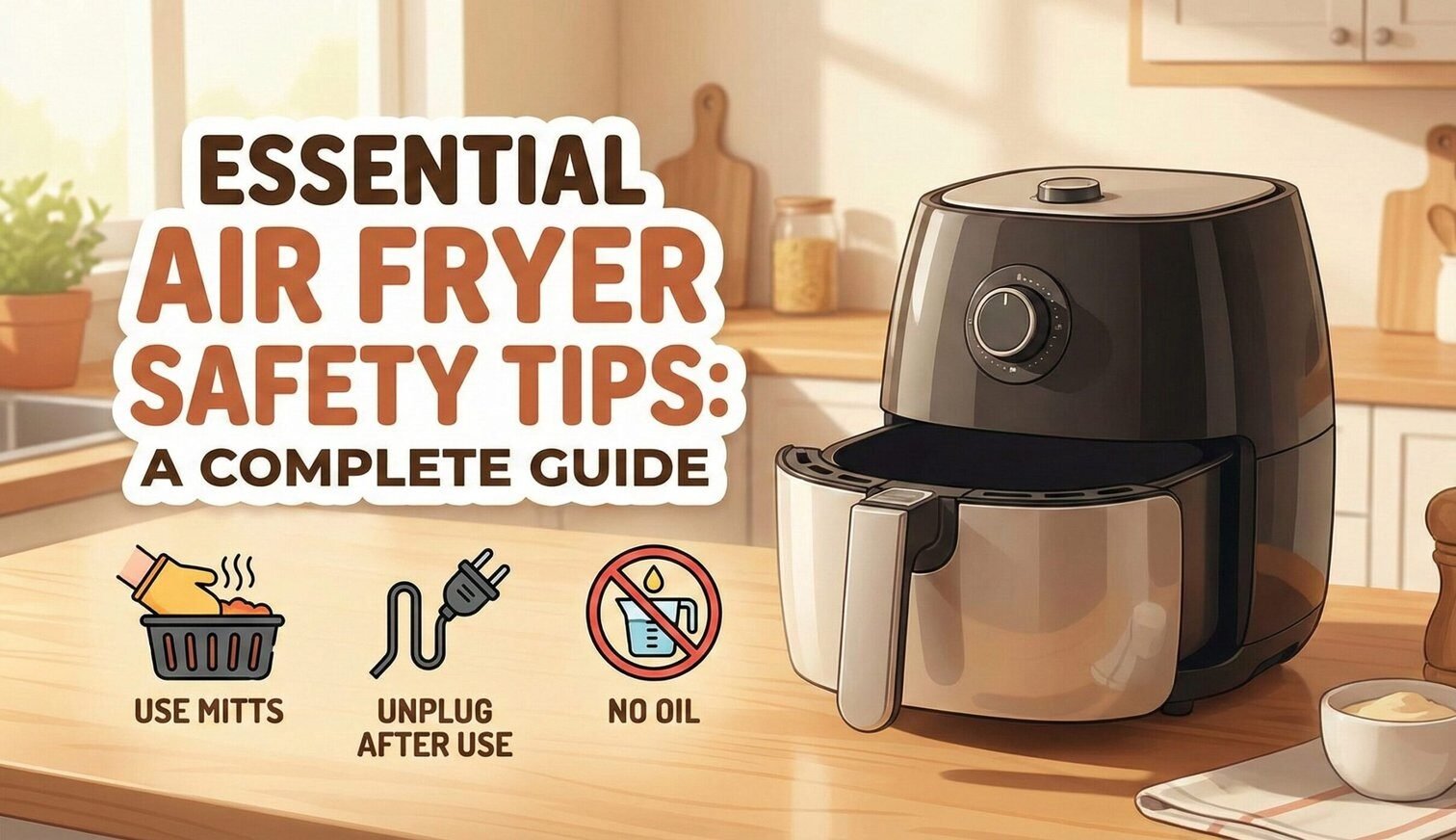
The air fryer has revolutionized modern cooking, offering a healthier, faster alternative to deep frying. However, like any high-wattage appliance that reaches temperatures of 400°F (200°C), it demands respect. Whether you own a massive Power XL Air Fryer or a compact model, safety should always be your first ingredient.
At Digital Fryer, we want you to enjoy your smart lifestyle upgrades without the risk of fire, burns, or kitchen mishaps. This comprehensive guide covers everything from proper ventilation to electrical safety.
1. Location & Ventilation: Give It Space
Air fryers work by circulating superheated air rapidly. For this mechanism to work safely, the machine needs to “breathe.”
The 5-Inch Rule
Always leave at least 5 inches (13cm) of clear space behind and above the air fryer. The exhaust vent releases hot air, which can damage walls or melt nearby plastic.
- DO: Place the unit on a heat-resistant, level countertop.
- DO: Use a silicone mat underneath to protect delicate quartz or granite counters.
- DO: Ensure the exhaust fan is not blowing into electrical sockets.
According to safety experts at the London Borough of Hammersmith & Fulham, you should never place your air fryer under a cupboard that doesn’t have an extraction fan, as the steam and heat can cause long-term damage to cabinetry.
2. Electrical Safety & Wattage
Air fryers are high-wattage appliances, often drawing 1500W to 1700W. This is similar to a space heater.
The “Wall Only” Rule: Always plug your air fryer directly into a wall outlet. Do not use extension cords or power strips. Most power strips are not rated for the sustained high amperage an air fryer requires, which can lead to the strip overheating and catching fire.
If you are using multiple appliances, like a high-powered blender alongside your fryer, ensure they are on different circuits to prevent tripping the breaker.
3. Preventing Grease Fires and Smoke
White smoke billowing from an air fryer is a common complaint, but it’s usually preventable. It happens when grease splatters onto the heating element.
Manage the Oil
Unlike a deep fryer, you only need a tablespoon of oil. If you are cooking fatty foods (like bacon or sausages) in a basket-style fryer like the Chefman Digital, grease can pool in the bottom.
The Fix: Add a small amount of water to the bottom drawer (below the basket) to prevent grease from overheating and smoking. Alternatively, use specific accessories to catch the drippings.

Silicone Liners
Catch grease effectively and prevent it from burning on the bottom of the pan. Essential for safety and cleanliness.
Shop Liners
Deep Cleaning Kit
Old grease buildup is a fire hazard. Use non-abrasive brushes to keep the heating element clean.
See Cleaning Kits4. Handling Hot Components
The exterior of some models, especially smaller plastic units or single-layer metal ovens like the Kalorik Maxx, can get surprisingly hot.
- DON’T: Touch the basket or internal pans with bare hands immediately after cooking.
- DON’T: Set the hot basket directly on a countertop without a trivet.
- DON’T: Reach inside to grab food. The heating element is often exposed at the top.
We strongly recommend investing in high-heat resistant fryer gloves. Standard tea towels may not provide enough insulation against the intense localized heat of metal air fryer baskets.
5. Material Safety: Coatings and Plastics
A common concern is the chemical safety of the non-stick coating. Does the coating degrade? Do air fryers use radiation? (Spoiler: No, they don’t).
To keep your air fryer safe for consumption:
- Avoid Metal Utensils: They scratch the non-stick coating (PTFE), which can then flake into food. Use silicone tongs or wooden spoons.
- Don’t Overheat Empty: Preheating for too long (over 3-4 minutes) can damage the coating.
- Check for PFOA-Free: Most modern units, like the Cosori and Instant Vortex, are PFOA-free. If you have a very old model with chipping coating, it’s time to upgrade.
6. Food Safety: Cooking to Temperature
Because air fryers cook fast, the outside can brown before the inside is safe to eat. This is common with thick chicken breasts or frozen burgers.
To avoid food poisoning, use a meat thermometer. If you are baking, ensure you are using precise digital kitchen scales to measure ingredients, as air fryer baking is less forgiving than oven baking.
For more details on what works best, check our guide: What Can You Cook in an Air Fryer?
7. Maintenance as Prevention
A clean air fryer is a safe air fryer. Buildup of crumbs and oil is fuel for a potential fire.
- Daily: Wipe down the basket and drawer.
- Weekly: Check the heating element (when cool) for grease splatter. Wipe gently with a damp cloth.
- Deep Clean: Use a dedicated cleaning kit to get into the vents and fan blades.
Also, never pour oil down the sink! If you are doing hybrid frying or using lots of marinade, use fryer strainers to separate food particles and dispose of oil responsibly.
8. Can Air Fryers Explode or Catch Fire?
This is one of the most searched safety questions, and the honest answer is: it’s rare, but it does happen, and it is almost always preventable. Air fryers do not “explode” in the dramatic, cinematic sense that a pressure cooker or a propane tank might. There is no sealed chamber building up pressure inside a standard air fryer. What actually happens in the small number of documented incidents is a thermal runaway event — grease or food debris ignites against the exposed heating coil, and the flames spread quickly because the appliance is essentially a small convection oven stuffed with flammable plastic housing and a plastic control panel.
News reports about air fryer fires almost always trace back to one of a handful of root causes: a buildup of old grease on the heating element, a paper towel or parchment sheet that wasn’t weighted down and got sucked into the fan, a unit placed too close to curtains or wooden cabinets, or a defective internal component in a very cheap, uncertified unit. None of these are inherent flaws of air frying as a cooking method — they are maintenance and placement failures that are entirely within your control.
If you smell an acrid, chemical-like odor (different from the normal “new appliance” smell some units have during their first few uses) or see sparking from the plug or cord, unplug the unit immediately at the wall — do not pull the appliance itself away first, as this can damage the cord further. Never use water on an electrical or grease fire. If a small fire does start inside the basket, the safest first response for most home cooks is to smother it by closing the drawer or lid if it can be done safely, cut power at the wall, and use a Class B or Class K fire extinguisher rated for grease and electrical fires if the flames don’t subside within a few seconds. If the fire grows beyond a small, contained flare-up, evacuate and call emergency services rather than continuing to fight it yourself.
9. Aluminum Foil, Parchment Paper & Liners: What’s Actually Safe?
Search interest around “can you put foil in an air fryer” and “air fryer parchment paper safety” is extremely high, and for good reason — this is one of the most common ways people accidentally start a small fire or damage their unit.
Aluminum Foil
Foil is generally safe in most air fryers, with three important caveats. First, never let loose foil touch or get close to the heating element at the top of the unit; the intense, direct heat can cause it to curl upward, contact the coil, and spark. Second, avoid using foil with acidic foods like tomatoes, citrus, or vinegar-based marinades for extended cook times, since the acid can react with the aluminum and leach into food. Third, always weigh foil down with the food itself — never leave a loose, empty corner flapping in the basket, since the powerful fan can lift it directly into the fan blades or heating coil.
Parchment Paper
Parchment paper is a popular choice because it’s non-reactive and helps with cleanup, but it comes with its own fire risk if used incorrectly. Standard parchment paper is only rated to withstand certain temperatures before scorching, and more importantly, if it is not weighed down by food, the fan can pull it upward into the heating element within seconds, where it will ignite almost instantly. Perforated, pre-cut air fryer liners are safer than a full sheet because they allow airflow and are typically sized to sit flush against the basket bottom.
- DO: Preheat with the liner and food already in place, never an empty liner alone.
- DO: Use perforated, purpose-made liners sized to your specific basket.
- DO: Trim foil or parchment so no edge extends above the food line.
- DON’T: Preheat an empty basket with a liner already inside.
- DON’T: Use wax paper — it is not heat-rated for air frying and will smoke.
- DON’T: Cover the entire basket surface, which blocks airflow and can cause uneven cooking or overheating.
If you frequently cook messy or saucy foods, the silicone liners mentioned earlier are a safer long-term alternative to disposable paper, since they’re reusable, don’t lift in the airflow the way paper can, and are rated for the full temperature range of most air fryers.
10. Should You Ever Leave an Air Fryer Unattended?
Manufacturer guidance and fire-safety organizations are consistent on this point: air fryers, like toaster ovens and space heaters, should not be run unattended for long, unsupervised stretches, especially not overnight or while you leave the house. Most home cook times run 10 to 25 minutes, which makes this easier to follow than it sounds — but it’s a habit worth building deliberately, particularly if you’re used to walking away from a slow cooker or oven for hours at a time.
If you need to step away briefly, that’s generally fine for most modern units with a built-in auto shut-off timer, since the appliance will stop heating once the countdown ends. The real risk comes from stacking tasks — starting a load of laundry, running an errand “for five minutes,” or falling asleep on the couch while a batch of wings finishes. A simple habit that many experienced air fryer users adopt is setting a phone timer in addition to the appliance’s own timer, specifically so you have an independent reminder to check on the unit even if you get distracted elsewhere in the house.
11. Air Fryer Safety Around Kids and Pets
Because air fryers sit on countertops rather than inside an enclosed oven cavity, they present a different risk profile around curious children and pets than a traditional wall oven does. The exterior housing, the exhaust vent, and especially the basket immediately after cooking can all reach temperatures capable of causing a serious burn in a fraction of a second on a child’s more sensitive skin.
Countertop Placement
Position the unit toward the back of the counter, away from the edge, and ideally away from areas where a toddler could reach up and pull on a dangling cord. Coil or clip excess cord length so it isn’t hanging within reach — a pulled cord can bring the entire hot appliance down with it.
The Exhaust Vent
The exhaust vent releases a steady stream of very hot air, often well above 300°F (150°C), for the entire cook cycle. Make sure it isn’t pointed toward a spot where a child might be standing or where a pet bed, blanket, or paper items are nearby.
Cool-Down Period
Teach kids in the household — and remind yourself — that “the fryer is off” doesn’t mean “the fryer is cool.” Baskets and drawers can retain significant heat for 10 to 15 minutes after the cycle ends. If young children are frequently in the kitchen, consider a countertop appliance guard or simply relocating the unit to a higher, child-inaccessible surface when not actively supervised.
12. Power Surges, Storms & Auto Shut-Off Features
Air fryers are sensitive electronics as much as they are heating appliances, and a power surge — from a lightning strike, grid fluctuation, or even another large appliance kicking on the same circuit — can damage the control board or, in rarer cases, cause a malfunction in the heating cycle. If you live in an area prone to storms or frequent power fluctuations, plugging your air fryer into a dedicated surge protector rated for its wattage (not a basic power strip without surge protection, and never one also carrying a space heater or other high-draw device) is a worthwhile investment.
Most modern air fryers include a thermal auto shut-off that cuts power if internal temperatures exceed a safe threshold, which is one of the most important safety features to check for before buying a unit, especially a budget or off-brand model. If your air fryer is older, doesn’t power back on reliably after a surge, or trips your circuit breaker repeatedly, treat that as a sign to have the unit inspected or replaced rather than continuing to use it.
13. Certifications to Look For: UL, ETL, and CE Marks
Not all air fryers are held to the same manufacturing and safety standards, and this is a keyword area shoppers frequently search but rarely find clear answers to. In the United States, look for a UL (Underwriters Laboratories) or ETL (Intertek) mark on the appliance or in the product listing, which indicates the unit has been independently tested against recognized electrical safety standards. In the European Union and UK, look for the CE or UKCA mark respectively.
These marks don’t guarantee an appliance will never fail, but they significantly reduce the odds of the kind of manufacturing defects — poor insulation, substandard wiring, missing thermal cutoffs — that show up disproportionately in uncertified, ultra-budget imports sold through third-party marketplace listings with no established brand history. When comparing models like the Cosori and Instant Vortex, both from established brands with a track record of certified products, you’re already starting from a safer baseline than an unfamiliar off-brand alternative.
14. Air Fryer Safety in Apartments & Rental Units
If you rent your home, air fryer safety carries a few extra considerations worth thinking through. Many rental leases and renters insurance policies have specific language about appliance-related fire damage, and repeated nuisance smoke alarms from grease buildup can strain a relationship with a landlord or neighbors in a shared building.
- DO: Confirm your renters insurance covers accidental fire or smoke damage from kitchen appliances.
- DO: Test your smoke detector regularly, especially if your kitchen is open-plan and close to the unit.
- DO: Keep the air fryer away from shared walls or built-in cabinetry the landlord may flag for heat damage.
If your rental kitchen is small, ventilation becomes even more important, since the 5-inch clearance rule discussed earlier is harder to maintain on a compact apartment countertop. A slim, vertical-style air fryer footprint can help here, but never sacrifice clearance space just to save counter real estate.
15. Recognizing a Recalled or Defective Unit
Appliance recalls happen more often than most shoppers realize, and air fryers are no exception — issues ranging from handle detachment to overheating control boards have prompted manufacturer recalls in recent years. Before your next use, it’s worth a quick search of your specific model number against your country’s consumer product safety authority (in the US, the Consumer Product Safety Commission; in the UK, the Office for Product Safety and Standards) to confirm your unit hasn’t been flagged.
Warning signs that suggest a defective unit — recalled or not — include a burning plastic smell that isn’t explained by food residue, a power cord that feels hot to the touch during normal use, a basket that doesn’t lock or seat properly, or a control panel that behaves erratically (resetting temperatures on its own, failing to shut off at the timer). Any of these warrant discontinuing use and contacting the manufacturer rather than trying to troubleshoot around the problem.
16. Treating Minor Burns from Hot Components
Even with careful handling, minor contact burns from a hot basket edge or exhaust vent are one of the most common air fryer-related injuries, so it’s worth knowing the basic first-aid response. For a minor burn (red skin, no blistering), run cool — not ice-cold — water over the area for about 10 to 20 minutes, then cover loosely with a clean, non-stick bandage. Avoid butter, oils, or toothpaste, which are common but ineffective home remedies that can trap heat and increase infection risk.
18. Oil Types, Smoke Points & Why They Matter for Safety
Not every cooking oil belongs in an air fryer, and the wrong choice isn’t just a flavor mistake — it’s a smoke and fire-risk issue. Every oil has a “smoke point,” the temperature at which it stops shimmering and starts visibly breaking down, releasing acrid smoke and, at higher concentrations, becoming a genuine flash-fire hazard. Because most air fryer recipes run between 350°F and 400°F (175–200°C), and hot spots near the heating coil can run even higher, the oil you choose needs enough headroom above that range.
Oils With Enough Headroom
Refined avocado oil, refined peanut oil, refined sunflower oil, and light or refined olive oil all have smoke points comfortably above 400°F, making them safe, stable choices for air frying. Avocado oil in particular has become a favorite among air fryer enthusiasts because its smoke point sits well north of 500°F in most refined versions.
Oils to Use Sparingly or Avoid
Extra virgin olive oil, unrefined coconut oil, and butter all have smoke points at or below the typical air fryer cooking range, which means they’re more prone to smoking and, in a basket with poor grease drainage, contributing to the kind of scorched-on residue that raises fire risk over repeated uses. That doesn’t mean you can never use them — a light brush of butter for flavor at the end of cooking is very different from filling a basket with a butter-heavy marinade for a 20-minute cook — but it does mean choosing a higher-smoke-point oil as your default, especially for longer cook times.
19. High-Altitude Air Frying: Extra Precautions
If you live at a higher elevation — generally above 3,000 feet (about 900 meters) — you may have noticed your air fryer behaves a little differently, and this is actually a safety-relevant quirk, not just a cooking one. Thinner air at altitude affects convection heat transfer, which can cause some units to run hotter internally than their displayed temperature would suggest, since the appliance’s internal sensor and calibration are typically tuned for sea-level conditions.
Practically, this means high-altitude cooks should keep a closer eye on early cook cycles with a new appliance, watch for smoke more attentively during the first several uses, and consider reducing suggested temperatures by 15 to 25 degrees Fahrenheit as a starting adjustment, refining from there based on results. It’s also worth double-checking that your specific model’s manual doesn’t list a maximum recommended elevation, since a small number of budget units have components not rated for extended high-altitude use.
20. Cross-Contamination & Raw Meat Safety in a Shared Basket
Because the air fryer basket is a single, shared cooking surface with limited separation between food items, cross-contamination is a more relevant concern here than in a multi-rack oven. If you’re cooking raw chicken and then immediately want to air fry vegetables or reheat leftovers in the same basket without washing it in between, you’re transferring raw juices and any bacteria they carry directly onto food that may not reach the same internal temperature.
- DO: Wash the basket and drawer with hot, soapy water between raw meat and any other food, even if you’re in a hurry.
- DO: Use separate silicone liners or trays for raw proteins versus vegetables if you cook in batches.
- DO: Let the basket cool before washing to avoid warping non-stick coatings with a sudden temperature change.
- DON’T: Reuse the same parchment liner across a raw-meat cook and a following cook without replacing it.
- DON’T: Stack raw and cooked items in the basket at the same time, even briefly.
- DON’T: Assume the high heat of air frying “sterilizes” the basket on its own between uses — it doesn’t clean residue left in corners and mesh gaps.
21. Air Fryer vs. Deep Fryer vs. Toaster Oven: A Safety Comparison
Shoppers comparing appliances often want to know how the actual safety profiles stack up, not just the cooking results. Here’s a straightforward comparison of the three most commonly cross-shopped countertop cooking methods.
Deep Fryers
Deep fryers involve several quarts of oil heated well above 350°F in an open or semi-open vessel. The risks are significant: oil splatter burns, the danger of adding wet or frozen food to hot oil (which causes violent, sometimes explosive, boil-over), and a genuinely serious fire risk if the oil overheats past its own flash point. Air fryers eliminate almost all of these risks simply by using a tablespoon of oil or none at all.
Toaster Ovens
Toaster ovens share more similarities with air fryers, since many modern combination units are essentially the same core technology. Standalone toaster ovens generally have lower wattage than dedicated air fryers, which slightly reduces electrical load risk, but they also tend to have less sophisticated auto shut-off and grease-management systems, meaning crumbs and drips can accumulate unnoticed at the bottom for longer stretches.
Air Fryers
Air fryers land in the safest middle ground of the three for most home kitchens: minimal oil, enclosed convection heating, and — on quality, certified units — a built-in auto shut-off and thermal cutoff. The primary risks, as this guide covers, come down to placement, maintenance, and paper/foil misuse rather than the fundamental cooking method itself.
22. Disposing of or Recycling an Old Air Fryer Safely
When it’s time to retire an old or damaged unit — especially one with a cracked housing, frayed cord, or malfunctioning heating element — proper disposal matters both for safety and the environment. Never simply place a damaged electrical appliance in regular household trash if your municipality offers e-waste recycling, since a compromised lithium-adjacent control board or cord can pose a fire risk in a waste truck or landfill.
Most municipalities and many big-box retailers offer small-appliance e-waste drop-off programs. If your unit is defective but not physically damaged, some manufacturers offer take-back or trade-in programs when you purchase a replacement. Before disposal, always cut or remove the power cord if you’re placing the unit in general recycling, to eliminate any chance of it being scavenged and reused unsafely.
23. Using an Air Fryer in an RV, Boat, or Tiny Home
Compact living spaces bring their own version of the safety considerations covered throughout this guide, amplified by tighter clearances and, often, more limited electrical capacity. RV and marine electrical systems frequently run on lower-amperage circuits than a standard home outlet, and running a 1500W+ air fryer off an inverter or generator can quickly overload the system if other appliances are running simultaneously.
- DO: Check your RV or boat’s electrical system amperage rating before running a full-size air fryer.
- DO: Choose a compact, lower-wattage model if you cook on the road frequently.
- DO: Secure the unit against a wall or in a dedicated appliance nook while driving or sailing, never left loose where it could tip.
The 5-inch clearance rule discussed earlier becomes especially important in a small galley kitchen, where cabinetry, curtains, and upholstery are often much closer to the countertop than in a standard home kitchen.
24. Printable Safety Checklist
Keep this quick-reference list near your kitchen for a fast pre-cook and post-cook safety check.
Before You Cook
- Check: At least 5 inches of clearance on all open sides.
- Check: Plugged directly into a wall outlet, not a power strip.
- Check: Basket and drawer are clean of old grease buildup.
- Check: Any foil or parchment is trimmed and weighed down by food.
- Check: A working smoke detector is present in the kitchen.
After You Cook
- Check: Unit unplugged if you won’t be using it again soon.
- Check: Hot basket placed on a trivet, away from the counter edge and pets.
- Check: Internal temperature of meat verified with a thermometer.
- Check: Basket and drawer washed before grease has a chance to harden.
26. Choosing a Location: Kitchen Layout Considerations
Beyond the basic 5-inch clearance rule, where you permanently station your air fryer within your kitchen layout has a real effect on long-term safety, not just convenience. A dedicated “appliance zone” — the same spot every time — helps build consistent habits around clearance and cord management, rather than moving the unit around and re-deciding placement under time pressure every time you cook.
Under Wall Cabinets
As referenced earlier, placing an air fryer directly beneath a wall cabinet without an extraction fan is a common cause of heat-related cabinet damage over time, including discoloration, warping, and in rare cases, scorching of the cabinet’s underside. If your only available counter space is beneath cabinetry, consider a heat-deflecting shield mounted to the cabinet bottom, sold as an accessory for over-the-range microwaves and adaptable to this use, or simply relocate the unit to an open stretch of counter for the duration of each cook.
Near the Sink vs. Near the Stove
Positioning your air fryer near the sink rather than directly beside the stove has two safety advantages: it keeps the appliance away from an open gas flame or hot stovetop surface, and it puts it closer to water for a fast response if you ever need to cool a minor burn immediately. The tradeoff is that a nearby running faucet increases the chance of water splashing onto the unit’s electrical components, so keep at least a foot of separation from the sink basin itself.
Corner Placement
Corners are tempting because they save counter space, but they often restrict airflow behind the unit and make the exhaust vent point directly into an adjacent wall. If a corner is your only option, angle the unit diagonally rather than flush against both walls, which restores meaningful clearance on the vent side.
27. Smoke Detectors, Carbon Monoxide, and Kitchen Air Quality
Air fryers don’t produce carbon monoxide the way a gas stove or a malfunctioning gas water heater can, since they run on electricity with no combustion involved — but they do produce enough steam, fine particulate matter, and occasional smoke to regularly trigger overly sensitive smoke detectors, especially in small or open-plan kitchens. This nuisance-alarm problem is worth addressing properly rather than simply disabling the detector, which some households do out of frustration and which removes a critical safety layer.
If your smoke detector is triggering frequently during normal air fryer use, first confirm the unit is genuinely just steam and not actual smoke from grease buildup — the two look and smell different, with steam dissipating quickly and smoke leaving a lingering, acrid odor. If it’s steam, consider relocating the detector slightly further from the cooking zone (within your local fire code’s minimum distance requirements), switching to a photoelectric-sensor detector, which tends to be less prone to nuisance alarms from steam than an ionization sensor, or simply running a range hood or window fan during cooking to clear the air faster.
28. Glossary of Air Fryer Safety Terms
A quick reference for some of the technical terms that come up throughout this guide and in manufacturer manuals.
- Thermal cutoff: A safety component that automatically stops the heating element if internal temperatures exceed a safe threshold, preventing overheating even if the main thermostat fails.
- Smoke point: The temperature at which a given cooking oil begins to visibly smoke and break down chemically, releasing compounds that can irritate airways and, at higher concentrations, ignite.
- PTFE: Polytetrafluoroethylene, the chemical name for the common non-stick coating (often marketed under brand names) used in many air fryer baskets.
- PFOA: Perfluorooctanoic acid, a chemical once used in manufacturing some non-stick coatings and now phased out of virtually all modern cookware, including the vast majority of current air fryers.
- Auto shut-off: A timer-based or thermal-based feature that stops the appliance from heating once a set condition — elapsed time or maximum temperature — is reached.
- Convection heating: The method by which air fryers cook, using a fan to rapidly circulate hot air around food, rather than relying on submerged oil or static oven heat.
- Dedicated circuit: An electrical circuit serving only one outlet or appliance, reducing the risk of overload when running high-wattage devices like an air fryer.
29. Comparing Cleaning Products: What’s Safe on Non-Stick Baskets
Not every kitchen cleaning product is appropriate for an air fryer basket, and using the wrong one can both damage the non-stick coating and, in some cases, leave a residue that smokes or off-gasses during the next cook. This is a keyword area with real search demand — “what to clean air fryer basket with” and similar phrasing — that also carries a genuine safety dimension.
Safe Options
Warm water with a small amount of mild dish soap and a soft sponge or non-abrasive brush is the gold standard for daily cleaning. For baked-on residue, a paste of baking soda and water left to sit for 15 to 20 minutes before scrubbing gently lifts grease without scratching the coating. A dedicated non-abrasive cleaning kit, like the one referenced earlier in this guide, is designed specifically for the tight corners and mesh sections of an air fryer basket where residue tends to accumulate.
Products to Avoid
Steel wool, abrasive scouring pads, and harsh oven-cleaner sprays are all poor choices for a non-stick air fryer basket. Steel wool and abrasive pads physically scratch through the coating, exposing the base metal and accelerating the flaking issue discussed earlier in this guide. Oven-cleaner sprays are formulated for enamel and bare metal oven interiors, not non-stick coatings, and their strong alkaline chemistry can degrade PTFE coatings and leave a chemical residue that isn’t meant to be heated again during your next cook.
- DON’T: Use steel wool or metal scouring pads on the basket interior.
- DON’T: Spray commercial oven cleaner directly into the basket or drawer.
- DON’T: Run a non-dishwasher-safe basket through a dishwasher cycle, since high heat and harsh detergents can degrade the coating faster than hand washing.
30. Building a Long-Term Safety Habit
Most of the guidance in this article boils down to a small number of repeatable habits rather than a long list of rules to memorize individually. If you take away just a handful of practices — plugging directly into the wall, giving the unit real breathing room, cleaning grease before it hardens, verifying doneness with a thermometer rather than color alone, and never leaving a long cook completely unsupervised — you’ll have addressed the overwhelming majority of realistic air fryer risks covered throughout this guide.
Safety habits, like cooking techniques, become automatic with repetition. The first few times you consciously check clearance space or wipe down the drawer before it’s visibly dirty will feel like an extra step. After a few weeks of regular use, it becomes as automatic as checking that a stove burner is off before leaving the kitchen.
25. Frequently Asked Questions
Is it normal for a new air fryer to smell or smoke slightly the first time?
A light smell or faint smoke during the very first use is common and usually comes from manufacturing residue or the protective coating burning off the heating element. Run it empty for 10 minutes at a moderate temperature with a window open before cooking food in it for the first time. If the smell persists past the first two or three uses, that’s no longer normal and worth investigating.
Can I use cooking spray directly in the basket?
Yes, but choose an oil-based spray in a pump bottle rather than a commercial aerosol propellant spray. Many aerosol cooking sprays contain lecithin and other additives that can build up as a sticky residue on non-stick coatings over repeated use, which both damages the coating and adds to the grease buildup that contributes to smoking.
Why does my air fryer trip my circuit breaker?
This usually means it’s sharing a circuit with other high-draw appliances, such as a microwave, toaster, or space heater. Because most air fryers pull 1500 to 1700 watts, running one alongside another high-wattage device on the same 15-amp circuit can exceed the circuit’s rated capacity. Move the air fryer to a dedicated outlet or circuit if this happens repeatedly.
Is it safe to air fry frozen food straight from the freezer?
Generally yes — air fryers are actually well suited to frozen foods since the rapid, circulating heat cooks them evenly. Just follow food safety basics from earlier in this guide: verify doneness with a thermometer rather than relying on color alone, since frozen foods are more prone to browning on the outside before the center reaches a safe internal temperature.
How do I know if my air fryer basket coating has degraded and needs replacing?
Look for visible flaking, scratching down to a metallic base layer, or a rough, dull patch where the coating has worn thin, usually from metal utensils or abrasive scrubbing. Once the coating is visibly compromised, replace the basket (many models sell baskets separately) rather than continuing to cook on a damaged non-stick surface.
Can I run my air fryer on an extension cord in an emergency?
It’s best avoided. If you absolutely must, use a short, heavy-gauge extension cord rated for at least 15 amps, never a thin lamp-style cord or a daisy-chained series of cords, and unplug it as soon as the cook cycle finishes rather than leaving it connected long-term.
Does an air fryer need to be cleaned after every single use?
The basket and drawer should be wiped or washed after every use where oil or food residue is present, even if it looks minor. A deeper clean of the heating element and vents can happen weekly under normal use, or more often if you cook fatty or breaded foods frequently.
Is it safe to preheat an air fryer while it’s empty?
A brief empty preheat of 2 to 3 minutes is fine and even recommended by some manufacturers for even cooking results. Extended empty preheating beyond that, especially with a liner already inside, is where the risk increases, since there’s nothing to shield the liner or basket coating from direct, sustained heat.
Final Thoughts
Air fryers are among the safest appliances when used correctly. They lack the open flame of a gas stove and the vat of boiling oil of a deep fryer. However, they generate intense heat and require proper airflow.
By following these tips—giving the unit space, plugging it into the wall, and keeping it clean—you can enjoy the benefits of air frying for years to come. Stay safe and happy cooking!


