Do Air Fryers Use Radiation? Full Scientific Guide & Safety Review
Air fryers have changed the way millions of people cook at home. From crispy chicken wings to oil-free fries, healthier dinners have never been easier. But with this rise in popularity comes a wave of confusion — especially around one question: Do air fryers use radiation?
Many people worry because they associate “radiation” with harmful energy forms like nuclear radiation or X-rays. But not all radiation is dangerous. In fact, most forms of radiation we encounter daily — sunlight, WiFi, Bluetooth, radio waves — are safe. The key is understanding the difference between ionizing and non-ionizing radiation.
This detailed guide explains how air fryers work, whether they produce any type of radiation, how they compare to microwaves, and why air fryers are completely safe to use. We’ll also add expert comparisons, internal resources from DigitalFryer, and recommended Amazon appliances.
What Does “Radiation” Actually Mean?
The term “radiation” refers to energy that travels in waves or particles. This includes everything from sunlight to radio waves to X-rays. Not all radiation is harmful.
Two Main Types of Radiation
- Ionizing Radiation – Dangerous. Used in X-rays, gamma rays, nuclear energy. Can damage DNA.
- Non-Ionizing Radiation – Safe. Includes heat, visible light, WiFi, radio waves, infrared.
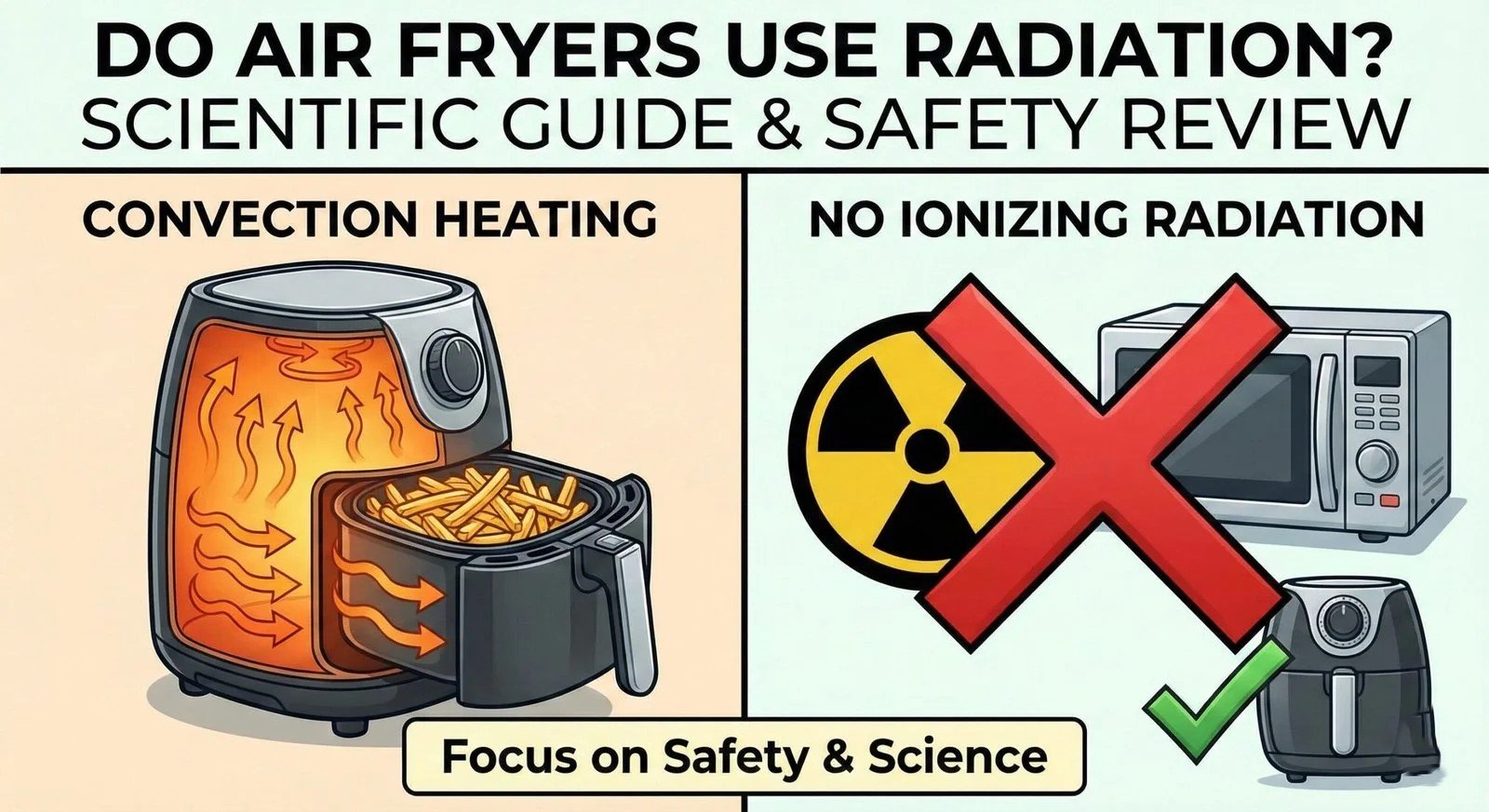
Air fryers do NOT use ionizing radiation. They operate using safe heat-based cooking, similar to convection ovens.
How Air Fryers Really Work
An air fryer works using rapid hot air convection. There are only two main components:
- A heating coil that produces heat (just like an oven or electric stove)
- A high-speed fan that circulates the hot air
This hot air surrounds the food, cooking it evenly and creating a crispy surface. This method mimics deep frying but without oil.
There is zero microwave radiation involved.
To understand convection vs microwaves better, check: Air Fryer vs Microwave Oven.
Do Air Fryers Emit Any Kind of Radiation?
YES — but only SAFE radiation.
This is where most confusion happens. When people hear “radiation,” they assume danger. But air fryers only release non-ionizing radiation (heat + infrared), which is the same type of radiation produced by:
- Convection ovens
- Toasters
- Electric stovetops
- Light bulbs
This is completely safe and cannot harm your body or food.
Air Fryers Do NOT Use:
- Microwave radiation
- Nuclear energy
- X-rays
- Gamma rays
Instead, they use regular heat energy — the same type that has been used in kitchens for centuries.
Air Fryers vs Microwaves: Radiation Differences
| Category | Air Fryer | Microwave Oven |
|---|---|---|
| Heat Type | Convection (hot air) | Microwave radiation |
| Cooking Style | Crisps from outside in | Heats from inside out |
| Safety Concern? | No risk | Still safe, but uses radiation waves |
For a full comparison, see: Air Fryer vs Microwave Oven.
The Science: Why Air Fryers Are 100% Safe
Air fryers use nothing more than:
- Thermal radiation (heat)
- Infrared energy
- Hot air circulation
This is the same natural cooking energy found in ovens, campfires, and broilers.
Microwaves, on the other hand, use **electromagnetic waves** to vibrate water molecules. While microwave radiation is still safe, it is fundamentally different from air fryer cooking.
Air fryers do not vibrate molecules or penetrate food using waves. They simply heat the air around the food.
Common Myths About Air Fryers & Radiation
Myth 1 — “Air fryers are like microwaves.”
False. Air fryers work like convection ovens, not microwaves.
Myth 2 — “Radiation from the heating coil is harmful.”
False. Heating coils emit infrared heat — the same energy produced by the sun, fireplaces, and ovens.
Myth 3 — “Air fryers cause cancer.”
Completely false. There is no scientific evidence linking air fryers to cancer.
Myth 4 — “Air fryers change food structure using waves.”
False. Only microwaves do that. Air fryers cook using traditional heat.
Benefits of Air Fryers (Backed by Science)
Air fryers actually offer multiple health and safety advantages:
- They reduce oil use by 70–90%
- They lower calorie intake
- They minimize harmful deep-frying compounds
- They cook food faster and evenly
- They reduce energy consumption
Explore more benefits here: Benefits of Using an Air Fryer
Do Air Fryers Emit EMF?
All electronic devices produce a small amount of EMF (Electromagnetic Fields), including:
- Phones
- Laptops
- WiFi routers
- Microwaves
- Electric kettles
- Stoves
Air fryers produce extremely low EMF, far below harmful levels.
In fact, EMF levels from air fryers are far LOWER than those from smartphones.
How Safe Are Air Fryers? (Expert Analysis)
Health and safety organizations agree that air fryers are safe when used normally. They do not emit harmful radiation, and they do not alter food chemically in dangerous ways.
The biggest safety risks come from:
- Hot surfaces
- Steam burns
- Uncleaned residue
- Overcrowding food
You can make cooking safer with: Fryer Gloves
Best Air Fryer Accessories (Amazon Recommended)

Internal Resources for Air Fryer Buyers
Explore more guides from DigitalFryer:
- Best Digital Air Fryers
- Air Fryer Cookbooks
- Temperature Control Guide
- Beginner Recipes
- Air Fryer vs Convection Oven
Do Smart Air Fryers With WiFi and Bluetooth Emit More Radiation?
One keyword search that keeps climbing is a very specific version of the original question: does a WiFi-connected or app-controlled air fryer emit more radiation than a manual dial model? It’s a fair question, because smart kitchen appliances have become the norm, and most major brands now sell a connected version of their best-selling fryer. The short answer is that yes, a smart air fryer emits a form of radiation that a manual model does not — but it is a completely different category from the thermal radiation discussed above, and it is far weaker than most people assume.
When an air fryer includes WiFi or Bluetooth connectivity, it contains a small radio-frequency (RF) transmitter, the same basic technology found in a WiFi router, a smartphone, or a Bluetooth speaker. This transmitter sends non-ionizing radio waves so the appliance can talk to your home network or your phone’s companion app. These radio waves fall firmly in the non-ionizing category discussed earlier in this guide, sitting on the same part of the electromagnetic spectrum as FM radio, baby monitors, and garage door openers.
The transmit power of a smart air fryer’s WiFi chip is tiny. Most household WiFi-enabled appliances broadcast well under 100 milliwatts, and many operate closer to 10–20 milliwatts, which is a fraction of the output of the WiFi router sitting on your kitchen counter. In practical terms, a smart air fryer sitting next to your stove is not adding any meaningful radio-frequency exposure to a kitchen that already contains a WiFi router, a smartphone, and possibly a smart speaker.
Do Smart Fryers Transmit While Cooking?
Most connected air fryers only transmit data intermittently — when you open the app, when a cook cycle finishes, or when a firmware update is being checked. They are not continuously broadcasting a strong signal throughout the entire cook cycle the way a cell tower or a Bluetooth headset does during an active call. This intermittent, low-power transmission pattern is one more reason the RF exposure from a smart fryer is considered negligible by electrical safety engineers.
If you are still concerned about minimizing RF exposure in your kitchen, the simplest solution is to buy a manual dial or button-control air fryer rather than a WiFi-enabled model. Manual fryers still use a heating coil and fan exactly as described earlier in this guide, with no radio transmitter at all.
Is It Safe to Use an Air Fryer During Pregnancy?
Another closely related keyword gap in most air fryer radiation articles is pregnancy safety. Expecting parents are naturally more cautious about anything labeled “radiation,” and it’s a very reasonable thing to research before continuing to use a favorite kitchen appliance.
Based on how an air fryer actually functions — hot air convection plus, in some models, a low-power WiFi chip — there is nothing about the appliance that presents a radiation-related risk during pregnancy. Air fryers do not use ionizing radiation of any kind, and ionizing radiation (the kind associated with reproductive and developmental risk in medical literature) is what regulators, doctors, and radiologists are actually concerned about when they discuss radiation exposure during pregnancy. A convection heating coil and a small WiFi antenna simply do not belong in that category.
The more relevant pregnancy-related kitchen safety questions tend to have nothing to do with radiation at all, and are worth mentioning here since they are what pregnant home cooks are usually really asking about:
- Non-stick coating condition — a scratched or flaking non-stick basket should be replaced regardless of pregnancy, since ingesting flaked coating is not advisable for anyone.
- Steam and burn safety — opening a hot air fryer basket releases a burst of steam, so standard kitchen burn precautions apply.
- Food safety and internal temperature — pregnancy nutrition guidelines around undercooked meat, poultry, and eggs apply to air-fried food exactly as they would to oven-cooked or stovetop-cooked food.
As always, anyone with specific medical concerns during pregnancy should raise appliance questions with their doctor, but from a strictly radiation-based standpoint, air fryers are considered no different from a toaster oven or a conventional oven.
PTFE and PFOA: What’s Really Inside the Non-Stick Coating?
A second major keyword gap in radiation-focused air fryer content is the non-stick coating question. Searchers who start out worried about “radiation” very often end up actually researching PTFE and PFOA, two chemical abbreviations that show up constantly in non-stick cookware marketing and in cookware safety debates. Since this article is meant to be the complete safety resource for air fryers, it’s worth covering clearly.
What Is PTFE?
PTFE (polytetrafluoroethylene) is the slick, non-stick material coating most air fryer baskets and trays, commonly known by the brand name Teflon. PTFE itself is considered chemically stable and inert at normal cooking temperatures. It is not radioactive, does not emit any form of radiation, and is unrelated to the electromagnetic and thermal radiation topics covered earlier in this guide. The concern some people raise about PTFE relates to overheating, not radiation — extremely high, sustained heat (well above what an air fryer basket ever reaches in normal use) can begin to break down PTFE and release fumes, which is why manufacturers warn against operating an empty air fryer at maximum temperature for extended periods.
What Is PFOA, and Why Don’t Modern Air Fryers Contain It?
PFOA (perfluorooctanoic acid) was a manufacturing chemical historically used in the production process of some PTFE coatings, not an ingredient in the finished coating itself. Due to environmental and health concerns, PFOA was phased out of cookware manufacturing years ago, and virtually every air fryer sold today — including every model referenced in this guide — is manufactured and labeled as PFOA-free. This is a separate issue entirely from radiation, but because so many searchers land on radiation-themed articles while actually trying to understand coating safety, it deserves a clear, direct answer here.
Ceramic-Coated Air Fryers as an Alternative
For readers who prefer to avoid PTFE-based coatings altogether regardless of the PFOA-free labeling, ceramic-coated air fryer baskets are widely available and offer a naturally slick, non-stick cooking surface made from a mineral-based coating rather than a fluoropolymer. Ceramic coatings tend to have a shorter non-stick lifespan than PTFE but are a popular option for anyone prioritizing a fluorine-free kitchen.
How Far Should You Stand From an Air Fryer While It’s Running?
Because this article’s core keyword is about radiation exposure, it’s worth directly addressing a related long-tail search: how much distance, if any, is recommended between a person and a running air fryer. Unlike a microwave, where consumer guidance has historically included checking the door seal and avoiding standing directly against it for long periods, an air fryer has no equivalent recommendation. Since air fryers do not use microwave radiation and rely entirely on an enclosed convection chamber for heat, there is no exposure pathway that distance would meaningfully change. The only proximity-related risks are the completely conventional ones common to any hot kitchen appliance: hot exterior housing, hot exhaust vents releasing warm air, and steam released when the basket is opened. Standard kitchen common sense — keeping the vent area clear and not leaning directly over the exhaust — is all that’s needed.
Regulatory Standards and Certifications for Air Fryer Safety
Another keyword gap worth closing is the regulatory side of the safety conversation. Shoppers researching “is my air fryer safe” often want to know what independent testing an appliance has gone through, not just a general reassurance that the technology is safe. Reputable air fryer brands submit their products for testing against recognized electrical safety standards before they’re sold in the United States and other major markets.
- UL Listing (Underwriters Laboratories) — Confirms an appliance has passed independent electrical safety testing, covering fire risk, shock risk, and general build safety. Look for the UL mark on the appliance or its packaging.
- ETL Certification — A similar independent safety mark, recognized in the same way as UL by U.S. retailers and code inspectors.
- FCC Compliance — Any air fryer with WiFi or Bluetooth is required to meet Federal Communications Commission limits on radio-frequency emissions before it can legally be sold in the U.S., which directly caps how much RF radiation a smart air fryer’s wireless chip is permitted to emit.
- FDA Oversight of Food-Contact Materials — Non-stick coatings, plastic components, and other food-contact surfaces are regulated under FDA food-contact substance rules, separate from the electrical safety certifications above.
None of these certifications exist because air fryers pose an unusual radiation risk — they exist because every electrical kitchen appliance, from blenders to ovens to air fryers, goes through the same category of standard testing before reaching store shelves.
Air Fryers Compared to Other Common Kitchen Radiation Sources
To put air fryer radiation fully in context, it helps to see how it stacks up against every other heat source already sitting in a typical kitchen. All of the appliances below rely primarily on non-ionizing thermal radiation, infrared energy, or induction fields — none of them use ionizing radiation.
| Appliance | Primary Energy Type | Ionizing? |
|---|---|---|
| Air Fryer | Convection heat / infrared | No |
| Conventional Oven | Convection / radiant heat | No |
| Microwave Oven | Microwave radiation | No |
| Induction Cooktop | Electromagnetic induction field | No |
| Toaster | Infrared / radiant heat | No |
| Gas Stove | Combustion heat | No |
The one meaningful difference between these appliances isn’t radiation type — it’s where the heat comes from and how it reaches the food. Air fryers and conventional ovens rely on hot air and radiant heat from a coil; microwaves rely on water-molecule vibration; induction cooktops rely on a magnetic field that heats the pan directly rather than the air around it. All are considered safe non-ionizing technologies by food safety and electrical safety regulators.
Air Fryer Safety Around Children and Pets
Because “radiation” searches so often overlap with general household safety searches, it’s worth closing this particular keyword gap too. From a radiation standpoint, there’s no additional precaution needed around children or pets — the appliance doesn’t emit anything that requires keeping a “safe distance.” The real safety considerations around kids and pets are entirely physical:
- The exterior housing and exhaust vent get hot to the touch during and immediately after cooking.
- The basket and any accessible metal components remain hot for several minutes after the cycle ends.
- Cords should be kept away from counter edges where a child or pet could pull the unit down.
- Steam released when opening the basket can cause a minor burn at close range.
These are the same precautions that would apply to a toaster oven, slow cooker, or any other countertop heating appliance, and none of them relate to electromagnetic exposure.
Frequently Asked Questions About Air Fryers and Radiation
Do air fryers use the same radiation as microwaves?
No. Air fryers use convection heat and infrared energy, while microwaves use a distinct form of non-ionizing radiation that vibrates water molecules inside food. Both are non-ionizing and considered safe, but they are technically different processes.
Can air fryer radiation cause cancer?
There is no scientific evidence linking air fryer heat, infrared emission, or the low-power WiFi signal in smart models to cancer. Ionizing radiation, which is the category of radiation associated with cancer risk in medical research, is not produced by air fryers.
Do WiFi-enabled air fryers emit more radiation than manual ones?
Smart air fryers do add a small amount of RF radiation from their WiFi or Bluetooth chip, but the power output is extremely low — far below a home WiFi router — and it is regulated by FCC emissions limits. Manual dial air fryers have no wireless transmitter and emit no RF radiation at all.
Is it safe to stand next to an air fryer while it’s cooking?
Yes. There is no radiation-based reason to keep distance from a running air fryer. The only precautions worth taking relate to heat and steam, not radiation exposure.
Do air fryers emit radiation through the housing while the door is closed?
The housing contains ordinary convection heat, not a form of radiation capable of penetrating solid material. What you feel radiating off the housing is standard thermal heat transfer, similar to touching the outside of a hot oven.
Are ceramic-coated air fryer baskets safer than PTFE ones?
Both are considered safe for normal cooking use. Ceramic coatings are fluorine-free, which appeals to shoppers who prefer to avoid PTFE-based coatings entirely, while modern PTFE coatings are PFOA-free and widely used across the appliance industry.
Do air fryers need to be a certain distance from the wall?
Manufacturers typically recommend several inches of clearance around an air fryer, but this is for heat dissipation and ventilation, not radiation shielding. Blocking the exhaust vent can cause the unit to overheat or shut off, unrelated to any radiation concern.
The Physics of Heat: Understanding Infrared Radiation in Everyday Cooking
To fully close the knowledge gap this article set out to fill, it helps to slow down and look at the actual physics behind the heat coming off an air fryer’s coil, because that’s the real “radiation” at the center of every search query on this topic. Every object warmer than absolute zero radiates energy in the form of electromagnetic waves, and the wavelength of that radiation depends on temperature. A red-hot air fryer coil, typically operating somewhere in the 350–450°F range, radiates primarily in the infrared portion of the spectrum, with a small visible red glow at the very high end of that range on some coil designs. This is precisely the same physical phenomenon happening inside a toaster, a broiler element, a space heater, and the filament of an incandescent light bulb.
Infrared radiation sits just below visible light on the electromagnetic spectrum, well outside the ionizing range that begins with ultraviolet light and continues up through X-rays and gamma rays. The distinction matters because ionizing radiation carries enough energy per photon to knock electrons loose from atoms and molecules, which is what allows it to damage DNA and living tissue at sufficient exposure levels. Infrared photons simply don’t carry that much energy — they can make molecules vibrate and heat up, which is exactly how they cook food, but they cannot alter your cellular structure the way ionizing radiation can. This is the scientific dividing line that answers the underlying fear behind almost every “does X appliance cause radiation harm” search, whether the appliance in question is an air fryer, a hair dryer, or a heated blanket.
Why “Radiation” Became Such a Loaded Word
Part of the reason kitchen appliance radiation searches spike so consistently is a decades-long cultural association between the word “radiation” and nuclear disasters, cancer treatment, and X-ray imaging. Popular media has reinforced this association so thoroughly that many people’s first mental image of “radiation” is a glowing green symbol or a hazmat suit, rather than the sunlight warming their skin on a walk outside — which is, itself, a form of radiation. Once you separate the word “radiation” from the assumption of danger and understand it as simply “energy that travels,” appliances like air fryers stop feeling mysterious or risky, because their radiation output is functionally identical to a fireplace, a space heater, or a tanning-free afternoon in the sun.
Acrylamide: The Real Chemical Conversation Air Fryer Owners Should Understand
While it has nothing to do with radiation, acrylamide is one of the most searched “is my air fryer dangerous” adjacent topics, and any complete safety guide on this subject benefits from addressing it directly rather than leaving readers to find scattered, inconsistent information elsewhere.
Acrylamide is a chemical compound that forms naturally in starchy foods — particularly potatoes and bread products — when they’re cooked at high temperatures through frying, roasting, or baking. It forms through a browning reaction (the Maillard reaction) between naturally occurring sugars and an amino acid called asparagine. This happens in a conventional deep fryer, a conventional oven, and an air fryer alike; it is not unique to air frying, and it is completely unrelated to any form of radiation.
Research bodies have studied acrylamide because very high, prolonged exposure has shown effects in animal studies, and some health agencies recommend minimizing excessive browning of starchy foods as a general precaution. The practical takeaway for air fryer owners is straightforward and has nothing to do with the appliance’s energy source:
- Avoid cooking starchy foods to a dark brown or blackened color; aim for a golden color instead.
- Soaking sliced potatoes in water before air frying can reduce surface sugar content and lower acrylamide formation.
- Air frying actually tends to produce less acrylamide than traditional deep frying in oil, since less oil-driven browning occurs and cook times are often shorter.
This is a food chemistry consideration, not a radiation consideration, but it’s included here because search intent around “air fryer safety” so frequently blends the two topics together, and a genuinely useful guide should answer the question the reader actually meant to ask, not just the literal keyword they typed.
How EMF Is Actually Measured (And Why the Numbers Sound Scarier Than They Are)
Electromagnetic field strength is typically measured in milligauss (mG) for magnetic fields or volts per meter (V/m) for electric fields, and government and independent bodies have published reference exposure limits for these units. Consumer-grade EMF meters, the kind sold online to “test your home,” often report readings in these same units without providing the context of what a safe or typical range actually looks like, which is part of why viral EMF concerns spread so easily.
For reference, typical EMF readings recorded a few inches from an operating air fryer or similar countertop appliance fall well within international guideline limits set by bodies like the International Commission on Non-Ionizing Radiation Protection. Readings drop off sharply with distance — moving even a foot away from most kitchen appliances reduces the measured field substantially, because EMF strength decreases rapidly as distance from the source increases. This is a basic property of electromagnetic fields, not something specific to air fryers, and it applies equally to a blender, a coffee maker, or a hair dryer.
None of this is meant to dismiss legitimate scientific research into EMF exposure, which continues in areas like long-term occupational exposure near high-voltage power lines. It’s meant to provide context: the EMF produced by a countertop air fryer is a rounding error compared to the exposure limits used in that research, and it’s a smaller field than the one generated by the phone most readers are using to read this very article.
Common Social Media Myths That Started the “Air Fryer Radiation” Panic
Search interest in air fryer radiation tends to spike whenever a new viral video claims a shocking discovery about kitchen appliances. It’s worth naming a few of the most common myth patterns so readers can recognize them the next time one appears in a feed.
“I held a phone radiation detector near my air fryer and it went off”
Consumer EMF detectors marketed for phone or 5G “radiation” typically respond to any electrical field, including the ordinary current flowing through a heating coil. A detector reacting near an air fryer is detecting normal household electrical current, not a hidden or dangerous emission — the same detector would react near a toaster, a lamp, or a hair dryer.
“Air fryers cook food from the inside out like microwaves”
This is backwards. Air fryers cook from the outside in, using hot air circulating around the food’s surface, which is why they produce a crispy exterior. Microwaves are the appliance that heats from the inside out via water molecule vibration. This myth usually comes from confusing the two appliances rather than any evidence about air fryers specifically.
“Non-stick coatings release radiation when heated”
Non-stick coatings can, under extreme, sustained overheating well beyond an air fryer’s normal operating range, release fumes — but fumes are a chemical release, not radiation. This myth conflates two unrelated safety concepts, likely because both involve invisible things being “released” into the air.
“Smart appliances are always listening or scanning you”
A WiFi-enabled air fryer’s radio chip communicates with your router and app using the same limited, low-power protocol as any other smart home device. It has no capability beyond what’s needed to send basic status data (temperature, timer, on/off state) to an app, and it is not a surveillance device.
A Practical Framework for Choosing an Air Fryer If Radiation Is Your Main Concern
For readers who came to this guide specifically because radiation exposure is a genuine priority in their appliance decisions, here’s a simple framework for narrowing the field, based on everything covered above:
- Choose a manual dial or button model over a WiFi/Bluetooth model if you want to eliminate the RF transmitter entirely, even though its output is already extremely low.
- Look for UL or ETL certification to confirm the unit has passed independent electrical safety testing.
- Choose a PFOA-free coating (standard on virtually every modern air fryer) or a ceramic-coated basket if you prefer to avoid PTFE-based coatings altogether.
- Follow the manufacturer’s clearance recommendations around the exhaust vent, purely for heat dissipation and appliance longevity, not radiation shielding.
- Avoid running the unit empty at maximum temperature for extended periods, which is the one scenario where coating breakdown becomes a realistic (non-radiation) chemical concern.
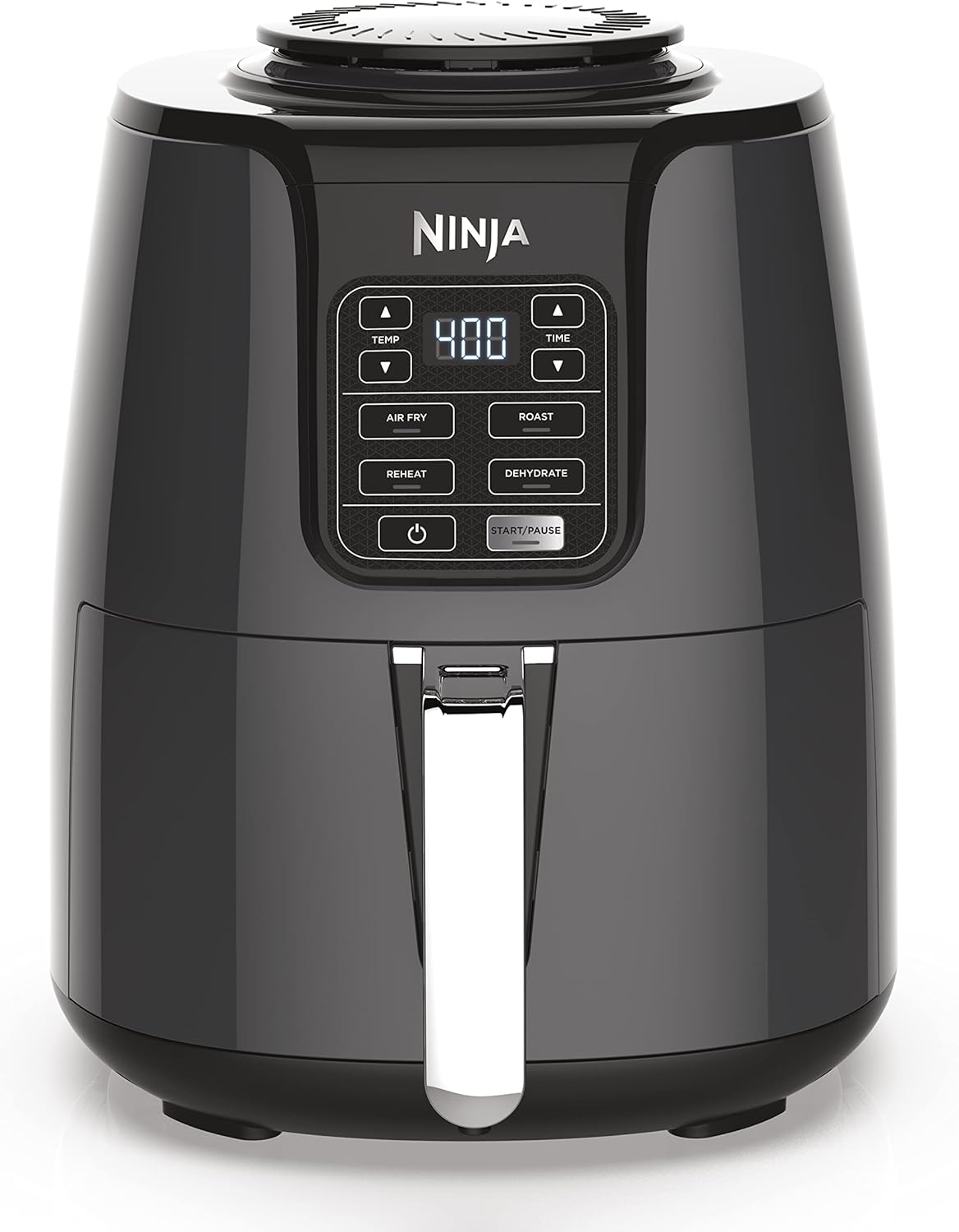
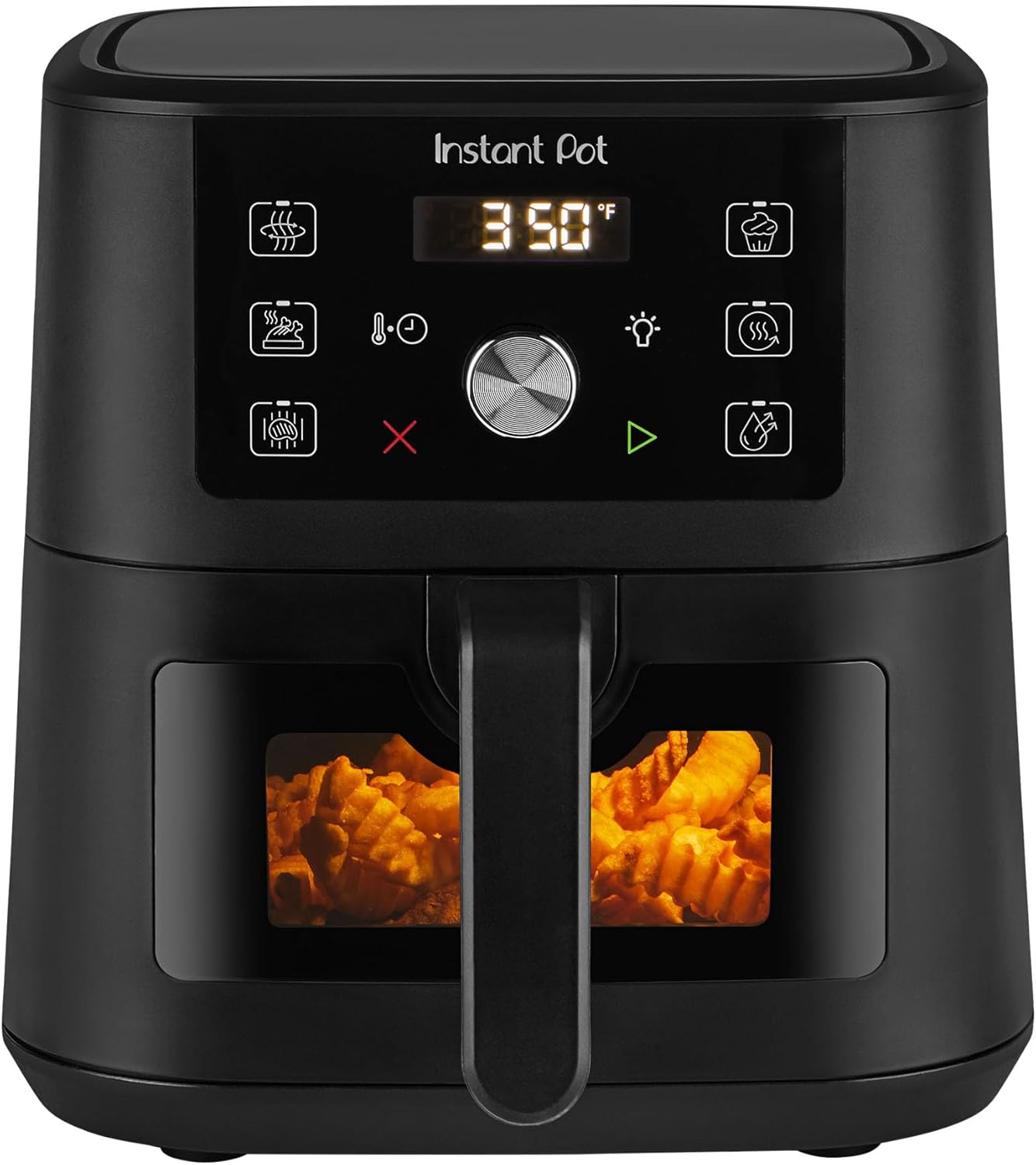
Every air fryer recommended in this guide, including the three Amazon-linked models below, meets standard UL/ETL safety certification and uses PFOA-free coatings, so any of them satisfy this framework out of the box.
A Brief History of Air Fryer Technology and How It Evolved From Convection Ovens
Understanding where air fryer technology came from helps explain why the radiation question keeps surfacing in the first place. The core idea behind the air fryer — using a fan to force hot air rapidly around food inside an enclosed chamber — is not a new invention. It’s a compact, high-powered evolution of convection oven technology that has existed in commercial kitchens for decades. Commercial convection ovens have used fan-forced hot air to cook food faster and more evenly than static ovens since the mid-20th century, long before “air fryer” became a marketing term.
What changed with the modern air fryer was packaging and marketing. By shrinking a convection oven down into a compact, single-basket countertop unit and pairing it with a smaller cooking chamber (which allows hot air to circulate closer to the food’s surface, producing a crisper result faster and with less oil), manufacturers created an appliance category that felt entirely new to consumers, even though the underlying heating principle — hot air convection — was already well understood and widely used. The name itself, “air fryer,” was a deliberate marketing choice designed to evoke the crispy result of deep frying while emphasizing that no oil bath was required. Unfortunately, that same marketing success is part of why the appliance still gets lumped in with genuinely newer, less familiar technologies in consumers’ minds, including microwave ovens, which really do use a different underlying process.
Because the air fryer entered the market with a name suggesting some kind of novel process, and because it exploded in popularity right alongside a cultural moment of increased skepticism toward processed food, non-stick chemicals, and “hidden” appliance risks, it became an easy target for viral misinformation. A device with a genuinely simple, decades-old heating principle got swept into search queries alongside appliances that use fundamentally different — though equally safe — technologies.
Wattage, Temperature Range, and What They Actually Tell You About Radiation Output
Shoppers comparing air fryer models often see wattage listed prominently in the spec sheet and wonder whether higher wattage means more radiation. It’s a reasonable question, since wattage does describe how much electrical energy a device draws, but it doesn’t map onto radiation exposure the way people sometimes assume.
Most household air fryers draw somewhere between 1,000 and 1,800 watts during active heating, which is comparable to a toaster oven or an electric kettle, and considerably less than a full-size conventional oven, which can draw 2,000–5,000 watts depending on size and settings. That wattage number describes electrical power consumption — how much energy is being converted into heat inside the coil — not the strength of any radiation being emitted outward from the unit. A higher-wattage air fryer heats up faster and can maintain higher temperatures more consistently, which is why premium and larger-capacity models tend to draw more power, but none of that extra wattage translates into a meaningfully different radiation exposure for the person standing in the kitchen.
The heating coil’s surface temperature, not the appliance’s overall wattage, is what determines the wavelength and intensity of the infrared radiation it emits. Since most air fryers operate within a fairly narrow, standardized temperature range (typically 180°F to 400°F, with some models reaching as high as 450°F), the infrared output across different brands and wattages is broadly similar. A 1,700-watt air fryer running at 400°F is not emitting meaningfully more “radiation” than a 1,200-watt air fryer running at the same 400°F setting — it’s simply reaching and maintaining that temperature more quickly.
What Wattage Actually Affects
- Preheat time — higher wattage units generally reach target temperature faster.
- Recovery time — how quickly the unit returns to temperature after the basket is opened and closed.
- Capacity handling — larger baskets often need higher wattage to maintain even heat across more food.
- Electricity cost — higher wattage draws more power per hour of use, though air fryers still use meaningfully less energy than a full oven for most cooking tasks.
None of these relate to radiation exposure, but they’re worth understanding since wattage is the spec most likely to get mentally (and incorrectly) linked to “more radiation” during a shopping comparison.
Putting It in Perspective: Air Fryers vs. Sunlight and Everyday Infrared Exposure
Because infrared radiation is the actual category of energy an air fryer’s heating coil produces, it helps to compare it to a source everyone already has direct, lifelong experience with: sunlight. Sunlight reaching the earth’s surface includes visible light, a significant amount of infrared radiation (which is why sunlight feels warm on skin even indirectly), and a smaller amount of ultraviolet radiation, which is the one component of sunlight capable of causing sunburn and, with excessive long-term exposure, skin damage.
An air fryer’s heating coil produces infrared radiation through the same basic physical mechanism as the sun’s warmth, just from a much smaller, fully enclosed source a few inches from your food rather than 93 million miles away. Critically, it does not produce the ultraviolet component of sunlight that’s responsible for sunburn and UV-related skin risk. In that sense, standing near an open air fryer is, from a pure radiation-type standpoint, less energetically complex than standing outside on a sunny day — it’s warmth without the UV component that actually carries the risk profile people associate with “too much sun.”
This comparison isn’t meant to suggest air fryers are somehow beneficial the way controlled sunlight exposure can be; it’s meant to illustrate, using a source of radiation everyone already trusts and understands intuitively, just how ordinary and low-risk the type of energy involved really is.
Glossary: Key Terms Used Throughout This Guide
| Term | Plain-Language Meaning |
|---|---|
| Ionizing radiation | High-energy radiation (X-rays, gamma rays) capable of damaging DNA |
| Non-ionizing radiation | Lower-energy radiation (heat, light, radio waves) that cannot damage DNA |
| Infrared radiation | The heat-carrying wavelength emitted by hot objects, including air fryer coils |
| Convection | Heat transfer through moving air, the core mechanism behind air frying |
| EMF | Electromagnetic field; a general term for the fields surrounding any electrical device |
| RF (radio frequency) | The specific type of non-ionizing radiation used by WiFi and Bluetooth chips |
| PTFE | The chemical name for Teflon-style non-stick coatings |
| PFOA | A now-phased-out manufacturing chemical once used in some PTFE production |
| Acrylamide | A browning-reaction compound formed in starchy foods during high-heat cooking |
| UL / ETL | Independent electrical safety certification marks |
Troubleshooting: What to Do If You’re Still Worried About Your Specific Air Fryer
For readers who’ve read this far and still want a concrete action plan rather than general reassurance, here’s a straightforward checklist for evaluating any specific air fryer already in your kitchen:
- Check the bottom or back of the unit for a UL, ETL, or equivalent safety certification mark, along with wattage and voltage ratings.
- Check the manufacturer’s product page or manual for a PFOA-free coating statement, standard on essentially all modern models.
- Inspect the basket coating periodically for scratches, flaking, or peeling, and replace the basket (not necessarily the whole unit) if damage appears.
- If your model has WiFi, know that you can typically still use it in fully manual mode without ever connecting it to the app, eliminating any RF transmission entirely.
- Keep the exhaust vent clear of walls, cabinets, and paper products, both for safe heat dissipation and for consistent cooking results.
- Avoid prolonged empty runs at maximum temperature, which is the only realistic scenario where coating breakdown becomes relevant.
Following this checklist addresses every legitimate safety consideration connected to air fryers — coating integrity, electrical certification, and appliance longevity — none of which involve any meaningful radiation exposure beyond the same everyday, non-ionizing heat energy produced by an oven, a toaster, or a sunny window.
Cleaning and Maintenance: Protecting Your Air Fryer’s Safety Profile Over Time
Since none of the safety considerations covered in this guide relate to radiation exposure, the single biggest factor in keeping an air fryer performing safely over its lifespan comes down to routine cleaning and maintenance. Grease buildup on the heating coil is one of the most overlooked issues in long-term air fryer ownership, and it has real consequences that get mistakenly lumped into “radiation” fears simply because people notice smoke or odor and assume something dangerous is being emitted.
When oil and food residue accumulate on the heating element or the underside of the basket over repeated uses, that residue can begin to smoke or burn on subsequent cook cycles. This produces visible smoke and a burnt smell, which understandably alarms anyone already primed to worry about hidden appliance risks — but it is a straightforward grease and residue issue, identical to what happens when a broiler pan or oven rack isn’t cleaned regularly, and it has nothing to do with radiation of any kind.
Recommended Cleaning Routine
- After every use: Wipe down the basket and tray once cooled, removing loose crumbs and grease before they bake onto the surface.
- Weekly (for frequent users): Remove and wash the basket, tray, and any drip pan with warm soapy water, and wipe the interior heating chamber with a damp cloth to remove splattered grease.
- Monthly: Check the heating coil area (with the unit unplugged and fully cooled) for visible buildup, and gently clean per the manufacturer’s instructions, since coils generally should not be submerged or heavily scrubbed.
- As needed: Replace the basket if the non-stick coating becomes significantly scratched, warped, or starts flaking, since a damaged coating no longer performs as intended and can affect cooking results.
A well-maintained air fryer not only performs better and lasts longer, it also avoids the smoke and odor situations that so often get mistaken online for something more alarming than a simple grease buildup issue.
How Long Do Air Fryers Typically Last?
With regular cleaning and normal home use, most quality air fryers have a usable lifespan in the range of three to five years, with heavier daily use on the shorter end of that range and lighter, occasional use potentially extending well beyond it. The heating element and fan motor are typically the components that eventually wear out, rather than anything related to the appliance’s electrical safety profile degrading in a way that would introduce new risks. If a unit ever develops a persistent burning smell that doesn’t resolve with thorough cleaning, unusual noise from the fan motor, or visible damage to the power cord, it’s a sign to retire the unit and replace it — again, an entirely conventional appliance-lifespan consideration rather than anything connected to radiation.
Final Verdict: Do Air Fryers Use Radiation?
No — air fryers do not use harmful radiation.
They use simple, safe heat-based convection, similar to ovens and toasters. Air fryers do not emit microwave radiation, do not damage food nutrients, and pose no electromagnetic health risks beyond normal household appliances.
They are one of the safest modern kitchen appliances available.
To explore more air fryer comparisons, reviews, and accessories, visit: kitchenoutput.com/.


