Chefman TurboFry Touch Air Fryer Review: Premium Digital Performance on a Budget
Do you really need to spend $200 for crispy, guilt-free food? We test the highly popular Chefman TurboFry Touch to see if it delivers elite performance at a fraction of the cost.
1. Introduction: The Quest for Uncompromising Value
The air fryer market has split into two distinct extremes. On one end, you have massive, multi-hundred-dollar smart ovens that connect to your Wi-Fi and feature dual heating elements. On the other end, you have incredibly cheap, dial-operated plastic buckets that barely circulate hot air. Finding the “Goldilocks” zone—an appliance that offers sleek digital precision, large capacity, and reliable cooking performance without breaking the bank—is increasingly difficult.
Enter the subject of this comprehensive Chefman TurboFry Touch budget air fryer review. Chefman has steadily built a reputation for democratizing premium kitchen features. Their TurboFry Touch lineup (specifically the highly popular 8-Quart and 5-Quart models) promises to deliver advanced rapid-air technology and a modern capacitive touch interface at a price point that undercuts industry titans like Ninja and Philips.
But does a lower price tag mean compromised quality? In this 2026 review, we put the Chefman TurboFry Touch through a rigorous culinary gauntlet. We will analyze its crisping speed, evaluate its non-stick durability, and determine if this budget-friendly machine deserves a permanent spot on your countertop.
This is also a considerably deeper review than most you’ll find elsewhere. Beyond the standard first-impressions rundown, we’ve dug into the full model lineup across capacities, cross-referenced independent lab temperature testing against Chefman’s own marketing claims, mapped out every built-in preset’s exact time and temperature, and pulled together the recurring long-term reliability patterns reported by owners months and years into ownership — not just the enthusiasm of a first unboxing. If you’re trying to decide between this appliance and a competing brand, or between the different sizes within the TurboFry Touch family itself, this guide is built to answer both questions in full.
2. Design and Build Quality: Stealthy Aesthetics
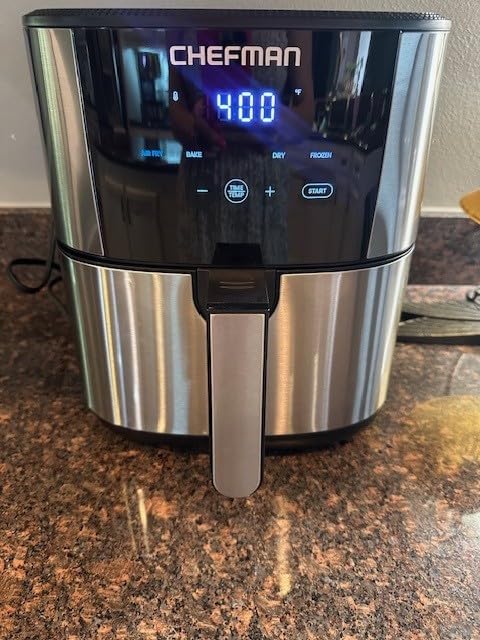
For a “budget” appliance, the Chefman TurboFry Touch is surprisingly handsome. It eschews the cheap, glossy plastic commonly found at this price point in favor of a sophisticated, matte black finish. This design choice is not just visual—matte finishes actively resist the greasy fingerprints and smudges that inevitably plague kitchen appliances.
The Footprint: The 8-Quart model is undeniably large, utilizing a deep, square-basket design to maximize internal volume. While it will take up a dedicated square of counter space, its flat top and sleek lines prevent it from looking like an eyesore. Some variations of the TurboFry Touch even include a front-facing viewing window, allowing you to monitor your food’s browning progress without opening the drawer and losing precious heat.
The materials used throughout also punch above their price point. The exterior housing is a rigid, double-walled plastic that stays genuinely cool to the touch even during long cooking cycles at maximum temperature, which matters more than it sounds — plenty of budget appliances in this category develop uncomfortably warm exterior panels that make handling the unit mid-cycle a minor hazard. The control panel sits on a slightly angled face rather than lying perfectly flat, which puts the display at a more natural viewing angle when the unit sits on a standard-height counter, sparing you from bending down to read cook times.
The basket handle deserves a specific mention, since it’s one of the most-touched components on the entire appliance. Chefman uses a cool-touch, ergonomically curved handle that stays comfortable to grip bare-handed straight out of a 400°F cycle, a detail that becomes genuinely appreciated once you’re juggling tongs, a plate, and a hot basket all at the same time on a busy weeknight.
Even small details like the rubber non-slip feet on the underside of the unit show a level of attention that’s easy to overlook until it’s missing on a cheaper competitor. A wobbling, sliding appliance is more than just annoying — it’s a genuine safety concern when it’s full of hot oil residue and food, and the TurboFry Touch’s grippy base keeps it firmly planted on granite, laminate, or tile countertops alike, even during the more vigorous basket-removal motion needed at the Shake Reminder stage.
Unboxing and First-Time Setup: What to Expect
The first few minutes with any new kitchen appliance set the tone for how much you’ll enjoy using it long-term, so it’s worth walking through exactly what arrives in the box and the handful of steps that get the TurboFry Touch ready for its first cook. Units typically ship inside a branded outer box with a built-in carry handle, which makes the trip from doorstep to countertop noticeably easier than wrestling with a plain shipping carton — a small but appreciated touch on an appliance that can weigh close to fifteen pounds on the larger models.
Inside, you’ll find the main unit, the removable basket with its non-stick crisper plate already seated inside, and a printed quick-start guide that doubles as a recipe booklet with starter cook times for a dozen or so common foods. There is no assembly required beyond sliding the basket into its housing, which is intentionally designed to click firmly into place — the same firm-seat design that some owners initially mistake for stiffness, as covered in the troubleshooting section.
Before your first real meal, manufacturers universally recommend a dry burn-in cycle: run the empty basket at or near its maximum temperature for roughly fifteen minutes. This step exists because manufacturing and shipping leave a very thin protective residue on interior metal components, and burning it off in a controlled empty cycle prevents any “new appliance” odor or faint smoke from transferring into your first batch of food. Cracking a window or turning on a range hood during this step is a sensible precaution, even though the smell is harmless and dissipates within minutes.
Once the burn-in cycle finishes, wipe down the interior fan guard and the basket’s crisping plate with a damp cloth to catch any lingering dust from manufacturing, then you’re ready to cook. First-time users often find it worthwhile to run one of the built-in presets — Fries is the classic choice — as a live test cycle, since it’s a fast, low-cost way to learn the sound of the Shake Reminder alert and get a feel for how the touch panel responds before committing to a more expensive cut of meat or a dish for guests.
It’s also worth taking two minutes at setup to locate and note your unit’s exact model number, usually printed on a small silver sticker on the back or underside of the housing. Because the TurboFry Touch spans several distinct models with different capacities and features, having this number on hand makes any future customer support conversation, replacement part search, or warranty claim considerably faster and more accurate.

Chefman TurboFry Touch Air Fryer (8-Quart)
Don’t overpay for crispy food. Upgrade to the sleek, digital Chefman TurboFry Touch. Enjoy an XL family-sized capacity, intuitive one-touch presets, and effortless cleanup at an unbeatable price.
Check Price on Amazon3. The Digital Touch Upgrade: Precision Matters
The biggest selling point of this specific model is the “Touch” interface. As we explored in our deep dive on digital vs. manual air fryers, mechanical dials are the enemy of consistent cooking. Trying to twist a stiff plastic dial to exactly 375°F for exactly 11 minutes is mostly guesswork.
The Chefman TurboFry Touch features a bright, angled LED control panel that is incredibly responsive. It offers:
- Pinpoint Accuracy: Set the exact temperature (up to 400°F) and time required for your recipe, ensuring perfectly repeatable results every time.
- One-Touch Presets: Built-in algorithmic presets for French Fries, Chicken, Meat, and Fish instantly set the optimal cooking parameters for beginners.
- LED Shake Reminder: A brilliant feature for a budget unit. Halfway through the cooking cycle, the machine will beep and display a “SHAKE” notification, reminding you to toss your food for perfectly even browning.
4. Which TurboFry Touch Model Should You Actually Buy?
One detail that trips up a lot of shoppers is that “Chefman TurboFry Touch” is not a single appliance — it is an entire family of air fryers spanning several capacities, control layouts, and price points. Before you add anything to your cart, it helps to understand exactly what separates the smallest unit from the largest, because the “best” TurboFry Touch genuinely depends on your household size and cooking habits.
At the entry level sits the 5-Quart Easy-View model. This is the version most often marketed toward singles, couples, or anyone working with a compact kitchen. It typically includes a front viewing window and an interior light, letting you watch food brown without popping the drawer and losing heat. Reviewers on major retail sites consistently point to the window and the interior light as the standout convenience features on this size, even more than the touch panel itself.
Moving up, the 6-Quart Easy-View variant adds a notable upgrade: a dedicated “Hi-Fry” button that pushes the unit to 450°F, well above the standard 400°F ceiling found on most models in the line. If searing wings or getting an ultra-blistered char on vegetables matters to you, this is the only TurboFry Touch model that closes that gap with premium competitors like the Ninja Max XL. It also ships with four built-in presets rather than the four-to-five found elsewhere, keeping the interface simple for less experienced cooks.
The 8-Quart XL model — the one most frequently reviewed and recommended, and the focus of most of this guide — trades the viewing window for raw capacity. Its square basket design is intentionally built to accommodate whole chickens, large batches of wings, and family-sized meals without batch-cooking. Some 8-Quart units come in a stainless-steel-and-black finish rather than pure matte black, which resists scuffing slightly better in high-traffic kitchens.
Finally, there is the 9-Quart Dual-Basket model, which is really a different appliance philosophy altogether. Instead of one large basket, it splits the interior into two independent 4.5-quart zones, each with its own heating control. This lets you cook chicken thighs on one side at 400°F while roasting vegetables on the other at 375°F, and have both finish at the exact same moment thanks to a “sync” feature that automatically staggers the start times. The tradeoff is that neither individual basket is especially large, so if you regularly cook for more than four people in a single dish, the dual-zone design can feel cramped compared to the single 8-Quart basket.
| Model | Capacity | Max Temp | Standout Feature | Best For |
|---|---|---|---|---|
| 5-Qt Easy-View | 5 Quarts | 400°F | Viewing window + interior light | Singles, couples, small kitchens |
| 6-Qt Easy-View Hi-Fry | 6 Quarts | 450°F | Dedicated Hi-Fry searing button | Wings, blistered veggies, crispy skins |
| 8-Qt XL | 8 Quarts | 400°F | Massive square single basket | Families, batch cooking, whole birds |
| 9-Qt Dual-Basket | 4.5 + 4.5 Quarts | 400°F | Two independent cooking zones | Cooking two different foods at once |
For most readers of this review, the 8-Quart XL remains the sweet spot: it is the version most widely available, the one with the deepest track record of user reviews, and the one that best matches the “budget family air fryer” use case this article is built around. If you live alone or have very limited counter space, though, the 5-Quart is worth a look, and if your dinners regularly involve two different proteins or a protein-and-side combo, the Dual-Basket model solves a real logistical headache that the single-basket versions can’t.
It’s also worth thinking about upgrade paths rather than treating this as a one-time, permanent decision. Many households start with a 5-Quart or 6-Quart unit for a smaller kitchen or a couple’s meal routine, then find themselves outgrowing it within a year or two as cooking habits shift — a new baby moving to solid foods, a returning college student, or simply cooking for guests more often. Because the entire TurboFry Touch lineup shares the same touch-panel logic and preset philosophy, moving from a smaller model to a larger one later involves essentially zero relearning curve, which is a meaningful advantage over switching between entirely different brands.
Price gaps between the sizes are also worth factoring in before defaulting to the largest option available. The jump from 5-Quart to 8-Quart is typically modest, but the Dual-Basket 9-Quart model commands a real premium over the single-basket 8-Quart for a fairly narrow use case — namely, needing two different temperatures running simultaneously. If your actual cooking pattern is “cook one large batch of one thing at a time,” the extra cost of the dual-zone design buys you a feature you may rarely use, making the straightforward 8-Quart XL the better value in that scenario.
5. Cooking Performance Tested: Does It Actually Crisp?
A beautiful interface means nothing if the machine can’t cook. The TurboFry utilizes a powerful heating element (up to 1700W on larger models) paired with a high-speed convection fan to drive heat down into the basket. When looking at heat distribution dynamics, the Chefman holds its own remarkably well.
The Frozen Fry Test
Cooking a massive batch of frozen crinkle-cut fries yielded excellent results. Thanks to the Shake Reminder, the fries were tossed midway, resulting in a shatteringly crisp exterior and fluffy interior in just 14 minutes at 400°F.
The Raw Protein Test
We loaded the basket with thick chicken thighs. The aggressive airflow rendered out the excess chicken fat (which dripped safely below the crisper plate), leaving behind beautifully blistered, golden-brown skin without drying out the meat.
The Preheating Factor: While you can put food in cold, Chefman recommends a 3-minute preheat. Because the unit is highly insulated, it reaches 400°F rapidly. Allowing it to preheat guarantees that immediate “sizzle” when your food hits the hot crisper plate, maximizing the Maillard reaction.

Make Cleanup Non-Existent
Protect your Chefman’s non-stick basket and skip the sink entirely. Grab a pack of custom-fit, disposable parchment paper liners. They are heat-safe, grease-proof, and make cooking messy foods a breeze.
Shop Air Fryer Liners6. Temperature Accuracy Deep Dive: What the Display Doesn’t Tell You
Every digital air fryer promises “pinpoint” temperature control, but a display showing 400°F and a basket actually reaching 400°F are two very different things. This is arguably the single most important — and most overlooked — performance metric for any digital appliance, and it’s where the Chefman TurboFry Touch shows its budget-tier roots most clearly.
Independent lab testing using calibrated internal thermometers has found that the TurboFry Touch’s actual cooking temperature can run meaningfully cooler than the number shown on the display — in some tested units, the gap measured close to 17°F below the set point. In practical terms, if you dial in 400°F expecting maximum crisping, the basket may be behaving closer to a 380–385°F environment for much of the cycle.
Why This Matters More Than You’d Think
A consistent 15–17°F undershoot won’t ruin dinner, but it does explain a few common complaints: fries that need a few extra minutes to hit peak crispness, wings that brown a shade lighter than expected, and slightly longer cook times than the presets suggest. The good news is that the unit’s temperature, while not perfectly accurate, is at least consistent from cycle to cycle — meaning you can compensate predictably rather than guessing every time.
The practical fix is simple: for foods where a deeply crisped, well-browned exterior is the goal (think wings, breaded cutlets, or anything you’d normally deep fry), set the temperature 15–20°F higher than the recipe calls for, or simply add 2–3 extra minutes to the cook time and check for doneness visually rather than trusting the clock alone. This is a standard workaround experienced air fryer owners use across nearly every budget-tier digital model, not just this one.
It’s also worth noting that heat distribution inside the basket is not perfectly even. Several testers found that food near the edges and corners of the crisper tray browns slightly faster than food sitting in the dead center, which is why the built-in Shake Reminder is doing more real work here than on premium units with true convection symmetry — it’s not just a nice-to-have, it’s actively compensating for a hot-and-cool-zone layout. Rotating the basket 180 degrees (not just shaking the food) at the reminder point can further even things out, especially for larger batches of fries or vegetables that fill the tray edge-to-edge.
If precision matters enough to you that you want hard numbers rather than a rule of thumb, an inexpensive oven-safe probe thermometer clipped to the basket’s edge (kept clear of the fan) for a single test cycle will tell you exactly how your specific unit behaves — manufacturing tolerances mean no two units will undershoot by the exact same margin, so your own unit could run anywhere from perfectly accurate to the higher end of the range other testers have measured. Running this test once, early in ownership, removes all the guesswork for every meal that follows.
None of this disqualifies the TurboFry Touch from being a good budget buy — it simply means you should treat the printed presets as a strong starting point rather than gospel, the same way you would with a slightly-off home oven. Once you know the unit runs a touch cool, dialing in your own +15°F habit takes about one cooking session to become automatic.
7. Basket Capacity Analysis: Feeding the Family
The Chefman TurboFry Touch lineup offers several sizes, but the 8-Quart model is the undisputed star for families. A common mistake buyers make is purchasing a tiny 3-quart fryer, only to realize they have to cook dinner in three separate, time-consuming batches.
The 8-Quart square basket is cavernous. You can comfortably fit:
- A whole 5-pound rotisserie-style chicken.
- Over 2 pounds of french fries.
- 4 to 6 large pork chops or steaks in a single, uncrowded layer.
By keeping food in a single layer rather than stacking it, you allow the hot air to circulate freely around every edge. This is the ultimate secret to achieving deep-fried textures without using gallons of oil.
8. Preset Times & Temperatures: The Full Breakdown
The One-Touch presets are the feature beginners lean on most, so it’s worth showing exactly what each button actually sets — rather than leaving you to discover it button-press by button-press. These are the factory defaults; all of them can still be manually adjusted up or down once selected, which is useful if you want to apply the “+15°F” correction covered in the temperature accuracy section above.
| Preset | Default Temp | Default Time | Best Used For |
|---|---|---|---|
| Fries | 400°F | 18 minutes | Frozen crinkle-cut, waffle, or shoestring fries |
| Chicken | 400°F | 22 minutes | Bone-in thighs, drumsticks, whole wings |
| Meat | 375°F | 18 minutes | Pork chops, steaks, burgers |
| Fish | 375°F | 10 minutes | Fillets, breaded fish sticks, shrimp |
On models with additional presets — including several 8-Quart and 9-Quart Dual-Basket units — you’ll also find dedicated buttons for bacon, burgers, veggies, steak, and shrimp, each tuned to a slightly different time-and-temperature curve appropriate for that food’s fat content and thickness. Dual-Basket owners can select different presets for each basket independently, or use the sync function so that a chicken-preset basket and a veggie-preset basket, despite running different temperatures, both finish cooking at the same moment.
A few practical notes worth knowing before you rely on the presets blindly: the Fries preset assumes a single, unstacked layer, so a heaping, crowded basket will need extra time regardless of what the display counts down to. The Chicken preset is calibrated for standard bone-in pieces — a spatchcocked or whole chicken will need considerably longer and should be checked with a meat thermometer rather than trusted to the timer alone. And because of the mild temperature undershoot discussed earlier, foods that specifically benefit from a hard sear (think a reverse-seared steak finish) may come out slightly under-browned on the default Meat preset; nudging the temperature up 15–20°F for the final two or three minutes closes that gap nicely.
9. Cleaning and Maintenance: Protecting the Coating
The Chefman utilizes a single-basket design with a removable rubber-footed crisper plate resting at the bottom. Both components feature a BPA-free non-stick coating.
The Golden Rule of Cleaning: While Chefman advertises these parts as dishwasher safe, we strongly advise against it. The harsh detergents and extreme heat of a dishwasher will prematurely degrade the non-stick coating, leading to peeling and flaking over time. Instead, let the basket cool, fill it with warm soapy water, and wipe it out with a soft sponge. It takes 60 seconds.
To ensure you never damage the interior or the sensitive heating element above the basket, review our guide on the best cleaning tools for air fryer fans and elements.
Understanding Liner Safety
If you want to use liners to make cleanup easier, ensure you are using the correct materials. Improper use of loose aluminum foil or cheap wax paper can cause severe fire hazards if sucked up by the fan. Read our updated guide on safe air fryer liner materials for 2026 before modifying your basket.
10. Troubleshooting Common Issues
No appliance in this price range is flawless, and a look through hundreds of verified owner reviews across major retailers surfaces a handful of recurring complaints. Knowing about them ahead of time means you can either avoid them entirely or fix them in seconds rather than assuming your unit is defective.
The Touch Panel Feels Unresponsive
A number of owners report needing to press buttons more firmly, or more than once, before the panel registers the input. This is a known quirk of the capacitive touch layer used on budget digital units — it tends to be less sensitive than the touchscreens on premium smart ovens. Wiping the panel with a dry microfiber cloth before use (grease residue on your fingers can interfere with capacitive sensing) resolves this for most users. If presses are consistently ignored after cleaning, that’s a legitimate case for contacting Chefman’s customer support rather than a user error.
The Drawer Is Hard to Close
This is one of the most frequently mentioned nitpicks across owner reviews: the basket requires a firm, deliberate push to fully seat and click into place, especially on 5-Quart and 6-Quart models. It’s a minor annoyance rather than a functional flaw — the drawer isn’t misaligned, it’s simply designed with a tight seal to keep hot air from escaping, which actually helps cooking performance. Lining up the basket squarely before pushing (rather than pushing at an angle) largely eliminates the sticking sensation.
The Fan Is Louder Than Expected Out of the Box
A small number of buyers have reported an initially loud, high-pitched fan noise on first use. In the vast majority of cases this settles down considerably after the first few cooking cycles as internal components seat properly. If a unit is still noticeably louder than a standard kitchen exhaust fan after a week of regular use, or if the noise is accompanied by rattling, that’s outside normal operating parameters and worth flagging to customer support while the warranty is active.
Grease Buildup in the Crisper Tray Corners
The rubber feet that elevate the crisper plate off the tray floor create small corner pockets where oil and food debris can collect and become difficult to reach with a standard sponge. A soft-bristled bottle brush or an old toothbrush reserved for kitchen cleaning makes short work of these corners. Letting grease sit and harden between uses makes this problem significantly worse, so a same-day wipe-down (even a quick rinse) rather than letting the basket sit overnight is the easiest preventative habit.
Dual-Basket Models: One Side Stops Heating
A subset of Dual-Basket 9-Quart owners have reported that after several months of regular use, one of the two independent heating zones stops actually cooking food even though the fan continues to run and the display continues to count down. This appears to be an isolated hardware issue affecting a minority of units rather than a widespread design flaw, but if you own or are considering the Dual-Basket model, it’s worth registering your warranty immediately and testing both baskets thoroughly within the return window.
The Unit Trips a Circuit Breaker
Because the larger TurboFry Touch models draw up to 1700 watts, running them on the same circuit as other high-draw kitchen appliances — a microwave, a coffee maker, or a second air fryer — can occasionally trip a household circuit breaker, particularly in older homes with lower-amperage kitchen circuits. This isn’t a defect in the appliance; it’s simply high-wattage electronics sharing limited circuit capacity. Plugging the unit into its own dedicated outlet, or at minimum avoiding running it simultaneously with another major appliance on the same circuit, resolves this in the overwhelming majority of reported cases.
Smoke During the First Few Uses
A small amount of thin smoke or visible haze during the first one or two cooking cycles, beyond the initial empty burn-in, is usually caused by residual oil or food debris from the factory testing process rather than a malfunction. This typically resolves itself after the second or third cook as any remaining residue burns away completely. Persistent smoke beyond the first few uses, however, is not normal and warrants unplugging the unit and contacting customer support rather than continuing to use it.
11. Energy Efficiency and Running Costs
One of the quieter selling points of air frying in general — and this unit specifically — is how much less energy it consumes compared to preheating a full-sized conventional or convection oven for a comparable meal. Because the TurboFry Touch’s compact cooking chamber requires far less energy to heat than an oven cavity many times its size, and because most presets run well under 25 minutes, a typical cooking session draws meaningfully less electricity than running your oven for the same dish.
Using the unit’s rated wattage (up to 1700W on the larger models) as a baseline, a 20-minute cooking cycle at that peak draw works out to roughly 0.57 kWh of electricity — though in practice the heating element cycles on and off to maintain temperature rather than running continuously at full draw, so real-world consumption per session tends to land somewhat lower than that theoretical ceiling. Compare that to a conventional oven, which needs 10–15 minutes just to preheat to 400°F before cooking even begins, plus a larger continuous draw to maintain temperature across a much bigger internal volume.
Beyond the electricity bill, there’s a second, less obvious cost saving: the TurboFry Touch does not meaningfully heat up your kitchen the way a full oven does, which matters more than people expect during summer months if your home relies on air conditioning. Running an oven for 30–40 minutes to cook a single tray of chicken thighs can noticeably raise ambient kitchen temperature, forcing your AC to work harder to compensate — a cost that rarely gets factored into oven-versus-air-fryer comparisons but adds up over a cooking season.
Time savings compound alongside the energy savings, even though time doesn’t show up on a utility bill. Skipping a 10-15 minute oven preheat on a weeknight when dinner is already running late is a genuine quality-of-life improvement, not just a minor convenience. Multiplied across a typical week of several weeknight dinners, the cumulative time saved by reaching for the TurboFry Touch instead of the oven for smaller portions can easily add up to an extra hour or more of free time, which is arguably as valuable to most households as the electricity savings themselves.
None of this means you should retire your oven entirely — large batches, multi-rack baking, and dishes that need more internal volume than an 8-quart basket allows still call for a full-sized oven. But for the weeknight staples this appliance is built around — fries, chicken pieces, roasted vegetables, and reheated leftovers — the energy and cooling-cost savings compound meaningfully over months of regular use.
12. Competitor Comparison: Chefman vs. Ninja vs. Gourmia
How does the Chefman TurboFry Touch stack up against other heavyweights in the budget and mid-tier space?
| Feature | Chefman TurboFry Touch (8 Qt) | Ninja Air Fryer Max XL (5.5 Qt) | Gourmia Digital (7 Qt) |
|---|---|---|---|
| Interface | LED Touch with Shake Reminder | Push Button (No Shake Reminder) | Digital Touch with Prompts |
| Max Temp | 400°F | 450°F (Max Crisp Mode) | 400°F |
| Capacity | Massive (8 Quarts) | Moderate (5.5 Quarts) | Large (7 Quarts) |
| Aesthetics | Sleek Matte Black | Glossy Grey/Utilitarian | Stainless Steel Accents |
| Price Tier | Budget/Highly Affordable | Mid-Range/Premium | Budget (Costco Favorite) |
If you demand extreme 450°F heat for blistering wings, the Ninja is superior. However, if you need massive capacity to feed a family and want a sleek touch interface with built-in shake reminders at a fraction of the cost, the Chefman easily wins the value proposition.
Health Benefits and Oil Usage Compared to Deep Frying
A significant part of the appeal behind any air fryer purchase — this one included — is the promise of fried-food texture without fried-food levels of oil. It’s worth taking a moment to unpack what that actually means in practice, rather than treating “healthier than deep frying” as a vague marketing phrase.
Traditional deep frying submerges food entirely in oil, meaning a meaningful percentage of that oil is absorbed into the food itself during cooking — often estimated at somewhere between 8 and 25 percent of the food’s final weight, depending on the item, its breading, and the oil temperature. The TurboFry Touch’s rapid hot-air circulation instead crisps the exterior using convected heat, requiring only a light spray or toss of oil — often as little as a teaspoon or two for an entire basket — to achieve a comparably crisp, browned surface.
The caloric and fat-content difference this produces is substantial. A serving of deep-fried chicken tenders, for instance, can carry meaningfully more fat and calories per portion than the same tenders air-fried with a light oil spray, simply because so much less oil physically ends up in the finished food. This doesn’t make air-fried food a health food in absolute terms — breaded, seasoned proteins and starchy sides are still calorie-dense choices relative to steamed vegetables or grilled lean protein — but relative to their deep-fried equivalents, the reduction in absorbed fat is real and consistently observed across independent nutritional comparisons.
There is a second, less discussed health angle worth mentioning: repeatedly reused deep-frying oil, especially when heated to high temperatures over multiple sessions, can break down and form compounds that some research associates with negative health effects when consumed regularly over time. Because the TurboFry Touch uses only a small amount of fresh oil per session rather than a large reservoir reused meal after meal, this degradation concern is essentially eliminated from your home cooking, even if you fry frequently.
For anyone actively managing dietary fat intake, cholesterol, or simply trying to build lower-oil habits without giving up crispy comfort food entirely, this is where a budget digital air fryer like the TurboFry Touch earns its keep — not by turning fried food into a health food, but by meaningfully reducing the oil load of dishes you were likely going to eat anyway.
One practical tip worth adopting from day one: resist the urge to pour oil into the basket the way you might into a deep fryer. The TurboFry Touch is designed around a light mist or toss coating, not a pooled liquid — excess oil in the bottom of the basket doesn’t improve crisping, and it can smoke or spatter against the heating element above. A simple oil mister or a small amount tossed directly onto the food before it goes in the basket is all that’s needed, and it keeps cleanup considerably simpler than dealing with a basket that has oil pooling around the crisper plate’s rubber feet.
13. Recipes to Try First: Building Confidence Fast
The fastest way to fall in love with a new air fryer is to nail a handful of easy wins before attempting anything ambitious. These five dishes are widely recommended as the ideal “first week” lineup for a new TurboFry Touch owner, chosen specifically because they’re forgiving of the unit’s mild temperature undershoot and benefit from the built-in Shake Reminder.
Crispy Frozen Fries
The simplest possible starting point. Use the Fries preset, shake at the halfway mark, and add 2–3 extra minutes if you prefer restaurant-level crunch. A light oil spray helps browning without needing to deep fry.
Crispy-Skin Chicken Thighs
Bone-in, skin-on thighs are the single best showcase for this appliance. Pat the skin bone-dry before seasoning, then run the Chicken preset. The rendered fat drips safely below the crisper plate, leaving shatter-crisp skin.
Roasted Vegetable Medley
Broccoli, brussels sprouts, and carrots tossed in oil and salt at 380°F for 12–15 minutes, shaken once, deliver caramelized edges without the oven’s long preheat wait.
Breaded Fish Fillets
The Fish preset’s shorter 10-minute window suits thin, breaded fillets well. Flip once at the halfway point for even color on both sides, since fish tends to brown less aggressively than higher-fat proteins.
Reheated Leftover Pizza
A short 350°F, 4-minute cycle re-crisps the crust far better than a microwave, without the sogginess that microwaving pizza typically produces.
Once these basics feel automatic, the natural next step is baking. As covered earlier, the precise digital control lets you drop into 320–350°F baking territory for cookies, brownies, or small cakes using a silicone pan or parchment liner sized to fit inside the basket — just be mindful of clearance under the heating element on shallower baskets.
A useful habit for building your own recipe library is keeping a simple running note of temperature and time adjustments that worked for your specific unit — since, as covered in the temperature accuracy section, individual units can undershoot the display by slightly different margins. After two or three weeks of regular use, most owners find they’ve essentially built a personalized cheat sheet that beats the printed presets for their particular favorite dishes, at which point the appliance stops feeling like a new gadget and starts feeling like a reliable, second-nature part of the weeknight routine.
14. Accessories and Replacement Parts
One practical question that comes up often after the initial purchase: what happens when a part wears out, or when you want to expand what the unit can do? The good news is that basic accessories are widely available and inexpensive. Silicone liners sized for 5, 6, 8, and 9-quart baskets are sold by numerous third-party kitchenware brands and eliminate direct food contact with the non-stick coating, extending its usable life considerably.
Parchment paper liners with pre-cut holes (to preserve airflow around the food) are another popular low-cost accessory, and are especially useful for messy marinated proteins or anything with a sticky glaze that would otherwise bake onto the basket floor. Skewer racks and multi-layer cooking racks, designed generically for round or square air fryer baskets, can also expand effective capacity by letting you cook in two stacked layers for foods like small kebabs or dumplings that don’t need direct crisper-plate contact.
A Word on Replacement Baskets
Some owners who experience non-stick coating degradation after extended use have found that Chefman does not always offer a standalone replacement crisper plate or basket for every model in the lineup. Before your warranty period ends, it’s worth confirming directly with Chefman customer support whether replacement parts are available for your specific model number, particularly on older or discontinued sub-variants, rather than assuming a worn basket can always be swapped rather than the whole unit replaced.
If you do reach for third-party liners or racks, stick to products explicitly rated for air fryer use — generic parchment or wax paper that isn’t perforated or properly weighted can be pulled into the fan and pose a genuine fire risk, a point worth repeating given how often it comes up in appliance safety recalls across the broader air fryer category.
Utensils are another small but meaningful accessory category. Standard metal tongs and spatulas will work in a pinch, but silicone-tipped or wood-handled tools designed specifically for non-stick cookware reduce the risk of scratching the crisper plate’s coating over repeated use — a habit that pays off directly in the longer coating lifespan discussed in the durability section. A dedicated basket-cleaning brush, sold cheaply alongside most air fryer accessory kits, is a worthwhile one-time purchase for anyone who finds the corner-grease issue particularly stubborn.
15. Long-Term Durability: What Happens After Month Six?
A launch-week review can only tell you so much. To get a fuller picture, it helps to look at what owners report after months — sometimes years — of regular use, since that’s where budget appliances most often reveal their true colors.
The encouraging news is that the majority of long-term owner feedback remains positive well past the honeymoon period. Multiple reviewers who’ve owned their units for a year or more report that cooking performance, crisping quality, and drawer mechanics remain consistent with day-one performance, with the touch panel and heating element holding up under near-daily use. This kind of longevity is not guaranteed at this price tier, and it’s a meaningfully positive signal.
That said, the complaints that do surface tend to cluster around a few specific failure points rather than being random. Non-stick coating wear is the most common — after six to twelve months of frequent use, especially with metal utensils or abrasive sponges, some baskets develop patchy spots where food begins to stick that didn’t before. This is avoidable almost entirely by using silicone-tipped tongs and the gentle handwashing method covered in the cleaning section, rather than a symptom of a design flaw.
The second cluster of long-term complaints centers on the Dual-Basket model’s independent heating zones, where a minority of owners report one basket losing cooking function months into ownership while the fan and display continue operating normally — reinforcing the advice above to test both zones thoroughly during the return window rather than assuming any issue will be self-evident on day one.
Overall, the durability picture is fairly typical of budget-tier digital appliances: strong odds of years of reliable service if basic care guidelines are followed, with a small but real minority of units experiencing component-level issues that are best caught early, while a manufacturer’s warranty is still in force.
A few simple habits meaningfully improve the odds of your unit falling into the “years of reliable service” category rather than the minority experiencing early issues. First, always allow the unit to cool fully before wiping down the exterior or handling the basket for storage — cleaning while components are still hot can accelerate wear on seals and gaskets. Second, avoid stacking anything on top of the unit while it’s not in active use, since the housing isn’t designed to bear significant weight and this can subtly warp the top panel over time. Third, if you notice the fan beginning to sound different — a new rattle, a grinding note, or noticeably increased volume compared to when the unit was new — unplugging it and inspecting for obstructions (a stray piece of food debris pulled into the fan housing is a common, easily fixed culprit) before continuing to use it can prevent a minor issue from becoming a costly one.
16. Who Should — and Shouldn’t — Buy This Air Fryer
Between the model lineup, the temperature quirks, and the long-term reliability data, a clearer picture emerges of exactly which kind of buyer gets the most value from the Chefman TurboFry Touch — and which buyer would be better served looking elsewhere.
You’re a Great Fit If…
- You’re buying your first air fryer and want a genuinely beginner-friendly interface with minimal learning curve.
- You regularly cook for a family of four or more and need single-batch capacity rather than multiple rounds.
- Budget is a real constraint and you want digital precision without paying premium-brand pricing.
- You mostly cook everyday staples — fries, chicken pieces, roasted vegetables — rather than needing extreme 450°F searing on every dish.
- You’re comfortable with a small amount of manual temperature tweaking once you learn the unit’s quirks.
Consider Something Else If…
- You need app control, voice commands, or a built-in temperature probe for sous-vide-style precision.
- Searing at 450°F+ is a non-negotiable requirement for most of your cooking (the 6-Qt Hi-Fry model aside).
- You have very limited counter space and can’t accommodate the larger 8-Qt or 9-Qt footprints.
- You want a unit built for genuinely heavy, multiple-times-daily commercial-style use, where a pro-grade stainless build with a longer warranty may serve you better long-term.
- Perfectly even, lab-grade temperature accuracy matters more to you than price — in which case a premium mid-range unit will undershoot the display less.
Weighing these two lists side by side, the pattern that emerges is a familiar one for budget-tier appliances across almost any category: the Chefman TurboFry Touch is built to excel at the core, everyday use case — crispy, healthier versions of familiar comfort food, cooked quickly, cleaned easily, operated intuitively — while making deliberate tradeoffs on the outer edges of performance (extreme searing temperatures, lab-grade accuracy, smart connectivity) that a smaller slice of shoppers actually need. If your cooking habits live mostly in that core use case, which the majority of home cooks’ do, the value proposition here is difficult to beat at this price point.
17. Pros and Cons: The Final Summary
The Pros
- Incredible Value: Offers premium digital features at an entry-level price.
- Intuitive Touch UI: Extremely easy to operate, even for complete beginners.
- Shake Reminder: Built-in alarm ensures your food cooks evenly without burning.
- Massive Capacity: The 8-Qt square basket easily fits a whole chicken.
- Aesthetic: The matte black finish looks great and hides fingerprints.
The Cons
- Max Temp 400°F: Lacks the extreme 450°F searing heat found on some premium models.
- Rubber Bumpers: The rubber feet on the crisper plate can be tricky to clean if grease gets trapped.
- Large Footprint: The 8-Qt model requires a significant amount of dedicated counter space.
18. Final Verdict: Is the Chefman TurboFry Touch Worth It?
The Chefman TurboFry Touch proves that you do not need to spend hundreds of dollars to achieve perfectly crispy, guilt-free fried food at home. It successfully bridges the gap between cheap, inaccurate analog fryers and overpriced smart ovens.
By providing a massive 8-quart capacity, a beautifully responsive digital interface, and foolproof features like the Shake Reminder, Chefman has created the ultimate family-friendly air fryer. If you are a beginner looking to enter the world of rapid-air cooking, or a family looking to upgrade from a tiny 3-quart basket, the Chefman TurboFry Touch is undoubtedly one of the best budget buys of 2026.
Buy the Chefman TurboFry Touch Today


