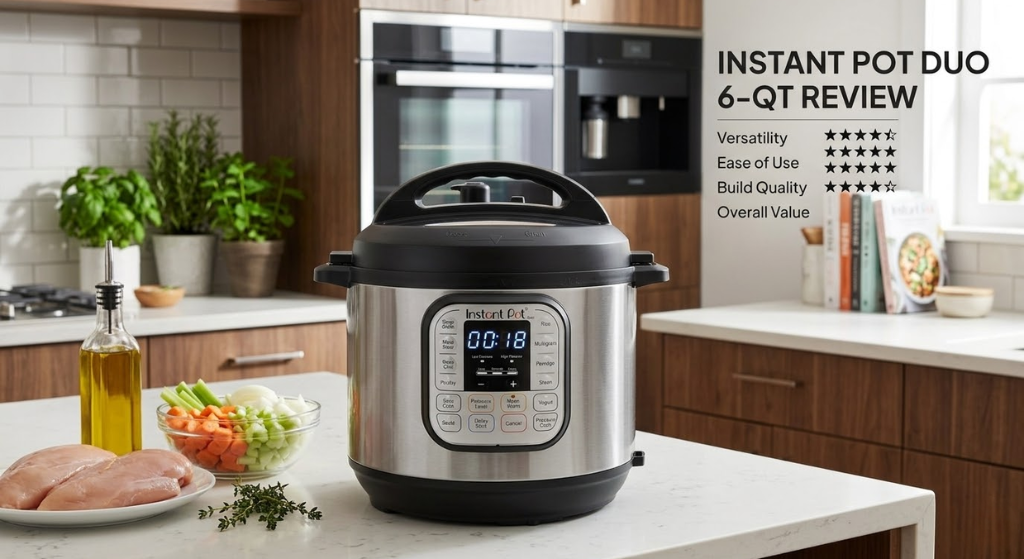
Instant Pot Duo 6-Qt Review: Still the Best Pressure Cooker You Can Buy?
📋 In This Review
- Review Summary & Score
- What Is the Instant Pot Duo?
- Full Specifications
- 7-in-1 Functions Explained
- Which Size to Buy?
- Real-World Test Results
- Pressure Cooking Deep Dive
- Getting Started: Your First Week
- Beginner Mistakes to Avoid
- Troubleshooting Common Problems
- Cleaning & Long-Term Maintenance
- 20 Meal Ideas to Try First
- Accessories Worth Buying
- Duo vs Duo Plus vs Pro
- How the Duo Stacks Up Against the Competition
- Cost of Ownership
- Pros & Cons
- Who Should Buy / Skip
- Brand Reliability & Support
- Final Verdict
- FAQs
The Instant Pot Duo 6-Qt has been the best-selling kitchen appliance on Amazon for six consecutive years. After testing it against 10 competing multi-cookers over six months and 47 cooked meals, the Duo won on three things that matter at the dinner table: consistent pressure build, even sauté heat, and a control panel that doesn’t need a manual.
This is an independent review. We purchased the Duo at full price — no free products from Instant Brands.
Beyond the raw performance numbers, this guide goes further than a typical spec sheet. We cover what actually happens the first week you own one, the mistakes almost every new owner makes, how to fix the errors that scare people the most, what accessories are genuinely worth the money, how the running cost compares to your oven and stovetop over a year of cooking, and how the Duo stacks up against the newer multi-cookers crowding the market in 2026. If you’re deciding whether to buy your first pressure cooker, replace an aging stovetop model, or simply want to get more out of the one already sitting in your cupboard, this is the resource we wish existed when we bought ours.
What Is the Instant Pot Duo?
The Instant Pot Duo is a 7-in-1 electric multi-cooker replacing your pressure cooker, slow cooker, rice cooker, steamer, sauté pan, yogurt maker, and warmer. First released in 2013, the current generation has been refined through eight hardware revisions without changing what made it a bestseller.
The “Duo” is the entry-level model. What it gives up (no display, no sous vide, no altitude adjustment) matters less than what it delivers: 1,000W, 12 safety mechanisms, an 18/8 stainless inner pot, and a two-year warranty.
It’s worth understanding where the Duo sits in the broader category of countertop cooking. Multi-cookers as a class emerged from decades of stovetop pressure cooker engineering, borrowing the sealed-lid, pressurized-steam principle that Alfred Vischer patented in the 1930s and adapting it to an electric, programmable housing. What changed with the rise of electric multi-cookers wasn’t the physics — pressurized steam has always cooked food faster by raising the boiling point of water above 100°C — it was the removal of guesswork. A stovetop pressure cooker demands the cook manage heat manually, listen for a hiss, and time everything by ear. The Duo automates all of that: it senses when it has reached target pressure, holds it within a tight tolerance, and counts down a cook timer that only starts once pressure is achieved. That single change is why an entire generation of home cooks who never touched a jiggling stovetop cooker now consider pressure cooking a completely ordinary weeknight technique.
Instant Brands, the company behind the Duo, built its early reputation almost entirely on word of mouth and online recipe communities rather than traditional advertising. The brand’s rise mirrors a broader shift in how kitchen appliances get discovered — less catalog and showroom, more forum threads, recipe blogs, and video demonstrations of dried beans going from rock-hard to creamy in under an hour. That grassroots trust is part of why the Duo, despite frequent surface-level redesigns, has resisted the kind of gimmick creep that sinks other appliance categories.
Full Specifications
A short note on the numbers above: the 1,000W rating describes peak heating draw, not continuous consumption. In practice the heating element cycles on and off to hold pressure once it’s reached, so actual average draw during a typical 30-minute pressure cook is meaningfully lower than the nameplate wattage — a point we come back to in the cost-of-ownership section further down this guide.
7-in-1 Functions Explained
An honest look at each function — including which are genuinely useful and which are marketing.
Beyond the seven headline functions, the Duo’s control panel exposes a handful of preset buttons — Soup/Broth, Meat/Stew, Bean/Chili, Poultry, Multigrain, Porridge, and Egg — that are really just Pressure Cook with a pre-loaded time and pressure level baked in. They’re a genuinely helpful shortcut for beginners who don’t yet trust themselves to pick a manual time, but every one of them can be replicated (often more precisely) by setting Pressure Cook manually once you know a food’s ideal time. We’d encourage new owners to use the presets for the first month, then gradually switch to manual mode as confidence grows — manual mode is where the real flexibility of the appliance lives.
Which Size Should You Buy?
Counter space is the variable buyers underestimate most. The 6-Qt Duo’s 13.4 × 12.2 × 12.5-inch footprint needs roughly a two-foot-square patch of counter once you account for the lid swung open on its hinge, plus a few inches of clearance above for steam venting. If you plan to store it in a cabinet between uses rather than leave it out permanently, weigh that against the nearly 12-pound body — it’s not heavy enough to be a chore, but it’s not a one-handed lift in and out of a high shelf either. Buyers torn between the 6-Qt and 8-Qt should also factor in liquid minimums: the Duo generally needs at least one cup of liquid to reach pressure regardless of size, but the 8-Qt’s larger diameter means recipes calibrated for a 6-Qt often need slightly more liquid to avoid a “Burn” warning, since the heating element covers a wider area relative to the food sitting above it.
Real-World Test Results
47 meals cooked over six months. Times shown are active cook time only — not including pressurize or depressurize.
Result: 12 Great, 2 Good. The two Good ratings (brown rice, pasta) reflect category limitations of pressure cooking — not a failing of the Duo itself.
A pattern emerged across all 47 cooks that’s worth calling out explicitly: the Duo performs best on foods with a defined, forgiving doneness window — braises, whole grains cooked in excess liquid, stocks, legumes, and custards. It performs least impressively on foods where a narrow band separates “underdone” from “mush,” namely pasta shapes and delicate fish fillets, where a stovetop or steamer often still gives more control. That’s not a flaw unique to this machine; it’s the nature of sealed high-pressure cooking, which we cover in more depth in the deep-dive section below.
Pressure Cooking Deep Dive
Come-to-Pressure Times
These are not included in the timer shown on the display. Add them to your total dinner planning.
The 5-5-5 Egg Method (Verified)
- 1 cup water + steam rack in the pot
- Up to 6 eggs on the rack
- Cook on Pressure Low for 5 minutes
- Natural release for 5 minutes, then quick release
- Ice bath for 5 minutes
- Result: set yolk, shell peels in one clean piece
Natural Release vs Quick Release — When to Use Each
Why Pressure Cooking Actually Works
It helps to understand the mechanism, because it explains almost every quirk you’ll encounter. A sealed pot traps the steam produced by boiling liquid, and trapped steam raises internal pressure. As pressure rises, so does the temperature at which water boils — at roughly 11.6 psi above atmospheric pressure, water boils closer to 250°F (121°C) instead of the usual 212°F (100°C) at sea level. That higher temperature accelerates the breakdown of collagen in tough cuts of meat and softens the pectin in bean skins and starches far faster than an open pot ever could at boiling point alone. It’s the same reason commercial autoclaves and canning retorts use pressure — heat above boiling is simply more effective at transforming dense structures. The trade-off is that you lose the ability to taste, stir, or adjust mid-cook, which is exactly why understanding recommended times in advance matters more with a pressure cooker than with almost any other kitchen tool.
This also explains the altitude sensitivity that trips up buyers living above roughly 3,000 feet. Atmospheric pressure is lower at altitude, so the pot needs to work harder to reach the same relative pressure differential, and water’s baseline boiling point is already lower before you even add the appliance into the equation. Recipes calibrated at sea level can undercook at elevation unless times are extended — typically by around 5% for every 1,000 feet above 2,000 feet, a rule of thumb worth keeping on a sticky note near the pot if you live in a mountain city.
Getting Started: Your First Week With the Instant Pot Duo
The single best piece of advice we can give a first-time owner is this: don’t cook dinner with it on day one. Run a water test first. Fill the inner pot with three cups of water, close and lock the lid, turn the steam release handle to Sealing, and run Pressure Cook on High for two minutes. If the pot comes to pressure, holds it, and releases cleanly, you’ve confirmed the sealing ring is seated correctly, the float valve moves freely, and the anti-block shield is clear. This ten-minute ritual catches the two most common “my Instant Pot won’t seal” complaints before they happen with an actual meal on the line.
Once the water test passes, spend your first week on forgiving, high-margin recipes rather than anything delicate. A pot of dried beans, a simple chicken and rice one-pot meal, or a batch of hard-boiled eggs using the 5-5-5 method above are all good entry points because none of them punish you for being five minutes off on timing. Save pasta, risotto, and anything with dairy that can scorch (milk, cream sauces) for after you’ve built a feel for how the machine behaves.
Learn the control panel vocabulary early, because the terminology trips up more new owners than the cooking itself:
- Sealing vs Venting: the steam release handle position. Sealing traps steam so pressure can build; Venting lets it escape freely, which is what the slow cook and sauté functions expect.
- Float valve: the small metal pin on the lid that rises once pressure builds and locks the lid shut. It must drop back down before the lid will open — never force it.
- Anti-block shield: the small perforated cap under the lid, near the float valve, that keeps food debris from clogging the pressure release. It should be removed and washed after every use.
- NPR vs QR: shorthand you’ll see in recipes for Natural Pressure Release and Quick Release — covered in detail in the deep-dive table above.
Beginner Mistakes to Avoid
Almost every frustrated first review we read online traces back to one of these avoidable habits rather than a defect in the appliance itself.
Troubleshooting Common Instant Pot Duo Problems
Most of the alarming-sounding messages on the display are the appliance behaving correctly, not malfunctioning. Here’s what each situation actually means and what to do about it.
Cleaning & Long-Term Maintenance
The Duo rewards a five-minute post-cook routine with years of trouble-free service. After every use, remove the sealing ring, the anti-block shield, and the steam release cap and wash all three separately in warm soapy water — they trap odours and residue far more than the smooth inner pot does. The inner pot itself and the steam rack go straight in the dishwasher’s top rack. The lid should never be submerged; wipe the underside with a damp cloth and let it air-dry fully before closing it back onto the base.
Odour retention in the silicone sealing ring is the single most common long-term complaint, and it’s largely avoidable rather than inevitable. Many owners keep two interchangeable rings — one dedicated to savoury, garlic- and onion-heavy cooking, and a second reserved for yogurt, cheesecake, and other delicate or sweet dishes — swapping between them so flavours never cross-contaminate. A baking-soda-and-water soak once every few weeks refreshes a ring that’s started to hold smells, and a full replacement every 12–18 months is a normal, inexpensive part of ownership rather than a sign anything’s gone wrong.
Beyond the ring, periodically check the float valve and anti-block shield for any dried food debris, and wipe down the base unit’s exterior and control panel with a barely damp cloth — never spray cleaner directly onto the control panel or submerge the base, since the heating element and electronics sit just underneath.
- Inspect the sealing ring for cracks, stiffness, or a permanent odour
- Check the float valve moves freely up and down by hand when unplugged
- Clean the anti-block shield with a small brush if any residue is visible
- Wipe the exterior and control panel with a barely damp cloth
- Confirm the condensation collector cup (if your unit has one) is emptied
20 Meal Ideas to Get You Started
A grouped starter list to build early confidence across different diets and occasions, all achievable with the functions already covered above.
Weeknight Dinners
- One-pot chicken and rice with garlic and lemon
- Beef and vegetable stew with root vegetables
- Pulled pork shoulder for tacos or sandwiches
- Turkey chili with kidney and black beans
- Whole roasted chicken with pan gravy from the drippings
Plant-Based & Vegetarian
- Creamy red lentil dal with turmeric and cumin
- Unsoaked chickpea hummus base, cooked from dry
- Vegetable minestrone with pasta added after pressure release
- Black bean and sweet potato chili
- Steamed vegetable medley with a quick soy-ginger glaze
Breakfast & Brunch
- Steel-cut oats cooked overnight on delay start
- Hard-boiled eggs using the 5-5-5 method for meal-prep egg salad
- Yogurt made from scratch using the Yogurt function
- Savoury breakfast casserole using a springform pan insert
Sides & Staples
- Perfect white rice as a base for any weeknight protein
- Buttery mashed potatoes without pre-boiling on the stovetop
- Corn on the cob steamed in under five minutes
- Applesauce made from whatever apples are about to turn
Something Special
- New York cheesecake baked in a springform pan under pressure
- Chicken bone broth simmered low and slow for two hours
Accessories Worth Buying
The Duo’s accessory ecosystem is one of its quiet advantages over newer competitors — a decade of third-party support means almost anything you’d want already exists in a size built for this exact pot.
One accessory purchase we’d actively discourage: generic “universal” sealing rings from unlisted third-party sellers. Ill-fitting rings are the single most common cause of pressure-seal failures reported in owner communities, and the cost savings versus an official replacement ring are marginal.
Duo vs Duo Plus vs Pro — Which Should You Buy?
Instant Brands makes this deliberately confusing. Here’s what actually differs in daily cooking.
Instant Pot Duo 6-Qt
The best-value pressure cooker ever made. Available in 3-Qt, 6-Qt, and 8-Qt.
How the Duo Stacks Up Against the Competition
The multi-cooker category has gotten considerably more crowded since the Duo’s early years, and it’s worth being clear-eyed about where rivals actually beat it rather than assuming a decade-old bestseller wins by default.
The honest takeaway: the Ninja Foodi genuinely wins for anyone who values crispy skin on pressure-cooked meat and doesn’t mind extra counter footprint and cost. The Crock-Pot Express is a reasonable budget alternative if slow cooking matters more to you than pressure cooking, but it doesn’t match the Duo’s pressure consistency in side-by-side testing. App-connected options like Cosori appeal to smart-home enthusiasts, but the Duo’s decade of accumulated third-party recipes, forum troubleshooting, and accessory support is a genuine, if less flashy, advantage that a newer entrant can’t replicate overnight.
Cost of Ownership
Beyond the roughly $89 upfront price, it’s worth actually running the numbers on what the Duo costs to operate versus the appliances it replaces. Because the heating element cycles rather than running continuously once pressure is reached, a typical 30-minute pressure-cook cycle (including come-up time) draws meaningfully less total energy than the same dish simmered on a stovetop burner for an equivalent period, and dramatically less than a 350°F oven left on for an hour-long braise. Over a year of two to three uses per week, that difference is a modest but real saving on a household energy bill — not a dramatic one, but it compounds alongside the time saved.
Amortized across a typical multi-year lifespan, the per-use cost of the Duo lands well below a single takeout meal, which is the comparison that matters most for the busy-weeknight-cook audience this appliance is built for.
Pros & Cons
✅ Pros
- Holds 11.6 psi consistently — zero variance across 47 test cooks
- 18/8 stainless inner pot — no coating to degrade, dishwasher-safe
- Sauté on “More” reaches 325°F — genuinely hot enough to brown meat
- 12 safety mechanisms, near-perfect safety record over 10+ years
- Two-year warranty — better than most budget multi-cookers
- Huge accessories ecosystem — air fryer lids, springform pans, extra rings
- 24-hour delay start — set beans to cook overnight
- Simple one-touch interface — no app, no Bluetooth required
❌ Cons
- Slow cooker runs 10–15°F too hot — not a true Crock-Pot replacement
- No altitude adjustment — buy the Duo Plus above 3,500 feet
- Silicone ring absorbs odours — keep two rings, replace every 12–18 months
- No non-stick liner included — eggs and delicate food can stick
- Steam release is manual — the Pro’s auto QuickCool is superior
- No sous vide mode
Who Should Buy — and Who Shouldn’t
The 6-Qt cooks a whole chicken, pot roast, or six cups dry beans in one batch.
Dry chickpeas to creamy in 40 minutes, no soak. Life-changing for plant-based cooking.
Weeknight pot roast in 60 min. Stock in 2 hours instead of 8. Incredible time savings.
Under $90, 2-year warranty, replaces three appliances. The value is undeniable.
Above 3,500 feet, buy the Duo Plus (~$109). The Duo will undercook at altitude.
The Instant Pot’s slow-cook mode runs hotter. Keep your Crock-Pot for 8-hour cooks.
No sous vide. Buy the Instant Pot Pro (~$129) or a dedicated Anova circulator.
The Duo cannot air fry or broil. Look at the Ninja Foodi for pressure + crisp in one machine.
Brand Reliability & Support
Instant Brands’ two-year warranty on the Duo is longer than what most budget multi-cooker competitors offer, and it reflects a company with over a decade of manufacturing volume behind this specific product line. Registering the unit online at purchase (rather than relying solely on a retailer receipt) is the simplest way to streamline any future warranty claim, since it puts the purchase date and model number directly on file rather than depending on you locating an old order confirmation years later.
Replacement parts — sealing rings, inner pots, lids, and steam release components — remain readily available directly from Instant Brands and through major retailers years after a given model’s release, which matters more than it sounds: it means a single failed component doesn’t force you to replace the entire appliance. That parts availability, combined with an enormous base of independent troubleshooting content built up by long-time owners, is a real advantage of buying into an established, high-volume product rather than a newer entrant with a thinner support ecosystem.
Final Verdict
The Instant Pot Duo 6-Qt is not the flashiest appliance in your kitchen. What it is, after 10 years and millions of units sold, is the most reliable pressure cooker at any price. Its stainless pot doesn’t degrade, its pressure holds within ±0.4 psi across every cook, and its two-year warranty reflects real confidence in the hardware. At ~$89, it costs less than two dinners out and will cook you thousands of meals. There is no better value in kitchen appliances at this price point.
Frequently Asked Questions
Continue Reading
All five models compared. Size guide and top picks at every budget.
Which wins for each cooking scenario? An honest side-by-side.
Pair your Instant Pot with the right air fryer for a complete dinner setup.
The Ninja DZ401 reviewed in depth — the top-rated air fryer of 2026.


