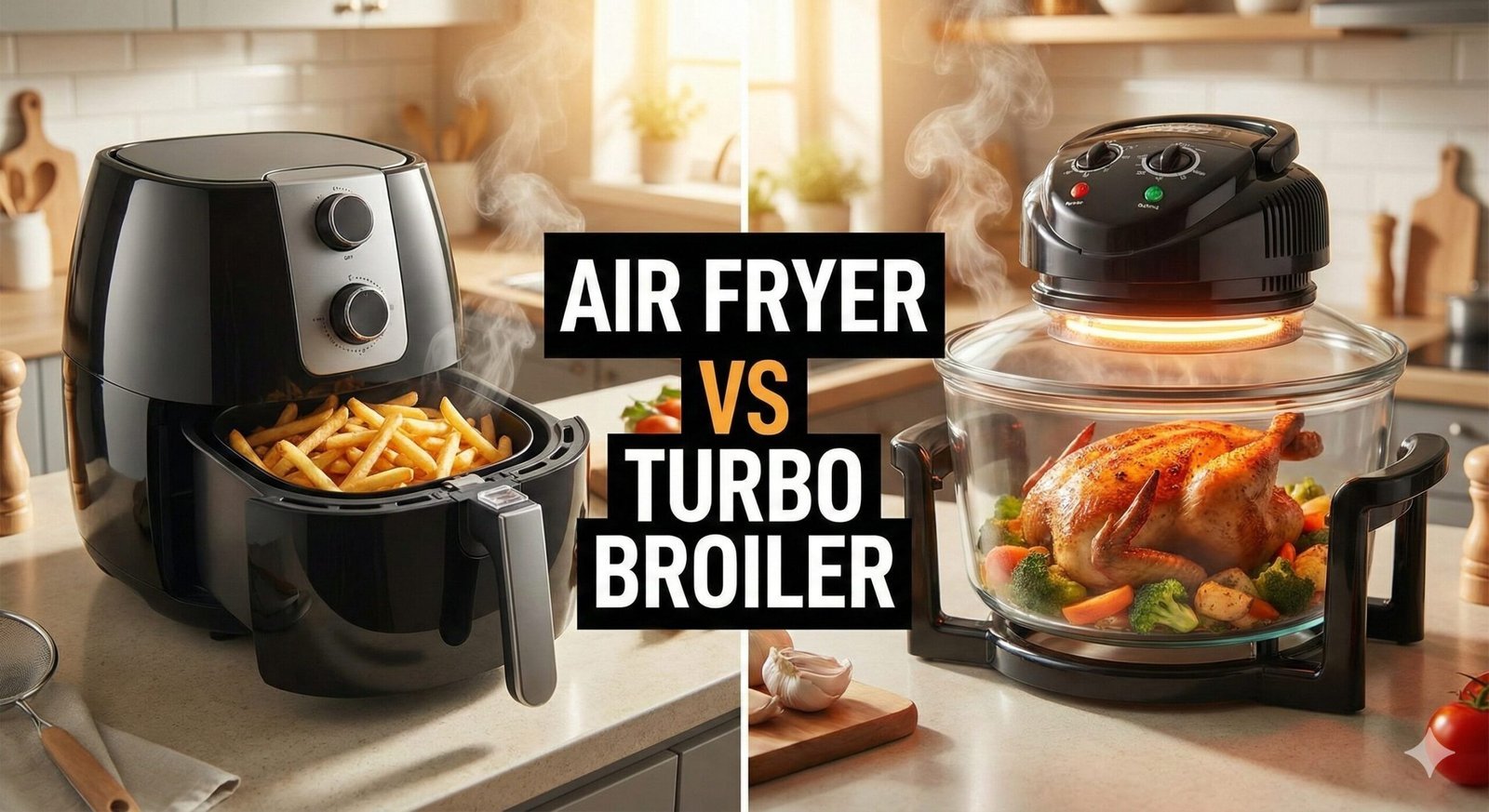
Air Fryer vs. Turbo Broiler: Which One Belongs on Your Countertop?
If you grew up in a household that loved Sunday roasts, you likely remember the “Turbo Broiler”—that spaceship-looking glass bowl that sat on the counter, glowing bright orange and humming loudly. It was the original countertop convection revolution. But today, a new challenger claims the throne: the Air Fryer.
Both appliances promise the same dream: faster cooking, less oil, and crisper results than a traditional oven. Yet, they are fundamentally different machines. Whether you are a home cook trying to replicate deep-fried texture or a meal-prepper roasting whole chickens, choosing between an Air Fryer vs. Turbo Broiler is a critical kitchen decision.
In this guide, we are stripping away the marketing hype. We will analyze the heating mechanisms, the energy efficiency, and ultimately, which one makes the better dinner. We will also cover everything from safety and brand recommendations to advanced cooking techniques and meal prep strategies—giving you the most thorough comparison available anywhere online.
Understanding the Technology
Before we look at the food, we need to understand the engine under the hood. At their core, both devices rely on convection heating—moving hot air around food to cook it evenly.
However, the execution differs dramatically. The primary difference lies in the heat source and the airflow velocity. A turbo broiler uses radiant heat from a halogen element combined with gentle fan circulation, while an air fryer relies on an electric heating coil paired with a powerful fan that forces air at high speed through a compact cooking chamber.
Think of it this way: a turbo broiler is like sitting near a campfire with a gentle breeze, while an air fryer is like sticking your hand in a commercial hot-air hand dryer on maximum power. Both deliver heat, but the intensity and distribution patterns are worlds apart.
How Convection Cooking Works
Convection cooking relies on three principles of heat transfer: conduction, convection, and radiation. In a standard oven, heat radiates from the walls and slowly circulates. In both the air fryer and turbo broiler, a fan actively moves the heated air, which speeds up cooking by stripping away the layer of cooler air (the “boundary layer”) that normally surrounds food. This boundary layer acts as insulation; removing it allows heat to reach the food surface much faster.
The key variable is velocity. Air fryers typically push air at speeds of 2-5 meters per second through a narrow chamber, while turbo broilers circulate air at roughly 0.5-1.5 meters per second through a much larger glass bowl. This velocity difference is why air fryers excel at crisping (they rapidly evaporate surface moisture), while turbo broilers are better at even roasting (the gentler airflow doesn’t dry out large cuts of meat).
For a detailed breakdown of how this differs from standard baking, read our guide on air fryers vs. convection ovens.
What is a Turbo Broiler?
The Turbo Broiler (often called a Halogen Oven or Glass Convection Oven) is instantly recognizable by its heavy glass bowl. The lid houses the mechanical components: a circular halogen lamp and a fan.
How It Works
When activated, the halogen bulb generates intense infrared light waves. This provides radiant heat, similar to the broiler element in your main oven or the coals of a grill. Simultaneously, the fan circulates the hot air within the glass bowl. The combination of radiant heat from above and convected heat from the fan creates a dual-zone cooking environment that is uniquely suited for large roasts and whole poultry.
The halogen element heats up instantly—there is no warm-up period like with a coil-based appliance. This means you can place food inside and start cooking immediately, with the halogen reaching full operating temperature in under two seconds. However, once the target temperature is reached, the element cycles on and off to maintain it, which you can observe through the glass as the bright orange glow appearing and disappearing.
The “Turbo” Advantages
- Visual Control: The glass bowl offers 360-degree visibility. You never have to guess if your chicken is burning. This is particularly valuable for first-time cooks or for recipes that require precise timing, like bread or pastries.
- Moisture Retention: Radiant heat seals the outside of meat quickly, often resulting in juicier roasts. The infrared energy penetrates the outer 2-3mm of the meat surface almost instantly, creating a “seal” that locks in juices before the slower convection process begins cooking the interior.
- Capacity: Most standard turbo broilers are 12-16 quarts, large enough to fit a whole turkey or a large rack of ribs. Some commercial models go up to 20 quarts, making them a genuine alternative to a full-size oven for holiday cooking.
- Even Browning: Because the halogen light radiates heat from the top while the fan distributes hot air throughout, you get remarkably even browning without the hot spots common in electric ovens. Many bakers report that cakes and breads rise more evenly in a turbo broiler than in their conventional oven.
- Cost-Effective: Turbo broilers typically consume less electricity per cooking session due to the efficient radiant-heat transfer and larger capacity (you can cook more food at once). The upfront purchase price is also generally lower, with quality models available starting at around $30-50.
Limitations of the Turbo Broiler
- Lower Air Velocity: The gentle airflow is great for roasting but poor at crisping. French fries and chicken wings will cook through but won’t achieve the same crunch as an air fryer.
- Fragile Glass: The tempered glass bowl is the Achilles heel. It can shatter from thermal shock (placing a cold bowl on a hot surface) or physical impact. Replacement bowls can cost $20-40 and may be difficult to find for older models.
- Counter Space: The glass bowl is bulky and cannot be stored inside itself. Even the lid takes up significant space. If you have a small kitchen, storing a turbo broiler between uses can be challenging.
- Noise: The fan motor on many turbo broilers is louder than modern air fryers. The combination of the fan and the halogen element creates a distinctive humming noise that some people find disruptive, especially in open-plan kitchens.
- Halogen Bulb Replacement: The halogen element has a finite lifespan (typically 1,000-2,000 hours of use). While replacement bulbs are available, they can be tricky to install and cost $10-20 each. Frequent users may need to replace the bulb every 1-2 years.

The quintessential Turbo Broiler design. Huge glass capacity, infrared cooking, and perfect for large family roasts. Comes with extension rings for even more capacity and multiple accessory racks.
Check Price on AmazonWhat is an Air Fryer?
The Air Fryer is the modern evolution of convection cooking. It typically uses a compact plastic shell with a sliding drawer (basket). Inside, a metal coil heats up, and a high-velocity fan blasts air downwards.
Because the cooking chamber is much smaller than a turbo broiler, the heat intensity is concentrated. This rapid movement of superheated air mimics the effect of submerging food in oil. The Maillard reaction—the chemical process that creates the brown, crispy crust on fried food—happens much faster when surface moisture is removed quickly, which is exactly what the high-velocity air achieves.
The “Air Fryer” Advantages
- The Crunch: The intense airflow removes surface moisture faster, creating a texture that rivals deep frying. In blind taste tests, most people cannot distinguish properly air-fried food from deep-fried food, particularly with breaded items like chicken tenders and mozzarella sticks.
- Speed: Smaller volume means it preheats almost instantly (2-3 minutes vs. 10-15 for a conventional oven). Cooking times are typically 20-30% faster than a turbo broiler for the same food items.
- Safety: No hot glass to shatter, and the heating element is hidden safely inside the unit. The exterior stays relatively cool compared to a turbo broiler’s glass bowl, which can reach surface temperatures of 300-400 degrees Fahrenheit.
- Precise Temperature Control: Most modern air fryers feature digital temperature controls with accuracy to within 5 degrees, while turbo broilers typically have a simple analog dial that controls the halogen intensity in broad strokes.
- Compact Footprint: A typical air fryer occupies roughly the same counter space as a standard coffee maker (about 12×12 inches), making it practical for apartments, dorm rooms, and tiny kitchens.
- Cooking Versatility: Many air fryers now include multiple cooking modes beyond just “air frying”—baking, roasting, reheating, dehydrating, and even toasting. This makes them a genuine multi-cooker that can replace several appliances.
Limitations of the Air Fryer
- Limited Capacity: Most consumer air fryers hold 4-8 quarts, which is enough for 2-4 servings. Cooking a whole chicken or a large batch of vegetables often requires multiple rounds, which defeats the time-saving advantage.
- Requires Shaking: To achieve even crisping, you need to shake or flip the food halfway through cooking. This isn’t always convenient, especially if you’re cooking multiple items simultaneously.
- Dry Results for Some Foods: While the high airflow is perfect for crispy foods, it can dry out items that benefit from moist heat—like slow-cooked pulled pork or delicate fish fillets.
- Non-Stick Concerns: The basket coating can degrade over time, especially if metal utensils are used or the basket is scrubbed with abrasive materials. This means the basket may need to be replaced every 2-3 years with heavy use.
- Plastic Odor: Some lower-quality air fryers emit a plastic smell during the first several uses, which can transfer to food. Quality brands minimize this, but it’s a common complaint with budget models.

The market leader for a reason. Ceramic coated basket, incredibly fast airflow, and dishwasher safe parts. Perfect for households of 2-4 people who want restaurant-quality crispiness at home.
Check Price on AmazonHead-to-Head Comparison Chart
Let’s look at the technical specifications side-by-side to see which fits your lifestyle.
| Feature | Air Fryer | Turbo Broiler |
|---|---|---|
| Heating Source | Electric Coil (Convection) | Halogen Bulb (Radiant + Convection) |
| Primary Strength | Crisping & Frying | Roasting & Baking |
| Capacity | 4-8 Quarts (Average) | 12-18 Quarts (Average) |
| Preheat Time | 2-3 Minutes | Instant (Light on) |
| Material | Plastic & Non-stick Metal | Tempered Glass & Metal |
| Breakability | Low (Durable) | High (Glass bowl can shatter) |
Cooking Tests & Taste Profiles
Round 1: French Fries & Snacks
Winner: Air Fryer.
The Turbo Broiler struggles here. Because the bowl is large, the air doesn’t move with the same velocity as an air fryer. Fries in a turbo broiler often end up baked rather than fried. The Air Fryer, however, delivers that golden, audible crunch. For best results, lightly toss the fries in 1-2 teaspoons of oil before air frying—this small amount of fat helps conduct heat to the surface and accelerates browning without significantly increasing calories.
Round 2: Whole Chicken
Winner: Turbo Broiler.
This is where the halogen lamp shines. The radiant heat acts like a rotisserie, crisping the skin while the gentle convection cooks the meat without drying it out. Plus, fitting a 5lb chicken into a standard air fryer basket is a struggle; in a Turbo Broiler, it’s easy. The glass bowl also lets you monitor the browning in real-time without opening the lid and losing heat.
Round 3: Baked Goods (Cookies & Muffins)
Winner: Turbo Broiler.
Baking in an air fryer is tricky because the intense top-down airflow can create uneven rising and a domed top. Turbo broilers excel here because the gentler air circulation more closely mimics a traditional oven environment. The ability to watch through the glass is a major bonus—you can see exactly when the cookies are golden without opening the lid.
Round 4: Reheating Leftovers
Winner: Air Fryer.
Leftover pizza, fried chicken, and spring rolls come back to life in an air fryer. The high-velocity air re-crisps the exterior while warming the interior in just 3-5 minutes. A turbo broiler works too, but the larger cavity means longer preheat cycles and the food can dry out before the exterior re-crisps.
Round 5: Dehydrating (Jerky & Dried Fruit)
Winner: Tie.
Both appliances can dehydrate food, but with different trade-offs. Air fryers with a dehydrate function run at low temperatures (130-170 degrees Fahrenheit) for extended periods (4-8 hours). Turbo broilers can do the same, but the halogen element’s on/off cycling can create inconsistent temperatures. However, the turbo broiler’s larger capacity means you can dehydrate more food at once. For serious dehydrating, a dedicated dehydrator is still the best choice.
Cleaning & Durability
The “after-dinner” experience is just as important as the meal itself. A beautiful appliance that’s a nightmare to clean will eventually end up gathering dust in a cabinet.
Turbo Broiler Maintenance
Cleaning a turbo broiler can be a workout. The glass bowl is heavy, bulky, and slippery when soapy. You have to be extremely careful not to chip it in the sink. The lid unit (containing the fan/light) cannot be submerged in water, making it tricky to wipe down if grease splatters up.
Cleaning Tips for Turbo Broilers:
- Allow the glass bowl to cool completely before cleaning—thermal shock is the number one cause of cracking.
- Fill the bowl with warm (not hot) soapy water and let it soak for 15-20 minutes to loosen baked-on grease.
- Use a non-abrasive sponge on the interior. Steel wool or scouring pads will scratch the glass and create micro-cracks that weaken it over time.
- Wipe the lid with a damp cloth—never immerse it. Pay special attention to the area around the halogen bulb, where grease can accumulate and cause uneven heating or even a fire risk.
- Store the bowl upside-down with the lid on top to prevent dust accumulation and reduce the chance of accidental chipping.
Air Fryer Maintenance
Modern air fryers are designed for convenience. Most baskets are dishwasher safe or feature high-quality non-stick coatings that wipe clean in seconds. The key to longevity is avoiding metal utensils and abrasive scrubbers on the basket coating.
Cleaning Tips for Air Fryers:
- After each use, wash the basket and tray with warm soapy water. Most can go in the dishwasher, but hand-washing extends the non-stick coating’s life.
- To clean the interior, wipe down the heating element area with a damp cloth once a month. Grease buildup on the element can cause smoke and affect performance.
- The exterior housing can be wiped with a damp cloth. Avoid getting water near the air intake or electrical components.
- If your basket develops stubborn residue, make a paste of baking soda and water, apply it to the affected area, and let it sit for 10 minutes before scrubbing gently with a soft sponge.
- Replace the basket or its non-stick liner every 2-3 years with heavy use, or sooner if you notice significant peeling or flaking.
Durability: Which Lasts Longer?
On average, a quality air fryer lasts 3-5 years with regular use, while a turbo broiler can last 5-10 years—provided the glass bowl doesn’t break. The mechanical simplicity of the turbo broiler (just a fan and a bulb) means fewer things can go wrong electronically. Air fryers have more complex circuit boards and digital displays that can fail over time.
However, if the turbo broiler’s glass bowl shatters, the entire unit is essentially useless unless you can find a replacement bowl. Air fryer baskets, by contrast, are readily available as replacement parts for most major brands. In terms of long-term value, both appliances are relatively inexpensive to maintain—neither requires professional servicing, and replacement parts are widely available online.
Price Guide & Budget Breakdown
One of the most common questions buyers ask is: “How much should I spend?” The answer depends on your cooking needs, household size, and how often you plan to use the appliance. Let’s break down exactly what you get at every price tier.
Air Fryer Price Tiers
Budget Tier ($25-$50): Basic basket-style air fryers with analog controls (a simple dial for temperature and time). These work perfectly fine for fries, nuggets, and simple proteins. However, they lack the precision of digital models and often have inconsistent airflow that leads to uneven cooking. The baskets tend to be smaller (2-4 quarts) and the non-stick coating is thinner. Brands like Chefman, GoWISE, and various unbranded Amazon options dominate this space. If you are testing whether air frying is for you, this tier is a perfectly reasonable starting point.
Mid-Range ($50-$120): This is the sweet spot for most buyers. Digital controls, larger baskets (5-7 quarts), multiple cooking presets, and better build quality. You will find the Ninja AF101, Philips Premium, Cosori, and Instant Vortex in this range. These models typically include shake reminders, preheat functions, and dishwasher-safe components. Build quality is noticeably better—sturdier baskets, better handles, and quieter fans. For a household of 2-4 people, this tier covers 90% of cooking needs.
Premium ($120-$300+): Large-capacity air fryers (8-12+ quarts), dual-basket models that let you cook two different foods simultaneously, and oven-style air fryers with multiple racks. The Ninja Foodi, Philips XXL, and Breville Smart Oven Air are in this range. These models feature advanced technology like smart connectivity (app-based recipes and remote monitoring), precise temperature calibration, and premium materials like stainless steel construction. If you cook for a family of 5+ or want to replace your conventional oven for daily use, this is the tier to consider.
Turbo Broiler Price Tiers
Budget Tier ($20-$40): Basic halogen ovens with a single glass bowl, simple mechanical timer and temperature dials, and one or two rack levels. Capacity is typically 10-12 quarts. These are the most common models in Southeast Asian and Middle Eastern markets, where turbo broilers remain extremely popular. Quality varies significantly—look for models with thick tempered glass and a sturdy lid handle. Brands to look for include Big Boss (entry models) and various store-brand options.
Mid-Range ($40-$80): Larger capacity (14-16 quarts), double or triple rack systems, and often include extension rings that add 2-3 quarts of additional capacity. The fan speed may be adjustable, and the timer goes up to 60 minutes instead of the basic 30-minute limit. The Big Boss 16QT and the LivingBasics models are popular choices. This tier is ideal for families of 4-6 who want the versatility of a turbo broiler without paying for premium features.
Premium ($80-$150+): High-end turbo broilers with digital controls, multiple cooking modes (fry, bake, grill, roast), and larger capacities (18-20 quarts). Some premium models include a rotisserie attachment, which is a game changer for whole chicken and pork roast. The glass is thicker and more shatter-resistant, and the halogen bulbs are rated for longer lifespans. Brands like Flav-R-Wave and Klarstein offer premium options with warranties of 2-3 years.
Price-to-Value Verdict
For the budget-conscious buyer, turbo broilers offer more capacity per dollar. You can get a 16-quart turbo broiler for the same price as a basic 4-quart air fryer. However, air fryers offer better value if you prioritize speed and crispiness. The mid-range tier ($50-$80) is where both appliances deliver the best balance of features, quality, and longevity. Avoid the cheapest turbo broilers (under $20) as they often use thin glass that is prone to cracking.
| Price Tier | Air Fryer | Turbo Broiler | Best Value Pick |
|---|---|---|---|
| Budget ($20-$50) | Basic 3-4qt, analog controls | 10-12qt, single rack | Turbo Broiler (more capacity) |
| Mid-Range ($50-$120) | 5-7qt, digital, presets | 14-16qt, dual rack, extension ring | Air Fryer (better daily use) |
| Premium ($120-$300+) | 8-12qt+, dual basket, smart | 18-20qt, digital, rotisserie | Depends on primary use case |
Energy Efficiency & Electricity Costs
With energy prices rising globally, the operating cost of kitchen appliances is no longer a trivial consideration. Both air fryers and turbo broilers are significantly more energy-efficient than a conventional oven, but how do they compare to each other?
Wattage Comparison
Air fryers typically draw between 1,200 and 1,800 watts, with most popular models in the 1,500W range. Turbo broilers are slightly more modest, usually running at 1,200 to 1,400 watts. On paper, this might suggest that turbo broilers use less energy, but wattage alone tells only part of the story.
The real metric is energy per meal, which factors in both wattage and cooking time. Here is a practical breakdown for common cooking scenarios:
| Cooking Task | Air Fryer (Watts x Time) | Turbo Broiler (Watts x Time) | Est. Cost Difference |
|---|---|---|---|
| Frozen Fries (400g) | 1,500W x 15 min = 0.375 kWh | 1,400W x 25 min = 0.583 kWh | Air fryer 36% cheaper |
| Whole Chicken (4lb) | 1,500W x 35 min = 0.875 kWh | 1,400W x 50 min = 1.167 kWh | Air fryer 25% cheaper |
| Baked Potatoes (4 medium) | 1,500W x 20 min = 0.500 kWh | 1,400W x 30 min = 0.700 kWh | Air fryer 29% cheaper |
| Cake (8-inch round) | 1,500W x 25 min = 0.625 kWh | 1,400W x 30 min = 0.700 kWh | Air fryer 11% cheaper |
| Large Roast (6lb pork) | 1,800W x 50 min = 1.500 kWh | 1,400W x 60 min = 1.400 kWh | Turbo broiler 7% cheaper |
At the US average electricity rate of $0.16 per kWh, a typical air fryer session costs $0.06-$0.24, while a turbo broiler session costs $0.08-$0.22. Over a year of daily use (365 sessions), the air fryer saves roughly $15-$30 on electricity. The savings are modest but real—especially for larger households cooking multiple times per day.
The Preheat Advantage
Air fryers preheat in 2-3 minutes, consuming about 0.05-0.08 kWh. Turbo broilers technically have no preheat time (the halogen fires instantly), but the larger cavity means the food starts cooking at a lower effective temperature until the glass walls heat up. This “thermal inertia” means the first few minutes of turbo broiler cooking are less efficient than they appear on paper.
Yearly Cost Estimate
Assuming average daily use with a mix of cooking tasks, an air fryer costs approximately $35-$65 per year to operate, while a turbo broiler costs $40-$70 per year. Compared to a conventional oven, which might cost $150-$250 per year for the same tasks, both appliances represent significant savings. The air fryer edges ahead for most cooking scenarios, but the turbo broiler becomes more competitive for large, slow-cooked meals where its efficient radiant heat transfer shines.
Safety Comparison
Kitchen safety should be a top priority, especially in households with children, elderly members, or pets. Both appliances are generally safe, but each carries specific risks that buyers should understand.
Air Fryer Safety Profile
- Exterior Temperature: Most air fryers maintain a relatively cool exterior during operation, typically staying below 120 degrees Fahrenheit on the plastic housing. This makes them safer for homes with curious toddlers who might touch the unit.
- Fire Risk: The primary fire hazard with air fryers is grease accumulation. Food particles and oil that drip into the bottom of the unit can smoke or ignite if not cleaned regularly. Never leave an air fryer unattended for extended periods, and always clean the drip tray after each use.
- Electrical Safety: Air fryers draw significant power (1,500W+). Avoid using extension cords, and ensure the outlet is rated for the appliance’s wattage. Overloading a power strip with an air fryer is a common cause of electrical fires.
- Non-Stick Fumes: When heated above 500 degrees Fahrenheit, some non-stick coatings can release fumes that are harmful to birds and may cause flu-like symptoms in humans (polymer fume fever). Always use the appliance within its rated temperature range and ensure adequate ventilation.
Turbo Broiler Safety Profile
- Glass Burns: The glass bowl reaches extremely high temperatures (300-400 degrees Fahrenheit on the exterior surface). Accidental contact can cause severe burns. Always use oven mitts when handling the bowl, and keep it out of reach of children and pets.
- Shattering Risk: While tempered glass is designed to be stronger than regular glass, it can still shatter from thermal shock (e.g., placing a cold bowl on a hot surface or pouring cold water on a hot bowl) or physical impact. When it does shatter, tempered glass breaks into small, relatively less dangerous pieces—but the risk is still significant.
- Halogen Bulb: The halogen element gets extremely hot (over 1,000 degrees Fahrenheit during operation). Never touch the bulb, and allow the lid to cool completely before handling. If the bulb breaks, ventilate the room immediately and clean up fragments carefully—they can be razor-sharp.
- Stability: The glass bowl can be unstable on uneven surfaces. Always place the turbo broiler on a flat, heat-resistant surface. The weight of a full glass bowl (5-8 lbs empty, much more with food) means it can tip if bumped.
Child Safety Ratings
For households with young children, the air fryer is the safer choice by a significant margin. The enclosed design, cool exterior, and absence of exposed heating elements make it much more difficult for a child to injure themselves. The turbo broiler, with its exposed hot glass and visible halogen glow, is inherently more dangerous around children. If you have toddlers or young kids, consider placing the air fryer on a high counter or in a location where children cannot reach it.
Best For: Scenario Recommendations
Choosing between an air fryer and a turbo broiler ultimately comes down to your primary use case. Here is a definitive guide to which appliance wins in each common kitchen scenario.
| Scenario | Winner | Why |
|---|---|---|
| Weeknight Dinner for Two | Air Fryer | Quick preheat, fast cooking, minimal cleanup |
| Holiday Turkey (12+ lbs) | Turbo Broiler | Capacity up to 18 quarts, even radiant heat for whole birds |
| Crispy Chicken Wings | Air Fryer | High-velocity air creates superior crunch |
| Homemade Bread | Turbo Broiler | Gentle airflow, glass visibility, even rising |
| Meal Prepping (Batch Cooking) | Turbo Broiler | Larger capacity for bulk proteins and vegetables |
| Dorm Room / Studio Apartment | Air Fryer | Compact, minimal smoke, enclosed design |
| Baking Cookies | Turbo Broiler | Even heat distribution, watch through glass |
| Reheating Pizza | Air Fryer | Re-crisps crust in 3-5 minutes |
| Rack of Ribs | Turbo Broiler | Large capacity fits a full rack without cutting |
| Kid-Friendly Snacks | Air Fryer | Frozen nuggets, fish sticks, and fries in 10-12 minutes |
| Rotisserie Chicken | Turbo Broiler (with rotisserie) | Models with rotisserie attachment produce restaurant-quality results |
| Vegan/Vegetarian Cooking | Both (Tie) | Both excel at roasted vegetables; air fryer is better for tofu crisping |
| Budget-Conscious Household | Turbo Broiler | More capacity per dollar, lower electricity cost for large meals |
| Solo Cook / Single Person | Air Fryer | Right-sized for 1-2 servings, faster cleanup |
The “Both” Strategy
Here is a secret that many seasoned home cooks know: you don’t have to choose. Many households own both an air fryer and a turbo broiler and use them for different tasks. The air fryer handles quick, crispy items on busy weeknights, while the turbo broiler tackles weekend roasts, batch baking, and holiday meals. Given the low entry price of both appliances, owning both is often more affordable than buying a single high-end countertop oven.
If you can only buy one, prioritize based on your most frequent cooking task. If 80% of your cooking is quick proteins and snacks, go air fryer. If you regularly roast large cuts of meat, bake bread, or cook for 5+ people, the turbo broiler gives you more versatility per dollar.
Top Brand Picks for Each Appliance
With dozens of brands competing in both categories, narrowing down the best options can be overwhelming. Here are our top recommendations based on reliability, performance, and value.
Best Air Fryer Brands
Ninja consistently ranks at the top for overall performance. Their AF101 model is the gold standard for basket-style air fryers, while the Ninja Foodi line offers multi-cooker functionality (air fry + pressure cook + slow cook) for those who want maximum versatility. Ninja’s build quality is excellent, their customer service is responsive, and replacement parts are readily available.
Cosori has emerged as the best value brand in the mid-range tier. Their Pro LE and Pro II models offer features (digital controls, shake reminder, 100+ recipes in the app) that rival premium brands at a fraction of the cost. The non-stick coating on Cosori baskets is particularly durable, and the company offers a generous 2-year warranty.
Philips invented the modern air fryer category and their Premium and XXL models remain excellent choices for buyers who want the original Rapid Air Technology. Philips air fryers tend to be pricier than competitors, but they offer superior build quality, quieter operation, and the best-tasting results for French fries specifically.
Instant Brands (makers of the Instant Pot) entered the air fryer market with the Vortex series and quickly gained a loyal following. Their dual-basket Vortex Plus is ideal for families who want to cook two different foods simultaneously with independent settings.
Best Turbo Broiler Brands
Big Boss is the most recognized turbo broiler brand, particularly in North America. Their 16-quart model is the best-selling glass convection oven on Amazon and offers an excellent balance of capacity, accessories, and build quality. The included extension ring and multiple racks add versatility right out of the box.
Flav-R-Wave offers premium turbo broilers with digital controls, larger capacities, and rotisserie attachments. Their models are pricier but come with better warranties (2-3 years vs. the typical 1-year) and thicker, more shatter-resistant glass.
Klarstein is a European brand that has gained popularity for stylish, well-built turbo broilers with unique design elements. Their models often feature stainless steel lids (instead of plastic) and adjustable fan speeds, giving you more control over the cooking process.
General rule for turbo broilers: Avoid the cheapest unbranded models. The glass quality on ultra-budget turbo broilers is often poor, increasing the risk of shattering. Spending an extra $15-20 on a reputable brand significantly improves safety and longevity.
Must-Have Accessories
Whether you choose an air fryer or a turbo broiler, the right accessories can dramatically expand your cooking capabilities and improve results.
Air Fryer Accessories
- Silicone Liners: Reusable, non-stick liners that sit at the bottom of the basket. They catch drips, prevent food from sticking, and make cleanup effortless. Avoid paper liners if you want an eco-friendly option. Look for BPA-free, heat-resistant silicone rated to at least 450 degrees Fahrenheit.
- Multi-Layer Rack: A metal rack that creates a second cooking level inside the basket, effectively doubling your cooking capacity. Essential for cooking items like bacon-wrapped appetizers or stacking chicken above vegetables to let the fat drip down.
- Meat Thermometer: An instant-read digital thermometer is non-negotiable for food safety. Air fryers cook fast, and it is easy to undercook or overcook proteins without a thermometer. The Thermapen and ThermoWorks Thermapen ONE are gold standards, but budget options from ThermoPro work well too.
- Parchment Paper Rounds: Pre-cut parchment paper that fits your basket perfectly. Creates a non-stick surface for delicate items like fish fillets or eggs. Always weigh the paper down with food—loose parchment can fly into the heating element and burn.
- Oil Sprayer: A fine-mist oil sprayer lets you apply a thin, even coat of oil to food without the excess calories of pouring or brushing. Olive oil and avocado oil are best for high-temperature air frying due to their high smoke points.
- Grill Pan / Griddle Plate: Some air fryers offer accessory grill pans that create sear marks on steaks and vegetables. While not a replacement for an actual grill, they add a nice char that plain basket cooking cannot achieve.
Turbo Broiler Accessories
- Extension Ring: An extra glass or metal ring that sits between the bowl and lid, adding 2-3 quarts of capacity. Many turbo broilers include one, but if yours doesn’t, it is the single most valuable accessory to buy. It lets you cook taller items like a whole turkey or a large bundt cake.
- Rotisserie Attachment: A spit and motor assembly that rotates food inside the glass bowl while it cooks. This is transformative for whole chickens and roasts—the constant rotation creates uniform browning on all sides without any manual flipping. Not all turbo broilers support rotisserie attachments, so check compatibility before purchasing.
- Wire Racks (Multiple Levels): Most turbo broilers come with one or two racks, but additional racks let you cook multiple items simultaneously. Stainless steel racks are more durable than chrome-plated options and won’t chip or peel over time.
- Tongs and Fetch Tool: Long-handled tongs designed for reaching into the deep glass bowl without burning yourself. Some turbo broilers include a fetch tool for lifting hot racks—this is essential for safety and should be used every time.
- Glass Bowl Replacement: Keep the dimensions of your bowl in mind and know where to order a replacement. Having a backup bowl means a cracked bowl doesn’t end your turbo broiling days—it just means a quick online order and you’re back in business.
Advanced Cooking Techniques
Once you have mastered the basics, both appliances offer advanced techniques that can elevate your home cooking to a professional level.
Air Fryer Advanced Techniques
The Double-Cook Method: For the ultimate crispy exterior on proteins, cook the food at a lower temperature (300 degrees Fahrenheit) first to bring the interior to the desired doneness, then blast it at high heat (400+ degrees Fahrenheit) for 3-5 minutes to crisp the outside. This technique works brilliantly for chicken thighs, pork chops, and thick fish fillets. The initial low-heat phase gently cooks the inside, while the high-heat finish creates the crunch without overcooking the center.
Wet Batter in an Air Fryer: Traditional wet batters (like tempura or beer batter) don’t work well in an air fryer because there is no pool of oil to set the batter before it drips off. The workaround: pre-coat the food in a thin layer of flour or cornstarch, dip it in the wet batter, then immediately coat in breadcrumbs or panko. This “dry-wet-dry” method creates a stable coating that crisps beautifully in the air fryer.
Layering for Flavor: Place aromatic ingredients (sliced onions, garlic, herbs) at the bottom of the basket and proteins on top. As the air circulates, it carries the aromatic flavors upward into the food. This simple technique adds depth to dishes that would otherwise taste one-dimensional.
Dehydrating with the Door Ajar: If your air fryer has a dehydrate function but you want even better results, prop the basket drawer slightly open (about 1 cm) with a wooden spoon handle. This increases airflow and reduces moisture buildup, resulting in more evenly dehydrated jerky, fruit leather, or herb-drying. Monitor closely and ensure children and pets cannot access the unit.
Turbo Broiler Advanced Techniques
Foil Tent Method: For large roasts that are browning too quickly on top, create a loose tent of aluminum foil over the top of the food. The foil deflects the halogen’s radiant heat while allowing the convected hot air to continue cooking from below. Remove the foil during the last 10-15 minutes for a final browning. This technique is essential for cooking items like stuffed pork loin or large meatloaf where the exterior can burn before the interior reaches a safe temperature.
Water Pan Technique: Place a small oven-safe dish of water at the bottom of the glass bowl during long cooking sessions. The evaporating moisture creates a steam-assisted cooking environment that keeps large roasts incredibly juicy. This is particularly effective for lean cuts like turkey breast or eye of round that tend to dry out. The water also helps prevent grease from smoking at the bottom of the bowl.
Two-Zone Cooking: Place different foods at different heights on the wire racks. Items closest to the halogen element (top rack) cook faster and get more browning, while items on the bottom rack cook more gently. This is perfect for a complete meal—place vegetables on top to roast and brown, and a protein below to cook through slowly. Rotate the racks halfway through for even results.
Bread Baking with Steam: For artisan-style bread with a crispy crust, spray the inside of the glass bowl with water before placing your dough inside. The steam helps the bread’s surface stay moist during the initial rise (oven spring), allowing the dough to expand fully before the crust sets. The glass bowl’s visibility lets you watch the bread rise in real-time—pull it out when the crust reaches your desired shade of golden brown.
Common Problems & Troubleshooting Guide
Every appliance has its quirks. Here are the most common issues owners encounter with each device and how to solve them.
Air Fryer Troubleshooting
Problem: Food is not crispy.
This is the most common complaint. The fix usually involves three things: (1) don’t overcrowd the basket—air needs to circulate around every piece; (2) pat food dry before cooking—surface moisture is the enemy of crispiness; (3) use a small amount of oil—just a light spray or teaspoon helps conduct heat to the surface and accelerates the Maillard reaction.
Problem: Smoking during cooking.
Smoke occurs when grease or food particles fall onto the heating element and burn. To prevent this, always use the drip tray, avoid cooking extremely fatty foods (like skin-on chicken thighs) without a barrier, and clean the heating element area monthly. If smoking occurs mid-cook, carefully pull out the basket, pour any accumulated grease from the tray, and resume.
Problem: Uneven cooking.
Air fryers cook from the top down, so the top layer of food always gets more heat. Fix this by shaking or flipping the food halfway through, and avoid stacking items. For items like chicken wings, use the shake reminder function if your model has one. If your model does not have this feature, set a manual timer on your phone.
Problem: The basket is difficult to remove.
This is often caused by grease buildup in the basket rails. Remove the basket, clean the rails thoroughly with warm soapy water, and apply a thin layer of food-grade mineral oil to the sliding mechanism. This should restore smooth operation.
Problem: Plastic smell during first uses.
This is normal for new air fryers and typically disappears after 3-5 uses. To speed up the process, run the air fryer empty at 400 degrees Fahrenheit for 15-20 minutes with the kitchen well-ventilated. Do not use the appliance for food until the smell has dissipated.
Turbo Broiler Troubleshooting
Problem: The halogen light won’t turn on.
The most common cause is a burned-out halogen bulb. Replacement bulbs are available online and are relatively easy to install—typically requiring you to remove 2-3 screws from the lid and swap the bulb. Before replacing the bulb, check that the power cord is fully inserted and the timer is set (the unit will not power on if the timer is at zero).
Problem: Food is burning on top but raw inside.
This indicates the halogen element is too close to the food. Move the food to a lower rack, or use the foil tent method described in the advanced techniques section. If your turbo broiler has an adjustable temperature dial, reduce the temperature by 25-50 degrees and extend the cooking time.
Problem: The glass bowl has developed a white film.
This is mineral buildup from hard water or steam. Clean it by filling the bowl with a solution of equal parts white vinegar and water, letting it soak for 30 minutes, then scrubbing gently with a non-abrasive sponge. For stubborn buildup, add 2 tablespoons of baking soda to the mixture. Rinse thoroughly and dry completely before storing.
Problem: The fan is making unusual noises.
This usually indicates a loose or unbalanced fan blade, which can happen if food particles build up on the blade over time. Unplug the unit, carefully remove the lid, and clean the fan blade area with a damp cloth. If the noise persists after cleaning, the fan motor may be wearing out—contact the manufacturer for warranty service.
Problem: The timer doesn’t shut off the unit.
On mechanical-timer turbo broilers, the timer knob can sometimes stick in the “on” position. This is a safety concern—always unplug the unit after use rather than relying solely on the timer. If the timer is malfunctioning, have it repaired before using the appliance again.
Air Fryer & Turbo Broiler vs. Other Cooking Methods
To fully understand the value proposition of these appliances, it helps to compare them against the other cooking methods you might use instead.
vs. Conventional Oven
A conventional oven is the baseline most people compare against. Both air fryers and turbo broilers cook 25-50% faster than a conventional oven due to their smaller cooking volumes and forced-air circulation. Energy consumption is 50-75% lower per meal. However, a conventional oven’s larger capacity (4-5 cubic feet vs. 4-20 quarts) makes it irreplaceable for large holiday meals, batch baking, and anything requiring multiple sheet pans. The conventional oven also provides more even heat distribution from all sides (top, bottom, and walls), which is why professional bakers still prefer it for precision baking.
vs. Microwave
Microwaves use electromagnetic radiation to heat water molecules in food, which is fundamentally different from the convective and radiant heat used by air fryers and turbo broilers. Microwaves are faster for reheating and defrosting, but they cannot brown, crisp, or caramelize food. A common workflow is to defrost in the microwave and finish in the air fryer for the best of both worlds. For cooking from raw, both air fryers and turbo broilers produce vastly superior results to a microwave in terms of texture and flavor.
vs. Instant Pot / Pressure Cooker
Pressure cookers excel at tenderizing tough cuts of meat and cooking dried beans quickly—tasks that neither an air fryer nor a turbo broiler can match. However, pressure cookers cannot brown or crisp food (unless you use the saute function, which is limited). Many home cooks use a pressure cooker for the initial cook and finish in an air fryer for crispiness. If you already own an Instant Pot, adding an air fryer gives you complementary capabilities rather than redundant ones.
vs. Deep Fryer
A dedicated deep fryer submerges food in hot oil, producing results that even the best air fryer can only approximate. The crunch, flavor, and texture of truly deep-fried food is distinctive. However, deep frying requires large quantities of oil (which is expensive and creates disposal challenges), produces significant smoke and odor, and poses burn and fire risks that countertop convection appliances simply do not. For occasional indulgences like homemade donuts or tempura, a deep fryer remains unmatched. For everyday cooking, air fryers offer 80-90% of the result at a fraction of the cost, mess, and risk.
vs. Toaster Oven
A toaster oven is the closest relative to both appliances. It uses electric heating elements and convection (in convection models) to cook food in a compact chamber. High-end toaster ovens like the Breville Smart Oven actually include air fry functionality, blurring the line between categories. If you already own a good convection toaster oven, adding a dedicated air fryer may be redundant—the toaster oven can handle most air frying tasks, albeit with slightly less airflow velocity and crisping power.
Environmental Impact & Sustainability
Conscious consumers increasingly consider the environmental footprint of their kitchen appliances. Here is how air fryers and turbo broilers stack up from a sustainability perspective.
Energy Consumption
Both appliances are significantly greener than a conventional oven. Using an air fryer instead of a full-size oven for small meals reduces energy consumption by up to 75%, according to studies by the American Council for an Energy-Efficient Economy. Over a year, the cumulative energy savings of using a countertop appliance for daily cooking can prevent 100-200 pounds of CO2 emissions from power plants. The air fryer’s shorter cooking times give it a slight edge in overall energy efficiency for most tasks.
Oil Reduction
Air fryers use 70-80% less oil than deep frying, and turbo broilers use virtually no oil at all for most tasks. Considering that global vegetable oil production is a major driver of deforestation (particularly palm oil in Southeast Asia), reducing oil consumption in home cooking has a tangible environmental benefit. Over a year, a household that switches from deep frying to air frying can save 15-25 liters of cooking oil—a meaningful reduction in both personal expense and environmental impact.
Waste and Longevity
Turbo broilers have a potential environmental advantage in longevity: their simpler mechanical design (fan + halogen bulb) means fewer electronic components that can fail. A well-maintained turbo broiler can last a decade or more. However, the glass bowl—when it eventually breaks—creates non-recyclable waste (tempered glass with metal rims is difficult to recycle in most municipal programs). Air fryers, with their plastic construction and electronic components, have a shorter lifespan (3-5 years) and generate more e-waste when disposed of. The non-stick coating on air fryer baskets also raises concerns, as PTFE-based coatings are not biodegradable.
Packaging and Manufacturing
Both appliances are typically manufactured in China and shipped globally, with significant packaging waste (styrofoam, plastic wrap, cardboard). Turbo broilers require more packaging due to the fragile glass bowl, which adds to their shipping weight and carbon footprint. Air fryers, being lighter and more compact, have a lower per-unit shipping impact. However, the difference is marginal in the context of a one-time purchase that will be used for years.
Material Safety & Health Considerations
When an appliance heats food, the materials it is made of come into direct or indirect contact with your meal. Understanding the safety profile of each appliance’s materials helps you make an informed decision.
Air Fryer Materials
Most air fryer baskets are coated with PTFE (polytetrafluoroethylene), commonly known by the brand name Teflon. PTFE is stable and safe at normal cooking temperatures (up to 500 degrees Fahrenheit). However, overheating a PTFE-coated surface above 500 degrees Fahrenheit can cause the coating to break down and release fumes. This is why it is critical to never use an air fryer above its rated maximum temperature and to ensure the basket is always clean (burnt food residue can concentrate heat on small spots of the coating, causing localized degradation).
Ceramic-coated air fryer baskets are an increasingly popular alternative. Ceramic coatings are PTFE-free and can withstand higher temperatures without breaking down. They are generally considered safer, though they tend to lose their non-stick properties faster than PTFE coatings. If you are concerned about PTFE, look for air fryers with ceramic or stainless steel baskets—the Ninja AF101, for example, uses a ceramic-coated basket.
The outer housing of air fryers is typically made of BPA-free plastics or stainless steel. BPA-free plastics are considered safe for food-contact applications, though some consumers prefer stainless steel for its durability and the absence of any plastic-related concerns.
Turbo Broiler Materials
Turbo broilers score well on material safety because the food-contact surface is tempered glass—one of the most inert and food-safe materials available. Glass does not leach chemicals, does not react with acidic foods, and can be cleaned with any household cleaner without concern about coating damage. This makes turbo broilers an excellent choice for people who are sensitive to non-stick coatings or who cook highly acidic foods (like tomato-based dishes) that can react with some metal and coating surfaces.
The halogen element itself is sealed within a quartz glass tube and does not contact food. The metal racks are typically stainless steel or chrome-plated steel, both of which are food-safe. The main material concern with turbo broilers is the tempered glass bowl itself—while shatter-resistant, it can still break, and the fragments can be sharp. Always inspect the bowl for chips or cracks before each use, and replace it immediately if any damage is found.
BPA, Phthalates, and Other Concerns
Neither appliance contains BPA in food-contact areas if purchased from a reputable brand. Phthalates (plasticizers used in some flexible plastics) are not typically present in either appliance’s construction. The primary material concern is the non-stick coating degradation mentioned above for air fryers, which is easily mitigated by using the appliance within its rated temperature range and replacing the basket when the coating shows signs of wear.
Meal Prep & Weekly Planning Strategies
Both air fryers and turbo broilers are powerful tools for meal preppers, but they serve different roles in a weekly cooking strategy.
Air Fryer Meal Prep
The air fryer shines in daily meal execution rather than bulk batch cooking. Its ideal meal prep role is as a “finishing appliance”—you do the bulk cooking (grilling, stovetop, or oven) on Sunday, portion and refrigerate, then use the air fryer throughout the week to reheat and re-crisp individual portions. This workflow produces reheated meals that taste freshly cooked rather than soggy and microwaved.
For protein prep, air fry chicken breasts, salmon fillets, or turkey meatballs in batches (cooking 2-3 rounds if necessary), then refrigerate in portioned containers. When ready to eat, 5-8 minutes in the air fryer restores the texture beautifully. For vegetables, roast a large batch of broccoli, sweet potatoes, or Brussels sprouts, refrigerate, and re-crisp individual portions in 3-4 minutes.
Turbo Broiler Meal Prep
The turbo broiler excels at the initial batch cooking phase due to its larger capacity. A 16-quart turbo broiler can accommodate 4-6 chicken breasts, a full rack of ribs, or a large tray of vegetables in a single session—no batch rotations required. This makes it ideal for Sunday meal prep when you want to cook a week’s worth of proteins and sides in one go.
The turbo broiler also benefits from its glass visibility during long, hands-off cooking sessions. Set it up with a large batch of pulled pork, chicken thighs, or roasted vegetables, and you can monitor progress without lifting the lid or interrupting the cooking cycle. This passive monitoring lets you multitask—clean the kitchen, prep other ingredients, or attend to other household tasks while the turbo broiler does its work.
The Optimal Weekly Strategy
For the most efficient weekly meal prep, consider this combined approach: Use the turbo broiler on Sunday for bulk protein and vegetable cooking (the larger capacity saves time and energy). Portion everything into containers and refrigerate. Then, during the week, use the air fryer to reheat and re-crisp individual portions in minutes. This combination gives you the best of both worlds—the turbo broiler’s capacity for batch cooking and the air fryer’s speed and crisping ability for daily reheating.
| Meal Prep Task | Better Appliance | Reason |
|---|---|---|
| Sunday Batch Cooking | Turbo Broiler | Large capacity, hands-off cooking, glass monitoring |
| Weekday Reheating | Air Fryer | Fast re-crisping, single portions, minimal wait time |
| Hard-Boiled Eggs (Batch) | Both (Tie) | Both produce excellent results; air fryer is slightly faster |
| Grain Bowls Topping | Air Fryer | Quick-roasted chickpeas, crispy tofu in 8-10 min |
| Marinated Proteins (Large Batch) | Turbo Broiler | Fits more pieces, radiant heat enhances marinade caramelization |
Cooking with Kids & Family Meals
Both appliances can be wonderful tools for involving children in the kitchen, but they require different safety considerations and offer different learning opportunities.
Teaching Kids with an Air Fryer
The air fryer is the safer choice for involving young cooks. The enclosed design, cool exterior, and simple push-button operation make it accessible for children as young as 8-10 with supervision. Kids can participate in loading the basket, selecting presets, and monitoring the countdown timer. The quick cooking times keep children engaged without the long waits that test young attention spans.
Great beginner recipes for kids include: homemade chicken nuggets (pre-cut chicken pieces in breadcrumbs), sweet potato fries (sliced sweet potato with oil spray), quesadillas (tortilla with cheese, 3-4 minutes), and fruit chips (thinly sliced apples or bananas on the dehydrate setting). These recipes teach basic kitchen skills while producing satisfying results that kids are proud to have made themselves.
Teaching Kids with a Turbo Broiler
The turbo broiler offers a more visual cooking experience that can be engaging for older children (12+). The glass bowl lets kids watch the cooking process in real-time—seeing bread rise, cheese melt, and chicken skin turn golden is genuinely fascinating and educational. However, the hot glass surface means adult supervision is mandatory at all times, and children should never touch the bowl or lid during or immediately after cooking.
The turbo broiler is particularly good for teaching baking fundamentals. Watching a cake rise through the glass is a powerful visual lesson in how heat transforms batter into cake. The gentle, even heat of the turbo broiler is also more forgiving for novice bakers, as it is less likely to burn the top before the center is cooked.
Family Meal Planning
For families, the choice often depends on household size and meal complexity. Families of 4-6 benefit from the turbo broiler’s capacity for cooking whole chickens, large pasta bakes, and family-sized casseroles. Smaller families or those who prefer varied meals (where each family member wants something different) benefit from the air fryer’s speed and the ability to cook single portions quickly.
A practical family workflow: Use the turbo broiler for weekend family dinners (whole roasted chicken with vegetables, large batches of baked potatoes, homemade pizza for the whole family) and the air fryer for weeknight quick meals (frozen items for kids, quick proteins for adults, reheating leftovers). This division plays to each appliance’s strengths while keeping weeknight cooking stress to a minimum.
Storage & Kitchen Space Planning
Counter space and storage are precious commodities in any kitchen. Understanding the physical footprint of each appliance helps you plan your kitchen layout effectively.
Air Fryer Footprint
A typical basket-style air fryer occupies approximately 12×12 inches of counter space and stands 12-14 inches tall—roughly the same footprint as a standard coffee maker or a large toaster. This compact size means it can live permanently on the counter without dominating the workspace. For storage, most air fryers can be tucked into a standard upper cabinet (measure your cabinet depth first; some larger models may be too deep for shallow cabinets).
Oven-style air fryers (like the Breville Smart Oven Air or the Ninja Foodi Oven) have a larger footprint (roughly 20×15 inches) and are designed to replace your toaster oven on the counter. These models are not practical to store in cabinets and are meant for permanent counter placement. If counter space is limited, stick with a basket-style model.
Turbo Broiler Footprint
Turbo broilers present a unique storage challenge. The glass bowl has a diameter of 12-14 inches and a height of 8-10 inches, making it wider and shorter than an air fryer but harder to store in standard cabinets due to its round shape and weight. The lid adds another 4-6 inches of height when stored together. Many owners keep the turbo broiler on the counter permanently due to the inconvenience of moving the heavy glass bowl in and out of cabinets.
If you plan to store the turbo broiler between uses, you will need a dedicated cabinet space that is at least 15 inches wide and 16 inches deep. Alternatively, some people store the bowl upside-down on a sturdy shelf with the lid placed on top—this reduces the height but requires enough horizontal space.
Space Optimization Tips
- Vertical stacking: Neither appliance should be stacked on top of another appliance for safety reasons (heat dissipation and stability). However, you can place lighter items on top of an air fryer when it is not in use.
- Cabinet organization: Use shelf risers in your cabinets to create additional vertical space for storing the turbo broiler bowl on one level and the lid on another.
- Under-cabinet mounting: Some creative kitchen organizers mount air fryers on sliding shelf trays under upper cabinets, allowing the unit to be pulled out for use and pushed back for storage. This works well for lighter air fryer models (under 12 lbs).
- Dual-purpose placement: If you own both appliances, consider placing the air fryer on the counter (for daily use) and storing the turbo broiler in a pantry or cabinet (for weekend use). This optimizes both convenience and space.
Noise Levels & Kitchen Environment
Kitchen noise is an often-overlooked factor that significantly impacts the cooking experience, especially in open-plan homes where the kitchen flows into living and dining areas.
Air Fryer Noise
Modern air fryers typically operate at 50-65 decibels, roughly equivalent to a running dishwasher or a normal conversation. Premium brands like Ninja and Philips are on the quieter end (50-55 dB), while budget models tend to be louder (60-65 dB). The noise comes primarily from the high-velocity fan, which creates a steady “whooshing” sound during operation.
For context, 50 dB is about the noise level of a quiet office or a refrigerator hum. 65 dB is comparable to a shower running. Neither level is disruptive for most people, but if you are sensitive to noise or cook early in the morning / late at night while others are sleeping, the difference between a 50 dB and 65 dB model can matter.
Turbo Broiler Noise
Turbo broilers are generally slightly louder than air fryers, operating at 55-70 decibels. The combination of the fan motor and the halogen element creates a distinctive humming/buzzing sound that is more noticeable than an air fryer’s steady whoosh. Budget turbo broilers tend toward the louder end of this range, while premium models with better-insulated motors are quieter.
The turbo broiler’s noise pattern is also different—it tends to be less consistent due to the halogen element cycling on and off, creating an intermittent hum rather than a steady drone. Some people find this less soothing than an air fryer’s constant sound.
Noise Comparison Table
| Appliance / Scenario | Typical Noise Level | Equivalent Sound |
|---|---|---|
| Premium Air Fryer | 50-55 dB | Quiet office, refrigerator hum |
| Budget Air Fryer | 60-65 dB | Shower running, normal conversation |
| Premium Turbo Broiler | 55-60 dB | Quiet dishwasher |
| Budget Turbo Broiler | 65-70 dB | Vacuum cleaner (distance), busy restaurant |
| Conventional Oven | 30-40 dB | Almost silent |
For open-plan living or noise-sensitive environments, a premium air fryer is the quieter choice. However, neither appliance is unreasonably loud, and the cooking noise is generally background-level rather than conversation-interrupting.
Final Verdict: Which One Should You Buy?
Choose the Turbo Broiler If:
- You cook large roasts (Chicken, Turkey, Pork Belly/Lechon) frequently.
- You prefer “monitoring” your food through the glass.
- You have plenty of storage space for the bulky glass bowl.
- You are on a budget (Turbo broilers are often cheaper upfront).
- You want food-safe glass surfaces that don’t rely on non-stick coatings.
- You enjoy baking bread, cakes, and pastries and want visual control over the process.
- You regularly cook for 5+ people and need the larger capacity.
- You want lower electricity costs for large, slow-cooked meals.
Choose the Air Fryer If:
- You want quick, crispy meals (Fries, Nuggets, Wings).
- You have a small kitchen and need a compact appliance.
- You hate washing heavy dishes.
- You want a safer option for teenagers or older kids to use.
- You live alone or cook for 1-3 people.
- You want precise digital temperature control.
- You prioritize speed and convenience over capacity.
- You want to reheat leftovers with crispy results.
Frequently Asked Questions
Technically, both are convection ovens. However, “Air Fryers” use high-velocity fans and coils in a small space for crisping, while “Turbo Broilers” use halogen lights and slower fans in a large glass bowl for roasting. The cooking results, capacity, and ideal use cases are quite different.
Yes! Turbo broilers are excellent for baking because you can see the cake rising without opening the lid. Just be careful with the top heating element; you may need to cover the cake with foil to prevent the top from burning before the inside is cooked. The gentle airflow also produces more even results than many conventional ovens for cakes and breads.
It uses infrared radiation (heat), which is completely safe and natural—it is the same heat you feel from the sun or a campfire. It does not use microwave radiation. Infrared radiation is simply electromagnetic energy that transfers heat directly to the surface of food, similar to how a broiler or a campfire cooks.
This is normal operation. The halogen bulb cycles on and off to maintain the set thermostat temperature. When the light is off, the fan continues to circulate the hot air. The cycling frequency depends on the temperature setting and the amount of food in the bowl—higher settings and larger food loads result in more frequent cycling.
Turbo broilers usually run at lower wattage (1200W-1400W) compared to air fryers (1500W-1800W). However, air fryers cook faster. For a 1-hour roast, a Turbo Broiler is slightly more efficient. For 15 minutes of fries, an Air Fryer is more efficient. Over a year of daily use, the air fryer typically saves $15-$30 on electricity for most cooking patterns.
Yes, aluminum foil can be used in an air fryer, but with caution. Never line the entire basket with foil—it must allow air to circulate around the food. Place foil only under the food to catch drips, and weigh it down with the food itself so it doesn’t blow into the heating element. Parchment paper with holes (designed for air fryers) is a safer alternative that allows better airflow.
A quality air fryer typically lasts 3-5 years with regular use, while a turbo broiler can last 5-10 years provided the glass bowl does not break. The turbo broiler’s simpler mechanics (just a fan and a bulb) mean fewer electronic components that can fail. However, air fryer replacement baskets are more readily available than turbo broiler glass bowls. Both appliances offer good long-term value relative to their purchase price.
No, air fryers do not cause cancer. The concern arose from studies on acrylamide—a chemical that forms when starchy foods are cooked at high temperatures (above 280 degrees Fahrenheit). Acrylamide is classified as a “probable human carcinogen” by the WHO, but it forms in ALL high-temperature cooking methods (frying, baking, grilling, roasting), not just air frying. In fact, air frying may produce less acrylamide than deep frying because the shorter cooking times and lower oil use result in less surface browning. As with all cooking methods, moderation and varied diet are key.
For high-temperature air frying, choose oils with high smoke points: avocado oil (520 degrees Fahrenheit), refined safflower oil (510 degrees Fahrenheit), rice bran oil (490 degrees Fahrenheit), or light/refined olive oil (465 degrees Fahrenheit). Extra virgin olive oil has a lower smoke point (375 degrees Fahrenheit) and is better suited for lower-temperature air frying or as a finishing drizzle after cooking. Avoid butter and unrefined oils at high air fryer temperatures, as they can smoke and produce off-flavors.
Yes, if the glass dish is oven-safe and can withstand the air fryer’s maximum temperature (typically 400-450 degrees Fahrenheit). Pyrex and borosilicate glass dishes work well in air fryers. Always ensure the dish fits inside the basket with adequate clearance for air circulation on all sides. Avoid rapid temperature changes—do not place a cold glass dish into a preheated air fryer, as thermal shock can cause cracking.
For households that cook frequently and have diverse cooking needs, owning both appliances is a worthwhile investment. The combined cost is often less than a single premium countertop oven, and each appliance excels at different tasks. Use the air fryer for quick, crispy daily meals and the turbo broiler for weekend roasts, batch baking, and family gatherings. If budget or space is limited, choose the one that best matches your most frequent cooking task.
Turbo broilers do generate some ambient heat, but significantly less than a conventional oven. The glass bowl becomes very hot on the exterior (300-400 degrees Fahrenheit), which radiates heat into the surrounding area. However, since the cooking chamber is much smaller than a full-size oven, the total heat output is modest. In a well-ventilated kitchen, this is rarely an issue. Air fryers produce even less ambient heat due to their enclosed, insulated design.
Yes, both air fryers and turbo broilers excel at cooking frozen food directly from the freezer—no thawing required. This is one of their biggest advantages over conventional ovens. In an air fryer, most frozen items (fries, nuggets, fish sticks) cook in 10-15 minutes. In a turbo broiler, add 5-10 minutes to account for the larger cooking chamber and lower air velocity. For best results with frozen foods, do not preheat either appliance—the food’s surface moisture will help create steam that aids in even cooking.
For families of 5 or more, the turbo broiler is generally the better primary choice due to its larger capacity (12-18 quarts vs. 4-8 quarts for most air fryers). You can cook a whole chicken, a large batch of vegetables, or a full rack of ribs in a single session. However, if your family prefers crispy snacks and quick meals, a large-capacity air fryer (8-12 quarts, like the Ninja Foodi or Philips XXL) may be more practical. Consider a dual-basket air fryer if different family members want different foods at the same time.


