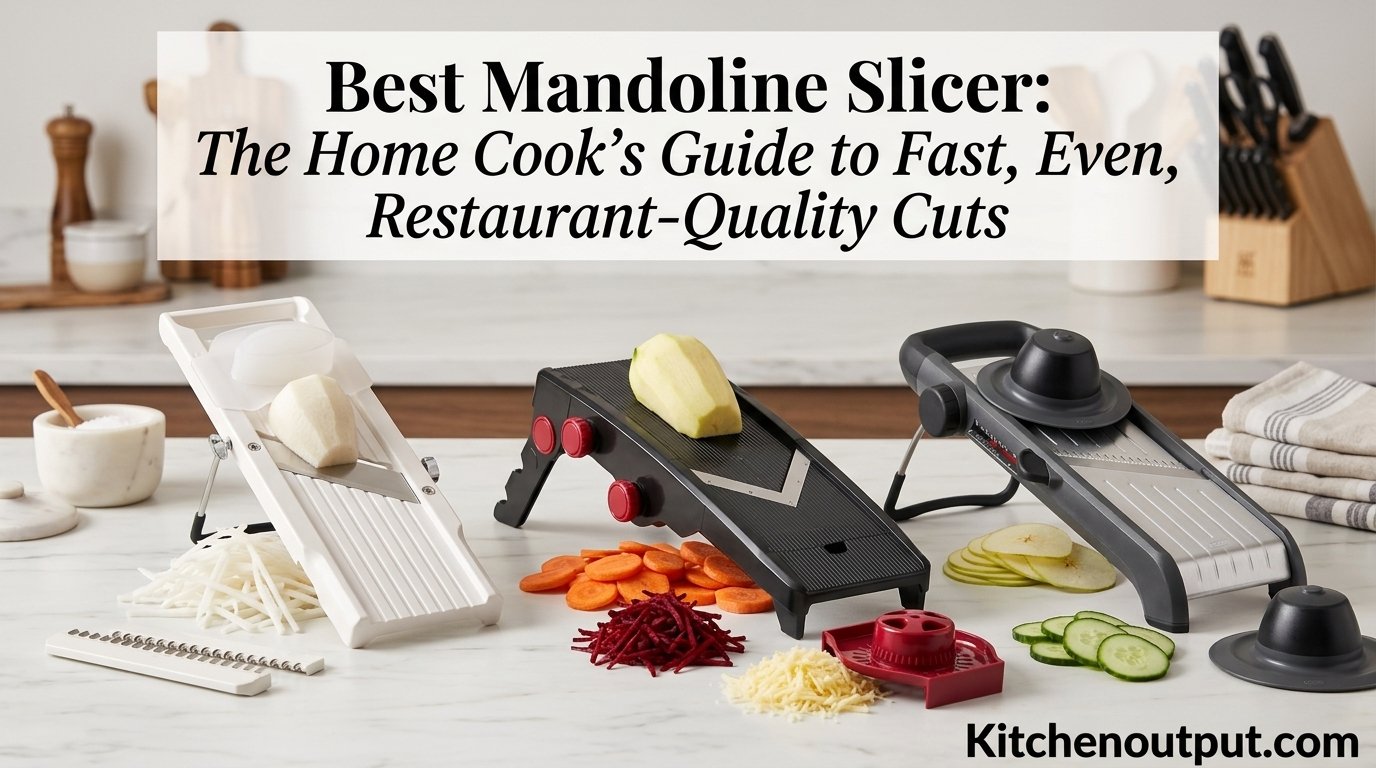
Best Mandoline Slicer: The Home Cook’s Guide to Fast, Even, Restaurant-Quality Cuts
A mandoline is one of those tools that quietly changes how you cook. Once you’ve sliced a potato paper-thin in four seconds flat, or fanned a cucumber into a perfect gratin pattern without a single uneven edge, going back to a chef’s knife for the same job starts to feel like using a rotary phone. But not every mandoline on the market deserves a spot on your counter, and picking the wrong one is a fast way to end up with a drawer clutterer or, worse, a trip to urgent care. This guide breaks down the best mandoline slicers available right now, how they stack up against each other, and everything you need to know before you buy one.


Check Current Price →
What a Mandoline Actually Does (and Why It’s Worth Owning One)
A mandoline slicer is, at its core, a stationary blade mounted in a frame that you drag food across, rather than a blade you move through food. That single difference in mechanics is what makes it so much more consistent than a knife. When you slice with a knife, even a very good one, your wrist angle, blade pressure, and cutting speed all vary slightly from stroke to stroke. A mandoline removes almost all of that variability. The blade is fixed at a set thickness, the food travels along a guide track or ramp, and every single slice comes out essentially identical to the one before it.
That consistency matters more than it might seem. Uneven potato slices cook unevenly — some pieces turn to mush while others stay crunchy in the center of a gratin. Salad vegetables sliced thick in some spots and paper-thin in others don’t dress evenly, so some bites are overwhelmingly acidic while others taste bare. Pickling and fermenting projects depend on uniform surface area to cure predictably. A mandoline solves all of these problems in one motion, and it does it dramatically faster than a knife could manage the same task.
The trade-off, and it’s a real one, is that a mandoline blade is usually sharper and more exposed than a kitchen knife blade, which means the margin for error when your fingers get close to it is smaller. That’s why hand guards, non-slip feet, and thoughtful design matter so much when you’re comparing models — we’ll get into that in detail further down.
If you’re weighing a mandoline against buying a quality knife set instead, the honest answer is that you probably want both. A sharp chef’s knife handles the tasks a mandoline can’t — dicing, mincing, breaking down proteins — while the mandoline takes over the repetitive, high-volume slicing work that a knife does slowly and inconsistently by comparison.
Quick Comparison Table: Best Mandoline Slicers at a Glance
Before diving into the full reviews, here’s a fast side-by-side look at how these seven mandolines compare on the factors that matter most: blade adjustability, build material, hand-guard design, and who each one is really built for.
| Model | Frame Material | Blade Adjustment | Hand Guard | Best For |
|---|---|---|---|---|
| OXO Good Grips Chef’s Mandoline Slicer 2.0 | Plastic body, stainless blades | Dial, multiple thickness settings | Full food holder with grip pad | Everyday home cooks wanting versatility |
| Mueller Austria Mandoline Slicer | Plastic body, stainless blades | Dial with 5+ preset thicknesses | Removable food holder | Budget-conscious buyers, meal preppers |
| Benriner Japanese Mandoline Slicer | ABS plastic, Japanese steel blade | Screw-adjustable single blade | Separate hand guard (sold as accessory) | Precision cooks, sushi/garnish prep |
| Dash Safe Slice® Mandoline | Plastic body | Simple 2-setting dial | Enclosed cage-style guard | Safety-first first-time buyers, families |
| Microplane Adjustable Mandoline Slicer | Compact plastic frame | Adjustable slicing gauge | Built-in finger guard | Small kitchens, minimal storage space |
| OXO Good Grips Handheld Mandoline Slicer | Handheld plastic frame | Fixed/limited thickness | Integrated handle-guard combo | Small jobs, garnishes, travel/RV kitchens |
| Swissmar V-Prep™ Mandoline Slicer | Plastic frame, V-shaped blade set | Interchangeable inserts | Food pusher/holder | Julienne, waffle-cut, and specialty cuts |
Every model above earns its spot for a different reason, which is exactly why “best” depends heavily on what you actually cook. Keep that comparison table in mind as you read through the individual breakdowns below — the right mandoline for a weeknight-salad household looks very different from the right mandoline for someone doing serious pickling or garde-manger work.
How We Chose These Mandoline Slicers
Not every mandoline that shows up in a search result deserves a recommendation, so before naming favorites it’s worth being upfront about the criteria that actually separated the good ones from the mediocre ones.
- Slicing consistency: Does the blade produce genuinely even slices across a range of vegetable densities, from soft tomatoes to dense sweet potatoes?
- Hand and finger safety: Is the guard actually usable, or does it feel like a box-ticking accessory that gets abandoned after the first use?
- Stability during use: Does the base grip the counter, or does the whole unit skate around while you’re pressing down on food?
- Blade sharpness and durability: Are the blades stainless steel or carbon steel, and do they hold an edge after repeated use?
- Ease of cleaning: Can it go in the dishwasher, and if not, how much of a hassle is hand-washing around the blade?
- Storage footprint: Does it fold flat, stack easily, or take up disproportionate drawer space for what it does?
- Value relative to price: Is the build quality proportional to the cost, or are you paying a premium for a brand name alone?
We weighed each of these factors against real-world kitchen tasks — julienning carrots for a slaw, slicing potatoes for a gratin, shaving fennel paper-thin for a salad — rather than just looking at spec sheets. That’s the lens the reviews below are written through.
See Price on Amazon →
In-Depth Reviews: The Best Mandoline Slicers, One by One
Here’s the detailed breakdown of each mandoline, including who it’s actually built for, where it shines, and where it falls short. If you already know your priorities — budget, safety, precision, or storage space — jump to the model that matches and read that section closely.

OXO Good Grips Chef’s Mandoline Slicer 2.0
OXO has built a reputation on kitchen tools that feel obviously well thought-out, and this mandoline is a good example of why. The V-shaped stainless blade sits in a sturdy plastic frame with rubberized feet that genuinely grip a countertop instead of skating around under pressure, which is one of the most common complaints with budget mandolines. The dial-based thickness adjustment moves through a wide enough range to go from paper-thin cucumber ribbons to thick steak-fry-style potato planks without swapping any parts.
What separates this model from a lot of the competition is the food holder. It’s a full-coverage grip pad with a spike plate that locks into whatever you’re slicing, so your hand never gets anywhere close to the blade during normal use — even toward the end of a vegetable, which is historically the most dangerous part of any mandoline pass. The julienne blade attachment produces genuinely restaurant-quality matchstick cuts, and the whole unit disassembles for cleaning without needing tools.
If you already own OXO’s kitchen knives, this mandoline fits the same design language — comfortable grips, thoughtful safety details, and a build quality that’s noticeably better than the price point suggests. It’s not the cheapest option here, but for most households it’s the one that gets pulled out of the drawer the most often, which is ultimately the best measure of whether a kitchen tool was worth buying.
Pros
- Excellent hand guard that’s actually comfortable to use
- Wide thickness range on one dial
- Non-slip feet keep it stable during heavy use
- Dishwasher-safe components
Cons
- Bulkier to store than simpler models
- Julienne blade attachment sold separately on some bundles

Mueller Austria Mandoline Slicer
The Mueller Austria mandoline consistently shows up as one of the best value options in this category, and it’s easy to see why once you use it. For a fraction of the price of premium models, it delivers five or more adjustable thickness settings, multiple julienne and grating inserts, and a sturdy enough frame that it doesn’t feel like a toy despite the low cost.
The blade quality is genuinely impressive for the price bracket. It’s German-engineered stainless steel that stays sharp through repeated use on dense root vegetables, which is often where cheaper mandolines start to struggle and require more downward pressure to force a clean cut. That extra pressure is exactly what tends to cause slips, so the fact that Mueller’s blade cuts cleanly with minimal effort is a meaningful safety plus, not just a convenience one.
It comes with a food holder for the bulk of the work, but it’s worth noting the holder isn’t quite as substantial as the OXO’s — it covers the top of the food but doesn’t lock in from the sides as securely, so it rewards a bit more attentiveness during the final few slices of any vegetable. For anyone stocking a kitchen on a budget, or looking for a reliable backup mandoline alongside Mueller’s V-Pro 5-blade version for heavier prep days, this is an easy recommendation.
Pros
- Outstanding value for the number of included blades
- Sharp stainless steel that cuts with light pressure
- Compact enough for smaller kitchens
- Includes storage case for blades
Cons
- Food holder grip is less secure than premium models
- Adjustment dial can feel slightly loose over time

Benriner Japanese Mandoline Slicer
If professional kitchens have a default mandoline, it’s usually this one. The Benriner has been a staple behind restaurant lines for decades, and once you use it, the reasons are obvious — the single carbon or stainless blade is exceptionally sharp straight out of the box and stays that way far longer than most Western mandolines, thanks to the quality of Japanese steel.
Adjustment happens through a small screw underneath the blade rather than a dial, which sounds fussier but actually allows for far more precise thickness control — the kind of precision that matters for tasks like katsuramuki-style daikon ribbons or perfectly uniform cucumber for pickling. The frame itself is lightweight ABS plastic, which keeps the whole unit easy to store but also means it’s not quite as rock-solid on the counter as the heavier OXO or Mueller models.
The one thing to know before buying: the hand guard on the base Benriner package is fairly minimal, and many serious users buy the specialized finger guard as a separate accessory rather than relying on the included one. This isn’t a knock against the tool itself so much as an honest heads-up — this is a mandoline built by and for people who already respect blade safety, not a first-timer’s model. Pair it with a set of cut-resistant gloves and it becomes one of the most precise, most satisfying tools in the kitchen.
Pros
- Exceptionally sharp Japanese steel blade
- Precise screw-adjustable thickness control
- Lightweight and easy to store
- Trusted by professional chefs
Cons
- Minimal included hand guard — a proper guard is highly recommended
- Lighter frame can shift on smooth countertops
- Steeper learning curve for beginners

Dash Safe Slice® Mandoline
Dash built this mandoline around a single, clear priority: reducing the chance of a slip anywhere near the blade. The enclosed cage-style guard fully surrounds the cutting area, so instead of pressing a food holder down onto an exposed blade, your food travels through a semi-enclosed chute that keeps fingers well away from the cutting edge at every stage of the slice.
That design choice does come with a trade-off — the range of cuts is more limited than a full-featured mandoline like the OXO or Swissmar, and the thickness settings are simpler (typically two options rather than a wide adjustable dial). But for households with less mandoline experience, or anyone who has been hesitant to buy one because of horror stories about mandoline injuries, this is the model that removes the most anxiety from the process.
It’s also noticeably lighter and more compact than most of the other options on this list, which makes it a strong secondary mandoline even for experienced cooks who want a low-stakes option for quick jobs like slicing cucumbers for a snack or onions for a quick pico de gallo, without setting up a more involved slicing station.
Pros
- Enclosed guard design significantly reduces injury risk
- Very approachable for first-time mandoline users
- Lightweight and compact for storage
- Simple, low-learning-curve operation
Cons
- Limited thickness settings compared to premium models
- Not ideal for julienne or specialty cuts

Microplane Adjustable Mandoline Slicer
Microplane is best known for graters, and that pedigree shows in how sharp and well-finished the blade on this mandoline is. What really sets it apart, though, is the footprint — this is one of the smallest full-function mandolines available, which makes it a genuinely good fit for apartment kitchens, RVs, or anyone with limited drawer space who still wants adjustable-thickness slicing.
The adjustable gauge lets you dial in thickness from very thin to moderately thick, and the built-in finger guard folds compactly against the frame for storage rather than being a separate piece you can lose in a drawer. That integrated design is a small but genuinely useful detail — a lot of guards get set aside after a few uses simply because they’re an extra loose part to keep track of, and Microplane’s approach removes that friction.
Where it gives something up is stability and capacity. The smaller frame means less surface contact with the counter, so on tile or textured surfaces it can shift slightly during firmer cuts, and the compact size means you’re working with smaller vegetables and fruit more comfortably than large items like whole cabbages or big squash. For someone whose priority is minimal storage footprint over maximum versatility, though, it’s hard to beat.
Pros
- Extremely compact and easy to store
- Sharp, well-finished blade
- Integrated fold-away finger guard
- Great for small kitchens and travel
Cons
- Less stable on smooth or textured counters
- Not well suited to large produce

OXO Good Grips Handheld Mandoline Slicer
This is a different category of tool from the frame-style mandolines above — it’s essentially a slicer you hold in one hand and drag across food that sits on a cutting board, more like a specialized peeler than a countertop appliance. That makes it far less versatile for high-volume slicing, but it earns its place for a different reason: speed of access.
There’s no setup involved. No dial to adjust, no frame to position over a bowl, no food holder to attach. You pull it out, run it across a cucumber or a block of parmesan, and put it away. For quick garnish work, shaving vegetables for a single salad, or jobs that don’t justify getting a full mandoline station out, it’s the fastest tool on this list to actually use.
The integrated handle doubles as a guard of sorts, keeping your slicing hand a reasonable distance from the blade, but because you’re controlling both the food and the blade with less mechanical assistance than a frame mandoline provides, it does require a bit more attentiveness, especially toward the end of whatever you’re slicing. It’s best thought of as a complement to a full-size mandoline rather than a replacement for one — the tool you grab for small jobs, while a frame-style model like the OXO Chef’s Mandoline handles the bigger prep sessions.
Pros
- Zero setup time — grab and go
- Very compact for storage
- Comfortable ergonomic handle
- Great for garnishes and small quantities
Cons
- Limited or fixed thickness options
- Not practical for large-batch slicing
- Requires more hand attentiveness near the end of a cut

Swissmar V-Prep™ Mandoline Slicer
Swissmar’s V-Prep is built around a V-shaped blade configuration and a set of interchangeable inserts, which together open up a wider range of specialty cuts than most of the other mandolines here manage. Beyond standard slicing, you get clean julienne, and with the right insert, waffle-style crinkle cuts that are otherwise hard to produce without a dedicated waffle-fry cutter.
The V-shaped blade geometry is worth understanding on its own, because it’s genuinely different from the straight-blade design most mandolines use. A V-blade cuts from the center outward in a shearing motion rather than pushing straight through the food all at once, which noticeably reduces the resistance you feel, especially on dense vegetables like sweet potato or butternut squash. Less resistance means less force needed, and less force needed means a lower chance of a slip.
The trade-off is that the interchangeable insert system, while versatile, means there are more small parts to track, store, and clean than a single fixed-blade mandoline. If you’re the type of cook who wants one tool that can do fry cuts, waffle cuts, and standard slicing without buying three separate gadgets, that trade-off is well worth it. If you’d rather have one simple blade and nothing to lose in a drawer, a simpler model like the Dash or the Benriner might suit you better.
Pros
- V-blade design reduces cutting resistance
- Interchangeable inserts for waffle and julienne cuts
- Sturdy food pusher included
- Great versatility in one tool
Cons
- More parts to store and keep track of
- Slightly steeper learning curve for insert swapping
Buying Guide: What to Actually Look For in a Mandoline Slicer
If none of the seven models above feels like an obvious match yet, or you’re comparing them against something else you found while shopping, here’s what actually matters when you’re evaluating a mandoline slicer on your own.
Blade Adjustability
The single biggest usability factor is how easily and precisely you can change slice thickness. A simple two-setting dial is fine for someone who mostly wants thin chips or thick fries and nothing in between. If you cook a wider variety of dishes — pickling one week, gratins the next, salads after that — a mandoline with a wide, finely graduated dial or screw adjustment earns its keep quickly.
Stability
A mandoline that slides around on the counter is both frustrating and dangerous, because instability is exactly what causes the blade to catch unevenly and pull your hand forward unexpectedly. Rubberized, non-slip feet are close to a non-negotiable feature. Heavier frames also tend to sit more securely than very lightweight ones, though that comes at the cost of storage convenience.
Hand Guard Quality
This is the feature people underrate the most and regret underrating the most. A hand guard that’s uncomfortable, awkward to attach, or doesn’t grip food securely gets abandoned within the first few uses — and that’s precisely when injuries happen. Look for a guard with a real grip surface (spikes or a textured pad) that locks onto food from multiple angles, not just a flat plastic paddle.
Blade Material
Stainless steel is the standard for a reason — it resists corrosion, holds an edge reasonably well, and is dishwasher-safe in most cases. Japanese carbon steel blades, like the one on the Benriner, get noticeably sharper and stay sharper longer, but require a bit more care to avoid rust if hand-drying isn’t immediate.
Storage Footprint
Frame-style mandolines with multiple blade inserts (like the Swissmar or Mueller) need a dedicated storage case or drawer space, while compact and handheld models slot easily into a utensil drawer. If kitchen storage is tight, weigh this factor more heavily than you might initially think to.
Price vs. Frequency of Use
A high-end mandoline that sits in a drawer because it feels intimidating to set up isn’t a good value regardless of its build quality. Be honest about how often you’ll realistically use it — someone doing weekly meal prep gets more return from a premium model than someone who slices cucumbers twice a year for a salad.
Check Price on Amazon →
Blade Types & Materials Explained
Not all mandoline blades are built the same way, and understanding the differences will help you make sense of why two mandolines at similar price points can feel completely different in use.
Straight Blades
The most common blade style, found on models like the Dash and the Mueller. A straight edge sits perpendicular to the frame, and food is pushed directly across it. Simple, effective, and easy to manufacture consistently, which is part of why it’s the default across most price ranges.
V-Shaped Blades
Used on the Swissmar V-Prep and several premium mandolines, a V-blade angles inward from both sides, cutting with a shearing motion rather than a straight push-through. This reduces resistance on dense vegetables and tends to produce cleaner edges on softer produce like tomatoes, since the shearing action is gentler than a straight push cut.
Single Fixed Japanese-Style Blades
The Benriner’s approach — a single, replaceable carbon or stainless blade set at a precise angle via a screw mechanism. These blades are typically the sharpest of the bunch out of the box and are prized in professional kitchens for exactly that reason, though they usually require more deliberate care to maintain that edge.
Interchangeable Insert Systems
Rather than one blade, some mandolines (again, the Swissmar and to a lesser extent the Mueller) use swappable inserts to switch between slicing, julienne, and specialty cuts like waffle fries. This adds versatility at the cost of more parts to store and track.
Stainless steel dominates the market because it resists rust and is broadly dishwasher-safe, but it’s worth knowing that carbon steel, while requiring more maintenance, typically takes and holds a sharper edge. If you already maintain carbon steel kitchen knives, the extra care a carbon steel mandoline blade needs — prompt drying, occasional light oiling — will already feel familiar.
Mandoline vs. V-Slicer vs. Food Processor: Which Tool Do You Actually Need?
It’s a common point of confusion, since all three tools can technically “slice” vegetables, but they’re built for genuinely different jobs.
A V-slicer is, in most casual usage, essentially a type of mandoline that uses a V-shaped blade — so the comparison is less “mandoline vs. V-slicer” and more a question of which blade geometry suits your cooking style, as covered in the blade section above. Where the real decision point comes in is choosing between a mandoline of any kind and a food processor with a slicing disc.
A food processor wins decisively on speed for large batches — feeding a whole bag of potatoes through a processor’s chute takes a fraction of the time a mandoline would need for the same volume, and it requires almost no manual technique. What it loses is precision and control. Processor slicing discs tend to produce slightly less uniform cuts than a good mandoline, especially on irregularly shaped vegetables, and they’re much harder to clean thoroughly given all the crevices in a processor bowl and lid.
A mandoline wins on precision, on producing genuinely paper-thin slices that a processor disc usually can’t match, and on being far easier to clean and store. It loses on speed for very large volumes and requires more hands-on attention throughout the process. If you’re regularly chopping large batches of vegetables for soups or big-batch cooking, a processor earns its keep. If your priority is precision cuts for salads, gratins, or garnish work, a mandoline is the better tool almost every time. Many serious home cooks end up owning both and simply reaching for whichever fits the task — a reliable food processor for volume, a mandoline for precision.
Safety Tips You Actually Need to Know
Mandolines have a reputation, not entirely undeserved, as one of the more injury-prone tools in a home kitchen. That reputation comes almost entirely from skipped safety steps rather than any inherent flaw in the tool itself. Follow these habits and the risk drops dramatically.
- Always use the hand guard, every single time — including for “quick” jobs. Most mandoline injuries happen during the last few slices of a vegetable, when the piece being held gets small enough that fingers start creeping closer to the blade without the guard in place.
- Check that the base is stable before you start slicing. Set it on a dry, flat, non-slippery surface, and confirm the feet are gripping before applying any real pressure.
- Don’t rush toward the end of a vegetable. When a piece gets too small to grip safely, even with the guard, set it aside for hand-cutting rather than forcing one more pass.
- Keep the blade dry and visible during cleanup. Mandoline blades are often the least visible sharp edge in a sink full of soapy water, which is a common source of accidental cuts that have nothing to do with the slicing itself.
- Consider cut-resistant gloves for extended sessions, especially with blade styles like the Benriner that ship with a more minimal guard. A pair of cut-resistant gloves adds a meaningful layer of protection during long pickling or fermenting prep sessions.
- Store blades separately from other utensils if they detach, so you’re not reaching blindly into a drawer and finding an exposed edge by touch.
- Read the specific guard instructions for your model. An enclosed cage-style guard like the one on the Dash Safe Slice works differently from a spike-plate holder like the OXO’s, and using either one incorrectly reduces its effectiveness significantly.
None of this is meant to make mandolines sound scarier than they are — used correctly, they’re no more dangerous than a sharp chef’s knife, and arguably safer for repetitive slicing tasks precisely because the guard keeps your hand at a fixed, predictable distance from the blade the whole time.
Cleaning & Maintenance
A well-maintained mandoline stays sharp and safe for years; a neglected one gets dull, which paradoxically makes it more dangerous, since a dull blade requires more downward force to cut, and more force means less control.
Cleaning Right After Use
Starch and vegetable fibers dry onto a blade quickly and are far easier to remove immediately than after they’ve hardened. Rinse the blade under running water right after use, using a stiff brush rather than a sponge — a sponge that touches the blade edge is a real cut risk during cleanup.
Dishwasher vs. Hand Washing
Most stainless steel frame mandolines, including the OXO, Mueller, and Dash models, are dishwasher-safe on the top rack. Carbon steel blades, like the Benriner’s, generally should be hand-washed and dried immediately to prevent rust or discoloration. Always check the specific model’s care instructions, since blade inserts and frames sometimes have different care needs even on the same unit.
Drying and Storage
Dry blades thoroughly before storing them, especially carbon steel ones. A light coating of neutral cooking oil on a carbon steel blade before long-term storage helps prevent rust between uses.
Sharpening
Most mandoline blades aren’t designed to be sharpened at home the way a kitchen knife is — the flat, embedded mounting makes it awkward to use a whetstone or honing rod safely. When a blade dulls significantly, replacement is usually the standard approach, and many models sell replacement blades separately rather than requiring a whole new unit.
Storage & Space-Saving Tips
Mandolines can be awkward to store simply because of their shape — long, flat, and often paired with loose blade inserts that are easy to misplace. A few habits make a real difference.
- Keep multi-insert models like the Swissmar or Mueller in their included storage case rather than loose in a drawer, both for organization and to avoid accidental contact with exposed blade edges.
- Mount a hook inside a cabinet door for frame-style mandolines that don’t fold flat — it keeps them accessible without eating into drawer space.
- Compact models like the Microplane are genuinely drawer-friendly on their own, but a dedicated blade sleeve or the original packaging insert still helps protect the edge from dulling against other utensils.
- If you’re short on dedicated kitchen storage generally, a broader look at kitchen tools and equipment organization can help you figure out where a mandoline realistically fits alongside everything else competing for drawer space.
Who Should (and Shouldn’t) Buy a Mandoline Slicer
A mandoline isn’t a universal must-have the way a chef’s knife or a cutting board is, so it’s worth being honest about who actually benefits from owning one.
You’ll Likely Get Real Use Out of One If…
- You cook potato-based dishes like gratins, scalloped potatoes, or homemade chips regularly and want consistent, even cooking.
- You make salads often and want professionally uniform vegetable ribbons or shavings.
- You pickle or ferment vegetables and need consistent surface area for even curing.
- You meal prep in bulk and want to cut slicing time down dramatically compared to knife work.
- You’re interested in presentation-focused cooking where uniform, thin cuts matter visually.
You Might Not Need One If…
- Your cooking rarely calls for thin, uniform slices in the first place.
- You have limited kitchen storage and already own a food processor with a slicing attachment that covers most of the same ground for your needs.
- You’re not comfortable following safety steps consistently, since a mandoline used carelessly is genuinely riskier than a knife used carelessly.
If you fall into the first group, even a budget-friendly option like the Mueller Austria or the compact Microplane will likely earn its keep within the first few uses. If your needs are more occasional, a handheld model like the OXO handheld slicer might make more sense than a full-size frame mandoline that ends up gathering dust.
Tools That Pair Well With a Mandoline
A mandoline rarely operates in isolation — it usually fits into a broader prep workflow alongside a few other tools.
- A quality chef’s knife: for the dicing, mincing, and irregular cuts a mandoline can’t handle. If you’re building out a kitchen from scratch, a beginner-friendly knife set covers the gap nicely.
- Cut-resistant gloves: especially valuable for extended slicing sessions or blades with minimal guards, like the Benriner’s. See our breakdown of cut-resistant and heat-resistant glove options.
- A food processor: for high-volume chopping tasks that don’t need mandoline-level precision. Our food processor reviews cover the models that pair best with a slicing-focused kitchen.
- Large mixing bowls: for tossing freshly sliced salad vegetables or marinating sliced produce right after cutting — see our guide to mixing bowls if you’re building out that part of your kitchen too.
- A general kitchen appliance plan: if you’re outfitting a kitchen more broadly, our kitchen appliance buying guide puts a mandoline’s cost and utility in context against everything else on a typical shopping list.
Frequently Asked Questions
Is a mandoline slicer worth buying if I already own a food processor?
Yes, for most cooks — the two tools solve different problems. A food processor is faster for large volumes but less precise, while a mandoline produces thinner, more uniform slices and is generally easier to clean thoroughly. If your cooking regularly calls for paper-thin or perfectly even cuts, a mandoline earns its own drawer space even alongside a good processor.
What’s the safest type of mandoline for a first-time buyer?
Models with an enclosed or cage-style guard, like the Dash Safe Slice, tend to be the most forgiving for beginners because the design keeps fingers away from the blade throughout the entire slicing motion, not just at the start. A full-coverage food holder with a spike plate, like the one on the OXO Chef’s Mandoline, is the next best option.
Can mandoline slicers go in the dishwasher?
Most stainless steel frame mandolines are dishwasher-safe on the top rack, but always check the specific model’s instructions first. Carbon steel blades, like the Benriner’s, are generally better hand-washed and dried immediately to prevent rust or discoloration.
What’s the difference between a mandoline and a V-slicer?
In everyday use, a “V-slicer” typically refers to a mandoline that uses a V-shaped blade rather than a straight one, which cuts with a shearing motion and tends to require less downward force on dense vegetables. It’s a blade geometry distinction more than an entirely separate category of tool.
How thin can a mandoline actually slice?
Most adjustable mandolines can achieve slices down to roughly 1mm or thinner at their finest setting, which is difficult to replicate consistently with a knife. Precision models like the Benriner, with its screw-adjustable single blade, are especially well suited to very fine, near-translucent slices.
Do I need to buy cut-resistant gloves with my mandoline?
They’re not strictly required if your mandoline has a strong hand guard that you use consistently, but they add meaningful protection, especially for long prep sessions or models with more minimal included guards. Many experienced users treat gloves as a standard part of their mandoline setup rather than an optional extra.
Why does my mandoline slice unevenly on soft vegetables like tomatoes?
Soft, high-moisture produce like tomatoes tends to compress under a straight blade before it cuts cleanly through, which can cause uneven or torn slices. A V-shaped blade, which shears rather than pushes straight through, generally handles soft produce more cleanly than a straight blade does.
How do I know when a mandoline blade needs replacing?
If you notice you’re pressing significantly harder than you used to for the same cut, or slices are coming out torn or ragged rather than clean, the blade has likely dulled. Since most mandoline blades aren’t designed for at-home sharpening, replacement blades — sold separately for most models — are the standard fix.
Are handheld mandolines as effective as full-size frame mandolines?
For small jobs like garnishes or single-serving prep, yes — handheld models like the OXO handheld slicer are fast and convenient. For larger batches or a wider range of thickness settings, a full-size frame mandoline is generally more capable and more comfortable to use over an extended session.
What vegetables should I avoid slicing on a mandoline?
Very small or irregularly shaped produce, like whole garlic cloves or small Brussels sprouts, can be genuinely difficult to hold safely against a mandoline blade even with a guard. These are typically better handled with a knife, where you have more direct control over a small, awkward shape.
Do more expensive mandolines actually cut better than budget ones?
Not always dramatically, but there are real differences in blade steel quality, adjustment precision, and how well the hand guard is designed. A budget option like the Mueller Austria performs impressively for its price, while premium options tend to differentiate themselves more through refinement, durability, and safety features than raw cutting ability alone.
How do I store mandoline blades safely between uses?
Keep detachable blades in their original storage case or a dedicated sleeve rather than loose in a utensil drawer, both to protect the edge from dulling against other tools and to avoid accidentally reaching into a drawer and finding an exposed blade by touch.
Final Recommendation
There isn’t a single “best” mandoline slicer for everyone, but there is a best mandoline slicer for your specific kitchen, and hopefully this guide made that choice clearer. For most home cooks who want one versatile, safe, well-built option, the OXO Good Grips Chef’s Mandoline Slicer 2.0 is the easiest overall recommendation — it balances adjustability, stability, and a genuinely usable hand guard better than almost anything else at its price point. If budget is the deciding factor, the Mueller Austria Mandoline Slicer delivers surprisingly strong performance without the premium price tag. Cooks chasing professional-level precision should look hard at the Benriner, while anyone prioritizing beginner-friendly safety will do best with the Dash Safe Slice.
Whichever model you land on, the biggest factor in getting real value out of a mandoline isn’t the brand — it’s consistent use of the hand guard and a stable, dry surface every single time you slice. Get those two habits right, and any of the seven mandolines covered here will earn a permanent spot in your kitchen rotation.
Shop Our Top Pick on Amazon →


