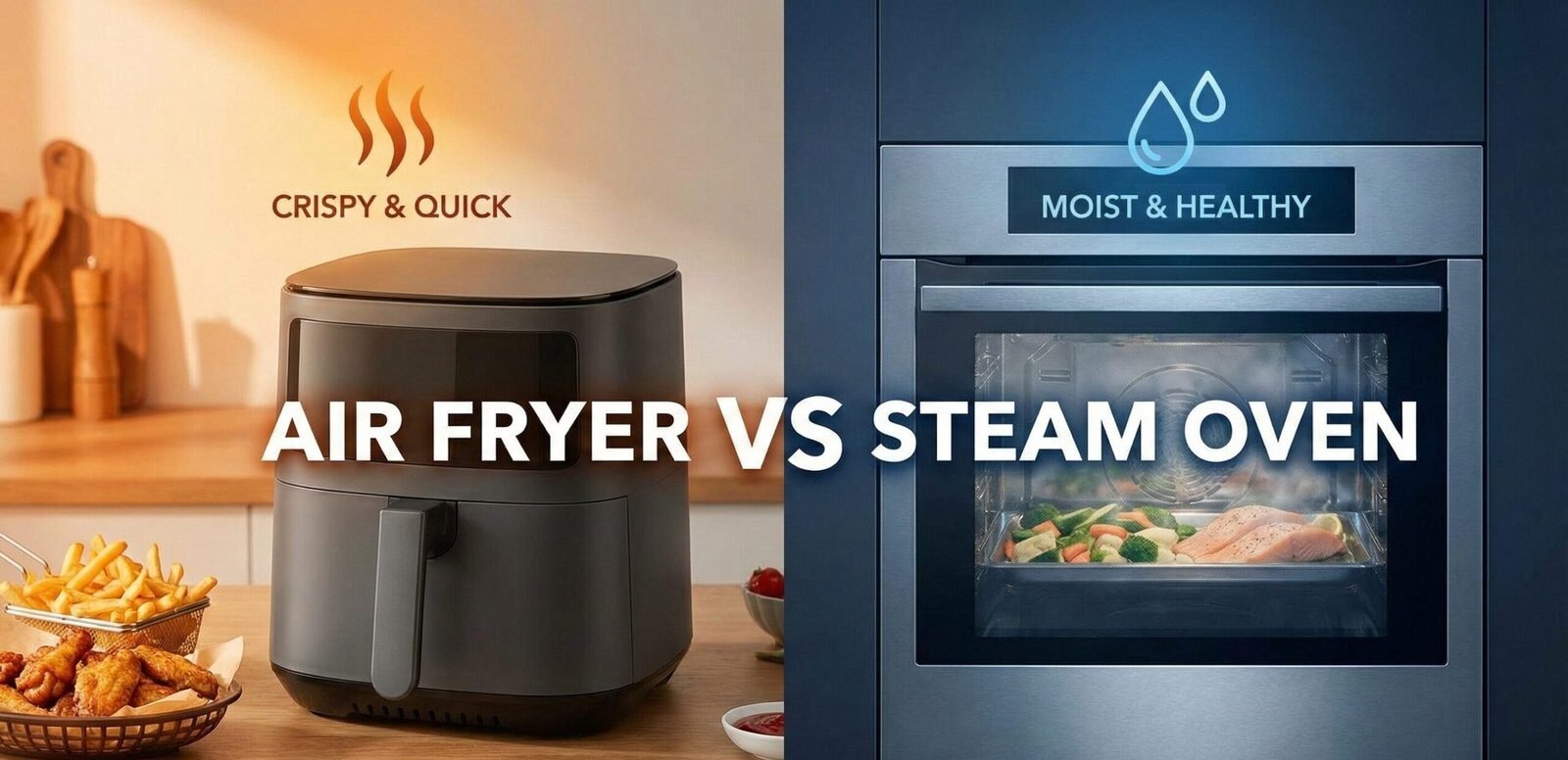
Air Fryer vs. Steam Oven: The Battle of Crisp vs. Moist
In the modern quest for healthier, faster cooking, two appliances have risen to the top of the food chain: the aggressive, high-speed Air Fryer and the gentle, precision-based Steam Oven.
Choosing between them isn’t just about budget; it’s about physics. Do you want superheated dry air that mimics deep frying, or do you want superheated moisture that preserves cellular structure? It is the culinary equivalent of a sauna versus a steam room.
If you are torn between the promise of guilt-free french fries and the allure of perfectly tender vegetables, this guide breaks down the science, the flavor profiles, and the practicality of both.
The Air Fryer: The King of Crunch
An air fryer is essentially a compact, turbo-charged convection oven. It works by blasting food with hot air (up to 400°F/200°C) circulated by a high-speed fan. This rapid air movement strips away surface moisture, creating the Maillard reaction—that browning process that equals flavor.
Why People Love It
- Texture: It is the only non-oil method that creates a genuine “crunch.”
- Speed: Because the chamber is small, it preheats almost instantly.
- Versatility: From reheating pizza to baking muffins, its range is surprising. You can read our full guide on what you can cook in an air fryer for some unexpected ideas.
The downside? It can be drying. If you are not careful with lean meats like chicken breast, they can turn into leather quickly because the air fryer is actively dehydrating your food as it cooks.

The Steam Oven: The Nutrient Preserver
A steam oven (or convection steam oven) boils water from a reservoir to fill the cooking cavity with hot steam. Unlike boiling food in a pot, the steam surrounds the food gently, cooking it evenly without leaching flavor into the water.
Why People Love It
- Moisture: It is impossible to dry out food. Chicken stays impossibly juicy; fish turns out buttery and flaky.
- Reheating: This is the steam oven’s secret weapon. It revitalizes leftovers (pasta, rice, meats) by injecting moisture back into them, making them taste freshly cooked rather than “nuked.”
- Vibrancy: Vegetables retain their bright colors and snap, rather than turning brown or mushy.
The downside? No crunch. Pure steam cannot brown food because water boils at 212°F (100°C), which is below the threshold needed for the Maillard reaction (roughly 300°F). If you try to cook frozen fries in a steam oven, you will get soggy potato sticks.

Head-to-Head Comparison
To truly understand the difference, we need to look at the mechanism of heat transfer. For a technical breakdown of fan-forced heat, check out our comparison of the air fryer vs. convection oven.
| Feature | Air Fryer | Steam Oven |
|---|---|---|
| Heat Mechanism | Dry, Rapid Air (Convection) | Wet, Hot Vapor (Steam) |
| Primary Goal | Crisping and Browning | Hydrating and Tenderizing |
| Max Temperature | 400°F+ (High) | 212°F (Steam) / Higher (Hybrid) |
| Speed | Very Fast | Moderate |
| Best For | Fries, Wings, Roasting Veggies | Fish, Rice, Custards, Reheating |
| Maintenance | Easy (Wipe basket) | Moderate (Descale water tank) |
Health & Nutrition
Both appliances claim the “healthy” title, but for different reasons.
The Air Fryer is healthy because of what it removes: oil. It allows you to mimic the taste of fried food with up to 85% less fat. If you are watching your calorie intake or managing cholesterol, this is a massive benefit. You can read more about the specific health benefits of using an air fryer here.
The Steam Oven is healthy because of what it retains: nutrients. High heat and water submersion (boiling) can destroy water-soluble vitamins like Vitamin C and B. Steam cooks gently, preserving the vitamin content and minerals within the vegetables.
Versatility & Workflow
Ideally, a modern kitchen would have both. But if you have space for only one, consider your diet.
If you live on “brown food”—roasted chicken, potatoes, toast, leftovers that need crisping—the air fryer is indispensable. It replaces the toaster, the deep fryer, and often the microwave.
However, if you do a lot of meal prep involving grains, seafood, and delicate greens, the steam oven is superior. It is also much more forgiving; it is hard to overcook broccoli in a steamer, but very easy to burn it in an air fryer.

Energy Use & Running Costs
Sticker price is only half the financial story with any countertop appliance. The other half shows up quietly on your electricity bill every month, and it’s a question we get asked constantly: does an air fryer or a steam oven cost more to run?
Most air fryers draw somewhere between 1,400 and 1,800 watts, which sounds like a lot until you remember that a cook cycle rarely lasts more than 20 minutes. Steam ovens, by contrast, typically pull 1,200 to 1,600 watts, but because they need time to bring water to a rolling boil and then maintain that vapor throughout the cook, sessions often stretch to 30 or 40 minutes for a full meal. When you multiply watts by hours, the numbers land closer together than most people expect.
Breaking Down the Real Numbers
Let’s do the math on a typical dinner. An air fryer running at 1,500 watts for 20 minutes uses about 0.5 kilowatt-hours (kWh). At a national average residential rate of roughly 16 cents per kWh, that’s about 8 cents per meal. A steam oven running at 1,400 watts for 35 minutes uses closer to 0.82 kWh, or about 13 cents per meal. Over a year of five dinners a week, that gap adds up to somewhere between $10 and $20—not enough to be the deciding factor for most households, but worth knowing if you’re cooking for a large family multiple times a day.
Where the calculation shifts dramatically is with reheating. A steam oven reheating a plate of leftovers usually only needs 5 to 8 minutes because it doesn’t need to build up a full head of steam for small portions in many models, especially those with rapid boilers. An air fryer reheating the same plate might take 10 to 12 minutes to get everything hot without burning the edges. In that specific use case, the steam oven can actually be the more efficient appliance.
Standby Power and Smart Features
Don’t overlook standby draw either. Wi-Fi-connected steam ovens and smart air fryers with always-on displays or app connectivity sip a small amount of power around the clock—usually under 2 watts, but it accumulates over a year. If you’re trying to squeeze every cent out of your utility bill, unplugging the unit between uses or choosing a model with a genuine off switch rather than a standby mode is a simple fix.
Compared to a full-size electric wall oven, both countertop devices are dramatically cheaper to run. A conventional oven can draw 2,000 to 5,000 watts and needs 10 to 15 minutes just to preheat before you even start cooking. If your household frequently cooks small portions—one or two servings rather than a family-style tray—switching from the big oven to either an air fryer or steam oven for weeknight meals is one of the easiest ways to trim your kitchen energy costs without changing your diet at all.
Capacity & Household Size
Capacity is where marketing claims and real-world usability often diverge. A “6-quart” air fryer basket sounds spacious, but once you factor in the airflow clearance food needs to crisp evenly, the usable capacity is often 30% smaller than the stated volume.
Cooking for One or Two
Singles and couples are usually well served by a 4 to 6-quart air fryer basket or a compact countertop steam oven in the 15 to 20-liter range. At this size, both appliances preheat quickly and a single cook cycle covers an entire meal—a chicken breast and a handful of vegetables, or a portion of salmon with rice. Anything larger becomes dead weight taking up counter space that a small household will rarely use to its full potential.
Cooking for a Family of Four or More
Here is where the two appliances diverge sharply. Air fryers hit a capacity ceiling fast. Even an 8-quart basket-style unit can typically only fit one layer of chicken thighs or a single tray of fries without needing to cook in batches, since overcrowding blocks airflow and ruins the crisping effect entirely. Families who cook air-fried meals in bulk usually end up buying a dual-basket or dual-zone model, or simply accepting that dinner comes out in two rounds.
Steam ovens, especially the larger 24 to 30-liter countertop models and full built-in units, handle multi-rack cooking far more gracefully. Because steam surrounds food from every angle rather than relying on directed airflow, you can stack multiple trays of vegetables, proteins, and grains simultaneously without the same crowding penalty. A built-in steam oven paired with a full-size wall oven is a genuinely popular setup in larger households precisely because it lets you cook three or four components of a meal at once without juggling batches.
Matching Capacity to Your Actual Cooking Habits
Before buying based on quart or liter size alone, think about your typical dinner. If you regularly cook a whole chicken, a large roast, or a big batch of vegetables for meal prep, look at the internal rack dimensions and clearance height listed in the product specs, not just the advertised capacity number. Many buyers are surprised to find that a whole chicken barely fits in a “large” air fryer basket, while the same bird sits comfortably on a steam oven rack with room to spare.
Built-In vs. Countertop Steam Ovens
Air fryers are almost universally countertop appliances, but steam ovens split into two distinct categories that suit very different kitchens and budgets.
Countertop Steam Ovens
A countertop steam oven, like the Tovala mentioned earlier in this guide, is a self-contained unit with its own water reservoir that you fill manually before each use, or top off periodically depending on the tank size. These units are ideal for renters, apartment dwellers, or anyone who wants to try steam cooking without committing to a kitchen renovation. Installation is as simple as plugging it in and finding counter space, and most models can be unplugged and stored away or taken along during a move.
The tradeoff is manual water management. Depending on tank size and how much steaming you do, you may need to refill the reservoir every one to three uses, and you’ll need to empty any collected condensation from a drip tray after cooking.
Built-In Steam Ovens
Built-in steam ovens are installed into cabinetry, typically wired directly and, in higher-end installations, plumbed into your home’s water line so the unit never needs manual refilling. These are a significant investment, both in the appliance itself and in the installation labor, cabinetry modifications, and sometimes electrical or plumbing work required. But for a household that steams food daily, the convenience of a self-filling, self-draining unit that looks like a permanent part of the kitchen is hard to overstate.
Built-in units also tend to offer more precise humidity and temperature control, multi-rack cooking, and often a combi-steam function that adds convection heat for browning, effectively giving you a hybrid of everything discussed in this guide in one integrated appliance.
Which One Should You Choose?
If you’re renting, working with a small kitchen, or simply want to test whether steam cooking fits your lifestyle before making a bigger commitment, a countertop model is the sensible starting point. If you already know you love steamed and reheated food, cook for a larger household, and are renovating or building a kitchen from scratch, a built-in unit plumbed to your water supply removes the single biggest daily annoyance of steam cooking: remembering to refill the tank.
Cooking Proteins: A Deep Dive
Protein is where the air fryer versus steam oven debate becomes most personal, because the “right” answer depends entirely on the cut and your tolerance for dry versus soft textures.
Chicken
Bone-in, skin-on chicken thighs and wings are arguably the air fryer’s signature dish. The high, dry heat renders fat from the skin and crisps it to a genuine crackle in 20 to 25 minutes with almost no oil. Boneless, skinless chicken breast is a different story—it has very little fat to protect it, and the air fryer’s dehydrating effect can turn it tough and stringy if you’re not watching the clock closely. A steam oven, or a sous-vide-then-sear approach using a combi appliance, keeps chicken breast noticeably juicier, though you sacrifice the browned exterior unless you finish it under a broiler afterward.
Fish and Seafood
This is arguably the steam oven’s strongest category. Delicate fish like cod, halibut, and sea bass can go from perfectly cooked to overcooked and rubbery within a minute or two under any dry heat method, and the air fryer’s aggressive fan makes that margin for error even smaller. Steam cooks fish gently and evenly, keeping it flaky and moist, and it’s forgiving of a minute or two of extra time in a way that dry heat simply isn’t. Shellfish like mussels, clams, and shrimp also steam beautifully, essentially replicating a stovetop steaming pot without the mess.
Beef and Pork
Steaks, pork chops, and burgers benefit from the air fryer’s ability to sear the surface, though a cast-iron pan will always out-perform it for a true crust. For larger cuts like a pork shoulder or a roast, a steam oven (particularly a combi model) can hold a low, moist environment for hours, producing fall-apart tenderness similar to a slow cooker, then switch to dry heat at the end to crisp the exterior—a technique professional chefs call reverse searing with humidity control.
Eggs and Dairy-Based Proteins
Steam ovens excel at custards, poached eggs, and delicate egg dishes like chawanmushi, where gentle, even heat prevents the curdling and rubberiness that dry oven heat or microwaving can cause. Air fryers can bake a reasonable frittata or hard-boil eggs in their shells, but they’re not the tool of choice for silky, custard-style egg preparations.
Vegetables, Grains & Plant-Based Cooking
For anyone building more plant-forward meals, the choice between these two appliances often comes down to whether you’re chasing char or preserving color and nutrients.
Root Vegetables and Cruciferous Veggies
Potatoes, carrots, brussels sprouts, and cauliflower all thrive in an air fryer, developing caramelized, slightly charred edges that mimic roasting in a fraction of the time. Steam, on the other hand, keeps these vegetables’ colors bright and their textures snappy rather than caramelized—ideal if you’re serving a side dish that needs to look vibrant on the plate or if you’re cooking for someone who prefers a more delicate texture.
Leafy Greens
Delicate greens like spinach, bok choy, and Swiss chard wilt beautifully in a steam oven within a minute or two, retaining their nutrients and bright green color. These greens don’t fare well in an air fryer at all; the aggressive fan tends to blow lightweight leaves around the basket and dry them into brittle, unappetizing shards rather than cooking them evenly.
Grains, Rice, and Legumes
This is an area where steam ovens genuinely shine and air fryers can’t compete. Rice, quinoa, farro, and other grains cook far more evenly in a steam environment, largely eliminating the burnt bottom or undercooked center problems common with stovetop methods. Many steam ovens include dedicated presets for white rice, brown rice, and grain bowls, and some allow you to steam dried legumes without the lengthy pre-soak a stovetop method usually requires.
Vegan and Vegetarian Meal Prep
Plant-based cooks often find the ideal workflow uses both appliances for different components of the same meal: a steam oven for grains, legumes, and delicate vegetables, and an air fryer for crispy tofu, tempeh, chickpeas, or breaded plant-based proteins that need that signature crunch. Crispy air-fried chickpeas or tofu cubes tossed with a sauce make an excellent topping for a steamed grain bowl, combining the strengths of both cooking methods in a single dish.
Baking & Pastry Showdown
Baking pushes both appliances outside their comfort zones in different ways, and understanding those limits will save you a few ruined batches of cookies.
Air Fryer Baking
Small-batch baking works surprisingly well in an air fryer. Muffins, small cakes, and cookies made in appropriately sized pans bake evenly thanks to the circulating hot air, often finishing faster than a conventional oven. The tradeoff is capacity; you’re generally limited to a 6 to 8-inch pan, so this is a tool for personal-sized treats and small households, not a birthday cake for twenty guests. The strong airflow can also dry out delicate cakes if you don’t reduce the temperature slightly from a standard recipe, typically by about 25°F.
Steam Oven Baking
Where the steam oven pulls ahead is in bread. Professional bakeries inject steam into their ovens during the first few minutes of baking to delay crust formation, which allows the loaf to expand fully before setting—the phenomenon bakers call “oven spring.” A combi-steam oven at home can replicate this exact effect, producing bakery-quality crusty bread, baguettes, and artisan loaves that a standard home oven struggles to match without a Dutch oven or steam-injection workaround. Custards, cheesecakes, and other delicate desserts that are prone to cracking also benefit enormously from a humid baking environment, which prevents the surface from drying out and splitting.
The Verdict for Bakers
If you bake bread regularly and are serious about crust quality, a combi-steam oven is a genuine upgrade over a standard home oven, let alone an air fryer. If your baking needs are limited to the occasional batch of cookies or a small cake, the air fryer’s speed and energy efficiency make it a convenient secondary tool, but neither should be your only oven if baking is a significant part of your cooking routine.
Noise, Footprint & Kitchen Ergonomics
Countertop appliances live—quite literally—in your daily environment, so noise and physical footprint matter more than spec sheets typically convey.
Noise Levels
Air fryers rely on a high-speed fan to circulate hot air, and that fan is audible, often compared to the hum of a small vacuum cleaner or a box fan on a low setting. In an open-concept kitchen or a small apartment, running an air fryer during a quiet evening or while on a video call can be noticeably disruptive. Steam ovens are considerably quieter in comparison; the main sound you’ll hear is the occasional click of a heating element cycling and a faint hiss as steam vents, both far less intrusive than a rushing fan.
Counter Footprint
Air fryers are generally more compact for their cooking capacity, and their vertical, boxy shape tucks under most upper cabinets. Countertop steam ovens tend to be wider and deeper because they house a water reservoir and often a full oven-style cavity, so measure your available counter space carefully, particularly the clearance needed above the unit for steam venting, which some models require.
Placement Considerations
Because air fryers vent hot air out the back or top, they need a few inches of clearance on all sides to avoid melting nearby appliances or damaging cabinet finishes with prolonged heat exposure. Steam ovens vent actual water vapor, which can create condensation on nearby walls or cabinet undersides if placed in an enclosed nook, so a spot with reasonable airflow works best for either appliance. If your kitchen has limited counter space, consider a slide-out shelf or an appliance garage that keeps the unit accessible but out of the way when not in use.
Cleaning, Descaling & Maintenance
We touched on basic cleaning differences earlier, but the long-term maintenance routines for each appliance are different enough to deserve a closer look.
Air Fryer Maintenance
Most air fryer baskets and crisper trays are dishwasher safe or can be hand-washed with warm soapy water. The main maintenance task is keeping the heating element and fan housing free of grease buildup, which can smoke on subsequent uses if ignored. Wiping down the interior with a damp cloth every few uses and doing a deeper clean of the fan area every month or two with a soft brush prevents most long-term issues.
Steam Oven Descaling
Steam ovens have an additional maintenance requirement that air fryers don’t: descaling. As the unit boils water repeatedly, mineral deposits from tap water accumulate on the heating element and inside the water lines, a problem that’s worse in areas with hard water. Left unaddressed, scale buildup reduces steam production efficiency and can eventually damage the heating element entirely. Most manufacturers recommend a descaling cycle using a citric acid solution or a dedicated descaling product every 20 to 50 uses, and many modern steam ovens include a built-in indicator that alerts you when it’s time.
Using filtered or distilled water instead of straight tap water dramatically slows scale buildup and is a simple habit that extends the appliance’s usable life, particularly if you live somewhere with notably hard water.
Preventing Mold and Odors
Because steam ovens introduce moisture into an enclosed cavity, they’re more prone to mold or mildew if left damp and closed after use. Leaving the door slightly ajar after cooking to let the cavity air-dry, and wiping down the interior and door seal after each use, prevents the musty smell that can develop in units that aren’t dried out between cooking sessions.
Safety Considerations
Both appliances are generally safe for everyday home use, but each carries specific risks worth understanding, especially in households with children.
Air Fryer Safety
The exterior housing of most air fryers stays relatively cool to the touch thanks to insulated double walls, but the exhaust vent releases genuinely hot air and should never be blocked or placed near curtains, paper towels, or other flammable materials. Overfilling the basket with breaded or battered foods can cause loose crumbs to fall onto the heating element and smoke, so always check manufacturer guidance on maximum fill lines. Non-stick basket coatings can degrade over time with metal utensils or abrasive scrubbing, so using silicone or wooden tools extends both the coating’s life and the safety of the surface.
Steam Oven Safety
The most obvious risk with a steam oven is the vapor itself—opening the door immediately after a cook cycle releases a burst of genuinely scalding steam, so always step back and let steam clear for a few seconds before reaching in, and use oven mitts rather than bare hands. The water reservoir and heating element also involve standing water near electrical components, so it’s important to only use manufacturer-approved reservoirs and never bypass a unit’s built-in leak-detection safety features.
General Precautions for Both
Keep either appliance on a stable, heat-resistant surface, away from the edge of a counter where curious hands or pets could pull it down. Unplug both when not in use for extended periods, and never leave either running unattended for long stretches, even though both are designed with automatic shutoff timers as a backup safeguard.
Can Either Replace Your Conventional Oven?
This is one of the most common questions we get, especially from people renovating small kitchens or moving into apartments without a full-size range.
The Case for the Air Fryer as an Oven Replacement
For a single person or couple who mostly cooks smaller portions, an air fryer can genuinely replace a conventional oven for a large percentage of everyday meals: roasted vegetables, baked chicken, frozen convenience foods, and small-batch baking. Where it falls short is capacity for entertaining, large roasts, and multi-tray baking, so anyone who regularly hosts dinner parties or bakes in volume will still need occasional access to a full-size oven.
The Case for the Steam Oven as an Oven Replacement
A high-end combi-steam oven, especially a built-in model with a generous cavity, comes much closer to full oven replacement territory because it can bake, roast, and broil in addition to steaming. Its larger capacity compared to most air fryers means it can more comfortably handle a whole chicken, a sheet pan of vegetables, or multiple components of a meal simultaneously. Still, very few households eliminate their conventional oven entirely; most treat a combi-steam unit as the primary daily cooking hub while keeping a standard oven for occasional large-format cooking like a holiday turkey.
A Realistic Middle Ground
Rather than framing this as an all-or-nothing decision, think of both appliances as tools that dramatically reduce how often you need to fire up a large, energy-hungry oven for everyday meals. Audit your last two weeks of dinners: if the vast majority were single-tray meals for one to three people, either appliance can absorb most of that cooking, freeing your conventional oven for the handful of occasions each month that genuinely need its larger capacity.
Price Tiers & Budget Guide
Both categories span an enormous price range, and understanding what you get at each tier helps avoid both overspending and buyer’s remorse.
Entry-Level Air Fryers ($50–$100)
Basic single-basket models in this range handle the fundamentals well: fries, wings, and simple roasted vegetables. You’ll typically sacrifice smart presets, dual-zone cooking, and larger capacity, but for a first-time buyer testing whether air frying fits their lifestyle, this tier is a low-risk entry point.
Mid-Range Air Fryers ($100–$200)
This is the sweet spot for most households, where you find larger baskets, dual-zone cooking for preparing two dishes at different temperatures simultaneously, and digital presets for common foods. The Ninja model featured earlier in this guide sits comfortably in this range and represents the best balance of price and everyday usability.
Premium Air Fryers ($200+)
At the top end, you’re paying for multi-function versatility—units that combine air frying with a toaster oven, dehydrator, and rotisserie in one larger footprint. These make sense if you want to consolidate several appliances into one, but they lose some of the compact convenience that makes basic air fryers so appealing.
Entry-Level Countertop Steam Ovens ($150–$300)
Basic countertop steamers in this range handle straightforward steaming and reheating well but often lack combi-cooking modes for browning. They’re an excellent way to test whether steam cooking fits your routine before investing further.
Mid-Range Countertop Steam Ovens ($300–$600)
The Tovala and similar smart steam ovens in this guide’s mid-range typically add app connectivity, scan-to-cook technology, and genuine combi-steam baking modes, making them versatile enough to handle the bulk of daily cooking for a small household.
Premium Combi & Built-In Steam Ovens ($600–$3,000+)
At the top of the market, you’ll find units like the Anova Precision Oven featured above, alongside built-in wall units from major appliance brands that offer plumbed water lines, precise humidity control, and large multi-rack capacity. This tier is aimed at serious home cooks and households renovating a kitchen who want steam cooking integrated as a permanent fixture rather than a countertop add-on.
Longevity & Durability
How long either appliance lasts depends heavily on usage frequency, maintenance habits, and build quality, but there are some general patterns worth knowing before you buy.
Air Fryer Lifespan
A well-maintained mid-range air fryer used several times a week typically lasts three to five years before the heating element weakens or the fan motor begins to fail. The most common point of failure isn’t the electronics but the non-stick coating on the basket, which can degrade with metal utensils or harsh scrubbing well before the appliance itself stops working. Choosing a model with a ceramic-coated or ceramic ready-basket, and replacing baskets when the coating begins to flake, can extend the practical life of the unit significantly.
Steam Oven Lifespan
Countertop steam ovens have a similar three-to-five-year expectation under regular use, though units in hard-water areas without regular descaling often fail sooner due to scale buildup damaging the heating element. Built-in steam ovens, being a larger investment with sturdier commercial-grade components, often carry warranties of five to ten years and, with proper descaling maintenance, can remain functional for well over a decade—closer to the lifespan expected of a full-size wall oven than a small appliance.
Extending the Life of Either Appliance
Simple habits go a long way: avoid overloading either appliance beyond its rated capacity, clean grease and mineral deposits regularly rather than letting them accumulate, and avoid rapid temperature swings by letting the unit cool before wiping it down with water. Keeping the original manual on hand for manufacturer-specific care instructions, and registering your warranty at purchase, ensures you’re covered if a genuine defect does surface within the first few years.
Environmental Impact
Beyond your personal electricity bill, both appliances have a broader environmental footprint worth considering if sustainability factors into your kitchen decisions.
Reduced Oil Consumption
Air fryers meaningfully cut down on cooking oil consumption compared to deep frying, which reduces both the ongoing cost and the waste associated with disposing of used frying oil—a genuine environmental win for households that previously deep-fried regularly.
Water Usage
Steam ovens use a relatively small amount of water per cook cycle, typically well under a cup, making their water footprint minor compared to, say, boiling a large pot of water on the stovetop for the same dish. Where it matters more is mineral waste from descaling solutions, which are generally citric-acid based and safely disposed of down a standard drain.
Energy Efficiency at Scale
As covered earlier in this guide, both appliances are dramatically more energy-efficient than heating a full-size oven for small portions, and shifting everyday cooking away from a large oven toward either of these compact appliances is one of the more meaningful, low-effort ways a household can trim its kitchen energy footprint without changing what it eats.
Appliance Longevity as a Sustainability Factor
The most sustainable appliance is often simply the one that lasts the longest before ending up in a landfill. Investing in a durable, well-reviewed unit and maintaining it properly—descaling steam ovens regularly, replacing air fryer baskets rather than the entire unit when the coating wears out—reduces the churn of replacing appliances every few years, which has a larger cumulative environmental impact than the electricity or water used during actual cooking.
Combi Ovens & Troubleshooting Common Problems
For readers still on the fence, it’s worth revisiting the idea of a hybrid appliance in more depth, along with some of the everyday issues owners run into with each type.
Understanding Combi-Steam Technology
Combi ovens, like the Anova Precision Oven featured earlier, blend the two heating philosophies covered throughout this guide by letting you dial in humidity anywhere from 0% (pure dry convection, essentially air-fryer territory) to 100% (pure steam). The real magic happens in between: a 50% humidity setting, for example, can roast a chicken with a genuinely crisp skin while keeping the meat far juicier than dry heat alone would allow, because the ambient moisture slows surface dehydration without preventing browning entirely.
These units also commonly support multi-stage cooking programs—steam first to gently cook something through, then a dry convection blast at the end to crisp the exterior. This is precisely how professional kitchens finish items like rotisserie chicken and pork belly, and it’s a technique that’s difficult to replicate with a standalone air fryer or standalone steamer alone.
Common Air Fryer Problems and Fixes
Food coming out unevenly cooked is almost always an overcrowding issue; shake or flip food halfway through, and cook in batches rather than piling everything into the basket at once. Excessive smoke usually means grease has dripped onto the heating element, which a quick interior wipe-down resolves. If the unit shuts off unexpectedly, check that the basket is fully and correctly seated, since most models have a safety sensor that cuts power if it detects the basket isn’t locked in place.
Common Steam Oven Problems and Fixes
A steam oven that isn’t producing visible steam, or is producing noticeably less than usual, is often overdue for descaling—mineral buildup on the heating element reduces its ability to boil water efficiently. Water leaking from the door seal usually indicates the door gasket has worn down and needs replacing, a straightforward and inexpensive fix on most models. If food isn’t cooking evenly, check that the water reservoir was filled to the correct level before starting; an underfilled tank can cause the unit to run out of steam mid-cycle on longer cook times.
When to Call a Professional
For countertop units, most issues are user-serviceable following the manufacturer’s manual, and replacement parts like baskets, gaskets, and water reservoirs are typically available directly from the manufacturer. Built-in steam ovens with plumbed water lines are a different matter; any leak, electrical fault, or plumbing-related issue on a hardwired unit should be handled by a qualified appliance technician rather than attempted as a DIY repair.
Final Verdict
The battle between air fryers and steam ovens isn’t about which is “better”—it’s about “wet” vs. “dry.”
Buy an Air Fryer If:
- Texture is your priority (you love crunch).
- You cook a lot of frozen convenience foods.
- You want the fastest possible cooking times.
Buy a Steam Oven If:
- You cook delicate proteins like salmon or scallops.
- You want to reheat food without it tasting dried out.
- You prioritize nutrient density over texture.
If you are still undecided, you might look into Combination Ovens. These are essentially digital toaster ovens with air fry capabilities that sometimes include water reservoirs for steam injection, giving you the best of both worlds.
Frequently Asked Questions
No, never do this. Adding water to the basket of an air fryer can damage the fan and heating element. It will not create effective steam; it will just create white smoke and potential electrical hazards.
Yes, typically. Steam transfers heat efficiently, but air fryers generally operate at higher temperatures (400°F vs 212°F for steam), which cooks food faster, especially for small items.
A standard steam oven cannot make food crispy because moisture prevents browning. However, “Combi-Steam” ovens (which are more expensive) can switch between steam and dry convection heat to brown food after steaming it.
The air fryer is usually easier. Most baskets are dishwasher safe. Steam ovens require wiping down the cavity after every use to prevent mold, and the water lines need occasional descaling (removing mineral buildup).
Yes! Professional bakers inject steam into ovens to help bread rise (oven spring) and create a shiny crust. A steam oven is actually superior to an air fryer for baking artisan breads.
Air fryers usually cost less to run per session because cook times are short, even though wattage is similar to a steam oven. Over a week of daily use, the difference is usually just a few cents, but the air fryer’s shorter cycles give it a slight edge for quick weeknight meals.
For reheating, yes, and arguably better—steam restores moisture that a microwave strips away. But for raw speed on a single mug of cocoa or a bag of popcorn, a microwave is still faster.
If you are renovating a kitchen and cook daily, a built-in unit with a plumbed water line is worth it for the convenience of never refilling a tank. For renters or smaller households, a countertop steam oven delivers most of the same results for a fraction of the price and installation hassle.


