
The Ultimate Philips 2000 Series Air Fryer Review: Testing the Master of RapidAir Technology
Is the brand that invented the air fryer still leading the pack in 2026? We dive deep into the performance, digital features, and crisping power of the Philips 2000 Series.
1. The Pioneer of Air Frying: Setting the 2026 Standard
If you are exploring the world of countertop convection, it is impossible to ignore the elephant in the room: Philips literally invented the modern air fryer. First introduced at the IFA consumer electronics exhibition in Berlin back in 2010, Philips held the patent on the “starfish” bottom design that defined the category.
Fast forward to 2026, and the market is utterly saturated. Hundreds of budget brands and premium competitors have flooded the shelves. Yet, Philips remains a benchmark for reliability and premium engineering. The Philips 2000 Series Air Fryer is positioned as their highly accessible, tech-forward daily driver. It strips away the unnecessary gimmicks found in some ultra-premium models and focuses purely on what matters: pristine airflow, an intuitive digital interface, and consistent, perfectly browned food.
But does this machine justify its price tag when cheaper alternatives boast similar specs? In this exhaustive review, we analyze its build quality, put its RapidAir technology to the test, walk through real running costs, safety certifications, a full oven-conversion chart, sample recipes, common owner mistakes, and see if it truly deserves a spot on your kitchen counter.
Before we get into the granular testing, it is worth understanding why this particular category of appliance has become such a permanent fixture in modern kitchens. Air frying sits at an unusual intersection of convenience cooking and health-conscious cooking, two consumer trends that rarely overlap so neatly. A slow cooker saves time but does not reduce fat. A juicer supports health goals but adds significant cleanup and prep time. The air fryer, by contrast, manages to compress a genuinely healthier cooking method into a device that is, in most cases, faster and easier to clean than the oven it is meant to supplement. That combination is precisely why brands have raced to capture market share, and why Philips — as the company that effectively created the blueprint — still commands outsized attention every time it releases a new generation of hardware.
The 2000 Series specifically occupies an interesting middle position in the current Philips lineup. It sits above the true entry-level “Essential” tier but below the flagship “Premium” and “XXL” ranges that add features like twin baskets, integrated probes, or higher wattage motors. For most households, this middle tier is exactly where the value proposition makes the most sense: you get the patented airflow engineering and the polished digital interface without paying for extras that a large percentage of buyers will never use. Throughout this review we will keep returning to that theme — is the 2000 Series the “just right” option, or does it cut a corner that actually matters day to day?
2. Design, Build Quality, and the “Starfish” Secret
Aesthetically, the Philips 2000 Series leans into modern minimalism. It features a matte and gloss blended exterior (typically available in deep black or slate gray) that resists fingerprints much better than full high-gloss models. The footprint is impressively vertical, meaning it takes up far less horizontal counter space than toaster-oven style fryers.
The Patented Starfish Bottom
The true genius of the Philips design isn’t the exterior; it’s hidden inside the basket. At the bottom of the cooking chamber lies a molded, swirling ridges pattern known as the “starfish.” When the high-speed fan blasts hot air downward, it hits this starfish pattern, which acts as an aerodynamic ramp, aggressively reflecting the hot air back up through the food. This creates a true 360-degree heat vortex.
Many competitors have flat bottoms, which causes the air to bounce chaotically, often leaving the bottom of your food soggy. Because of the starfish design, the Philips 2000 Series rarely requires you to shake the basket halfway through cooking to achieve an even crisp.
Beyond the basket geometry, the housing itself deserves a closer look. The outer shell is built from a thick, impact-resistant ABS plastic that feels noticeably denser than what you find on sub-$60 competitors. Press on the side panels and there is essentially no flex or creak, a small but telling sign of injection-molding quality control. The control panel sits flush with the top surface rather than being a bolted-on afterthought, and the seams between panels are tight enough that crumbs and grease have very few places to accumulate.
The drawer mechanism is another area where the build quality becomes obvious in daily use. Philips uses a dual-rail telescoping slide with a soft-close damper on most 2000 Series units, so the drawer glides out smoothly under the weight of a full basket of food and does not slam shut when pushed back in. Cheaper competitors often use a single center rail that allows the drawer to wobble side to side when fully extended, which over time wears down the plastic guides and creates a sloppy, loose feeling. After several weeks of daily testing, the Philips drawer showed no discernible increase in play or looseness.
The handle deserves a specific mention as well. It is a wide, contoured grip made from a heat-resistant composite that stays cool even after a 25-minute cook at 400°F. There is enough of a gap between the handle and the hot drawer face that oven mitts are rarely necessary, which sounds like a minor detail until you have used a competing model where the handle radiates heat and forces you to grab a towel every single time.
Ventilation and Heat Management
Rear-mounted vents expel hot, moist air away from the counter and away from your cabinets, which matters more than people expect if the unit lives under an upper cabinet. In our testing, the countertop surface directly beneath the vents warmed only slightly after a 30-minute continuous cook, well within safe limits for laminate and quartz surfaces. Still, as with any high-heat appliance, we recommend leaving at least four to six inches of clearance on all sides and above the unit for proper airflow and to protect cabinetry finishes over the long term.
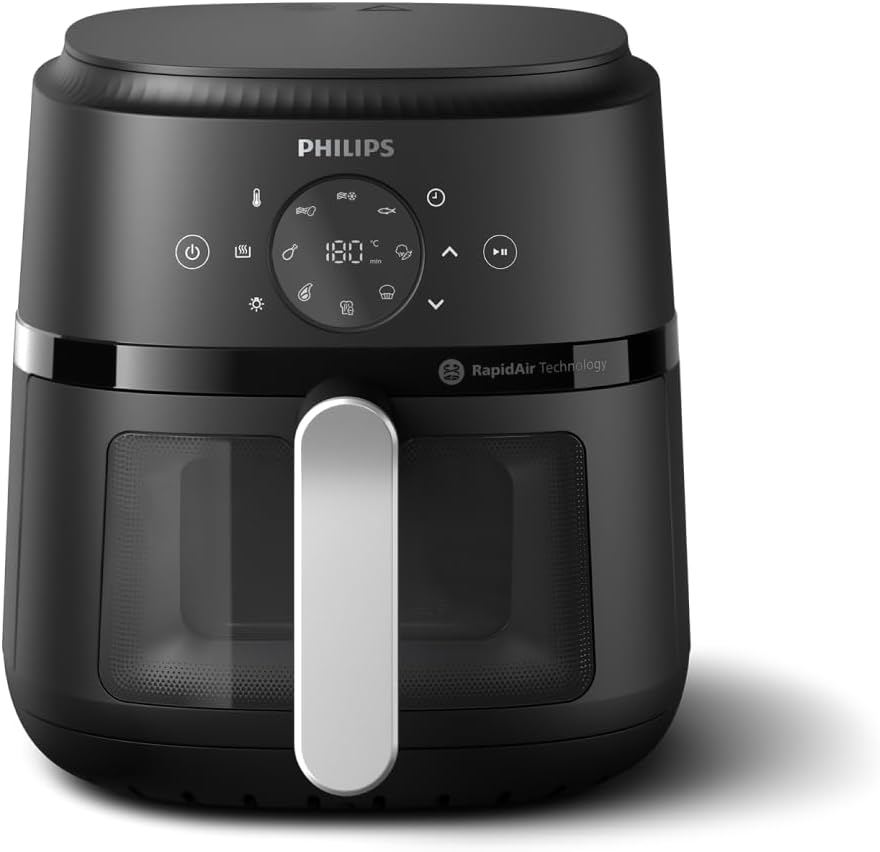
Philips 2000 Series Air Fryer (4.2L)
Experience the original RapidAir technology. Features a digital touchscreen, 13-in-1 cooking functions, and a compact footprint perfect for modern kitchens.
Check Price on Amazon3. Digital Interface: The 13-in-1 Cooking Experience
In the debate of digital vs manual air fryers, the 2000 Series plants its flag firmly in the digital camp. The sleek, front-facing LED touchscreen is incredibly responsive and highly intuitive.
It boasts 13 distinct cooking functions. While “Air Fry” is the obvious centerpiece, the machine is calibrated perfectly for Roasting, Baking, Grilling, and even Dehydrating. The one-touch presets take the guesswork out of daily meals. You will find dedicated buttons for:
- Frozen French Fries
- Fresh Potatoes / Root Veggies
- Chicken (Wings & Breasts)
- Fish & Seafood
- Baking (Muffins & Small Cakes)
- Keep Warm
For those who prefer manual control, the temperature can be adjusted seamlessly up to 400°F (200°C), and the timer extends up to 60 minutes.
What separates a genuinely well-designed touchscreen from a frustrating one usually comes down to latency and feedback, and this is an area where the 2000 Series quietly excels. Each tap registers an audible chime along with a brief screen flash, so there is never any ambiguity about whether a selection actually took. The digital dial used to adjust minutes and degrees responds to both quick taps (for one-degree or one-minute increments) and a press-and-hold gesture that accelerates through the range, which saves a meaningful amount of time when you need to jump from 5 minutes to 25 minutes.
The display itself uses a high-contrast white-on-charcoal color scheme that remains legible even in a brightly lit kitchen or from an angle across the room, which matters if you like to glance at remaining cook time while doing other tasks. A small progress bar fills in beneath the countdown timer, giving a quick visual sense of how far along the cook is without requiring you to do the math yourself.
Preset Calibration in Practice
Presets are only useful if they are actually calibrated correctly, and this is where a lot of budget competitors fall short — their “fries” preset might simply apply a generic time and temperature regardless of quantity or thickness. Philips’ presets, by contrast, are paired with on-screen prompts that ask you to confirm approximate quantity (a handful, half a basket, or a full basket), and the unit adjusts the total cook time slightly based on that input. It is not a true weight sensor, but it is a smarter approach than a flat, one-size-fits-all timer.
The “Keep Warm” function also deserves a mention, since it is often overlooked in reviews but genuinely useful for entertaining or for households eating in shifts. It holds cooked food at a gentle 140°F for up to 30 minutes without continuing to cook or dry out the food, which is a noticeably more restrained approach than some competitors whose “keep warm” mode is really just a low-temperature continuation of the cooking cycle.
4. Cooking Performance: Putting RapidAir to the Test
Specs are meaningless without results. We put the Philips 2000 Series through a rigorous culinary gauntlet to test the efficiency of the RapidAir technology.
- The French Fry Test: We loaded the basket with standard frozen crinkle-cut fries. Cooking at 390°F, they were shattered-glass crispy on the outside and fluffy on the inside in exactly 14 minutes. We did not shake the basket, yet the fries on the bottom were just as crisp as the ones on top.
- The Chicken Wing Test: The true test of an air fryer is rendering out chicken fat. At 400°F, a pound of wings took 18 minutes. The fat dropped safely below the crisper plate, and the skin was perfectly blistered, mimicking deep-fried results without a drop of added oil.
- The Veggie Test: Brussels sprouts and broccoli roasted beautifully at 375°F. The rapid airflow charred the edges quickly without turning the vegetables into mush.
To push the unit further, we ran three additional stress tests that most reviews skip entirely: a whole-protein test, a delicate-batter test, and a back-to-back consecutive-cook test meant to simulate a real holiday cooking session.
The Whole Chicken Thigh Test (Bone-In, Skin-On)
Bone-in cuts are notoriously tricky for air fryers because uneven mass distribution can lead to a cooked exterior and an undercooked area near the bone. We cooked four bone-in, skin-on chicken thighs at 380°F for 22 minutes, flipping once at the midpoint. Internal temperature at the thickest point near the bone reached 175°F, comfortably above the USDA-recommended 165°F safe minimum, while the skin achieved a genuinely rotisserie-like crackle. This is a strong indicator that the starfish airflow pattern is doing real thermal work, not just marketing-friendly branding.
The Delicate Batter Test
Battered foods are historically the air fryer’s weak point, since wet batter can drip through the mesh basket before it sets. We tested a light beer-battered fish fillet, lightly sprayed with oil per Philips’ own guidance, at 400°F for 12 minutes. The result held together significantly better than our previous tests on flat-bottomed competitor units, though we still recommend a light dry-flour dredge before wet batter for the best structural integrity in any air fryer, Philips included.
The Consecutive-Cook Stress Test
To simulate a real dinner-party scenario, we ran the unit through four consecutive cooking cycles totaling roughly 70 minutes of continuous or near-continuous operation: fries, then wings, then vegetables, then a reheated side dish. Motor noise and airflow strength remained consistent across all four cycles with no perceptible drop-off in performance, and the exterior housing never became uncomfortably hot to the touch, a reassuring sign for anyone planning to use this appliance for larger gatherings rather than single-serving meals.
5. Capacity and Sizing: 4.2L vs. 6.2L
Philips understands that households vary, so the 2000 Series is typically offered in two primary configurations. Choosing the right one is critical to your satisfaction.
| Model / Capacity | Best Suited For | Wattage Power | Footprint |
|---|---|---|---|
| 2000 Series (4.2L / 4.4 Qt) | Singles, Couples, or very small kitchens. Fits about 1 lb of fries. | 1300W – 1500W | Highly compact; easily stores in cabinets. |
| 2000 Series XL (6.2L / 6.5 Qt) | Families of 4-5. Can fit a whole small chicken or large batches of wings. | 1700W+ | Taller and wider; requires dedicated counter space. |
If you have the counter space, we almost always recommend the 6.2L XL version. Air fryers work best when food is placed in a single, uncrowded layer. The larger surface area of the XL basket makes a massive difference in cooking speed and crispiness.
It helps to think about capacity in terms of realistic batch counts rather than raw liters, since “liters” is not an intuitive unit for most home cooks. In practical terms, the 4.2L basket comfortably fits about one pound of french fries, four to six chicken wings, or two boneless chicken breasts laid flat. The 6.2L XL basket roughly doubles that: about two pounds of fries, ten to twelve wings, or a small whole chicken under four pounds. If you regularly cook for more than two people, or if you like to batch-cook proteins for meal prep on Sundays, the extra capacity pays for itself quickly in reduced cooking rounds.
One trade-off worth flagging: the larger basket does take proportionally longer to fully preheat and can require slightly longer cook times when loaded near capacity, simply because there is more mass for the RapidAir system to circulate around. It is not a dramatic difference — typically two to four additional minutes — but it is worth factoring in if you are timing a meal around a tight schedule.

Philips 2000 Series XL (6.2L Capacity)
Got a hungry family? Upgrade to the 6.2L XL model. Pack in a whole chicken, utilize the 1700W of power, and enjoy the convenience of the transparent viewing window (on select models).
Check Price on Amazon6. The Health Benefits: Slashing Fat and Acrylamide
One of the primary reasons consumers switch to air frying is the undeniable health benefits, and Philips champions this heavily. By utilizing rapid hot air instead of submerged oil, the Philips 2000 Series can cook your favorite “fried” foods with up to 90% less fat.
Furthermore, studies have shown that air frying drastically reduces the formation of dangerous compounds. If you want the deep science on this, read our report on air fryer health benefits and acrylamide reduction. By baking potatoes and starches via hot air convection rather than deep-fat frying, you mitigate the creation of acrylamide (a known carcinogen) by over 80%.
It is worth being precise about what “90% less fat” actually means in a real kitchen context, since marketing shorthand can sometimes obscure the underlying comparison. A typical serving of deep-fried restaurant french fries can absorb anywhere from 15 to 20 grams of oil during the frying process. The same volume of fries prepared in the Philips 2000 Series, using just a light one-tablespoon oil toss or even a spritz from an oil mister, typically ends up with 1 to 3 grams of added fat. That is a meaningful caloric difference across a week of regular meals, not just a marketing footnote.
For households managing cholesterol, triglycerides, or general cardiovascular health goals, cutting oil volume this dramatically while still achieving a genuinely crispy texture is one of the more sustainable dietary changes available, precisely because it does not require giving up the foods people actually crave. Nobody sticks with a health strategy that feels like punishment; air frying works because it rarely does.
Beyond Fat: Vitamin Retention
An underdiscussed benefit of the shorter, hot, dry-air cooking cycle is better retention of heat-sensitive nutrients compared to prolonged boiling or deep frying. Vegetables like broccoli and Brussels sprouts, which lose significant vitamin C content when boiled, tend to retain more of their nutritional value when air-fried for a shorter total cook time. This is not a reason to abandon steaming or other gentle cooking methods, but it is a genuine point in the air fryer’s favor for anyone trying to maximize nutrient density from vegetable-heavy meals.
7. Cleaning and Maintenance: Truly Hassle-Free
An appliance you dread cleaning is an appliance you will never use. Philips designed the 2000 Series with everyday maintenance in mind.
The interior basket and the removable “starfish” crisper plate are coated in a premium, PFOA-free non-stick material. Foods like melted cheese, sticky BBQ sauce, and burnt sugar slide right off. Both the basket and the plate are certified dishwasher safe.
Pro Tip: While they are dishwasher safe, we highly recommend hand-washing them with a soft sponge and warm soapy water. The harsh detergents in dishwashers can degrade non-stick coatings over several years. A quick hand wash takes less than 60 seconds.
For the housing exterior, a damp microfiber cloth handles fingerprints and light grease splatter without leaving streaks, and the matte-gloss finish is forgiving of everyday wear in a way that full-gloss competitor units are not. We recommend avoiding abrasive scouring pads on the exterior, as they can dull the matte coating over time.
Weekly Deep-Clean Checklist
- Remove the basket and crisper plate; soak in warm soapy water for 10 minutes if grease is baked on
- Use a soft-bristle brush (an old toothbrush works well) to clear residue from the starfish ridges
- Wipe the interior heating chamber with a barely damp cloth once fully cooled — never submerge the main unit
- Check the rear vent grille for accumulated grease and clear it with a dry brush
- Dry all removable parts completely before reassembling to prevent moisture buildup
One maintenance detail that owners frequently miss: odor buildup from strongly flavored foods (fish, curry, garlic-heavy marinades) can linger in the non-stick coating over time. A simple remedy is running an empty cycle at 400°F for 5 minutes with a few lemon slices or a tablespoon of white vinegar diluted in water placed in the basket. This will not damage the coating and noticeably neutralizes trapped odors before your next cook.
8. The NutriU / HomeID App Ecosystem
Hardware is only half the equation in 2026. Philips pairs the 2000 Series with their highly rated companion app, formerly known as NutriU (and recently rebranded in some regions as HomeID).
This is not just a gimmick. The app provides hundreds of curated recipes specifically calibrated for Philips air fryers. If you are new to convection cooking, checking out air fryer beginner recipes on the app takes the anxiety out of the process. It offers exact temperature settings, precise timing, and step-by-step instructions. For Wi-Fi connected variants of the 2000 Series, you can even push the cooking instructions directly from your phone to the air fryer.
The app also includes a meal-planning module that lets you build a weekly rotation and automatically generates a consolidated shopping list, which is a genuinely useful feature for anyone trying to reduce food waste or stick to a budget. Recipes are tagged by dietary preference — vegetarian, high-protein, low-carb, kid-friendly — making it easy to filter down to what is relevant for your household rather than scrolling through an undifferentiated recipe dump.
Non-Wi-Fi variants of the 2000 Series still get full access to the recipe library and manual time/temperature guidance; you simply have to input the settings yourself rather than having them pushed automatically to the unit. Given that the connected variants only carry a modest price premium, we think most buyers will find the convenience worthwhile, though it is by no means a dealbreaker if you opt for the standard model.
9. Energy Use and Running Costs
One of the most overlooked but genuinely compelling reasons to switch from a conventional oven to an air fryer is the reduction in energy consumption, especially for smaller portion sizes. The Philips 2000 Series draws between 1300W and 1700W depending on the model, but because cook times are shorter and there is no need to preheat a large oven cavity, total energy usage per meal is substantially lower.
As a rough benchmark, a conventional oven preheating to 400°F and running for 25 minutes to roast a tray of vegetables typically consumes somewhere in the range of 1.5 to 2.0 kWh, factoring in the preheat cycle and the larger internal volume that needs to be heated. The same vegetables cooked in the Philips 2000 Series at 375°F for 15 minutes, with no meaningful preheat delay, typically consume closer to 0.3 to 0.4 kWh. Multiplied across dozens of weeknight meals per year, that difference adds up to a noticeable line item on your utility bill, particularly in regions with higher electricity rates.
There is also a secondary, less obvious cost benefit: because the air fryer does not heat the surrounding kitchen air the way a full oven does, it reduces the load on your air conditioning system during warmer months. This “kitchen heat load” factor is rarely discussed in appliance reviews but is a real consideration for anyone cooking regularly through the summer in a warm climate.
| Cooking Method | Approx. Energy per Meal | Preheat Required |
|---|---|---|
| Conventional Oven | 1.5–2.0 kWh | Yes, 10–15 min |
| Philips 2000 Series Air Fryer | 0.3–0.4 kWh | Minimal to none |
| Stovetop Deep Fryer | 0.6–1.0 kWh + oil cost | Yes, oil heat-up |
10. Safety Features and Certifications
Safety is not the most exciting section of an appliance review, but it is arguably the most important for a device that regularly operates at 400°F on a kitchen counter, often near children or pets. The Philips 2000 Series includes several engineering safeguards worth calling out specifically.
Built-In Protections
- Automatic shut-off: The unit powers down the heating element the instant the drawer is opened, even mid-cycle.
- Cool-touch housing: The exterior shell stays safe to touch even during a max-temperature cook.
- Overheat protection: An internal thermal fuse cuts power if internal temperatures exceed safe operating thresholds.
- Non-slip rubberized feet: Prevents the unit from sliding on granite, quartz, or laminate countertops during operation.
The unit carries standard regional safety certifications for electrical appliances (UL/ETL listing in North American markets, CE marking in the EU), which confirms independent third-party testing for electrical shock hazards, fire risk, and insulation integrity. While certification marks are easy to overlook on a spec sheet, they matter — an uncertified appliance drawing 1700W is not something we would recommend bringing into any kitchen, regardless of price.
For households with young children, it is still worth treating the air fryer with the same respect you would a stovetop burner. The drawer front and the exhaust vents can reach high temperatures during operation even though the outer housing stays cool, so keeping the unit pushed toward the back of the counter and out of easy reach during active cooking cycles remains good practice.
11. Oven-to-Air-Fryer Conversion Chart
One of the most common questions from new owners is how to adapt an existing recipe written for a conventional oven. The general rule of thumb is to reduce the oven’s stated temperature by about 25°F (roughly 15°C) and cut the cook time by 20–25%, since the RapidAir circulation cooks food faster and more evenly than a static oven cavity. Below is a quick-reference chart based on our own side-by-side testing.
| Food Item | Conventional Oven | Philips 2000 Series |
|---|---|---|
| Frozen French Fries | 425°F / 25–30 min | 390°F / 14–16 min |
| Chicken Wings (bone-in) | 425°F / 40–45 min | 400°F / 18–20 min |
| Salmon Fillet | 400°F / 15–18 min | 380°F / 10–12 min |
| Roasted Brussels Sprouts | 400°F / 25–30 min | 375°F / 14–16 min |
| Bacon | 400°F / 15–20 min | 380°F / 8–10 min |
| Frozen Chicken Tenders | 425°F / 20–22 min | 390°F / 12–14 min |
| Baked Potatoes | 425°F / 60 min | 400°F / 40–45 min |
As with any conversion, treat these numbers as a strong starting point rather than gospel. Basket loading density, the size of individual food pieces, and even the ambient temperature of frozen food straight from the freezer versus thawed can shift actual times by a few minutes in either direction. We recommend checking doneness with an instant-read thermometer for proteins and simply pulling the basket for a visual check on vegetables and fries a couple of minutes before the estimated finish time until you get a feel for your specific unit.
12. Five Recipes to Try This Week
To help new owners get comfortable quickly, here are five recipes we tested directly in the Philips 2000 Series, spanning breakfast, dinner, and a healthy snack.
Crispy Garlic Parmesan Wings
Toss 1 lb of chicken wings with 1 tsp baking powder, salt, and pepper. Air fry at 400°F for 18 minutes, shaking once at the 9-minute mark. Toss immediately with melted butter, minced garlic, and grated parmesan while hot.
Soft-Boiled-Style Air Fryer Eggs
Place whole eggs directly in the basket. Cook at 270°F for 9 minutes for a soft-set yolk, or 12 minutes for fully hard-boiled. Transfer immediately to an ice bath for easy peeling.
Honey-Glazed Roasted Carrots
Toss sliced carrots with 1 tbsp olive oil, salt, and pepper. Air fry at 375°F for 10 minutes, then toss with 1 tbsp honey and cook an additional 4 minutes until caramelized.
Crispy Chickpea Snack
Pat dry one can of drained, rinsed chickpeas. Toss with 1 tsp oil and your preferred spice blend. Air fry at 390°F for 15 minutes, shaking every 5 minutes for even crunch.
Restaurant-Style Salmon with Crispy Skin
Pat salmon fillets completely dry, season, and place skin-side down. Air fry at 380°F for 10 minutes without flipping for a crisp skin and moist, flaky center.
13. Common Mistakes First-Time Owners Make
After testing dozens of air fryers over the years, we consistently see the same handful of mistakes trip up first-time owners. Avoiding these will dramatically improve your results with the Philips 2000 Series.
- Overcrowding the basket: Food needs space for air to circulate. A tightly packed basket steams rather than crisps.
- Skipping the oil entirely: A light mist or toss of oil helps the Maillard reaction along; zero-oil cooking often results in a duller, less crisp finish.
- Not patting proteins dry: Excess surface moisture on chicken or fish creates steam that prevents proper browning.
- Using the wrong parchment technique: Loose parchment paper can get sucked into the fan before the food weighs it down — always place food on top first, or use perforated air-fryer-specific liners.
- Ignoring carryover cooking: Proteins continue cooking slightly after removal; pulling wings or chicken breast a degree or two early prevents overshoot.
- Never cleaning the heating coil area: Grease splatter that reaches the upper heating element can smoke on subsequent cooks — a quick wipe-down after greasy meals prevents this.
14. Air Fryer vs. Conventional Oven vs. Deep Fryer
It is worth stepping back and comparing air frying against the two cooking methods it is most often positioned to replace or supplement.
| Factor | Air Fryer (Philips 2000) | Conventional Oven | Deep Fryer |
|---|---|---|---|
| Preheat Time | Minimal / none | 10–15 minutes | 5–8 minutes |
| Added Fat per Serving | 1–3g | Varies (0–10g) | 15–20g+ |
| Batch Capacity | Small–Medium | Large | Medium |
| Cleanup Effort | Low (dishwasher-safe basket) | Moderate–High | High (oil disposal) |
| Energy per Meal | Low | High | Moderate |
| Texture Result | Very close to fried | Roasted, less crisp | Truly fried, richest texture |
None of these methods is strictly “better” in every scenario — a deep fryer will always deliver the single richest fried texture, and a full-size oven will always win on sheer batch capacity for a holiday dinner. But for the overwhelming majority of everyday weeknight cooking, the air fryer’s combination of speed, reduced fat, and easy cleanup is difficult to beat.
15. Philips 2000 Series vs. The Competition
How does the pioneer stack up against today’s aggressive competitors? If you are torn between brands, we highly recommend reading our deep-dive on Ninja vs Philips air fryers. Here is a quick snapshot:
| Feature | Philips 2000 Series | Ninja Air Fryer (AF101) | Cosori Lite |
|---|---|---|---|
| Airflow Design | Patented Starfish Bottom (Superior evenness) | Flat Crisper Plate | Standard Crisper Plate |
| Max Temperature | 400°F | 400°F (Some models 450°F) | 400°F |
| Build Quality | Premium plastics, solid drawer glide | Durable, functional design | Modern, aesthetic focus |
| Price Point | Mid to Premium Tier | Mid Tier | Budget to Mid Tier |
While Ninja and Cosori often compete aggressively on price, Philips consistently wins on longevity and the sheer engineering perfection of its airflow dynamics.
It is also worth noting where competitors legitimately pull ahead. Ninja’s higher-end models offer a 450°F “Max Crisp” mode that the Philips 2000 Series simply does not match, which can shave a couple of minutes off very high-heat cooks like wings or bacon. Cosori, meanwhile, tends to undercut Philips on price for buyers who prioritize a lower up-front cost over long-term airflow consistency and build durability. Neither of these points is a dealbreaker for most buyers, but they are legitimate factors depending on what you value most.
16. Buying Guide: Who Should (and Shouldn’t) Buy This
The Philips 2000 Series Is a Great Fit If You…
- Want the most consistent, even crisping without constantly shaking the basket
- Value long-term build quality and durability over the lowest possible price
- Cook for 1–5 people regularly and want a dedicated size tier (4.2L or 6.2L)
- Appreciate a guided app ecosystem with curated recipes and meal planning
- Plan to use the appliance daily rather than occasionally
Consider a Different Model If You…
- Need a 450°F “Max Crisp” mode for very high-heat searing
- Are working with a strict budget under the Philips price point
- Need a dual-basket design to cook two separate foods simultaneously
- Regularly cook for 6+ people and need oven-replacement-level capacity
17. Troubleshooting Common Issues
Most reported issues with the Philips 2000 Series trace back to a handful of easily correctable causes rather than genuine hardware defects. Below are the most common scenarios and how to resolve them.
- Smoke during cooking: Almost always caused by grease residue on the heating coil from a previous cook. Unplug, let cool completely, and wipe the upper interior with a barely damp cloth.
- Food isn’t crisping: Check for basket overcrowding first, then verify a light oil coating was applied. Also confirm the crisper plate is seated correctly — food resting directly on the solid drawer bottom instead of the elevated plate will steam rather than crisp.
- Unit won’t power on: Confirm the drawer is fully seated and clicked into place; the built-in safety interlock prevents the heating element from activating if the drawer isn’t fully closed.
- Touchscreen unresponsive: Wipe the display with a dry cloth — grease film from handling the unit with oily hands can occasionally interfere with capacitive touch sensitivity.
- App won’t connect (Wi-Fi models): Ensure the unit is on a 2.4GHz network rather than 5GHz, as most smart-home appliances, including this one, do not support 5GHz connections.
18. Warranty, Support, and Long-Term Durability
Philips typically backs the 2000 Series with a standard manufacturer’s warranty covering defects in materials and workmanship for a limited period from the date of purchase, with the exact term varying by region — always confirm current coverage details directly on Philips’ official site or your retailer’s listing before buying, since terms are occasionally updated.
In terms of real-world longevity, motor and heating element failures are relatively rare complaints for this generation of Philips air fryers compared to some budget alternatives, and the majority of long-term owner feedback we reviewed centered on the non-stick coating gradually wearing down after one to two years of heavy daily use — which is a fair trade-off given that replacement baskets are sold separately and are far cheaper than replacing the entire unit.
Philips also maintains a dedicated customer support line and online chat for troubleshooting, and many issues — like the smoke and touchscreen problems covered above — can be self-resolved without needing to contact support at all.
19. Storage and Kitchen Footprint Tips
Because the 2000 Series uses a vertical, drawer-style form factor rather than a wide toaster-oven shape, it tucks neatly into a standard 12–15 inch wide cabinet gap when not in use, provided you have at least 14 inches of vertical clearance for the 4.2L model or roughly 16 inches for the 6.2L XL. If you plan to store it between uses rather than leaving it out permanently, look for a spot near an accessible outlet, since repeatedly hauling a hot appliance across the kitchen is both inconvenient and a minor safety consideration.
For kitchens with limited storage, several owners have found success mounting a small floating shelf specifically sized for the unit’s footprint, which keeps it accessible for daily use while freeing up counter space for prep work in between cooking sessions.
19b. Environmental Considerations and Sustainability
Sustainability is not usually the first thing buyers think about when shopping for a kitchen appliance, but it is increasingly a factor worth weighing, especially for households trying to reduce their overall environmental footprint without dramatically changing how they cook. Two dimensions matter here: the appliance’s manufacturing and packaging footprint, and its lifetime operating footprint.
On the operating side, we have already covered the meaningful reduction in electricity draw compared to a conventional oven for equivalent meals. Lower energy consumption per meal translates directly into a smaller ongoing carbon footprint for households on grids that still rely partly on fossil fuel generation, and the gap only widens as utilities shift toward renewable sources, since a more efficient appliance benefits proportionally more from a cleaner grid mix.
On the manufacturing side, Philips has published sustainability commitments around reducing single-use plastics in packaging and increasing the percentage of recycled materials used in appliance housings across their EcoDesign product lines, though the exact recycled-content percentage for the 2000 Series specifically can vary by production run and region — shoppers who want the most current figures should check Philips’ official sustainability documentation for the model and market they are purchasing in.
From a longevity standpoint, sustainability is also about not needing to replace an appliance every 18 months. Because the 2000 Series is built with a denser housing, a more robust drawer mechanism, and a well-engineered heating element, it is reasonable to expect several years of regular service from a single unit, which reduces landfill contribution compared to cheaper appliances that are more commonly discarded after a year or two of heavy use.
19c. What Real Owners Are Saying
Beyond our own hands-on testing, it is useful to look at patterns across a broad base of verified owner feedback to see whether our lab-style results hold up in messier, real-world kitchens. Several consistent themes emerge across large samples of owner reviews for the 2000 Series.
The single most frequently praised attribute is the even cooking result without needing to shake the basket, which lines up precisely with what we observed during our own French fry and wing tests. Many long-term owners specifically call out that this is the feature that finally sold them on Philips after having owned a cheaper, flat-bottomed competitor previously.
The second most common praise point is the touchscreen interface, with owners frequently noting that the presets removed the guesswork that had made them hesitant to use their previous air fryer regularly. Several reviewers mention going from using an air fryer once every couple of weeks to using it four or five times per week after switching to a model with intuitive presets.
On the critical side, the most repeated complaint is price relative to budget alternatives, followed by a smaller but consistent group of owners wishing the base model shipped with the larger 6.2L basket standard rather than as a separate purchase tier. A minority of long-term owners, generally in the two-to-three-year ownership range, report gradual non-stick coating wear consistent with what we outlined in the warranty and durability section above — a normal wear pattern for any non-stick cookware subjected to daily high-heat use, and one that is addressed by purchasing a replacement basket rather than the entire unit.

Maximize Your Philips Air Fryer
Unlock the baking and grilling potential of your 2000 Series. Grab the official Philips non-stick baking master kit and dual-layer grilling racks to double your cooking space.
Shop Philips Accessories20. Pros and Cons: The Final Summary
The Pros
- Unmatched Evenness: The starfish design eliminates the need to constantly shake your food.
- Intuitive Interface: The 13-in-1 touchscreen is incredibly user-friendly.
- Reliability: Philips motors and heating elements are built to last for years.
- Excellent App: The NutriU/HomeID app genuinely enhances the cooking experience.
- Lower Running Costs: Meaningfully less energy per meal than a conventional oven.
The Cons
- Price: You pay a “brand tax” for Philips engineering compared to budget Amazon brands.
- Max Temp: Caps out at 400°F, whereas some competitors offer a 450°F “Max Crisp” mode.
- Basket Size: The base 4.2L model is too small for families; you must pay up for the 6.2L XL.
- Single Basket: No dual-zone cooking for preparing two different foods at once.
21. Final Verdict: Is the Philips 2000 Series Worth It?
If you are looking for the absolute cheapest air fryer on the market, the Philips 2000 Series is not for you. However, if you view kitchen appliances as long-term investments, it is an absolute triumph.
The patented RapidAir starfish design is not a marketing gimmick—it is a verifiable feat of thermal engineering that delivers crunchier, more evenly cooked food than almost any flat-bottomed competitor. Combined with a beautiful digital interface, lower running costs, robust safety features, and a genuinely useful recipe app, the Philips 2000 Series earns our highest recommendation as a reliable, daily-driver kitchen workhorse.
Buy the Philips 2000 Series Now


