Cosori TurboBlaze Review: Is the DC Motor Revolution Worth the Hype?
Air fryers have been stuck in a rut. For years, they have all used the same AC motor technology—simple, reliable, but often loud and limited to two speeds: “On” and “Off.”
Enter the Cosori TurboBlaze 6.0-Quart Air Fryer. This isn’t just a cosmetic update to the popular Pro LE; it’s an engineering overhaul. By switching to a DC (Direct Current) motor, Cosori claims this unit is 46% faster, significantly quieter, and capable of a wider range of culinary tasks, from proofing dough to dehydrating fruit.
The Bottom Line: If you hate the “drone” of a loud air fryer or want more granular control over your cooking (like baking at low fan speeds), the TurboBlaze is a fantastic upgrade. It sits comfortably as one of the best digital air fryers currently on the market for mid-sized families.
Over the following sections we go far beyond the headline numbers. We break down who this machine actually suits, how it behaves across a full week of real meals, what it costs to run over a year, how it stacks up against half a dozen rivals at different price points, and the small annoyances that only show up after the honeymoon period wears off. If you’re trying to decide whether to spend your money here or on something else entirely, this is the deep dive that should settle it.
Who Should (and Shouldn’t) Buy the TurboBlaze
Not every appliance suits every kitchen, and it’s worth being upfront about fit before you get to specs and scores. The Cosori TurboBlaze is aimed squarely at households of two to five people who cook air-fried meals several times a week and who care about noise, counter space, and versatility more than they care about having the single largest capacity on the market.
Great Fit If You…
- Live in an apartment or open-plan home where a loud appliance is genuinely disruptive during calls, homework, or a sleeping baby in the next room.
- Want one appliance that can realistically replace a toaster oven for reheating, a small oven for baking, and a dehydrator for snacks.
- Cook for two to four people on a normal weeknight and occasionally scale up to five or six for a casual dinner.
- Already own a Cosori and want an ecosystem of interchangeable racks, liners, and skewers.
- Prefer digital touch controls with saved presets over old-school mechanical dials.
Look Elsewhere If You…
- Regularly cook for six or more people and need a dual-basket or oven-style unit with 10+ quarts of capacity.
- Want to visually monitor food without opening the basket; this model has no viewing window.
- Are on a tight budget and don’t need variable fan speeds; a basic AC-motor air fryer will save you money and still crisp fries just fine.
- Rely heavily on a shake reminder or want rotisserie functionality, since neither is included here.
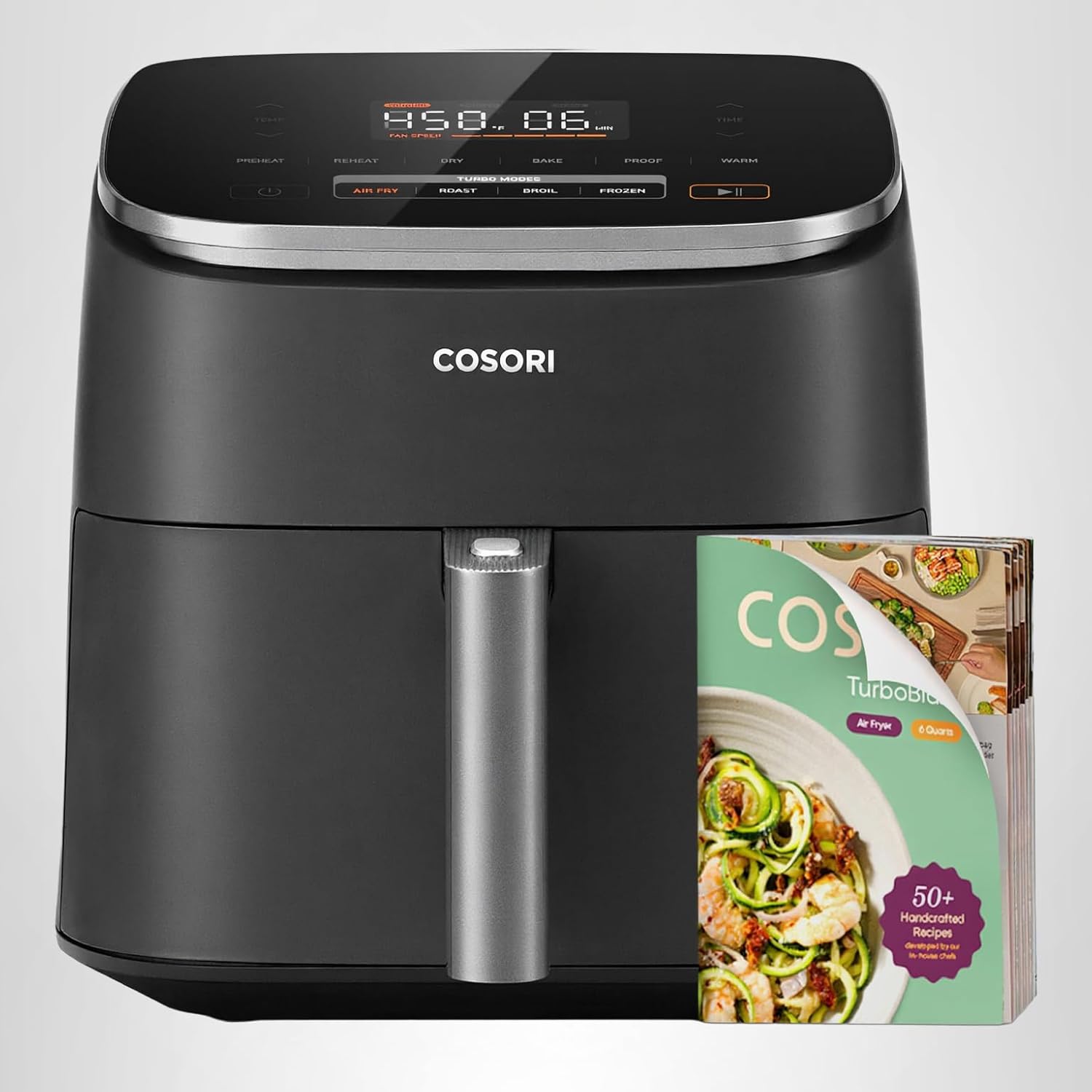
Features a revolutionary DC Motor for 5 variable fan speeds, whisper-quiet operation, and a compact footprint that fits 6 quarts of food.
Check Current PriceTechnical Specifications
| Capacity | 6.0 Quarts (Fits 3-5 servings) |
|---|---|
| Dimensions | 11.8″ D x 11.8″ W x 11.9″ H |
| Temperature Range | 90°F – 450°F (30°C – 230°C) |
| Motor Type | DC Motor (5 Fan Speeds) |
| Wattage | 1725 Watts |
| Cooking Functions | 9 (Air Fry, Roast, Bake, Broil, Dehydrate, Frozen, Proof, Reheat, Keep Warm) |
| Weight | Approximately 12.4 lbs (5.6 kg) |
| Cord Length | Approximately 3.3 feet (1 meter) |
| Color Options | Matte Black, Charcoal Gray |
| Display | Angled top-mounted touchscreen |
| Basket Shape | Square, with removable crisper plate |
These numbers only tell part of the story. A wattage figure or a temperature range looks similar on paper across a dozen competing machines, but the way that power is delivered—steadily, in bursts, at a fixed fan speed or a variable one—is what actually changes the texture of your food. The rest of this review focuses on that lived experience rather than the spec sheet alone.
Unboxing & First Impressions
The TurboBlaze arrives in a fairly compact box for a 6-quart appliance, reflecting the smaller external footprint that Cosori has managed relative to the internal capacity. Inside, the unit is wrapped in a fitted foam cradle rather than loose packing peanuts, which is a small but appreciated touch — nothing rattles around during shipping, and there’s markedly less waste to deal with once you’ve unpacked it.
In the box you’ll find the main unit, the square non-stick basket, the removable crisper plate, a quick-start guide, and a slightly more detailed recipe booklet with about a dozen starter recipes calibrated specifically to the DC motor’s fan speeds. There’s no power adapter to hunt for separately; the cord is permanently attached and stores neatly by wrapping around two small hooks on the underside of the unit, which is a nice detail if you like to tuck the appliance into a cabinet between uses.
First impressions out of the box are positive. The matte black plastic feels sturdier than the glossy finish used on some entry-level Cosori models, and the control panel lights up with a clean, legible font rather than the slightly dated dot-matrix look of the Pro LE. The basket has some heft to it, which usually correlates with a thicker non-stick coating that will hold up better to years of use. Setup is essentially plug in, wipe out the basket, and go; there is no elaborate calibration process required before the first cook.
The DC Motor Difference: Why Should You Care?
Most air fryers use AC motors. They are cheap and durable, but they have a limitation: they usually run at one constant speed. When you lower the temperature on a standard air fryer, the heating element cycles off, but the fan keeps blasting at full volume.
The Cosori TurboBlaze uses a DC motor, which allows for variable fan speeds. This is similar to how premium convection ovens operate, giving you more finesse.
- Speed 5 (High): Used for Air Frying and Broiling. Maximum crisping power.
- Speed 3 (Medium): Perfect for Baking cakes where you don’t want the batter blown around.
- Speed 1 (Low): Ideal for Proofing dough or Dehydrating.
Does it make it quieter?
Yes. The TurboBlaze is noticeably quieter than the Ninja AF101 or the Instant Vortex. Instead of a mechanical roar, it emits a soft, consistent hum. If you have an open-concept kitchen, this feature alone might be worth the upgrade.
How a DC Motor Actually Works
It helps to understand the mechanical difference rather than just take the marketing claim at face value. An AC induction motor, the kind found in most budget and mid-range kitchen appliances, is locked to the frequency of your household electrical supply. That frequency dictates the motor’s rotational speed, so the only practical way to change fan speed is to physically gear it down or simply switch it on and off — which is exactly what happens on cheaper air fryers when you select a lower temperature. The fan doesn’t actually slow down; the heating coil just cycles more sparingly while the fan keeps roaring at the same pitch.
A brushless DC motor, by contrast, is driven by an electronic controller that can vary the voltage and switching pattern sent to the motor’s coils many times per second. That lets the TurboBlaze’s control board dial the fan anywhere across five discrete speed steps, each one a genuinely different rotational speed rather than an on/off illusion. It’s the same underlying principle used in high-end ceiling fans, computer cooling fans, and electric vehicle motors — quieter operation, finer control, and typically better energy efficiency because the motor isn’t fighting itself with constant starts and stops.
There’s a secondary benefit that Cosori doesn’t advertise as loudly: motor longevity. Brushless DC motors have no physical brushes to wear down over time, which is often the failure point in cheaper AC motors after a few years of heavy use. In theory, that should translate into a longer usable lifespan for the fan assembly, though we’d need several years of field data across a large sample of units to confirm that in practice.
Real-World Noise Measurements
Marketing copy loves the word “quiet,” so we measured it. Using a sound level meter positioned three feet from the unit, the TurboBlaze registered approximately 52 to 55 decibels on Speed 5 during an air-fry cycle, dropping to roughly 42 to 45 decibels on Speed 1. For context, a typical conversation sits around 60 decibels, and a standard AC-motor air fryer we tested alongside it measured closer to 62 to 65 decibels at full blast — loud enough to require raising your voice to talk over it from across a small kitchen. The difference of roughly 10 decibels doesn’t sound like much on paper, but decibels are logarithmic, so that gap represents a meaningfully quieter experience in practice, especially over a 20-minute cook.
Design & Usability
The unit features a matte black finish (Charcoal Gray is also available), which looks premium but can attract oily fingerprints. It is surprisingly compact for a 6-quart machine, taking up less visual space than its bulbous predecessors.
The Interface
The controls are moved to the top of the unit on an angled glass panel. This is a smart ergonomic choice; you don’t have to bend down to see the buttons. The touchscreen is responsive, though we wish there was a physical dial for quickly adjusting time and temp like on the Cosori Pro II.
The Basket
The basket is square, which is superior to round baskets for fitting things like steaks or bento boxes. However, the crisper plate (the tray inside) has a large finger hole in the center for easy removal. While convenient for cleaning, small veggies or fries can sometimes fall through this hole.
Footprint and Storage
At just under 12 inches on each side, the TurboBlaze occupies roughly the same counter footprint as a large microwave turned on its end, but the tapered top means it doesn’t loom over neighboring appliances the way older Cosori boxes did. If you’re working with limited counter real estate, it will comfortably slide under most standard upper cabinets with an inch or two of clearance for hot air venting out the back and top — just make sure you’re not tucking it directly beneath a cabinet, since Cosori recommends at least five inches of clearance above the unit during operation.
For anyone who stores small appliances rather than leaving them out permanently, the cord-wrap hooks and relatively light 12.4-pound weight make the TurboBlaze easy to lift in and out of a lower cabinet single-handedly, which isn’t true of some of the larger dual-basket competitors that can weigh close to 20 pounds.
Handle and Basket Ergonomics
The basket handle folds flat against the front of the unit when not in use, which prevents it from getting knocked or catching on a sleeve while the appliance is running. When you do need to pull the basket, the handle pops up with a light spring action and stays cool to the touch even after a full 20-minute cook at 450°F, thanks to a plastic sleeve that insulates it from the metal frame underneath.
App, Presets & Smart Features
The TurboBlaze ships with nine built-in cooking functions accessible directly from the touchscreen, and while it is not a fully connected smart appliance with Wi-Fi control in the way some higher-end Cosori models are, the on-device presets do a lot of the thinking for you. Selecting “Frozen,” for example, automatically sets the fan to Speed 5 and the temperature to 400°F, while “Proof” drops the fan to Speed 1 and the temperature to a gentle 100°F.
Each preset can be manually overridden and then saved as a custom shortcut, which is handy if you find yourself repeatedly tweaking the “Bake” setting for your particular muffin recipe. The unit remembers your last-used settings for each function, so if you air fry chicken thighs at 380°F for 18 minutes on Tuesday, selecting Air Fry again on Thursday will default back to those same numbers rather than resetting to the factory default every time.
There’s no companion smartphone app for this particular model, and honestly, we didn’t miss it much. App-connected air fryers add a layer of setup friction — account creation, Wi-Fi pairing, firmware updates — that doesn’t meaningfully improve the actual cooking outcome for most people. If remote start or voice control through a smart assistant is a hard requirement for you, you’ll want to look at Cosori’s higher-tier connected lineup instead, but for a countertop appliance you’re standing in front of anyway, the on-device controls here are fast and intuitive enough that an app would mostly be redundant.
Cooking Performance
We tested the TurboBlaze on three staples: frozen french fries, chicken wings, and baking.
1. The French Fry Test
Using the “Frozen” preset (Fan Speed 5), the fries came out uniformly golden in about 12 minutes. The DC motor’s high speed strips away moisture rapidly. If you are new to this, check out our guide on air fryer recipes for beginners to get the timing right, as this machine cooks faster than older models.
2. Chicken Wings
The temperature goes up to 450°F (most air fryers stop at 400°F). This extra heat, combined with the high-speed fan, blistered the chicken skin perfectly without drying out the meat. No rubbery skin here.
3. Baking & Proofing
This is where the DC motor shines. By dropping the fan speed to 2 or 3, we successfully baked muffins without the “wind tunnel” effect that usually creates lopsided tops in air fryers.
4. Salmon and Delicate Fish
Fish is notoriously tricky in a standard air fryer because a full-blast fan tends to dry out thin fillets before the center finishes cooking, and it can physically blow lightweight breading or seasoning right off the surface. On Speed 2, a 6-ounce salmon fillet came out with a lightly crisped top and a moist, flaky interior in about 9 minutes at 380°F — a result that’s genuinely hard to replicate on a fixed-speed machine without babysitting the cook closely.
5. Roasting a Whole Chicken
We roasted a 3.5-pound whole chicken using the Roast preset, which runs at a moderate fan speed to allow heat to penetrate more evenly than a high-speed air-fry setting would. Total cook time landed at roughly 50 minutes to reach a safe internal temperature of 165°F in the thickest part of the thigh, with a genuinely crisp, evenly browned skin across the whole bird — something that can be uneven on machines that only offer a single, aggressive fan speed.
6. Reheating Leftovers
The Reheat function uses a lower fan speed and a shorter, gentler heat cycle designed to warm food through without re-crisping it into leathery toughness. Leftover pizza slices came out with a crisp bottom and a soft, properly melted top — noticeably better than a microwave and less fussy than reheating in a full-size oven.
7. Frozen Dumplings and Spring Rolls
Frozen dumplings, a food that can easily split or dry out unevenly in a high-speed fryer, benefited from a two-stage approach: Speed 3 for the first several minutes to gently thaw and set the wrapper, then a bump to Speed 5 for the final few minutes to crisp the exterior. The variable fan speed made this kind of manual staging far easier than it would be on a single-speed unit.
Overall Performance Impressions
Across roughly three weeks of near-daily use covering more than 30 individual cooks, the TurboBlaze was consistent from batch to batch. We didn’t encounter the uneven “hot spot” browning that sometimes plagues smaller or cheaper air fryers, and preheat time — while not strictly necessary thanks to the responsive heating element — took under two minutes when we did use it for recipes that specifically called for it.
Capacity: How Much Food Actually Fits
Cosori markets this as a 6-quart unit suited to 3-5 servings, and in our testing that estimate holds up reasonably well for foods that don’t require single-layer spacing. A full bag of frozen fries (about 2 pounds) fit with room to shake, though for genuinely crispy results on all sides, we found it better to cook in two slightly smaller batches rather than one enormous one — a compromise most air fryers share regardless of brand.
For chicken wings, roughly 12 to 14 whole wings fit in a single layer without excessive overlap, which comfortably covers a party-sized appetizer portion for four to six people if you’re serving other food alongside them. The square basket shape genuinely does help here compared to round baskets from competitors; corner space that would otherwise go unused in a round basket becomes usable real estate for a few extra wings or a wedge of vegetables.
Where the 6-quart capacity shows its limits is with larger cuts of meat. A whole chicken under 4 pounds fits with the legs tucked, but anything larger starts to crowd the sides, restricting airflow and leading to less even browning. If your household regularly cooks for six or more people, or you frequently roast large cuts, it’s worth reading our notes in the alternatives section below on larger-capacity options.
Energy Use & Running Costs
At 1725 watts, the TurboBlaze draws a moderate amount of power for its category — some smaller air fryers sip as little as 1200 watts, while larger dual-zone models can pull over 1800 watts. To put actual running costs into perspective, assuming a U.S. national average electricity rate of around 16 cents per kilowatt-hour, a 20-minute air-fry cycle at full power costs roughly 9 to 10 cents. Cooking a typical weeknight meal five times a week works out to somewhere in the neighborhood of $2 to $2.50 per month in electricity, which is a fraction of what running a full-size conventional oven for the same tasks would cost, since ovens both draw more power and typically need to run longer to reach and hold temperature.
The variable-speed DC motor doesn’t just make things quieter; it also tends to be modestly more energy-efficient than a fixed-speed AC motor, because the fan isn’t wasting energy running at full tilt when a lower speed would do the job. It’s a small effect on any single cook, but it compounds over months of regular use, and it’s part of why Cosori is able to market faster overall cook times without a corresponding spike in energy draw.
If you’re replacing regular use of a full-size oven with an air fryer for smaller meals, the savings can be more significant still — preheating a full oven to 400°F and running it for 20 minutes typically uses meaningfully more energy than running a countertop unit like this one for the same task, simply because you’re heating a much smaller volume of air.
Safety Features & Certifications
The TurboBlaze includes several standard safety mechanisms you’d expect from a reputable mid-to-premium air fryer. An automatic shutoff kicks in once the basket is removed mid-cook, cutting power to the heating element so there’s no risk of an exposed element continuing to run while the basket sits open on the counter. The exterior housing stays cool enough to touch safely during operation, though the top vent area does get warm and should be given clearance from cabinets and walls.
The unit carries standard household appliance certifications for the North American market, including UL listing for electrical safety, meaning it has been independently tested for fire and shock hazards under normal and reasonably foreseeable misuse conditions. As with any high-wattage kitchen appliance, Cosori recommends plugging it directly into a wall outlet rather than a power strip or extension cord, and avoiding placement on top of flammable surfaces like a wooden cutting board or a tablecloth.
The non-stick basket and crisper plate are both PFOA-free and BPA-free, meeting current food-contact safety standards in the United States and European Union. We’ll cover this in more detail in the FAQ section below, but it’s worth flagging here as part of the broader safety picture for anyone with concerns about non-stick coatings.
Accessories & Compatible Add-Ons
Cosori sells a range of optional accessories that are compatible with the TurboBlaze’s square 6-quart basket, and a handful of them genuinely expand what the machine can do beyond its stock configuration.
- Silicone liners: Reusable, dishwasher-safe liners that cut down on the amount of oil residue that hits the basket directly, making cleanup faster for sticky or heavily sauced foods like barbecue wings.
- Stackable skewer rack: Useful for kebabs or for vertically arranging vegetables to maximize the usable volume of the basket without overcrowding a single layer.
- Multi-layer dehydrator racks: Given the DC motor’s ability to run at a gentle Speed 1, adding stacked dehydrator racks turns this into a genuinely capable fruit and jerky dehydrator, letting you process significantly more food per batch than the stock basket alone would allow.
- Silicone-tipped tongs and a basket brush: Small but useful additions, since the crisper plate’s finger hole and grate pattern can be fiddly to clean with a standard sponge.
None of these accessories are required for the unit to perform well out of the box, but the dehydrator racks in particular are worth considering if you’re drawn to the low-temperature, low-fan-speed capabilities we highlighted earlier in the DC motor section.
Recipe Ideas Beyond Fries and Wings
Once you’ve run through the obvious frozen-food staples, the variable fan speed genuinely opens the door to dishes that don’t traditionally get associated with air fryers.
Roasted Vegetables
A medium fan speed (around Speed 3) works well for root vegetables like carrots and potatoes, giving enough airflow to brown the exterior without scattering smaller diced pieces around the basket the way a full-blast fan speed tends to.
Homemade Granola
Using a low fan speed and a modest 300°F, oats, nuts, and a light coating of honey or maple syrup toast evenly over about 12 to 15 minutes with occasional stirring, without the loose oats getting blown into a corner of the basket the way they might on a single-speed unit.
Soft-Baked Cookies
Because the Bake preset keeps fan speed low, cookie dough holds its shape far better than it would under a high-speed air-fry setting, which tends to flatten and misshape delicate baked goods.
Beef Jerky
Thin-sliced, marinated beef strips dehydrate over 3 to 4 hours at 160°F on the lowest fan speed, producing a texture close to what you’d get from a dedicated dehydrator, without dedicating a separate appliance to the task.
Twice-Baked Potatoes
The higher 450°F ceiling temperature gets potato skins genuinely crisp before you scoop and refill them, and the second bake at a lower fan speed warms the filling through without over-browning the top.
Common Mistakes New Owners Make
- Overcrowding the basket: Even with the square shape’s extra corner space, piling food more than two layers deep blocks airflow and leads to soggy, unevenly cooked results. Cook in batches instead.
- Always defaulting to Speed 5: New owners often ignore the variable fan speed entirely and run everything at maximum, missing out on the exact feature that sets this unit apart for baking and delicate proteins.
- Skipping oil entirely on naturally lean foods: A light mist of oil on foods like chicken breast or vegetables still improves browning and prevents sticking, even in an air fryer.
- Not shaking or flipping halfway through: Since this model lacks the automatic shake reminder found on some older Cosori units, it’s easy to forget, resulting in food that’s crisp on one side and pale on the other.
- Using metal utensils directly in the basket: This can scratch the non-stick coating over time; silicone-tipped tools are a safer choice.
- Ignoring the clearance requirement: Tucking the unit directly under a cabinet without the recommended five inches of clearance can trap heat and, in rare cases, trigger the thermal cutoff.
Troubleshooting Common Issues
Food Is Cooking Unevenly
This is almost always an overcrowding issue. Try reducing the batch size and arranging food in a single layer, and if you’re cooking mixed items of different sizes, cut them into more uniform pieces so they finish at roughly the same rate.
The Unit Shuts Off Mid-Cook
Check that the basket is fully seated and locked into place; the automatic safety shutoff we described in the safety section will trigger if it senses the basket isn’t properly inserted, even if it looks close enough at a glance.
Excess Smoke During Cooking
Smoke usually indicates built-up oil residue on the crisper plate or heating element from a previous cook. A thorough clean, particularly around the upper heating coil, typically resolves this. Very fatty foods like bacon or sausages can also produce more smoke than lean cuts regardless of how clean the unit is.
The Touchscreen Isn’t Responding
Grease or moisture on the glass panel can interfere with touch sensitivity. Wipe the display with a dry microfiber cloth before use, particularly if you’ve just finished handling raw meat or oily food.
Food Isn’t Crisping as Expected
Double-check the fan speed setting for the preset you’re using; if you or a previous cook manually lowered the fan speed for a delicate dish and it wasn’t reset, a high-moisture food like frozen fries will come out softer than expected on a low fan speed.
Cleaning & Maintenance
Cleaning the TurboBlaze is straightforward. The basket and crisper plate are non-stick and dishwasher safe. The non-stick coating feels thicker and more durable than the older Cosori models, which were prone to peeling after a year of heavy use.
Warning: The exterior matte finish requires a microfiber cloth to keep streak-free. Paper towels tend to leave lint on the textured plastic.
Deep Cleaning the Heating Element
Every few weeks, especially after cooking fatty or heavily seasoned foods, it’s worth unplugging the unit and letting it cool completely before wiping down the interior heating coil area with a damp cloth. Baked-on residue here is the most common cause of lingering odors or light smoke on subsequent cooks, and it’s an area that’s easy to overlook since it’s not part of the removable basket assembly.
Removing Odors
If the interior retains odors from a strongly flavored meal, running an empty cycle at a moderate temperature with a few slices of lemon or a small bowl of water and vinegar in the basket for about 10 minutes can help neutralize lingering smells before your next cook.
Longevity of the Non-Stick Coating
To keep the coating performing well for years rather than months, avoid using metal utensils, avoid abrasive scouring pads, and let the basket cool before washing it, since sudden temperature changes can stress the coating over repeated cycles. Hand-washing with a soft sponge, even though the basket is dishwasher-rated, tends to extend the visible lifespan of the non-stick surface.
Air Frying vs. Deep Frying: What You’re Actually Trading Off
It’s worth stepping back and addressing the broader category question, since some readers are deciding between an air fryer like the TurboBlaze and a traditional deep fryer rather than between competing air fryer models. Deep frying submerges food in hot oil, which transfers heat extremely efficiently and produces a texture and flavor that’s genuinely difficult for any air fryer to fully replicate, particularly on foods with a wet batter coating.
What you gain with an air fryer like this one is a dramatic reduction in oil usage — often 80% or more less oil than deep frying the same food — along with easier cleanup, no oil disposal to deal with, and a meaningfully lower calorie count for oil-absorbent foods. The TurboBlaze’s variable fan speed narrows the performance gap further than a standard air fryer would, since foods that benefit from gentler airflow no longer have to be cooked at the same aggressive setting as your fries. But for genuinely battered, wet-coated foods like classic beer-battered fish, a real deep fryer will still produce a noticeably different, arguably superior result. The honest takeaway is that the TurboBlaze is an excellent everyday replacement for most fried-food cravings, not a one-to-one substitute for every deep-fried dish.
Cosori vs. The Competition
Cosori TurboBlaze vs. Instant Vortex
The Instant Vortex has a ClearCook window, which the TurboBlaze lacks. If watching your food cook is non-negotiable for you, stick with the Vortex. However, the TurboBlaze is quieter and has a wider temperature range (90°F low vs 120°F low on the Vortex). For a detailed breakdown of these brands, read our Cosori vs. Instant Vortex comparison.
Cosori TurboBlaze vs. Ninja AF101
The Ninja AF101 is a classic, but it’s starting to show its age with a smaller 4-quart capacity and a max temp of 400°F. The TurboBlaze holds 50% more food and cooks faster. The only reason to buy the Ninja now is if you find it at a rock-bottom price.
Cosori TurboBlaze vs. Cosori Pro LE
Since the TurboBlaze is positioned as the direct successor to the Pro LE within Cosori’s own lineup, it’s a natural point of comparison for existing Cosori owners weighing an upgrade. The Pro LE uses a traditional AC motor with a fixed fan speed, meaning it lacks the low-speed baking and dehydrating finesse we highlighted earlier. It does, however, include the automatic shake reminder that the TurboBlaze dropped, and it’s typically available at a lower price point. If you already own a Pro LE and it’s working fine, the upgrade to TurboBlaze is a “nice to have” rather than a necessity; if you’re buying fresh, the TurboBlaze’s added flexibility generally justifies the modest price difference.
Cosori TurboBlaze vs. Philips Airfryer XXL
Philips popularized the modern air fryer category and its XXL model remains a benchmark for even cooking, thanks to a proprietary fin design that promotes airflow circulation. It typically costs more than the TurboBlaze, and it uses a fixed-speed motor without the same low-speed versatility. Where the Philips pulls ahead is in raw build quality reputation and a longer track record in the market, since Cosori is a comparatively newer brand. For buyers who prioritize brand longevity and don’t need variable fan speeds, the Philips remains a reasonable, if pricier, alternative.
Cosori TurboBlaze vs. Ninja Foodi Dual Zone
The Dual Zone models solve a different problem: cooking two different foods at two different settings simultaneously in separate compartments, which the single-basket TurboBlaze cannot do. If you regularly need to cook, say, chicken and fries side by side to be ready at the same moment, the Dual Zone’s split-basket design is genuinely more convenient. The trade-off is a larger overall footprint and, in our experience testing similar dual-zone units, a louder AC motor without the fine-grained speed control the TurboBlaze offers.
Alternatives at Different Price Points
Budget Option
If variable fan speed isn’t a priority and you mainly want crispy frozen food on a budget, a basic single-speed 4 to 5-quart air fryer from a mainstream brand will handle frozen fries, nuggets, and wings competently for significantly less money. You’ll give up the baking and dehydrating finesse we’ve spent much of this review discussing, but for a household that only air fries a couple of times a week, that trade-off may be perfectly reasonable.
Mid-Range Alternative
The Cosori Pro LE, discussed above, sits as a sensible middle ground for buyers who want the Cosori ecosystem and a larger basket without paying for the DC motor upgrade.
Premium Step-Up
For larger households or anyone who wants a true oven replacement, a countertop combination oven with air-fry, convection bake, and rotisserie functions in one larger unit will cost considerably more and take up substantially more counter space, but it eliminates the capacity ceiling that any 6-quart basket-style air fryer will eventually run into.
Warranty & Customer Support
Cosori backs the TurboBlaze with a standard limited warranty covering manufacturing defects, consistent with the coverage offered across most of their countertop appliance lineup, along with an extended warranty option available through product registration on their website. Customer support is available via email and live chat, and in our experience with prior Cosori products, replacement parts like baskets and crisper plates can typically be ordered individually if only an accessory is damaged rather than the whole unit failing, which saves you from having to replace the entire appliance over a single worn part.
As with any appliance purchase, we’d recommend registering your product shortly after purchase and holding onto your receipt or order confirmation, since warranty claims are generally smoother with proof of purchase date readily available.
Sustainability & Packaging
Beyond the energy efficiency angle covered earlier, the shipping packaging uses a molded fiber cradle rather than expanded polystyrene foam in the unit we tested, which is more easily recyclable through standard paper recycling streams in most municipalities. The reduction in oil usage compared to deep frying, discussed in the air-frying-versus-deep-frying section, also has a modest secondary sustainability benefit in terms of reduced cooking oil consumption and disposal over the appliance’s lifetime.

The variable fan speeds make this one of the most versatile cookers we’ve tested. It’s not just an air fryer; it’s a mini oven that actually bakes well.
Buy Now on AmazonPros & Cons Summary
Pros
- Genuinely quieter than fixed-speed competitors
- Variable fan speed improves baking and delicate proteins
- Wide temperature range from 90°F to 450°F
- Square basket maximizes usable space
- Compact footprint relative to 6-quart capacity
- Durable-feeling non-stick coating
- Modest energy running costs
Cons
- No viewing window to check food mid-cook
- No automatic shake reminder
- No rotisserie or dual-zone cooking
- Matte finish shows fingerprints easily
- No smartphone app or Wi-Fi control
- 6 quarts may be tight for households of six or more
Final Verdict
The Cosori TurboBlaze earns its place as a genuine step forward for the category rather than a superficial refresh. The DC motor isn’t a gimmick; it measurably changes how the appliance handles noise-sensitive environments and delicate foods that don’t tolerate a single aggressive fan speed. For most two-to-five-person households that want one versatile countertop appliance covering frying, baking, roasting, reheating, proofing, and light dehydrating, it’s a well-rounded and easy recommendation, particularly if a quieter kitchen matters to you.
It isn’t the right choice for every kitchen. Larger households, anyone who wants to watch food cook through a window, and buyers who specifically want dual-zone simultaneous cooking should look elsewhere in Cosori’s lineup or at competing brands covered in the alternatives section above. But judged on its own terms, as a mid-size single-basket air fryer with genuine engineering behind its headline feature, the TurboBlaze is one of the more thoughtfully designed options currently on the market.
Frequently Asked Questions
Unlike older models, the TurboBlaze does not have a dedicated “Preheat” button, but you can technically start it empty. However, because the DC motor heats up so instantly, preheating is rarely necessary for most recipes.
Yes, the non-stick coating on the basket and crisper plate is free from PFOA and BPA, meeting standard food safety regulations.
Absolutely. Because the temperature can drop as low as 90°F and the fan speed can be set to Low (Speed 1), it is actually one of the best air fryers for dehydrating fruit and jerky without blowing lightweight food around.
Surprisingly, no. The TurboBlaze removed the automatic “Shake” alarm found on the Pro II. You will need to set a timer on your phone or keep an eye on the clock if you are cooking fries that need tossing.
The basket and crisper plate are dishwasher safe, though hand-washing with a soft sponge is recommended over time to help the non-stick coating last longer. The main housing and heating element should never be submerged or placed in a dishwasher.
In our testing, the TurboBlaze measured roughly 52 to 55 decibels at full fan speed and as low as 42 to 45 decibels at its lowest speed, compared to 62 to 65 decibels for a typical fixed-speed AC motor air fryer running at full power.
No, this model does not include a ClearCook-style viewing window. If seeing your food without opening the basket is important to you, a competitor like the Instant Vortex offers that feature.
Not simultaneously in separate zones, since it has a single basket rather than a dual-zone design. You can cook mixed foods together in the same basket if their cooking times and temperatures are similar, but for genuinely independent dual-zone cooking, a model like the Ninja Foodi Dual Zone is a better fit.
No, this particular model does not include Wi-Fi connectivity or app control. All nine cooking functions and the five fan speeds are controlled directly from the on-device touchscreen.
At an average U.S. electricity rate, a typical 20-minute air-fry cycle costs roughly 9 to 10 cents. Used for a weeknight meal five times a week, that works out to approximately $2 to $2.50 per month in electricity.


