Air-Fried Chicken vs. Deep Fried Chicken Calories: The Data-Driven Truth
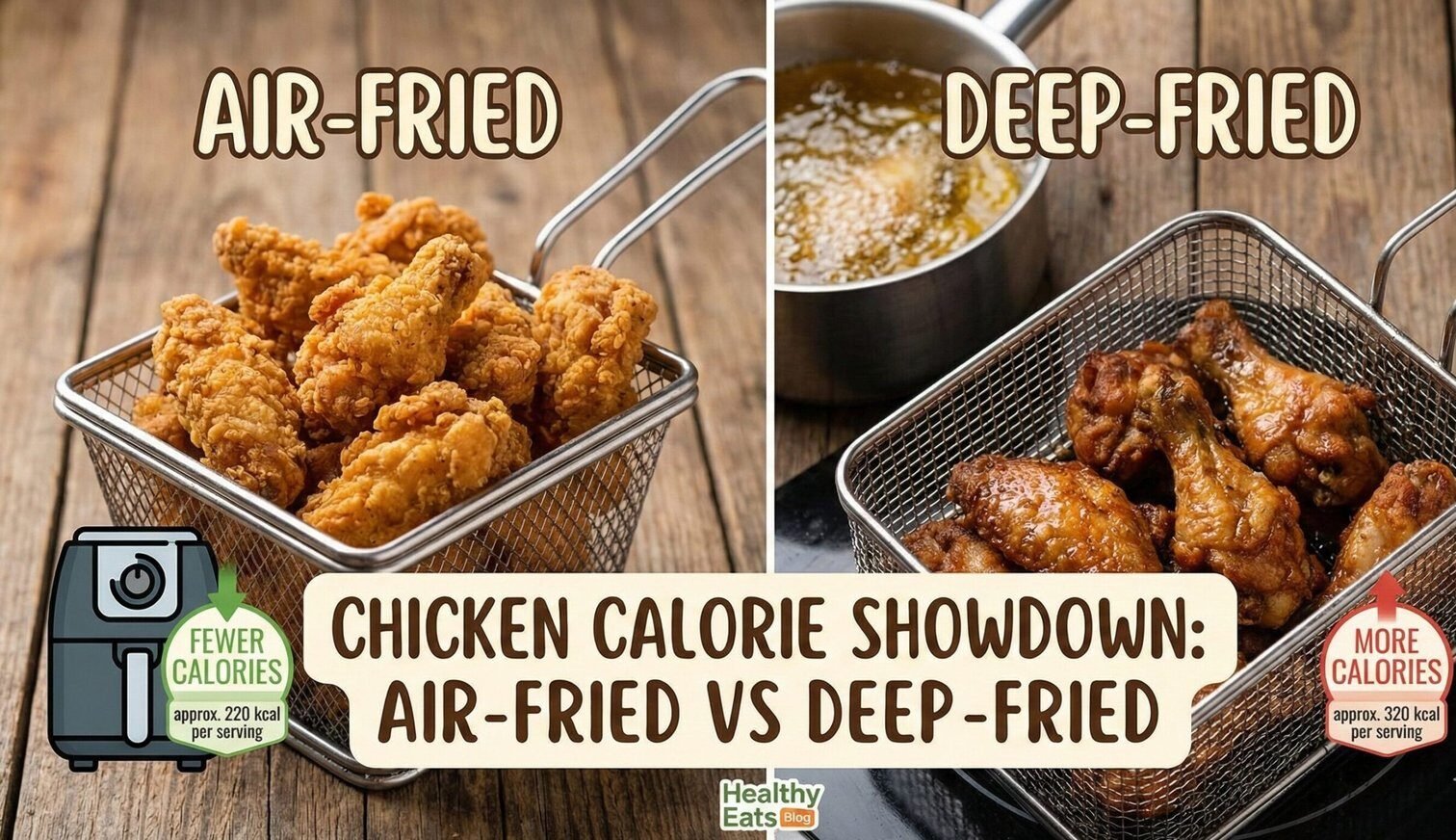
If you are standing in your kitchen holding a raw chicken breast, debating whether to drop it into a vat of bubbling oil or slide it into a sleek digital appliance, you aren’t just making a culinary choice. You are making a mathematical one. The battle of Air-Fried Chicken vs. Deep Fried Chicken calories is one of the primary reasons millions of households have made smart lifestyle upgrades by adopting convection cooking.
But does the hype match the nutritional facts? As experts in culinary tech, we’ve broken down the numbers, the science of oil absorption, and the taste trade-offs.
The Short Answer
Air-fried chicken generally contains 70% to 80% fewer calories from fat than deep-fried chicken. While a 100g serving of deep-fried chicken breast can clock in at roughly 250-300 calories with 14g of fat, the same air-fried serving (using minimal oil spray) averages 160-180 calories and only 4-6g of fat. The massive difference comes from oil absorption during submersion versus the rapid air circulation method.
The Calorie Breakdown: By The Numbers
To understand the difference, we have to look at the physics of cooking. Deep frying works by submerging food in fat. As the water inside the chicken evaporates (steam), the oil rushes in to fill the void. This is why deep-fried food is so calorie-dense.
In contrast, air frying uses the benefits of rapid air circulation (convection) to crisp the exterior. You only need enough oil to conduct heat on the surface—usually a teaspoon or a quick spray.
| Metric (per 100g / 3.5oz) | Deep Fried (Traditional) | Air Fried (1 tsp Oil) | Savings |
|---|---|---|---|
| Total Calories | ~290 kcal | ~175 kcal | Save ~115 kcal |
| Total Fat | 16g | 4.5g | 70% Less Fat |
| Carbohydrates (Breading) | 14g | 12g | Negligible Diff |
| Protein | 22g | 24g | Slightly Higher |
Note: Values are estimates based on breaded chicken breast. Dark meat (thighs/wings) will have higher baseline calories but similar reduction ratios.
Calories By Chicken Cut: Breast, Thigh, Wing & Drumstick
Averages are useful for a quick gut-check, but the truth is that a chicken breast and a chicken wing behave very differently in a fryer. Skin surface area, bone content, and fat marbling all change the math. If you’re trying to hit a specific daily calorie target, working from a whole “fried chicken” average instead of the actual cut you’re eating is one of the most common tracking mistakes people make. Below is a per-piece breakdown that reflects how a typical breaded, skin-on serving compares across the two cooking methods.
| Chicken Cut (1 piece, skin-on, breaded) | Deep Fried | Air Fried | Calories Saved |
|---|---|---|---|
| Breast (whole, ~172g) | ~360-390 kcal | ~185-270 kcal | ~120-175 kcal |
| Thigh (~62g) | ~250 kcal | ~170 kcal | ~80 kcal |
| Drumstick (~49g) | ~195 kcal | ~140 kcal | ~55 kcal |
| Wing (~29g) | ~160 kcal | ~110 kcal | ~50 kcal |
Two variables move these numbers more than anything else: whether the skin is left on, and how heavy the breading is. Removing the skin from a fried breast can cut its calorie count by roughly a quarter to a third on its own, independent of the cooking method. Meanwhile, a “standard” flour dredge adds somewhere in the neighborhood of 80 to 100 calories per piece, while an extra-crispy double-breaded coating can tack on 120 to 150 calories, and a light seasoned dusting adds closer to 40 to 60. If your goal is calorie control, the combination that wins hardest is a skinless cut with a light breading, cooked in the air fryer.
Why Bone-In Cuts Are Deceptive on a Nutrition Label
Bone-in thighs and drumsticks often look lower in calories than boneless cuts on a per-piece basis, but that’s partly because a chunk of the piece’s weight is bone, not edible meat. When you compare cuts on a per-100g-of-edible-meat basis (as we did in the table above), thighs and drumsticks are actually higher in calories than breast meat because dark meat carries more intramuscular fat. That fat is exactly why thighs stay juicier in an air fryer than breast meat does — there’s more built-in moisture to protect against the drying effect of convection heat.
Scientific Validation: The Yedi Report
This isn’t just marketing fluff. Independent laboratory testing validates these claims. For example, a report regarding calorie claims associated with Yedi Air Fryers demonstrated significant reductions in lipid content when comparing preparation methods. You can read the detailed findings in this External Lab Report PDF.
The study highlights that the Oil Uptake Ratio is the critical metric. In deep frying, the breading acts like a sponge. In air frying, the breading crisps up via dehydration rather than oil saturation.
To put a number on that “sponge” effect: research on frying oil absorption generally puts deep-fried food at absorbing somewhere between 8% and 25% of its own weight in oil, with the exact figure depending on frying temperature, breading thickness, and how long the food stays submerged. A thicker batter and a lower oil temperature both increase how much fat gets pulled in, because the food spends more time in contact with the oil before its surface sets. An air-fried piece, by comparison, absorbs close to none of the oil it’s cooked with — the only fat present is whatever you sprayed or brushed on beforehand, which is why the calorie gap is as dramatic as it is.
Beyond Calories: Acrylamide, Trans Fats & Oxidized Oil
Calorie counts get the headlines, but they aren’t the only reason people are moving away from the deep fryer. Repeated, high-heat frying — especially with oil that gets reused across multiple batches, which is standard practice in most commercial kitchens — breaks down the oil’s chemical structure over time. That degraded oil can generate trans fats, the type of fat most strongly linked to raised LDL (“bad”) cholesterol, lowered HDL (“good”) cholesterol, and elevated inflammation markers. Air frying sidesteps this issue almost entirely, since you’re using a small, fresh amount of oil each time rather than a vat that gets reheated for hours or days.
There’s also the matter of acrylamide, a chemical compound that can form when starchy foods — including breaded chicken coatings — are cooked at high temperatures. Acrylamide has been flagged by health researchers as a potential carcinogen at high exposure levels, and studies on cooking methods have found that air frying can reduce dietary acrylamide formation by a substantial margin compared to deep frying, sometimes cited at up to 90% less. Air frying also tends to produce fewer polycyclic aromatic hydrocarbons (PAHs), another class of compounds associated with high-temperature oil frying. None of this means deep-fried chicken is dangerous in moderation, but for anyone frying regularly, the compounding exposure is worth factoring in alongside the calorie math.
Does Air-Fried Chicken Actually Help With Weight Loss?
Calorie savings only translate into weight loss if they fit into your overall energy balance — losing weight still comes down to maintaining a caloric deficit, meaning you burn more energy across the day than you take in. Where air frying earns its reputation as a genuine weight-management tool is in how easily it lets you preserve lean protein while cutting the fat that usually rides along with it. A 172-gram fried chicken breast can carry well over 20 grams of protein either way it’s cooked, but the air-fried version delivers that protein for roughly half the calories once you strip out the absorbed frying oil.
Protein also has a higher thermic effect than fat, meaning your body burns more energy simply digesting and processing it. Keeping protein density high while fat density stays low is part of why high-protein, lower-fat meals tend to keep people fuller for longer and help stabilize blood sugar, which in turn can reduce cravings later in the day. If you’re actively counting calories for a cut, swapping your fried-chicken night from a deep fryer to an air fryer is one of the simpler, lower-effort changes you can make without giving up the comfort-food format entirely.
Homemade vs. Restaurant Fried Chicken: A Reality Check
All of the numbers above describe home cooking with a standard flour dredge and a home-sized portion. Restaurant and fast-food fried chicken is a different animal almost across the board. Chains tend to run heavier breading, larger cuts, and significantly more sodium than a typical home recipe, plus many items are cooked in oil blends optimized for shelf life and flavor rather than nutrition. A well-known fast-food fried chicken sandwich, for example, can carry well north of 600 calories and over 40 grams of fat in a single sandwich — more than double what a comparable homemade, air-fried chicken breast sandwich would cost you calorically.
This is one of the strongest arguments for cooking fried chicken at home with an air fryer rather than treating “fried chicken” as a single interchangeable category. The cooking method matters, but portion size, breading thickness, and sodium content compound the differences even further. If weight management is your goal, home-prepared air-fried chicken with a light breading and controlled portions will consistently beat both homemade deep-fried chicken and restaurant fried chicken on every relevant metric — calories, fat, and sodium alike.
The Role of Equipment in Calorie Reduction
Believe it or not, the type of air fryer you use can impact the calorie count. High-efficiency units like the NuWave IQ360 Pro or the powerful Ninja Foodi series circulate air faster.
Faster air circulation means the food crisps quicker, requiring less time and less oil spray to achieve that golden color. Older, manual units might require you to add more oil to prevent the breading from tasting like dry flour. This is a key point in the digital vs manual air fryer debate.
Temperature Control is Key
If you cook at too low a temperature, your food dries out. If you cook too high, it burns. Proper temperature control ensures the natural fats in the chicken render out (drip away) rather than getting locked in. Always use a perforated basket or fryer strainers to let that excess fat drip away from the meat.
Cooking Time & Preheating Matter Too
Most air fryers benefit from a short 3-to-5-minute preheat before the chicken goes in. Starting with a hot basket mimics the immediate sear you’d get dropping food into hot oil, which helps set the breading’s crust faster and reduces the amount of total cooking time the coating spends absorbing surface moisture. As a rough guide, a full cook cycle for breaded chicken pieces in an air fryer typically runs 20 to 30 minutes at a moderate-high temperature, compared with the 12-to-15-minute submerged cook time typical of a deep fryer — the trade-off for those extra minutes is the dramatic drop in fat absorption discussed above.
Because most air fryer baskets circulate heat primarily from above and behind the food, flipping or shaking partway through the cycle is what keeps browning even on every side. Skipping this step is one of the most common reasons people end up with pale, unevenly cooked spots on the underside of a breaded piece.
The “Taste Gap”: Closing the Distance
The biggest hesitation people have is flavor. “Will it taste like cardboard?”
It won’t, if you do it right. The calories you save allow you to “spend” them on better ingredients. Here is the Web Dev Pro formula for high-flavor, low-calorie fried chicken:
- Marinate: Use buttermilk or a brine. Moisture is key since you aren’t submerging in oil.
- The Oil Choice: Don’t use butter (low smoke point). Use Avocado Oil or Grapeseed oil in a mister.
- The Shake: Halfway through cooking, shake the basket. If you have fryer gloves, give the basket a vigorous toss to ensure even browning.
- Don’t Overcrowd: If you stack chicken, it steams instead of frying. If you need to cook for a crowd, look into larger units like the Kalorik Maxx Air Fryer Oven.
For specific step-by-step instructions, check our recipes for beginners guide.
Wet Batter vs. Standard Breading Procedure
One texture mistake trips up more first-time air fryer users than anything else: using a classic wet, drippy batter meant for a deep fryer. In a deep fryer, that thin batter sets almost instantly on contact with hot oil, so it clings and crisps. In an air fryer, there’s no oil bath to “shock” the batter into place, so a wet batter tends to slide right off the chicken and pool in the bottom of the basket. The fix is to switch to what’s often called the standard breading procedure — flour, then egg wash, then a dry breadcrumb or panko coating — which gives the crumb something to physically grip onto as it dehydrates and crisps in the moving hot air.
Essential Gear for Low-Calorie Frying
To get the best results (and accurate calorie tracking), you need the right tools. We’ve curated this list from Amazon based on our testing.

COSORI Air Fryer TurboBlaze 6.0-Quart
Consistent airflow is vital for low-oil cooking. The TurboBlaze motor ensures crispy skin with 95% less oil than deep frying. A massive upgrade over standard baskets.
Check Price on Amazon
Oil Sprayer for Air Fryer
Stop pouring calories! This glass mister allows you to spray a fine mist of your favorite high-heat oil. Essential for coating breading evenly without soaking it.
Check Price on Amazon
Etekcity Food Kitchen Scale
You can’t track calories if you don’t weigh your food. Pair this with our guide on best digital kitchen scales for precision nutrition.
Check Price on Amazon
Air Fryer Disposable Paper Liners
While parchment liners don’t save calories directly, they prevent old burnt oil from smoking up your next meal, keeping flavors fresh.
Check Price on AmazonNavigating the Challenges
Transitioning from deep frying isn’t always smooth. You might miss the specific “mouthfeel” of fat. If you are struggling, consider using a digital toaster oven air fryer which often allows for rotisserie cooking—basting the meat in its own juices rather than added oil.
Another common issue is cleaning. If you use sticky sauces (like BBQ wings) in an air fryer, they can burn to the element. Always keep a cleaning kit handy to maintain the appliance’s efficiency.
Finally, consider the prep work. Deep frying is forgiving with wet batters. Air frying demands a different approach. Standard wet batter drips off. You need a “Standard Breading Procedure” (Flour > Egg > Crumb). To master this, having the best mixing bowls and measuring cups set up in a station is vital.
Dry or Rubbery Chicken: Troubleshooting the Most Common Complaint
The single most common complaint about air-fried chicken is dryness, especially in lean cuts like breast meat. Since there’s no oil bath insulating the meat, it’s easier to overshoot the ideal internal temperature. Using a simple probe thermometer and pulling the chicken as soon as it hits a safe internal temperature — rather than cooking by time alone — solves most dryness complaints. Brining or marinating beforehand, as covered above, also gives the meat a moisture buffer that helps it survive the drier heat of convection cooking.
Frequently Asked Questions
How many calories does air frying save compared to deep frying chicken?
On average, air-fried chicken saves somewhere between 100 and 175 calories per piece compared to the same cut deep-fried, depending on the size of the piece, whether the skin is on, and how heavy the breading is. Across a full meal, that gap widens further once sides and multiple pieces are factored in.
Is air-fried chicken healthier than deep-fried chicken?
By most standard nutrition metrics, yes. Air-fried chicken carries substantially less fat and fewer calories for the same protein content, and it also tends to produce lower levels of acrylamide and other high-heat frying byproducts. Deep-fried chicken isn’t inherently unsafe eaten occasionally, but air frying gives you a lighter option for regular meals.
Does removing the skin make a bigger difference than switching cooking methods?
Both matter, but they aren’t equivalent. Removing skin from a fried piece can cut roughly a quarter to a third of its calories on its own, while switching from deep frying to air frying primarily attacks the fat absorbed by the breading and exposed meat surface. For the biggest calorie reduction, combine both: skinless chicken, air-fried.
Why does air-fried chicken sometimes taste drier than deep-fried?
Deep frying’s oil bath insulates the meat and helps lock in moisture, while air frying relies on hot, moving air that can pull moisture out of lean cuts more aggressively if overcooked. Brining, marinating, and pulling the chicken at the correct internal temperature rather than by a fixed cook time both help close this gap.
Do different air fryer models change the calorie outcome?
Somewhat. Units with stronger, more even convection fans crisp breading faster and more reliably with less added oil, while weaker or older units sometimes need extra oil spray to avoid a dry, floury texture. The cooking method still does the majority of the calorie-saving work, but equipment efficiency can shift the numbers slightly in either direction.
Is restaurant fried chicken worse than homemade deep-fried chicken?
Generally yes. Restaurant and fast-food fried chicken tends to use heavier breading, larger portions, and more sodium than a typical home recipe, which stacks additional calories on top of whatever the frying method itself contributes. Homemade chicken, air-fried or deep-fried, usually comes out lighter than the restaurant equivalent simply because you control the portion and coating.
Air Frying vs. Baking vs. Grilling: How Does Frying Stack Up?
Air frying often gets marketed as “the healthy way to fry,” but it’s worth putting it in context against the other lower-fat cooking methods people reach for when they want fried-chicken flavor without the full calorie hit. Baking chicken in a conventional oven uses no oil bath at all, and a plain baked, skinless chicken breast typically lands in the 165-to-190-calorie range per 100 grams — close to, and sometimes slightly below, an air-fried equivalent. Grilling lands in a similar territory, with the caveat that grilled chicken skips the crispy breaded coating entirely unless you build one yourself with a dry rub or thin flour dust before grilling.
Where air frying pulls ahead of both baking and grilling is texture. Because convection heat circulates rapidly around the food in an enclosed chamber, air fryers replicate the crisp, browned exterior of deep frying far better than a standard oven or grill can, especially with breaded items. Baking a breaded piece of chicken in a conventional oven often leaves the underside pale and slightly soggy unless you flip it partway through and use a wire rack to let air circulate beneath it — which is essentially what an air fryer basket does automatically. For anyone chasing the specific “fried chicken” eating experience at the lowest possible calorie cost, air frying remains the closest match to deep frying’s texture while landing calorically closer to baking.
Where Deep Frying Still Wins
It would be dishonest to pretend deep frying has no advantages. Restaurant-quality fried chicken — the kind with a thick, craggy, deeply golden crust — is genuinely harder to fully replicate in an air fryer, particularly for very thick batters designed for submersion cooking. Deep frying also cooks large batches more uniformly and quickly, since every piece is surrounded by hot oil simultaneously rather than relying on air circulation around a single layer in a basket. If you’re cooking for a large gathering and batch size matters more than calorie count, a well-maintained deep fryer with fresh oil and precise temperature control is still going to be faster for high-volume cooking.
Popular Fried Chicken Formats: Tenders, Nuggets & Popcorn Chicken
Whole pieces of chicken aren’t the only format worth comparing. Smaller, bite-sized formats like tenders, nuggets, and popcorn chicken are extremely popular, especially for families and kids’ meals, and they carry their own calorie math because of their higher surface-area-to-meat ratio. More surface area means more breading per gram of chicken, and more breading means more opportunity for oil absorption in a deep fryer.
| Format (per 100g serving) | Deep Fried | Air Fried | Notes |
|---|---|---|---|
| Chicken Tenders | ~275-310 kcal | ~190-210 kcal | High breading-to-meat ratio |
| Chicken Nuggets | ~295-330 kcal | ~215-240 kcal | Often processed/ground meat |
| Popcorn Chicken | ~310-340 kcal | ~225-250 kcal | Smallest pieces, most surface area |
Because tenders, nuggets, and popcorn chicken carry more breading proportionally than a whole breast or thigh, the raw calorie counts run higher for both cooking methods compared to the whole-cut numbers earlier in this guide. The percentage savings from switching to an air fryer stay roughly consistent, generally in the 25-35% range, but the absolute calories saved per 100g is often larger in these smaller formats simply because there’s more breaded surface for oil to cling to in the first place.
If you regularly make nuggets or tenders for kids, portion size becomes just as important as cooking method. A serving that looks modest on a plate can add up quickly once you count the breading weight on several small pieces. Weighing a batch with a kitchen scale before cooking, rather than estimating by piece count, gives a far more accurate calorie total — especially useful if you’re logging meals in a nutrition tracking app.
Sodium, Not Just Calories: The Other Number Worth Watching
Calorie counting tends to dominate the fried chicken conversation, but sodium deserves equal attention, particularly for anyone managing blood pressure. Breading itself typically contains salt, and many home and restaurant recipes add additional seasoning salt or brine before cooking. The cooking method — air frying versus deep frying — doesn’t meaningfully change sodium content on its own, since sodium isn’t washed out or absorbed the way fat is. What does change sodium load dramatically is portion size and where the chicken comes from.
A homemade piece of breaded chicken, cooked either way, generally lands somewhere in the 250-450mg sodium range per piece depending on how it was seasoned and brined. Restaurant and fast-food fried chicken frequently runs several times higher per piece, since commercial recipes are often formulated for maximum flavor impact rather than sodium moderation. If you’re watching sodium alongside calories, the biggest lever isn’t air fryer versus deep fryer — it’s cooking at home with a measured amount of salt in your dredge and brine, rather than relying on a restaurant’s seasoning blend.
Fitting Fried Chicken Into Different Diet Styles
Because air-fried chicken shifts the macro balance toward more protein and less fat per calorie, it tends to fit more easily into several popular eating styles than deep-fried chicken does. That said, the fit isn’t identical across every diet, and it’s worth understanding where the nuances are before assuming “air-fried” automatically means “diet-friendly” for your specific approach.
High-Protein and Calorie-Deficit Diets
This is where air-fried chicken shines the most. A high protein-to-calorie ratio is exactly what most calorie-deficit and muscle-preservation diets are optimized for, and air-fried chicken breast in particular delivers a favorable ratio compared to almost any deep-fried format.
Low-Carb and Keto Approaches
Traditional flour or breadcrumb breading adds carbohydrates regardless of cooking method, so neither air-fried nor deep-fried breaded chicken is inherently low-carb. For a keto-friendly version of fried chicken, many home cooks swap the flour and breadcrumb coating for a crushed pork rind or almond flour dredge, which crisps up well in an air fryer’s convection heat and adds negligible carbohydrates compared to a traditional dredge.
Whole30, Paleo, and Similar Frameworks
These frameworks typically restrict conventional breading ingredients like wheat flour and standard breadcrumbs. A compliant version usually relies on almond flour, coconut flour, or crushed nut-based coatings, which — like the keto swap above — tend to crisp more reliably in an air fryer’s dry heat than in the wetter environment of a partially cooled deep fryer.
The Cost & Convenience Side of the Equation
Calories aren’t the only reason people switch cooking methods, and it’s worth being upfront that the decision usually involves cost and convenience too. A deep fryer requires several cups to several quarts of oil depending on its size, and that oil needs to be replaced periodically as it degrades from repeated heating — an ongoing cost that adds up over months of regular use. An air fryer, by contrast, uses at most a tablespoon or two of oil per batch, which means the ongoing cost of oil essentially disappears from your grocery bill after the first bottle.
There’s also the matter of cleanup and kitchen safety. A deep fryer involves large volumes of hot oil that need to cool completely before disposal or storage, and spills or splatters carry a real burn risk. Air fryers contain a small basket and minimal residual oil, which generally makes them faster to clean and safer for households with children moving through the kitchen. Over the lifespan of the appliance, many people find that the reduced oil spend and easier cleanup offset the upfront cost of a quality air fryer within the first year of regular use.
Common Myths About Air Frying Calories
A few misconceptions come up constantly in comments and forums whenever this topic is discussed. Clearing them up helps set realistic expectations for anyone switching cooking methods.
Myth: Air Fryers Use “No Oil”
Most recipes still call for a light coat of oil to help the breading brown and crisp properly. The point isn’t zero oil — it’s a teaspoon or so of oil versus the cups or quarts a piece absorbs while submerged in a deep fryer. Skipping oil entirely in an air fryer often produces a dry, pale, flour-tasting crust rather than a truly “oil-free” version of fried chicken.
Myth: Air-Fried and Deep-Fried Chicken Have Identical Calories If You Use the Same Amount of Oil
This misunderstands where the calorie difference actually comes from. It’s not primarily about how much oil is in the fryer or basket — it’s about how much oil the food itself absorbs during cooking. Submerged food in a deep fryer physically pulls oil into the breading as steam escapes; a lightly oiled piece in an air fryer never has that opportunity, regardless of how much oil sits in the reservoir of either appliance.
Myth: All Air Fryer Brands Produce the Same Nutritional Results
As covered earlier in the equipment section, fan strength and heat distribution vary meaningfully between models, and weaker units sometimes require more added oil to avoid a dry, underwhelming crust. The gap between models is smaller than the gap between cooking methods, but it isn’t zero.
Meal Prep Tips for Lower-Calorie Fried Chicken All Week
If you’re trying to make air-fried chicken a repeatable part of your weekly routine rather than a one-off dinner, a little batch-prep planning goes a long way. Bread multiple pieces of chicken in one sitting using the standard breading procedure described earlier, then freeze the uncooked, breaded pieces in a single layer on a tray before transferring them to a freezer bag. Breaded chicken frozen this way can go straight from freezer to air fryer basket with a few extra minutes added to the cook time, which means you always have a lower-calorie fried chicken option on hand without needing to bread chicken from scratch on a busy weeknight.
For already-cooked leftovers, reheating breaded chicken in an air fryer for a few minutes restores a surprising amount of crispness compared to a microwave, which tends to leave breading soft and slightly rubbery. This makes air-fried chicken a genuinely practical meal-prep protein in a way that deep-fried chicken rarely is, since deep-fried leftovers reheated in a microwave lose their crust almost entirely and reheating in fresh oil defeats much of the point of home cooking in the first place.
Does the Type of Oil You Use Change the Calorie Count?
A gram of fat is a gram of fat regardless of which bottle it came from — olive oil, avocado oil, canola oil, and peanut oil all carry roughly the same 120 calories per tablespoon. So switching oils won’t meaningfully change the calorie total of either a deep-fried or air-fried piece of chicken on its own. Where oil choice matters more is smoke point and how the oil behaves under repeated heating, which circles back to the trans-fat and oxidized-oil concerns discussed earlier in this guide.
For deep frying, oils with a high smoke point — refined peanut, canola, or vegetable oil — hold up better across multiple batches without breaking down as quickly. For air frying, where you’re only using a light spray or brush of oil, a mister filled with avocado oil or grapeseed oil tends to perform well because both have high smoke points and a neutral flavor that won’t overpower the chicken’s seasoning. Butter and other low-smoke-point fats aren’t ideal for either method at frying temperatures, since they scorch and produce a bitter, burnt flavor well before the chicken finishes cooking.
How Much Does a Light Oil Spray Actually Add?
It’s worth putting a real number on the “light spray” people talk about when describing air fryer prep. One teaspoon of oil adds roughly 40 calories total — spread across an entire batch of chicken, that works out to a small handful of extra calories per piece, compared with the 150-250 calories that a genuinely oil-submerged deep fry can add to the same piece. This is the entire calorie story in miniature: it’s not that air frying uses “good” oil and deep frying uses “bad” oil, it’s that one method uses a teaspoon and the other uses a quart-plus, and the food’s exposure time to that oil determines how much of it actually ends up on your plate.
Serving Size Math for Families and Meal Planning
Most of the numbers throughout this guide are given per 100 grams or per individual piece, which is useful for precision but doesn’t always map cleanly onto how a family actually plates a meal. A typical adult dinner portion of fried chicken is often two pieces — commonly a thigh and a drumstick, or a half breast — which means the calorie gap between cooking methods roughly doubles from the single-piece numbers shown earlier. For a household serving four people two pieces each, switching an entire meal from deep-fried to air-fried chicken can realistically save somewhere in the neighborhood of 800 to 1,400 total calories across the table, depending on which cuts are used and how they’re breaded.
This is where the appliance size decisions from earlier in this guide start to matter practically. A compact single-basket air fryer struggles to cook enough chicken for a family of four or five without running multiple back-to-back batches, which adds significant time to dinner prep. Larger capacity units, or dual-basket and oven-style models like the Kalorik Maxx mentioned earlier, let you cook a full family-sized batch in a single cycle, which is often the deciding factor for households moving away from a deep fryer’s higher batch capacity.
Meal Planning Around the Numbers
If you’re tracking calories across a full week rather than a single meal, it helps to think in terms of weekly totals rather than judging one dinner in isolation. Swapping just two fried-chicken dinners a week from deep-fried to air-fried, using the family-of-four math above, can realistically remove somewhere around 1,600 to 2,800 calories from a household’s weekly intake without anyone needing to eat a smaller portion or a different meal. That’s a meaningful lever for weight management goals precisely because it doesn’t require giving up a favorite comfort food — it only requires changing which appliance cooks it.
Building a Complete Lower-Calorie Fried Chicken Meal
The cooking method for the chicken itself is only part of the calorie equation on a full plate. Traditional fried chicken dinners are often served alongside sides that carry their own significant calorie and fat loads — mashed potatoes with gravy, buttered biscuits, mac and cheese, or a second fried item like French fries. Pairing air-fried chicken with a deep-fried side effectively cancels out a meaningful portion of the savings you worked to achieve on the main protein.
A more complete lower-calorie approach extends the same convection-cooking logic to the sides. Air-fried potato wedges, roasted vegetables, or a simple slaw dressed lightly rather than in a heavy mayonnaise-based dressing all keep the rest of the plate in line with the chicken. Since most air fryers can handle vegetables and starches in the same basket style used for chicken — often at the same time in a second basket on dual-zone models — building a full lower-calorie fried chicken dinner doesn’t require separate cooking equipment or a significantly different grocery list than a traditional fried chicken night.
Reading Nutrition Labels and Restaurant Menus Correctly
One practical skill this whole comparison points toward is knowing how to read a calorie listing critically, whether it’s on a frozen chicken package or a restaurant menu. Packaged breaded chicken products often list nutrition information “as packaged” (raw and uncooked) rather than “as prepared,” which means the calorie count on the box can look artificially low compared to what you’ll actually eat once it’s cooked in oil. Always check whether a label specifies “as prepared” values, and if it doesn’t, assume the cooking method you choose will add calories beyond what’s printed.
Restaurant menus present a different challenge: many chains don’t specify their exact frying method or oil blend, and calorie listings for fried chicken items are typically averages across a large batch rather than the specific piece served to you. When a menu lists a calorie range rather than a single number, it’s usually because portion size varies naturally across pieces of real chicken — bone-in cuts especially. Treating restaurant calorie listings as a reasonable estimate rather than an exact figure, and leaning toward the higher end of any listed range, tends to produce a more realistic picture of what you’re actually eating.
Conclusion: The Verdict
When weighing Air-Fried Chicken vs. Deep Fried Chicken calories, the winner is clear. Air frying offers a massive nutritional advantage, slashing fat calories by nearly 75% while retaining protein content. It is arguably one of the most impactful must-have kitchen appliances for health-conscious foodies.
While the taste profile is slightly different, modern appliances from brands like Ninja, Philips, and Chefman have narrowed the gap significantly. By using the right oils and accessories, you can have your cake (or chicken) and eat it too—without the guilt.
Ready to start cooking? Check out our review of the best small digital air fryers under $100 to get started on a budget.


