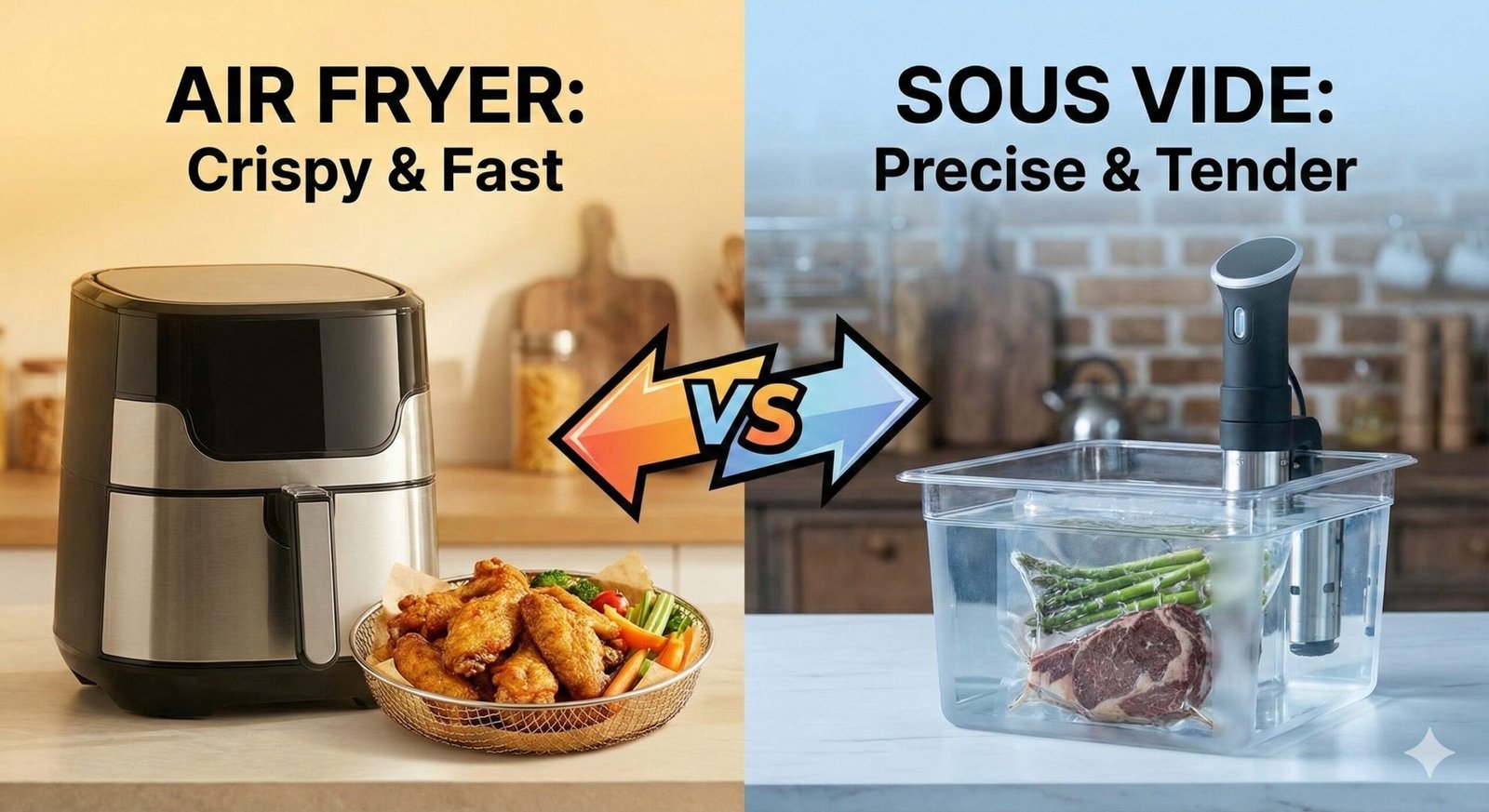
Air Fryer vs. Sous Vide: The Battle of Speed vs. Precision
In the world of modern cooking, there are two distinct camps. On one side, we have the “Fast and Furious” crowd: busy parents and professionals who want crispy, golden-brown food on the table in 15 minutes. On the other side, we have the “Low and Slow” perfectionists: home chefs seeking restaurant-quality steak that you can cut with a spoon.
This is the essence of the Air Fryer vs. Sous Vide debate.
These two appliances couldn’t be more different. One blasts food with superheated air; the other gently bathes it in warm water. One is about crunch; the other is about melt-in-your-mouth tenderness. But do you need both? Or can one appliance rule them all?
In this comprehensive guide, we’ll break down every aspect of these two revolutionary cooking methods — from the food science that makes them work, to the real-world scenarios where each one shines. Whether you’re a weeknight warrior looking for speed or a weekend chef chasing perfection, this guide will help you make the right choice for your kitchen.
The Air Fryer Explained: Speed & Crunch
The air fryer has taken over kitchens globally for one reason: it mimics deep frying without the mess or calories. But how does it work?
An air fryer is essentially a high-intensity convection oven. A heating coil generates heat, and a powerful fan circulates that hot air rapidly around a perforated basket. This creates the Maillard reaction—browning and crisping the exterior of food while cooking the interior quickly.
If you are wondering about the versatility of this machine, you might be surprised. It’s not just for fries; check out what you can cook in an air fryer, from vegetables to desserts.
How Air Frying Actually Works
The science behind air frying is straightforward but elegant. When food enters the basket, a heating element (usually positioned above the food) heats air to temperatures between 300°F and 450°F. A powerful fan — often running at 1,500 to 3,000 RPM — forces this superheated air downward and through the perforated basket. The air swirls around every surface of the food, creating convective heat transfer that is far more efficient than a standard oven.
The key to air frying’s success is the Maillard reaction, a chemical process that occurs when amino acids and sugars in food are exposed to heat above 280°F. This reaction creates hundreds of flavor compounds and the characteristic browning we associate with fried food. In a deep fryer, this reaction happens in oil; in an air fryer, it happens through rapid air circulation.
The perforated basket serves a critical function: it allows hot air to reach the bottom of the food, ensuring even cooking on all sides. Some models even have a stirring mechanism or shake reminder to ensure uniform exposure. The result is food that is crispy on the outside and moist on the inside — remarkably similar to deep frying, with up to 80% less fat.
Air Fryer Technology Evolution
The modern air fryer has come a long way since Philips introduced the first consumer model. Today’s units feature dual-basket systems for cooking two foods simultaneously, windowed designs so you can monitor progress without opening the basket, and even dehydrating functions that turn your air fryer into a multi-purpose tool. Some premium models incorporate smart sensors that automatically adjust time and temperature based on the food’s moisture content.
The evolution of air fryer baskets has also been significant. Early models had flat, non-stick baskets that sometimes caused food to stick. Modern baskets use ceramic coatings, stainless steel mesh, or even silicone liners that promote airflow while preventing sticking. These improvements have made air frying more accessible and foolproof for home cooks of all skill levels.
Pros of Air Fryers
- Speed: Cooks most meals in 10-20 minutes, making it ideal for weeknight dinners when time is limited.
- Texture: Excellent for creating crispy skins and crunchy coatings that rival deep frying.
- Versatility: Can roast, bake, reheat, dehydrate, and even grill depending on the model.
- Health: Uses up to 80% less fat than traditional deep frying while achieving similar results.
- Convenience: Preheats in 2-3 minutes and cleanup is typically fast with dishwasher-safe baskets.
- Space-efficient: Takes up minimal counter space compared to a full-size oven.
Cons of Air Fryers
- Dryness: Because it uses intense hot air, it can dry out lean meats if you aren’t careful with timing.
- Capacity: Basket space is limited compared to a water bath or full-size oven.
- Noise: The powerful fan can be loud, especially at higher temperature settings.
- Learning curve: Adjusting times and temperatures from conventional oven cooking takes practice.
- Even cooking challenges: Overcrowding the basket leads to uneven results.

A powerhouse air fryer that offers OdorErase technology and a window to watch your food crisp up to perfection.
Check Price on AmazonThe Sous Vide Explained: Precision & Tenderness
Sous Vide (French for “under vacuum”) used to be the secret weapon of Michelin-star chefs. Now, it’s a stick you can buy for under $100.
The process involves vacuum-sealing food in a bag and submerging it in a water bath. A sous vide immersion circulator heats the water to an exact temperature (e.g., 129°F for medium-rare steak) and holds it there. The food cooks to that exact temperature from edge to edge, making it impossible to overcook.
How Sous Vide Actually Works
Sous vide leverages the principle of thermal equilibrium. When food is sealed in a bag and submerged in water held at a precise temperature, heat transfers from the water through the bag and into the food via conduction. Over time, the food reaches the same temperature as the water. Since water is a far better conductor of heat than air, this process is both more efficient and more uniform than oven cooking.
The vacuum-sealed bag serves multiple purposes. First, it eliminates air pockets that would create uneven heating. Second, it prevents moisture loss — the food cooks in its own juices, concentrating flavors rather than diluting them. Third, it allows for precise seasoning and marinade infusion, as the vacuum pressure forces liquids into the food’s cellular structure.
The magic of sous vide lies in temperature precision. Most immersion circulators maintain water temperature within 0.1°F of the target. This means if you set your steak to 130°F, the entire piece of meat — from the outermost edge to the center — will eventually reach exactly 130°F. There is no temperature gradient, no “bullseye” effect, and no risk of overshooting. This is something no other cooking method can achieve with the same consistency.
The History of Sous Vide
Sous vide was invented in the 1960s by Bruno Goussault, a French food scientist, and Georges Pralus, a French chef working for the restaurant Troisgros. They discovered that cooking foie gras at a precise low temperature preserved its texture and reduced shrinkage compared to traditional methods.
For decades, sous vide remained exclusively in professional kitchens due to the high cost of equipment. The turning point came in the early 2010s when companies like Anova and Joule introduced consumer-grade immersion circulators at accessible price points. The technology has since become one of the fastest-growing segments in home cooking equipment, with millions of units sold worldwide.
Pros of Sous Vide
- Perfection: You get the exact same doneness from the center to the edge. No “grey bands” on your steak.
- Texture: Breaks down collagen in tough cuts of meat over long cooks (24+ hours), turning cheap cuts into filet mignon.
- Stress-Free: You can leave a steak in the water for an extra hour, and it won’t burn.
- Consistency: Every piece of food comes out identical every single time, eliminating guesswork.
- Flavor: Cooking in sealed bags concentrates flavors and prevents nutrient loss.
- Batch cooking: Can cook 10 or more identical portions simultaneously.
Cons of Sous Vide
- Time: It is slow. A chicken breast takes an hour; ribs can take 24 hours.
- No Sear: Food comes out of the bag looking grey and unappetizing. You must sear it afterwards in a pan or with a torch.
- Equipment: Requires a vacuum sealer, bags, and the immersion circulator itself.
- Setup: More prep time involved compared to other cooking methods.
- Texture limitation: Cannot achieve crispy or crunchy textures on its own.

The most popular sous vide stick on the market. Connects to your phone so you can monitor your steak from the couch.
Check Price on AmazonHead-to-Head Comparison
| Feature | Air Fryer | Sous Vide |
|---|---|---|
| Primary Mechanism | Hot Air (Convection) | Warm Water (Conduction) |
| Cooking Time | Minutes (Fast) | Hours (Slow) |
| Best For | Wings, Fries, Veggies, Frozen Foods | Steaks, Roasts, Fish, Eggs |
| Texture Result | Crispy, Crunchy | Tender, Moist, Soft |
| Learning Curve | Easy (Plug & Play) | Moderate (Requires searing step) |
| Temperature Range | 300°F – 450°F | 80°F – 195°F |
| Temperature Precision | Within 5-10°F | Within 0.1°F |
| Moisture Retention | Moderate to Low | Very High (sealed environment) |
| Maillard Reaction | Excellent (high heat) | None (requires post-sear) |
| Collagen Breakdown | Limited (short cook times) | Excellent (long cook times) |
| Energy Usage | Moderate (runs 15-30 min) | Low per hour, but runs for hours |
| Counter Space | Small to Medium | Small (stick) + Container |
| Cleanup Difficulty | Easy (dishwasher-safe baskets) | Easy (bag + container) |
| Price Range | $50 – $300 | $80 – $500 |
| Multi-Batch Cooking | Difficult (limited capacity) | Easy (add more bags) |
The Science Behind Each Method
Understanding the food science behind air frying and sous vide helps you make smarter cooking decisions. These aren’t just kitchen gadgets — they’re precision instruments that exploit different principles of heat transfer and chemistry.
Heat Transfer Mechanisms
All cooking is fundamentally about transferring thermal energy from a heat source to food. There are three primary mechanisms at play:
Conduction is the direct transfer of heat between two objects in contact. In sous vide, heat moves from the warm water through the plastic bag and into the food. Water is an excellent conductor of heat — roughly 25 times more efficient than air at transferring thermal energy. This is why sous vide cooking is so efficient despite using lower temperatures.
Convection is the transfer of heat through a moving fluid (liquid or gas). Air fryers rely entirely on forced convection — a fan rapidly circulates hot air around food, continuously replacing the cooled air near the food’s surface with fresh superheated air. This dramatically speeds up cooking compared to a standard oven, where air movement is minimal.
Radiation is heat transfer through electromagnetic waves. While not the primary mechanism in either appliance, some air fryers use radiant heat from the heating element to supplement convection, particularly for browning the top surface of food.
The Maillard Reaction: Air Fryer’s Secret Weapon
The Maillard reaction is arguably the most important chemical process in cooking. Named after French chemist Louis-Camille Maillard, who first described it in 1912, this reaction occurs when amino acids (from proteins) react with reducing sugars at temperatures above 280°F (140°C). The result is hundreds of new flavor and aroma compounds, along with the characteristic brown color of seared, roasted, and baked foods.
Air fryers excel at the Maillard reaction because they operate at high temperatures (300-450°F) with rapid air circulation that efficiently delivers heat to the food’s surface. The dry heat environment is ideal — moisture inhibits the Maillard reaction, and the air fryer’s forced convection helps evaporate surface moisture quickly.
Sous vide, by contrast, operates below the Maillard threshold. Food cooked sous vide never browns on its own. This is why the searing step is essential — it’s not just about appearance, but about developing the complex flavors that only the Maillard reaction can produce.
Protein Denaturation
When heat is applied to proteins, they unfold and restructure — a process called denaturation. Different proteins denature at different temperatures, which is why temperature control matters so much.
Myosin (the primary muscle protein) begins denaturing at about 122°F (50°C). This is what gives meat its cooked texture. Collagen (the tough connective tissue) begins breaking down into gelatin at around 160°F (71°C), but this process takes time — the longer you hold collagen at temperature, the more it converts to silky gelatin.
This is where sous vide truly shines. By holding meat at a precise temperature for extended periods, you can achieve collagen breakdown (tenderness) while keeping the muscle proteins from over-tightening (dryness). An air fryer, with its short cooking times and high heat, cannot replicate this effect on tough cuts.
Moisture and Evaporation
The relationship between heat, moisture, and food texture is fundamental to understanding these two methods. In an air fryer, the dry, moving air actively pulls moisture from the food’s surface. This evaporative cooling effect is actually what keeps the interior from overcooking — the surface dries and crisps while the interior heats more slowly. But this same mechanism means lean foods can dry out if cooked too long.
In sous vide, the sealed bag prevents any moisture loss. Food literally cooks in its own juices. A chicken breast cooked at 145°F for one hour will retain nearly 100% of its moisture, resulting in a juiciness that no other method can match. The tradeoff is that without moisture evaporation, there’s no way to develop a crust — the surface remains soft and pale.
Temperature Precision: Why It Matters
Temperature precision is where sous vide absolutely dominates. Understanding why this matters requires looking at what happens to food at specific temperatures.
The Doneness Spectrum
For steak, the difference between medium-rare and medium is just 10°F (from 130°F to 140°F). In a conventional oven or on a grill, this narrow window is nearly impossible to hit consistently because the heat source is so much hotter than the target temperature. You’re essentially trying to stop a runaway process at exactly the right moment.
Sous vide eliminates this problem entirely. If you want medium-rare, you set the water to 130°F and walk away. The steak will reach 130°F and stop. It can’t go higher because the water won’t get hotter. It can’t go lower because the circulator maintains temperature. The result is edge-to-edge medium-rare perfection every single time.
Protein-Specific Temperature Targets
| Protein | Sous Vide Temp | Cook Time | Result |
|---|---|---|---|
| Beef Steak (1 inch) | 129°F | 1-4 hours | Perfect medium-rare edge-to-edge |
| Chicken Breast | 145°F | 1-2 hours | Juicy, slightly pink, safe |
| Pork Chop | 140°F | 1-4 hours | Moist, tender, slightly pink |
| Salmon Fillet | 125°F | 30-60 minutes | Buttery, translucent center |
| Eggs | 147°F | 45-60 minutes | Custard-like, soft scramble |
| Beef Short Ribs | 155°F | 24-72 hours | Fork-tender, falls apart |
| Chicken Thighs | 165°F | 1-4 hours | Shreddable, ultra-juicy |
| Carrots | 183°F | 1-2 hours | Tender-crisp, glazed |
Why Air Fryer Temperature Control Falls Short
Air fryers use thermostat-controlled heating elements that cycle on and off to maintain an average temperature. However, the actual temperature inside the basket fluctuates significantly — often by 5-10°F or more. This is because the fan creates uneven airflow patterns, and opening the basket to shake or check food releases accumulated heat.
For most foods, this fluctuation doesn’t matter — the Maillard reaction occurs over a broad temperature range, and a few degrees either way won’t dramatically change your fries or chicken wings. But for precision proteins like steak or fish, this inconsistency can mean the difference between perfect and overcooked.
The key takeaway: air fryers are excellent for high-heat cooking where texture matters more than internal temperature precision. Sous vide is essential when exact internal doneness is the goal.
Time & Energy Analysis
One of the most common questions about these cooking methods is “how long does it take?” The answer depends on what you’re cooking, but the comparison is stark.
Cooking Time Comparison
| Food Item | Air Fryer Time | Sous Vide Time | Winner |
|---|---|---|---|
| Frozen French Fries (1 lb) | 12-15 minutes | N/A (not suitable) | Air Fryer |
| Chicken Wings (2 lbs) | 20-25 minutes | 2 hours + 5 min sear | Air Fryer |
| Steak (1-inch, medium-rare) | 10-12 minutes | 1-4 hours + 2 min sear | Air Fryer (speed) / Sous Vide (quality) |
| Chicken Breast | 10-12 minutes | 1-2 hours | Air Fryer |
| Salmon Fillet | 8-10 minutes | 30-60 minutes | Air Fryer |
| Hard-Boiled Eggs | 10-12 minutes | 45-60 minutes | Air Fryer |
| Pork Tenderloin | 15-20 minutes | 2-4 hours | Air Fryer (speed) |
| Beef Short Ribs | 25-30 minutes (won’t tenderize) | 24-72 hours (fork-tender) | Sous Vide |
| Vegetables (mixed) | 10-15 minutes | 1-2 hours | Air Fryer |
| Whole Chicken (4 lbs) | 25-30 minutes (in pieces) | 1-4 hours | Depends on goal |
Energy Consumption
Energy efficiency is a nuanced comparison between these two methods. An air fryer typically uses between 800 and 1,800 watts of power, but it runs for only 10-30 minutes per cooking session. A sous vide circulator uses only 800-1,200 watts, but it runs for 1-24 hours.
Here’s the math: a 1,200-watt air fryer running for 20 minutes uses 0.4 kWh of electricity. A 1,000-watt sous vide circulator running for 4 hours uses 4.0 kWh — ten times more. However, sous vide is more energy-efficient per pound of food cooked, especially when you’re batch cooking multiple portions simultaneously.
For a family of four cooking chicken breasts, sous vide might use 1.5 kWh total (4 breasts in one bath), while an air fryer would need to cook them in two batches at 0.3 kWh each (0.6 kWh total). The sous vide still uses more energy, but the per-serving difference narrows considerably.
Energy Tip: For small, quick meals (1-2 servings), the air fryer is dramatically more energy-efficient. For large batch cooking (4+ identical portions), sous vide’s efficiency improves relative to its cooking time.
Texture & Taste Test
The biggest difference lies in moisture retention versus surface texture. Each method produces fundamentally different eating experiences.
The Air Fryer Experience
Air fryers excel at dehydration. They pull moisture out of the surface of the food to create a crust. This is perfect for chicken wings or french fries. However, if you cook a steak in an air fryer, you risk the “bullseye” effect—well done on the outside, but potentially raw in the middle if the temperature is too high.
The texture of air-fried food is characterized by a thin, crispy exterior layer with a moist interior. The thickness of this crust depends on cooking time and temperature — higher heat and longer times create a thicker, crunchier crust. This is ideal for breaded foods, where the coating crisps up beautifully, and for natural-skin proteins like chicken wings, where the skin renders and becomes glass-like.
Flavor-wise, air frying produces deeply caramelized, toasty notes from the Maillard reaction. The browning creates complex flavor compounds that our palates associate with comfort food. This is why air-fried french fries taste remarkably similar to deep-fried ones — the Maillard reaction produces similar compounds regardless of whether the heat comes from oil or air.
The Sous Vide Experience
Sous vide cooks in a sealed environment, meaning zero moisture loss. A chicken breast cooked sous vide is incredibly juicy, unlike anything you can achieve in an oven. However, it has zero crunch. To fix this, sous vide users often perform a “reverse sear,” where they cook the meat in water first, then flash-fry it in a pan with high-heat oil.
The texture of sous vide food is characterized by uniform doneness and exceptional tenderness. Every bite, from edge to center, has the same texture. This consistency is impossible to achieve with any high-heat cooking method. For tough cuts like brisket or short ribs, extended sous vide cooking (24-72 hours) breaks down collagen into gelatin, creating a melt-in-your-mouth texture that would require a smoker or slow cooker to achieve otherwise.
Flavor in sous vide cooking is concentrated and pure. Since no juices escape during cooking, the natural flavors of the food intensify. Many chefs describe sous vide proteins as tasting “more like themselves” — a steak tastes beefier, chicken tastes more like chicken. The sealed bag also allows aromatics (herbs, spices, citrus zest) to infuse deeply into the food, creating flavor profiles that are impossible with open-air cooking.
The Best of Both Worlds: The Reverse Sear
Many experienced cooks combine both methods for optimal results. The reverse sear technique involves cooking food sous vide first for perfect internal doneness, then finishing it in an air fryer (or with a torch) for a crispy exterior. This gives you the precision of sous vide with the texture of high-heat cooking — arguably the best possible outcome.
For example, a thick pork chop cooked sous vide at 145°F for 2 hours will be perfectly pink and juicy throughout. Pat it dry, brush with oil, and air fry at 400°F for 3-5 minutes, and you’ll get a golden, crispy crust without overcooking the interior. This two-step approach is increasingly popular among home cooks who want restaurant-quality results.
Health & Nutrition
Both methods are considered healthier than traditional deep frying, but for different reasons.
Air Frying: Fat Reduction
Air Frying: Significantly reduces fat intake because you are not submerging food in oil. You can cut calories by up to 70-80% compared to deep frying. We broke down these numbers in our article on air fried chicken vs. deep fried chicken calories.
The health benefits of air frying extend beyond fat reduction. By avoiding deep frying, you also reduce your exposure to acrylamide — a potentially harmful compound that forms when starchy foods are cooked at high temperatures in oil. While air frying can still produce some acrylamide, studies suggest it produces significantly less than deep frying.
Air frying also encourages cooking with whole foods rather than processed options. Many people who adopt air frying report eating more vegetables, lean proteins, and whole grains because these foods taste excellent when air fried with minimal oil.
Sous Vide: Nutrient Preservation
Sous Vide: Requires little to no added fat during the cooking process. You are cooking the food in its own juices. Additionally, because the temperatures are lower and more controlled, there is some evidence that sous vide preserves heat-sensitive vitamins better than high-heat blasting.
Research has shown that sous vide cooking retains more water-soluble vitamins (like vitamin C and B vitamins) compared to boiling or high-heat methods. The sealed environment prevents these nutrients from leaching into cooking water or being destroyed by excessive heat.
Sous vide also makes it easier to control sodium and sugar intake. Because food is sealed with seasonings, you can use precise amounts of salt and sugar for maximum flavor impact with minimal quantity. The vacuum sealing process forces these seasonings into the food, so a little goes a long way.
Air Fryer Health Benefits
- 70-80% less fat than deep frying
- Lower acrylamide formation
- Encourages whole food cooking
- Reduced calorie density
- No oil absorption for frozen foods
Sous Vide Health Benefits
- Higher nutrient retention
- Precise sodium/sugar control
- No added fat required
- Consistent pasteurization
- Reduced formation of harmful compounds
Protein-Specific Cooking Guide
Different proteins respond differently to air frying and sous vide. Here’s a detailed breakdown of how each method handles the most popular proteins.
Beef Steak
Air Fryer: Excellent for thin steaks (under 1 inch) that can cook through quickly. Cook at 400°F for 7-10 minutes for medium-rare. Works best with ribeye and New York strip — cuts with enough fat to stay moist. Thicker steaks (over 1.5 inches) are challenging because the exterior overcooks before the interior reaches target temperature.
Sous Vide: The gold standard for steak. Set your circulator to 129°F for medium-rare, 135°F for medium, or 145°F for medium-well. Cook for 1-4 hours (1 hour minimum for food safety). The result is edge-to-edge perfection with zero grey band. The only downside is the lack of crust — you must sear in a ripping-hot pan or with a torch afterward.
Recommendation: For thick-cut steaks (1.5+ inches), sous vide is clearly superior. For thin steaks or quick weeknight meals, the air fryer wins on speed.
Chicken
Air Fryer: Chicken wings are an air fryer’s signature dish — crispy skin, juicy meat, done in 20 minutes. Bone-in thighs work beautifully at 380°F for 18-22 minutes. Boneless, skinless breasts can dry out if overcooked — set a timer and check early.
Sous Vide: Chicken breast cooked at 145°F for 1-2 hours is a revelation — juicy, slightly pink, and miles ahead of oven-baked chicken. Thighs at 165°F for 1-4 hours become shreddable and incredibly flavorful. The sealed bag keeps all the juices in, resulting in the moistest chicken you’ve ever tasted.
Recommendation: For wings and thighs with crispy skin, use the air fryer. For moist, perfectly cooked breasts, use sous vide.
Pork
Air Fryer: Pork chops (bone-in, 1 inch thick) cook beautifully at 400°F for 10-12 minutes. Tenderloin works at 400°F for 15-20 minutes. The high heat creates an excellent crust while keeping the interior juicy.
Sous Vide: Pork chops at 140°F for 1-4 hours are transformative — moist, tender, and slightly pink (which is perfectly safe). Pork shoulder at 155°F for 24-72 hours becomes fork-tender pulled pork without a smoker. Ribs at 165°F for 12-24 hours are fall-off-the-bone tender.
Recommendation: Quick pork chops go to the air fryer. Any tough cut that needs time to tenderize belongs in the sous vide.
Fish & Seafood
Air Fryer: Salmon fillets cook in 8-10 minutes at 400°F — the skin gets crispy while the interior stays moist. Shrimp take just 5-6 minutes. Delicate fish like cod or tilapia can be breaded and air fried for a fish-and-chips experience with minimal oil.
Sous Vide: Fish is where sous vide’s precision truly shines. Salmon at 125°F for 30-45 minutes results in a silky, buttery texture that’s impossible to achieve with any other method. Lobster tail at 140°F for 1 hour is perfectly translucent and sweet. The gentle cooking prevents the protein fibers from tightening and squeezing out moisture.
Recommendation: Both methods work well for fish. Choose based on whether you want crispy skin (air fryer) or silky-smooth texture (sous vide).
Tough Cuts (Brisket, Short Ribs, Chuck Roast)
Air Fryer: Not suitable for tough cuts. The short cooking time cannot break down collagen, resulting in chewy, tough meat regardless of temperature settings.
Sous Vide: This is where sous vide is untouchable. Short ribs at 155°F for 48-72 hours transform from tough, chewy cuts into fork-tender, flavor-bomb pieces. Brisket at 155°F for 24-48 hours achieves the “burnt ends” texture without a smoker. Chuck roast at 155°F for 24 hours becomes pot roast-quality tender in its own concentrated juices.
Recommendation: Tough cuts are exclusively sous vide territory. No other home cooking method comes close to the results achievable with extended sous vide cooking.
Vegetables & Plant-Based Cooking
Vegetables respond differently to these two methods, and the results can be dramatically different.
Air Fryer for Vegetables
The air fryer is exceptional for vegetables that benefit from roasting and caramelization. Brussels sprouts, broccoli, cauliflower, and carrots develop beautiful browning and slightly charred edges that enhance their natural sweetness. The high heat triggers the Maillard reaction on vegetable surfaces, creating complex flavors that steaming or boiling cannot achieve.
Air-fried vegetables typically take 8-15 minutes at 375-400°F. A light coating of oil (1-2 teaspoons) helps with browning and prevents sticking. The results are similar to oven roasting but faster and often crispier due to the concentrated air flow.
Root vegetables like potatoes, sweet potatoes, and beets are air fryer stars. Cut into fries or wedges, they develop crispy exteriors and fluffy interiors that rival deep-fried versions. Frozen vegetables also benefit from air frying — frozen broccoli and cauliflower become surprisingly crispy and flavorful.
Sous Vide for Vegetables
Sous vide vegetables have a completely different character — tender-crisp, intensely flavored, and brightly colored. The sealed environment prevents color loss and nutrient degradation, resulting in vegetables that look and taste fresher than any other cooking method.
Carrots sous vide at 183°F for 1-2 hours with butter, honey, and thyme become glazed and sweet. Asparagus at 185°F for 30-40 minutes retains its bright green color and snap. Root vegetables benefit from the long, gentle cooking that concentrates their natural sugars.
The main limitation of sous vide vegetables is the lack of browning. Without the Maillard reaction, vegetables can taste flat despite their excellent texture. Many cooks address this by searing sous vide vegetables in a hot pan for 30-60 seconds after cooking.
Pro Tip: For the best vegetables, use both methods. Sous vide your carrots or beets for perfect tenderness, then air fry for 3-4 minutes at 400°F to add caramelization. The result is restaurant-quality glazed vegetables at home.
Eggs & Delicate Foods
Eggs are a unique category because they’re extremely sensitive to temperature changes. Both methods handle eggs well, but in very different ways.
Air Fryer Eggs
Air fryer eggs are surprisingly versatile. Hard-boiled eggs can be made by placing whole eggs (in their shells) directly in the basket at 270°F for 10-15 minutes, followed by an ice bath. The result is easy-peel eggs with creamy yolks. Baked eggs in ramekins with cheese and vegetables make excellent breakfast dishes. Even egg bites (like Starbucks-style sous vide egg bites) can be approximated in an air fryer with silicone molds.
Sous Vide Eggs
Sous vide eggs are where precision truly matters. At 147°F for 45-60 minutes, you get a custard-like “soft scrambled” egg with a texture that’s impossible to achieve any other way. The white is barely set while the yolk is thick and creamy. At 155°F, you get a more traditional scrambled egg texture. At 167°F for 13 minutes, you get a perfect hard-boiled egg with a tender, bright yellow yolk.
The ability to produce identical eggs every time is particularly valuable for meal prep. Batch-cooked sous vide eggs can be refrigerated and reheated gently, maintaining their perfect texture.
Egg Temperature Guide: 147°F = custard-like (60 min), 155°F = soft scrambled (60 min), 163°F = medium scrambled (60 min), 167°F = hard-boiled (13 min). Adjust times based on egg size and altitude.
Advanced Techniques
Both appliances have advanced techniques that can elevate your cooking beyond the basics.
Air Fryer Advanced Techniques
The Shake Method
For even cooking, shake the basket every 5-7 minutes during cooking. This redistributes food items and ensures all surfaces are exposed to the hot air. Some air fryers have a built-in shake reminder that beeps at the appropriate interval.
Parchment Paper Lining
Using perforated parchment paper prevents small items from falling through the basket while still allowing airflow. This is especially useful for delicate foods like fish fillets or items with loose coatings. Always weigh down the paper with food before starting the air fryer — loose parchment can fly into the heating element.
Layering with Rack Accessories
Premium air fryers come with stacking racks that double the cooking capacity. This is perfect for cooking multiple items simultaneously — chicken on top, vegetables on the bottom. The key is to place items that need more heat on the upper rack.
The Broil Finish
Many air fryers have a broil setting that uses only the top heating element at maximum temperature. Use this for the final 2-3 minutes of cooking to add extra browning to items like casseroles, melted cheese, or glazed proteins.
Sous Vide Advanced Techniques
The Ice Bath Shock
After sous vide cooking, immediately transfer the sealed bag to an ice bath. This stops the cooking process and preserves the exact doneness you achieved. The food can then be refrigerated for up to 2 weeks and reheated by placing the sealed bag in warm water for 15-20 minutes.
Pressure Sealing Without a Vacuum
If you don’t have a vacuum sealer, use the water displacement method. Place food in a zip-lock bag, slowly lower it into water (keeping the seal above water level), and the water pressure will push out air before you seal the bag. This works almost as well as vacuum sealing for most applications.
Multi-Zone Cooking
Advanced sous vide cooks use multiple containers to cook different foods at different temperatures simultaneously. For example, cook potatoes at 185°F in one container while steak cooks at 129°F in another. This requires two circulators but allows complete meal preparation with perfect results across all components.
The Sear Station
For the perfect post-sous vide sear, heat a cast iron pan until it’s smoking hot (500°F+). Pat the protein completely dry with paper towels, add a high-smoke-point oil (avocado or grapeseed), and sear for 30-60 seconds per side. Alternatively, use a culinary torch for more controlled browning, especially on irregularly shaped items.
Complete Equipment Guide
Choosing the right equipment is crucial for getting the best results. Here’s a comprehensive guide to what’s available at every price point.
Air Fryer Buying Guide
Budget Tier ($50-$100)
Budget air fryers offer basic functionality with 2-4 quart capacity. They typically have manual dial controls and a single basket. While they lack the features of premium models, they still deliver the core air frying experience. Best for individuals or couples cooking simple meals.
- Capacity: 2-4 quarts (serves 1-2)
- Controls: Manual dials or basic digital
- Features: Single basket, basic temperature control
- Best for: Single users, small kitchens, trying air frying for the first time
Mid-Range ($100-$200)
Mid-range air fryers add digital controls, preset cooking programs, larger capacity (5-7 quarts), and features like shake reminders and preheat functions. Many include multiple cooking modes (air fry, roast, bake, reheat). Best for families of 3-4.
- Capacity: 5-7 quarts (serves 3-4)
- Controls: Digital touchscreen with presets
- Features: Multiple cooking modes, shake reminder, window
- Best for: Families, regular air frying, versatile cooking
Premium ($200-$300+)
Premium air fryers feature dual baskets for cooking two foods simultaneously, large capacity (8-12 quarts), smart connectivity, and advanced features like dehydrating and rotisserie. Some include interior lights and windows for monitoring. Best for large families and serious home cooks.
- Capacity: 8-12 quarts (serves 4-8)
- Controls: Advanced digital with WiFi/app control
- Features: Dual baskets, rotisserie, dehydrate, smart features
- Best for: Large families, entertaining, meal prep enthusiasts
Sous Vide Buying Guide
Budget Stick ($80-$150)
Entry-level immersion circulators offer precise temperature control in a simple stick format. They clamp to any pot or container and circulate water efficiently. Most have WiFi or Bluetooth connectivity for app-based monitoring.
- Power: 800-1,000 watts
- Precision: Within 0.1°F
- Connectivity: WiFi or Bluetooth
- Best for: Beginners, occasional sous vide cooking
Premium Stick ($150-$300)
Premium circulators offer faster heating, larger water capacity, and more robust construction. They often include advanced app features, recipe libraries, and remote monitoring.
- Power: 1,000-1,200 watts
- Precision: Within 0.1°F
- Connectivity: WiFi with advanced app features
- Best for: Regular sous vide cooks, batch cooking
All-in-One Systems ($300-$500+)
Premium sous vide systems include a dedicated container, rack system, and circulator as a complete package. These offer the largest water capacity and most consistent results.
- Power: 1,200+ watts
- Precision: Within 0.1°F
- Capacity: 10-20+ liters
- Best for: Serious enthusiasts, professional use, large batch cooking
Essential Accessories
The right accessories can dramatically improve your results with both appliances.
Air Fryer Accessories
- Silicone liners: Reusable, non-stick liners that protect the basket and make cleanup easier. Look for ones with perforations for airflow.
- Parchment paper rounds: Pre-cut, perforated parchment that prevents sticking without blocking air circulation.
- Stacking racks: Metal racks that double your cooking capacity by creating a second layer in the basket.
- Meat thermometer: Essential for checking internal temperatures, especially for larger proteins.
- Oil sprayer: A fine-mist sprayer for applying minimal oil evenly across food surfaces.
- Silicone-tipped tongs: For safely handling hot food without scratching non-stick coatings.
- Small cake pans and ramekins: For baking cakes, bread puddings, and egg dishes inside the air fryer.
Sous Vide Accessories
- Vacuum sealer: Essential for proper sous vide cooking. Choose a model with both bag sealing and canister sealing functions.
- Vacuum bags: BPA-free bags in various sizes. Consider reusable silicone bags for sustainability.
- Sous vide container: A dedicated polycarbonate container with a lid cutout for the circulator. Insulated containers maintain temperature more efficiently.
- Container rack: Keeps bags submerged and organized during cooking, preventing floating and ensuring even water circulation.
- Culinary torch: For searing after sous vide without dirtying a pan. Butane torches offer more control; propane torches offer more power.
- Cast iron skillet: For pan-searing after sous vide. Retains heat better than stainless steel for a superior crust.
- Heavy-duty clips: For securing bags to the container edge during long cooks.
Meal Prep & Batch Cooking
Both methods excel at meal prep, but in different ways. Understanding how to leverage each for weekly meal preparation can save significant time and money.
Air Fryer Meal Prep
Air fryer meal prep focuses on cooking individual portions quickly throughout the week. The key advantage is speed — you can have a fresh, hot meal in 15-20 minutes from raw ingredients. This makes the air fryer ideal for people who prefer freshly cooked food over reheated meals.
Common air fryer meal prep strategies include batch-cooking proteins (grilling 4-6 chicken breasts at once), pre-cutting and seasoning vegetables for quick cooking, and preparing freezer-ready portions that can go directly from freezer to air fryer. Frozen items like chicken nuggets, fish fillets, and vegetable medleys are air fryer staples for quick weeknight meals.
The limitation of air fryer meal prep is capacity. Most air fryers can only cook 2-4 servings at once, requiring multiple batches for larger families. This is where the sous vide’s batch cooking advantage becomes significant.
Sous Vide Meal Prep
Sous vide is the king of batch protein prep. You can cook 10 or more identical chicken breasts, steaks, or pork chops simultaneously. Once cooked, seal them in individual bags, ice bath them, and refrigerate for up to 2 weeks. When ready to eat, simply reheat in warm water for 15-20 minutes and sear for texture.
This method is particularly valuable for fitness-focused individuals who meal prep protein-heavy diets. Cooking 10 chicken breasts at once ensures every portion is identical — same doneness, same juiciness, same portion size. The consistency is impossible to replicate with any other cooking method.
Sous vide also excels at weekend batch cooking for tough cuts. Prepare a large batch of pulled pork, brisket, or beef cheeks over 24-48 hours, then portion and freeze. These can be reheated and served throughout the week with minimal effort.
Air Fryer Meal Prep Wins
- Fresh, hot food in 15-20 minutes
- No reheating required
- Great for frozen convenience foods
- Crispy texture maintained
- Minimal equipment needed
Sous Vide Meal Prep Wins
- Batch cook 10+ identical portions
- 2-week refrigerated shelf life
- Perfect consistency every time
- Excellent for tough cuts
- Minimal daily effort after prep
Cost Analysis
Beyond the initial purchase price, it’s important to consider the ongoing costs of each cooking method.
Startup Costs
| Item | Air Fryer | Sous Vide |
|---|---|---|
| Primary Equipment | $50-$300 | $80-$300 |
| Essential Accessories | $10-$30 (oil sprayer, tongs) | $50-$100 (vacuum sealer, bags) |
| Container/Vessel | Included with unit | $20-$50 (dedicated container) |
| Total Startup Cost | $60-$330 | $150-$450 |
Per-Meal Operating Costs
Air Fryer: Electricity costs roughly $0.03-$0.06 per meal (based on 15-20 minutes of cooking at 1,200-1,800 watts at average US electricity rates). Consumables like oil are minimal — a tablespoon of oil lasts for multiple meals.
Sous Vide: Electricity costs roughly $0.10-$0.50 per meal depending on cooking time. A 4-hour cook at 1,000 watts uses about 4 kWh, costing roughly $0.50-$0.60 at US average rates. However, this cost is spread across however many portions you cook simultaneously. Vacuum bags cost $0.10-$0.30 each (reusable silicone bags reduce this over time).
Long-Term Value
Over a year of regular use, the air fryer typically costs less to operate than sous vide. However, sous vide’s ability to transform cheap cuts into premium-quality meals can offset its higher operating costs. A $5 pork shoulder cooked for 48 hours sous vide becomes restaurant-quality pulled pork that would cost $20+ at a restaurant.
Value Tip: The sous vide’s best value proposition is transforming inexpensive cuts into extraordinary meals. Brisket, short ribs, pork shoulder, and chuck roast are all budget-friendly cuts that become premium dishes with extended sous vide cooking.
Convenience & Workflow
Air Fryer: The king of convenience. You come home from work, throw seasoned chicken thighs in the basket, press a button, and eat in 20 minutes. It is a standalone, all-in-one solution.
The air fryer’s workflow is simple: season food, place in basket, set time and temperature, shake once halfway through, and serve. Total hands-on time is typically under 5 minutes. Cleanup involves removing the basket and either hand-washing or placing it in the dishwasher.
Sous Vide: A multi-step process. You must prep the water bath, season and bag the food, wait hours for it to cook, remove it, dry it off, and then dirty a pan to sear it. It is a “weekend project” or a “planned ahead” meal, not a quick fix.
The sous vide workflow involves more steps: fill container, heat water, season food, vacuum seal, submerge, wait, remove, dry, sear, serve. While the active cooking time is minimal (10-15 minutes total), the passive cooking time (1-72 hours) requires planning. Modern sous vide apps help by sending notifications when food is ready, but the method still demands more forethought than air frying.
Weeknight Dinner Comparison
| Step | Air Fryer Chicken Thighs | Sous Vide Chicken Thighs |
|---|---|---|
| Prep time | 3 minutes (season) | 10 minutes (season, bag, seal) |
| Cook time | 18 minutes | 2 hours |
| Finish time | 0 minutes (serve immediately) | 5 minutes (dry + sear) |
| Total time | 21 minutes | 2 hours 15 minutes |
| Hands-on time | 4 minutes | 15 minutes |
| Dishes to wash | 1 (basket) | 3 (bag, container, sear pan) |
However, newer multi-cookers are blurring these lines. Devices like the Ninja Foodi combine pressure cooking, air frying, and sometimes even sous vide functions into one unit. See our comparison of Ninja Foodi vs. Instant Pot Air Fryer to see which hybrid might suit you.
How They Compare to Other Cooking Methods
Understanding how air frying and sous vide stack up against traditional cooking methods helps you decide when to use each technique.
vs. Traditional Oven
Both air frying and sous vide offer advantages over conventional oven cooking. The air fryer preheats faster, cooks 25-50% quicker, and uses less energy. Sous vide offers precision that no oven can match — an oven’s temperature fluctuations and hot spots make consistent results difficult. However, the oven remains superior for large roasts, baking, and anything requiring a specific oven environment (like bread baking).
vs. Grilling
Grilling provides a smoky flavor that neither air frying nor sous vide can replicate. However, grilling is weather-dependent, requires outdoor space, and offers less temperature control. The combination of sous vide + grilling is increasingly popular — cook the steak sous vide for perfect internal doneness, then finish on the grill for smoky char marks.
vs. Slow Cooker
Slow cookers and sous vide both excel at tenderizing tough cuts, but sous vide offers far more precision. A slow cooker typically operates at a single temperature (low or high) with significant fluctuations. Sous vide maintains exact temperature throughout the entire cook, resulting in more consistent and predictable results. However, slow cookers are better for stews, soups, and liquid-based dishes.
vs. Smoking
Smoking produces flavors that air frying and sous vide cannot replicate — the combination of wood smoke, low heat, and time creates a unique flavor profile. However, smoking requires specialized equipment, outdoor space, significant time (6-16 hours for most items), and considerable skill. For most home cooks, sous vide + a quick sear produces results that are 90% as good with 10% of the effort.
vs. Deep Frying
Deep frying is the gold standard for crispy texture — nothing truly replicates the crunch of deep-fried food. However, it requires large amounts of oil, generates significant mess and odor, and poses safety risks. Air frying achieves approximately 80% of the texture with none of the mess or danger. For most applications, air frying is the practical replacement for deep frying.
Which Method Is Right for You
Different lifestyles and cooking priorities naturally align with one method or the other. Here’s a guide to help you decide.
The Busy Professional
If you have limited time and want dinner on the table fast, the air fryer is your best friend. Season protein, toss in vegetables, and eat in 20 minutes. No planning ahead, no multi-step processes. The air fryer fits perfectly into a hectic schedule.
The Meal Prep Enthusiast
If you spend Sunday afternoon preparing meals for the week, sous vide is your secret weapon. Cook 10 identical chicken breasts, portion them out, and have perfectly cooked protein ready all week. The consistency and shelf life are unmatched.
The Steak Perfectionist
If you obsess over getting the perfect medium-rare steak with edge-to-edge pinkness, sous vide is non-negotiable. No other home cooking method can match its precision for thick-cut steaks.
The Health-Conscious Cook
Both methods are healthier than traditional deep frying, but they excel in different areas. Choose air frying if you want to reduce fat and calories in fried foods. Choose sous vide if you want maximum nutrient retention and precise control over seasonings.
The Budget Cook
If you’re watching your budget, the air fryer is the clear winner — lower startup costs and lower operating costs make it more economical. However, if you’re willing to invest in sous vide equipment, the ability to transform cheap cuts into premium meals can save money on groceries over time.
The Entertainer
If you frequently host dinner parties, both methods have value. The air fryer excels at quick appetizers and side dishes (wings, loaded fries, bruschetta). Sous vide excels at perfectly cooked main courses that can be prepared ahead and seared just before serving.
The Experimenting Chef
If you love trying new techniques and pushing culinary boundaries, sous vide offers more room for experimentation. The precision control allows you to explore the exact effects of time and temperature on different proteins and ingredients. Air frying is more forgiving but less nuanced.
Common Mistakes & Troubleshooting
Even experienced cooks make mistakes with these methods. Here are the most common issues and how to fix them.
Air Fryer Mistakes
Overcrowding the Basket
The most common air fryer mistake is filling the basket too full. Hot air needs to circulate around every piece of food for even cooking and crisping. When food is stacked or overlapping, the trapped areas steam instead of crisping. Fix: cook in batches, leaving at least 1/2 inch of space between items.
Not Preheating
Many air fryers benefit from 2-3 minutes of preheating before adding food. This ensures the basket is at the optimal temperature when food goes in, promoting better browning from the start. Some premium models have auto-preheat functions.
Using Too Much Oil
Air frying requires minimal oil — typically 1-2 teaspoons per serving. Too much oil can cause smoking, uneven cooking, and excess grease. The goal is a light coating, not saturation. Use an oil sprayer for even distribution.
Not Shaking or Flipping
For even cooking, most items benefit from being shaken or flipped halfway through. This ensures all surfaces are exposed to the hot air. Some air fryers have a shake reminder that beeps at the appropriate interval.
Ignoring Internal Temperature
Visual cues (golden brown color) don’t always indicate doneness, especially for thicker proteins. Always use an instant-read thermometer to verify internal temperatures, particularly for chicken (165°F) and pork (145°F).
Sous Vide Mistakes
Not Drying Before Searing
Moisture is the enemy of a good sear. After removing food from the bag, pat it completely dry with paper towels before searing. Any surface moisture will steam instead of brown, resulting in a pale, unappetizing crust.
Cooking Too Short
Sous vide requires time for heat to penetrate to the center of food. A thick steak needs at least 1 hour to reach equilibrium with the water bath. Cooking for less time results in uneven doneness — warm outside, cold inside.
Overcrowding the Water Bath
While sous vide can cook multiple items, overcrowding reduces water circulation and extends cooking time. Ensure at least 1 inch of water surrounds each bag. If cooking many items, use a larger container or cook in batches.
Using the Wrong Temperature for Tough Cuts
Tough cuts require higher temperatures (150-170°F) to break down collagen. Cooking them at steak temperatures (125-135°F) won’t tenderize them regardless of how long you cook. Match the temperature to the cut’s connective tissue content.
Not Accounting for Bag Float
Bags that float to the surface cook unevenly. Use weights, clips, or a rack to keep bags fully submerged. A vacuum sealer also helps by removing air that causes floating.
Safety Note: Never leave a sous vide running unattended for more than the recommended cook time for your specific protein. While sous vide is generally safe, food left in the “danger zone” (40°F-140°F) for too long can harbor bacteria growth. Follow recommended time-temperature guidelines from trusted sources.
Cleaning & Maintenance
Proper cleaning and maintenance extend the life of your appliances and ensure consistent performance.
Air Fryer Cleaning
Most air fryer baskets and trays are dishwasher-safe, making cleanup straightforward. For hand washing, soak the basket in warm, soapy water for 10 minutes, then scrub with a non-abrasive sponge. Avoid steel wool or abrasive cleaners that can damage non-stick coatings.
Wipe down the interior of the air fryer after each use to remove grease splatters that can smoke during future cooking. The heating element should be cleaned periodically — unplug the unit, let it cool completely, and wipe the element with a damp cloth. Never submerge the main unit in water.
For stubborn grease buildup, mix equal parts water and white vinegar, spray on the affected areas, and let sit for 5 minutes before wiping. This natural degreaser is safe for all air fryer surfaces.
Sous Vide Cleaning
Sous vide cleanup is minimal. The immersion circulator can be wiped down with a damp cloth after each use. Never submerge the motor housing in water — only the lower portion (below the water line) is designed to get wet.
The water container should be emptied, rinsed, and dried after each use to prevent mineral buildup, especially in areas with hard water. For stubborn mineral deposits, fill the container with equal parts water and white vinegar, run the circulator for 30 minutes, then rinse thoroughly.
Vacuum sealer bags should be disposed of after each use (unless using reusable silicone bags). Clean the vacuum sealer’s sealing bar with a damp cloth and check for food particles that could affect the seal.
Maintenance Schedule
| Task | Air Fryer | Sous Vide |
|---|---|---|
| After each use | Wipe interior, wash basket | Wipe circulator, empty container |
| Weekly | Clean heating element | Descale if needed |
| Monthly | Deep clean fan area | Check bag supply, clean vacuum sealer |
| As needed | Replace non-stick coating | Replace worn bags or clips |
Storage Solutions
Counter space is precious in most kitchens. Here’s how to store each appliance efficiently.
Air Fryer Storage
Air fryers range from compact (fitting easily in a cabinet) to large (requiring dedicated counter space). For smaller models, store in a cabinet or pantry when not in use. For larger units, consider a rolling kitchen cart or dedicated appliance shelf.
Cord management is important — wrap the cord around the base or use a cord organizer to prevent tangling. Some models have built-in cord storage compartments. Leave at least 4 inches of clearance around the air fryer for proper ventilation during use.
Sous Vide Storage
Sous vide circulators are remarkably compact and easy to store. Most fit in a kitchen drawer. The water container takes up more space — consider nesting it with other containers or storing it vertically.
Keep vacuum sealer bags organized in a drawer or container near the circulator for easy access. A small bin with compartments for the circulator, bags, clips, and thermometer creates a complete sous vide station that can be stored together.
Space-Saving Tips
- Use vertical storage — stack containers and nest accessories
- Store accessories inside appliances when not in use
- Consider wall-mounted storage for light items
- Use magnetic strips for metal accessories
- Keep frequently used items accessible, store rarely used items in less convenient locations
Safety Considerations
Both appliances are generally safe, but understanding potential hazards helps prevent accidents.
Air Fryer Safety
- Fire risk: Grease buildup can cause smoke and fire. Clean regularly and don’t overfill with fatty foods.
- Burn risk: The basket and exterior become very hot during cooking. Use oven mitts and keep away from children.
- Smoke: Cooking fatty foods at high temperatures can produce smoke. Ensure proper ventilation and don’t overfill the basket.
- Plastic melting: Never place non-oven-safe plastics in the air fryer. Only use oven-safe containers and utensils.
- Electrical safety: Keep the cord away from heat sources and water. Unplug when not in use.
Sous Vide Safety
- Bacterial growth: Food in the “danger zone” (40°F-140°F) can harbor bacteria. Follow recommended time-temperature guidelines.
- Electrical safety: The circulator is designed for water use, but keep the motor housing dry. Never submerge the entire unit.
- Burn risk: The water bath can be very hot. Use caution when handling bags and containers.
- Plastic concerns: Use BPA-free, food-safe bags. Some concerns exist about microplastic transfer at high temperatures — research is ongoing.
- Long cooks: Don’t leave sous vide unattended for extremely long periods. Check periodically and ensure adequate water levels.
Recipe Ideas & Inspiration
Here are specific recipes that showcase each method’s strengths.
Air Fryer Signature Dishes
- Crispy Buffalo Wings: Toss wings in baking powder and spices, air fry at 380°F for 24 minutes, flipping halfway. Toss in buffalo sauce. Result: restaurant-quality wings without deep frying.
- Loaded Nachos: Spread tortilla chips in a single layer, top with cheese, jalapeños, and beans. Air fry at 350°F for 3-5 minutes until cheese melts. Add toppings after cooking.
- Vegetable Spring Rolls: Wrap vegetables and cream cheese in wonton wrappers, spray with oil, air fry at 375°F for 8-10 minutes until golden and crispy.
- Garlic Parmesan Fries: Cut potatoes into fries, soak in cold water for 30 minutes, pat dry, toss with oil and garlic powder. Air fry at 400°F for 15-18 minutes, shaking halfway. Toss with parmesan and parsley.
- Salmon Cakes: Mix canned salmon with breadcrumbs, egg, and seasonings. Form into patties, spray with oil, air fry at 375°F for 10-12 minutes until crispy.
Sous Vide Signature Dishes
- Perfect Steak: Season ribeye with salt and pepper, vacuum seal, cook at 129°F for 2 hours. Pat dry, sear in ripping-hot cast iron for 45 seconds per side. Result: edge-to-edge medium-rare perfection.
- Fork-Tender Short Ribs: Season short ribs, vacuum seal with thyme and garlic, cook at 155°F for 48 hours. Sear briefly. Result: incredibly tender, falling-apart beef.
- 63°C Egg (Onsen Tamago): Cook eggs in the shell at 147°F for 60 minutes. Result: custard-like texture with runny yolk — perfect for ramen or toast.
- Confit Duck Legs: Season duck legs with salt and herbs, vacuum seal with duck fat, cook at 155°F for 8 hours. Crisp skin in a pan. Result: meltingly tender, French bistro quality.
- Citrus Salmon: Season salmon with lemon zest, dill, and butter. Vacuum seal, cook at 125°F for 40 minutes. Result: silky, buttery, restaurant-quality fish.
Combination Recipes (Best of Both)
- Reverse Sear Steak: Cook steak sous vide at 129°F for 2 hours, then air fry at 400°F for 3 minutes for a crispy crust without overcooking the interior.
- Sous Vide + Air Fryer Pork Chops: Cook pork chops sous vide at 140°F for 2 hours, then air fry at 400°F for 4 minutes for a golden, crispy exterior.
- Sous Vide Chicken Wings: Cook wings sous vide at 165°F for 1 hour for perfect doneness, then air fry at 400°F for 8 minutes for crispy skin.
Expert Tips & Pro Secrets
Professional chefs and experienced home cooks share their best tips for getting the most out of each method.
Air Fryer Pro Tips
- The baking powder trick: For extra-crispy chicken wings, toss them in a mixture of baking powder (not baking soda) and salt before air frying. The alkalinity helps break down proteins and create a crispier surface.
- Cold start for frozen foods: Most frozen foods go directly from freezer to air fryer without thawing. The rapid air circulation handles frozen items beautifully.
- The toothpick test: Insert a toothpick into the thickest part of meat — if it slides in easily with no resistance, the meat is done.
- Oil selection matters: Use oils with high smoke points (avocado, grapeseed, canola) for air frying. Olive oil can smoke at high temperatures.
- The double-crisp method: For extra-crispy results, cook food, let it rest for 2 minutes, then air fry again at the same temperature for 2-3 minutes. This drives out remaining surface moisture.
- Room temperature proteins: Let refrigerated proteins sit at room temperature for 10-15 minutes before air frying for more even cooking.
- The foil trick: Line the bottom of the basket with aluminum foil (leaving gaps for airflow) to catch drips and make cleanup easier.
Sous Vide Pro Tips
- The 10-minute sear rule: After sous vide, let protein rest for 10 minutes before searing. This allows surface moisture to evaporate, resulting in a better crust.
- Freeze before searing: For the crispiest sear, cook sous vide, ice bath, refrigerate for 30 minutes, then sear. The cold surface sears better because it takes longer to overcook the interior.
- Aromatics in the bag: Add fresh herbs, garlic, citrus zest, or compound butter to the vacuum bag for deep flavor infusion during cooking.
- The zip-lock method: For small items, use zip-lock bags and the water displacement method instead of a vacuum sealer. It’s faster and almost as effective.
- Temperature carryover: Remember that carryover cooking adds about 5°F after searing. If you want medium-rare (130°F), set your sous vide to 125°F.
- The ice bath is essential: Don’t skip the ice bath after sous vide cooking. It stops the cooking process immediately and preserves your target doneness.
- Batch freeze: Cook extra portions and freeze them in vacuum bags. They can be reheated directly from frozen in warm water for 30-45 minutes.
Final Verdict: Which Tool Wins?
Get an Air Fryer If:
- You want to replace your microwave or oven for reheating.
- You love texture: crunchy fries, crispy skins, and roasted veggies.
- Time is your biggest constraint.
- You’re cooking for 1-3 people on most occasions.
- You want a simple, plug-and-play appliance with minimal learning curve.
- You primarily cook frozen or pre-prepared foods.
- Counter space is limited.
Get a Sous Vide If:
- You are obsessed with cooking the perfect steak or fish.
- You want to bulk-prep proteins (cook 10 chicken breasts perfectly, then freeze them).
- You enjoy the scientific side of cooking and have patience.
- You want to transform cheap cuts into premium meals.
- You frequently entertain and need consistent results across multiple portions.
- You’re willing to invest time upfront for better results.
- You appreciate edge-to-edge doneness perfection.
Pro Tip: Use them together. Sous vide your thick pork chops to perfect internal temperature, then air fry them for 3 minutes at 400°F to get a crispy crust without overcooking the inside. It’s the ultimate kitchen hack.
The Bottom Line
There is no single “winner” in the air fryer vs. sous vide debate because they solve different problems. The air fryer is a speed and convenience tool — it excels at getting food on the table fast with satisfying texture. Sous vide is a precision and quality tool — it excels at producing consistently perfect results that no other method can match.
For most home cooks, the air fryer is the more practical everyday appliance. It’s faster, simpler, and handles a wider variety of foods. But for anyone who is serious about cooking and willing to invest the time, sous vide opens up possibilities that are genuinely impossible with any other method.
The ideal kitchen has both. Use the air fryer for weeknight dinners, snacks, and reheating. Use sous vide for weekend projects, dinner parties, and batch protein prep. Together, they cover virtually every cooking scenario you’ll encounter at home.
Frequently Asked Questions
Absolutely not. Plastic sous vide bags will melt instantly in an air fryer, ruining both the food and the machine. Always remove food from the bag before air frying.
It depends on preference. If you prefer texture and crunch, air frying tastes better. If you prefer melt-in-your-mouth tenderness and natural juices, sous vide wins. Many experienced cooks use both methods together for the best of both worlds.
Yes! This is a great technique. After sous vide cooking, pat the meat dry, brush with oil, and air fry at max temperature (400°F/200°C) for 3-5 minutes to crisp the outside. This gives you the precision of sous vide with the texture of high-heat cooking.
Both are safe if used correctly. Sous vide requires careful attention to cooking times and temperatures to ensure pasteurization, especially at lower heats. Air frying is generally safer regarding bacteria kill-rates due to higher heat, but carries a small risk of acrylamide formation in starchy foods. Both methods are significantly safer than deep frying.
Sous vide is generally very energy efficient once the water is heated, as it only maintains temperature. However, because it runs for hours, the total consumption might be similar to running an air fryer for 20 minutes. Both are cheaper than a large electric oven.
Technically no — you can use the water displacement method with zip-lock bags. However, a vacuum sealer provides a better seal, removes more air, and is essential for long cooks (24+ hours) where bag integrity matters. Most serious sous vide cooks consider a vacuum sealer a worthwhile investment.
Yes, absolutely! One of the air fryer’s greatest strengths is cooking frozen food directly from the freezer. Frozen chicken nuggets, fish fillets, french fries, and vegetables all cook beautifully in the air fryer. Most frozen foods need an additional 3-5 minutes compared to thawed versions.
Sous vide food, still sealed in its bag, can last up to 2 weeks in the refrigerator. The vacuum seal prevents bacterial contamination and moisture loss. For longer storage, freeze the sealed bags — they can last 6-12 months in the freezer. Reheat directly from frozen in warm water for 30-45 minutes.
Yes! Sous vide vegetables come out tender-crisp with intense flavor and bright colors. Carrots, asparagus, beets, and root vegetables work particularly well. The sealed environment preserves nutrients and prevents color loss. Most vegetables cook at 180-185°F for 1-2 hours.
Use oils with high smoke points: avocado oil (520°F), grapeseed oil (420°F), or light/refined olive oil (465°F). Avoid extra virgin olive oil (smoke point 375°F) and butter (350°F) for high-temperature air frying. A light spray is all you need — typically 1-2 teaspoons per serving.
Absolutely! Air frying is one of the best ways to reheat leftovers, especially foods that should be crispy (pizza, fried chicken, fries). Reheat at 350°F for 3-5 minutes — the results are far superior to a microwave, which tends to make food soggy.
Bags float due to trapped air or fat rendered during cooking. Use a vacuum sealer for the best results. If using zip-lock bags, use the water displacement method to remove air. Weigh down bags with clips, weights, or a sous vide rack. Skimming fat from the water bath during cooking also helps.
Yes! Many air fryers can bake small loaves, dinner rolls, and even cookies. Use oven-safe pans that fit in the basket and reduce the temperature by 25°F compared to a conventional oven recipe. The circulating air creates a nice crust on bread, making it excellent for reheating day-old bread or baking small batches.
For most home cooks, yes — they complement each other perfectly. The air fryer handles everyday quick cooking, while sous vide excels at precision proteins and batch meal prep. If you can only choose one, the air fryer is more versatile for daily use. If you’re serious about cooking quality, sous vide offers capabilities no other method can match.
Yes, absolutely. Sous vide cooking is actually one of the safest methods because you can pasteurize food at lower temperatures over longer times. For example, chicken at 140°F held for 1.5 hours achieves the same bacterial reduction as chicken cooked to 165°F instantly. The key is following recommended time-temperature combinations from food safety authorities.
For protein meal prep, sous vide is superior — you can cook 10+ identical portions simultaneously with perfect consistency and 2-week shelf life. For overall meal prep including vegetables and sides, the air fryer is faster for day-of cooking. Many meal prep enthusiasts use sous vide for proteins and the air fryer for vegetables and reheating.
Air frying can produce acrylamide, a compound formed when starchy foods are cooked at high temperatures. However, air frying produces significantly less acrylamide than deep frying. To minimize acrylamide, avoid overcooking starchy foods and cook at the lowest effective temperature. The health benefits of air frying (reduced fat, fewer calories) generally outweigh this minor concern.
No — sous vide requires precise temperature control that a regular pot cannot provide. An immersion circulator maintains water within 0.1°F of the target temperature, which is essential for food safety and consistent results. Attempting sous vide with a stovetop and thermometer is impractical and unreliable.
Start with something simple and forgiving: frozen french fries or chicken wings. These are practically foolproof in an air fryer and will give you a feel for the appliance. Once you’re comfortable, move on to fresh proteins and vegetables. Avoid complex recipes until you understand your specific air fryer’s quirks and hot spots.
Not really. Sous vide fundamentally requires precise temperature control that only an immersion circulator or dedicated sous vide machine can provide. You also need bags (vacuum or zip-lock) and a container to hold the water bath. While DIY setups exist, they’re unreliable and potentially unsafe. A basic immersion circulator starts at around $80, making it accessible for most home cooks.
In sous vide, “done” is defined by time, not temperature. Once the steak has been at the target temperature long enough for heat to penetrate to the center (1-4 hours for a typical steak), it’s done. Unlike traditional cooking, there’s no visual cue — the steak won’t change appearance. Use a timer and follow recommended cook times for your cut thickness.


