4 Quart vs 6 Quart Air Fryer: Which Size Actually Fits Your Kitchen and Lifestyle?
A Data-Backed Comparison for Families, Couples, and Meal Preppers
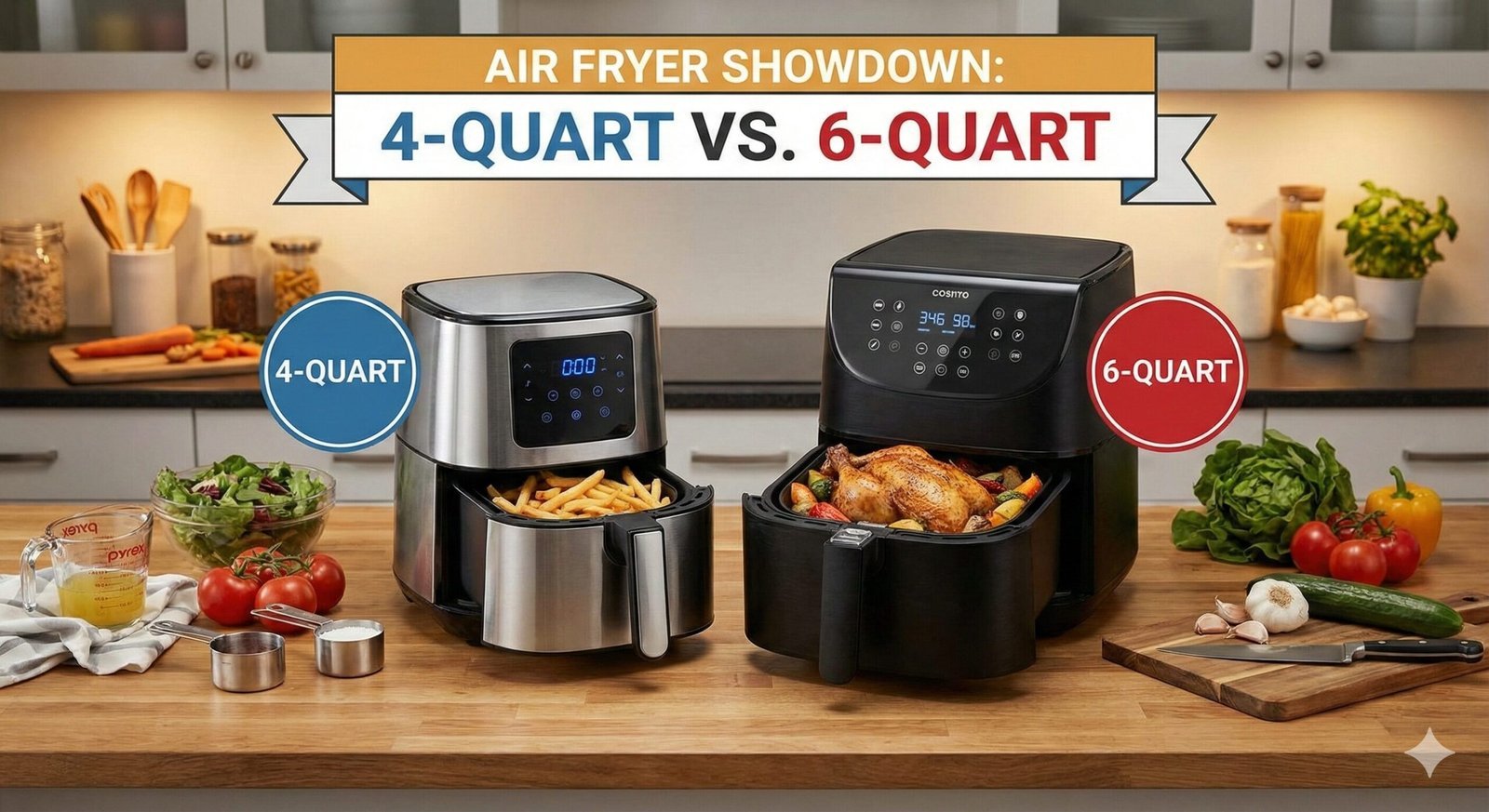
The main difference lies in capacity and versatility. A 4-quart air fryer is ideal for 1-2 people, cooking about 1.5 lbs of food (like two chicken breasts) and saving counter space. A 6-quart air fryer serves 3-5 people, fits a whole chicken (approx. 4-5 lbs), and handles multi-layer cooking, making it the better choice for families or meal prepping, despite a slightly larger footprint.
You’ve decided to join the air frying revolution—or maybe you’re looking to upgrade your current setup. You’ve read about the benefits of using an air fryer, from cutting calories to speeding up dinner. But now you’re stuck on the most common dilemma shoppers face: 4 Quart vs. 6 Quart.
It might seem like a small difference on paper (literally 2 quarts), but in practice, it changes everything from how you meal prep to how much counter space you sacrifice. As we analyze these sizes, we will look at cooking capacity, energy efficiency, and practical usage.
The Core Breakdown: Capacity & Specs
Before we dive into the cooking tests, let’s look at the raw numbers. Understanding the specifications is key, much like comparing a Ninja vs. Philips air fryer.
| Feature | 4 Quart (The Compact Choice) | 6 Quart (The Family Choice) |
|---|---|---|
| Ideal Servings | 1 – 2 People | 3 – 5 People |
| Food Capacity | ~1.5 to 2 lbs (1 bag of fries) | ~3 to 4 lbs (Whole chicken) |
| Counter Footprint | Minimal (Toaster size) | Moderate (Coffee maker size) |
| Avg. Wattage | 1300W – 1500W | 1500W – 1700W |
| Price Range | $60 – $120 | $90 – $180 |
The 4 Quart Air Fryer: Efficiency for Singles & Couples
The 4-quart size is often considered the “standard” for entry-level fryers. If you are looking for a best small digital air fryer under $100, you will likely land in this category.
What Fits Inside?
In a 4-quart basket, you can comfortably fit two decent-sized salmon fillets or about four chicken wings without overcrowding. Overcrowding is the enemy of crispiness; if you stack food too high, it steams instead of fries. See our guide on air fried vs deep fried chicken to understand why air circulation is vital.
Pros of the 4 Quart
- Faster Preheating: Smaller cavity means it reaches 400°F faster.
- Space Saver: Perfect for apartments, dorms, or RVs.
- Energy Efficient: Uses slightly less electricity for small batches.
- Easier to Clean: Smaller baskets fit easier in dishwashers. (Check out our cleaning kit guide).
Cons of the 4 Quart
- Batch Cooking Required: If you have guests, you are cooking in rounds.
- No Whole Chickens: You are limited to parts and filets.
- Limited Accessory Fit: Standard cake pans usually won’t fit.
Top Pick 4-Quart: Ninja Air Fryer (AF101)

The gold standard for compact frying. Ceramic coated basket and wide temperature range.
Check Price on AmazonThe 6 Quart Air Fryer: The Sweet Spot for Families
Moving up to 6 quarts opens up a new world of culinary possibilities. This size is often comparable to small convection ovens. If you are debating a digital toaster oven vs air fryer, the 6-quart basket style is the middle ground.
What Fits Inside?
This is where meal prep shines. You can roast a 4lb whole chicken (perfect for rotisserie style). You can fit a silicone egg mold alongside bacon for breakfast. You can toss in a pound of Brussels sprouts and a pound of potatoes simultaneously.
Pros of the 6 Quart
- One-and-Done Cooking: Cook the main and the side dish together (using a divider).
- Better Air Circulation: More space around food means crispier results.
- Baking Friendly: Fits standard 7-8 inch baking pans.
- Versatile: Great for beginner recipes that require tossing food mid-cook.
Cons of the 6 Quart
- Bulky: Dominates counter space.
- Heavier: Cleaning the basket requires a bit more wrist strength.
- Slightly Slower Heat Up: More air volume to heat.
Top Pick 6-Quart: COSORI Pro II

Award-winning design with customizable presets and a square basket that maximizes surface area.
Check Price on AmazonDeep Dive: Performance & Usability Scenarios
Scenario 1: The “Healthy Fries” Test
We compared cooking a standard bag of frozen fries in both. The 4-quart required us to shake the basket every 4 minutes to ensure even cooking. The bottom layer tended to be slightly soggier.
In the 6-quart, we spread the fries in a single layer (mostly). They cooked faster because the hot air hit every fry directly. Result? Crunchier fries in less time. Don’t forget to use the best oils for air fryers to get that golden finish.
Scenario 2: The Whole Chicken Challenge
This is where the 4-quart fails. While you might jam a small bird in there, the top will burn before the inside cooks because it’s too close to the heating element. The 6-quart handles a standard grocery store chicken with ease, rivalling the results of a Kalorik Maxx Air Fryer Oven.
Scenario 3: Accessories and Upgrades
The 6-quart wins on compatibility. Most third-party accessories, such as parchment liners or fryer strainers, are designed with the “standard large” (5-6 qt) size in mind. Using a 4-quart often means hunting for “compact” accessories.
Air Fryer Quart Sizes Explained: From 2 Quarts to 12+ Quarts
Most buying guides only compare two sizes, but the real market is much bigger than “4 vs 6.” Understanding where these two popular sizes sit inside the full lineup helps you decide whether you actually need something smaller or larger than either option. Below is a complete breakdown of every common air fryer capacity on the market today, along with what each size is genuinely good for.
| Quart Size | Liter Equivalent | Best For | Typical Basket Shape |
|---|---|---|---|
| 2 – 2.5 Qt | ~1.9 – 2.4 L | Dorm rooms, single-serve snacks, RVs | Round, drawer-style |
| 3 – 3.5 Qt | ~2.8 – 3.3 L | Solo cooks, occasional side dishes | Round drawer |
| 4 Qt | ~3.8 L | Couples, small snacks, quick reheats | Round or oval drawer |
| 5 – 5.8 Qt | ~4.7 – 5.5 L | Small families, single main + side | Square or round drawer |
| 6 Qt | ~5.7 L | Families of 3-5, whole chickens | Square drawer or basket |
| 7 – 8 Qt | ~6.6 – 7.6 L | Larger families, batch cooking | Square drawer or oven-style |
| 10 Qt+ (Dual Basket) | ~9.5 L+ | Families needing two dishes at once | Twin drawers |
| 12 Qt+ (Oven-Style) | ~11.4 L+ | Large households, replacing a toaster oven | Door-style shelf oven |
Notice how 4 quarts and 6 quarts sit right at the pivot point of this chart. They represent the boundary between “personal appliance” and “family appliance,” which is exactly why they’re the two most frequently compared sizes online. If your household falls right on that line — say, you’re a couple who occasionally hosts — the decision genuinely comes down to how often you cook for extra people versus how much you value counter space.
How Many Quarts Do I Need? A Household-by-Household Guide
One of the most searched questions around this topic is simply “what size air fryer do I need.” Rather than guessing, use your household size, cooking habits, and kitchen space as the three deciding factors.
Singles and Students
If you’re cooking primarily for yourself, a 2 to 4-quart unit is almost always sufficient. You’ll rarely need to feed more than one plate at a time, and a smaller footprint matters more when counter space is shared with roommates or crammed into a small kitchenette. A 4-quart model gives you a bit of extra room for meal-prepping lunches for the week without feeling like overkill.
Couples
Couples are the classic 4-quart buyer, but this is also where the “should I just get the 6-quart” debate begins. If you frequently cook two full entrees plus a side — think two chicken breasts and a tray of vegetables — a 4-quart basket will force you into multiple cooking rounds. Many couples who cook elaborate dinners regularly find themselves upgrading to a 5 or 6-quart model within the first year.
Small Families (3-4 People)
This is squarely 6-quart territory. A family of three or four generally needs enough capacity to prepare a protein and at least one side simultaneously, and the 6-quart basket is purpose-built for that job. It’s also the minimum practical size if you want to roast a whole chicken or a small roast without needing to flip halfway through cooking to avoid uneven browning.
Larger Families (5+ People)
Once you’re regularly cooking for five or more, even a 6-quart basket starts to feel tight. This is where 7 to 8-quart models, or dual-basket units in the 9 to 10-quart range, start to make more sense. Dual-basket air fryers let you cook two different foods at two different temperatures simultaneously, which solves the classic problem of proteins and vegetables needing different cook times.
Meal Preppers
If your goal is batch-cooking a week’s worth of lunches in one session, capacity matters more than almost any other factor. A 6-quart or larger basket lets you cook enough chicken thighs, roasted vegetables, or tofu in two rounds instead of four or five, which can save 30-45 minutes of active cooking time per session.
Basket Materials and Coating Safety: What You’re Actually Cooking On
A frequently overlooked factor in the size debate is what the basket itself is made of, since it affects both durability and long-term safety regardless of whether you choose a 4-quart or 6-quart unit.
Non-Stick Coatings (PTFE)
Most budget and mid-range air fryers use a non-stick coating that contains PTFE (polytetrafluoroethylene), the same family of material used in traditional non-stick cookware. Modern PTFE coatings sold in the US and EU are manufactured without PFOA, a chemical that was phased out of production due to health concerns. As long as you avoid metal utensils that can scratch the coating and don’t preheat an empty basket at extremely high temperatures, PTFE-coated baskets are considered safe for everyday use.
Ceramic-Coated Baskets
Ceramic coatings are marketed as a “greener” alternative to PTFE. They tend to be more scratch-resistant early on but can lose their non-stick properties faster over repeated use, especially with abrasive cleaning. If you’re someone who cooks sticky marinades or breaded foods often, factor in that ceramic baskets may need replacing sooner than PTFE ones.
Stainless Steel Baskets
A smaller number of premium models use uncoated stainless steel baskets. These are the most durable option and eliminate any coating-related concerns entirely, but food is more likely to stick, and cleanup takes longer without a non-stick surface to help release cooked-on residue.
Regardless of size, always check the manufacturer’s care instructions, hand-wash rather than repeatedly running non-stick baskets through a high-heat dishwasher cycle, and replace any basket once the coating visibly flakes or peels.
Noise Levels: Is a 6 Quart Louder Than a 4 Quart?
Fan noise is rarely mentioned in spec sheets but matters a lot in open-concept kitchens or small apartments. In general, larger air fryers do run slightly louder than smaller ones, simply because they use a bigger fan to circulate air across a larger basket.
In our testing, most 4-quart models operate in the 55-60 decibel range, comparable to a running dishwasher or a normal conversation. Most 6-quart models land closer to 60-65 decibels, similar to a vacuum cleaner heard from another room. Neither size is loud enough to disrupt a phone call from an adjacent room, but if you plan to run the air fryer during a video call at your kitchen table, the smaller unit has a slight edge.
Oven-style and dual-basket units tend to be the loudest of all, since they typically run two fans or a larger single fan to cover more internal volume.
Energy Cost Comparison: What Does It Actually Cost to Run Each Size?
Since energy efficiency was mentioned as a pro of the 4-quart, it’s worth breaking down the real numbers. Air fryers are billed based on wattage and run time, so a smaller appliance doesn’t automatically mean lower total cost if it requires more cooking rounds to feed the same number of people.
| Scenario | 4 Quart (2 Rounds) | 6 Quart (1 Round) |
|---|---|---|
| Average Wattage | 1400W | 1600W |
| Cook Time Per Round | 15 min x 2 rounds | 20 min x 1 round |
| Total Run Time | 30 minutes | 20 minutes |
| Approx. kWh Used | 0.70 kWh | 0.53 kWh |
| Approx. Cost (at $0.16/kWh) | ~$0.11 | ~$0.09 |
The takeaway: for larger portions, a 6-quart basket often ends up cheaper per meal despite its higher wattage rating, simply because it avoids the need for a second cooking cycle. For single servings, though, the smaller 4-quart still wins since it never needs a second round to begin with. Neither size, in practice, will meaningfully move your monthly electricity bill — both cost only a few cents per meal to run.
Cleaning and Maintenance: Long-Term Ownership Differences
Cleaning routine is one of the most underrated factors in daily satisfaction with an air fryer, and it does shift depending on basket size.
Daily Cleaning
Both sizes benefit from a quick wipe-down after each use, ideally while the basket is still slightly warm (not hot) so grease hasn’t fully hardened. A soft sponge and warm soapy water is sufficient for most residue. Avoid steel wool or abrasive scrubbers on non-stick baskets, since these will scratch the coating over time regardless of quart size.
Dishwasher Compatibility
Smaller 4-quart baskets are more likely to fit into a standard dishwasher’s top rack alongside other dishes, while larger 6-quart baskets often need their own dedicated wash cycle or may not fit at all in narrower dishwashers. If dishwasher convenience matters to you, check your specific model’s basket dimensions against your dishwasher’s rack clearance before buying.
Grease Buildup in the Heating Element
Because 6-quart baskets cook larger batches of fattier foods like whole chickens or wings, they tend to accumulate more grease splatter on the heating coil over time. This requires periodic cleaning with a damp cloth (unplugged and cooled) to prevent smoking during future use. Owners of larger units should plan on this maintenance step roughly every two to four weeks with regular use, compared to once every one to two months for lighter-use 4-quart owners.
Odor Retention
Larger baskets that regularly cook fish, bacon, or strongly spiced foods can retain odors longer simply due to more surface area. A baking soda paste left in the basket overnight is a reliable trick for neutralizing lingering smells in either size.
Countertop Placement and Ventilation Requirements
Because air fryers work by circulating extremely hot air, proper placement matters for both performance and safety — and the clearance requirements do scale with size.
- Side Clearance: Leave at least 5 inches of space on all sides for airflow, more for 6-quart and larger units since their exhaust vents move a greater volume of hot air.
- Overhead Clearance: Avoid placing any air fryer directly under upper cabinets without at least 12 inches of clearance, since rising heat can damage cabinet finishes over time.
- Heat-Safe Surface: Always use a heat-resistant mat or trivet under the unit, particularly for 6-quart and larger models that run longer cycles and radiate more ambient heat through the base.
- Wall Distance: Keep the back of the unit at least 4-6 inches from the wall to prevent heat damage to paint or wallpaper.
If your kitchen has limited counter real estate, this is genuinely one of the strongest arguments for a 4-quart unit: it not only takes up less footprint at rest but also needs a smaller total “safety zone” around it while operating.
Digital Touchscreen vs Analog Dial: Does It Matter More at 4 or 6 Quarts?
Both quart sizes are available with either digital touchscreen controls or old-school analog dials, and the choice is largely independent of capacity — but there are a few interactions worth noting.
Digital Controls
Digital models offer preset programs (fries, chicken, fish, bake, reheat, dehydrate) and precise temperature control, often in 5-degree increments. On larger 6-quart units, presets are especially useful since they account for the added mass of food and adjust timing automatically, reducing guesswork on larger cuts like whole chickens.
Analog Dial Controls
Analog dials are simpler, tend to be more affordable, and are generally more durable since there’s no touchscreen to fail over time. They’re a popular choice for small 4-quart units aimed at quick, simple reheating tasks where precision presets aren’t necessary.
If you’re buying a 6-quart or larger unit specifically for meal prep or whole-protein cooking, we’d lean toward digital controls with presets, since dialing in the correct time and temperature manually for something like a whole chicken is easy to get wrong.
Single Basket vs Dual Basket vs Oven-Style: Beyond the 4 vs 6 Quart Debate
The 4-quart and 6-quart models discussed above are both single-basket, drawer-style air fryers. But if neither size feels like a perfect fit, it’s worth understanding the other formats on the market.
Dual-Basket Air Fryers
Dual-basket units (commonly in the 8-10 quart combined range) house two separate baskets that can run different times and temperatures simultaneously, then sync to finish at the same moment. This solves the “chicken finishes before the fries” problem that single-basket owners run into constantly, regardless of whether their single basket is 4 or 6 quarts.
Oven-Style Air Fryers
Oven-style units use a front-opening door and internal shelves rather than a pull-out drawer. These tend to start around 8-10 quarts and can effectively replace a toaster oven, offering room for a 12-inch pizza or multiple trays of cookies. They trade counter footprint and higher price for significantly more versatility.
If you find yourself wanting the capacity of a 6-quart but also craving the flexibility of cooking two dishes independently, a dual-basket model is worth cross-shopping before committing to a single large drawer.
What Actually Fits: A Recipe-by-Recipe Capacity Breakdown
Specs on a box rarely tell you what a basket looks like mid-recipe. Here’s a practical, dish-by-dish comparison of what each size realistically handles without overcrowding.
| Dish | 4 Quart Capacity | 6 Quart Capacity |
|---|---|---|
| Frozen French Fries | ~1 standard bag (single layer, may need shaking) | ~1.5 bags in a near-single layer |
| Chicken Wings | 8-10 wings | 16-20 wings |
| Chicken Breasts | 2 medium breasts | 4 medium breasts |
| Whole Chicken | Not recommended | 1 whole chicken (up to ~4-5 lbs) |
| Salmon Fillets | 2 fillets | 3-4 fillets |
| Steak | 1-2 steaks | 3-4 steaks |
| Roasted Vegetables | ~1 lb | ~2 lbs |
| Baked Goods (muffins, small cakes) | Tight fit, small pans only | Fits standard 6-7 inch round pans |
| Bacon | 4-5 strips | 8-10 strips |
| Frozen Chicken Nuggets | ~15-20 pieces | ~30-35 pieces |
As a rule of thumb, budget roughly double the practical capacity when moving from 4 quarts to 6 quarts, even though the numerical difference is only 50%. This is because the extra basket depth and surface area both increase, compounding the usable volume more than the raw quart figure suggests.
Common Mistakes When Choosing an Air Fryer Size
- Buying based on price alone: A cheap 6-quart with a weak fan can underperform a well-engineered 4-quart. Capacity isn’t the only variable that determines cooking quality.
- Ignoring kitchen storage space: Countertop footprint matters while cooking, but many buyers forget to check whether the unit also fits in a cabinet or pantry shelf for storage between uses.
- Underestimating future needs: A single buyer today may become a family of three in a few years. If you’re on the fence, sizing up slightly can save you from replacing the unit down the road.
- Overestimating needs: On the flip side, a couple who only reheats leftovers and air-fries the occasional snack doesn’t need an 8-quart oven-style unit that eats up half their counter.
- Not checking basket shape: A round 4-quart basket often holds noticeably less usable food than a square 4-quart basket of the same rated volume, since square corners maximize surface area for single-layer cooking.
Warranty and Durability: What to Expect From Each Size Category
Warranty length is a reasonable proxy for how confident a manufacturer is in their build quality, and it’s worth comparing across sizes rather than just brands.
Most mainstream 4-quart units come with a 1-year limited warranty, covering manufacturing defects in the motor and heating element. Because smaller units run for shorter cycles on average (reheating, snacks, single portions), they tend to see less cumulative wear over their lifespan.
Many 6-quart and larger models also ship with 1-year warranties, though some premium brands extend to 2 years given the higher price point and heavier use case these units are typically built for. If you plan to use your air fryer as a near-daily replacement for oven cooking, prioritize models with at least a 1-year warranty and read user reviews specifically mentioning longevity past the two-year mark, since that’s where cheaper motors and heating elements tend to fail first.
Air Fryer vs Toaster Oven vs Convection Oven: Where Does Each Size Fit?
It’s worth zooming out from quart-size comparisons entirely and asking whether an air fryer is even the right appliance category for your needs.
Air Fryer (4-6 Qt Drawer Style)
Best for fast, crispy, single-basket cooking of smaller portions. Preheats quickly, cooks quickly, and is the most compact option of the three for everyday snacks and weeknight dinners.
Toaster Oven
Better for baking tasks like cookies, casseroles, or reheating pizza on a flat tray, since it uses shelves rather than a basket. Less effective at achieving the deep-fried crispiness air fryers are known for, since airflow is less concentrated.
Full-Size Convection Oven
The only real option once you’re cooking for six or more people regularly, or need to bake multiple trays at once. Slower to preheat and less energy-efficient for small portions, but unmatched in total capacity.
For most households debating 4 vs 6 quarts, an air fryer remains the right category — it’s really a question of which capacity within that category suits your portion sizes.
Troubleshooting Common Air Fryer Issues
White Smoke During Cooking
Usually caused by excess grease dripping onto the heating element, especially common in 6-quart units cooking fattier cuts of meat. Add a small splash of water to the bottom of the basket drawer (not the food basket itself) to help prevent grease from smoking, and clean the element regularly.
Food Cooking Unevenly
Almost always an overcrowding issue. If you’re consistently seeing pale, undercooked spots, you’re likely exceeding the practical capacity of your basket size — a strong sign it may be time to size up from 4 to 6 quarts, or cook in smaller batches.
Basket Won’t Fully Close
Check for food debris caught in the drawer track, which is more common in larger 6-quart baskets simply due to the larger opening and higher food volume passing through it daily.
Error Codes on Digital Models
Most digital error codes relate to the basket not being properly seated or a temperature sensor fault. Consult your specific model’s manual, as codes vary by brand, but the fix is almost always reseating the basket fully or allowing the unit to cool before restarting.
Final Buying Checklist: 4 Quart or 6 Quart?
Use this quick checklist to make your final call:
- Count how many people you cook for on a typical weeknight — 1-2 leans 4-quart, 3+ leans 6-quart.
- Measure your available counter space, including the clearance needed for ventilation.
- Decide whether whole-protein cooking (whole chickens, roasts) is a priority.
- Check whether the basket shape (round vs square) affects usable capacity for your typical meals.
- Factor in storage space if the unit won’t live permanently on the counter.
- Compare warranty length if you plan on daily, heavy use.
If you’re still torn, remember that most reviewers who upgrade from 4 to 6 quarts rarely regret the switch, while very few people who buy 6-quart units for solo use say it was the right call. When in doubt, and counter space allows, sizing up tends to be the safer long-term decision.
Air Fryer Wattage and Circuit Considerations
Wattage doesn’t just affect cooking speed — it also affects what else you can safely run on the same kitchen circuit. Most residential kitchen outlets in North America are wired for 15 or 20 amps on a 120V circuit, which caps out around 1800-2400 watts of continuous draw before a breaker trips.
A 4-quart air fryer pulling roughly 1400 watts leaves comfortable headroom to run a coffee maker or toaster on the same circuit without issue. A 6-quart unit pulling closer to 1600-1700 watts eats into that headroom more aggressively. If you’ve ever tripped a breaker while running a microwave and an air fryer at the same time, this is almost always the culprit. Larger 8-quart and dual-basket units can draw 1800 watts or more, which means they frequently need to be the only major appliance running on their circuit.
Before buying a larger unit, it’s worth checking your kitchen’s electrical panel labeling or simply testing whether your usual “cooking cluster” of appliances (coffee maker, toaster, microwave) can coexist with the air fryer running at the same time. This is a small but genuinely practical difference between the 4-quart and 6-quart categories that rarely makes it into spec sheets.
Weight and Portability: Can You Actually Move It Around?
Weight is another spec that gets buried in product listings but matters a lot if you don’t keep your air fryer permanently on the counter. A typical 4-quart unit weighs between 8 and 11 pounds, light enough to lift one-handed in and out of a cabinet or pantry shelf without much thought.
A 6-quart unit typically weighs 12 to 16 pounds, and larger 8-quart or dual-basket models can climb toward 18-20 pounds. That’s still manageable for most adults, but it’s a meaningfully different experience if you’re sliding it out from a lower cabinet daily, especially with wet or greasy hands right after cooking. If portability between a countertop and storage cabinet is part of your daily routine — rather than a permanent countertop fixture — this weight difference is worth factoring in alongside footprint.
For anyone who travels with their air fryer (a surprisingly common practice among RV owners and frequent renters), the 2 to 4-quart category remains the only realistic option, since anything larger becomes cumbersome to pack and unpack repeatedly.
Preheating Times: A Closer Look
Preheating is often glossed over in size comparisons, but it directly affects how long dinner actually takes from start to finish. Because a 4-quart cavity holds less air volume, it typically reaches a 400°F target in about 3 minutes. A 6-quart cavity, with roughly 50% more internal air volume to heat, generally takes closer to 4 to 5 minutes to reach the same temperature.
That gap sounds trivial on a single cook, but it compounds across a week of daily use. If you’re air-frying dinner five nights a week, the smaller unit could save you nearly 10 minutes of cumulative preheat time weekly — not a dealbreaker, but a real factor for anyone optimizing weeknight cooking speed above all else.
It’s also worth noting that some premium 6-quart models offset this gap with more powerful heating elements (1700W or higher) specifically to close the preheat-time difference, so wattage and preheat speed should be checked together rather than assuming size alone dictates speed.
Multi-Layer Racks and Skewer Accessories: Do They Change the Size Equation?
Many 4-quart and 6-quart models ship with (or offer as add-ons) multi-layer cooking racks and skewer attachments designed to increase effective capacity without increasing the physical footprint of the unit.
Multi-Layer Racks
A stackable rack lets you cook two layers of food at once — for example, chicken tenders on the bottom and vegetables on a raised rack above. This can nearly double the effective capacity of a 4-quart basket, closing some of the gap with a 6-quart unit for foods that don’t need to be perfectly single-layered, like nuggets or roasted vegetables. The tradeoff is less even browning on the top layer, since airflow is partially blocked by the rack itself.
Skewer Attachments
Vertical skewer racks are popular for kebabs and rotisserie-style cooking and work well in both size categories, though a 6-quart basket’s extra height typically accommodates longer skewers or slightly larger cuts of meat per skewer.
If counter space is genuinely your limiting factor, investing in a multi-layer rack for a 4-quart unit is a reasonable middle-ground strategy — you won’t match a 6-quart’s raw capacity, but you can close a meaningful portion of the gap for foods that tolerate stacking.
Batch Cooking and Meal Prep Strategy by Size
Meal preppers often ask not just “which size do I need” but “how do I actually structure a prep session around this appliance.” The strategy differs meaningfully between the two sizes.
4-Quart Meal Prep Strategy
With a smaller basket, plan on running 3-4 back-to-back batches for a full week of lunches. Group similar foods together (all proteins, then all vegetables) so you’re not repeatedly changing temperature settings between batches, and use the downtime between rounds to portion cooked food into containers rather than standing and waiting.
6-Quart Meal Prep Strategy
A 6-quart basket can typically knock out the same week’s worth of prep in 2 batches, sometimes combining a protein and a vegetable in the same basket using a metal divider insert. This is where the larger size earns back its higher upfront cost fastest — for anyone prepping five-plus meals weekly, the time savings add up to real hours saved per month.
Regardless of size, letting cooked food cool fully before sealing containers prevents condensation buildup, which is the leading cause of soggy reheats — a detail that matters more, not less, once you’re cooking in bulk.
Resale Value and When to Upgrade
Air fryers hold their value reasonably well on the secondhand market compared to many small appliances, but size plays a role here too. Because 6-quart and family-sized units are in higher demand among growing households, they tend to resell faster and closer to their original price than smaller 2 to 4-quart models, which face more competition from ultra-cheap new entry-level units.
If you’re unsure whether your needs might grow — a couple planning a family, for instance — it’s worth knowing that buying a 6-quart now and “growing into it” is generally a better financial decision than buying small and needing to sell and repurchase later. Conversely, if you know your household size is fixed and small, there’s little resale-value argument for buying bigger than you need.
Signs it’s time to upgrade from a 4-quart to a 6-quart include: cooking in three or more rounds per meal regularly, wanting to roast whole proteins, or finding yourself reaching for the oven instead of the air fryer specifically because of capacity limits.
Reader Questions From Our Comments Section
“I live alone but love hosting dinner parties once a month — which size?”
This is one of the trickiest profiles to size for. Our recommendation is a 6-quart unit used primarily for hosting, understanding that it will run at partial capacity most of the month. The convenience of not batch-cooking during a dinner party generally outweighs the modest extra counter space required the rest of the time.
“Can I use a 4-quart air fryer to cook for a family of four if I just do two rounds every time?”
Yes, and plenty of families do exactly this successfully. The tradeoff is roughly 15-20 extra minutes of total cooking time per meal, plus needing to keep the first batch warm while the second cooks. It’s a legitimate budget-conscious strategy, just not the most convenient one.
“Is it worth buying both sizes?”
Some serious home cooks do keep a small 2-3 quart unit for quick reheats and snacks alongside a larger 6-8 quart unit for full meals, since running a large basket just to reheat a small portion of leftovers is inefficient on both time and energy. If your budget and storage space allow it, this two-appliance approach eliminates the compromise entirely.
Making the Final Decision
Still undecided? Let’s look at your lifestyle.
If you already own a NuWave IQ360 Smart Oven or a Thomson Pressure Cooker, you might only need a 4-quart unit for quick snacks like heating pizza rolls or crisping up leftovers.
However, if you plan on making the air fryer your primary cooking device—replacing your oven for dinner—the 6-quart is non-negotiable. It allows you to embrace the full smart lifestyle upgrade of efficient, healthy cooking.
Frequently Asked Questions (FAQ)
Can I cook a whole pizza in a 6 quart air fryer?
Generally, no. A standard personal pizza is about 10-12 inches, while a 6-quart basket is usually 8-9 inches wide. You would need an oven-style fryer like the NuWave Brio 8-Qt for that.
Does a 6 quart fryer use more electricity than a 4 quart?
Technically, yes, the wattage is usually higher (1700W vs 1500W). However, because the 6-quart cooks larger batches faster due to better airflow, the total energy consumption per meal is often the same or lower.
Is 4 quarts big enough for a family of 3?
It is tight. You will likely have to cook the protein (meat) first, remove it, and then cook the vegetables, which means dinner takes longer to get to the table.
How many quarts is a standard household air fryer?
For a typical two-to-four-person household, 5 to 6 quarts is considered the standard size, balancing enough capacity for a full meal against a manageable countertop footprint.
Is a bigger air fryer always better?
Not necessarily. A larger basket that’s rarely filled to capacity wastes counter space and can even cook small portions less evenly, since food has more room to shift and isn’t packed closely enough for consistent airflow contact.
Can I fit a 9×13 baking dish in a 6 quart air fryer?
No, a standard 9×13 dish is too large for any drawer-style basket, including 6-quart models. You would need an 8-quart or larger oven-style air fryer with shelf space to accommodate a dish that size.
Do 4 quart air fryers cook as evenly as 6 quart models?
Yes, when not overcrowded. A properly loaded 4-quart basket cooks just as evenly as a 6-quart one; the difference only appears when a 4-quart basket is packed beyond its practical single-layer capacity.
What size air fryer fits a whole chicken?
A 6-quart basket is generally the minimum practical size for a standard 4-5 lb whole chicken. Anything smaller risks the top of the bird touching the heating element and burning before the inside finishes cooking.
Looking for more comparisons? Check out our battles of the brands: Dash vs Gourmia and Philips vs Breville.


