How to Get Rid of Sugar Ants in the Kitchen (Step-by-Step Guide)
A practical, no-nonsense walkthrough for tracking down sugar ant trails, cutting off their food supply, and keeping them from ever finding your kitchen worth visiting again.
What Sugar Ants Are and Why They Invade Your Kitchen
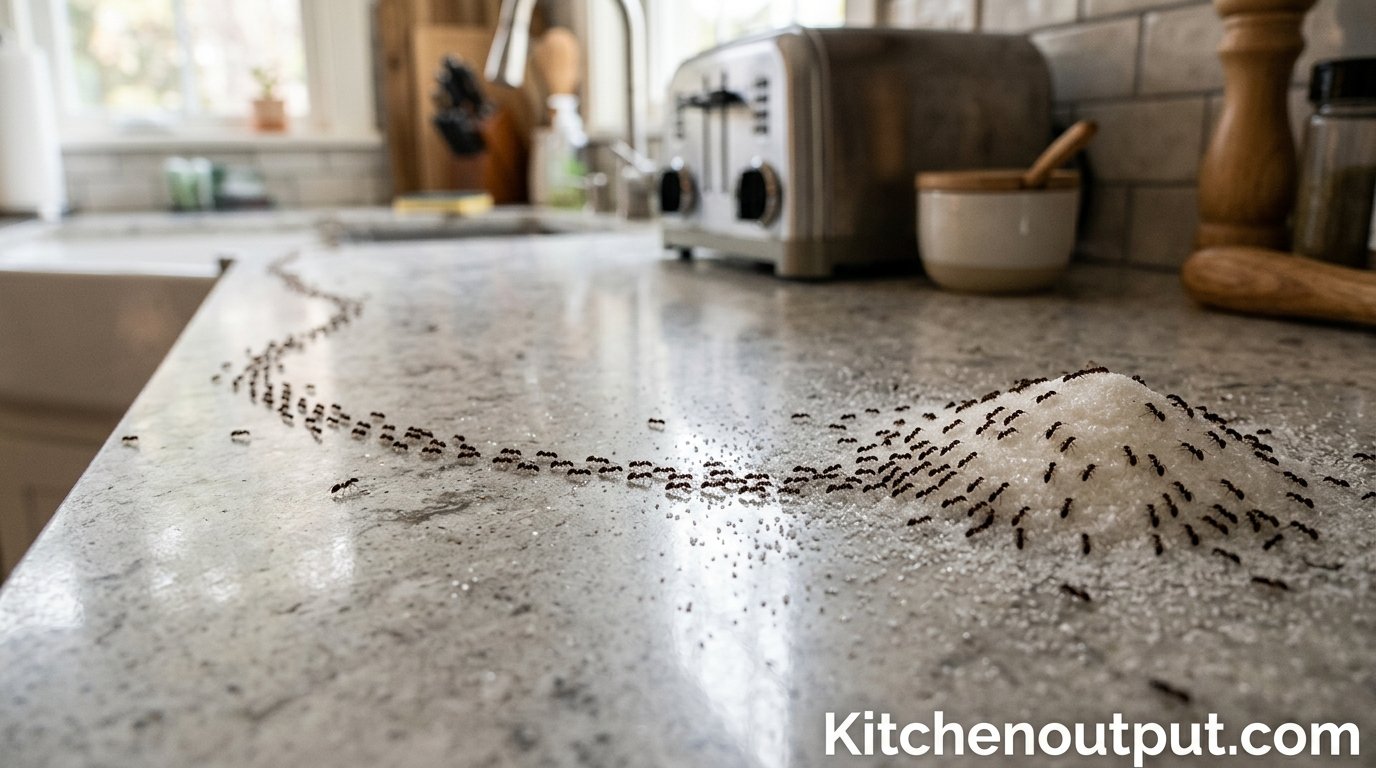
“Sugar ants” is the catch-all name most homeowners use for small, light-to-dark brown ants that show up in tidy, predictable lines across countertops, backsplashes, and pantry shelves. In North America this label usually covers a handful of look-alike species — odorous house ants, pavement ants, and the true banded sugar ant — all of which share the same obsession: simple carbohydrates. Spilled juice, an open honey jar, a few grains of sugar left on the counter, or even the sticky residue inside a recycled soda can is more than enough to pull an entire colony indoors.
Sugar ants don’t wander randomly. A scout finds a food source, feeds, and lays down a chemical trail (a pheromone path) on the way back to the nest. Every ant that follows reinforces that trail, which is why you’ll often see a single thin line of ants rather than a scattered cloud. Understanding this behavior matters because it changes the whole strategy: you’re not just killing the ants you can see, you’re disrupting a communication system and removing the reason the colony chose your kitchen in the first place.
Kitchens are especially attractive because they combine three things ants need in one place: food residue, moisture (from sinks, dishwashers, and drip trays), and warmth. Even a spotless-looking kitchen can have crumbs wedged into cabinet hinges, sugar dust inside a coffee maker’s drip tray, or condensation collecting under a fridge that’s invisible at eye level but obvious to a colony of foraging ants.
Signs You Have a Sugar Ant Problem
Before jumping into treatment, it helps to confirm the scope of what you’re dealing with. A few ants near an open jar of jam on a summer afternoon is different from a recurring trail that reappears every evening regardless of what’s on the counter.
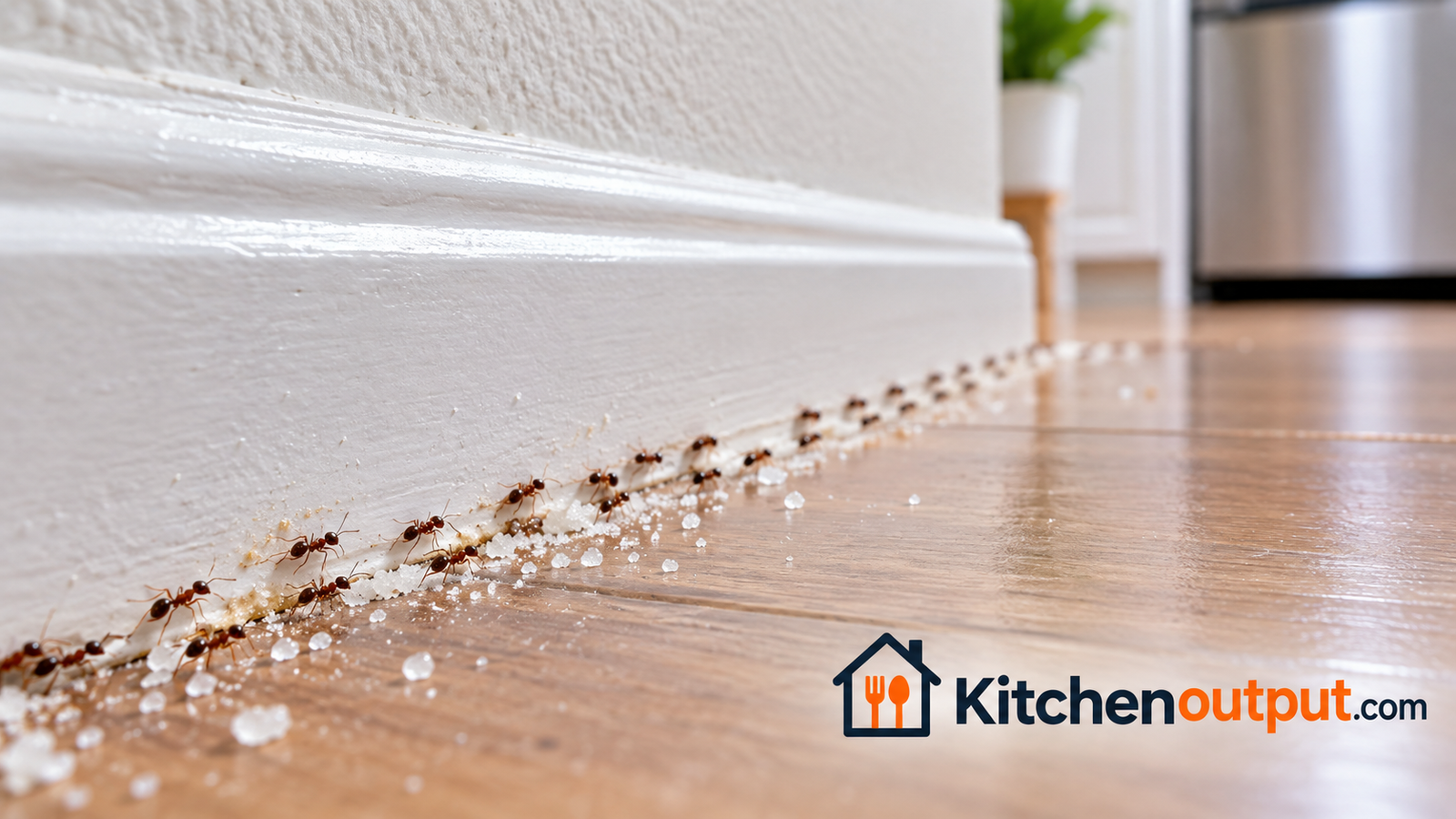
- Visible trails: A consistent line of ants moving in both directions along the same path, usually along baseboards, counter edges, or around a window.
- Trail timing: Sugar ants are often most active in the early morning and evening, especially in warmer months.
- Concentration near specific appliances: Coffee makers, toasters, and the space behind the stove tend to accumulate sugary or greasy residue that draws repeat visits.
- Ants in unexpected containers: Finding ants inside sealed-looking packaging (cereal boxes, sugar canisters with loose lids) is a strong sign the colony has been established for a while.
- A faint musty or rotten-coconut smell when crushed: This is characteristic of odorous house ants specifically, one of the most common “sugar ant” culprits.
If you’re seeing large numbers appear within minutes of a spill being wiped up, or trails that persist for more than two or three weeks despite cleaning, you’re likely dealing with an established colony rather than a one-off scouting event — which is exactly what the step-by-step process below is built to handle.
Step 1: Find and Seal Entry Points
Trace the trail back to where ants enter the room
Follow an active trail slowly, without disturbing it, back to the point where ants are entering the kitchen — most commonly a gap under a baseboard, a crack around a window frame, a utility penetration under the sink, or a gap where a countertop meets the wall. Mark each entry point with a small piece of tape so you don’t lose track while you gather sealing materials.
Once you’ve mapped the entry points, seal them with silicone caulk for gaps around pipes and frames, and steel wool packed into larger cracks before caulking over it (ants can chew through plain caulk over time, but not through steel wool). For gaps under appliances or cabinet toe-kicks, a weatherstrip or draft seal works well and doesn’t require any cutting.
Pay special attention to the area directly beneath the sink, since plumbing penetrations are one of the most common entry routes in kitchens, and to any exterior-facing wall where the kitchen shares a wall with the outside of the house.
A paintable, flexible silicone sealant makes quick work of baseboard and pipe gaps without leaving a visible bead.
Check Price on AmazonStep 2: Deep Clean Surfaces and Remove Food Sources
Strip the kitchen of anything a scout ant could report back on
With entry points sealed, the next job is removing every food source that could be re-establishing the trail. This goes beyond a quick wipe-down: pull the toaster and coffee maker forward and clean underneath them, empty and rinse the recycling bin (soda cans and juice containers are a favorite), and check inside drawers near the stove for spilled sugar or spice granules that have settled into the corners.
Vacuum crumbs from cracks in tile grout and along cabinet toe-kicks, then follow up with a hot, soapy wipe-down of every hard surface — counters, backsplash, stovetop, and cabinet fronts near handles where sticky fingers often leave residue. Don’t forget the underside of upper cabinets and the top of the refrigerator, both easy to overlook and both surprisingly common ant highways.
Store all opened food in airtight containers rather than folded bags or loosely closed boxes. Sugar, flour, cereal, pet food, and honey are the highest-priority items — glass or hard plastic containers with a sealing gasket keep scent from escaping and make it physically impossible for ants to get in even if a trail reaches the shelf.
A set of airtight pantry canisters removes the scent cues that keep scouting ants coming back to the same shelf.
Check Price on AmazonStep 3: Erase Scent Trails with Natural Cleaners
Break the pheromone path ants rely on to navigate
Even after visible ants are gone, the invisible pheromone trail left behind will keep pulling new scouts along the same route for days. A simple 1:1 solution of white vinegar and water, wiped along every surface where you’ve seen ants travel, breaks down that trail chemically and leaves a scent ants actively avoid while it’s still fresh.
Work in small sections, spraying and wiping rather than just spraying and walking away — the mechanical wiping action matters as much as the vinegar itself. Repeat daily for the first three to five days after you first notice a trail, since a single cleaning rarely removes 100% of the pheromone residue, especially in textured surfaces like grout lines or the underside of appliance feet.
If the vinegar smell is a concern, a few drops of citrus essential oil in the same mixture masks it while adding a second scent ants tend to avoid.
Step 4: Set Up DIY Ant Bait Stations
Let foraging ants carry the treatment back to the colony
Cleaning removes the food sources ants are currently using, but it doesn’t eliminate the colony itself. Bait stations work by offering a slow-acting treatment mixed with something ants find irresistible, which foragers carry back and share with the nest — including the queen, who never leaves and who a spray or wipe-down will never reach directly.
You can build a simple homemade version using a small, shallow lid filled with a mix of borax and a sweet carrier such as sugar water or a thin syrup, placed in a container with tiny entry holes so pets and kids can’t access it directly. Place stations directly along active trails rather than in random corners — ants are far more likely to investigate bait that intersects a path they’re already using.
DIY Bait Pros
- Inexpensive, uses common pantry ingredients
- Targets the whole colony, not just visible ants
- Easy to refresh or relocate
DIY Bait Cons
- Slower results than sprays (days, not minutes)
- Needs to be kept away from pets and children
- Requires patience — killing the trail early can backfire
Resist the urge to kill every ant you see near a bait station. Foragers need to survive long enough to carry bait back to the nest — spraying them on contact defeats the entire mechanism.
Pre-filled, child-and-pet-resistant bait stations are a faster option if you’d rather skip mixing your own.
Check Price on AmazonStep 5: Use Natural Repellents to Reinforce Sealed Entry Points
Add a scent barrier ants avoid crossing
Once entry points are sealed and trails are cleaned, natural repellents act as a secondary line of defense at the borders ants are most likely to test — windowsills, the gap beneath the back door, and the base of exterior-facing walls. Diatomaceous earth (food-grade), cinnamon, and peppermint essential oil are three of the most commonly used options, each working slightly differently.
Diatomaceous earth works mechanically rather than chemically — its microscopic sharp edges damage the ants’ exoskeleton on contact, so it needs to stay dry to remain effective and should be reapplied after cleaning or humid weather. Cinnamon and peppermint oil work as scent deterrents rather than killing agents, making them a gentler option for households wanting to avoid any powder residue on visible surfaces.
None of these repellents eliminate an existing colony on their own — think of them as a perimeter reinforcement layered on top of the sealing and baiting steps above, not a replacement for them.
Step 6: Apply Commercial Ant Baits and Gels Strategically
Bring in a stronger, pre-formulated option for stubborn colonies
When a DIY approach isn’t moving fast enough, or the trail keeps reappearing in a new spot after a week or two, a commercial gel bait or pre-filled bait station formulated with an active ingredient like indoxacarb, fipronil, or borax-based formulas tends to work faster and more consistently, since it’s manufactured for a precise concentration ants find both palatable and slow enough to carry back to the nest.
Apply small, dime-sized dots rather than long lines — a concentrated dot stays potent longer and is easier to place precisely along cabinet hinges, behind appliances, and inside cabinets near plumbing, all areas kids and pets typically don’t access. Avoid combining gel bait with a repellent spray in the same area; scent-based repellents can make ants avoid the bait entirely, undoing the whole strategy.
Give commercial baits one to two weeks to work through the full colony before reassessing. A temporary uptick in ant activity right after placing bait is actually a good sign — it usually means foragers have found it and are recruiting more ants to help carry it back.
A precision gel bait syringe makes it easy to apply small, targeted dots in tight cabinet corners.
Check Price on AmazonNatural vs. Chemical Control: Side-by-Side Comparison
Neither approach is universally “better” — the right choice depends on how established the colony is, whether you have pets or small children, and how quickly you need results. Here’s how the two paths compare across the factors that matter most.
| Factor | Natural Methods (Vinegar, DE, Essential Oils) | Chemical Baits & Gels |
|---|---|---|
| Speed of results | Slower, often 1–2 weeks | Faster, often 3–10 days |
| Safety around pets/kids | Generally very safe | Safe when used in enclosed stations, caution needed with open gel |
| Effect on the colony/queen | Limited unless combined with baiting | Strong — designed to reach the nest |
| Cost | Very low, pantry ingredients | Low to moderate, one-time purchase |
| Best used for | Prevention and light trail activity | Established, recurring infestations |
| Odor | Vinegar/citrus scent, temporary | Minimal to none |
Many households get the best results by combining both: natural cleaning and repellents to remove attractants and reinforce entry points, paired with a bait station or gel to finish off the colony that’s already established.
Preventing Sugar Ants From Returning
Getting rid of an active trail is only half the job — the habits you keep afterward determine whether ants come back in a month or stay away for good.
- Wipe counters immediately after cooking or baking, especially anywhere sugar, syrup, or fruit juice was used.
- Rinse recyclables before they sit in the bin, particularly cans and bottles that held anything sweet.
- Keep pet food bowls elevated or cleaned after each feeding rather than left out overnight.
- Fix small leaks promptly — moisture under sinks and around dishwashers is a secondary draw almost as strong as food.
- Re-inspect sealed entry points seasonally, since caulk and weatherstripping can shrink or crack over a year of temperature swings.
- Trim vegetation and mulch away from exterior walls if the nest is likely outdoors, since dense ground cover right against the foundation gives colonies easy cover to approach the house.
Common Mistakes That Make Sugar Ant Problems Worse
A surprising number of ant problems that “won’t go away” are being unintentionally prolonged by a handful of avoidable habits.
- Killing foragers on sight near bait. This feels productive but removes the exact ants meant to carry treatment back to the colony.
- Spraying a repellent directly on a trail you’re also baiting. The scent pushes ants away from the bait before it can work.
- Cleaning only the visible counter and skipping cracks and crevices. Pheromone residue in grout lines and cabinet seams keeps pulling new scouts.
- Sealing entry points but skipping the cleaning step. Ants already inside will simply relocate their foraging to a new spot in the same kitchen.
- Giving up on bait too early. A colony can take one to two weeks to fully respond; switching products every few days resets the process.
- Ignoring outdoor conditions. If the nest is outside, indoor-only treatment provides temporary relief at best.
When to Call a Professional Pest Control Service
Most sugar ant activity in a kitchen responds well to the steps above within two to three weeks. It’s worth bringing in a licensed pest control provider when:
- Trails return repeatedly in the same spot despite consistent cleaning and baiting over several weeks
- You find multiple, separate trails entering from different points, suggesting more than one satellite colony
- You notice winged ants indoors, which can indicate a mature colony preparing to expand
- The infestation is inside a wall cavity or other space you can’t access or treat directly
A professional can also confirm which species you’re actually dealing with — some ants that look similar to sugar ants (like carpenter ants) require an entirely different treatment approach, and misidentifying the species is one of the most common reasons DIY treatment stalls.
For more on keeping the rest of your kitchen running smoothly while you handle a pest issue, see our guide to organizing a small kitchen and our kitchen appliance buying guide for tips on choosing appliances that are easier to keep crumb-free.
Frequently Asked Questions
What attracts sugar ants to a kitchen in the first place?
Spilled sugar, juice, honey, and other simple carbohydrates are the biggest draw, but moisture from sinks and warmth from appliances also make kitchens especially appealing compared to other rooms.
How long does it take to get rid of sugar ants completely?
Light activity often clears up within a few days of cleaning and sealing entry points. An established colony treated with bait usually takes one to two weeks to fully respond.
Is it safe to use vinegar around food prep areas?
Yes. A diluted vinegar-and-water solution is safe on most kitchen surfaces and doesn’t leave a harmful residue, though it should be avoided on natural stone counters like marble, which vinegar’s acidity can etch over time.
Should I kill the ants I see, or let them reach the bait?
Let them reach the bait. Foraging ants need to survive long enough to carry the treatment back to the nest, so killing them on contact actually slows the process down.
Why do sugar ants keep coming back to the same spot?
Pheromone trails left by previous scouts linger on surfaces even after ants are gone. Wiping the area with a vinegar solution breaks down that scent trail and discourages new ants from following the same route.
Are sugar ants and odorous house ants the same thing?
Odorous house ants are one of the most common species referred to informally as “sugar ants,” identifiable by a faint rotten-coconut smell when crushed, but the term is also used loosely for pavement ants and other small brown ants.
Can essential oils get rid of an ant infestation on their own?
Essential oils like peppermint work well as a repellent along entry points, but they rarely eliminate an established colony by themselves — they’re best used alongside baiting.
Is diatomaceous earth safe to use in a kitchen with pets?
Food-grade diatomaceous earth is considered low-risk, but it should still be applied in cracks and along baseboards rather than open surfaces pets frequently walk on or lick.
Why did ant activity increase right after I placed bait?
A short-term increase is common and usually means foragers have found the bait and are recruiting more workers to help transport it — this typically settles down within a week.
Do sugar ants cause any structural damage to a home?
No, sugar ants are a nuisance and food-contamination concern rather than a structural one. That said, carpenter ants can look similar and do cause wood damage, so correct identification matters if you’re unsure which one you have.
What’s the fastest way to stop an active trail right now?
Wipe the visible trail with a vinegar-and-water solution to break the scent path, then place a bait station along the same route so foragers still passing through can carry treatment back to the colony.
Can sealing entry points alone solve the problem?
Sealing stops new access points but doesn’t remove ants already inside or an existing colony nearby. It works best combined with cleaning and baiting rather than as a standalone fix.
The Bottom Line
Getting rid of sugar ants for good comes down to layering four things: sealing how they get in, removing what draws them, breaking the scent trail they rely on, and using bait to reach the colony itself rather than just the ants you can see. Skip any one of these steps and it’s easy for a trail to quietly reappear a few weeks later in a slightly different spot.
Start with the entry-point and cleaning steps today, add a bait station along any active trail, and give the process one to two weeks to fully take hold before judging results.
Shop Ant Bait Stations on Amazon


