What Is a Scratch Kitchen? A Complete Guide to Cooking From Real Ingredients
Understanding the philosophy, equipment, and economics behind kitchens that build every dish from raw ingredients up.
Walk into any restaurant kitchen and ask the head chef whether they cook “from scratch,” and you’ll usually get a proud, immediate answer. But the term gets thrown around loosely — slapped on menus, stamped on packaging, and used as a marketing shorthand for “quality.” The truth is that a genuine scratch kitchen is a specific operational philosophy, not just a buzzword. It shapes everything from the equipment on the line to the way a chef plans next week’s menu. In this guide, we’ll break down exactly what a scratch kitchen is, how it differs from other food-service models, what it takes to build and run one, and whether the concept makes sense for your own home cooking. Along the way we’ll point you toward some of the tools and appliances that make scratch cooking realistic for everyday cooks, not just professional chefs.
1. Defining a Scratch Kitchen
A scratch kitchen is a kitchen — commercial or residential — where meals are prepared primarily from raw, whole, or minimally processed ingredients rather than pre-made, frozen, or heavily processed components. In practice, that means sauces are reduced on the stove instead of poured from a bag, stocks are simmered from bones and vegetable scraps instead of reconstituted from bouillon cubes, and bread, if served, is baked in-house rather than trucked in frozen. The defining trait isn’t that nothing pre-packaged is ever used; it’s that the kitchen’s default posture is to build flavor and texture through actual cooking technique rather than through reheating.
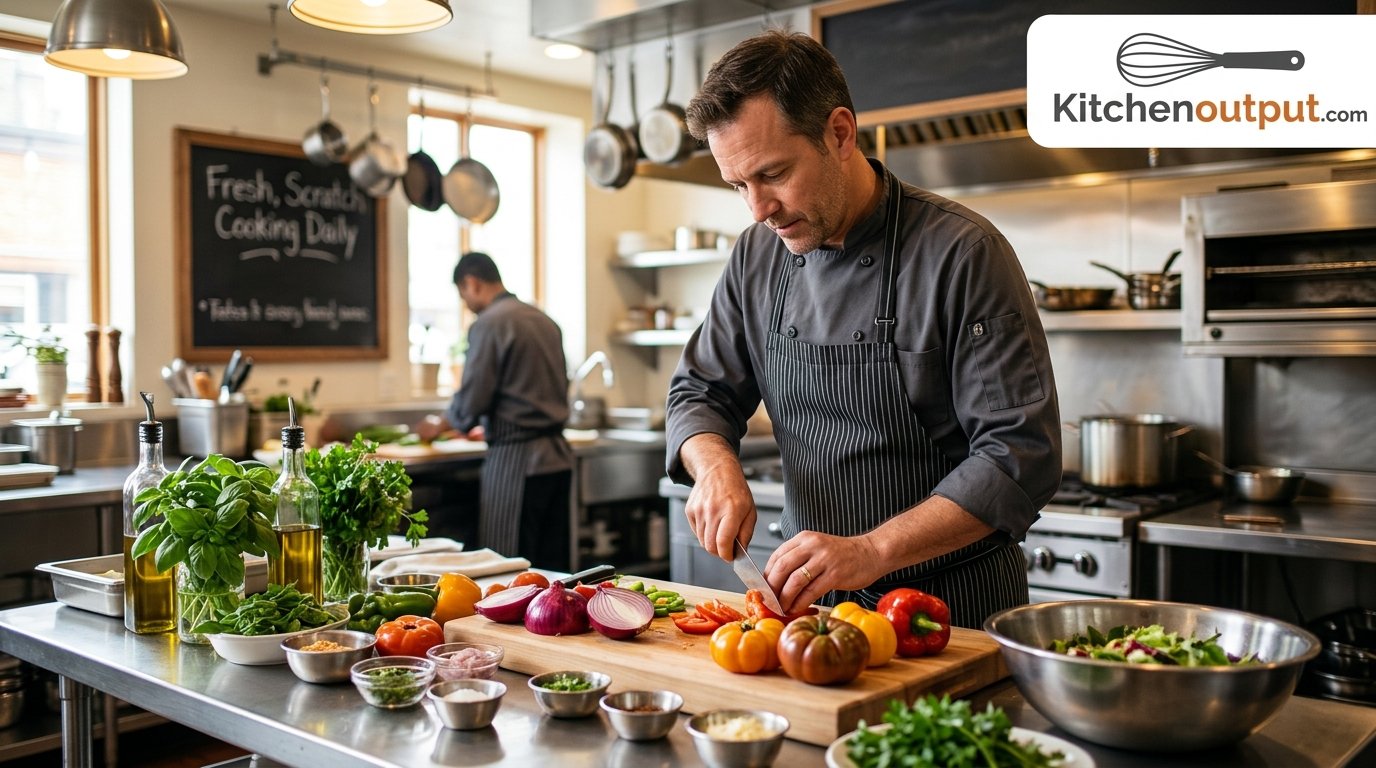
This distinction matters because the food-service industry has, for decades, leaned heavily on “cook-and-chill” or “heat-and-serve” systems, where centralized commissaries prepare food in bulk, flash-freeze or vacuum-seal it, and ship it to individual locations for reheating. A scratch kitchen rejects that model in favor of doing the labor-intensive work — chopping, braising, reducing, fermenting, baking — on-site, day by day. The result is typically fresher flavor, more control over ingredient quality, and the ability to adapt a dish on the fly, at the cost of higher labor hours and more kitchen equipment. If you’re outfitting a kitchen to support this kind of cooking, a solid kitchen appliance buying guide is a useful starting point before you buy anything.
It’s also worth noting that “scratch” exists on a spectrum rather than as a strict on/off switch. A kitchen that makes its own stocks and sauces but buys commercially milled flour and store-bought butter is still operating well within scratch-cooking norms — very few kitchens, professional or otherwise, mill their own grain or churn their own dairy. The practical definition most chefs and food-service consultants use is one of proportion and intent: does the kitchen default to raw-ingredient preparation for the components that most influence flavor, or does it default to purchasing those components pre-made? That question, more than any single ingredient rule, is what separates a genuine scratch kitchen from one simply borrowing the term for marketing purposes.
2. Scratch Kitchen vs. Other Kitchen Models
To really understand what makes a scratch kitchen distinct, it helps to compare it side by side with the other common food-preparation models used in restaurants, cafeterias, and even meal-kit operations. Each model represents a different trade-off between labor cost, consistency, speed, and flavor control.
| Model | Where Food Is Prepared | Typical Ingredients | Labor Intensity | Flavor Control |
|---|---|---|---|---|
| Scratch Kitchen | On-site, day of service | Raw, whole ingredients | High | Very High |
| Cook-and-Chill Commissary | Central facility, shipped out | Bulk-cooked, chilled/frozen | Medium | Medium |
| Heat-and-Serve / Ghost Kitchen | Reheated on-site | Fully pre-cooked components | Low | Low-Medium |
| Assembly Kitchen | On-site assembly only | Pre-cut, pre-portioned items | Low-Medium | Medium |
Notice that a scratch kitchen isn’t automatically “better” in every category — it simply trades speed and low labor cost for depth of flavor and ingredient transparency. Many successful food businesses actually blend models, running a scratch kitchen for signature items while using pre-portioned components for high-volume sides. Understanding where your own kitchen or business sits on this spectrum is the first step toward making an informed choice.
A useful way to test which model a kitchen actually follows is to look at what happens in the walk-in cooler or pantry on any given day. In a scratch kitchen, you’ll typically find whole cuts of meat waiting to be broken down, cases of unwashed produce, bags of dried beans and grains, and containers of stock cooling from the previous night’s simmer. In a heat-and-serve or ghost-kitchen operation, the same space is dominated by vacuum-sealed pouches, portion-controlled frozen trays, and labeled reheating instructions. Neither approach is inherently dishonest, but only one of them matches what most customers picture when they read “made from scratch” on a menu.
3. The History and Rise of Scratch Cooking
Cooking from scratch isn’t a new invention — it’s simply how virtually all food was prepared before industrial food processing became widespread in the mid-20th century. The rise of canned goods, frozen dinners, and shelf-stable convenience foods after World War II reshaped both home kitchens and commercial food service, prioritizing speed and shelf life over flavor complexity. Restaurants followed suit, particularly fast-food and casual-dining chains, which built entire business models around centralized commissary kitchens shipping pre-made components to thousands of locations.
The pendulum began swinging back in the late 1990s and 2000s, driven by the farm-to-table movement, rising consumer interest in ingredient transparency, and chefs like those associated with the slow food movement pushing back against industrialized eating. Today, “scratch kitchen” has become a genuine point of differentiation for restaurants, school cafeterias, hospitals, and even fast-casual chains trying to signal quality to increasingly ingredient-conscious customers. Home cooks have followed a parallel path, with a renewed interest in baking bread, fermenting vegetables, and making stocks at home rather than relying solely on packaged staples.
The COVID-19 pandemic accelerated this trend further in an unexpected way: with restaurants closed or operating at reduced capacity, millions of home cooks who had never baked their own bread or simmered a stock from scratch were suddenly forced to, simply because grocery store shelves were unpredictable and takeout wasn’t always an option. Many of those habits stuck. Social media platforms amplified the shift, turning scratch-cooking techniques like sourdough starters, homemade pasta, and slow-braised dishes into widely shared content, which in turn normalized the idea that scratch cooking was accessible to everyday home cooks rather than something reserved for professional kitchens.
4. Key Characteristics of a True Scratch Kitchen
Not every kitchen that claims the “scratch” label actually operates that way. A handful of consistent characteristics separate a genuine scratch kitchen from one that’s simply reheating slightly less processed food. These traits show up across restaurants, institutional kitchens, and dedicated home setups alike.
- Raw ingredient intake: Deliveries consist mostly of whole produce, unprocessed proteins, dairy, grains, and pantry staples — not pre-cooked components.
- In-house stock and sauce production: Bases like stocks, demi-glace, and mother sauces are made on-site rather than purchased pre-made.
- Daily prep lists: Kitchens run active mise en place routines each day rather than pulling frozen bags from a walk-in.
- Skilled labor allocation: Staff spend meaningful time on knife work, reductions, and technique-driven tasks rather than purely reheating and plating.
- Menu flexibility tied to seasonality: Because ingredients are raw, menus can shift with seasonal availability and quality.
- Transparent ingredient sourcing: Many scratch kitchens can name the farm, purveyor, or region an ingredient came from.
If a kitchen is missing most of these traits — for example, if 80% of its menu arrives frozen and pre-portioned — it’s more accurately described as an assembly or heat-and-serve operation, regardless of what the marketing says.
It’s worth pointing out that these characteristics tend to reinforce one another. A kitchen that commits to in-house stock and sauce production, for instance, naturally needs a daily prep list to manage that workload, which in turn requires staff with the skill and time to execute it. Remove any single characteristic and the others tend to erode along with it — cut the daily prep list and stocks quietly start getting replaced with concentrate, even if nobody explicitly decides to make that change. This is one reason genuine scratch kitchens require ongoing management attention rather than a one-time policy decision; the model tends to drift toward convenience unless it’s actively maintained.
5. Essential Equipment for a Scratch Kitchen
Because scratch cooking relies on transforming raw ingredients rather than reheating finished ones, the equipment list looks different from a heat-and-serve setup. Ovens, ranges, and refrigeration are baseline requirements everywhere, but scratch kitchens lean more heavily on prep-oriented tools. A sharp, reliable knife set is non-negotiable — see our guide to the best knife sets for beginners if you’re building a kitchen from zero, and keep those edges maintained with the right approach to sharpening kitchen knives.
Beyond knives, a dependable food processor speeds up the volume of chopping, pureeing, and dough work that scratch cooking demands — our breakdown of the best food processors covers the models that hold up under daily use. A stand mixer earns its keep for bread, pastry, and sauce emulsification; check our picks for the best stand mixer for scratch baking. For long-cooked stocks, braises, and batch-cooked grains, a pressure cooker or multi-cooker like those covered in our best Instant Pot roundup can cut hours off traditional simmering times without sacrificing depth of flavor.
Cookware selection deserves its own consideration too. Scratch kitchens tend to favor versatile, heavy-gauge pans that can move from stovetop searing to oven finishing without issue — cast iron and heavier stainless steel pieces both fit this role well, though they behave differently enough that it’s worth understanding the trade-offs; our comparison of cast iron vs. stainless steel breaks down which is better suited to which techniques. Rounding out the core equipment list, sturdy mixing bowls and accurate measuring tools matter more in scratch cooking than in assembly-based kitchens, since recipe consistency depends entirely on getting ratios right from raw ingredients rather than following printed instructions on a package.
Must-Have Equipment
- Chef’s knife + paring knife + honing steel
- Heavy-bottomed stockpot
- Cast iron or stainless steel skillets
- Food processor and stand mixer
- Digital kitchen scale
Nice-to-Have Upgrades
- Sous vide immersion circulator
- Countertop convection oven
- High-powered blender
- Mandoline slicer
- Fermentation crocks
6. Ingredient Sourcing and Ordering in a Scratch Kitchen
Sourcing is where scratch kitchens diverge most sharply from convenience-based operations. Instead of ordering pre-cut vegetables or fully seasoned proteins from a broadline distributor, scratch-focused kitchens typically work with a mix of broadline suppliers for shelf-stable staples and specialty or local purveyors for produce, dairy, and proteins. This often means placing multiple smaller orders throughout the week rather than one large weekly delivery, since fresh whole ingredients have shorter shelf lives than their processed counterparts.
Inventory management becomes more demanding as a result. A head chef or kitchen manager needs to track perishables closely, adjust prep quantities based on projected covers, and build menus flexible enough to absorb ingredient substitutions when a supplier runs short. Home cooks scaling this philosophy down can apply the same logic at a smaller scale: shopping more frequently for perishables, buying pantry staples like grains, flours, and dried legumes in bulk, and keeping a rotating stock of frozen homemade stock and sauce bases to bridge busy weeks. Reliable food storage is essential here — see our thoughts on storing kitchen appliances and ingredients properly to extend shelf life and reduce waste.
Relationship-based sourcing also plays a bigger role in scratch kitchens than most people realize. Because ingredient quality has such a direct effect on the final dish, chefs often build long-term relationships with specific farmers, butchers, or fishmongers, sometimes adjusting menus around what a particular supplier has available that week rather than dictating fixed specifications months in advance. This flexibility runs counter to the standardized, centrally negotiated contracts that heat-and-serve chains rely on, but it’s part of what allows scratch kitchens to consistently source higher-quality raw ingredients even when working with smaller purchasing volumes than large chains.
7. Staffing, Skills, and Training for Scratch Cooking
Running a scratch kitchen commercially requires a different staffing model than a heat-and-serve operation. Because so much of the work involves actual technique — knife skills, sauce-making, dough handling, braising — kitchens need cooks who either arrive trained or who are willing to go through a structured onboarding process. This is one of the biggest reasons scratch kitchens carry higher labor costs: skilled labor commands higher wages, and training itself takes time away from production.
Many scratch-focused restaurants address this with tiered training programs, starting new cooks on basic prep tasks (washing, portioning, simple knife cuts) before moving them into sauce stations, then grill or sauté positions, and eventually into more autonomous roles. Standardized recipe cards with precise weights (hence the reliance on digital kitchen scales) help maintain consistency even as less experienced cooks rotate through stations. For home cooks, the “training” process looks more like gradually building a repertoire — starting with a few reliable scratch recipes and slowly expanding technique confidence over months, rather than trying to abandon convenience foods overnight.
Cross-training also plays an outsized role in scratch kitchens compared to heat-and-serve operations. Because so much institutional knowledge lives in the hands and habits of individual cooks — how long a particular braise needs, how a specific sauce should reduce, how a dough should feel at the right hydration — losing a key staff member can meaningfully disrupt quality if that knowledge was never documented or shared. Kitchens that handle this well tend to treat recipe documentation as an ongoing responsibility rather than a one-time task, updating written standards whenever a cook develops a better technique so the improvement survives staff turnover instead of leaving with the person who discovered it.
8. Pros and Cons of a Scratch Kitchen
Like any operational model, running or maintaining a scratch kitchen comes with real trade-offs. Weighing these honestly is important whether you’re a restaurant owner deciding on a concept or a home cook deciding how far to lean into from-scratch cooking.
Pros
- Greater control over flavor, seasoning, and quality
- Full transparency into ingredients and allergens
- Easier to adapt to dietary restrictions
- Often perceived as higher quality by customers
- Less reliance on preservatives and additives
Cons
- Higher labor costs and longer prep times
- Requires more storage for perishables
- Greater skill dependency among staff
- More waste risk from perishable ingredients
- Slower ticket times during service
Weighing these trade-offs isn’t purely a financial exercise — it’s also a question of brand identity and customer expectations. A fine-dining restaurant charging premium prices is expected to operate as a scratch kitchen, and failing to do so would likely damage its reputation if discovered. A quick-service chain competing primarily on speed and price, on the other hand, may reasonably decide that a hybrid or heat-and-serve model better serves its business goals, as long as it doesn’t misrepresent that fact to customers. The “right” answer depends heavily on what a kitchen is trying to promise, and whether it can consistently deliver on that promise at scale.
9. Cost Analysis: Scratch vs. Processed
One of the most persistent myths is that scratch cooking is always more expensive. The reality is more nuanced: raw ingredients are often cheaper per pound than their processed equivalents, but labor costs to transform them are higher. A pre-made sauce might cost more per gallon than the raw tomatoes, onions, and herbs needed to make it from scratch — but paying a cook to spend two hours reducing that sauce adds a labor cost that doesn’t exist when you simply open a bag.
| Cost Factor | Scratch Kitchen | Processed/Heat-and-Serve |
|---|---|---|
| Raw ingredient cost | Lower | Higher (processing markup) |
| Labor cost | Higher | Lower |
| Equipment investment | Higher upfront | Lower upfront |
| Waste/spoilage risk | Higher | Lower |
| Long-term flexibility | Higher | Lower |
For home cooks, the calculus often favors scratch cooking financially, since labor is unpaid personal time rather than a line-item cost. Batch cooking stocks, sauces, and grains on weekends — then freezing portions — is one of the most effective ways to capture the cost benefits of scratch cooking without the daily time burden professional kitchens face.
There’s also a hidden cost dimension that rarely shows up on a simple ledger: waste. Processed, shelf-stable ingredients have a built-in cost advantage in that they rarely spoil before use, while raw produce, dairy, and proteins carry real spoilage risk if not managed carefully. Kitchens — commercial or home — that don’t plan portions and purchasing carefully can easily erase the raw-ingredient cost savings of scratch cooking through wasted food. This is precisely why disciplined inventory rotation and realistic batch sizing matter just as much to the bottom line as the ingredient prices themselves.
10. Building a Scratch Kitchen at Home: A Step-by-Step Overview
Transitioning a home kitchen toward a scratch-cooking philosophy doesn’t require a full remodel — it’s mostly about equipment, habits, and pantry structure. Start by auditing what you currently rely on that’s pre-made: bottled sauces, frozen sides, canned soups. You don’t need to eliminate all of them immediately, but identifying the top three or four you use most often gives you a clear starting point for scratch replacements.
Next, invest in a small core set of equipment rather than trying to buy everything at once. A good knife, a sturdy stockpot, and a reliable cutting board cover the majority of scratch-cooking tasks. From there, build out your pantry with shelf-stable staples — flours, dried grains, vinegars, oils, and spices — that support scratch cooking without requiring daily shopping trips. Finally, build a rotating handful of “base” recipes: a basic stock, a tomato sauce, a vinaigrette, and a simple bread or flatbread dough. Once these become second nature, expanding your scratch-cooking repertoire becomes much easier, and appliances like a stand mixer or food processor start paying for themselves quickly. If you want a template dish to practice technique on, our garlic paprika butter chicken skewers recipe is a good low-pressure entry point.
It also helps to accept that a fully scratch-based kitchen is a direction, not a destination you either reach or fail to reach. Very few home cooks will ever mill their own flour or press their own oil, and that’s fine — the goal isn’t purity, it’s shifting the balance of what’s on your plate toward ingredients you controlled and techniques you executed yourself. Even replacing a single processed staple, like swapping a jarred pasta sauce for a simple homemade version made in under thirty minutes, moves a kitchen meaningfully closer to the scratch-cooking philosophy without requiring a complete lifestyle overhaul.
11. Menu Planning and Recipe Development in Scratch Kitchens
Because scratch kitchens rely on raw ingredients, menu planning tends to be more iterative and seasonally driven than in operations built around fixed, pre-made components. Chefs in scratch kitchens frequently build menus around what’s currently at peak quality and availability, then design supporting dishes around a handful of versatile base preparations — a good stock, a mother sauce, a house-made spice blend — that can flex across multiple menu items.
Recipe development in this context also demands more rigorous documentation. Since dishes are built from raw components rather than assembled from consistent pre-made parts, small variations in ingredient quality (a riper tomato, a fattier cut of meat) can shift the outcome more than they would in a heat-and-serve kitchen. Standardized recipes with precise measurements, cook times, and plating instructions help scratch kitchens maintain consistency despite these natural ingredient variations. Home cooks benefit from the same discipline: keeping a simple recipe journal, noting adjustments, and weighing ingredients with a scale rather than eyeballing measurements leads to far more repeatable results over time.
Menu planning in a scratch context also tends to favor dishes built around modular components rather than one-off recipes cooked in isolation. A well-designed scratch menu might use the same base tomato sauce in a pasta dish, a braised protein, and a soup, simply adjusting seasoning and finishing techniques for each application. This modular approach reduces the total number of from-scratch preparations a kitchen needs to manage on any given day while still preserving the flavor and ingredient-quality benefits that define scratch cooking in the first place — a principle that scales down just as effectively to a home kitchen trying to get more mileage out of a single weekend batch-cooking session.
12. Common Challenges and How Successful Scratch Kitchens Solve Them
Even well-run scratch kitchens run into recurring challenges. Labor cost and turnover top the list — because scratch cooking depends on skilled hands, losing an experienced cook hurts more than it would in a heat-and-serve kitchen. Successful operations mitigate this with detailed recipe documentation, cross-training, and building redundancy so no single dish depends entirely on one person’s memory.
Food waste is another persistent issue, since raw perishables spoil faster than processed, shelf-stable alternatives. Kitchens address this by tightening ordering cycles, using “first in, first out” rotation systems, and designing menus that intentionally repurpose trim and scraps — vegetable peels into stock, bread ends into croutons or bread pudding. Ticket speed during peak service is a third common friction point; scratch kitchens often solve this by shifting labor-intensive work (stocks, sauces, braises, doughs) to off-peak prep hours, so that service itself becomes largely an assembly and finishing process built on components that were, themselves, made from scratch earlier that day. Home cooks can borrow this exact strategy by doing “big batch” scratch cooking on weekends and assembling quick weeknight meals from those prepared components.
Equipment failure and maintenance represent a less obvious but very real challenge as well. Scratch kitchens place heavier, more continuous demand on core tools — knives dull faster with constant use, food processors and stand mixers see more daily cycles, and stockpots and skillets take more direct heat exposure than in a kitchen that primarily reheats. Successful scratch kitchens build routine maintenance into their operations: scheduled knife sharpening, regular equipment inspection, and a habit of retiring worn tools before they fail mid-service. This same discipline pays off for home cooks too — a knife that’s sharpened regularly and cookware that’s cared for properly will simply perform better and last longer than equipment that’s neglected until something goes wrong.
Frequently Asked Questions
What does “cooked from scratch” actually mean?
It means a dish is built from raw or minimally processed ingredients — fresh produce, raw proteins, base pantry staples — rather than assembled from pre-made components like bottled sauces or frozen pre-cooked items.
Is a scratch kitchen the same as a farm-to-table restaurant?
Not exactly. Farm-to-table refers specifically to ingredient sourcing (local, direct-from-farm), while scratch kitchen refers to how food is prepared once it arrives. A restaurant can be farm-to-table without being fully scratch-based, and vice versa.
Do scratch kitchens use any pre-made ingredients at all?
Most do, to some degree. Even dedicated scratch kitchens often rely on a small number of purchased shelf-stable staples, such as certain condiments or specialty items that aren’t practical to make in-house. The defining factor is that the majority of preparation happens on-site from raw ingredients.
How much more expensive is scratch cooking than using pre-made food?
Raw ingredients are often cheaper per unit than processed equivalents, but labor costs to prepare them are higher. For commercial kitchens this can raise overall costs; for home cooks, since labor is unpaid, scratch cooking is frequently the more economical option.
Can a small home kitchen be considered a scratch kitchen?
Yes. The scratch-kitchen philosophy scales down easily — it’s about the approach to ingredients and preparation, not the size of the operation.
What equipment is absolutely non-negotiable for scratch cooking?
A good chef’s knife, a sturdy cutting board, and a reliable stockpot or Dutch oven cover the vast majority of scratch-cooking tasks. Everything else is an efficiency upgrade rather than a strict requirement.
How do scratch kitchens handle food safety and shelf life?
Through tighter inventory rotation, more frequent ordering of perishables, proper cold storage practices, and staff training on food-safety protocols like temperature logging and “first in, first out” stock rotation.
Are scratch-made meals healthier than processed alternatives?
They can be, since scratch cooking typically involves fewer preservatives, additives, and added sodium — but outcomes still depend heavily on the specific ingredients and techniques used.
How long does it take to transition a kitchen to a full scratch model?
For a restaurant, it can take several months to fully retrain staff, redesign menus, and rework supply chains. For a home kitchen, the transition can happen gradually over just a few weeks by replacing one or two convenience items at a time.
Do scratch kitchens cost more to staff?
Generally yes, since scratch cooking demands more hands-on technique and experience, which commands higher wages than roles focused primarily on reheating and assembly.
What’s the difference between a scratch kitchen and a central commissary kitchen?
A commissary kitchen prepares food in bulk at a central location and ships it to multiple sites for reheating or light finishing. A scratch kitchen prepares food on-site, closer to the point of service, from raw ingredients.
Is scratch cooking realistic for busy families?
Yes, particularly with batch-cooking strategies. Preparing stocks, sauces, and grains in larger quantities on a slower day, then freezing portions, makes scratch cooking manageable even on tight weeknight schedules.
Conclusion
A scratch kitchen isn’t defined by a single ingredient rule or a marketing label — it’s a consistent commitment to building flavor from raw, whole ingredients rather than leaning on pre-made shortcuts. That commitment carries real trade-offs: more labor, more equipment, more attention to sourcing and storage, but in exchange it delivers flavor control, ingredient transparency, and flexibility that heat-and-serve models simply can’t match. Whether you’re evaluating a restaurant’s claims or deciding how far to take your own home cooking, understanding these fundamentals gives you a clear framework for judging what “scratch” really means.
If you’re ready to start building your own scratch kitchen, the right equipment makes the biggest difference in how sustainable the habit becomes.


