What Does “All Day” Mean in a Kitchen? A Line Cook’s Guide to Restaurant Terminology
If you’ve ever stood near a busy kitchen pass and heard a chef shout something like “two chicken, all day,” you’ve witnessed one of the most useful — and most misunderstood — phrases in professional cooking. Here’s exactly what it means, why it exists, and how the same thinking can make your own kitchen run like a five-star line.

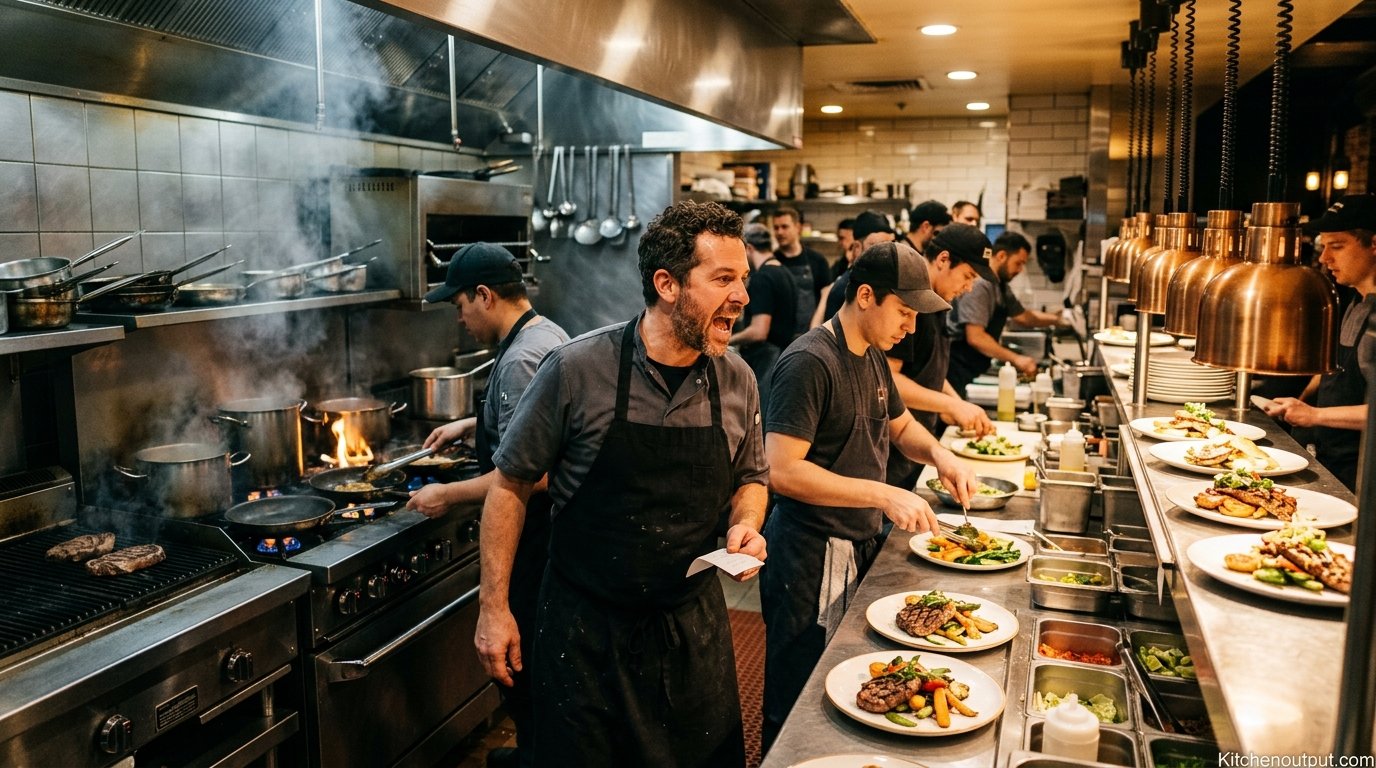
The ticket rail is where “all day” counts come to life — it’s the nerve center of every busy service.
Every profession has its own shorthand, and few industries have developed one as colorful — or as necessary — as the restaurant kitchen. Between the clatter of pans, the hiss of the flat-top, and the constant beeping of timers, cooks need a way to communicate that cuts through the noise instantly. “All day” is one of the pillars of that shorthand, and once you understand it, you’ll never hear a kitchen the same way again.
This guide breaks down exactly what “all day” means, where the phrase came from, how professional kitchens use it to survive a Friday night rush, and — because this is a resource for home cooks as much as it is for culinary history buffs — how you can borrow the same mindset to make your own weeknight cooking dramatically less chaotic.
1. Where “All Day” Comes From: The Origins of Kitchen Lingo
Kitchen slang didn’t appear overnight. It grew out of necessity, shaped by decades of French brigade-style kitchens, American diner counters, and the sheer physical demands of cooking for hundreds of people in a single evening. The French brigade system, formalized by Georges Auguste Escoffier in the late 1800s, organized kitchens into stations — garde manger, saucier, poissonnier, rotisseur, and so on — each with a clear chain of command. That structure required a shared vocabulary so that an order shouted from the pass could be understood instantly by every station, regardless of how loud the room got.
“All day” grew out of that same pressure-cooker environment. As American diners and later fine-dining restaurants adopted ticket-based ordering, cooks needed a fast way to communicate not just what was on a single ticket, but how many of an item were needed across every ticket currently in play. Rather than repeating “one burger” five separate times as five different tickets came in, a cook or expediter could say “five burgers, all day” and immediately convey the full scope of what needed to hit the pass.
The phrase has since become so embedded in professional kitchen culture that it shows up in cooking shows, culinary school curricula, and even casual conversation among people who have never worked a line but have absorbed restaurant culture from television and social media. Chefs like Anthony Bourdain helped popularize the rhythm and language of the kitchen for a mainstream audience, and “all day” is one of the terms that made the leap from strictly professional jargon into something home cooks now recognize, even if they’re fuzzy on the exact meaning.
Understanding the history matters because it explains why the phrase exists at all. It isn’t decorative slang — it’s a tool that evolved specifically to solve a communication problem under time pressure. That’s a theme you’ll see repeated throughout this guide: almost every piece of kitchen lingo exists because plain English was too slow, too ambiguous, or too easy to mishear over the roar of exhaust fans and clattering pans.
- Noise levels on a busy line make full sentences hard to hear accurately
- Orders arrive continuously, not one at a time, so totals matter more than individual requests
- Mistakes are expensive — wasted food, refired tickets, and unhappy guests
- Every station needs the same information at the same moment
- Verbal confirmation prevents duplicated or missed items
2. What “All Day” Actually Means on the Line
Here’s the plain-English definition: in a professional kitchen, “all day” means “in total, across every open ticket right now.” It is almost always paired with a number and an item, as in “three risotto, all day” or “one salmon, one steak, all day.” The phrase tells everyone on the line the cumulative quantity of a dish that needs to be fired, plated, or prepped at that moment — not just for the newest ticket, but for every ticket currently active on the board.
This is a critical distinction. A single ticket might call for one order of salmon. But if there are four other open tickets that also include salmon, the expediter isn’t going to make each cook count tickets individually. Instead, they call the running total: “five salmon, all day.” Every cook on that station immediately knows the target number they’re working toward, regardless of which specific table each portion belongs to.
It’s worth noting that “all day” is not the name of a specific dish, a time of service, or a type of menu (that confusion does happen, more on that in our FAQ section below). It’s purely a quantity aggregator — a way of saying “here is the sum total right now,” which then gets updated as new tickets come in or dishes go out. Think of it as a live-updating tally that keeps the whole team synchronized without anyone needing to physically look at the ticket rail themselves.
A Simple Example
Imagine three tickets come in within two minutes of each other:
| Ticket | Items Ordered |
|---|---|
| Table 12 | 2x Chicken Skewers, 1x Caesar Salad |
| Table 14 | 1x Chicken Skewers, 1x Ribeye |
| Table 9 | 1x Chicken Skewers, 2x Caesar Salad |
Rather than calling each ticket out separately, the expediter reads the board and calls: “Four chicken, all day. Three Caesar, all day. One ribeye.” The grill station now knows it needs four skewer portions moving through the pan at roughly the same time — a much more useful piece of information than three disconnected orders. If you enjoy the kind of dish that shows up in an “all day” count like this, our garlic paprika butter chicken skewers recipe is a great example of a dish built for exactly this kind of batch-style cooking.
3. How Chefs and Line Cooks Use “All Day” During a Service
In practice, “all day” is called out by whoever is reading tickets at the pass — usually the expediter (often shortened to “expo”) or the chef de cuisine during a rush. This person’s entire job during service is to translate the incoming stream of paper or digital tickets into clear, actionable instructions for each station. Calling totals “all day” is one of the core techniques they use to keep the kitchen synchronized.
The process typically works like this: as tickets print or appear on a kitchen display system (KDS), the expo scans them, mentally groups items by station, and calls out both the individual new ticket and the updated running total. A typical call might sound like: “Order in — one burger, one fries. Burgers, all day: three. Fries, all day: five.” Cooks on the grill and fry stations repeat the numbers back — “Heard, three burgers, five fries, all day” — to confirm they’ve registered the information correctly.
This call-and-response pattern is deliberate. It’s not enough for the expo to shout numbers into a loud room; each station must verbally confirm receipt so mistakes get caught immediately rather than discovered ten minutes later when a table is missing food. That confirmation loop is often the difference between a smooth service and a kitchen that falls “in the weeds” (another term we’ll unpack shortly).
Why the Running Total Changes Constantly
An “all day” count isn’t static. It rises every time a new ticket comes in with that item, and it drops every time a portion is fired and sent to the pass. A good expo re-calls the total periodically throughout service, especially during a rush, so cooks always know exactly how many portions they’re racing to complete. This constant recalibration is what allows a kitchen with five or six line cooks to move dozens of simultaneous orders without confusion.
For line cooks, mastering this system is a rite of passage. New cooks often struggle at first to track running totals while also physically cooking, plating, and cleaning as they go. Experienced cooks develop a kind of working memory for these numbers, updating their mental tally the instant they hear a new call, much the way an air-traffic controller tracks multiple aircraft simultaneously.
4. “All Day” vs. Other Kitchen Call-Outs: A Full Glossary
“All day” doesn’t exist in isolation. It’s part of a whole vocabulary of call-outs that keep a kitchen synchronized. Understanding how it relates to — and differs from — other common terms makes the whole system click into place.
| Term | What It Means | How It Differs From “All Day” |
|---|---|---|
| All Day | The running total of an item needed across every open ticket | N/A — this is the baseline term |
| Fire | An instruction to start actively cooking a specific item right now | “Fire” triggers action; “all day” reports quantity |
| Behind | A verbal warning that someone is walking behind you, often carrying something hot or sharp | A safety call, unrelated to order quantities |
| Heard / Heard That | Confirmation that an instruction or call was received and understood | Used as a direct response to an “all day” call |
| On the Fly | A rush request to prepare and fire an item immediately, often out of normal sequence | Overrides the normal timing implied by an “all day” count |
| In the Weeds | A kitchen or cook who has fallen dangerously behind on tickets | A state that “all day” tracking is specifically designed to prevent |
| 86’d | An item that is no longer available, typically because the kitchen has run out | Removes an item from future “all day” counts entirely |
| Pick Up | An instruction telling a cook or server to grab a finished plate from the pass | Happens after an “all day” total has been fully completed |
Notice how each of these terms serves a distinct function. “Fire” tells you when to start cooking. “All day” tells you how much you’re cooking in total. “Heard” confirms the message was received. “86’d” removes an item from consideration entirely. Together, they form a compact operating language that lets a kitchen function almost like a single organism instead of a collection of individuals working in isolation.
Why This Shorthand Works
- Short phrases cut through kitchen noise more reliably than full sentences
- Every term has exactly one meaning, reducing ambiguity
- Call-and-response confirms information was received correctly
- New staff can learn the core vocabulary in a single shift
Where It Can Go Wrong
- Slang varies slightly between restaurants and regions
- New hires can mishear similar-sounding calls under pressure
- Overlapping calls during a rush can be genuinely hard to track
- Terms borrowed inaccurately by non-restaurant workers cause confusion online
5. Why “All Day” Matters: The Logic Behind Ticket Management
It’s easy to treat “all day” as a quirky piece of trivia, but the underlying logic is genuinely valuable, and it applies far beyond restaurant walls. At its core, the concept solves a batching problem: when you have multiple simultaneous requests for the same resource, it’s almost always more efficient to fulfill them together than one at a time.
Picture a grill station cooking steaks to order. If the cook fires one steak, waits for it to finish, then fires the next, and the next, the kitchen falls behind almost immediately — the grill has capacity for six steaks at once, but the cook is using a fraction of that capacity by cooking sequentially. By contrast, if the expo calls “six ribeyes, all day” the moment those six tickets exist, the cook can load the entire grill at once, monitor doneness across all six simultaneously, and pull them in a coordinated sequence. The total cooking time for six steaks fired together is dramatically shorter than six steaks fired one after another.
This is fundamentally a resource-allocation problem, the same kind of problem that shows up in manufacturing, logistics, and computer science under names like batch processing or job scheduling. A kitchen that tracks “all day” totals is essentially running a real-time scheduling algorithm with human beings as the processors and food as the job queue. The expo’s running count is the queue; each cook is a worker pulling from that queue and reporting back capacity.
The Cost of Getting It Wrong
When a kitchen fails to track totals accurately, several things tend to happen. Cooks might duplicate effort, firing more of an item than was actually ordered, which wastes food and money. Alternatively, they might undercount, sending fewer portions than needed and forcing a table to wait for a second, embarrassing round. Both mistakes erode trust between the front of house and the kitchen, and both are avoidable with a disciplined “all day” tracking habit.
There’s also a psychological benefit that’s easy to overlook. Line cooks working under pressure perform better when they have a clear, concrete target rather than an open-ended stream of requests. “Cook six of these” is far less stressful than “keep cooking these indefinitely until someone tells you to stop.” The all day count transforms an overwhelming, continuous flow of orders into a series of discrete, achievable targets — which is a big part of why experienced cooks rely on it so heavily, even in kitchens that have moved to digital ticket systems with automated totals.
“You’re not cooking for a table. You’re cooking for the board. The board doesn’t lie, and it doesn’t care which ticket a portion ends up on — it only cares about the number.” — a common sentiment echoed across culinary forums and line cook communities.
6. A Real-World Example: Walking Through a Rush With “All Day” Counts
To really internalize how this works, it helps to walk through a condensed version of a real dinner rush from the expo’s point of view. Imagine a mid-sized restaurant with a four-person line: grill, sauté, fry, and garde manger (cold station), plus one expediter calling tickets from the pass.
At 7:02 PM, three tickets print within thirty seconds of each other. The expo scans them and calls: “Fire two chicken, one salmon. Chicken, all day: two. Salmon, all day: one.” The grill cook repeats it back: “Heard, two chicken, one salmon, all day.” At this point the totals are small enough that each new ticket is called individually alongside its updated total.
By 7:14 PM, the rush intensifies. Six more tickets have printed. The expo now calls: “Chicken, all day: seven. Salmon, all day: four. Ribeye, all day: three, two medium-rare, one medium.” Notice how the call now includes modifiers — not every “all day” count is a simple, undifferentiated number. When a dish has variations (temperature, toppings, allergies), the expo has to fold that detail into the count so the cook doesn’t just hit the right total, but the right total of the right variations.
At 7:22 PM — the peak of the rush — the fry station is straining to keep up, and the expo notices the ticket times are stretching. Rather than letting the kitchen fall further behind, they call a checkpoint: “Everybody, where are we? Fries, all day, still: eleven. Say your count.” Each station calls back their in-progress number, allowing the expo to see exactly where the backlog is forming and reallocate help — maybe pulling the garde manger cook over to bag fries for two minutes — before the situation spirals into being fully “in the weeds.”
By 7:45 PM, the initial wave clears. Tickets slow down, and the “all day” totals shrink accordingly. The expo calls a final check: “Chicken, all day: zero. We’re clear.” That “zero” call is its own small ritual in many kitchens — a signal that the immediate crunch has passed and the team can catch its breath, restock, and prepare for the next wave.
- Counts scale up and down dynamically as tickets arrive and clear
- Modifiers (temperature, allergies, substitutions) get folded into the total, not tracked separately
- Checkpoints allow the expo to spot bottlenecks before they become a crisis
- A count reaching “zero” is a meaningful, shared signal across the whole team
7. The Expo Station and the Role of “All Day” in Communication
If “all day” is the language, the expeditor is the person doing most of the talking. In many restaurants, the expo role rotates between the sous chef, chef de cuisine, or a highly experienced line cook who has effectively memorized every station’s workflow. Their job isn’t to cook — it’s to read the entire kitchen at once and keep everyone synchronized through calls like the ones described above.
A good expo does far more than read numbers off tickets. They anticipate bottlenecks before they happen, noticing when one station’s “all day” count is climbing faster than that station can realistically clear. They adjust the pace of new fire calls to avoid overwhelming a struggling station, effectively acting as a pressure valve for the whole kitchen. This is a skill that takes years to develop, and it’s one of the reasons experienced expos are so highly valued — a mediocre expo can turn an otherwise well-staffed kitchen into chaos, while a great one can help an understaffed kitchen survive a brutal Saturday night.
Digital Ticket Systems and the Future of “All Day”
Many modern restaurants now use kitchen display systems (KDS) that automatically calculate running totals and display them on screens above each station. In theory, this reduces the need for verbal “all day” calls since the number is always visible. In practice, most kitchens still rely on verbal calls alongside the screens, because a spoken confirmation forces active attention in a way that a passively glowing screen doesn’t. Cooks can glance past a screen without truly registering the number; they’re far less likely to ignore a call-and-response exchange with a colleague standing three feet away.
This is a useful lesson even outside professional kitchens: passive information (a number on a screen, a notification badge) is easy to tune out, while active, spoken, or interactive confirmation tends to stick. It’s part of why many home organization systems — whether it’s a shared grocery list, a meal plan, or a kitchen inventory — work better when there’s some form of active check-in rather than a static list nobody actually reads.
8. How Line Cooks Track “All Day” Counts Without Losing Their Minds
Given how many numbers can be in play simultaneously, how do line cooks actually keep track of everything without a spreadsheet in front of them? The answer is a mix of physical technique, mental discipline, and a few surprisingly low-tech tricks that have been passed down through generations of cooks.
Ticket Rails and Physical Organization
Most kitchens use a physical or digital “rail” — a horizontal bar or screen where tickets are displayed in the order they were fired. Cooks glance at the rail constantly, and many use it as their primary memory aid rather than trying to hold every number in their head. Tickets are often physically arranged by course or by how far along they are (appetizers on the left, mains in the middle, tickets about to fire on the right, for example), which gives a visual, at-a-glance sense of the total without anyone needing to recite numbers out loud every thirty seconds.
Chunking and Repetition
Experienced cooks use a memory technique similar to “chunking,” a concept well documented in cognitive psychology. Rather than tracking seven individual tickets, they track one number: “seven chicken, all day.” Every time a new ticket adds to that total, they update the single number rather than re-deriving it from scratch. This is far less mentally taxing than trying to remember which specific tables ordered which specific items, and it’s part of why “all day” calls are repeated verbally — repetition reinforces the chunked number in working memory.
Physical Cues and Muscle Memory
Many cooks also use physical cues — lining up ramekins, placing a specific number of proteins on the flat-top, or using tongs to tap a countertop the number of times matching the current count. These small physical rituals aren’t just habit; they offload some of the tracking burden from working memory onto the physical environment, a strategy cognitive scientists sometimes call “distributed cognition.” In plain terms: cooks use their hands and their station layout as an extension of their memory, rather than trying to hold every number purely in their head.
- Physically organizing tickets on the rail by proximity to firing
- Chunking multiple tickets into a single running total
- Verbal repetition (“heard, all day”) to reinforce short-term memory
- Physical cues like pre-portioned ramekins or aligned proteins on the grill
- Periodic checkpoints called by the expo to reset and confirm totals
These same techniques translate remarkably well to a home kitchen, especially when you’re cooking for a crowd, hosting a holiday dinner, or batch-prepping meals for the week. A little bit of “line cook” discipline goes a long way toward reducing the chaos of juggling multiple dishes at once, which is exactly what the next few sections dig into.
9. Bringing “All Day” Thinking Into Your Home Kitchen
You don’t need a ticket printer, a KDS screen, or a team of line cooks to benefit from “all day” logic. The core idea — track the total demand for each item before you start cooking, rather than reacting one request at a time — applies directly to weeknight dinners, holiday hosting, and weekly meal prep.
Consider a common scenario: you’re cooking dinner for a family of five, and everyone wants something slightly different — two people want their chicken well-done, one wants it with extra sauce, one is vegetarian, and one wants a smaller portion. If you cook this “to order,” handling each request as it comes up, you’ll be running back and forth to the stove all evening, cooking one portion at a time and letting the rest of dinner go cold. If instead you take thirty seconds to mentally total the demand first — “four chicken all day, two well-done, one extra sauce, one veggie substitute” — you can plan a single, efficient cooking sequence that gets everything to the table hot and at the same time.
The Weekly Meal Prep Version of “All Day”
This mindset scales up beautifully for meal prep. Instead of cooking one meal on Monday, another on Tuesday, and so on, many home cooks now plan their week the way a kitchen plans a rush: total up demand first. If three of your five planned dinners call for shredded chicken, cook all of that chicken in one batch — your own personal “three chicken, all day” — rather than starting from scratch three separate times. The same logic applies to rice, roasted vegetables, sauces, and other building blocks that show up across multiple meals.
This isn’t just a time-saver; it’s meaningfully more efficient in terms of energy use, cleanup, and even ingredient cost, since buying and prepping in bulk is almost always cheaper per portion than buying small quantities repeatedly. If you’re new to structuring your week this way, our kitchen appliance buying guide is a useful starting point for figuring out which tools actually support batch-style cooking versus which ones are better suited to single-serving meals.
A Simple Framework You Can Use Tonight
- Total the demand first. Before turning on a single burner, write down (mentally or on paper) exactly how many portions of each component you need.
- Group by cooking method. Everything that goes in the oven, goes in together. Everything that hits the stovetop, gets sequenced together.
- Fire the largest batch first. Just like a line cook loading the grill, start with whatever takes the longest or has the highest total count.
- Track your “count” as you go. A simple mental note — “two down, two to go” — keeps you from losing track mid-cook.
- Call your own “zero.” When everything’s plated, take the small mental win a line cook gets from clearing the board.
10. Batch Cooking and Mise en Place: The Home Cook’s Version of “All Day”
“All day” thinking doesn’t work in isolation — it’s built on top of another piece of kitchen philosophy: mise en place, the French phrase for “everything in its place.” Professional cooks live by mise en place because it’s what makes rapid, accurate “all day” cooking possible in the first place. If your ingredients aren’t prepped, measured, and organized before service starts, no amount of clever quantity-tracking will save you once the tickets start flying.
The same is true at home. Batch cooking and “all day” totals only work smoothly if your mise en place is solid first. That means chopping vegetables, measuring spices, and portioning proteins before you start cooking, not while a pan is already smoking on the stove. A well-organized prep station — clear counter space, the right bowls, a sharp knife, and ingredients arranged in the order you’ll use them — is what separates a smooth batch-cooking session from a stressful one.
Benefits of Prepping “All Day” Style
- Fewer trips to the fridge or pantry mid-cook
- Consistent portion sizes across every serving
- Less food waste since quantities are planned in advance
- Significantly less stress during the actual cooking window
- Easier cleanup since prep mess is contained to one phase
Common Pitfalls to Avoid
- Underestimating total prep time before the actual cook begins
- Not having enough storage containers ready for finished batches
- Skipping the “total demand” step and falling back into cooking to order
- Overcrowding pans, which slows cooking and hurts browning
- Forgetting to label batches, especially when freezing multiple meals
Storage Matters as Much as Cooking
Once you’ve cooked your own version of an “all day” batch, how you store it determines whether that effort actually pays off during the week. Proper containers, clear labeling, and a system for what goes in the fridge versus the freezer all matter. If you’re building out a batch-cooking routine for the first time, it’s worth reading our guide on how to store kitchen appliances so your countertop stays functional and your tools stay in good condition between big cooking sessions.
It’s also worth understanding what separates a professional “scratch kitchen” from one that relies heavily on pre-made components, since the amount of from-scratch cooking you do directly affects how useful batch totals are for your household. Our explainer on what a scratch kitchen actually is digs into that distinction in more detail, and it’s a genuinely useful frame for deciding how much of your own “all day” cooking should happen from raw ingredients versus semi-prepared staples.
11. Tools That Help You Run Your Kitchen Like a Pro
None of this “all day” discipline matters much if your equipment can’t keep up with batch demands. Professional kitchens invest heavily in equipment specifically because volume cooking punishes underpowered tools — a home cook trying to replicate that efficiency benefits from the same principle, even at a smaller scale. Below is a practical breakdown of the categories of tools that make “all day” style cooking realistic in a home kitchen, along with what to look for in each.
Multi-Function Cookers
A quality multi-cooker — something in the Instant Pot family — lets you produce large batches of proteins, grains, and beans in a single, mostly hands-off cycle. This is arguably the single highest-leverage appliance for anyone trying to adopt batch-style “all day” cooking, since it removes the need to babysit a pot on the stove while you handle other components.
High-Capacity Air Fryers
Air fryers have become a staple for batch cooking proteins and vegetables with consistent texture and minimal added fat. The key word for “all day” style cooking is capacity — a small two-quart basket forces you back into cooking in rounds, which defeats the purpose. Look for models built for families, and pay attention to basket shape, since square baskets typically fit more food per square inch than round ones.
Stand Mixers
If your batch cooking extends into baking — bread, muffins for the week, or big-batch cookie dough — a capable stand mixer removes a huge amount of manual labor and lets you scale a recipe up without extending your own effort proportionally.
Sharp, Reliable Knives
Every batch-cooking session starts with prep, and prep starts with a knife. A dull knife doesn’t just slow you down — it’s genuinely more dangerous, since it requires more force and is more likely to slip. If your knives haven’t been sharpened recently, our guide on how to sharpen kitchen knives is worth reading before your next big cooking session.
| Tool Category | Why It Matters for “All Day” Cooking | What to Prioritize |
|---|---|---|
| Multi-cooker | Handles large batches of protein/grains hands-off | Capacity, pressure-cook speed, ease of cleaning |
| Air fryer | Consistent batch texture without constant monitoring | Basket size and shape, wattage, digital presets |
| Stand mixer | Scales baking recipes without extra manual effort | Bowl capacity, motor power, attachment options |
| Chef’s knife | Speeds up and improves safety of prep work | Blade sharpness, balance, comfortable grip |
| Food processor | Handles repetitive chopping/shredding at volume | Bowl size, blade quality, motor durability |
| Digital scale | Keeps portioning consistent across a whole batch | Accuracy, tare function, max weight capacity |
For a broader overview of which appliances genuinely earn counter space versus which ones tend to gather dust, our roundup of must-have kitchen appliances is a good next stop, especially if you’re building out a kitchen specifically to support batch cooking and meal prep rather than single-serving, cook-to-order meals.
12. Common Mistakes People Make Misusing or Misunderstanding “All Day”
Because “all day” has crossed over from strictly professional slang into broader food culture, it’s picked up a few misunderstandings along the way. Clearing these up helps you use — and recognize — the term correctly.
Mistake #1: Assuming It Refers to a Time of Service
The most common misconception is that “all day” describes when food is available, as in “breakfast served all day.” That’s an entirely different, unrelated use of the same two words. In a kitchen context, “all day” has nothing to do with hours of operation — it’s strictly about quantity, not timing.
Mistake #2: Treating It as a Specific Dish or Menu Item
Some newer restaurant-goers, after overhearing the phrase, assume “all day” refers to a particular dish (understandably, since it’s often shouted alongside a food name, like “chicken, all day”). It doesn’t name a dish; it’s always modifying a quantity of whatever dish was just mentioned.
Mistake #3: Confusing It With “On the Fly”
Both phrases relate to order management, but they mean very different things. “All day” is a running total; “on the fly” is an urgent, out-of-sequence request, usually because a table needs something immediately — a forgotten side, a remade dish, or a VIP order that needs to jump the line.
Mistake #4: Using It Casually Without Understanding the Underlying System
It’s become trendy for home cooks and content creators to use restaurant lingo like “all day,” “fire,” and “heard” for flavor, without necessarily grasping the operational logic behind it. There’s nothing wrong with adopting the vocabulary, but the real value — as this guide has hopefully made clear — comes from understanding and applying the batching logic itself, not just repeating the phrase for effect.
Mistake #5: Applying It Only to Restaurants
Because the phrase originated in professional kitchens, some people assume the underlying idea has no relevance outside them. As sections nine and ten of this guide demonstrate, the exact opposite is true — the total-demand-first approach behind “all day” is one of the most transferable pieces of kitchen wisdom for anyone who regularly cooks for more than one person.
- Is: A running total of an item needed across all open tickets
- Is: A tool for batching and prioritizing cooking during service
- Isn’t: A reference to hours of availability
- Isn’t: The name of a dish or menu category
- Isn’t: The same thing as “on the fly” or “fire”
Frequently Asked Questions About “All Day” in a Kitchen
What does “all day” mean in a restaurant kitchen?
It means the total running quantity of a specific item needed across every currently open ticket. If five tickets each call for one order of pasta, the kitchen would call “five pasta, all day” to communicate the full total at once.
Does “all day” refer to what time food is served?
No. That’s a common mix-up with an unrelated, casual use of the same phrase (like “breakfast served all day”). In professional kitchen slang, “all day” is exclusively about quantity, not timing or hours of operation.
Who calls out “all day” totals during service?
Usually the expediter, sous chef, or chef de cuisine — whoever is reading and organizing incoming tickets at the pass. In smaller kitchens, this responsibility sometimes rotates among senior line cooks.
Is “all day” the same thing as “fire”?
No. “Fire” is an instruction to begin actively cooking an item right now. “All day” reports the cumulative quantity needed. The two are often used together, as in “fire six chicken, all day,” but they serve different functions.
Why don’t kitchens just call out each ticket individually?
Because it’s far less efficient. Calling running totals lets cooks batch their work — loading a full grill at once, for example — rather than cooking one portion at a time, which slows service down dramatically during a rush.
What does “heard” mean when a cook responds to an “all day” call?
“Heard” (or “heard that”) is a verbal confirmation that the cook received and understood the instruction. It’s part of a call-and-response system designed to catch miscommunication immediately, before it turns into a wrong or missing order.
What does “in the weeds” mean, and how does it relate to “all day”?
“In the weeds” describes a cook or kitchen that has fallen dangerously behind on outstanding tickets. Accurate “all day” tracking is one of the main tools kitchens use to prevent this from happening, since it keeps everyone aware of total demand before it becomes overwhelming.
What does “86’d” mean?
An item that has been “86’d” is no longer available, typically because the kitchen has run out of an ingredient. Once something is 86’d, it’s removed from future “all day” counts entirely.
Can home cooks actually use “all day” thinking?
Yes, and it’s genuinely useful. Totaling up demand before you start cooking — whether for a family dinner with different preferences or a week’s worth of meal prep — helps you batch tasks efficiently instead of cooking one request at a time.
What’s the difference between “all day” and “on the fly”?
“All day” is a running total used for normal-paced ordering. “On the fly” is an urgent, out-of-sequence request — usually because something was forgotten, remade, or needs to be rushed ahead of the normal cooking order.
Is “all day” used in every restaurant?
The core concept is nearly universal in professional kitchens, though the exact phrasing can vary slightly by region, restaurant culture, or the chef’s personal preference. Some kitchens use alternate phrasing but rely on the same underlying total-tracking logic.
What is an expediter (expo), and why are they so important to this system?
The expediter is the person who reads incoming tickets, organizes them by station, and calls totals like “all day” counts to keep the whole kitchen synchronized. A skilled expo can prevent a busy kitchen from falling behind by pacing calls and spotting bottlenecks early.
Does learning kitchen lingo like “all day” actually help home cooks?
The vocabulary itself is optional, but the underlying discipline — totaling demand, batching similar tasks, and tracking progress as you cook — genuinely improves efficiency in a home kitchen, especially when cooking for a group or prepping meals in advance.
Bringing It All Together
“All day” is one of those small pieces of kitchen language that turns out to carry a surprisingly big idea. On its surface, it’s just a way of saying “here’s the running total.” Underneath that, it represents an entire philosophy of batching, prioritizing, and communicating clearly under pressure — one that professional kitchens have refined over more than a century of service.
Whether you’re a curious home cook who just wanted to understand what your favorite chef meant on that cooking show, or someone looking to genuinely upgrade how you cook for your own family, the takeaway is the same: total your demand before you start cooking, batch what you can, and track your progress as you go. That single shift in approach is exactly what separates a chaotic kitchen from one that runs like clockwork — whether it’s got six line cooks and a ticket printer, or just you, a cutting board, and a Tuesday night dinner to get on the table.


