How to Organize a Small Kitchen: A Room-by-Room System That Actually Sticks
A practical, zone-based plan for turning a cramped, cluttered kitchen into a space that works — even if you’re renting, sharing walls with three roommates, or cooking in a footprint the size of a walk-in closet.
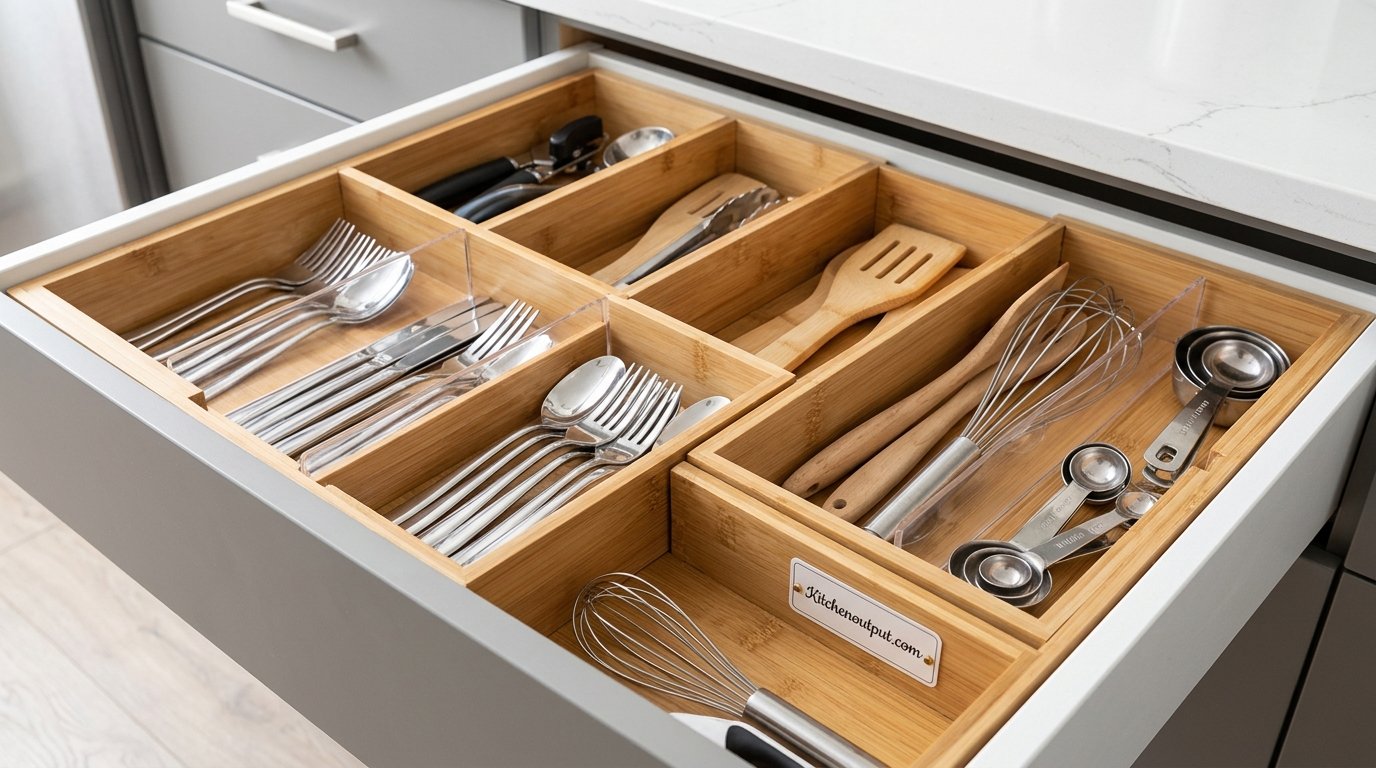
Table of Contents
Small kitchens don’t fail because they’re small. They fail because they’re organized like big ones — with everything stored “somewhere reasonable” instead of stored where it’s actually used. If you’ve ever dug through three drawers to find a can opener, stacked mixing bowls only to have them avalanche the second you need the one on the bottom, or given up and just left the toaster, the coffee maker, and a fruit bowl permanently blocking your only counter space, this guide is for you.
What follows isn’t a list of forty products to buy. It’s a system: map your kitchen into functional zones, remove what doesn’t belong, build storage vertically and inside your existing cabinetry before adding anything new, and then layer in tools only where they solve a specific, repeated annoyance. Do the steps in order and the “buying” part becomes almost optional.
Before we dig in — a few of the organizers referenced throughout this guide are linked below for convenience.
Browse Kitchen Organizers on Amazon →1. Map Your Kitchen Into Zones
Professional kitchens are built around workflow — prep, cook, plate, clean — and your kitchen, no matter how small, benefits from the same thinking. Before you touch a single drawer, walk through how you actually cook. Where do you stand when you chop vegetables? Where’s the trash can relative to that? Where do dishes land after a meal?
Step 1 — Identify Your Four Core Zones
Every kitchen, regardless of size, breaks down into four working zones: Prep (cutting boards, knives, mixing bowls), Cook (stove-adjacent pots, oils, utensils), Clean (sink, dish soap, towels, trash/recycling), and Store (pantry items, backstock, appliances used less than weekly). In a small kitchen, these zones often overlap physically — that’s fine. What matters is that items live near the zone they’re used in, not near where there happened to be an empty shelf.
Step 2 — Walk the Workflow, Don’t Guess It
Cook one full meal without moving anything, and simply notice every time you have to walk more than two steps to grab something you use constantly. That’s your zoning map. The goal in a small kitchen isn’t a beautiful layout — it’s minimizing steps for the things you touch daily.
Once you know your zones, everything else in this guide is just execution — putting things where the zone map says they should go, and building storage that supports it.
A dedicated cutting board organizer makes zoning your prep area painless.
See Cutting Board Organizers →2. The Real Declutter (Not the Pinterest Version)
Most kitchen organization content skips straight to bins and labels. That’s backwards. Buying storage for clutter you don’t need just makes the clutter look tidier — it doesn’t create space. In a small kitchen, decluttering isn’t optional; it’s the majority of the work.
The Three-Bin Method
Pull everything out of one zone at a time — start with the most chaotic drawer or cabinet — and sort into three piles: Keep and use weekly, Keep but use rarely, and Donate or toss. Be honest about duplicates. Most kitchens have two or three vegetable peelers, four spatulas, and a drawer of takeout chopsticks nobody asked for.
Keep If…
- You’ve used it in the last 3 months
- It has no duplicate that works as well or better
- It serves a task you can’t do another way (e.g., a can opener)
Let Go If…
- It’s a single-use gadget used once a year or less
- You own two or more of the same tool
- It’s broken, warped, or missing a piece “you’ll replace eventually”
For a full walkthrough of what deserves a permanent spot in a small kitchen versus what’s just taking up prime real estate, our guide to must-have kitchen appliances is a useful gut-check before you restock anything.
Clear, stackable storage bins make the “keep but rarely used” pile easy to store out of the way.
Shop Stackable Storage Bins →3. Go Vertical Before You Go Anywhere Else
Small kitchens are short on floor and counter space but almost always have unused vertical space — the wall above the backsplash, the inside of cabinet doors, the space between the top of your upper cabinets and the ceiling. Vertical storage is the single highest-leverage move you can make before buying anything else.
Step 3 — Install a Wall Rail or Rack Near the Stove
A rail with S-hooks near your cooking zone gets frequently used utensils, pot lids, and even small pots off the counter and off precious cabinet shelves, while keeping them within arm’s reach of where you actually cook.
Step 4 — Use the Inside of Cabinet Doors
Over-the-door racks or adhesive hooks turn dead space inside cabinet doors into storage for cutting boards, spice jars, measuring cups, or cleaning supplies under the sink. This is free storage you already own — no renovation required.
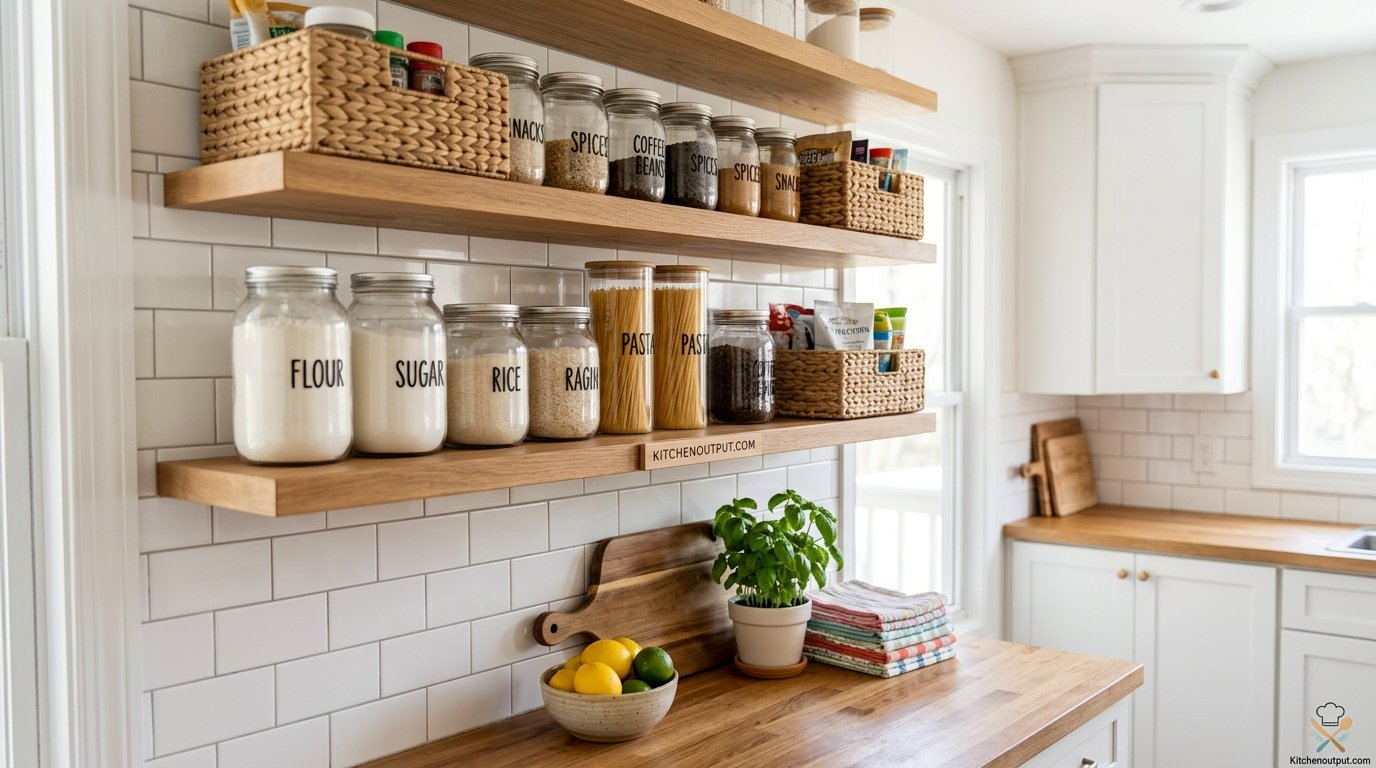
Floating shelves are another strong option if your walls can support light anchors — great for cookbooks, everyday glasses, or a small plant that keeps the kitchen from feeling purely utilitarian.
An adhesive or magnetic wall rail is one of the fastest upgrades in any small kitchen.
Shop Wall Rails & Hooks →4. Drawer Systems That Don’t Collapse in a Week
Drawer organization fails almost universally for one reason: the dividers don’t match the drawer, so everything shifts back into chaos within days. Measure before you buy anything, and separate drawers by task rather than trying to fit everything into one “junk” drawer.
Step 5 — Measure and Divide by Category
Use an expandable divider tray for utensils, a separate shallow tray for measuring spoons and small tools, and — if you have the depth — a deep drawer dedicated entirely to pots and pans with peg-style dividers so nothing nests badly.
What to Actually Measure
| Measurement | Why It Matters |
|---|---|
| Interior width & depth | Expandable trays need real clearance on both ends |
| Drawer height | Deep drawers can handle stacked or peg-style dividers |
| Handle/hardware clearance | Some trays interfere with drawer pulls when open |
Expandable bamboo or acrylic drawer dividers adjust to fit almost any drawer width.
Shop Drawer Dividers →5. Cabinet Organization by Category
Cabinets in small kitchens do double duty — they’re storage for cookware, pantry backup, and appliances all at once. The fix is the same zoning logic from earlier: group by category, and stack by frequency of use, with daily items at eye level or waist height and rare items up high or down low.
Lower Cabinets: Cookware
Nesting cookware saves real space, but only if lids are stored separately using a vertical lid organizer — lids are almost always the reason a “nested” cabinet turns back into chaos. A pull-out shelf, even a basic wire one, turns a deep lower cabinet from a black hole into usable storage you can actually see into.
Upper Cabinets: Dishware and Glassware
Stacking shelves (the kind that create a second tier inside a cabinet) roughly double usable shelf space for plates, bowls, and mugs without any installation. Keep everyday dishware at the front and bottom shelf, and occasion-only items (the good platter, the fondue set) at the back or top.
Good Cabinet Habits
- Store lids upright, separate from pots
- Keep daily dishware within easy reach
- Use risers to stack rather than pile
Habits That Undo It
- Nesting mismatched pot sizes with lids left on
- Stacking too high to see what’s on the bottom
- Mixing categories (bakeware with everyday plates)
If your cabinet organization keeps sliding back into chaos, it’s often a sign your actual cookware collection is bigger than your kitchen — our guide to stainless steel cookware sets covers space-efficient sets built for smaller kitchens specifically.
Stacking shelf risers instantly double vertical space in upper cabinets.
Shop Cabinet Shelf Risers →6. Reclaiming Counter Space
Counter space is the most fought-over real estate in a small kitchen, and it’s usually lost not to cooking but to storage — appliances, mail, fruit bowls, and “landing zone” clutter that accumulates because there’s nowhere else designated for it.
Step 6 — Create a Dedicated Landing Zone
Every kitchen needs one small tray or shallow basket near the entry point — keys, mail, a phone charger — so that clutter has a home instead of spreading across the entire counter. This single habit prevents more counter clutter than any organizer you could buy.
Beyond the landing zone, look at what’s permanently plugged in. A general rule: if an appliance is used daily (coffee maker, electric kettle), it earns counter space. Anything used weekly or less — blenders, stand mixers, waffle makers — belongs in a cabinet, on an appliance garage shelf, or on a rolling cart that tucks away.
| Frequency of Use | Where It Belongs |
|---|---|
| Daily | Counter, in your primary work zone |
| Weekly | Lower cabinet or appliance garage, easy reach |
| Monthly or less | Top cabinet, pantry, or storage closet |
A slim rolling kitchen cart adds counter-height storage without eating floor space permanently.
Shop Rolling Kitchen Carts →7. Small-Pantry and No-Pantry Storage
Not every small kitchen has a pantry at all, and that’s fine — pantry function doesn’t require a pantry room. It requires a consistent system for dry goods, and clear containers that let you see what you have without opening five bags.
If You Have a Small Pantry Cabinet
Use door-mounted racks for spices and small jars, turntables (lazy Susans) for oils and condiments that are hard to reach at the back, and uniform, stackable bins for bulk dry goods like rice, flour, and pasta. Uniform containers stack more efficiently than the mismatched original packaging ever will.
If You Have No Pantry
Designate one cabinet as your “pantry cabinet” and treat it the same way — categorize by type (baking, grains, canned goods, snacks), and use vertical can organizers so cans don’t get lost two rows deep. A narrow rolling cart can also function as a pull-out pantry tucked beside the fridge or in any leftover gap wider than about 10 inches.
Clear, airtight pantry bins keep dry goods fresh and visible in any size cabinet.
Shop Pantry Storage Bins →8. Appliance Storage Without the Clutter
Small-kitchen appliance clutter is almost always a mismatch between how many appliances you own and how often you actually use them. Before buying storage, do a quick honesty check: which of your appliances have you used in the past month?
For appliances you keep, an appliance garage — even a DIY version using a tension rod and curtain, or a simple cabinet shelf dedicated to appliances — keeps them dust-free and out of sight without making them hard to grab. Heavier appliances like stand mixers do best on a pull-out shelf at counter height, since lifting them in and out of a low cabinet daily is enough friction that most people just stop putting them away.
For a full breakdown of which appliances are worth the space in a small kitchen and which tend to become clutter, see our kitchen appliance buying guide, and pair it with our notes on how to store kitchen appliances for cabinet-specific setups.
Worth Keeping Out
- Coffee maker or kettle (daily use)
- Toaster if used most mornings
- Knife block if counter allows it
Worth Storing Away
- Stand mixer (unless you bake weekly)
- Blender or food processor
- Waffle maker, panini press, single-use gadgets
A pull-out cabinet shelf makes even heavy stand mixers easy to store and retrieve daily.
Shop Pull-Out Cabinet Shelves →9. What to Buy vs. What to Skip
It’s easy to over-shop small-kitchen organization products. Some genuinely solve a space problem; others just repackage clutter in a nicer container. Here’s a realistic breakdown.
| Product | Worth It? | Why |
|---|---|---|
| Expandable drawer dividers | Yes | Directly solves drawer chaos, adjusts to your exact drawer |
| Cabinet shelf risers | Yes | Nearly doubles usable shelf height for free vertical space |
| Over-door racks | Yes | Uses genuinely dead space, no installation required |
| Matching pantry canisters | Situational | Great for visibility, but skip if budget is tight — bins work too |
| Single-use gadget organizers | Usually skip | Better to donate the gadget than organize around it |
If you’re building out a small kitchen from scratch, our roundup of essential kitchen tools and equipment is a good baseline list to organize around instead of guessing.
Start with the highest-impact basics: drawer dividers, shelf risers, and a wall rail.
Shop Starter Organization Kits →10. Daily and Weekly Habits That Keep It Organized
No storage system survives without habits behind it. Small kitchens especially punish inconsistency, because there’s no spare cabinet to absorb the overflow when things slip.
Daily: The Two-Minute Reset
Before bed, spend two minutes returning anything that’s migrated out of its zone — the cutting board back in its slot, mail off the counter, dishes either washed or in the rack. This alone prevents 80% of the “how did this get so messy again” moments.
Weekly: The Fridge and Pantry Check
Once a week, scan the fridge and pantry cabinet for anything expired or forgotten. This keeps storage from silently filling up with things you’re not actually using, which is often the real cause of “we need more storage” when the real issue is stale inventory.
A simple over-sink or countertop dish rack keeps the two-minute reset fast and frictionless.
Shop Compact Dish Racks →11. Renter-Friendly and No-Drill Solutions
If you’re renting, damage-free is non-negotiable. Fortunately, almost everything in this guide works without a single screw.
- Adhesive wall rails and hooks — rated for real weight, and removable without wall damage when done correctly.
- Tension rods — inside cabinets to create a second shelf level, or under the sink to hang spray bottles.
- Freestanding shelving units — a slim shelving unit in any unused corner adds pantry-equivalent storage with zero installation.
- Magnetic strips — for knives or spice tins on the side of a fridge, avoiding wall mounting entirely.
Renters should also prioritize storage that moves with them — bins, dividers, and rolling carts relocate easily, while anything built into cabinetry doesn’t.
Adhesive hooks and rails rated for kitchen use hold real weight without damaging walls.
Shop Renter-Friendly Hooks →12. Common Mistakes That Undo Your Work
Buying Storage Before Decluttering
Organizing clutter into bins just makes it prettier clutter. Declutter first, buy second.
Ignoring Vertical Space
Most small kitchens have 2–4 feet of unused wall space above counters that never gets used.
No Assigned Home for Items
If a category of items doesn’t have one specific spot, it will end up scattered across three.
Skipping the Reset Habit
Even a perfect system degrades within a week without the two-minute daily reset from Section 10.
For deeper dives into specific storage categories — knives, bakeware, or appliance-specific setups — our beginner knife set guide and food processor reviews both include storage-friendly picks sized for smaller kitchens.
Frequently Asked Questions
What’s the single best first step to organize a small kitchen?
Declutter one zone completely before buying any organizers. Storage products only help once you know exactly what needs to be stored.
How do I organize a kitchen with no pantry?
Designate one cabinet as your pantry cabinet and use uniform, stackable bins plus vertical can organizers to maximize the space.
Is vertical storage really worth it in a small kitchen?
Yes — it’s usually the highest-impact, lowest-cost change available, since most kitchens have unused wall space above counters and inside cabinet doors.
How often should I re-declutter my kitchen?
A light check monthly and a full declutter every six months keeps a small kitchen from slowly refilling with unused items.
Should I store pots and pans nested or separated?
Nested is fine for pots, but store lids separately in a vertical lid organizer — lids are the most common cause of cabinet chaos.
What appliances should stay on the counter in a small kitchen?
Only appliances used daily, like a coffee maker or electric kettle. Weekly-use appliances belong in a cabinet or on a pull-out shelf.
Can I organize a rental kitchen without drilling holes?
Yes — adhesive wall rails, tension rods, freestanding shelving, and magnetic strips all add real storage with zero permanent installation.
How do I keep a small kitchen organized long-term?
Build a two-minute daily reset habit and a weekly fridge/pantry check into your routine — the system fails without consistent upkeep.
What size drawer dividers should I buy?
Measure interior width, depth, and height first, and choose expandable dividers that fit your exact drawer rather than a fixed universal size.
Are matching pantry containers necessary?
No — they’re nice for visibility and aesthetics, but functional stackable bins in any style will organize a pantry cabinet just as effectively.
How do I stop counter clutter from coming back?
Create one small designated landing zone for mail, keys, and loose items, so clutter has a consistent home instead of spreading across the counter.
What’s the most overlooked storage space in a small kitchen?
The inside of cabinet doors — it’s free space most kitchens never use, and it’s ideal for spices, lids, wraps, and cleaning supplies.
The Bottom Line
Organizing a small kitchen isn’t about cramming in more storage — it’s about matching what you own to how you actually cook, then building vertical, zoned systems around that reality. Declutter first, zone second, and layer in tools like drawer dividers, shelf risers, and wall rails only where they solve a specific problem you’ve already identified. Do that, and a small kitchen can function better than a much larger one organized on autopilot.
Shop All Kitchen Organization Essentials →


