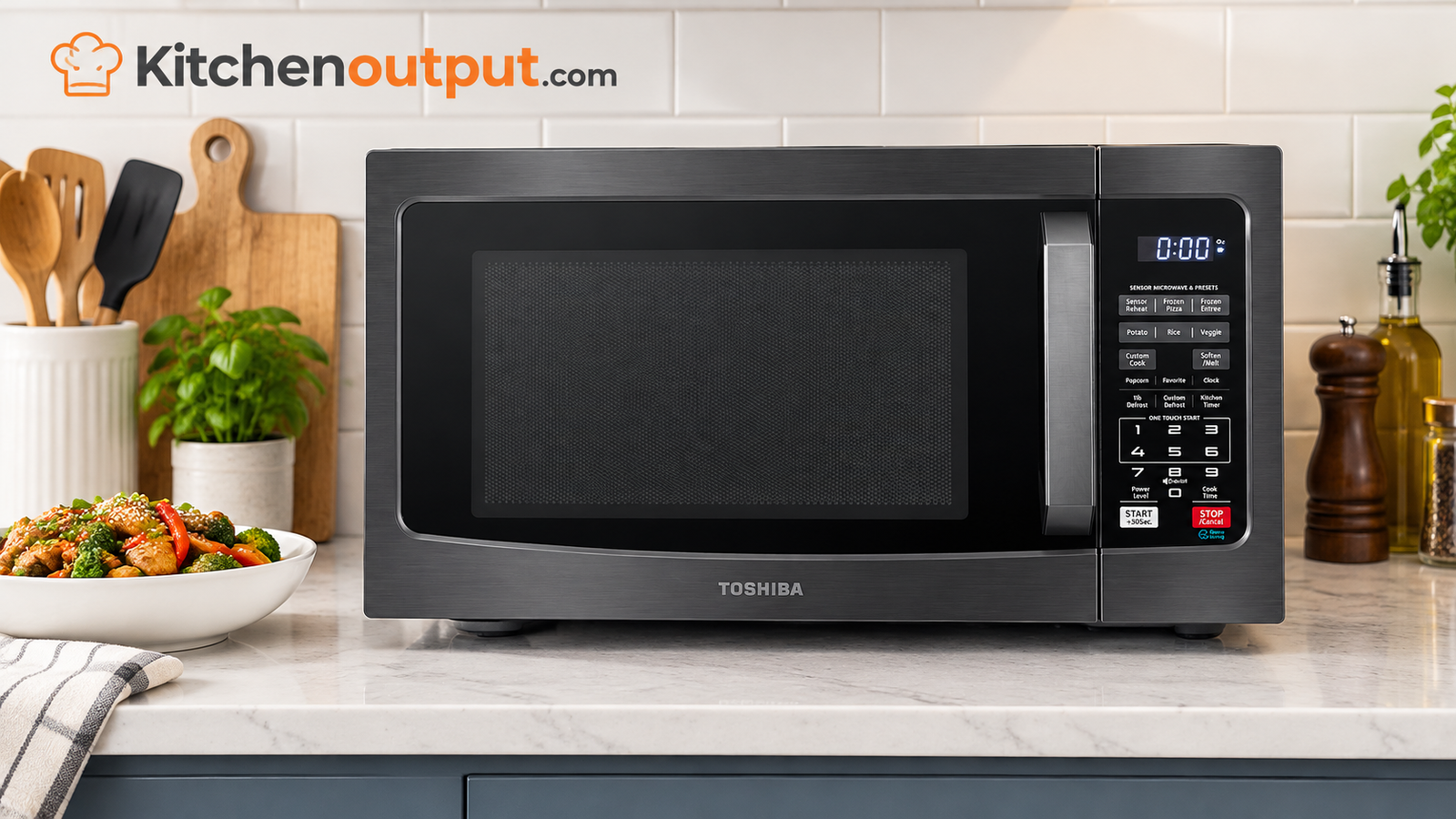
10 Best Microwaves: Top Countertop Picks for Every Kitchen, Budget, and Family
From compact dorm-friendly models to large inverter units that cook food evenly, here is a plain-spoken guide to the microwaves worth putting on your counter.

Short on time? The Toshiba EM131A5C-BS is the best all-around choice for most households. Pick the Panasonic NN-SN67KS if you want gentler, more even heating, the Samsung MS19M8000AS if you cook for a crowd, and the Comfee AM720C2TA-S if space or budget is tight.
Everything else is below, along with a buying guide, care tips, and answers to the questions people ask most.
We may earn a small commission when you buy through links on this page. It never changes the price you pay, and it does not decide which microwaves we recommend.
Our Top Microwave Picks at a Glance
The microwave is probably the most used appliance in the average kitchen, and also the one people think about least until it dies in the middle of reheating dinner. Shopping for a new one should be simple, yet the market is crowded with near-identical stainless boxes that differ in ways the product titles never explain. Some are built for one person making instant oatmeal. Others are built to defrost a whole roast without cooking the edges.
We narrowed the field to ten countertop models that cover the real range of needs: tiny budget units, solid mid-size workhorses, and a few step-up machines with sensors and inverter technology. The table below gives you the quick version. The detailed reviews follow, and further down you will find a buying guide that explains what the specs actually mean.
| Rank | Model | Capacity | Standout trait |
|---|---|---|---|
| 1 | Toshiba EM131A5C-BS | 1.2 cu ft | Balanced features, sensor cooking, mute option |
| 2 | Panasonic NN-SN67KS | 1.6 cu ft | Inverter heating for even results |
| 3 | GE JES1460DSBB | 1.4 cu ft | Black stainless finish and easy controls |
| 4 | Amazon Basics Countertop | Compact (see listing) | Simple, low-cost everyday heating |
| 5 | Comfee AM720C2TA-S | 0.7 cu ft | Small footprint, friendly price |
| 6 | Farberware FMO12AHTBSA | 1.2 cu ft | Mid-size value with stainless styling |
| 7 | BLACK+DECKER EM720CB7 | 0.7 cu ft | Dorm and office favorite |
| 8 | Samsung MS19M8000AS | 1.9 cu ft | Smart sensor and a very roomy cavity |
| 9 | Sharp SMC1161KB | 1.1 cu ft | 1000-watt power in a tidy black body |
| 10 | Midea MMO-1052W | 1.1 cu ft | Straightforward mid-size performer |
- Best overall: Toshiba EM131A5C-BS, because it gets the fundamentals right without charging for gimmicks.
- Best for even heating: Panasonic NN-SN67KS, thanks to its inverter design.
- Best for big families: Samsung MS19M8000AS, with the largest interior on the list.
- Best for small spaces: Comfee AM720C2TA-S and BLACK+DECKER EM720CB7.
- Best simple option: Amazon Basics Countertop Microwave.
Want to compare current prices on the most popular models before you read the full reviews?
See Top Microwaves on AmazonHow We Chose These Microwaves
Rather than chase whatever happens to be trending, we started with the questions a real household asks. Will it heat a bowl of soup without leaving an icy center? Is it loud enough to wake the baby at night? Can my parents figure out the buttons without a manual? Will it fit under the cabinet? From there we compared published specifications, feature sets, design details, and the recurring themes in owner feedback for each model.
The criteria that carried the most weight
- Heating performance: Wattage, how the power is delivered, and whether the oven reliably avoids the cold-center, scorched-edge problem.
- Usable capacity: Cubic feet matter, but turntable diameter matters more. A dinner plate has to actually rotate.
- Ease of use: Clear displays, sensible presets, and controls that do not require decoding.
- Build and design: Door feel, interior finish, handle versus push-button release, and how easy the surfaces are to wipe clean.
- Value: What you get for the money compared with other models in the same size class.
- Everyday practicality: Noise, footprint, ventilation clearance, and quality-of-life touches such as a mute function or child lock.
A note on specifications. Manufacturers sometimes revise a model quietly, and retailers sometimes list near-identical variants under similar names. Before you buy, glance at the wattage, capacity, and dimensions on the current product page to make sure they match what you need and what your counter can hold.
We also made a deliberate choice to include different price tiers. A student who needs a microwave for instant noodles and a household that reheats four plates every evening should not be steered toward the same machine. Each review below states plainly who the oven suits and who should skip it.
Ready to browse countertop models by size and price?
Browse Countertop MicrowavesMicrowave Types Explained
Before comparing individual models, it helps to understand the main categories. All ten picks in this guide are countertop microwaves, which are the easiest to install and the easiest to replace, but they are not your only option.
Countertop microwaves
These are freestanding boxes that plug into a standard outlet. Sizes run from compact units under one cubic foot up to roomy models near two cubic feet. They are the right choice for most renters, dorm residents, and anyone replacing an old unit without wanting a renovation. The tradeoff is counter space, which is why measuring before you buy is not optional.
Over-the-range microwaves
Mounted above the stove, these double as a vent hood. They free up counter space but need a proper mounting bracket, and their ventilation is usually weaker than a dedicated hood. If you are planning a kitchen refresh, a built-in or over-the-range design might make sense, but it is a different shopping process entirely.
Built-in and drawer microwaves
These sit flush inside cabinetry for a clean, custom look. They cost considerably more and require professional installation in many cases. Drawer models open downward, which some people find easier on the shoulders and wrists. They are lovely, but they are a design investment rather than a simple appliance purchase.
Convection and combination microwaves
These add a heating element and fan so the unit can brown and roast as well as reheat. If that sounds appealing, it is worth reading about what a convection oven actually does so you understand the cooking style you would be paying for. Many households find that a separate toaster oven handles the browning side of things while the microwave sticks to speed.
Conventional versus inverter power
Traditional microwaves control power by cycling the magnetron fully on and off. At a medium setting, that means bursts of full-power energy followed by pauses. Inverter systems, such as the one in the Panasonic below, deliver steadier, continuous power at lower levels. The practical benefit is gentler defrosting, less rubbery reheated rice, and fewer overcooked edges.
Looking for a specific style or size? Search by type to see what is in stock.
Explore Inverter MicrowavesBuying Guide: What Really Matters in a Microwave
Spec sheets are written to impress rather than to inform. Here is a clearer translation of the features that influence daily use.
Wattage and cooking speed
Wattage describes how much microwave energy the oven produces. Higher wattage generally means faster, more even cooking, and package directions on frozen meals are typically written for around 1,000 to 1,200 watts. A 700-watt compact unit will still do the job, but expect to add time, stir halfway through, and accept that large portions heat more slowly. If you have ever compared blenders, you already know how much wattage shapes real-world performance; microwaves follow the same logic.
Capacity and turntable size
Cubic feet tell you the interior volume, but the turntable diameter tells you what will fit. A 1.2 cubic foot oven with a roughly 12-inch turntable handles most dinner plates. A 0.7 cubic foot oven with a turntable around 10 inches will struggle with wide plates and large casserole dishes. Measure the biggest dish you reheat regularly and compare it against the listing before you commit.
Sensor cooking
A sensor measures steam released from food and adjusts the cooking time automatically. For popcorn, potatoes, and reheating leftovers, it removes most of the guesswork. Models with sensor functions, including the Toshiba, Panasonic, GE, and Samsung in this guide, are noticeably more forgiving than ones that rely solely on timers.
Presets and controls
Presets for popcorn, beverages, pizza, and baked potatoes are handy, but only if the buttons are clearly labeled and the results are dependable. Push-button door releases look sleek, while handles are easier for people with limited grip strength. Also consider a child lock, which stops small hands from starting the oven.
Noise and the mute option
Beeps can be surprisingly irritating, especially in open-plan homes or late at night. A few models, like the Toshiba, let you silence the signal sounds. It is a small thing that you will appreciate every single day.
Footprint and ventilation
Microwaves need breathing room, typically a few inches at the back and sides plus clearance above. Squeezing one into a tight cubby can shorten its life. If your space is limited, this guide to organizing a small kitchen offers layout ideas, and our thoughts on what deserves a spot on your kitchen counters can help you decide whether a larger microwave earns its place.
Interior finish
Painted interiors are common and perfectly fine, but they can chip over time. Ceramic enamel, found on the Samsung, resists stains and wipes clean more easily. If you cook saucy foods often, that difference is more meaningful than it sounds.
For broader context on how a microwave fits into the larger picture of kitchen equipment, our kitchen appliance buying guide walks through the logic of prioritizing purchases.
Know your size and wattage? Narrow down the field and see what fits.
Shop 1000-Watt MicrowavesThe Best Microwaves: Our Top Three
These three models represent the strongest combination of performance, features, and everyday usability. If you are not sure where to start, start here.

1. Toshiba EM131A5C-BS 1.2 cu ft Microwave Oven
A thoughtful, well-rounded mid-size microwave that does the basics right and adds a few genuinely useful extras.
The Toshiba EM131A5C-BS earns the top spot because it avoids both extremes. It is not a flimsy budget box, and it is not an overpriced showpiece loaded with features you will never use. At 1.2 cubic feet with roughly 1,100 watts of power, it sits comfortably in the sweet spot where most households live: big enough for a dinner plate or a large mug, strong enough to heat a frozen entrée without endless stirring.
The sensor cooking function is the headline convenience. Instead of guessing how long a bowl of leftover pasta needs, you let the oven read the steam and adjust. Presets handle popcorn, beverages, and other routine tasks, and the control panel is laid out so that a first-time user can work it out in seconds. One feature we especially like is the option to mute the beeps. In a home with a light sleeper, a nursery, or a studio apartment, that quiet mode is worth more than another preset button. An eco mode that trims standby power draw is a thoughtful touch as well.
The stainless-and-black styling blends into most kitchens without screaming for attention, and the smooth front is easy to wipe down. If there is a limitation, it is that the unit is not the largest on this list, so very big casserole dishes may feel snug.
- Capacity: 1.2 cu ft
- Power: About 1,100 watts
- Cooking aids: Sensor menu, presets
- Extras: Mute option, eco mode, child lock
Pros
- Strong power for its size
- Sensor cooking removes guesswork
- Mute function for quiet kitchens
- Clean, unfussy design
Cons
- Not ideal for very large dishes
- Lacks inverter-style gentle power
Who should buy it: Almost anyone replacing an aging microwave who wants dependable results without overspending. It is a safe recommendation for couples, small families, and first apartments alike.
Check the latest price and availability for the Toshiba EM131A5C-BS.
Check Price on Amazon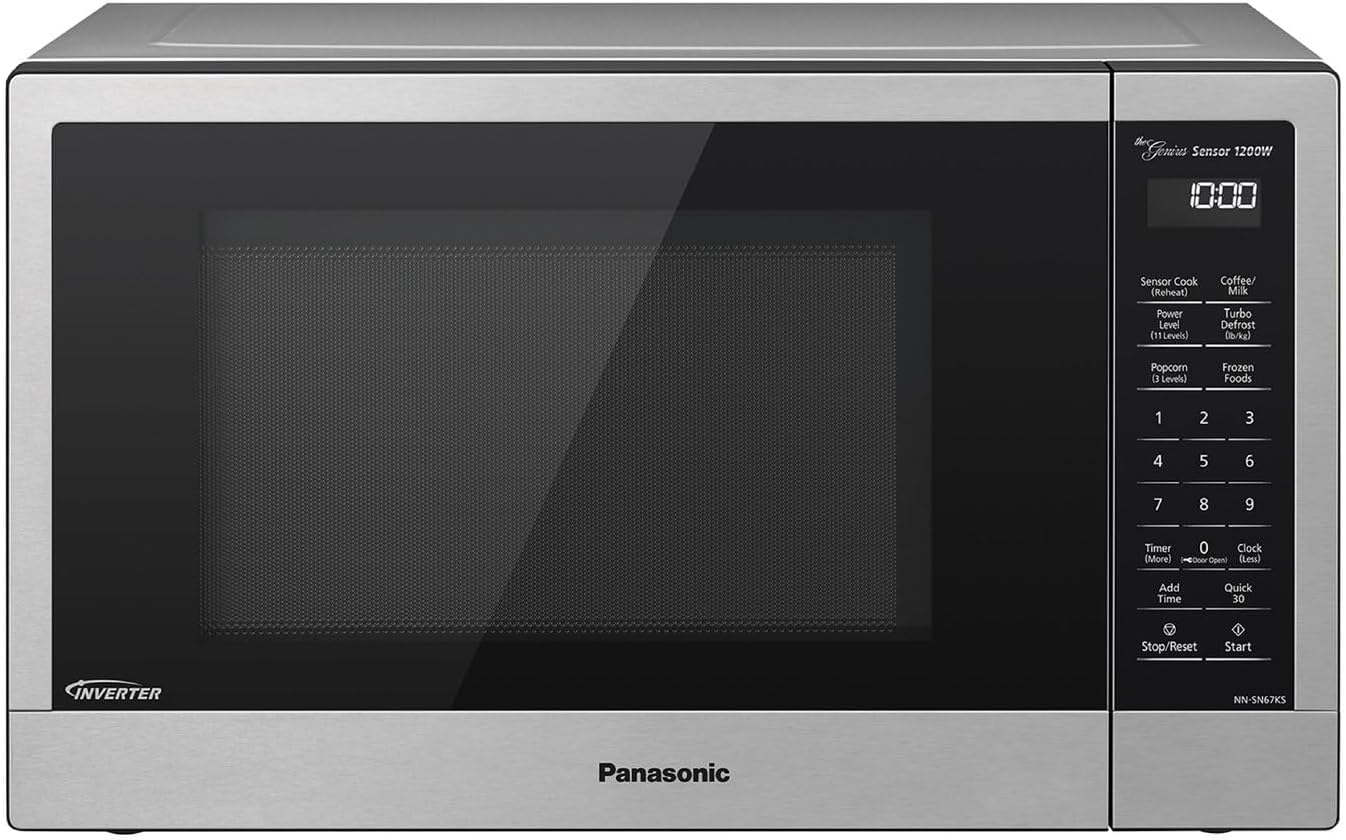
2. Panasonic NN-SN67KS 1.6 cu ft Countertop Microwave
Inverter technology makes this the pick for anyone tired of lava-hot edges and frozen centers.
Panasonic essentially introduced inverter technology to home microwaves, and the NN-SN67KS shows why the idea caught on. Where conventional ovens pulse between full power and nothing, this model delivers a steady stream of energy at the level you choose. Run it at fifty percent and it genuinely behaves like fifty percent, rather than a rapid stutter of maximum bursts. The result is the part you notice at the dinner table: rice that stays fluffy, soup that heats uniformly, and chicken that does not turn leathery at the thin end.
Defrosting is where the inverter earns its keep. Frozen meat and fish thaw more evenly, with far less of the cooked-on-the-edges, still-icy-in-the-middle problem that plagues basic units. Pair that with sensor cooking and a generous 1.6 cubic foot interior, and you have a microwave that handles reheating, defrosting, and light cooking with equal confidence. Around 1,250 watts keeps things fast, and the stainless exterior looks right at home in a modern kitchen.
The cost of all this refinement is a higher price tag than the basic models and a slightly larger footprint. If your microwave is mostly used for coffee and frozen burritos, the premium is harder to justify. If you cook real food in it, the investment shows.
- Capacity: 1.6 cu ft
- Power: About 1,250 watts
- Technology: Inverter, sensor cooking
- Extras: Turbo defrost, presets
Pros
- Inverter delivers consistent, gentle heat
- Excellent defrosting
- Large, family-friendly interior
- High power for quick results
Cons
- Costs more than basic models
- Needs more counter space
Who should buy it: Home cooks who use the microwave for more than reheating, and anyone who regularly thaws meat or cooks delicate foods like fish and eggs.
See today’s price for the Panasonic NN-SN67KS inverter microwave.
Check Price on Amazon
3. GE JES1460DSBB 1.4 cu ft Countertop Microwave
A handsome black stainless finish and straightforward controls from a brand people trust.
GE has spent decades building appliances that ordinary households can live with, and the JES1460DSBB reflects that practical philosophy. At 1.4 cubic feet it offers more room than most mid-size models, with around 1,100 watts of power behind it. The black stainless finish is the real eye-catcher: it resists fingerprints better than traditional stainless and pairs nicely with modern dark appliance suites.
Controls are intentionally straightforward. You get one-touch express cooking, sensor-assisted programs, a clear display, and a timer that works as expected. For households where several people share the microwave, that familiarity matters. Nobody has to hunt through nested menus to warm a plate or melt butter. A control lock keeps curious toddlers from starting the oven, and a quick-add feature lets you tack on thirty seconds without retyping the whole time.
Interior space is sufficient for a standard dinner plate and a medium casserole dish, and the turntable runs quietly. The main compromise is that it skips the inverter technology and ultra-premium extras found in the Panasonic and Samsung. For everyday reheating, popcorn, and defrosting small portions, that is not a dealbreaker.
- Capacity: 1.4 cu ft
- Power: About 1,100 watts
- Finish: Black stainless steel
- Extras: Sensor cooking, control lock, express cook
Pros
- Fingerprint-resistant finish
- Easy, intuitive controls
- Roomy for its price bracket
- Trusted brand with wide service network
Cons
- No inverter technology
- Fewer smart extras than pricier models
Who should buy it: Shoppers matching a dark-finish kitchen, families sharing one microwave, and anyone who wants simple operation from a familiar name.
Compare the GE JES1460DSBB with other models at today’s prices.
Check Price on AmazonBest Value Microwaves: Picks 4 Through 6
Not every household needs top-tier technology. These three models focus on dependable everyday performance at friendlier prices, which is exactly what many people want from a microwave.
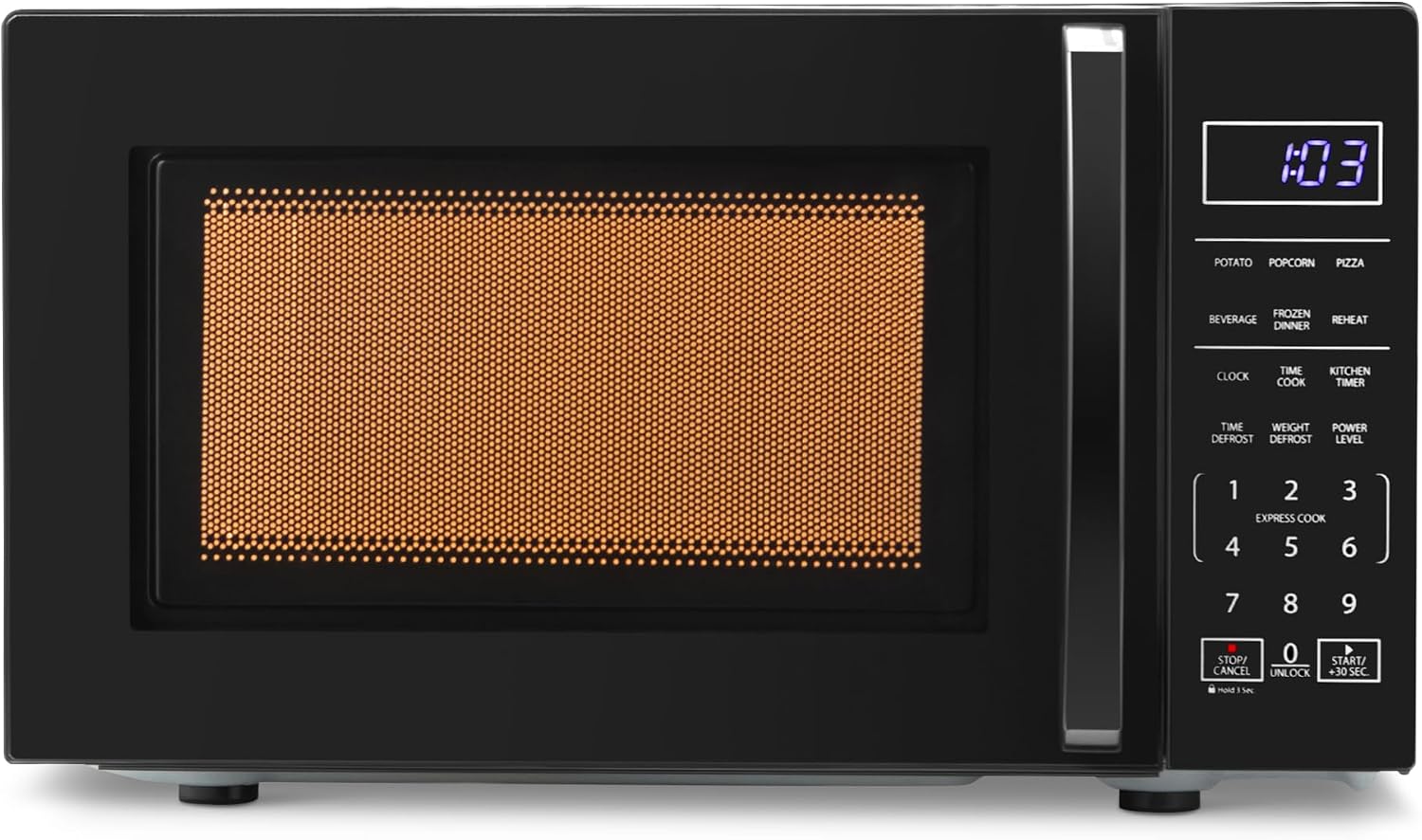
4. Amazon Basics Countertop Microwave
No-frills heating from a brand known for keeping things affordable and uncomplicated.
The Amazon Basics Countertop Microwave is exactly what the name promises: a plain, practical appliance designed to reheat, defrost, and cook everyday foods without drama. There is no elaborate sensor system and no premium finishing. Instead, you get a clean front panel, familiar presets, and a design that stays out of the way. For many buyers, that restraint is a feature rather than a flaw.
One detail worth noting: the Amazon Basics line has included more than one microwave configuration over time, and some versions have offered voice-control compatibility with Alexa. Capacity and wattage can differ from one version to the next, so check the listing for the exact specs before you order. If you are building a smart kitchen, voice commands for quick timers can be genuinely convenient, especially when your hands are covered in flour or raw chicken.
As a general rule, this is the sort of microwave to choose when you want a reliable second unit for a garage, basement, rental property, or office kitchen. It handles coffee, soup, frozen meals, and popcorn without fuss. Expect to stir or rotate foods occasionally, and do not expect the even heating of an inverter model.
- Style: Compact countertop
- Controls: Simple presets and timer
- Extras: Voice control on certain versions
- Best use: Everyday reheating
Pros
- Affordable and uncomplicated
- Easy for everyone to operate
- Great as a second microwave
- Voice control available on some versions
Cons
- Specs vary by version, so verify the listing
- Basic heating, no premium extras
Who should buy it: Budget-conscious shoppers, rental owners, and anyone who just wants a microwave that works.
Check the current version, size, and price of the Amazon Basics microwave.
Check Price on Amazon
5. Comfee AM720C2TA-S 0.7 cu ft Microwave
A small, friendly-priced microwave that punches above its weight for singles and tight kitchens.
Compact microwaves tend to get dismissed as underpowered novelties, but the Comfee AM720C2TA-S is a good reminder that small does not have to mean disappointing. With 0.7 cubic feet of interior space and around 700 watts, it is aimed squarely at people who want fast, convenient heating without surrendering half their counter. A silver front keeps it looking tidy beside a coffee maker or toaster.
Usability is the strongest selling point. Power levels are easy to adjust, presets cover the greatest hits like popcorn, pizza, and beverages, and a child lock provides peace of mind. Because the cavity is modest, food heats quickly and evenly enough for single servings. Reheating a bowl of rice, warming a mug of tea, or steaming a bag of frozen vegetables all go smoothly.
The limitations are the ones you would expect. A turntable of roughly ten inches will not accept large dinner plates, and the lower wattage means longer cook times for dense foods. If you regularly feed three or four people, you will feel the constraint quickly. For a solo diner, a couple, or a studio apartment, it is a smart, space-efficient choice.
- Capacity: 0.7 cu ft
- Power: About 700 watts
- Controls: Presets, adjustable power levels
- Extras: Child lock
Pros
- Tiny footprint
- Very approachable price
- Easy, clear controls
- Quick for single servings
Cons
- Too small for large plates
- Slower with big portions
Who should buy it: Singles, couples, students, and anyone short on counter space.
Check the latest price for the Comfee AM720C2TA-S compact microwave.
Check Price on Amazon
6. Farberware FMO12AHTBSA 1.2 cu ft Microwave
A familiar kitchenware name delivering mid-size capacity and stainless styling at a sensible price.
Farberware has long been associated with cookware and kitchen basics, and the FMO12AHTBSA brings that practical mindset to the microwave aisle. It offers 1.2 cubic feet of space, comparable to the Toshiba, with a stainless steel look that suits most kitchens. The size is generous enough for dinner plates, large mugs, and medium casserole dishes, which makes it a comfortable step up from compact units.
Cooking power lands in the 1,000-plus watt range, so reheating and defrosting are quick. Preset programs cover common tasks, and multiple power levels let you dial back the intensity when melting chocolate or warming delicate sauces. The control layout is straightforward, which is helpful if the microwave is used by guests, kids, or older family members who prefer predictable buttons.
Where it differs from the pricier models is in refinement. You will not find inverter heating or an advanced sensor, so it pays to pause and stir mid-cycle with thick foods. But for the money, the combination of capacity, brand familiarity, and simple operation is hard to fault. It is the kind of microwave that quietly does its job for years.
- Capacity: 1.2 cu ft
- Power: Around 1,100 watts
- Finish: Stainless steel look
- Controls: Presets, multiple power levels
Pros
- Roomy enough for dinner plates
- Solid value for the size
- Simple, predictable controls
- Attractive stainless styling
Cons
- No inverter or advanced sensor
- Basic feature set
Who should buy it: Families and shared households wanting a mid-size microwave without paying for extra tech.
See current pricing on the Farberware FMO12AHTBSA.
Check Price on AmazonCompact Favorite and Large-Capacity Champion: Picks 7 and 8
These two sit at opposite ends of the size spectrum. One is the small, budget-friendly sidekick for dorms and offices. The other is the roomiest, most feature-packed microwave in the guide.
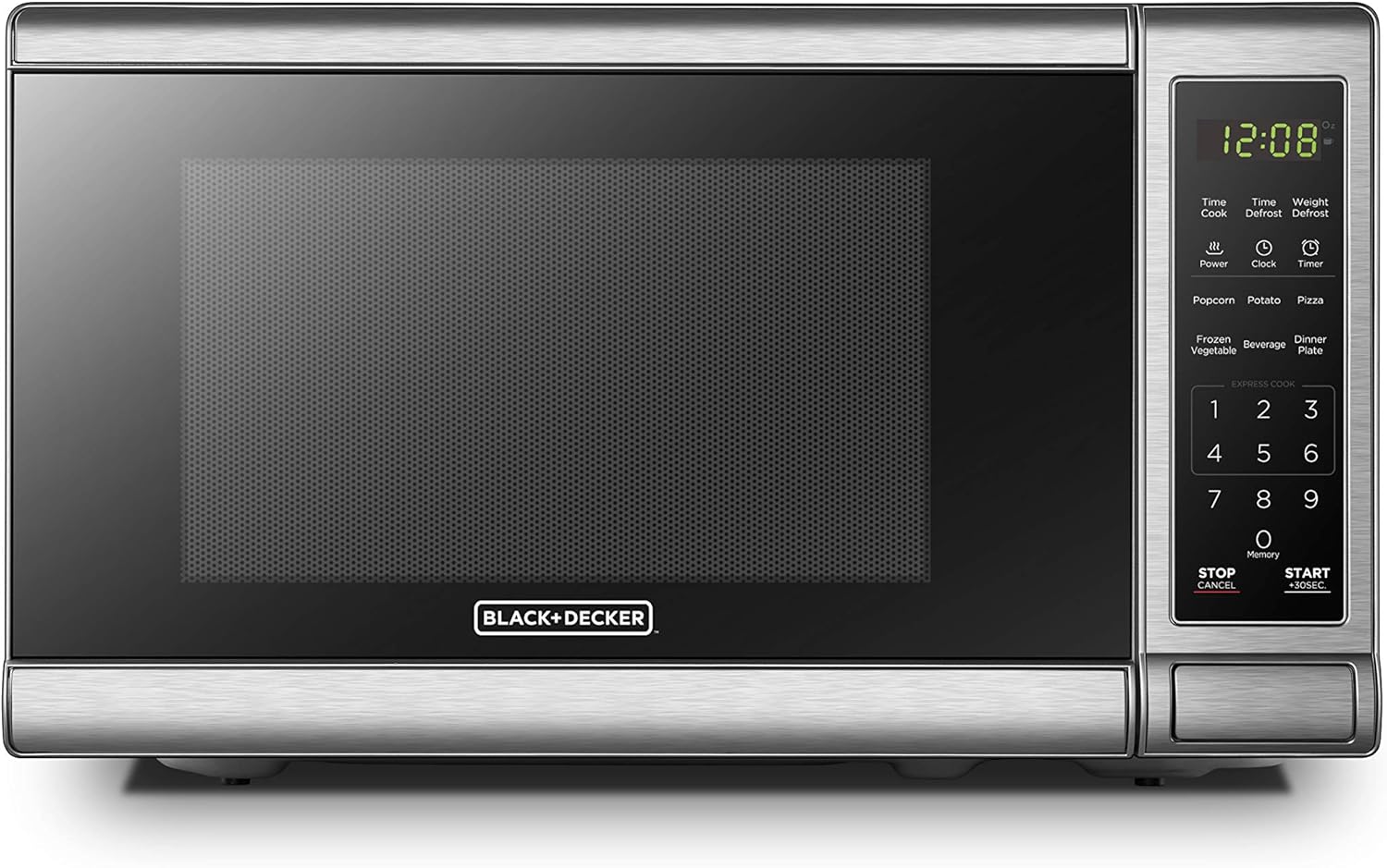
7. BLACK+DECKER EM720CB7 0.7 cu ft Microwave
A small, dependable microwave with a recognizable name and easy one-touch presets.
BLACK+DECKER has built a reputation on affordable, no-nonsense home appliances, and the EM720CB7 follows the formula. With 0.7 cubic feet of capacity and around 700 watts, it is built for small spaces and short menus: coffee, oatmeal, soup, popcorn, and the occasional frozen burrito. It is also lightweight, so moving it between dorm rooms, office break rooms, or apartment kitchens does not require a second person.
The one-touch presets are the highlight. Press a button for popcorn, pizza, or a beverage and the oven handles the timing, which is ideal when you are rushing between classes or meetings. Power levels give you some flexibility for gentler tasks, and a child lock adds a measure of safety. The black finish hides smudges reasonably well and matches many small-appliance collections.
As with any compact microwave, there are compromises. Large plates will not rotate freely, and denser foods take longer to heat through. But in the right setting, those limits barely matter. It is a classic example of an appliance that does a small job well.
- Capacity: 0.7 cu ft
- Power: About 700 watts
- Controls: One-touch presets, power levels
- Extras: Child lock, lightweight body
Pros
- Light and easy to move
- Convenient one-touch presets
- Budget-friendly
- Small footprint
Cons
- Limited interior space
- Longer times for dense foods
Who should buy it: Students, office kitchens, guest rooms, and anyone who wants a basic, space-saving microwave.
Check the latest price on the BLACK+DECKER EM720CB7.
Check Price on Amazon
8. Samsung MS19M8000AS 1.9 cu ft Smart Sensor Microwave
The largest cavity on this list, a ceramic enamel interior, and sensor cooking for confident results.
If your household regularly reheats big platters, bakes casseroles in glass dishes, or feeds a crowd on holidays, the Samsung MS19M8000AS deserves a serious look. At 1.9 cubic feet it is the roomiest microwave in this guide, with space for oversized plates, tall containers, and wide serving dishes that would be a squeeze in smaller ovens. Roughly 1,000 watts of power keep cooking brisk even with larger loads.
The interior is where Samsung gets clever. A ceramic enamel coating is tougher than painted metal, resists stains from tomato sauce and curry, and wipes clean with very little effort. That matters because large microwaves tend to see heavy use, and splatters are inevitable. The smart sensor adjusts cooking automatically based on moisture released from the food, so reheating a plate of leftovers becomes a one-touch affair rather than a guessing game.
Naturally, size comes with tradeoffs. This is the biggest unit on the list, so measure your counter and your cabinet clearance carefully. It also costs more than the budget picks. But for people who truly use the capacity, it is a satisfying upgrade, and the interior will look better for longer than most competitors.
- Capacity: 1.9 cu ft
- Power: Around 1,000 watts
- Interior: Ceramic enamel
- Cooking aid: Smart sensor
Pros
- Largest interior in this guide
- Stain-resistant, easy-clean interior
- Sensor cooking for effortless reheating
- Accommodates oversized dishes
Cons
- Needs substantial counter space
- Higher price than compact models
Who should buy it: Big families, frequent entertainers, and anyone who wants a spacious, easy-to-clean microwave.
See current pricing on the Samsung MS19M8000AS.
Check Price on AmazonReliable Mid-Size Performers: Picks 9 and 10
Rounding out the list are two 1.1 cubic foot microwaves with 1,000 watts of power. They are not flashy, but they hit a very practical balance of size, speed, and price.

9. Sharp SMC1161KB 1.1 cu ft 1000W Black Countertop Microwave Oven
Real 1,000-watt power in a body that does not hog the counter.
Sharp has been making microwaves for decades, and the SMC1161KB reflects that experience. It packs 1,000 watts into a 1.1 cubic foot frame, which is an appealing middle ground: much stronger than the 700-watt compact models, yet noticeably smaller than the family-size units. If your kitchen cannot accommodate a bulky oven but you refuse to settle for slow heating, this is the sort of microwave that solves the problem.
The black exterior is clean and modern, and the controls are refreshingly direct. Preset buttons cover common tasks, a timer is easy to set, and adjustable power levels allow gentle defrosting and warming. Because the wattage matches what most frozen-food packaging assumes, cooking instructions translate neatly without the awkward math you often need with lower-power ovens.
The tradeoff is the same one every mid-size model faces: it will not fit the biggest platters, and it lacks inverter technology. For daily use by one to three people, that is rarely an issue. It is a practical, sturdy microwave that gets on with the job.
- Capacity: 1.1 cu ft
- Power: 1,000 watts
- Finish: Black
- Controls: Presets, adjustable power levels
Pros
- 1,000 watts in a compact-friendly size
- Direct, easy controls
- Matches standard package directions
- Trusted microwave brand
Cons
- No inverter technology
- Not ideal for oversized dishes
Who should buy it: Small households and apartment dwellers who want fast heating without sacrificing counter space.
Check the latest price for the Sharp SMC1161KB.
Check Price on Amazon
10. Midea MMO-1052W 1.1 cu ft Microwave
An uncomplicated mid-size microwave from a major appliance maker at a modest price.
Midea is one of the largest appliance manufacturers in the world, and the MMO-1052W shows how that scale translates into value. Its 1.1 cubic foot interior comfortably handles a standard dinner plate, and the roughly 1,000-watt output means reheating takes minutes rather than a long wait. Check the finish on the current listing, since the model code points to a lighter-colored option that suits brighter kitchens and rental spaces where a black box would feel heavy.
Day-to-day operation is simple. Presets for common foods, adjustable power levels, a clear timer, and a child lock cover the essentials. There is no inverter, no advanced sensor, and no showy extras. What you get instead is a predictable microwave that behaves exactly as expected, which is more valuable than it sounds when you are cooking dinner on a tired weeknight.
It is not the most refined oven on the list, and the build feels more functional than premium. Yet for the price, it delivers the main thing people need: quick, even-enough heating in a size that suits real kitchens. It is a sensible pick for first homes, vacation rentals, and secondary kitchens.
- Capacity: 1.1 cu ft
- Power: Around 1,000 watts
- Controls: Presets, adjustable power levels
- Extras: Child lock
Pros
- Good size and power for the price
- Simple, no-surprise operation
- Suits rentals and secondary kitchens
- Child lock included
Cons
- Plainer build than premium picks
- No inverter or advanced sensor
Who should buy it: First-home buyers, landlords furnishing rentals, and anyone who wants a decent mid-size microwave without a high price.
See current pricing on the Midea MMO-1052W.
Check Price on AmazonWhich Microwave Fits Your Kitchen and Lifestyle?
Rankings are useful, but the best microwave is the one that matches how you actually live. Here is how the ten picks map to common situations.
For big families and frequent entertainers
Choose the Samsung MS19M8000AS or the Panasonic NN-SN67KS. Their large cavities handle oversized plates, and the sensor and inverter systems cope well with the constant stream of reheating that comes with multiple eaters. If you are also upgrading the rest of your cooking setup for a crowded household, our roundup of the best air fryer for family cooking pairs nicely with a roomy microwave.
For students, offices, and tiny apartments
The Comfee AM720C2TA-S and BLACK+DECKER EM720CB7 are the obvious choices. They are light, inexpensive, and compact, and they handle the foods that dominate small-space cooking. The Sharp SMC1161KB is a good step up if you want more power but still need a small body.
For people who reheat leftovers constantly
Even heating is the difference between a satisfying reheated meal and a disappointing one. The Panasonic leads here, followed by the Toshiba and Samsung with their sensor features. For specific proteins, such as leftover steak, you may prefer another method entirely; we cover the options in our guide to the best way to reheat steak in an air fryer.
For households with older adults or young kids
Look for large, legible buttons, a child lock, and simple presets. The GE JES1460DSBB and Farberware FMO12AHTBSA fit that description well, and the Toshiba’s mute option is a bonus for anyone sensitive to loud beeping.
For secondary kitchens, rentals, and garages
The Amazon Basics Countertop Microwave and Midea MMO-1052W make sense here. They are affordable enough that you will not agonize over wear and tear, and they deliver reliable results for basic heating.
For tidy, design-conscious kitchens
The black stainless finish on the GE and the sleek exteriors of the Samsung and Panasonic make them the best looking of the group. If your countertop is already crowded, remember the principle that every appliance has to earn its spot. Our list of must-have kitchen appliances can help you decide what truly deserves counter real estate.
| Your situation | Best match | Runner-up |
|---|---|---|
| Large family | Samsung MS19M8000AS | Panasonic NN-SN67KS |
| Even heating and defrosting | Panasonic NN-SN67KS | Toshiba EM131A5C-BS |
| Best all-rounder | Toshiba EM131A5C-BS | GE JES1460DSBB |
| Dorm or office | BLACK+DECKER EM720CB7 | Comfee AM720C2TA-S |
| Tight budget | Midea MMO-1052W | Amazon Basics Countertop |
| Small kitchen, strong power | Sharp SMC1161KB | Farberware FMO12AHTBSA |
Found your match? Take another look at current prices across popular brands.
Compare Microwave PricesMicrowave Safety Basics: What Goes In and What Stays Out
Microwaves are safe when used as intended, but a few habits separate a worry-free appliance from a hazard. Most issues come down to containers, covering, and common sense.
Containers that work well
- Glass and ceramic: Tempered glass bowls and ceramic plates marked microwave-safe are the gold standard.
- Microwave-safe plastics: Look for a clear microwave-safe label and replace containers that are warped, scratched, or stained.
- Paper plates and towels: Fine for short reheating tasks, but avoid recycled paper that may contain stray metal flecks.
Things that should never go inside
- Metal cookware and foil: Metal can spark and damage the oven. That includes traditional pans, which is a good reminder that choices like cast iron versus stainless steel are strictly stovetop and oven decisions.
- Sealed containers: Steam builds pressure and can burst a closed lid. Always vent.
- Whole eggs in the shell: They can explode from internal steam pressure.
- Containers with metallic trim: Gold rims and silver paint cause arcing.
- Empty operation: Running the oven with nothing inside can damage the magnetron.
Avoiding burns
Steam is the real hazard. Liquids can superheat, meaning they exceed boiling temperature without bubbling and then erupt when disturbed. Place a microwave-safe spoon or wooden stir stick in the cup, heat in short intervals, and let hot items stand for a moment. Pull lids away from your face. A good pair of heat resistant gloves or a thick towel makes handling hot bowls much safer.
Nonstick coatings and microwave-safe claims
Many people ask whether plastics and coatings leach chemicals when heated. The safest approach is to use glass or ceramic for hot, fatty, or acidic foods. If you are concerned about surfaces more broadly, read our explainer on whether non-stick cookware is safe.
The radiation question
Microwaves use non-ionizing radiation, the same family as radio waves, and the door and seals are designed to contain it. The practical rule is to replace any oven with a damaged door, broken latch, or warped hinge. If the radiation question comes up for other appliances, our piece on whether air fryers use radiation helps clear up the confusion. For broader appliance habits, the principles in our air fryer safety tips apply in spirit to many countertop machines.
Need microwave-safe dishes and covers to go with your new oven?
Shop Microwave-Safe ContainersCleaning and Care: How to Make Your Microwave Last
A microwave that is cleaned regularly heats better, smells better, and lasts longer. The routine is easy, and most of it takes only a few minutes.
The steam-clean method
Fill a microwave-safe bowl with a cup of water and a few slices of lemon or a splash of white vinegar. Heat it for three to five minutes until the window is foggy, then leave the door closed for five more minutes. The steam loosens baked-on splatters so you can wipe them away with a damp cloth. It is the same logic behind cleaning other countertop machines; see our walkthrough on how to clean an air fryer for parallel ideas.
Weekly habits
- Wipe the interior after sticky or saucy foods rather than letting residue bake in.
- Remove the turntable and ring, then wash them in warm soapy water.
- Wipe the door seal and edges where grease collects, since a dirty seal can interfere with closing.
- Clean the control panel with a barely damp cloth, never a soaking one.
Preventing odors
Lingering smells usually come from fish, popcorn, or spilled curry. A bowl of water with baking soda or lemon neutralizes most of them. Cover foods loosely with a vented microwave-safe lid to reduce splatter in the first place.
Placement and storage
Give the unit space around the vents and avoid stacking items on top, which traps heat. If your kitchen is running short on room, take a look at our tips for how to store kitchen appliances so the microwave stays accessible without cluttering the counter.
Signs it is time to replace it
- The door does not latch securely or the seal is cracked.
- Sparks appear from the interior wall or waveguide cover.
- Food heats unevenly even after stirring and rotating.
- The unit runs loudly, hums unusually, or trips the breaker.
Moving house? Packing carefully protects your appliances, and our guide to how to pack a kitchen for moving covers the essentials.
Keep your microwave sparkling with the right cleaning tools and covers.
Shop Microwave AccessoriesMicrowave vs Other Countertop Appliances: Where It Fits
The microwave excels at speed, but it is not a replacement for everything. Understanding where it shines, and where another appliance does better, saves money and counter space.
Microwave vs air fryer
An air fryer crisps and browns, which a microwave simply cannot do. A microwave reheats quickly and steams vegetables in minutes. Many kitchens benefit from owning both, and our detailed comparison of air fryer versus microwave oven explains which tasks belong to which machine. If you are weighing crisping tools against the full-size range, air fryer versus oven and air fryer versus convection oven cover the details.
Microwave vs toaster oven
A toaster oven toasts, bakes, and broils in a compact footprint, while the microwave heats fast but does not brown. Households short on space sometimes choose a combination unit, and our picks for the best digital toaster oven air fryers show how far that category has come.
Microwave vs slow cooker and pressure cooker
When you want hands-off, all-day cooking, a slow cooker wins. When you want speed and deep flavor, a pressure cooker is the better tool. The tradeoffs are laid out in Instant Pot versus slow cooker, and you can browse recommendations in our guides to the best slow cooker and the best Instant Pot.
Microwave vs rice cooker and kettle
You can cook rice and boil water in a microwave, but dedicated tools do it with more consistency and less supervision. Consider the best rice cooker for grain lovers and the best electric kettle for tea and coffee drinkers.
Building a smarter kitchen
If you are equipping a new space, our guides to the best smart kitchen appliances and the 20 kitchen tools and equipment pieces worth owning can help you prioritize. A microwave is rarely the star of the kitchen, but it is quietly the most often used piece in it.
Round out your kitchen with other countertop appliances worth owning.
Explore Kitchen AppliancesFrequently Asked Questions About Microwaves
What is the best microwave overall?
For most households, the Toshiba EM131A5C-BS is the best overall pick because it combines solid power, sensor cooking, a useful mute option, and a mid-size interior at a fair price. If you cook more elaborate meals or defrost often, the Panasonic NN-SN67KS offers more even heating thanks to inverter technology.
How many watts should a good microwave have?
Aim for about 1,000 watts or more for a main kitchen microwave. That is the power level most frozen-food instructions assume. Compact 700-watt models still work well, but you will need to add time and stir more often.
What size microwave do I need?
For one or two people, 0.7 to 1.1 cubic feet is usually enough. For families, 1.2 to 1.6 cubic feet is more comfortable. If you often heat large platters or tall containers, consider something closer to 1.9 cubic feet, like the Samsung. Always check the turntable diameter against your biggest plate.
What is an inverter microwave and is it worth it?
An inverter microwave delivers continuous, steady power at lower settings instead of switching fully on and off. That produces more even heating and much better defrosting. It is worth the extra cost if you thaw meat, reheat delicate foods, or cook real meals in the microwave. If you mostly heat drinks and frozen snacks, a conventional model is fine.
Is a microwave with sensor cooking better?
Usually yes. Sensor cooking detects steam from the food and adjusts the time automatically, so popcorn, potatoes, and leftovers come out more consistently. It does not replace common sense, but it reduces overcooking and makes the oven friendlier for people who do not want to guess.
What is the best small microwave for a dorm or apartment?
The Comfee AM720C2TA-S and BLACK+DECKER EM720CB7 are both strong compact choices. They are light, affordable, and sized for single servings. If you want more power in a similar footprint, the Sharp SMC1161KB gives you 1,000 watts in a modest body.
Can I put aluminum foil or metal in a microwave?
No. Metal can create sparks and damage the oven. Avoid foil, metal pans, and dishes with metallic trim. A few microwaves allow very small, smooth pieces of foil in specific situations, but you should only do that if your manual explicitly says so.
How do I clean a microwave quickly?
Heat a bowl of water with lemon slices or a splash of vinegar for three to five minutes, leave the door closed for five more minutes, then wipe the interior with a damp cloth. Wash the turntable and ring separately in warm soapy water.
How long does a microwave usually last?
Most countertop microwaves last seven to ten years with normal use, and sometimes longer. Keeping the interior clean, avoiding empty operation, and giving the unit proper ventilation all help extend its life.
Are microwaves safe to use every day?
Yes, when they are in good condition and used as directed. The door seals and interlocks are designed to contain the energy. Use microwave-safe containers, vent covered dishes, and replace any unit with a damaged door or latch.
Should I choose a microwave or an air fryer?
They do different jobs. A microwave is better for fast reheating, defrosting, and steaming. An air fryer is better for crisping and browning. Many kitchens use both, and the choice depends on how you cook. Our comparison of air fryer versus microwave oven breaks it down in more detail.
Why does my microwave heat food unevenly?
Microwave energy forms hot and cold spots, which is why turntables exist. Uneven heating can also come from dense foods, uneven shapes, or a lower-wattage oven. Stir halfway, arrange food in a ring with the thickest parts toward the outside, and let it stand for a minute so the heat evens out. Inverter models reduce the problem considerably.
Ready to choose? Browse popular microwave models and check today’s prices.
Shop Best MicrowavesFinal Thoughts: Which Microwave Should You Buy?
A great microwave is one you stop thinking about. It heats evenly, it fits your counter, the buttons make sense, and it does not wake the house with shrill beeping. Every model in this guide delivers on those basics in its own way, and the right pick depends on your kitchen and your habits rather than on a single winner.
If you want one dependable answer, the Toshiba EM131A5C-BS is the easiest recommendation for most homes. If you cook, thaw, and reheat constantly, the Panasonic NN-SN67KS brings inverter-quality heating. Large households will appreciate the space inside the Samsung MS19M8000AS, while small kitchens and students will be well served by the Comfee, the BLACK+DECKER, or the Sharp. Budget buyers can lean on the Amazon Basics, Farberware, or Midea models without feeling shortchanged.
Whatever you choose, measure your space, confirm the specs on the current listing, and keep the safety and cleaning habits in this guide in mind. A well-chosen microwave will quietly save you time every single day for years.
Take the next step and see which microwave fits your kitchen and budget.
Find Your Microwave on AmazonYou May Also Like
Keep exploring with more guides, reviews, and comparisons from our kitchen library.


