Cookware Review
Lodge Cast Iron Review: Is America’s Favorite Skillet Still Worth Your Money?
After years of sizzling steaks, cornbread, and weeknight eggs, here is the honest verdict on Lodge cast iron: what it does brilliantly, where it frustrates, and who should buy it.

Walk into almost any kitchen where someone genuinely loves to cook and you will find a black, slightly scarred, wonderfully heavy pan sitting on the back burner. Odds are good it says Lodge on the handle. For well over a century this South Pittsburg, Tennessee foundry has been turning out the same basic idea: a thick piece of iron, shaped into a pan, that gets better the more you use it.
But reputation only goes so far. Cast iron is heavy, it asks for a little care, and plenty of modern cookware promises easier cleanup and lighter weight. So does Lodge deserve the hype, or are you better off spending your money elsewhere? This review walks through the build, the heat performance, the seasoning, the cleanup, and the honest trade-offs, so you can decide with confidence.
1. Why Lodge Still Matters in a Crowded Cookware Market
Lodge was founded in 1896 and still casts its iron in South Pittsburg, Tennessee. That kind of continuity is rare in a market now flooded with imported pans, direct-to-consumer start-ups, and gleaming designer cookware. When you buy a Lodge skillet, you are buying into a manufacturing tradition that has quietly shaped how Americans cook, from Sunday cornbread to campfire breakfasts.
What makes the brand special is not luxury. It is accessibility. Boutique makers sell hand-finished, glass-smooth skillets for several times the price, and some of them are gorgeous. Lodge took the opposite path: make solid, honest iron at a price almost anyone can afford, and ship it already seasoned so you can cook the same day. That decision brought cast iron back into millions of ordinary kitchens.
The pre-seasoned advantage
Traditional cast iron arrived bare, and new owners had to season it themselves with oil and patience. Lodge pre-seasons its pans with vegetable oil at the foundry, which means you can open the box, rinse the pan, and cook. The factory coating is a starter layer rather than a finished masterpiece, but it removes the biggest barrier that kept beginners away.
A pan that outlasts trends
Non-stick pans wear out. Many stainless sets develop warped bases or stained interiors. A cast iron skillet, treated reasonably, can last for generations. Plenty of cooks cook on pans inherited from a grandparent, and a Lodge skillet bought today is designed with the same long horizon in mind. If you are tired of replacing cookware every few years, that longevity alone is a strong argument. For a wider look at how it fits among durable options, our guide to the best stainless steel cookware sets is a useful companion read.
That said, longevity only matters if you actually enjoy using the pan. Later sections cover the weight, the learning curve, and the care routine honestly, because those are the things that decide whether a skillet ends up in daily rotation or in the back of a cabinet.

Ready to try one yourself? See today’s pricing and available sizes.
Check the current price of the Lodge skillet2. Lodge Cast Iron at a Glance
Before the deep dive, here is the snapshot. The classic Lodge pre-seasoned skillet is available in several sizes, and the most popular choices are the 10.25-inch and 12-inch pans. Most of the specifics below apply across the standard skillet line.
| Feature | What You Get |
|---|---|
| Material | Cast iron, single solid piece including handle |
| Finish | Factory pre-seasoned with vegetable oil |
| Origin | Cast in the USA at Lodge’s Tennessee foundry |
| Heat sources | Gas, electric coil, glass-top (with care), induction, oven, grill, campfire |
| Surface texture | Slightly pebbled compared with vintage pans |
| Weight (typical) | Roughly 5 lb for a 10.25-inch, around 8 lb for a 12-inch |
| Lid | Sold separately for most skillets |
| Care level | Low to moderate: dry promptly, oil lightly |
Our scorecard
The only score that dips noticeably is ease of use, and that is simply the nature of cast iron. It is heavy and slow to change temperature. If those traits do not bother you, the rest of the card looks excellent.
Real-world impressions after daily use
Numbers on a table only tell part of the story. After weeks of daily cooking, the first thing most people notice is how quickly the pan becomes the default choice for anything involving browning. Morning bacon, lunchtime quesadillas, and evening pan-seared chicken all end up in the same skillet, because it is already on the stove and it simply works. The second thing is how little the pan seems to mind abuse. A burnt batch of onions, a forgotten pan left on the burner a few minutes too long, an accidental scrape with a metal spatula: none of it leaves a permanent mark.
The third observation is about rhythm. A Lodge skillet teaches you to slow down at the start and speed up at the end. You preheat patiently, you cook confidently, and you clean up quickly while the pan is still warm. Once that rhythm clicks, the supposed hassle of cast iron fades into habit, much like making coffee in the morning.
Compare sizes and bundles before you decide.
See Lodge skillets on Amazon3. Design and Build Quality
Pick up a Lodge skillet and the first thing you notice is mass. The walls are thick, the base is flat and dense, and the handle feels like part of the pan, because it is. There are no rivets to loosen, no coatings to chip, and no plastic components to melt. That single-piece construction is a big part of why cast iron survives for decades.
The cooking surface
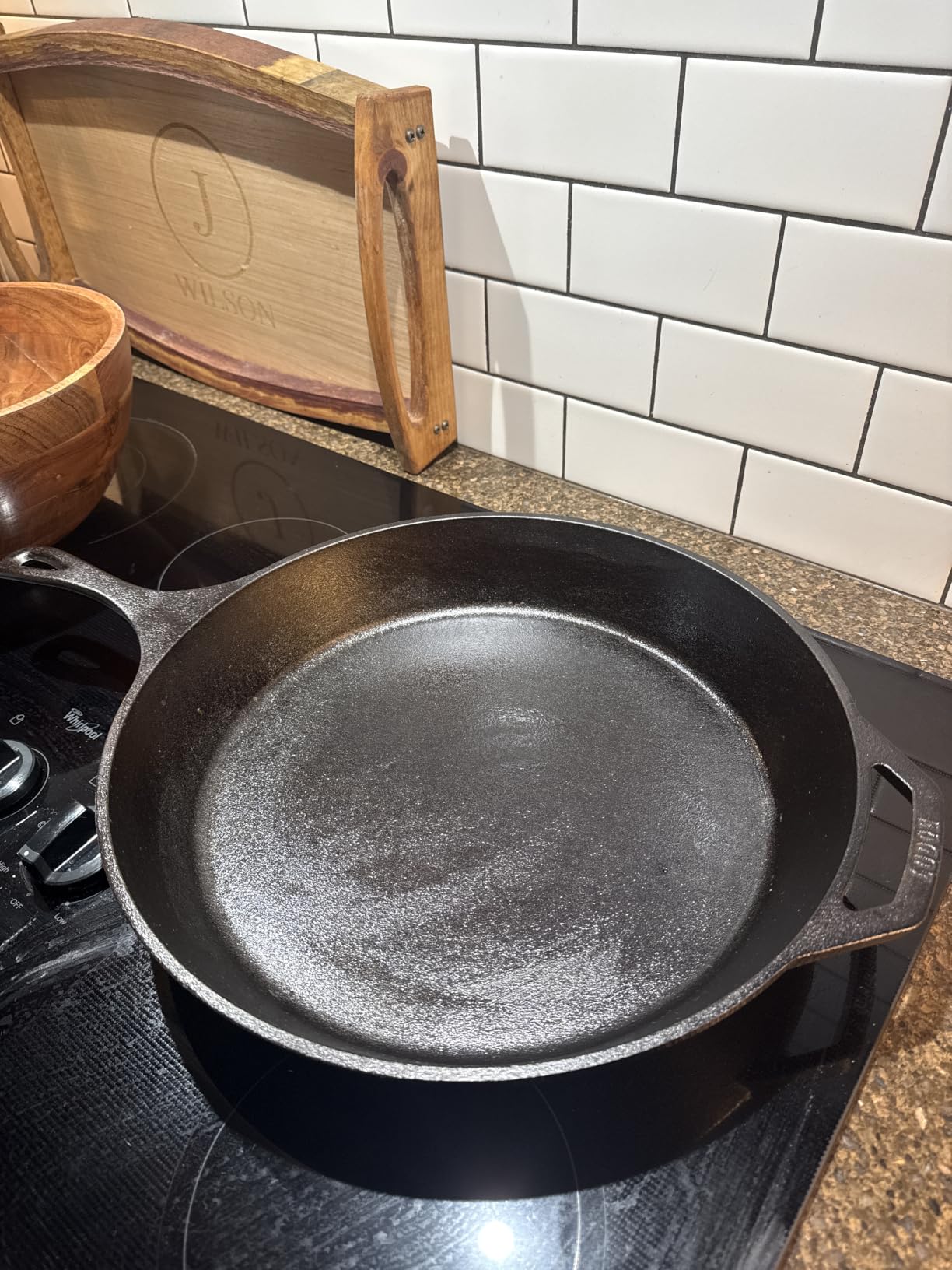
Here is where purists sometimes complain. Older, vintage cast iron was polished to a remarkably smooth finish before seasoning. Modern Lodge pans have a slightly pebbled, sand-cast texture. You can feel it with your fingertips, and in the first few uses food may catch a little more than it would on a glass-smooth antique.
In practice, the texture matters less than it sounds. As the seasoning builds, the dips fill in and the surface becomes noticeably smoother and more naturally slick. Many owners also lightly sand the interior, or simply cook with fat for a few weeks, and report the pebbling fading into the background.
Handle and ergonomics
The long handle is comfortable and gives you decent leverage, but it gets very hot on the stovetop and in the oven. Lodge’s larger skillets add a small assist handle opposite the main one, which is a real blessing when you are lifting a pan full of food. Keep a silicone sleeve or a heat-resistant mitt close. Our roundup of heat resistant gloves covers solid options.
Pour spouts and rim design
Most Lodge skillets include pour spouts on two sides, making it easier to drain grease or pour sauces without splashing. They are not as precise as the lip on a dedicated saucepan, but they work well enough and cost nothing extra.
Imperfections are normal
Because each pan is cast in a sand mold, you may notice small surface variations, mold lines, or slight roughness around the edges. These are cosmetic and do not affect performance. Think of them as the fingerprints of a pan that was actually made, not stamped out by the thousand in a factory that polishes away every trace.
Is it too heavy to be practical?
Weight is the number one complaint, and it deserves a fair hearing. A 12-inch pan filled with food can approach ten pounds, which is a lot to lift with one hand. The practical solutions are simple: use both hands when moving a full pan, choose the smaller size if you are not comfortable, and take advantage of the assist handle. Most people adapt within a week, and many come to appreciate the stability, since a heavy pan does not slide around when you stir or scrape.
A single solid piece of iron that is made to last.
View the Lodge skillet4. Cooking Performance: Heat, Searing, and Baking
This is the section that decides everything, so let’s be direct: Lodge cast iron cooks extremely well when you match it to the right jobs. The pan’s strength comes from its thermal mass. It takes a while to heat up, but once hot, it holds that heat like nothing else in the cabinet.
Searing steaks and burgers
Drop a cold steak into a thin pan and the temperature crashes, leaving you with grey, steamed meat. Drop it into a properly preheated Lodge skillet and the surface barely flinches. You get a deep brown crust, a fast sear, and juicy interior. This is where cast iron earns its reputation, and where it beats most non-stick and many stainless pans at the same price point.
Heat distribution
Cast iron is not the fastest conductor of heat, so it develops hot spots over the burner if you rush it. The fix is simple: preheat slowly over medium heat for five to ten minutes. After that, the thick walls even things out nicely. On a gas flame that is smaller than the pan, expect the center to run hotter than the edges, which can actually be handy when you want to cook some food hot and keep other items warm.
Oven and broiler performance
Because the pan is one solid piece, you can take it from stovetop to oven without a second thought. Searing a thick pork chop and finishing it at higher oven heat, baking cornbread, making a skillet cookie, or even baking a deep-dish pizza all work beautifully. The crust on cast iron cornbread, in particular, is difficult to replicate in any other vessel.
Frying and shallow frying
The pan’s ability to hold temperature makes it great for fried chicken, crispy potatoes, and shallow-fried cutlets. Oil temperature stays steadier, so food browns evenly instead of getting greasy. Pair it with a good thermometer and a quality spider or fryer strainer and you have a very capable frying setup without buying a dedicated fryer.
Where it struggles
Delicate fish, very acidic sauces simmered for a long time, and fast-change cooking (where you need to drop the temperature quickly) are the weak spots. Slow-simmered tomato sauces can strip some seasoning and pick up a metallic taste, especially in a young pan. Eggs can stick until the seasoning matures, though a bit of butter and patience solve most issues.
Everyday test: eggs, pancakes, and fish
To be fair, we ran Lodge through the foods that give cast iron the most trouble. Fried eggs in a freshly opened pan needed a generous slick of butter and a patient flip, but after a couple of weeks of bacon and sausage the same eggs slid around with very little effort. Pancakes cooked evenly, with a lovely golden color, though the first batch always needed a slightly lower flame than expected, because iron stays hotter than it looks. Fish fillets with skin worked well once the pan was hot and the fish was dry; without those two conditions, sticking was almost guaranteed.
The lesson is consistent: cast iron rewards preparation. Dry your food, preheat fully, use enough fat, and resist the urge to move things around too soon. Do those four things and Lodge behaves much better than its reputation suggests.
Fuel and burner considerations
On gas ranges, Lodge pairs beautifully with medium heat, since the flame responds instantly and the iron smooths out any unevenness. On electric coil burners the pan sits flat and heats steadily, while on induction it heats quickly and directly, so lower settings than usual are wise. On glass or ceramic cooktops, lift the pan instead of sliding it, and make sure the bottom is clean and dry to avoid scratches or marks.
The everyday size for steaks, eggs, and cornbread.
Shop the 10.25-inch Lodge skillet5. Sizes and the Wider Lodge Lineup
Lodge sells far more than a single skillet. Choosing the right size and shape matters more than most buyers realize, because cast iron is heavy and the pan you can comfortably lift will be the one you actually use.
| Piece | Best For | Notes |
|---|---|---|
| 8-inch skillet | Single servings, eggs, toasting spices | Light and easy to handle |
| 10.25-inch skillet | Most households, everyday cooking | The sweet spot for many cooks |
| 12-inch skillet | Families, big steaks, batch cooking | Heavy, but has an assist handle |
| Round or square griddle | Pancakes, quesadillas, flatbreads | Low sides, easy to flip |
| Dutch oven | Braises, soups, no-knead bread | Bare-iron and enameled versions exist |
| Grill pan | Indoor grill marks | Ridges are harder to clean |
| Combo cooker | Bread baking, deep frying, camping | Lid flips over to become a shallow skillet |
Which size should you start with?
For one or two people, the 10.25-inch is the practical answer. It fits on a standard burner, holds two chicken thighs or a pair of eggs with room to spare, and is manageable to lift with one hand once you build a bit of wrist strength. If you regularly cook for four or more, the 12-inch is hard to beat, although you will feel the weight at around eight pounds empty.
The Dutch oven question
If your appetite leans toward stews and artisan bread, a Lodge Dutch oven is a smart second purchase. The traditional bare-iron versions are rugged and affordable, while the enameled line trades some of that grit for easier cleaning and colorful looks. If you are already weighing slow-cooking options, compare them with our picks for the best slow cooker, since the two can overlap for braises.
Build a small collection
Many cooks settle on a two- or three-piece trio: a 10.25-inch skillet, a larger skillet or griddle, and one Dutch oven. That covers nearly everything from weekday breakfast to Sunday roasts without cluttering your cabinets. Storage can become an issue, so our tips on organizing a small kitchen are worth a look if cupboard space is tight.
Bundles often lower the cost per piece.
Browse Lodge cast iron sets6. Seasoning Explained: What Lodge Does and What You Do
Seasoning is the thin, hardened layer of polymerized oil that bonds to the surface of cast iron. It is what makes the pan naturally slick, protects it from rust, and gives it that deep black color. It is not a coating you buy; it is a layer you build.
How Lodge’s factory seasoning works
Lodge applies vegetable oil to the pan and bakes it on at the foundry. This gives you a usable surface and some rust protection from day one. Think of it as a good primer coat. It gets the job started, but the finish improves dramatically with repeated cooking.
Building seasoning through cooking
The easiest way to improve the finish is simply to cook fatty foods. Bacon, sausage, burgers, fried chicken, and pan-roasted potatoes all lay down additional layers over time. For the first few weeks, favor those foods over delicate eggs or acidic sauces and the pan will quickly develop a dependable non-stick character.
Re-seasoning in the oven
If you want to speed things up, or restore a pan that has dulled, you can re-season it in the oven:
- Wash the pan with warm water and a little soap, then dry it thoroughly, ideally on a warm burner.
- Rub a very thin layer of a high smoke point oil over every surface, then wipe off as much as you can so it looks nearly dry.
- Bake it upside down in a hot oven for about an hour, with a sheet pan underneath to catch any drips.
- Turn off the oven and let the pan cool inside it.
- Repeat a few times if you want a deeper, more durable finish.
The key is thinness. Too much oil results in a sticky, uneven coating that feels tacky. If that happens, simply bake the pan again at a higher temperature to finish polymerizing the oil.
Which oil is best?
Opinions vary widely, and honestly most common cooking oils work. Neutral oils with higher smoke points, such as canola, grapeseed, or refined vegetable oil, are popular because they polymerize cleanly. If you are curious about how different oils behave under heat, see our breakdown of the best oils for crispy cooking.
A little maintenance oil goes a long way.
Shop cast iron seasoning supplies7. Cleaning, Rust Prevention, and Everyday Care
Cast iron has an undeserved reputation for being fussy. The truth is that the routine is short, and once it becomes a habit you will barely think about it.
The simple daily routine
- Let the pan cool slightly after cooking, but clean it while still warm.
- Scrape off stuck bits with a pan scraper or a stiff brush. Hot water is usually enough.
- If needed, use a small amount of mild dish soap. Modern soap will not ruin well-seasoned iron.
- Dry completely with a towel, then set the pan on a low burner for a minute to drive off hidden moisture.
- Wipe a few drops of oil over the cooking surface with a paper towel.
What to avoid
- The dishwasher: It strips seasoning and invites rust.
- Soaking: Long soaks in water are the fastest route to orange spots.
- Air drying: Always dry by hand and heat.
- Harsh scouring pads: Heavy abrasion every wash wears down your hard-earned finish.
Dealing with rust
Rust looks dramatic but is usually easy to fix. Scrub the affected area with steel wool or a stiff brush until the orange is gone, rinse and dry the pan, and then re-season it in the oven. A rusty cast iron pan is almost never ruined. It is simply asking for attention.
Stuck-on food
For stubborn residue, simmer a little water in the pan for a few minutes to loosen it, or scrub with coarse salt and a drop of oil. Chainmail scrubbers are also popular and gentle enough on seasoning when used with moderation.
Storage tips
Store the pan somewhere dry, and if you stack cookware, place a paper towel or pan protector between pieces to prevent scratches and trapped moisture. If you keep appliances and cookware together, our guide to storing kitchen appliances has ideas that translate well to heavy cookware.
A word on cleaning acidic or sticky messes
Sticky sugar glazes, cheese crisps, and eggs are the most irritating things to clean off iron. The trick is to deglaze while the pan is still hot: pour in a splash of hot water, scrape gently with a wooden spoon, and the residue will lift in seconds. Once the pan is clean, a quick dry over heat and a thin coat of oil restore the surface. If a spot looks dull or grey, that is simply a lightly worn patch of seasoning; a bit of oil and a few more meals bring it back.
How often should you re-season?
There is no fixed schedule. A pan used every few days with fatty foods may never need a full oven session, whereas a pan used rarely for tomato-based dishes may benefit from a refresh every few months. Let the pan guide you: if it looks patchy, feels rough, or food begins to stick more than usual, a round of oiling and baking will usually fix it in an hour.
Scrapers and scrubbers make cleanup quick and gentle.
Get cast iron care tools8. Lodge vs Other Cookware Types
Cast iron does not exist in a vacuum. Most shoppers weigh it against stainless steel, non-stick, carbon steel, and newer hybrid pans. Here is how Lodge stacks up.
| Cookware | Heat Retention | Ease of Care | Weight | Lifespan |
|---|---|---|---|---|
| Lodge cast iron | Excellent | Moderate | Heavy | Generations |
| Stainless steel | Good | Easy | Medium | Decades |
| Non-stick | Fair | Very easy | Light | Few years |
| Carbon steel | Very good | Moderate | Medium | Generations |
| Hybrid (e.g., HexClad) | Good | Easy to moderate | Medium | Varies |
Cast iron vs stainless steel
Stainless is lighter, non-reactive, and great for sauces, while cast iron wins on searing and heat retention. If you can only own one, stainless is more flexible, but cast iron is cheaper and arguably more rewarding. We break down the decision in depth in our cast iron vs stainless steel comparison.
Cast iron vs non-stick
Non-stick wins easily on convenience for eggs and delicate foods, but its coating does not last. Seasoned cast iron develops a natural release surface that you can renew indefinitely. If safety questions are on your mind, read our explainer on whether non-stick cookware is safe.
Cast iron vs carbon steel
Carbon steel is lighter and heats up faster, which many professional cooks prefer for high-heat, quick-moving work. If you love the idea of a responsive pan, our guide to the best carbon steel woks is a great place to explore. Cast iron, on the other hand, is better for thick cuts, baking, and slow, steady heat.
Cast iron vs hybrid and ceramic pans
Hybrid designs aim to blend easy cleanup with some of the searing ability of metal. They are interesting, but they cost considerably more and do not match the sheer lifespan of a pan that is a single solid piece of iron. You can read our HexClad review and our overview of every GreenPan line to see how those alternatives compare.
The budget-friendly path to serious searing power.
See Lodge on Amazon9. Pros and Cons of Lodge Cast Iron
No cookware is perfect. Here is the balanced list after plenty of real cooking, so you know exactly what you are signing up for.
What We Like
- Outstanding value for the quality of iron
- Extremely durable, one-piece construction
- Superb heat retention for searing and baking
- Pre-seasoned, so you can cook right away
- Works on nearly every heat source, including induction and campfires
- Seasoning improves with use
- No chemical coatings to worry about
- Made in the USA by a long-established foundry
What Could Be Better
- Heavy, especially the larger sizes
- Pebbled surface is rougher than vintage or premium pans
- Slow to heat up and slow to cool down
- Handle gets very hot
- Needs drying and occasional oiling
- Not ideal for long, acidic simmers in a young pan
- Can scratch glass and ceramic cooktops if dragged
The big picture
Most of the cons are about trade-offs rather than flaws. Weight is the price of thermal mass. The learning curve is the price of a surface that lasts forever. The pebbled texture is the trade you make for a price that is a fraction of boutique alternatives. Whether those trade-offs are acceptable depends on how you cook, which brings us to the next section.
Prices shift, so a quick look can save you money.
Check today’s Lodge deals10. Who Should Buy Lodge Cast Iron (and Who Should Skip It)
You will love it if you…
- Enjoy searing steaks, chops, burgers, and chicken thighs
- Want a pan that can move from stovetop to oven to grill
- Like the idea of cookware that improves with age
- Cook over a campfire or on an outdoor grill
- Prefer to avoid coated non-stick pans
- Are building a first real kitchen on a sensible budget
Consider alternatives if you…
- Have wrist, grip, or mobility limitations that make heavy pans difficult
- Mostly cook delicate fish and eggs and want zero learning curve
- Rely heavily on glass-top cooking and are worried about scratches
- Want to toss pans or flip food with a flick of the wrist
- Run everything through the dishwasher by habit
For beginners
If you are brand new to cooking, a 10.25-inch Lodge is a great teacher. It forgives overcooking, rewards good heat control, and builds skills around preheating and browning. Pair it with a decent knife and board and you have the foundation of a very capable kitchen. If you are still gathering the basics, our guides to the best knife set for beginners and essential kitchen tools and equipment will help you fill the gaps.
For experienced cooks
Seasoned cooks often keep a Lodge skillet purely for its performance per dollar. It is the pan you do not baby: use it on a grill, in a fire pit, or in a screaming-hot oven without worrying about damage. Many serious home cooks own more expensive pans and still reach for the Lodge on busy nights.
For campers and outdoor cooks
If your cooking extends beyond the kitchen, few pans make sense outdoors like cast iron. It tolerates open flames, uneven heat, and rough handling, and a Lodge combo cooker doubles as a Dutch oven and a skillet around the fire.
Perfect for braises, soups, and fresh bread.
Explore Lodge Dutch ovens11. What to Cook: Recipes and Ideas That Shine in a Lodge Skillet
A good pan is only as valuable as the meals it produces. These are the dishes where a Lodge skillet genuinely outperforms most cookware.
Perfect steak
Pat the steak dry, season generously with salt, and let the pan preheat until a drop of water dances and evaporates immediately. Add a thin film of high smoke point oil, lay in the steak, and leave it alone until the crust releases naturally. Finish with butter, garlic, and herbs. The crust you get is the stuff restaurants advertise.
Crispy-skinned chicken thighs
Start skin-side down in a cold or moderately warm pan so the fat renders slowly, then cook until the skin is deep golden. Flip, transfer to the oven, and finish cooking. The result is shatteringly crisp skin with tender, juicy meat. If you also own an air fryer, compare the two techniques in our air fryer vs oven article.
Cornbread and skillet breads
Preheat the skillet with a little fat in the oven, pour in the batter, and listen for the sizzle. That contact with hot iron creates a golden, crunchy crust that is the entire point of cast iron cornbread. The same approach works for Dutch babies, soda bread, and focaccia.
Breakfast hash and eggs
Crispy potatoes, onions, peppers, and sausage turn out beautifully when cooked in a hot skillet, and a few eggs cracked on top finish in minutes. For pancakes and flatbreads, a Lodge griddle is easier to work with than a deep skillet, and if you are comparing options you can see our guide to the best electric griddles for pancakes.
One-pan dinners and desserts
Fajitas, shakshuka, frittatas, seared salmon, baked pasta, fruit cobblers, and giant skillet cookies all work in the same pan. Because heat stays steady, one-pan meals finish cooking evenly and can go straight from oven to table, where the pan doubles as a rustic serving dish.
Finishing and serving
Remember that cast iron stays hot for a long time after it leaves the heat. Always place it on a trivet or a sturdy wooden board, and keep a mitt nearby. A good cutting board and a sharp knife, kept in shape with one of the best knife sharpeners, make the pan-to-plate step smooth.
Make it a full meal: a sample weeknight plan
Here is how a single Lodge skillet can anchor an entire week. Monday could be sausage and pepper hash with fried eggs. Tuesday, seared chicken thighs finished in the oven with roasted vegetables around them. Wednesday, quesadillas on a griddle. Thursday, a pan pizza with a blistered crust. Friday, a thick steak with butter and herbs. Saturday, skillet cornbread alongside slow-cooked beans. Sunday, a fruit cobbler for dessert. Each of those dishes plays to cast iron’s strengths, and the pan keeps improving the entire time.
Tips for better results every time
- Pat food dry. Surface moisture creates steam and blocks browning.
- Salt early for meats. It draws out surface moisture that you can wipe away before searing.
- Do not crowd the pan. Overloading drops the temperature and steams the food.
- Let meat release naturally. If it resists the spatula, it usually needs another moment.
- Rest your food. Give steaks and chops a few minutes off the heat before slicing.
Handle covers and trivets make serving safer.
Shop skillet accessories12. Value, Longevity, and Smart Buying Tips
On a pure cost-per-year basis, Lodge is one of the best deals in the kitchen. A pan that costs a modest amount today and lasts decades is hard to beat. By comparison, a premium stainless set can run into the hundreds, and non-stick pans typically need replacing every few years.
How long will it really last?
With ordinary care, a Lodge skillet should outlast most of the other items in your kitchen. Cast iron does not wear out from use; it only suffers from neglect, and neglect is usually reversible. Rust can be scrubbed away, burnt-on grime can be stripped, and a re-seasoning brings the pan back. That repairability is what separates cast iron from nearly every other type of cookware.
Is it worth upgrading to premium cast iron?
Boutique cast iron can be wonderful. It is lighter, smoother, and prettier. But performance in the pan, where heat retention and searing power live, is not dramatically different for most home cooks. Unless you really care about weight and surface finish, the extra money is usually better spent on good ingredients or other tools.
Smart buying tips
- Pick the right size first. Lift it in your head: if you struggle with eight pounds, choose the 10.25-inch.
- Consider a bundle. Sets with a lid or a griddle often lower the cost per piece.
- Add a lid only if you need it. Lids are handy for braising and steaming but not essential for searing.
- Buy care basics. A scraper, an oven mitt, and a small bottle of oil are the only extras you really need.
- Check seller reviews. Buy from reputable retailers so you receive an unused, properly packaged pan.
Building the rest of your kitchen
Cast iron works best as one piece of a balanced setup. Pair it with a reliable saucepan, a sharp knife, and a few appliances that earn their space. If you are planning a bigger kitchen refresh, our must-have kitchen appliances list and kitchen appliance buying guide can help you prioritize, while our ideas for kitchen counters show how to keep everything tidy.
Common mistakes new owners make
The first mistake is expecting a non-stick experience on day one. A new pan is a work in progress, and patience pays off. The second is overheating: cranking the burner to maximum scorches oil, leaves sticky residue, and makes food burn before it cooks through. The third is over-cleaning, scrubbing the pan so aggressively after every use that the seasoning never gets a chance to build. And the fourth is neglecting the dry-and-oil step, which quietly invites rust over time. Avoid those four and nearly every complaint about cast iron disappears.
Gift potential
A Lodge skillet is also one of the most dependable gifts for anyone who loves to cook, is moving into a first apartment, or simply wants to eat better at home. It is practical, durable, and a little sentimental, since it carries the promise of many meals to come. Pair it with a scraper, a mitt, and a bottle of oil, and you have a thoughtful present that will outlast most gadgets.
Find the combination that fits the way you cook.
See Lodge bundles and setsFrequently Asked Questions About Lodge Cast Iron
Is Lodge cast iron really worth buying?
For most home cooks, yes. It delivers excellent heat retention, durability, and versatility at a price that is difficult to match. Its main costs are weight and a small amount of care, both of which are manageable for most people.
Do I need to season a Lodge skillet before using it?
No. It arrives pre-seasoned and ready to cook. That said, adding a few extra layers by oven seasoning, or by cooking fatty foods during the first weeks, improves the non-stick performance and rust resistance.
Is Lodge cast iron made in the USA?
Lodge’s cast iron cookware is cast at its foundry in South Pittsburg, Tennessee. The company has operated there since the late nineteenth century, which is a large part of why the brand is so closely tied to American home cooking.
Can I use soap on my Lodge pan?
Yes. A small amount of mild dish soap will not damage a well-seasoned pan. What matters most is drying the pan completely afterward and applying a thin coat of oil. Avoid the dishwasher and long soaks.
Does Lodge cast iron work on induction cooktops?
Yes. Because it is iron, it is magnetic and works well on induction. Lift rather than slide the pan on glass or ceramic surfaces so you do not scratch them, and preheat gently.
Why is my food sticking to the pan?
Usually it is one of three things: the seasoning is still young, the pan was not preheated enough, or there was not enough fat. Preheat slowly, use a bit more oil or butter, and keep cooking fatty foods to build up the finish.
What size Lodge skillet should I buy first?
The 10.25-inch is the best all-around starter for one to three people. Choose the 12-inch for larger households or bigger cuts, provided you are comfortable with its weight.
Can I cook acidic foods like tomato sauce in it?
You can, but with caution. Short cooking times are fine in a well-seasoned pan. Long simmers can strip seasoning and add a metallic taste, so use stainless or enameled cookware for slow-simmered acidic sauces.
How do I fix a rusty Lodge skillet?
Scrub the rust off with steel wool or a stiff brush, wash and dry the pan thoroughly, and then re-season it in the oven. In most cases the pan returns to normal and works as well as before.
Is cast iron safe to cook with every day?
Cast iron is a traditional, uncoated cookware material and is commonly used daily. It can add a small amount of dietary iron to food, which is harmless for most people. If you have a medical condition affecting iron levels, check with your doctor.
Can I use a Lodge skillet in the oven or on a grill?
Absolutely. Lodge cast iron handles high oven temperatures, broilers, outdoor grills, and open campfires. Just remember that the handle becomes extremely hot, so always use a mitt or a handle cover.
How does Lodge compare to more expensive cast iron brands?
Premium brands typically offer lighter weight and a smoother cooking surface. Lodge offers nearly the same cooking performance at a much lower price, making it the better value for most households.
Final Verdict: Should You Buy a Lodge Cast Iron Skillet?
After everything covered here, the answer is a confident yes for most home cooks. Lodge cast iron is not the lightest pan, the smoothest pan, or the lowest-maintenance pan. What it is, is a rare combination: affordable, nearly indestructible, extremely capable, and improved by every meal you cook in it.
If you want a skillet that sears like a steakhouse, bakes a proper cornbread, and can handle the oven, the grill, and the campfire without complaint, a Lodge is the smartest place to start. Commit to a simple care routine, build the seasoning with good fatty meals, and you will have a pan that is still working long after most cookware has been replaced.
Start with the 10.25-inch if you are unsure, add a Dutch oven when your cooking grows more ambitious, and enjoy the satisfaction of using tools that were made to last.
Our top pick for durable, versatile, budget-friendly cooking.
Get your Lodge cast iron skillet today


