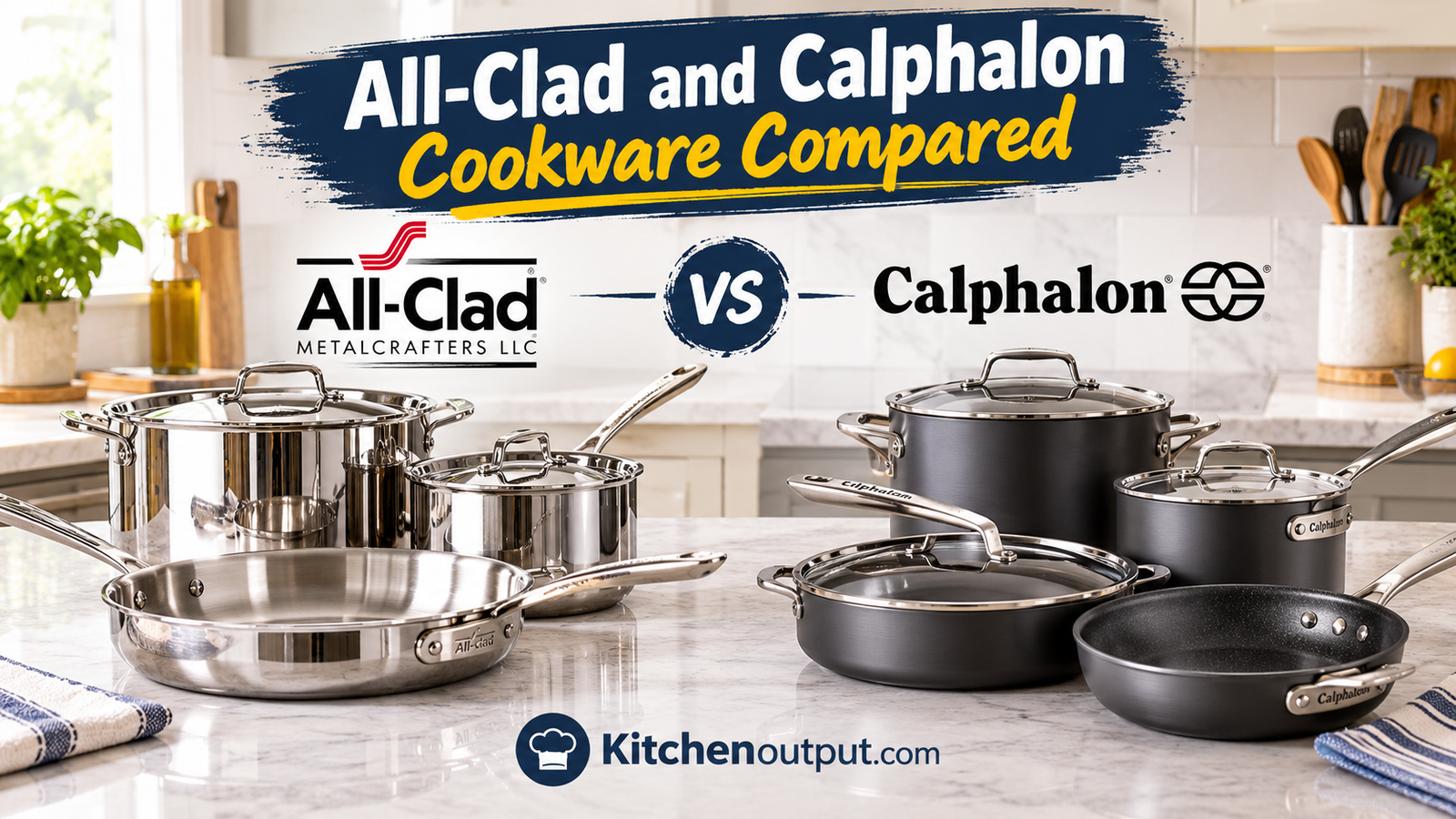
Cookware Comparison
All-Clad vs Calphalon: Which Cookware Brand Actually Deserves Your Stovetop?
One brand is the bonded-metal benchmark that pros and serious home cooks swear by. The other is the approachable workhorse that fills millions of kitchens. Here is how they really compare, pan for pan and dollar for dollar.
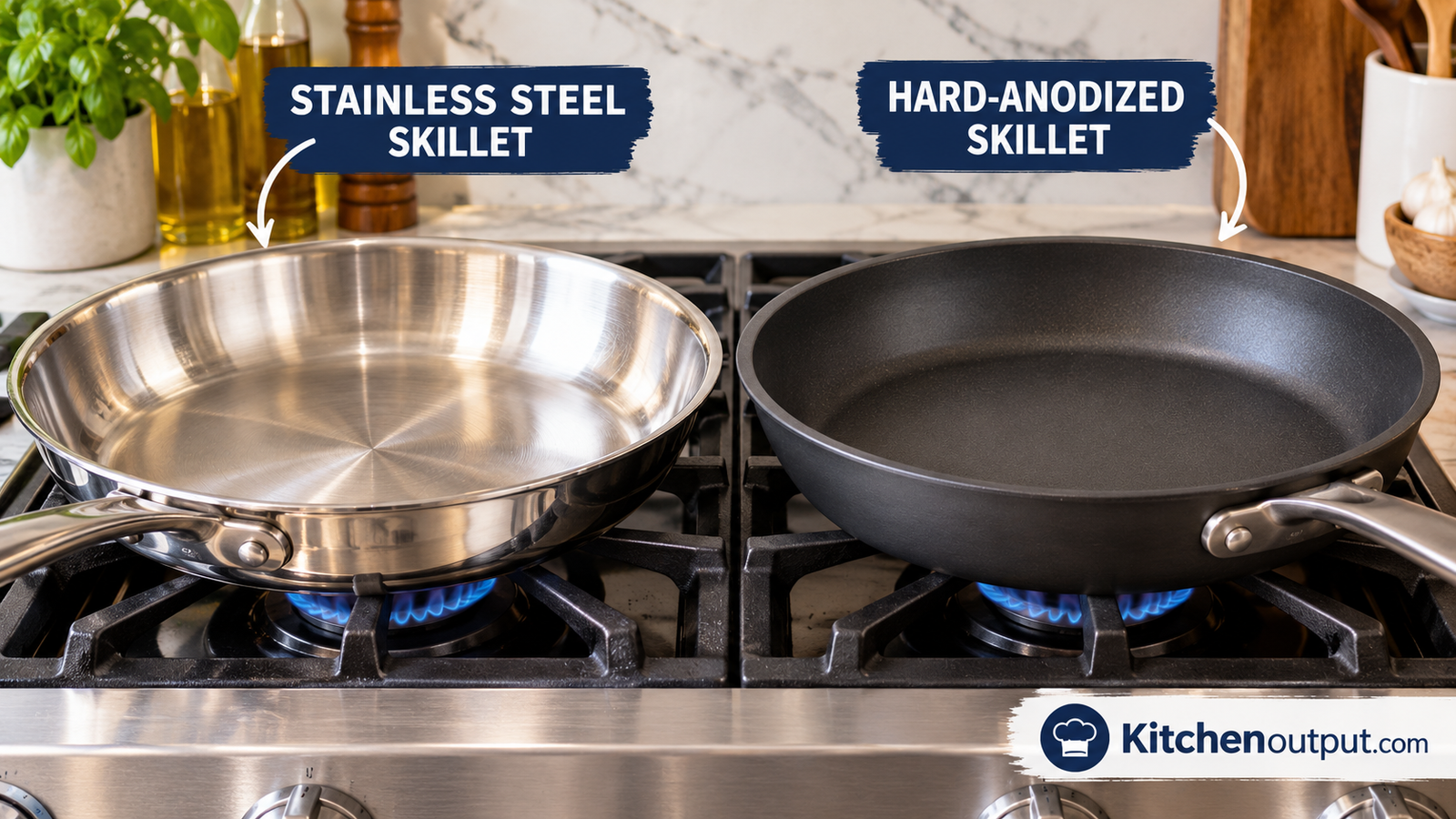
Walk into any kitchen store and you will eventually end up staring at two shelves. On one sits All-Clad, gleaming, heavy, and carrying a price tag that makes you do a quick mental budget check. On the other sits Calphalon, friendlier, often on promotion, and available in everything from a single frying pan to a thirteen-piece set. Both brands are American names with real heritage. Both promise to last. And both have fiercely loyal owners who will happily tell you the other brand is the wrong call.
The truth is more interesting than either camp admits. These two companies approach cookware from genuinely different angles, and the “better” brand depends almost entirely on how you cook, what you cook on, and how much you want to spend upfront versus over the next two decades. A weeknight cook who flips eggs and reheats leftovers has different needs than someone searing steaks, building pan sauces, and doing it all on an induction burner.
In this guide, we break the comparison down the way a careful buyer would: construction, heat behavior, nonstick performance, stainless performance, ergonomics, compatibility, maintenance, and value. We also map which specific product lines compete with each other, because comparing “All-Clad” to “Calphalon” as whole brands hides the details that really matter. If you are also weighing materials beyond these two names, our breakdown of cast iron vs stainless steel is a useful companion read.
1. The Quick Verdict: All-Clad vs Calphalon at a Glance
If you only have two minutes, here is the short version. All-Clad is the premium, performance-first choice. Its fully bonded stainless cookware heats evenly all the way up the walls, handles brutally high oven temperatures, works on induction, and is built to be passed down. You pay noticeably more for that, and the pans are heavier than most people expect. Calphalon is the accessible, value-driven choice. Its hard-anodized nonstick lines are lightweight, easy to live with, and far kinder to a starter budget, though the coatings and some construction details do not have the same long-haul durability as All-Clad’s stainless.
Neither brand is universally better. They overlap in the middle, where Calphalon’s tri-ply stainless lines compete with All-Clad’s entry-level stainless options, and that overlap is where most shoppers get stuck. The table below sums up how they differ before we dig into the reasons.
| Factor | All-Clad | Calphalon |
|---|---|---|
| Best known for | Bonded stainless steel cookware | Hard-anodized aluminum nonstick |
| Typical price tier | Premium to luxury | Budget to mid-range |
| Weight | Heavier, substantial feel | Lighter, easier to maneuver |
| Oven safety | Very high on stainless lines | Good, but varies more by line |
| Induction | Stainless lines compatible | Depends on the specific line |
| Nonstick durability | Good, still a coating | Good, still a coating |
| Long-term resale and legacy value | Strong | Modest |
| Best for | Serious home cooks, long-term investment | Everyday cooks, first kitchens, tight budgets |
Rule of thumb: If you plan to buy cookware once and use it for decades, lean All-Clad. If you want solid performance now at a friendlier price and do not mind replacing nonstick pans every few years, Calphalon makes a lot of sense.
Want to compare current options yourself? Browse popular All-Clad cookware right now.
Shop All-Clad on Amazon2. Two Brands, Two Origin Stories
Understanding where each company came from explains almost everything about how their products feel today. All-Clad was founded in 1971 in Canonsburg, Pennsylvania, by metallurgist John Ulam, who had spent years working with bonded metals. His big idea was to metallurgically bond layers of different metals together, so that a pan could combine the heat-spreading talent of aluminum with the toughness and non-reactivity of stainless steel. The name itself comes from that concept: a pan that is “clad” in metal, all the way through. Today, All-Clad is part of Groupe SEB, and its flagship stainless lines are still associated with Pennsylvania manufacturing, although some of its more affordable collections are produced elsewhere.
Calphalon began in Toledo, Ohio, in the 1960s, founded by Ronald Kasperzak, and made its name by bringing hard-anodized aluminum cookware, originally a commercial product, into home kitchens. Hard anodizing is an electrochemical process that hardens the surface of aluminum, making it denser, more scratch resistant, and less reactive than raw aluminum. For decades, that dark gray, silky pan was the aspirational cookware for American home cooks. The company is now part of Newell Brands, and while the brand identity remains American, a large share of its modern production happens overseas, which is a big reason it can offer such competitive pricing.
What these origins mean for you
All-Clad started with professional-grade stainless and has stayed loyal to that identity, expanding into nonstick and specialty pieces without losing its reputation as a stainless brand first. Calphalon started with hard-anodized aluminum, and it still shines there, while later adding tri-ply stainless lines to meet shoppers who wanted something more traditional. In other words, each brand is strongest where it started. Keep that in mind as you read the product-line comparisons later on.
It is also worth noting how each company has widened its catalog. All-Clad extends beyond pans into specialty items, and if you like the brand you may enjoy our hands-on look at the All-Clad electric skillet. Calphalon, meanwhile, has long offered a broad range of kitchen electrics, bakeware, and cutlery alongside its cookware, giving it a more complete “one brand for the whole kitchen” feel at lower price points.
All-Clad snapshot
- Founded in Pennsylvania in 1971
- Bonded metal specialist
- Premium positioning
- Core lines built around stainless
Calphalon snapshot
- Founded in Ohio in the 1960s
- Hard-anodized pioneer
- Value and mid-range positioning
- Core lines built around nonstick
How the brands have evolved
Both companies have changed noticeably over the years. All-Clad has widened its range to include nonstick, specialty pieces, and different finishes, while trying to protect the reputation of its stainless core. Calphalon has moved beyond a single hard-anodized identity, adding stainless, ceramic-style and premium nonstick lines to compete across price points. That evolution means older reviews, and even older family experiences with either brand, may not describe what is on shelves today. A set your parents loved decades ago may differ in construction from the current version, so judge each collection on its present specifications rather than on the brand’s past glory.
Curious how the heritage shows up in the pan? See popular Calphalon sets.
Shop Calphalon on Amazon3. Construction and Materials: What Is Actually Inside the Pan
Construction is where the two brands differ most, and it is the single biggest driver of how a pan behaves on your stove. Let’s start with All-Clad’s stainless collections, then look at Calphalon’s approach.
All-Clad: bonded layers from rim to rim
The signature All-Clad design is a fully clad pan, meaning the heat-conducting layers do not stop at the base. They travel all the way up the sidewalls. In the popular D3 collection, a core of aluminum is sandwiched between two layers of stainless steel. The inner stainless surface is the cooking surface, which is durable and non-reactive, while the outer layer is magnetic, which is what allows the pan to work on induction cooktops. Because the aluminum runs up the sides, heat distributes through the whole vessel instead of pooling in the bottom.
Step up to the D5 collection and you get five layers, alternating stainless and aluminum, with a stainless layer in the middle that slows and smooths heat transfer. Copper Core pans add a layer of copper for fast responsiveness. These upgrades cost more, and whether they change your cooking noticeably is something we will explore in the heat performance section.
Calphalon: hard-anodized aluminum and tri-ply options
Calphalon’s classic construction is a thick hard-anodized aluminum body with a nonstick interior coating. Aluminum is an excellent conductor of heat, and the anodized surface gives it a tough, dense exterior. Because the entire body is aluminum, heat spreads quickly and evenly, and the pans are noticeably lighter than clad stainless.
For shoppers who prefer stainless, Calphalon also sells tri-ply stainless lines with an aluminum core between stainless layers, which sit in direct competition with All-Clad D3. The key difference is not the concept but the execution: thickness of the layers, finish quality, rivet design, and handle shape all vary, and those details shape the feel and long-term durability.
| Construction Detail | All-Clad (Stainless Lines) | Calphalon (Hard-Anodized Lines) |
|---|---|---|
| Primary body material | Bonded stainless and aluminum | Hard-anodized aluminum |
| Cooking surface | Bare stainless steel | Nonstick coating |
| Heat spread | Through base and sidewalls | Through whole aluminum body |
| Rim finish | Flared, drip-resistant | Varies by line |
| Handle attachment | Stainless rivets | Rivets or welded, line dependent |
Why this matters: A pan that heats evenly up the sides browns food more consistently, reduces cold spots, and makes pan sauces easier to control. It is the main reason professionals gravitate toward fully clad stainless.
See the layers for yourself: Compare tri-ply stainless cookware sets.
Compare Tri-Ply Sets4. Heat Performance in Real Cooking
Spec sheets are interesting, but what matters is what happens when you drop a chicken thigh into a hot pan. Heat performance has three parts: how evenly a pan heats, how quickly it responds when you change the burner, and how well it holds heat when cold food hits the surface.
Evenness
Both brands spread heat well, and both clearly beat thin, cheap cookware. All-Clad’s clad design gives it a slight edge on sidewalls, which matters when you are reducing a sauce or shallow frying. Calphalon’s hard-anodized aluminum pans are very even across the bottom, which is where most everyday cooking happens. If you are cooking pancakes, eggs, or sautéing vegetables, you may struggle to notice any difference.
Responsiveness
Aluminum reacts quickly to temperature changes, so Calphalon’s aluminum-bodied pans heat up fast and cool down fast. All-Clad’s clad stainless is a little more measured, particularly in D5 where the extra stainless layer deliberately slows heat flow. Some cooks love that smoothness, because it makes it harder to scorch things. Others find it slower to react when they need a quick drop in heat. Copper Core is the most responsive in All-Clad’s lineup.
Heat retention and searing
Searing is where mass and surface type matter. A heavy stainless pan with a bare cooking surface can be preheated until it is genuinely hot, then it will produce a deep, flavorful crust on steak, scallops, or chicken skin. Nonstick surfaces, whether Calphalon’s or All-Clad’s own nonstick lines, are not meant to be heated aggressively empty, and they do not develop the same fond (those browned bits that become pan sauce). For serious searing, a stainless pan wins, which is why the All-Clad vs Calphalon tri-ply matchup is the fairest comparison.
If searing and crust are central to how you cook, it is also worth reading about Lodge cast iron, which holds heat even better than either brand’s clad pans at a fraction of the cost.
| Cooking Task | Better Fit | Why |
|---|---|---|
| Searing steak | All-Clad stainless | Bare steel, high heat tolerance, great fond |
| Scrambled eggs | Calphalon nonstick | Easy release with little fat |
| Pan sauces | All-Clad stainless | Fond and sidewall heat |
| Delicate fish | Either nonstick | Low sticking risk |
| Rapid weeknight sautés | Calphalon | Light and quick to heat |
| Braising and oven finishing | All-Clad stainless | Very high oven tolerance |
Preheating and fat: the part nobody explains
A lot of frustration with both brands comes down to preheating. On stainless, a properly preheated pan is the difference between food that glides and food that welds itself to the surface. A good habit is to heat the pan over medium for a couple of minutes, add your oil, and wait until it shimmers. On nonstick, the opposite applies: you want to start gently, add a little fat, and avoid blasting an empty pan on high. The same stove, the same recipe, and two completely different technique rules. Understanding this is half the battle, and it is why people who switch from one material to the other often assume the new pan is defective when it is really just a different set of habits.
Ready to sear like a pro? Browse stainless steel skillets and sauté pans.
Shop Stainless Skillets5. Product Lines Compared: Matching the Right Collections
Here is where most “All-Clad vs Calphalon” articles go wrong. They compare brand to brand, when the real decision is line to line. Each company sells multiple collections that target different budgets and cooking styles, so the smart move is to compare the ones that actually compete.
All-Clad’s main collections
- D3 Stainless: The classic. Three bonded layers, flared rims, long stainless handles. It is the benchmark most people mean when they say “All-Clad.”
- D5 Stainless: Five layers for steadier, more forgiving heat. Often in a brushed finish and a slightly different handle profile.
- Copper Core: A copper layer for responsiveness, favored by cooks who like quick control.
- HA1 Hard Anodized Nonstick: The brand’s answer to Calphalon, a hard-anodized body with a nonstick surface.
- NS1 Nonstick: A nonstick line built with induction cooktops in mind.
Calphalon’s main collections
- Classic Hard-Anodized Nonstick: The everyday entry point. Affordable, lightweight, widely available.
- Premier Hard-Anodized Nonstick: A step up with sturdier build and often better oven tolerance.
- Signature and Select lines: Positioned as higher-end nonstick options with more durable coatings and refined handles.
- Tri-Ply Stainless Steel: The direct rival to All-Clad D3 for those who want stainless.
Collection names and specs change from time to time, so always check the current product listing for exact details before buying.
| If You Want… | All-Clad Option | Calphalon Option |
|---|---|---|
| Classic tri-ply stainless | D3 Stainless | Tri-Ply Stainless Steel |
| Hard-anodized nonstick | HA1 | Classic or Premier |
| Induction-friendly nonstick | NS1 | Select lines vary, verify listing |
| Maximum heat finesse | D5 or Copper Core | No direct equivalent |
| Lowest cost of entry | Entry-level nonstick pans | Classic nonstick sets |
Smart shortcut: If you cook mostly on stainless, compare D3 to Calphalon Tri-Ply. If you cook mostly nonstick, compare HA1 to Calphalon Premier. Comparing across those categories will mislead you.
For a wider view of options beyond these two brands, our roundup of the best stainless steel cookware sets puts several competing names side by side.
Narrowing down a collection? Check current All-Clad D3 stainless pieces.
View All-Clad D36. Nonstick Showdown: Coatings, Longevity and Safety
For most households, nonstick is where the day-to-day cooking happens, so this section deserves attention. Both All-Clad and Calphalon sell PTFE-based nonstick cookware made without PFOA, which has been phased out of modern nonstick production. Both are tough on paper and both will eventually wear out, because every nonstick coating on the market has a finite life.
How long does nonstick really last?
Honest answer: it depends far more on how you treat the pan than on the logo. High heat, metal utensils, dishwasher cycles, and stacking without protection all shorten coating life. With careful use, many owners get several years from a quality nonstick pan, and a more premium line tends to give you a bit more headroom. Calphalon’s premium nonstick lines were designed around tougher, multi-layer coatings that stand up to more abuse than basic budget pans, and All-Clad’s HA1 and NS1 lines take the same approach.
The cost-per-year math
This is where Calphalon often makes more sense. Because its nonstick pans cost less, replacing one every few years hurts less. If you pay a premium for an All-Clad nonstick pan and its coating wears at the same pace as a cheaper one, you have effectively paid extra for the body and handle rather than longevity of the surface. Some buyers are fine with that, and some are not.
Is nonstick cookware safe?
Used correctly, modern PTFE nonstick is considered safe for normal cooking. The main guidance is to avoid overheating an empty pan, keep the coating intact, and ventilate when cooking at high heat. We covered the topic in depth in our guide on whether non-stick cookware is safe, including what to look for when a coating starts to degrade. If you would rather avoid PTFE entirely, ceramic-style options exist, and our complete look at GreenPan’s product lines explains how those compare.
Where Calphalon nonstick wins
- Lower price per pan
- Lighter and easier to flip and toss
- Huge range of sets and sizes
- Easy to replace without guilt
Where All-Clad nonstick wins
- Sturdier body and refined handles
- Better compatibility options like NS1 for induction
- Long-term brand support
- Cleaner, more upscale looks
Habits that stretch nonstick life
Whichever brand you choose, a handful of habits make nonstick last noticeably longer. Cook on low to medium heat, since nonstick rarely needs more. Use a little oil or butter even if the pan claims you do not need it, because a thin layer protects the surface. Let the pan cool before it meets water, wash with a soft sponge, and never stack pans directly on top of each other without a paper towel or pan protector between them. Store lids separately if you can. Do these things consistently and a good nonstick pan from either brand can serve you well far beyond the point where a neglected one would have given up.
| Nonstick Factor | All-Clad | Calphalon |
|---|---|---|
| Coating type | PTFE-based, PFOA-free | PTFE-based, PFOA-free |
| Metal utensils | Generally discouraged | Varies, premium lines claim more tolerance |
| Dishwasher | Often allowed, hand wash recommended | Often allowed, hand wash recommended |
| Replacement cost | Higher | Lower |
Need a reliable nonstick pan? Browse hard-anodized nonstick fry pans.
Shop Nonstick Pans7. Stainless Steel Head to Head: D3 vs Tri-Ply
This is the matchup that really tests both brands, because stainless is unforgiving. There is no coating to hide behind. A bare steel surface exposes how evenly a pan heats, how well it releases food when used properly, and how it ages.
Heat and cooking feel
In side-by-side cooking, All-Clad D3 tends to feel more substantial and a touch more even on the sidewalls. Calphalon Tri-Ply performs well for the price and is a legitimate step up from thin, single-layer stainless, but it is generally a little lighter, and its edge-to-edge consistency is not quite as refined. For everyday cooking, the difference is modest. For tasks like building a fond and deglazing, or making a delicate sauce where hot spots punish you, All-Clad’s tighter engineering gives it the edge.
Durability and finish
Both brands produce stainless that can last for decades if cared for. All-Clad’s fit and finish, including the flared rim, polished interior, and sturdy rivets, tends to hold up beautifully over time. Calphalon’s tri-ply lines are durable too, though the price gap partly reflects differences in material thickness and finishing detail.
The learning curve
Cooking on stainless takes practice no matter which brand you choose. Preheat the pan, add oil once it is hot, and let food release naturally before you try to move it. New owners who skip these steps often blame the pan. If you are brand new to stainless, start with an egg-free recipe, since eggs are the least forgiving test.
Fond, deglazing and why stainless matters for flavor
One reason serious cooks stay loyal to stainless is fond, the caramelized layer that forms on the bottom of the pan when meat or vegetables brown. Pour in wine, stock, or even water and scrape, and that layer dissolves into the base of a sauce with remarkable depth. Nonstick coatings are specifically designed to prevent that sticking, which means they also prevent the browning that creates fond. If you love restaurant-style pan sauces, gravies, or braises, stainless is simply the right tool, and this is where All-Clad’s even sidewall heating helps keep the fond from scorching in one corner while the rest of the pan lags behind.
Choose All-Clad D3 if…
- You want fully clad performance
- You cook at high heat often
- You value an heirloom-quality feel
- You are building a long-term set
Choose Calphalon Tri-Ply if…
- You want stainless at a lower price
- You prefer a lighter pan
- You are testing whether you like stainless
- You are outfitting a first kitchen
Pro tip: You do not have to commit to one brand. Many cooks buy one All-Clad stainless skillet for searing and a Calphalon nonstick pan for eggs, getting the best of both without the premium price across the whole set.
If you are shopping for a whole cooking setup, our 20 kitchen tools and equipment list helps you prioritize what to buy first, and the best knife set for beginners rounds out the basics.
Looking at stainless sets? Compare complete stainless cookware sets.
Compare Stainless Sets8. Handles, Weight and Comfort in Daily Use
You will hold your cookware nearly every day, so ergonomics deserve as much attention as heat performance. A pan that is technically perfect but uncomfortable to lift gets used less.
Weight
All-Clad stainless is heavy. A large skillet filled with food has real heft, which many cooks love for stability on the burner and a feeling of quality, but it can be tiring for anyone with wrist or grip limitations. Calphalon’s hard-anodized aluminum is significantly lighter, making it more approachable for quick flips, one-handed tosses, and everyday handling. If you plan to lift a full stockpot or Dutch oven often, the weight difference becomes even more noticeable.
Handle design
All-Clad’s signature stainless handles are long, narrow, and slightly angled, with a groove along the underside that suits a firm grip. Some people find them very comfortable, while others find the edges less cozy than a rounded handle. Because they are metal, they get hot on the stovetop during long cooking sessions, particularly on gas. Calphalon uses a mix of handles depending on the line: some are stainless, some are coated, and some include a stay-cool design that stays comfortable for longer. The softer grips on certain Calphalon models are friendlier for small hands and lower oven limits are the tradeoff for silicone-style parts.
Lids and extras
Lids matter more than people think. All-Clad lids are stainless and oven safe in the stainless collections, which is convenient for braises. Calphalon’s glass lids let you monitor food without lifting, which is helpful for simmering and steaming, though glass can have a lower temperature limit. Both brands design lids to fit snugly, which helps retain moisture.
| Comfort Factor | All-Clad | Calphalon |
|---|---|---|
| Overall weight | Heavy, stable | Lighter, nimble |
| Handle style | Long stainless, firm grip | Varies, some stay-cool designs |
| Handle heat | Can warm up on long cooks | Depends on the line |
| Lids | Stainless in stainless lines | Often tempered glass |
| Pouring | Flared rims drip less | Varies by line |
If kitchen space is limited, consider how each set stores. Heavier pans can strain shelves and cabinets, and our tips on how to organize a small kitchen show how to make everything fit.
Prefer a lighter pan? Browse lightweight Calphalon cookware.
Shop Calphalon Pans9. Cooktops, Induction and Oven Use
Compatibility is one of the most practical differences between these brands, and it can quietly make or break a purchase. Before you buy anything, check your stove type.
Induction compatibility
Induction cooktops require magnetic cookware. All-Clad’s stainless collections are built with a magnetic exterior and work on induction. Calphalon is more of a mixed bag. Many of its traditional hard-anodized aluminum lines are not magnetic and will not work on induction, while some newer or specific lines are designed to be induction-ready. If you have or plan to buy an induction range, always confirm compatibility on the product page, and use a simple magnet test at home if you are unsure.
Gas, electric and glass tops
Both brands work well on gas and electric coils. On glass or ceramic cooktops, All-Clad’s stainless bases are smooth enough to avoid scratching when lifted rather than dragged, and Calphalon’s anodized bases are smooth too. On any glass top, lifting pans instead of sliding them is the best way to protect the surface.
Oven safety
All-Clad stainless collections are well known for very high oven tolerance, which makes them excellent for starting a dish on the stove and finishing it in the oven, such as searing a steak then roasting, or baking a frittata. Calphalon’s tolerance depends more on the line. Basic nonstick lines are usually rated lower, while premium and stainless lines go higher. The lid, handle, and coating can each limit the rating, so always check the lowest-rated component.
| Compatibility | All-Clad Stainless | Calphalon Nonstick | Calphalon Tri-Ply |
|---|---|---|---|
| Induction | Yes | Often no, verify the line | Yes, verify the line |
| Gas and electric | Yes | Yes | Yes |
| Oven use | Very high rating | Moderate, line dependent | High, line dependent |
| Broiler use | Typically fine for stainless | Check the rating carefully | Check the rating carefully |
Magnet test: If a refrigerator magnet clings firmly to the bottom of a pan, it will work on induction. If it barely sticks or falls off, it will not.
Cooking on induction? Browse induction-compatible cookware.
Shop Induction Cookware10. Cleaning, Care and Longevity
How a brand ages in your kitchen tells you far more than how it looks on day one. Let’s talk about what ownership actually involves for each.
Caring for All-Clad stainless
Stainless is forgiving in a way coated cookware is not. You can scrub it, soak it, and use metal utensils without destroying the surface. Stuck-on food usually releases after a soak in hot water and a bit of baking soda or a dedicated stainless cleaner. Heat tint, the rainbow discoloration that sometimes appears, can be wiped away with a splash of white vinegar. Many All-Clad stainless pieces are technically dishwasher safe, but hand washing keeps the finish looking its best for longer.
Caring for Calphalon nonstick
Nonstick demands gentler habits. Use wood, silicone, or nylon utensils, avoid high empty-pan heat, and let the pan cool before washing to prevent warping. Even when a manufacturer says a pan is dishwasher safe, harsh detergent cycles speed up wear, so hand washing with a soft sponge is wise. Never use abrasive pads. Over time the surface will lose its slickness, and when it starts flaking or turning sticky even with oil, it is time to replace it.
Lifespan reality check
All-Clad stainless can realistically last decades, and it is common to see sets handed down. Calphalon’s stainless can also last a very long time. Nonstick from either brand, though, is a consumable. Plan on replacing the pans you use most every few years, and spend accordingly. This single point shapes the value equation more than any other.
Warping, thermal shock and other silent killers
Plunging a hot pan into cold water is one of the quickest ways to shorten a pan’s life. Thin cookware can warp, which leaves a pan rocking on the burner and heating unevenly. Thicker, bonded cookware resists warping better, which is one more argument for All-Clad’s heavier construction, but no pan is immune to rough treatment. Let everything cool for a few minutes before washing. Also watch out for overheating oil, which leaves a sticky, polymerized residue that is hard to remove and can make both stainless and nonstick surfaces feel tacky.
Easy-care wins
- Stainless handles metal utensils
- Nonstick cleans in seconds when new
- Both brands offer lifetime-style warranties on many lines
Care headaches
- Stainless can stain or show heat tint
- Nonstick wears with abuse
- Warping from thermal shock on thin pans
If you use a lot of specialty cookware, our guide on how to store kitchen appliances has helpful tips for keeping everything protected and accessible.
Keep your pans looking new: Browse stainless steel cleaners and nonstick-safe utensils.
Shop Cleaning Supplies11. Price, Value and Warranty
Price is the elephant in the room, so let’s address it directly without pretending the gap is small. All-Clad costs considerably more than Calphalon, often two to three times as much for comparable pieces, and its top collections sit well above that. Calphalon, by contrast, regularly appears at mid-range prices and goes on promotion frequently. Prices shift constantly, so check current listings rather than relying on any number you read in an article.
What you are paying for with All-Clad
The premium buys better materials thickness, more refined finishing, strong resale and gift value, and a reputation for lasting a very long time. If you cook often and plan to keep your pans for decades, the cost per year of ownership can be competitive or even lower than repeatedly replacing cheaper sets.
What you are paying for with Calphalon
You are paying for accessibility. A full set of reliable hard-anodized nonstick pans at a manageable price lets someone outfit a kitchen without a big upfront hit. For students, first apartments, and busy families, that flexibility is genuinely valuable.
Warranty
Both brands advertise limited lifetime-style warranties on many of their lines, covering defects in materials and workmanship, though not normal wear, misuse, or damage from overheating. Terms vary by collection and by retailer, so read the fine print. Warranties are a real comfort, but remember that nonstick wear is generally not a warrantable defect.
Sets versus open stock
Another smart value move is to think about whether you need a full set at all. Sets look like a bargain on paper, but they often include pieces you rarely use, such as a small saucepan duplicate or an oversized stockpot that takes up half a cabinet. Open stock, meaning individual pans purchased one at a time, lets you buy exactly what you cook with. A twelve-inch skillet, a three-quart sauté pan, a saucepan, and a stockpot cover the vast majority of home cooking. With All-Clad, where each piece carries a premium price, open stock often saves real money. With Calphalon, where sets are heavily discounted, buying a complete set can actually make more sense for someone furnishing a kitchen from scratch.
| Value Factor | All-Clad | Calphalon |
|---|---|---|
| Upfront cost | High | Low to moderate |
| Cost over decades (stainless) | Low per year | Low per year |
| Cost over decades (nonstick) | Moderate, replacement needed | Low, replacement needed |
| Gifting and heirloom appeal | Excellent | Good |
| Frequency of sales | Occasional | Frequent |
Money-saving idea: Build a hybrid kitchen. Buy two or three key All-Clad stainless pieces, like a skillet and a sauté pan, and fill the rest with affordable Calphalon nonstick for eggs and sticky foods.
For more guidance on spending wisely across your kitchen, our kitchen appliance buying guide walks through how to decide where premium prices are worth it, and our list of must-have kitchen appliances helps you prioritize.
Check the latest pricing: See current deals on cookware sets.
See Current Cookware Deals12. Who Should Buy Which: Real-Life Scenarios
Enough theory. Let’s match each brand to real kitchens. Find the description closest to yours.
The serious home cook
You cook most nights, you sear meat, you make pan sauces, and you finish dishes in the oven. You want pans you never have to think about again. All-Clad stainless is the clear fit, with a nonstick pan or two alongside for eggs.
The new cook or first apartment
You are building a kitchen from nothing, probably on a budget, and still figuring out your style. Calphalon gives you a complete starter set at a friendly price, and you can upgrade individual pieces later as your skills grow.
The busy family
Weeknights are chaotic, cleanup needs to be fast, and kids are involved. A Calphalon nonstick set keeps things simple, lightweight, and low-stress. Just plan to replace pans eventually.
The induction household
If you cook on induction, All-Clad stainless or NS1 is a safe bet. Calphalon works too, but only on lines specifically designed for induction, so verify before you buy.
The gift giver
For a wedding or milestone gift, All-Clad carries weight. It looks and feels like a lasting present. For a housewarming or graduation, Calphalon delivers real usefulness without a steep price.
The cook who wants zero chemical coatings
Skip nonstick from either brand and go with bare stainless. If you want to compare other coating-free materials, look at our review of HexClad, which blends stainless and nonstick-style performance in an interesting way.
The weekend entertainer
If you host dinners, roast chickens, and bring big dishes straight from the stove to the table, the polished look and oven versatility of All-Clad stainless is hard to beat. Pieces move from burner to oven to table without a fuss. Calphalon pieces can handle many of these jobs as well, but you will spend more time checking temperature limits and handling instructions, which is a small hassle that adds up when you are juggling a full menu.
| Your Situation | Best Pick |
|---|---|
| Serious searing and sauces | All-Clad D3 or D5 |
| Tight budget | Calphalon Classic or Premier |
| Induction cooktop | All-Clad stainless or NS1 |
| Lightweight everyday pans | Calphalon hard-anodized |
| Long-term heirloom set | All-Clad stainless |
| Starter stainless to test the waters | Calphalon Tri-Ply |
A simple decision checklist
If you are still undecided, run through a quick mental checklist. First, what is your cooktop, and does it need magnetic pans? Second, how often do you sear, brown, or build sauces, as opposed to scrambling eggs and reheating leftovers? Third, how comfortable are you lifting heavier pans every day? Fourth, how much do you want to spend now versus over the next ten years? Finally, are you comfortable replacing nonstick pans periodically? Your answers to these five questions will point toward one brand or the other far more reliably than any review score, and they will also tell you whether a hybrid kitchen is the most sensible path.
Found your match? Browse the best-selling cookware from both brands.
Browse Best-Selling CookwareFrequently Asked Questions About All-Clad vs Calphalon
Is All-Clad really worth the extra money compared to Calphalon?
It can be, if you cook often and want pans that last for decades. The premium buys fully bonded construction, strong finishing, and a durable stainless surface. If you mostly use nonstick and expect to replace pans periodically, Calphalon’s lower price may deliver better value.
Which brand heats more evenly?
All-Clad’s fully clad stainless is slightly more even up the sidewalls, which helps with sauces and shallow frying. Calphalon’s hard-anodized aluminum pans heat evenly across the bottom and perform very well for everyday cooking.
Can Calphalon pans go in the oven?
Many can, but temperature limits vary by line. Basic nonstick pans usually have lower ratings than premium or stainless collections, and lids or handles can limit the number further. Always check the rating for the specific product you own.
Does All-Clad work on induction cooktops?
Its stainless collections are magnetic and work on induction. Specific nonstick lines such as NS1 are also designed with induction in mind. Check the product listing to confirm for the exact piece you are considering.
Does Calphalon work on induction cooktops?
Only some lines do. Many traditional hard-anodized aluminum pans are not magnetic and will not work. Its tri-ply stainless and select newer lines are typically compatible, so verify first or try a magnet on the base.
Is the nonstick on All-Clad better than Calphalon’s?
Both use PTFE-based coatings and both eventually wear out. Premium lines from each offer better durability than budget versions. The bigger difference is cost: Calphalon is cheaper to replace when the coating finally gives out.
Are All-Clad and Calphalon dishwasher safe?
Many pieces from both brands are listed as dishwasher safe, but hand washing is gentler on finishes and nonstick surfaces. Harsh detergents and heat cycles can dull stainless and shorten the life of nonstick coatings.
Which brand is better for beginners?
Calphalon is usually the easier starting point thanks to lighter pans, nonstick convenience, and lower prices. Beginners who want to learn on stainless can still start with Calphalon Tri-Ply or a single All-Clad skillet.
Are both brands made in the USA?
All-Clad is closely associated with Pennsylvania manufacturing for its core stainless lines, though some collections are made elsewhere. Calphalon is an American brand, but much of its production now happens overseas. Check the label on the exact line you are buying.
What is the best way to avoid food sticking to stainless steel?
Preheat the pan, add oil once it is hot, and let proteins release naturally before flipping. Avoid overcrowding the pan, and pat food dry first. These simple habits make stainless far easier to use.
Can I mix All-Clad and Calphalon in the same kitchen?
Absolutely. Many cooks use All-Clad stainless for searing and sauces and Calphalon nonstick for eggs and delicate foods. It is a practical way to get strong performance without paying premium prices for every pan.
How long do these cookware sets typically last?
Stainless from either brand can last decades with sensible care. Nonstick pans are shorter-lived, often a few years depending on use, heat, and cleaning habits. Treat nonstick as a replaceable tool rather than a lifetime purchase.
Final Thoughts: All-Clad or Calphalon?
After comparing construction, performance, compatibility, maintenance, and price, the picture is refreshingly clear. All-Clad is the better cookware if you value performance, longevity, and a pan that gets better with experience. It is an investment, and a worthwhile one for anyone who cooks seriously or wants something to keep for life. Calphalon is the smarter pick if you want dependable everyday cooking, lighter pans, and a price you can say yes to without a second thought.
If you are still torn, the hybrid approach is hard to beat: a small number of All-Clad stainless pieces for the tasks that demand them, and Calphalon nonstick for the quick, messy, everyday jobs. Whichever route you take, check your cooktop compatibility first, care for your pans properly, and buy the line that fits how you actually cook rather than how you imagine you will.
Ready to upgrade your kitchen? Shop top-rated cookware and find the right fit for your stove.
Shop Cookware on Amazon


Pingback: HexClad Frying Pan Review: Worth the Hype?