Cookware Review
Our Place Always Pan Review: The Honest Look at the Pan Everyone Keeps Talking About
Design, nonstick performance, care, value, and who this one-pan-does-it-all promise really works for.
Few pieces of cookware have split opinion quite like the Our Place Always Pan. Scroll through social media and you will see it in pastel colors on beautifully styled counters, promoted as the one pan that can replace half your cabinet. Scroll through the comment sections and you will find a second camp, people who say a single pan could never be that versatile and that ceramic nonstick never lasts. So which camp is right?
The truth, as it usually is with popular products, sits somewhere in the middle. The Always Pan is a genuinely well-thought-out piece of cookware with a smart shape, a clever set of accessories, and a coating that skips the chemistry many cooks want to avoid. It is also a premium-priced ceramic pan, which means it asks for a little more care than an old cast iron skillet and will not last forever if it is treated roughly.
In this review we walk through everything that matters before you spend your money: how it is built, how the nonstick surface behaves, what it truly replaces in your kitchen, how to clean it, how it stacks up against rivals, and who should skip it. If you want to understand the broader safety conversation around coated pans first, our guide on whether non-stick cookware is safe is a good companion read.
Quick Take
- Ceramic nonstick coating
- Roughly 10.5-inch cooking surface
- Deep sides, about 2.6 quarts
- Nesting steamer basket included
- Oven safe to moderate temperatures
- Induction-ready in the current version
Specifications can change between versions and color releases, so confirm the details on the current product listing before ordering.

1. What the Our Place Always Pan Actually Is
At its core, the Always Pan is a wide, fairly deep skillet with sloped sides, a lid, and a handful of accessories designed to let it behave like several different pans. Our Place, the direct-to-consumer kitchen brand behind it, built the whole idea around a simple observation: most home cooks reach for the same two or three pieces of cookware again and again, while the rest of the cabinet collects dust. If one pan could cover frying, sautéing, simmering, steaming, and shallow braising, you would need far less equipment.
The shape is the key. A traditional frying pan has low, flared walls that help moisture escape and make flipping easy. A saucepan has tall, straight walls that hold liquid. The Always Pan lands between them. The walls are tall enough to hold a decent amount of sauce, soup, or boiling water, yet angled enough that a spatula can still slide under an egg or a fillet without a struggle. That compromise is what makes the multi-use claim believable rather than a marketing stretch.
The body is aluminum, which spreads heat quickly, wrapped in a ceramic nonstick finish. A cast stainless steel handle, a lid with a steam vent, a pair of pour spouts, and a nesting steamer basket complete the package. Our Place also sells matching pieces, such as a smaller version and a pot, but the original pan is the product that built the brand, and it is the one we focus on here.
It is worth saying plainly that the Always Pan is not a professional restaurant tool. It does not try to replace a carbon steel wok or a heavy cast iron skillet for high-heat searing. It is a thoughtfully designed everyday pan for people who cook real weeknight meals, who value a clean look on the stove, and who prefer a coating free of PTFE. Keep that identity in mind and every section below will make more sense.
If you are still building out your kitchen basics, our rundown of 20 essential kitchen tools and equipment helps you decide where a pan like this fits and what else deserves a spot.
The Idea Behind the Brand
Our Place launched with a clear point of view: cookware should be approachable, good-looking, and built around how people really cook rather than how restaurants cook. That philosophy shows up everywhere in the pan, from the soft color options to the way the accessories are designed to nest together and stay out of the way. Traditional cookware brands often lead with professional credentials and heavy metal. This one leads with everyday life, and for plenty of home cooks that is a more relevant promise.
It also helps explain the price positioning. You are not only paying for aluminum and a coating, you are paying for a design system, a set of thoughtfully matched accessories, and a brand experience that makes buying cookware feel less intimidating. Whether that is worth it depends on how much you value those things, which is exactly what the rest of this review helps you decide.
How We Approached This Review
We evaluated the pan the way a typical home cook would use it: weeknight dinners, weekend breakfasts, quick cleanups, and the occasional ambitious recipe. We paid attention to the design details, the realistic limits of ceramic coatings, the accessories, and the long-term care routine, then compared the results against the main alternatives. Where a specification can change between versions, we say so, so you can verify the details on the current listing before ordering.
2. Design and Build Quality
Pick the pan up for the first time and the first impression is balance. It feels substantial without being heavy, noticeably lighter than cast iron and a little lighter than a comparable tri-ply stainless skillet. For anyone who tires of lifting cookware with a sore wrist, that matters, especially once the pan is full of pasta water or a braise.
The handle deserves its own mention. It is a cast stainless piece with a gentle curve and a comfortable thickness, and the way it is mounted keeps it from wobbling. Stainless handles can get warm during long stovetop sessions, so a dish towel or one of the options in our guide to heat-resistant gloves is smart insurance when the pan has been in the oven or on the burner for a while.
The two pour spouts, one on each side, are a small design win that you only truly appreciate after using them. Draining pasta water into a colander, pouring off bacon fat, or serving sauce becomes cleaner, and it works equally well for right-handed and left-handed cooks. Many skillets drip no matter how careful you are, so a rim that actually directs liquid is a nice touch.
Shape and Capacity
With roughly a 10.5-inch diameter and a capacity near 2.6 quarts, the pan sits in the sweet spot for one to four people. It will comfortably cook two chicken thighs and a side of vegetables, or enough stir-fry for a small family. Large families, or anyone who regularly cooks for six or more, will probably want an additional bigger skillet or stockpot.
Colors and Kitchen Aesthetics
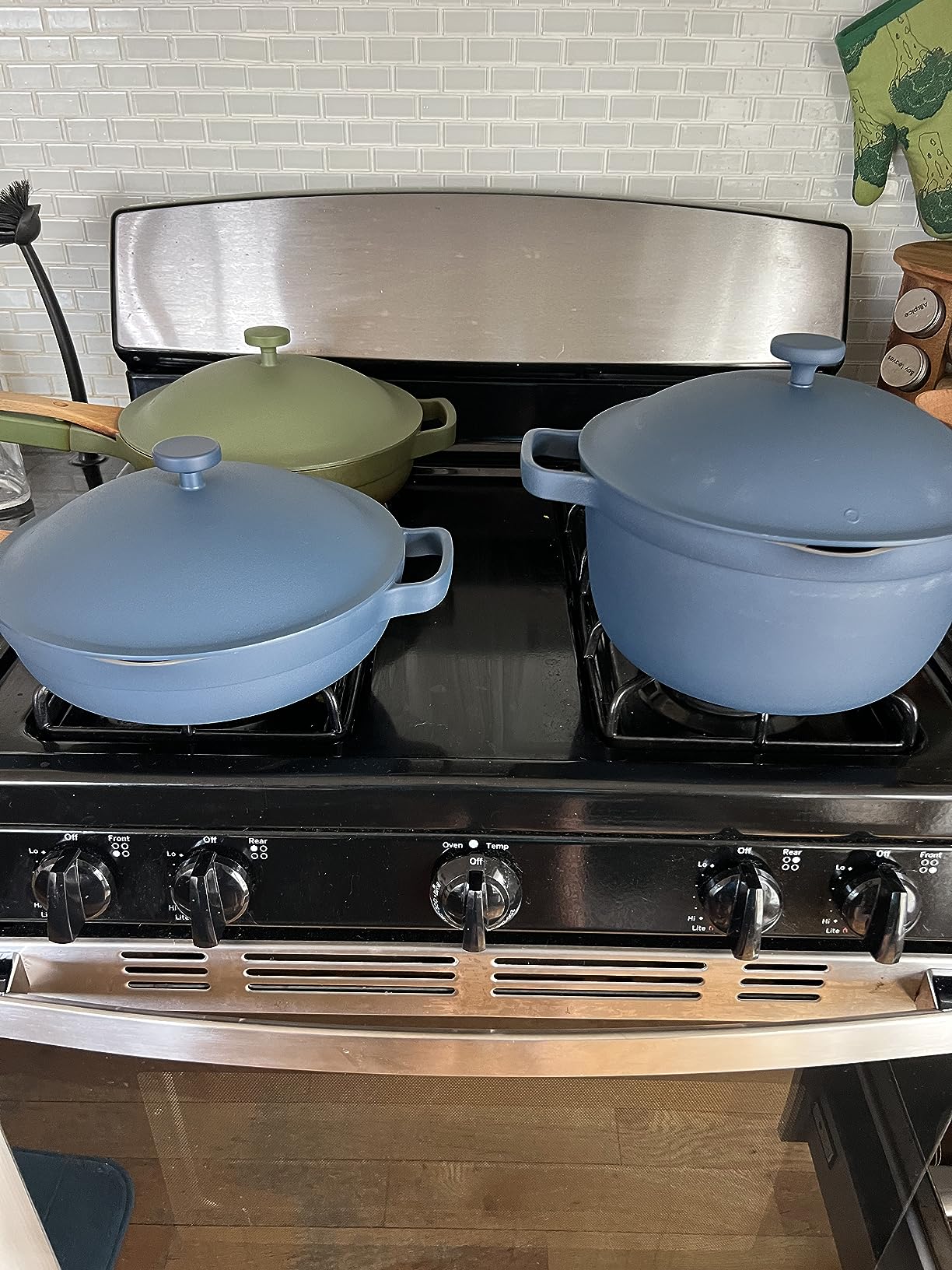
Our Place made color part of the identity, offering the pan in a range of muted tones that look good left out on the stove. That is not a trivial detail. A pan that looks attractive tends to stay on the burner rather than hiding in a cabinet, and a pan within arm’s reach gets used. If you are working with limited space, our tips on organizing a small kitchen pair nicely with the idea of keeping one good-looking pan within reach.
Fit and Finish
The rivet-free interior is easy to wipe, the rim is cleanly finished, and the lid sits snugly with a visible steam vent. Quality control is something to watch with any mass-market product, so inspect the coating for scratches or flaws as soon as the box arrives, and contact the seller quickly if anything looks off.
3. The Ceramic Nonstick Coating Explained
The headline feature for many buyers is what the pan does not contain. The Always Pan uses a ceramic nonstick coating rather than a traditional PTFE-based one, and it is marketed as free of PFOA and PFAS-type compounds, along with lead and cadmium. For shoppers who have grown wary of conventional coatings, that positioning is the main reason this pan exists.
Ceramic coatings are typically sol-gel finishes made from silica-based materials sprayed onto the metal and cured. They create a smooth, slick surface that releases food without much oil, and they tolerate higher temperatures without the offgassing concerns people associate with older coatings. The trade-off is durability. Ceramic nonstick tends to lose its slickness faster than PTFE does, and it is more sensitive to heat abuse, abrasive cleaning, and cooking sprays.
How Slick Is It, Really?
Out of the box, the surface is impressively slippery. Eggs release without fuss, pancakes slide, and delicate fish skin can be lifted without tearing, provided the pan is properly preheated and a thin film of fat is used. That performance is the best it will ever be, and the question every ceramic owner eventually asks is how long it stays that way.
What Shortens Coating Life
Four habits do the most damage: cooking on high heat, using aerosol sprays that leave a sticky residue, scrubbing with abrasive pads, and stacking other cookware on top of the surface without protection. Avoid those and you will get far more years of use. Ignore them and even the best ceramic will turn sticky within a season or two. This is not a flaw unique to the Always Pan. It is the nature of the material.
Is Ceramic the Right Choice for You?
If you want an everyday pan for eggs, vegetables, fish, and weeknight dinners and you prefer to avoid PTFE, ceramic makes sense. If you want a surface you can hammer with high heat and metal tools for decades, look at seasoned iron or stainless steel instead. Our breakdown of cast iron versus stainless steel explains how those materials behave and when they beat any nonstick pan.
4. Heat and Cooking Performance
The aluminum body is the reason the Always Pan heats up quickly and fairly evenly. Aluminum is an excellent conductor, so you will notice the pan reaches cooking temperature faster than a heavy stainless skillet. That quick response is great for eggs and sautéed vegetables, and it helps weeknight cooking move along.
That same quick response also means you should use less heat than you think. Medium and medium-low are the working zones for this pan. A ceramic surface thrives at moderate temperatures, and a lot of the sticking people complain about comes from cooking too hot, which polymerizes oil on the surface and builds a film that behaves like glue.
Eggs and Delicate Foods
This is where the pan shines. A scrambled egg cooked gently with a small knob of butter slides around the pan and releases cleanly. Omelets fold without tearing, and fried eggs lift off intact. Thin fish fillets and crepe-like pancakes behave well too. If your main job for a pan is breakfast, the Always Pan is a pleasure to use.
Searing and Browning
Here you need realistic expectations. Chicken thighs, burgers, and sausages brown nicely at medium-high heat after a proper preheat, and you can build a pleasant crust. A truly dark, steakhouse-style sear, however, is easier in cast iron or carbon steel, which hold huge amounts of heat. The Always Pan can brown food, but it is not designed to match those materials at the extreme end. If searing is your priority, our Lodge cast iron review shows what a dedicated searing pan looks like.
Simmering, Braising, and One-Pan Meals
The higher walls give you real range for sauces, curries, shallow braises, and one-pan pastas. The lid holds in moisture, and the sloped sides keep splatter reasonable. Because liquid recipes do not strain the coating the way dry high-heat cooking does, this is a very safe use for a ceramic pan.
Oil Choice Matters
With ceramic, the oil you choose affects how long the surface lasts. Refined, higher smoke-point oils behave better than delicate unrefined ones, and a small amount applied to a pan that is already warm works best. Our guide to the best oils for crispy results covers smoke points in more detail, and the same logic applies on the stovetop.
A Simple Preheating Routine
Good technique makes a bigger difference with this pan than any feature on the spec sheet. Set the burner to medium-low and let the empty pan warm for about a minute, then add a teaspoon or two of oil or a small pat of butter and let it spread. When the fat shimmers lightly or the butter foams and settles, add the food. Starting with a cold pan and cold food invites sticking, while a screaming hot pan invites burnt oil and a damaged surface. The gentle middle path is where ceramic is happiest.
Cooking in Batches
Because the pan is on the compact side, overcrowding is the most common mistake. Piling in a whole pound of chicken or a mountain of vegetables drops the temperature, releases moisture, and leaves you with steamed rather than browned food. Cook in two rounds, keep the first batch warm, and you will get better color and flavor. That patience is also kinder to the coating because the pan never has to be pushed hard to recover its heat.
Troubleshooting Sticking
If food starts to grab, resist the urge to crank the heat or reach for a metal tool. Lower the temperature, add a little more fat, and give the food a minute to release naturally. Proteins often stick until they form a crust, then let go on their own. If the whole surface feels tacky even when clean, a baking soda wash usually helps, and a softer cooking routine going forward will keep it from coming back.
5. The “Eight Pieces in One” Claim
Our Place markets the Always Pan as replacing eight traditional pieces of cookware: a fry pan, a sauté pan, a steamer, a skillet, a saucier, a nonstick pan, a saucepan, and a spoon rest, with a spatula in the package as well. It makes a great headline, so let us test each claim against the reality of a working kitchen.
| Claimed Role | How Well It Works | Our Take |
|---|---|---|
| Fry pan | Excellent for eggs, fish, and vegetables | Its natural strength |
| Sauté pan | Very good thanks to the tall walls | Handles a full weeknight stir-fry |
| Steamer | Good with the included basket | Fine for vegetables and dumplings |
| Skillet | Good at moderate heat | Not a cast iron replacement |
| Saucier | Decent for small batches of sauce | Sloped sides help whisking |
| Nonstick pan | Excellent while the coating is fresh | Longevity depends on care |
| Saucepan | Fine for small amounts of liquid | Too wide for big pots of soup |
| Spoon rest | Handy built-in spot for the spatula | Small but useful |
The honest reading is that the pan is superb at four or five of those jobs and acceptable at the rest. It will not replace a stockpot for a big batch of chili, a rice cooker for perfect grains, or a cast iron skillet for a thick ribeye. It can replace the odds and ends that fill most cabinets: the extra nonstick skillet you keep for eggs, the tiny saucepan, the steamer insert you rarely pull out.
For that reason, the best way to think about the Always Pan is not as a total replacement but as the workhorse that lets you own fewer, better things. If you are curious how this fits alongside appliances, our list of must-have kitchen appliances shows which devices still earn their counter space even after you buy a versatile pan.
6. Steamer Basket, Spatula, and Lid
The accessories are a big part of the value story, so they deserve scrutiny of their own. Many pan sets include forgettable extras. This one includes pieces you will actually use.
The Nesting Steamer Basket
The steamer sits inside the pan and lets you steam vegetables, dumplings, or fish above a shallow layer of simmering water. It is sized to the pan, so it fits without wobbling, and it folds or nests away rather than adding storage headaches. For broccoli, green beans, and potstickers, it works well. It is not meant for steaming a giant batch of food at once, but for a couple of portions it is perfect.
The Beechwood Spatula
A wooden spatula protects the ceramic surface from scratches, which is the right choice for a pan like this. Its shape is designed to rest against the pan’s rim, so you can set it down without making a mess on the counter. That seems trivial until you realize how often you drip sauce on a stove while looking for a place to put a utensil.
The Lid
The lid fits closely and includes a vent that helps manage steam, which prevents the soggy, overcooked texture lids can cause in sautéed dishes. It is not a glass lid, so you cannot watch your food without lifting it, but you do get a clean look and decent heat retention.
Beyond the Box
You will still want a few supporting tools. A quality cutting surface makes prep faster, so look at our guide to the best cutting boards, and a sharp knife changes everything, which is why our picks for the best knife sets for beginners are worth a look if your drawer is thin.
7. Stovetop, Induction, and Oven Use
Compatibility is where many ceramic pans trip up, so let us be specific. The current version of the Always Pan is built to work on gas, electric, and induction cooktops, which makes it flexible for apartments, rentals, and kitchens that may change over time. Always check the product listing for the exact version you are buying, because earlier editions differed in this respect.
Induction Notes
Induction needs a magnetic base. Aluminum on its own does not work, so induction-ready pans include a ferromagnetic layer. If you cook on induction, confirm that the listing for your specific pan states induction compatibility, and expect the usual quirks, such as a faint hum and very fast response. Because induction heats rapidly, be even more careful with heat settings to protect the coating.
Oven Use
The pan is oven safe to a moderate temperature, which is plenty for finishing a frittata, warming leftovers, or baking a one-pan dinner. Keep the lid’s limits in mind, and always check the manufacturer’s stated maximum temperature before using high oven settings. Use oven mitts, since the stainless handle gets hot quickly.
What Not to Do
Do not use the pan under a broiler, do not preheat it empty on high heat, and do not move a hot pan directly under cold water. Thermal shock is one of the fastest ways to damage any nonstick surface, ceramic included.
Compared with Appliance Cooking
Plenty of one-pan meals can also be made in a countertop device. If you are weighing options, our guide on Instant Pot versus slow cooker shows how appliances compare for hands-off cooking, and the pan wins when you want quick, attentive stovetop control.
8. Cleaning, Care, and Making It Last
Care is the single biggest factor in how long the Always Pan keeps performing. The good news is that the routine is simple, and once it becomes habit you will barely notice it.
Daily Cleaning
Let the pan cool for a few minutes after cooking, then wash it by hand with warm water, mild dish soap, and a soft sponge. Food typically wipes away with almost no effort. For stuck-on residue, soak the pan for ten to fifteen minutes before wiping rather than scrubbing hard.
Skip the Dishwasher
Even though some versions are described as dishwasher tolerant, hand washing is the safest way to extend the coating’s life. Strong detergents and high heat cycles gradually dull ceramic finishes. If you rely on a dishwasher, our overview of the best dishwashers can help you choose gentler cycles for your other dishes while keeping this pan out of the rack.
Dealing with Stains and Residue
Over time a thin, brownish film can build up from oil. A paste of baking soda and water applied with a soft sponge can lift it. Avoid steel wool, abrasive powders, and harsh scouring pads, which scratch the surface.
Storage Tips
Do not stack heavy cookware inside the pan. If you must nest pans, place a paper towel, dish cloth, or pan protector between them. Hanging the pan is an excellent option, and the look suits an open kitchen. For ideas on keeping everything tidy, our tips on how to store kitchen appliances translate nicely to cookware.
A Simple Longevity Checklist
- Cook on low to medium heat most of the time.
- Use wood, silicone, or nylon utensils only.
- Skip aerosol cooking sprays and use a little oil or butter.
- Let the pan cool before washing.
- Hand wash with a soft sponge.
- Protect the surface when storing.
Signs the Coating Is Wearing Out
Every ceramic pan eventually shows its age. Early signs include food that needs more fat than it used to, eggs that cling at the edges, and a surface that looks slightly dull rather than glossy. None of these mean the pan is unsafe, only that it has lost some slickness. Deep scratches that expose bare metal are a different matter, and at that point it is time to retire the pan and replace it rather than keep cooking on a compromised surface.
Seasoning a Ceramic Pan
Unlike cast iron, ceramic does not need formal seasoning, but a very light wipe of neutral oil on the clean, dry surface every few weeks can help maintain its feel. Use a tiny amount and buff it with a paper towel so nothing sticky is left behind. Too much oil does the opposite of what you want and leaves a residue that bakes on during the next use.
Building a Habit Around Care
The people who get the most from this pan are rarely the ones with special knowledge. They are the ones who built a small routine: cool, wipe, wash, dry, store. It takes less than two minutes, and over several years it is the difference between a pan that still performs and one that was quietly worn down by a hundred small shortcuts.
9. Our Place Always Pan vs. the Competition
No review is complete without context. The Always Pan competes in a crowded category, and the right choice depends on what you value: price, material, durability, or style.
| Feature | Always Pan | Hybrid Stainless Nonstick | Cast Iron | Tri-Ply Stainless |
|---|---|---|---|---|
| Surface | Ceramic nonstick | Textured nonstick over steel | Seasoned iron | Bare steel |
| Heat tolerance | Moderate | High | Very high | Very high |
| Weight | Light to medium | Medium | Heavy | Medium |
| Ease for eggs | Excellent | Very good | Good when seasoned | Needs technique |
| Maintenance | Gentle hand wash | Easy | Seasoning required | Easy but may stain |
| Typical lifespan | Several years with care | Long | Generations | Decades |
| Multi-use accessories | Steamer and spatula | Rarely | None | None |
Versus Hybrid Nonstick Pans
Hybrid pans pair a stainless surface with a raised pattern to give a semi-nonstick experience that tolerates metal utensils and higher heat. If you want to cook more aggressively, they are an excellent alternative, and you can compare the details in our HexClad review. The Always Pan beats them on light weight, easy release for eggs, and the included accessories.
Versus Other Ceramic Brands
There are several ceramic competitors, and each shares the same lifespan limitations. Our overview of every GreenPan product line shows how another leading ceramic brand approaches the category, and it is a useful way to compare coatings, price tiers, and warranties. See the latest listings for options like ceramic nonstick pans on Amazon.
Versus Traditional Stainless Sets
A stainless set will outlast nearly any coated pan, and it excels at searing and building fond for pan sauces. Its weakness is eggs and delicate fish unless you master heat control. Anyone building a long-term kitchen should consider both, and our guides to the best stainless steel cookware sets and the All-Clad versus Calphalon comparison explain how premium and midrange stainless lines differ.
The Bottom Line on Comparisons
The Always Pan wins on convenience, design, accessories, and gentle nonstick performance. It loses on longevity and high-heat versatility. Many experienced cooks end up owning an Always Pan for everyday ease alongside a cast iron or stainless pan for heavy-duty tasks.
10. Pros, Cons, and Who Should Buy
After looking at every feature, it is time to summarize the pan’s strengths and weaknesses in a form you can scan quickly.
What We Like
- Smart shape that bridges frying and saucepan roles
- Excellent release for eggs and delicate foods when new
- Ceramic coating without PTFE
- Useful included steamer and wooden spatula
- Dual pour spouts
- Lightweight and easy to handle
- Works on induction in the current version
- Attractive enough to live on the stove
What Could Be Better
- Ceramic nonstick wears faster than PTFE or seasoned iron
- Not ideal for hard, high-heat searing
- Premium price compared with basic nonstick skillets
- Hand washing is strongly recommended
- Too small for large families or big batches
- Opaque lid means no peeking
Who Should Buy It
- Small households and couples cooking weeknight meals
- Apartment dwellers with limited cabinet space
- Cooks who want to avoid PTFE coatings
- First-time kitchen builders who want one capable piece
- Gift buyers for housewarmings and weddings
Who Should Skip It
- Cooks who sear steaks on very high heat every week
- Anyone unwilling to hand wash cookware
- Large families who need bigger capacity
- Shoppers who want a lifetime pan with zero special care
Questions to Ask Before You Buy
Run through a short mental checklist. How many people do you usually cook for? Do you cook on gas, electric, or induction? Are you willing to hand wash one pan? How often do you sear at very high heat? Do you value the included accessories, or would you rather put the money into a single heavy skillet? If your honest answers lean toward small portions, gentle cooking, and a preference for PTFE-free surfaces, the Always Pan is a natural fit. If they lean the other way, you will probably be happier elsewhere, and that is perfectly fine.
Buying Smart
Buy from an authorized seller, check the listing for the exact color and version, and look at recent customer feedback for patterns about coating durability and shipping condition. Inspect the pan when it arrives, wash it by hand before the first use, and keep the packaging for a little while in case you need to arrange a return or replacement.
If you are weighing broader equipment choices before committing, our kitchen appliance buying guide offers a framework for judging value that applies to cookware too.
11. Everyday Meals the Always Pan Handles Well
Specifications only go so far, so let us look at how the pan fits into typical meals. Think about the dinners you cook most often, then see where this pan makes life easier.
Weekday Breakfasts
Scrambled eggs, omelets, French toast, and pancakes all suit the slick surface. If pancakes are a family tradition, a flat electric griddle may still beat any round pan for volume, and our guide to the best electric griddles for pancakes explains why, but the Always Pan handles a short stack for two without trouble.
One-Pan Pasta and Grain Dishes
The depth makes one-pan pasta realistic. Add broth, dry pasta, and aromatics, simmer under the lid, and finish with cheese or greens. Rice-based skillet dishes also work, though dedicated gadgets are better for plain rice. If you eat a lot of rice, our tips on how to use a rice cooker properly will save you effort, and the best rice cooker roundup shows which models deserve your counter space.
Stir-Fries and Sautés
Chopped vegetables and sliced chicken cook nicely over medium-high heat, particularly if you work in batches so the pan does not steam the food. The sloped sides help you toss ingredients, though a true wok will always give more room and more heat.
Steamed Vegetables and Dumplings
With the basket, you can steam broccoli in minutes, then use the same pan to sauté garlic and finish a dish. This is the sort of multitasking that truly saves dishes.
Fish and Delicate Proteins
Salmon fillets, tilapia, shrimp, and scallops benefit from a nonstick surface that will not tear the flesh. Pat the food dry, preheat gently, and use a little fat.
Sauces and Simmered Dishes
Tomato sauce, curry, shakshuka, and braised chicken thighs all work, with one caution: very acidic simmers for hours can slowly affect any coating, so keep long braises to a modest length and rinse the pan soon after cooking.
A Sample Week of Meals
To picture how the pan fits into real life, imagine a typical week. Monday could be a quick vegetable sauté with eggs on top. Tuesday might call for chicken thighs browned and then simmered with tomatoes and olives under the lid. Wednesday is a one-pan pasta night, Thursday is steamed dumplings with a drizzle of chili oil, and Friday brings a salmon dinner with green beans steamed in the basket just beforehand. Weekend mornings add pancakes and omelets. That is nearly a full week of cooking from one pan, with minimal extra dishes, which is exactly the lifestyle this product is designed to support.
Cooking for Guests
When company comes, the pan can serve as both a cooking vessel and a casual serving dish, thanks to its tidy looks and pour spouts. It is not designed for large banquets, but for a dinner for two to four people it keeps things relaxed and cuts down on cleanup, which is half the battle when you are hosting.
Dishes It Struggles With
Large roasts, deep frying, and anything that needs sustained, very high heat are not what this pan is for. For recipe inspiration that plays to a pan’s strengths, our garlic paprika butter chicken skewers show the kind of flavor-forward dinners worth building around.
12. Is the Always Pan Worth the Money?
Value is the question that decides most purchases, and it deserves a careful answer rather than a quick yes or no. The Always Pan costs more than a typical big-box nonstick skillet, and it is priced in the premium ceramic range. You are paying for design, accessories, brand experience, and a coating chemistry that matches your preferences.
The Cost-Per-Use View
If the pan lasts several years with good care and replaces two or three cheaper items you would otherwise buy, the math becomes more favorable. Cooking dinner five nights a week for three years means hundreds of uses, so even a premium price breaks down to a modest cost per meal. If it only lasts a year because of heat abuse, it feels expensive.
What You Are Really Buying
You are buying convenience. A pan that steams, sautés, simmers, and fries lets you clean one item instead of three. You are buying a coating that suits those who prefer ceramic. And you are buying a good-looking, thoughtfully engineered piece that makes cooking at home feel a bit nicer.
When a Cheaper Option Makes More Sense
If you only need a pan for occasional eggs, an inexpensive skillet is perfectly reasonable, and you can replace it when it wears out. If you cook aggressively and want something to last, stainless or cast iron beats any coated pan on value. The Always Pan sits in the middle for people who cook often, cook gently, and care about both function and look.
Warranty and Support
Check the current warranty terms on the manufacturer’s page and the Amazon listing before buying, since policies change. Keep your purchase record in case you need to ask for support.
Our Value Verdict
For the right cook, the Always Pan earns its price. For the wrong one, it is an expensive reminder that ceramic needs care. Be honest about your cooking style and the decision becomes easy.
If you are building out the rest of your setup, our reviews of the All-Clad electric skillet and the guide to what to put on kitchen counters offer ideas for completing a kitchen that works as well as it looks.
Frequently Asked Questions
Is the Our Place Always Pan really nonstick?
Yes. It uses a ceramic nonstick coating that releases food well, especially eggs and fish, when the pan is properly preheated and used with a little fat. Like all ceramic coatings, its slickness gradually declines with use, so gentle care is important.
Does the Always Pan contain PTFE or PFOA?
The brand markets the coating as free of PTFE and PFOA, along with lead and cadmium. Check the manufacturer’s current product information for the most accurate and up-to-date material details.
Can I use the Always Pan on an induction cooktop?
The current version is designed to work on induction as well as gas and electric. Because earlier versions differed, confirm that the listing for the exact pan you are buying states induction compatibility.
Is the Always Pan oven safe?
Yes, to a moderate temperature stated by the manufacturer. That makes it fine for finishing dishes and gentle baking, but check the maximum temperature before use and wear oven mitts since the handle gets hot.
Can I put the Always Pan in the dishwasher?
Hand washing is strongly recommended. Dishwasher detergents and heat can dull ceramic coatings over time, so a quick wash with soft sponge and mild soap is the best way to keep the surface slick.
What utensils are safe to use?
Wood, silicone, and nylon utensils are safest. Metal tools can scratch the ceramic surface, so avoid them even though the coating feels hard.
How long does the nonstick coating last?
It depends on how you use it. With low to medium heat, soft utensils, and hand washing, many owners get several good years. High heat, aerosol sprays, and abrasive cleaning shorten that considerably.
Can the Always Pan sear steak?
It can brown a steak decently at medium-high heat, but it will not deliver the deep crust that cast iron or carbon steel can. If searing is your priority, pair this pan with a heavier skillet.
What size is the Always Pan and who is it best for?
It has a roughly 10.5-inch diameter and a capacity near 2.6 quarts, which suits one to four people. Larger households may want a bigger pan or pot for big batches.
Why does food start sticking after a while?
The usual culprit is a thin layer of polymerized oil left by high heat or cooking sprays. Gently cleaning with baking soda paste and cooking at lower temperatures often restores much of the slickness.
Does the Always Pan really replace eight pieces of cookware?
It can replace several, such as an egg pan, small saucepan, and steamer insert, but not everything. It will not replace a large stockpot, a rice cooker, or a heavy cast iron skillet for every task.
Is the Always Pan a good gift?
Yes. It looks great, comes with useful accessories, and suits new homeowners, couples, students moving out, and anyone who likes tidy, stylish cookware. Include a note about hand washing so the recipient gets the longest life from it.
Final Verdict: Should You Buy the Our Place Always Pan?
The Always Pan is a good pan with a great idea behind it. The shape is genuinely versatile, the accessories are practical, the handle and spouts are thoughtful, and the ceramic nonstick surface is a joy for eggs, fish, vegetables, and weeknight one-pan dinners. It looks good enough to leave on the stove, and a pan you want to use is a pan that earns its price.
It is not magic. It will not sear like cast iron, it will not last forever, and it will not forgive years of high heat and dishwasher cycles. If you cook gently, hand wash, and use soft utensils, you will likely be very happy. If you want an indestructible tool for aggressive cooking, choose stainless or iron and consider the Always Pan an optional supplement.
For small households, apartment kitchens, and cooks who value both design and everyday ease, we think it is one of the more compelling premium pans available. Check the current price and color options below, then decide with your own cooking style in mind.
Disclosure: As an Amazon Associate we earn from qualifying purchases. If you buy through links on this page, we may earn a small commission at no extra cost to you.


